
Parenteral Drug Visual Inspection Systems Market Size and Share
Market Overview
| Study Period | 2020 - 2031 |
|---|---|
| Market Size (2026) | USD 271.84 Million |
| Market Size (2031) | USD 405.37 Million |
| Growth Rate (2026 - 2031) | 8.32 % |
| Fastest Growing Market | Asia-Pacific |
| Largest Market | North America |
| Market Concentration | Medium |
Major Players *Disclaimer: Major Players sorted in no particular order Image © Mordor Intelligence. Reuse requires attribution under CC BY 4.0. | |
Parenteral Drug Visual Inspection Systems Market Analysis by Mordor Intelligence
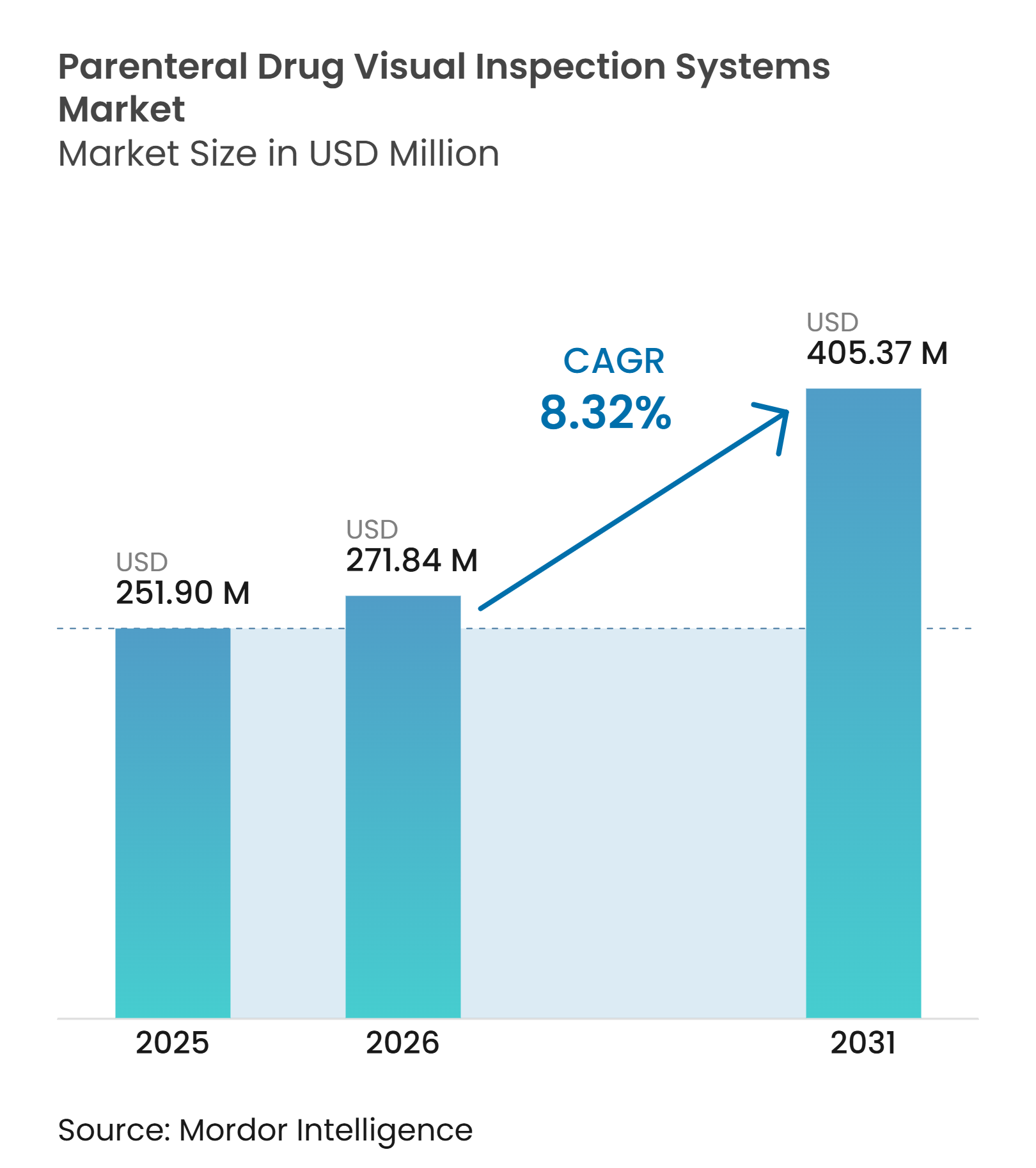
The Parenteral drug visual inspection systems market size is projected to expand from USD 251.90 million in 2025 to USD 271.84 million in 2026, and to USD 405.37 million by 2031, registering a CAGR of 8.32% from 2026 to 2031. Growth is tied to a larger pipeline of biologics, biosimilars, and other injectable medicines that require reliable batch-level quality controls before release. Regulatory expectations for 100% visual inspection have made validated inspection capacity a direct manufacturing requirement, rather than a discretionary line upgrade. Pharmaceutical companies and CDMOs are also moving toward automated platforms as they expand sterile fill-finish capacity, accommodate more complex products, and seek a more consistent inspection process. This shift favors suppliers that can support changing container formats, challenging drug formulations, frequent line changeovers, and documented validation requirements without adding unnecessary operational complexity. The Parenteral drug visual inspection systems market is also being reshaped by AI-based classification tools that are intended to reduce false rejects, improve the review of complex defects, and make inspection data more useful across multiple production lines.
Key Report Takeaways
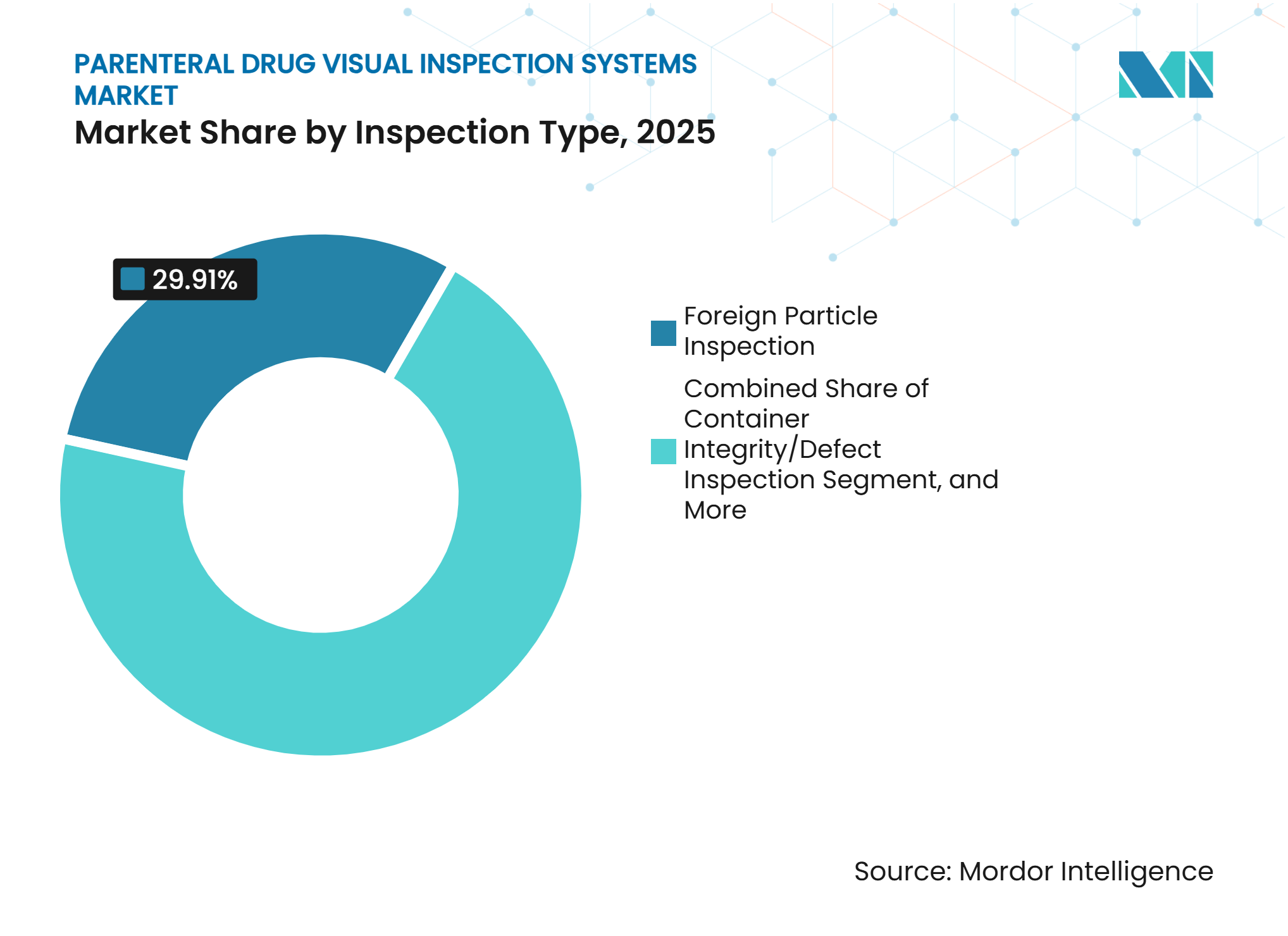
- By inspection type, foreign particle inspection held 29.91% of the parenteral drug visual inspection systems market share in 2025 and is projected to expand at a 9.18% CAGR through 2031.
- By machine type, fully automated systems held 68.89% of revenue in 2025 and are projected to grow at a 9.11% CAGR through 2031.
- By container type, vials accounted for 52.24% of revenue in 2025, while cartridges are projected to grow at a 9.39% CAGR through 2031.
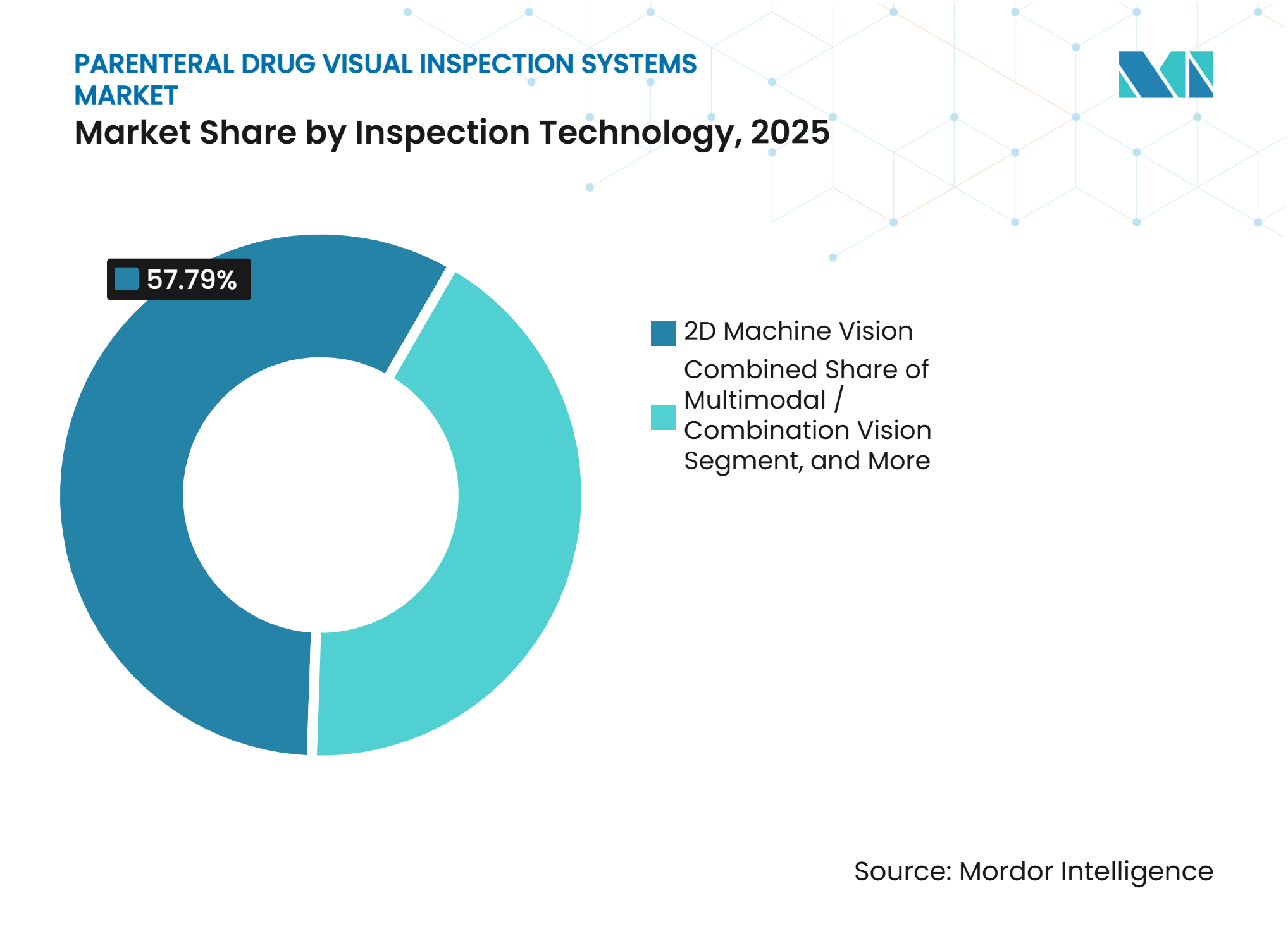
- By inspection technology, 2D machine vision held 57.79% of revenue in 2025, while AI and deep-learning vision are projected to grow at a 9.13% CAGR through 2031.
- By end-user, pharmaceutical manufacturers held 48.71% of revenue in 2025, while biopharmaceutical manufacturers are projected to grow at a 9.62% CAGR through 2031.
- By geography, North America held 30.12% of revenue in 2025, while Asia-Pacific is projected to expand at a 9.81% CAGR through 2031.
Note: Market size and forecast figures in this report are generated using Mordor Intelligence’s proprietary estimation framework, updated with the latest available data and insights as of January 2026.
Market Trends and Insights
Drivers Impact Analysis of Parenteral Drug Visual Inspection Systems Market*
| Driver | (~) % Impact on CAGR Forecast | Geographic Relevance | Impact Timeline |
|---|---|---|---|
| Expansion Of Biologics And Complex Injectable Pipelines | +3.1% | Global, concentrated in North America, Europe, and Asia-Pacific | Long term (≥ 4 years) |
| Tightening Requirements For 100% Injectable Product Inspection | +2.2% | Global, primary in Europe and North America, with spillover into Asia-Pacific and South America | Medium term (2-4 years) |
| Shift From Manual To Automated And Semi-Automated Inspection | +1.5% | Global, with faster conversion in North America and Europe | Short term (≤ 2 years) |
| Growth Of Prefilled Syringes, Cartridges, And Combination Products | +0.9% | North America and Europe, with expansion into Asia-Pacific | Medium term (2-4 years) |
| AI-Enabled Defect Classification And False-Reject Reduction | +0.7% | Global, with early adoption in Europe and North America | Long term (≥ 4 years) |
| Adoption Of Modular Inspection And Container Closure Integrity Platforms | +0.4% | North America and Europe, with early gains in Japan and South Korea | Long term (≥ 4 years) |
| Source: Mordor Intelligence | |||
Expansion of Biologics and Complex Injectable Pipelines
The expansion of biologics and complex injectable products remains the strongest driver of demand for the Parenteral Drug Visual Inspection Systems market, as each commercial batch requires reliable container-level quality control. The FDA approved 46 novel drugs in 2025 and 37 novel drugs through September 2026, providing a continuing flow of products that may require specialized sterile manufacturing and inspection.[1] Many of these products use subcutaneous injection, prefilled syringe, or infusion formats, which introduce container, formulation, and handling requirements that manufacturers must account for before release. These formats require visual inspection at the container level for each commercial batch, making inspection performance part of the wider sterile production process. Biologic formulations can create difficult inspection conditions because protein aggregates, lyophilized fragments, and variable product appearance can resemble defects or obscure relevant signals. The resulting need for more sensitive, repeatable, and documented inspection supports demand for validated automated systems across the Parenteral Drug Visual Inspection Systems market.
Tightening Requirements For 100% Injectable Product Inspection
Regulatory requirements continue to shape purchasing decisions in the Parenteral drug visual inspection systems market, as manufacturers must demonstrate that their inspection processes are suitable for the products they release. EU GMP Annex 1 requires 100% visual inspection of parenteral products and expects automated inspection to perform at least as well as manual inspection under appropriately controlled conditions. The framework also requires challenge testing before the start of each batch, making routine inspection operations closely connected to preparation and qualification activities. A 2025 survey of 115 professionals found continuing gaps in defect-set qualification and challenge-test frequency, which remain areas of attention during regulatory scrutiny. These gaps increase the value of suppliers that offer established defect libraries, documented inspection performance, and practical support for validation work. A validated system can reduce the qualification burden when manufacturers add or replace equipment, thereby strengthening its commercial appeal in the Parenteral drug visual inspection systems market.
Shift From Manual to Automated and Semi-Automated Systems
The shift from manual inspection to automated and semi-automated equipment drives demand in the Parenteral drug visual inspection systems market, as manufacturers seek more consistent decisions across batches and shifts. Manual inspection remains common at smaller CDMOs and in markets where lower production volumes do not immediately support a major capital investment. False-reject rates on manual lines ranged from 1% to 45%, depending on product complexity, creating avoidable product review and reinspection work. Körber estimated that false rejects and related reinspections cost the pharmaceutical sector up to USD 740 million annually, making the operational case for improved classification more visible. The Parenteral Drug Association reported consistent automated detection performance beyond 99%, compared with an operator-dependent range of 92% to 96% for manual inspection. CDMOs still need adaptable equipment because changes in container type, fill volume, and client molecule can otherwise require additional validation before a line can move to the next product.
Growth Of Prefilled Syringes, Cartridges, and Combination Products
Prefilled syringes, cartridges, and combination products are increasing the technical requirements placed on inspection equipment in the Parenteral drug visual inspection systems market. The change is linked to GLP-1 medicines, home administration, and high-viscosity biologic formulations, which are often designed for more convenient delivery formats. GRAM announced a 150,000-square-foot syringe and cartridge filling center with capacity for up to 4 inspection lines, showing how CDMO capacity is being configured for these containers. Incog BioPharma began an expansion of its Fishers, Indiana, site in early 2026, with a USD 200 million investment and plans for a larger injectable manufacturing hub. Cartridges may include rubber stoppers, metal retaining rings, and dual-chamber designs that require dedicated inspection stations, careful handling, and product-specific qualification. These features can extend qualification timelines and favor suppliers with practical experience across more complex primary containers.
Restraints Impact Analysis of Parenteral Drug Visual Inspection Systems Market*
| Restraint | (~) % Impact on CAGR Forecast | Geographic Relevance | Impact Timeline |
|---|---|---|---|
| High Capital Expenditure And Validation Costs | -1.9% | Global, most pronounced in emerging markets and smaller CDMOs | Short term (≤ 2 years) |
| Complex Integration With Existing Aseptic Manufacturing Lines | -1.2% | Global, with highest friction in legacy European and North American sites | Medium term (2-4 years) |
| Limited Availability Of Representative Defect Data For AI Training | -0.5% | Global, particularly acute in small-batch and niche biologic segments | Long term (≥ 4 years) |
| Model Drift, Data Integrity, And Unclear AI Validation Expectations | -0.3% | Europe and North America, where regulatory expectations are more advanced | Medium term (2-4 years) |
| Source: Mordor Intelligence | |||
High Capital Expenditure and Validation Costs
High capital expenditure and validation needs can delay adoption by smaller manufacturers and CDMOs in the Parenteral drug visual inspection systems market. An automated inspection line requires equipment, installation, commissioning, and a controlled qualification process that must be incorporated into wider manufacturing planning. The commercial decision extends beyond the purchase of hardware, as each product and container format requires documented evidence that inspection performance is appropriate. Challenge-set preparation also requires representative defect samples for the relevant product format and can involve significant development work before routine use begins. Shared inspection platforms may repeat this work when they add a new client molecule, container type, or formulation with distinct visual characteristics. These costs make modular or flexible platforms more attractive where production volumes, customer demand, or future product portfolios are uncertain.
Complex Integration with Existing Aseptic Manufacturing Lines
Integration with established aseptic lines can slow the replacement of existing inspection systems in the Parenteral drug visual inspection systems market. Materials and surfaces must remain compatible with cleaning agents, sterilization procedures, and the cleanliness requirements of classified manufacturing environments. The Parenteral Drug Association noted that multi-vendor integration may require custom interfaces between inspection machines, filling systems, and isolators, even where each piece of equipment is already established. These projects can also trigger facility change-control processes, affect surrounding equipment, and create further validation activity before the line returns to routine production. The same source reported that custom integration extended installation timelines by 3 to 9 months on average, which can influence the timing of investment decisions. Suppliers that integrate effectively across established aseptic equipment environments can therefore have an advantage at legacy sites.
*Our forecasts treat driver/restraint impacts as directional, not additive. The impact forecasts reflect baseline growth, mix effects, and variable interactions.
Parenteral Drug Visual Inspection Systems Market Segment Analysis
By Inspection Type:
Foreign Particle Detection Supports Demand Across a Broader Defect SetForeign particle inspection accounted for 29.91% of the Parenteral drug visual inspection systems market size by inspection type in 2025, reflecting particulate contamination control requirements across injectable medicines. USP 790, USP 1790, and the European Pharmacopeia 2.9.20 set expectations for visual inspection and particulate matter in injectable products. Foreign particles have historically been linked to serious recalls and patient safety events in the parenteral sector. Manufacturers, therefore, continue to place high-sensitivity particle detection at the center of their inspection decisions. This category remains important even when a line also inspects cosmetic defects and container integrity.
Cosmetic inspection covers scratches, chips, and other visible container defects that can affect product acceptance. Container-integrity inspection covers defects that may compromise closure performance and product protection during storage or use. Complex biologic matrices can contain protein aggregates, lyophilized cake fragments, and silicone oil droplets from prefilled syringes, which can resemble critical defects. Inspection platforms must distinguish these formulation-related pseudo-defects from safety-critical particles while maintaining a repeatable decision process. The Parenteral drug visual inspection systems industry therefore requires systems that combine particle sensitivity with a practical approach to the changing visual behavior of injectable products.



By Machine Type:
Fully Automated Systems Lead While Flexible Platforms Gain UseFully automated systems accounted for 68.89% of the Parenteral drug visual inspection systems market in 2025, giving this machine type a clear lead. Their position reflects the operational needs of high-volume parenteral fill-finish operations and the demand for consistent inspection conditions. Automated machines reduce reliance on individual operator decisions during the inspection process. They can also support the documentation and repeatability expected in regulated manufacturing settings. The strong share indicates that automation has moved beyond early evaluation at larger commercial production sites.
High-mix, low-volume platforms are becoming more relevant to CDMOs and clinical-stage manufacturers that manage varied client products. These users previously relied more often on semi-automated equipment because conventional automated systems were built for single-format, high-speed production. Körber introduced ALVA in May 2026 for high-mix, low-volume applications involving syringes, vials, and cartridges. The platform was designed for frequent product changeovers without sacrificing inspection quality, addressing a practical need in outsourced manufacturing. Semi-automated systems retain a role in which lower entry costs and operator-assisted decisions better suit smaller manufacturers or less mature regulatory environments.
By Container Type:
Vials Remain the Leading Format as Cartridges GrowVials held 52.24% of the Parenteral drug visual inspection systems market size by container type in 2025, making them the leading primary container format. They are used across biologics, small-molecule injectables, and lyophilized products, which gives vials a broad and durable application base. Vial inspection also has a long-established foundation of validated 2D vision applications. Manufacturers still need to identify particles, cosmetic defects, and closure-related issues in these containers across different product presentations. The scale and variety of vial filling support continued demand for systems designed around this format.
Cartridges are projected to expand at a 9.39% CAGR from 2026 to 2031, supported by GLP-1 delivery systems, insulin therapies, and biologic combination products. They create optical and mechanical inspection challenges that differ from those of conventional vials. Cartridges can contain several components that require careful handling and dedicated inspection during each production run. Manufacturers are moving certain injectable products from vials to cartridges to simplify administration and support patient adherence. Ampoules have a smaller and contracting role because new product development is moving toward crimp-sealed containers with stronger closure integrity.
By Inspection Technology:
2D Vision Leads As AI-Based Vision Expands2D machine vision accounted for 57.79% of the Parenteral drug visual inspection systems market by inspection technology in 2025. The technology benefits from decades of validated use in vial and ampoule inspection across pharmaceutical manufacturing sites. It aligns with established pharmacopoeial expectations and has a substantial installed base. These factors preserve the leading role of 2D vision in applications with clearly defined defect patterns. Replacement decisions also require validation work, which can slow the transition from proven 2D platforms.
2D vision can be less reliable when containers are curved, reflective, or opaque, and when products have high visual variability. It can also struggle to separate pseudo-defects from critical particles in high-viscosity biologics. AI and deep-learning vision is expected to be the fastest-growing inspection technology through 2031, with Antares Vision launching AI-GO in June 2025 and Cognex making OneVision generally available in May 2026.[2] EU GMP Annex 22 draft guidance states that AI model training and validation should use independent test datasets in controlled GMP conditions. The availability of representative defect data remains a practical constraint on faster adoption.

By End-User:
Pharmaceutical Manufacturers Lead While Biopharma Grows FasterPharmaceutical manufacturers led the Parenteral drug visual inspection systems market by end-user in 2025. Their position reflects the scale of their injectable portfolios and their ability to qualify and operate automated inspection equipment. Large pharmaceutical plants can run complex inspection systems within established quality and manufacturing structures. Their range of vials, syringes, and other injectable products supports demand for new installations and replacement projects. This group remains central to investment in sterile manufacturing capacity and related inspection controls.
Biopharmaceutical manufacturers are projected to grow at a 9.62% CAGR through 2031. High-viscosity monoclonal antibodies, recombinant proteins, and suspension-based vaccines can require specialized inspection conditions. Suppliers that qualify systems for silicone oil droplets, protein aggregates, and opaque suspensions can strengthen their position with these manufacturers. CDMOs and CMOs form a third major end-user group as injectable fill-finish outsourcing expands. Simtra BioPharma, GRAM, and PCI Pharma Services announced syringe and cartridge capacity additions during 2025 and 2026, creating demand for dedicated inspection capacity across outsourced manufacturing networks.
Geography Analysis
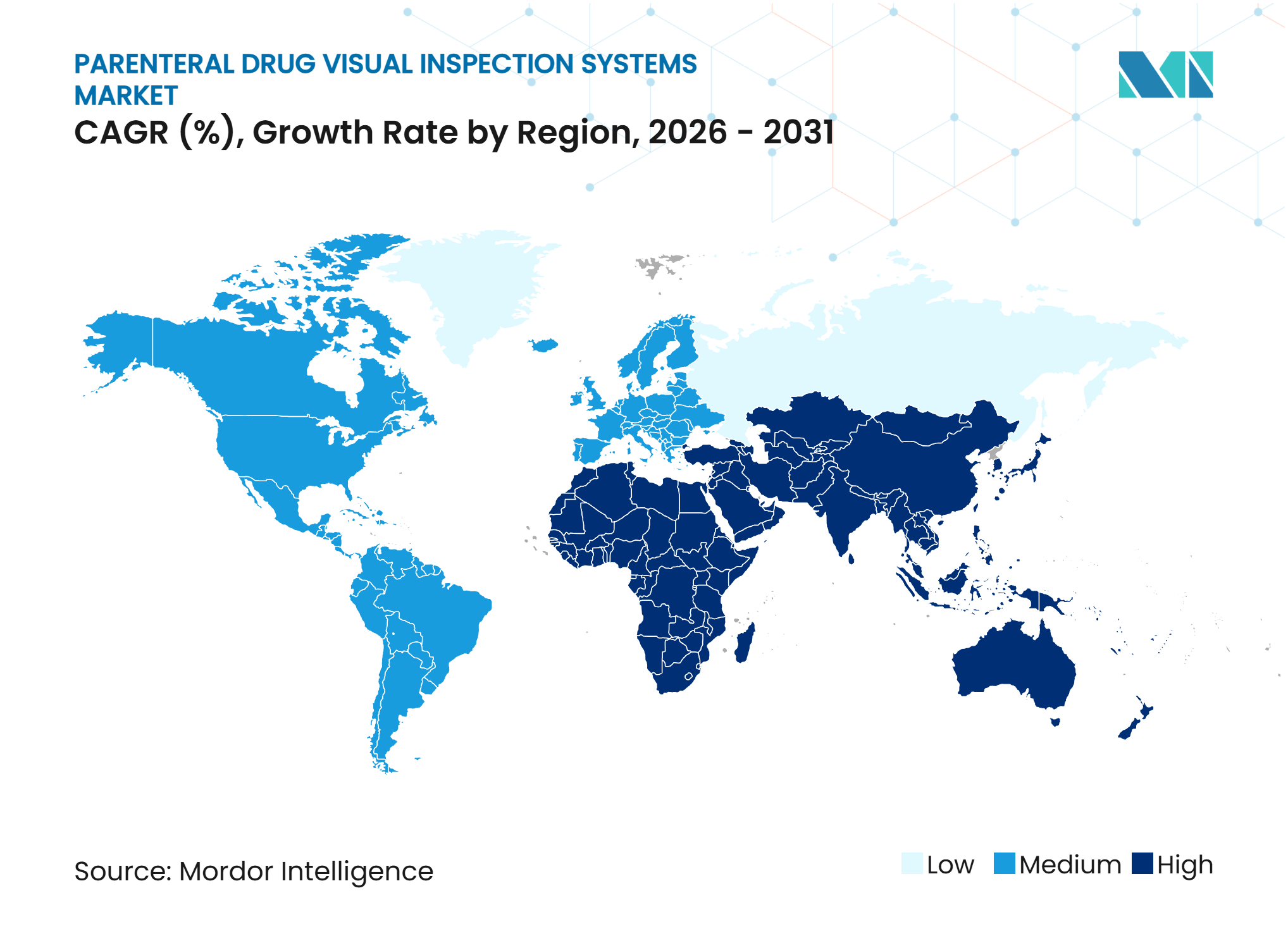
North America held 30.12% of the Parenteral drug visual inspection systems market share in 2025, supported by a dense concentration of regulated pharmaceutical and biopharmaceutical manufacturing sites. The region combines substantial biologics fill-finish capacity with a capital-intensive approach to compliance, quality systems, and the regular replacement or upgrade of manufacturing equipment. U.S. requirements under 21 CFR Parts 210 and 211 create a consistent baseline for manufacturing controls at pharmaceutical sites, while the FDA’s visible particulate guidance focuses attention on the risks associated with injectable product defects. FDA guidance reinforces the need to inspect injectable products for visible defects that could affect quality and patient safety, and provides manufacturers with a clear reference point for their internal inspection programs.
Europe is the second-largest geographic region in the Parenteral drug visual inspection systems market, with Germany, Italy, the United Kingdom, France, and Spain as key manufacturing centers. The region has deep industrial experience in pharmaceutical inspection engineering and contains several established specialized equipment suppliers. Vetter announced a EUR 480 million (USD 520 million) production facility in Saarland, Germany, with construction planned from Q2 2026 and operations expected in 2031, signaling sustained future equipment demand.[3]EU GMP Annex 1 requirements are enforced through regular inspections by national competent authorities. This environment supports demand for systems that can demonstrate validated performance across defined defect sets.
Asia-Pacific is projected to expand at a 9.81% CAGR from 2026 to 2031, making it the fastest-growing geographic area in the Parenteral drug visual inspection systems market. China’s pharmaceutical production is growing at 6.6% in 2026 after a 3.6% increase in 2025, supported by policies that promote biopharmaceutical innovation. India’s pharmaceutical output is forecast to rise 5% in 2026, with support from the Biopharma SHAKTI program. South America, the Middle East, and Africa are smaller but growing markets, where generics manufacturers are modernizing facilities to serve regulated export markets.
Competitive Landscape
Market Concentration
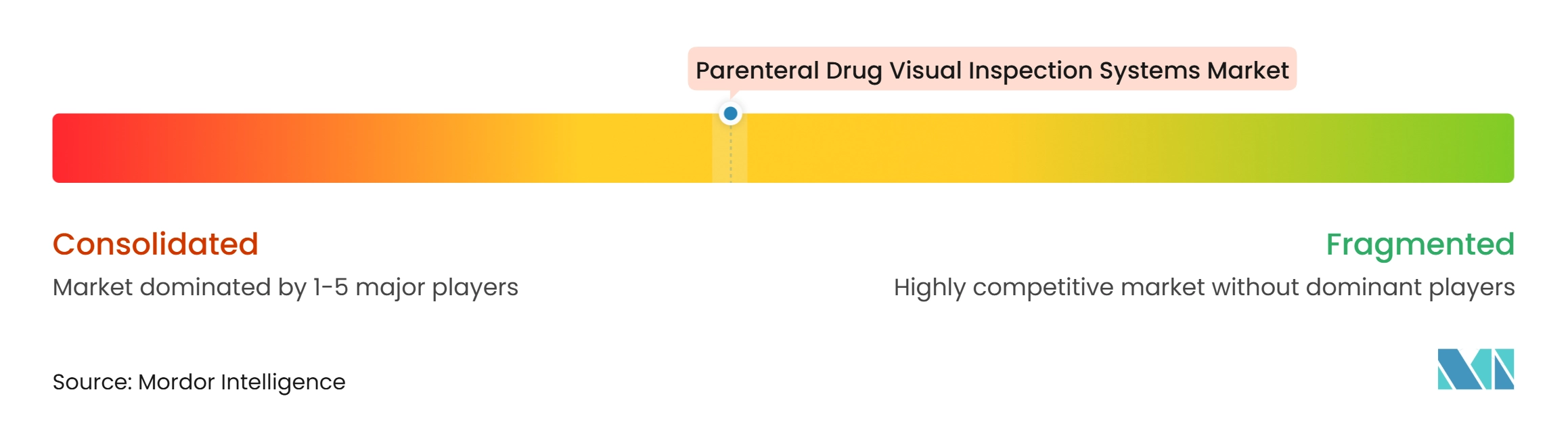
The Parenteral drug visual inspection systems market is moderately consolidated, with European specialists holding strong positions in pharmaceutical-grade vision inspection engineering. Italian and German companies benefit from extensive experience in regulated parenteral and packaging applications, where container handling, optics, software, and validation support must work together. Antares Vision, Brevetti CEA, and Syntegon focus closely on inspection solutions for pharmaceutical production environments and have product ranges built around sterile manufacturing needs. They compete on inspection sensitivity, container handling, validation support, throughput, and integration with sterile fill-finish lines.
Broader machine vision providers also have a clear role in the Parenteral drug visual inspection systems market. Cognex Corporation and Keyence Corporation serve pharmaceutical customers while retaining extensive industrial vision businesses outside life sciences. Cognex made OneVision generally available in May 2026 after its beta launch in June 2025, expanding its collaborative environment for AI-based inspection development. The company then launched the In-Sight 6900 Vision Controller in April 2026 for high-capacity AI edge processing in demanding inspection work.
Körber and Marchesini Group compete through broader automation and packaging offerings that include inspection as part of an integrated line. Körber unveiled ALVA in May 2026 for high-mix, low-volume inspection of syringes, vials, and cartridges, while Brevetti CEA showcased the K15 DR for automated syringe inspection at up to 600 syringes per minute.[4] Crane NXT completed its USD 418.2 million acquisition of Antares Vision in April 2026, connecting visual inspection to a wider detection, authentication, and traceability portfolio. Competition therefore centers on specialized inspection capability, AI development, and practical integration with fill-finish operations.
Parenteral Drug Visual Inspection Systems Industry Leaders
-
Antares Vision S.p.A.
-
Stevanato Group S.p.A.
-
Körber AG
-
Syntegon Technology GmbH
-
Brevetti CEA S.p.A.
- *Disclaimer: Major Players sorted in no particular order
Parenteral Drug Visual Inspection Systems Market Companies Covered in this Report
- Antares Vision S.p.A.
- Stevanato Group S.p.A.
- Körber AG
- Syntegon Technology GmbH
- Brevetti CEA S.p.A.
- Mettler-Toledo International Inc.
- Cognex Corporation
- Omron Corporation
- Optel Group
- Jekson Vision Pvt. Ltd.
- WIPOTEC GmbH
- Marchesini Group S.p.A.
- Thermo Fisher Scientific Inc.
- Keyence Corporation
- Minebea Intec GmbH
- Loma Systems
- ATS Corporation
- Dabrico Inc.
- Sensum d.o.o.
Recent Industry Developments in Parenteral Drug Visual Inspection Systems Market
- May 2026: Körber unveiled ALVA, a fully automatic inspection machine specifically designed for high-mix, low-volume pharmaceutical applications including syringes, vials, and cartridges, at interpack 2026 in Düsseldorf. The platform enables rapid format changes and reliable inspection of small clinical-scale batches, directly targeting CDMOs and manufacturers of personalized therapies and advanced therapy medicinal products.
- May 2026: Brevetti CEA showcased the K15 DR at interpack 2026, a fully automated syringe inspection machine capable of processing up to 600 syringes per minute for both glass and plastic formats using a contact-free, worm-screw-free handling system. The platform integrates de-nesting, inspection, and re-nesting within a single compact unit, targeting the growing prefilled syringe and combination product segment.
- April 2026: Crane NXT completed the full acquisition of Antares Vision S.p.A. for EUR 361.5 million (USD 418.2 million) across 2 phases, delisting Antares Vision from the Euronext Milan exchange and integrating it into a new Detection and Traceability Technologies segment.
- February 2026: Syntegon launched the AIM9 inspection platform, combining visual inspection and leak detection for outputs of up to 600 vials per minute.
Global Parenteral Drug Visual Inspection Systems Market Report Scope
The Parenteral Drug Visual Inspection Systems Market comprises automated and manual systems used to inspect parenteral drug products for visible particulate matter, container defects, fill-level inconsistencies, and other quality-related issues before distribution.
The Parenteral Drug Visual Inspection Systems Market Report is Segmented by Inspection Type (Foreign Particle Inspection, Cosmetic Defect Inspection, Container Integrity/Defect Inspection, Fill-Level Inspection, Closure and Seal Inspection, and Label and Print Inspection), Machine Type (Fully Automated Systems, Semi-Automated Systems, and Manual Inspection Systems), Container Type (Vials, Ampoules, Prefilled Syringes, Cartridges, Bottles, and Other Container Types), Inspection Technology (2D Machine Vision, 3D Machine Vision, AI/Deep-Learning Vision, Multimodal/Combination Vision, and Other Inspection Technologies), End-User (Pharmaceutical Manufacturers, Biopharmaceutical Manufacturers, CMOs/CDMOs, and Contract Testing/Inspection Organizations), and Geography (North America, South America, Europe, Asia-Pacific, Middle East, and Africa). The Market Forecasts are Provided in Terms of Value (USD).
Segmentation Overview
| Foreign Particle Inspection |
| Cosmetic Defect Inspection |
| Container Integrity/Defect Inspection |
| Fill-Level Inspection |
| Closure and Seal Inspection |
| Label and Print Inspection |
| Fully Automated Systems |
| Semi-Automated Systems |
| Manual Inspection Systems |
| Vials |
| Ampoules |
| Prefilled Syringes |
| Cartridges |
| Bottles |
| Other Container Types |
| 2D Machine Vision |
| 3D Machine Vision |
| AI/Deep-Learning Vision |
| Multimodal / Combination Vision |
| Other Inspection Technologies |
| Pharmaceutical Manufacturers |
| Biopharmaceutical Manufacturers |
| CMOs/CDMOs |
| Contract Testing/Inspection Organizations |
| North America | United States |
| Canada | |
| Mexico | |
| South America | Brazil |
| Argentina | |
| Chile | |
| Rest of South America | |
| Europe | Germany |
| United Kingdom | |
| France | |
| Italy | |
| Spain | |
| Rest of Europe | |
| Asia-Pacific | China |
| Japan | |
| India | |
| South Korea | |
| Australia | |
| Rest of Asia-Pacific | |
| Middle East | United Arab Emirates |
| Saudi Arabia | |
| Turkey | |
| Rest of Middle East | |
| Africa | South Africa |
| Egypt | |
| Nigeria | |
| Rest of Africa |
| By Inspection Type | Foreign Particle Inspection | |
| Cosmetic Defect Inspection | ||
| Container Integrity/Defect Inspection | ||
| Fill-Level Inspection | ||
| Closure and Seal Inspection | ||
| Label and Print Inspection | ||
| By Machine Type | Fully Automated Systems | |
| Semi-Automated Systems | ||
| Manual Inspection Systems | ||
| By Container Type | Vials | |
| Ampoules | ||
| Prefilled Syringes | ||
| Cartridges | ||
| Bottles | ||
| Other Container Types | ||
| By Inspection Technology | 2D Machine Vision | |
| 3D Machine Vision | ||
| AI/Deep-Learning Vision | ||
| Multimodal / Combination Vision | ||
| Other Inspection Technologies | ||
| By End-User | Pharmaceutical Manufacturers | |
| Biopharmaceutical Manufacturers | ||
| CMOs/CDMOs | ||
| Contract Testing/Inspection Organizations | ||
| By Geography | North America | United States |
| Canada | ||
| Mexico | ||
| South America | Brazil | |
| Argentina | ||
| Chile | ||
| Rest of South America | ||
| Europe | Germany | |
| United Kingdom | ||
| France | ||
| Italy | ||
| Spain | ||
| Rest of Europe | ||
| Asia-Pacific | China | |
| Japan | ||
| India | ||
| South Korea | ||
| Australia | ||
| Rest of Asia-Pacific | ||
| Middle East | United Arab Emirates | |
| Saudi Arabia | ||
| Turkey | ||
| Rest of Middle East | ||
| Africa | South Africa | |
| Egypt | ||
| Nigeria | ||
| Rest of Africa | ||
Key Questions Answered in the Report
What is the size of the parenteral drug visual inspection systems market?
The market was valued at USD 251.90 million in 2025, stands at USD 271.84 million in 2026, and is projected to reach USD 405.37 million by 2031 at an 8.32% CAGR from 2026 to 2031.
What is driving demand for parenteral drug visual inspection systems?
Growth in biologics, stricter 100% inspection requirements, automated inspection adoption, and rising use of syringes and cartridges are key demand factors. These forces increase the need for validated systems that manage complex injectable product conditions.
Which machine type leads parenteral drug visual inspection?
Fully automated systems led with 68.89% of revenue in 2025 because they suit high-volume regulated fill-finish operations. They provide consistent inspection conditions and support the documentation expected in regulated manufacturing settings.
Which container type is growing fastest for visual inspection systems?
Cartridges are projected to grow at a 9.39% CAGR through 2031, supported by GLP-1 delivery systems, insulin therapies, and biologic combination products. Their component design can require dedicated inspection stations and product-specific validation.
Which region is expected to grow fastest through 2031?
Asia-Pacific is projected to grow at a 9.81% CAGR from 2026 to 2031, supported by manufacturing expansion, regulatory modernization, and biologics investment. China and India are important contributors to the region’s pharmaceutical production growth.
Why is AI used in injectable product inspection?
AI-based vision can help classify complex defects and separate pseudo-defects from safety-critical particles. It is especially relevant for reflective containers, high-viscosity biologics, and products where conventional 2D vision has practical limitations.