
Paid Search Management Software Market Size and Share
Market Overview
| Study Period | 2020 - 2031 |
|---|---|
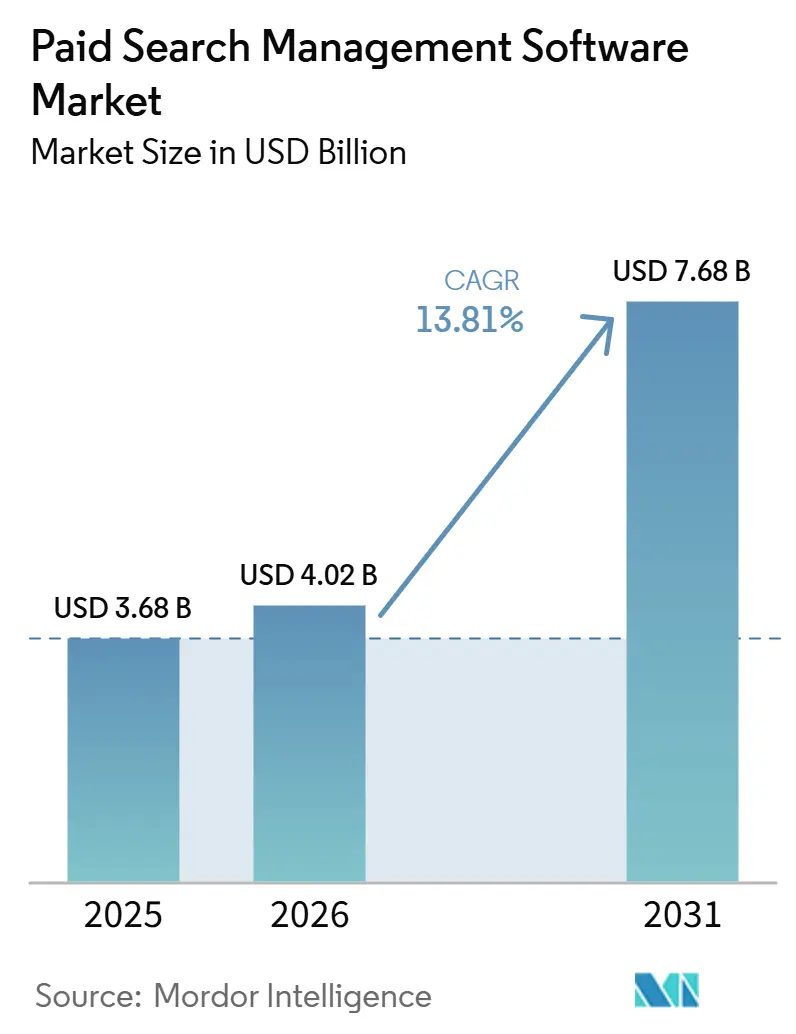
| Market Size (2026) | USD 4.02 Billion |
| Market Size (2031) | USD 7.68 Billion |
| Growth Rate (2026 - 2031) | 13.81% CAGR |
| Fastest Growing Market | Asia-Pacific |
| Largest Market | North America |
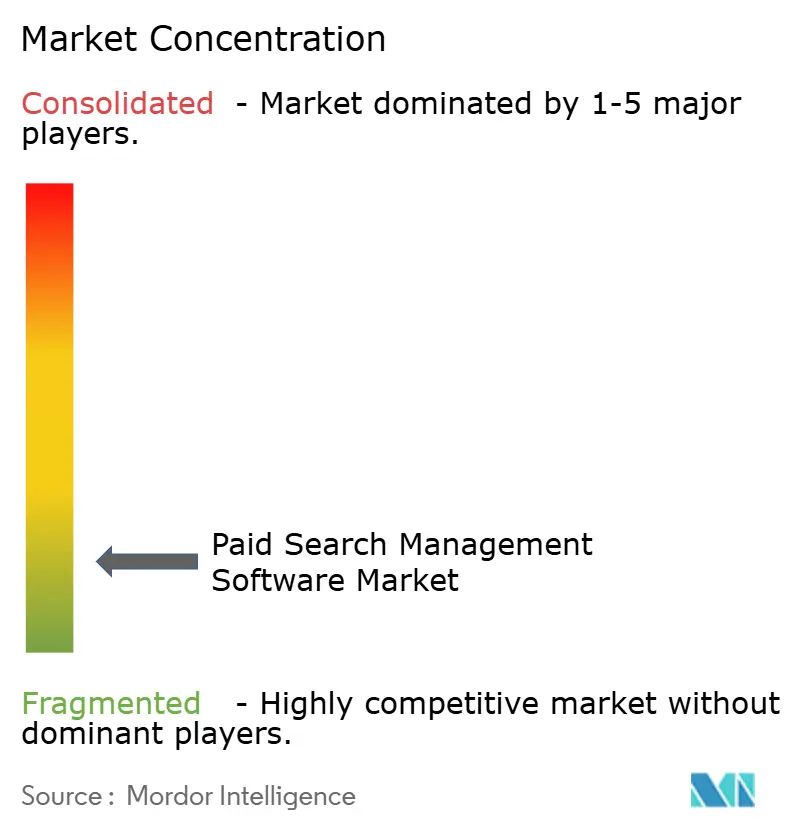
| Market Concentration | Low |
Major Players *Disclaimer: Major Players sorted in no particular order Image © Mordor Intelligence. Reuse requires attribution under CC BY 4.0. | |
Paid Search Management Software Market Analysis by Mordor Intelligence
The paid search management software market size is projected to expand from USD 3.68 billion in 2025 and USD 4.02 billion in 2026 to USD 7.68 billion by 2031, registering a CAGR of 13.81% between 2026 and 2031. Investment in automated campaign management is rising as brands and agencies move routine bidding and budget work into software-led workflows. Machine learning-based optimization, first-party measurement, and retailer-owned search inventory are broadening the scope of work for paid search tools. Platform-native automation is also becoming more capable, making cross-platform management, attribution, and agency workflow support increasingly important differentiators. Vendors that combine these functions can address a wider set of advertiser needs, while vendors focused only on bid automation face a narrower opening. The paid search management software market, therefore, offers an opportunity for platforms that can coordinate search, retail media, and performance measurement without adding complexity for users.
Key Report Takeaways
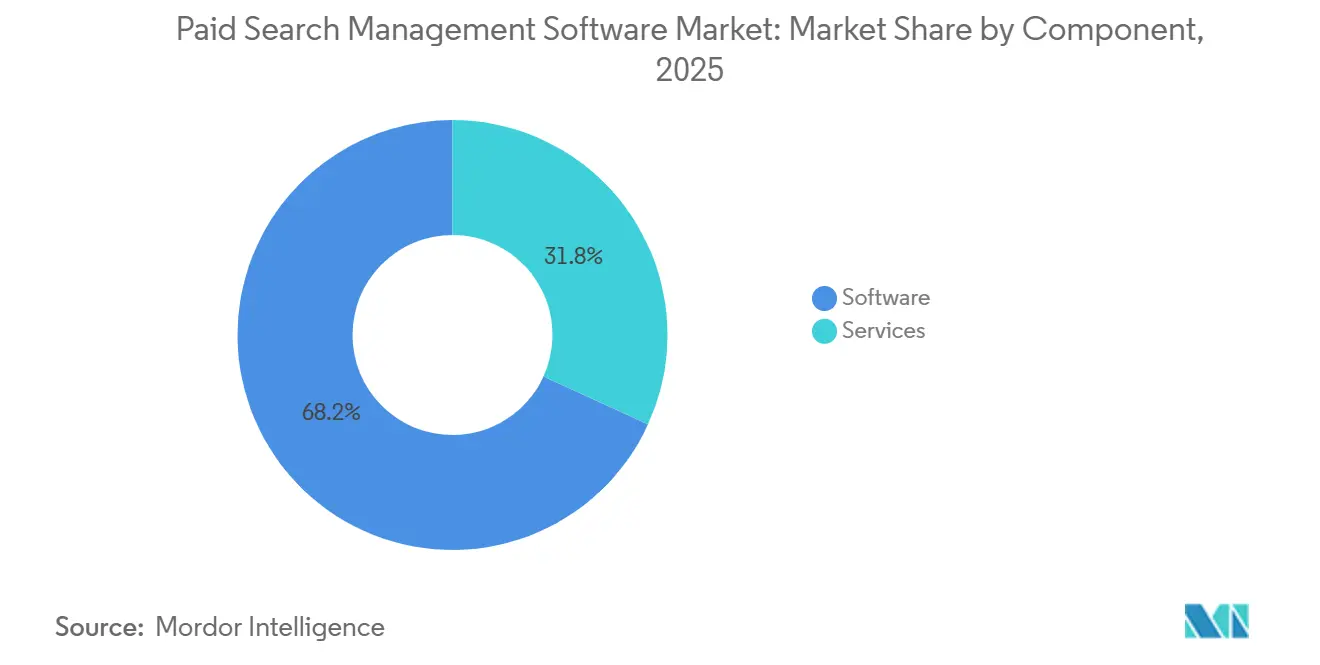
- By component, software held 68.19% of the paid search management software market share in 2025, while services are projected to expand at a 16.67% CAGR through 2031.
- By deployment mode, cloud accounted for 70.21% of the paid search management software market revenue in 2025 and is expected to expand at a 16.05% CAGR through 2031.
- By organization size, large enterprises accounted for 72.68% of paid search management software revenue in 2025, while SMEs are projected to grow at a 16.34% CAGR through 2031.
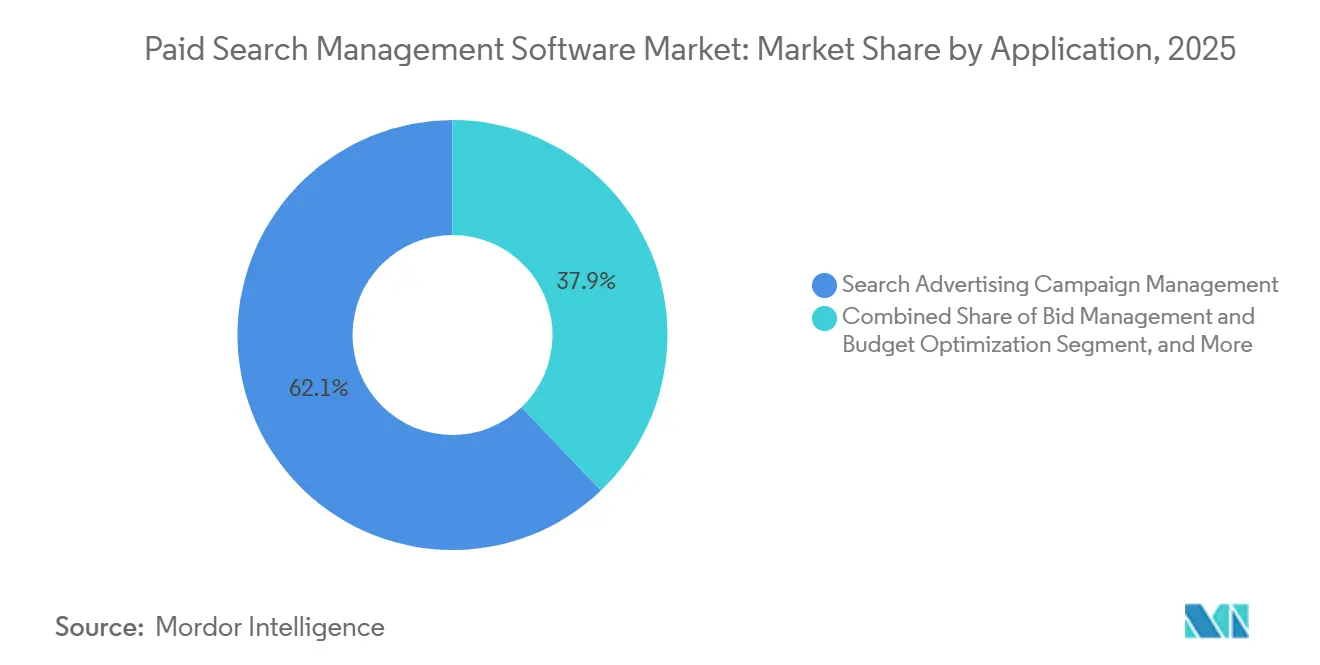
- By application, search advertising campaign management accounted for 62.13% of the paid search management software market revenue in 2025, while performance tracking and attribution analytics are projected to grow at a 15.77% CAGR through 2031.
- By end-user industry, retail and e-commerce accounted for 24.51% of revenue in 2025, while information technology and telecommunication are expected to expand at a 15.02% CAGR through 2031.
- By geography, North America held 36.44% of the paid search management software market revenue in 2025, while Asia-Pacific is projected to grow at a 15.36% CAGR through 2031.
Note: Market size and forecast figures in this report are generated using Mordor Intelligence’s proprietary estimation framework, updated with the latest available data and insights as of January 2026.
Global Paid Search Management Software Market Trends and Insights
Drivers Impact Analysis*
| Driver | (~) % Impact on CAGR Forecast | Geographic Relevance | Impact Timeline |
|---|---|---|---|
| Rising Need for Automated Bid and Budget Reallocation | +3.2% | Global, with highest intensity in North America and Western Europe | Short term (≤ 2 years) |
| Shift Toward First-Party Search Performance Analytics | +2.7% | North America and Europe core, spillover to Asia-Pacific | Medium term (2-4 years) |
| Retail Media and Search Convergence | +2.4% | North America core, Asia-Pacific and Europe spillover | Medium term (2-4 years) |
| Growth of Multi-Account Agency Workflows | +1.9% | Global, accelerated uptake in Asia-Pacific and South America | Short term (≤ 2 years) |
| Increased Adoption of AI-Assisted Query Mining | +1.6% | Global | Short term (≤ 2 years) |
| Greater Demand for Incrementality and Incremental ROAS Measurement | +1.2% | North America and Europe | Medium term (2-4 years) |
| Source: Mordor Intelligence | |||
Rising Need for Automated Bid and Budget Reallocation
The paid search management software market is driven by the replacement of manual bid rules with portfolio-level optimization across larger portfolios, where small changes in search demand, conversion quality, and available budget require frequent decisions that are difficult to sustain through manual checks alone. Google Ads API v25 introduced an AI Max campaign setting that lets connected platforms configure AI Max for Search at scale. This makes third-party automation a layer that can guide native platform automation rather than simply replace it, and the paid search management software market benefits when software adds controls that advertisers can apply consistently across accounts, teams, and changing campaign conditions. Academic work presented at COLING 2025 found that on-the-fly keyword generation can adapt to changing performance indicators more effectively than static keyword sets. Microsoft Advertising also introduced cross-account portfolio bidding for Search and Shopping in May 2026, raising the bar for independent tools. As campaign settings become more automated, advertisers still need consistent budget control across accounts and channels.
Shift Toward First-Party Search Performance Analytics
The move toward first-party data is increasing demand for measurement features in the paid search management software market. Google told the UK Competition and Markets Authority in 2025 that it would retain user choice on third-party cookies in Chrome, but this did not restore broad cross-site measurement. Google Analytics supports user-provided data collection to improve conversion modeling when consented first-party data is available.[1]Google LLC, “Google Ads API v25 Release Notes,” Google Developers, developers.google.com These configurations require reliable data handling and consistent campaign processes across accounts. Platforms that connect cleaner first-party data to bidding and reporting can help advertisers improve the quality of their performance signals, while also giving agencies a consistent process for checking consent status, conversion inputs, and reporting definitions across client accounts. Privacy and consent requirements also make compliance-aware analytics functions important in Europe and other regulated markets, which gives the paid search management software market a role in helping teams maintain consistent data practices while reviewing search performance.
Retail Media and Search Convergence
Retail media is extending the range of search activity that advertisers want to manage in one place. Sponsored product campaigns on retailer platforms use different inventory and workflow structures from standard search advertising. This creates a need for tools that can bring retail media results together with Google and Microsoft campaign data. The change is relevant to the paid search management software market because agencies increasingly manage both forms of search for the same client. A single reporting view can reduce duplicate work and improve budget discussions across channels, enabling the paid search management software market to support decisions that previously had to be made in separate platform dashboards and agency reports. Vendors without retail media connectivity may find it harder to retain broad agency mandates as campaign portfolios become less centered on a single platform, especially when the same client expects teams to compare product search results, conventional search outcomes, and the use of shared budgets in a single review.
Growth of Multi-Account Agency Workflows
Agency teams require tools that work across many advertiser accounts without repeated manual setup. Microsoft Advertising added cross-account portfolio bidding in May 2026, underscoring the importance of multi-account workflow capabilities in the paid search management software market. Optmyzr also described a 2026 connection that lets teams use natural-language prompts to access live account data via its MCP integration. These features can reduce the time required for reporting, optimization checks, and rule creation. The result is a clearer difference between platforms built for agency operations and tools meant for a single advertiser, and the paid search management software market can favor providers that make review, approval, and reporting tasks easier across a large client base. Agencies may favor fewer systems when they can consolidate routine work and account oversight in a single environment, because shared templates, account alerts, approval records, and standardized reporting can reduce the manual work associated with serving a large group of advertisers.
Restraints Impact Analysis*
| Restraint | (~) % Impact on CAGR Forecast | Geographic Relevance | Impact Timeline |
|---|---|---|---|
| Dependence on Platform Policy and API Changes | -1.7% | Global | Short term (≤ 2 years) |
| Budget Compression in Small Advertiser Accounts | -1.3% | North America and Europe | Short term (≤ 2 years) |
| Attribution Noise Across Cross-Device Search Journeys | -0.8% | Global | Medium term (2-4 years) |
| Limited In-House Expertise for Advanced Automation Governance | -0.6% | South America, Middle East and Africa, Rest of Asia-Pacific | Long term (≥ 4 years) |
| Source: Mordor Intelligence | |||
Dependence on Platform Policy and API Changes
The paid search management software market depends on the policies and release schedules of advertising platforms. Google deprecated call-only ads from the Google Ads API in January 2026, and existing call-only ads are scheduled to stop serving in February 2027. Google also released API versions 20 through 22 between June and October 2025. Each release can require software vendors to update integrations and campaign workflows, creating ongoing costs for the paid search management software market and putting greater pressure on smaller providers with limited engineering capacity. Smaller vendors may need to reallocate engineering resources from new product development to maintenance. Advertisers can face workflow disruption when an advertising platform changes faster than a connected software product, since campaign teams may need to pause routine changes, verify settings, and review data flows while a vendor adjusts its integration to the revised platform requirements.
Budget Compression in Small Advertiser Accounts
Higher cost-per-click can make it harder for smaller advertisers to justify subscriptions. Semrush reported softer demand at the lower end of its market in 2025, linking it to higher paid search cost-per-click. This pressure can lead smaller accounts to treat management tools as discretionary spending even when media budgets remain in place, which means the paid search management software market must show a clear operational benefit before smaller advertisers will add another recurring cost. It limits how quickly the paid search management software market can reach smaller businesses. The issue remains relevant despite the projected 16.34% CAGR for SMEs, as the affordability of software does not eliminate concerns about campaign returns. Vendors that offer simpler pricing and practical workflow support may be better placed to serve this group, particularly when they can show how automation, reporting, and budget controls reduce the operational burden without requiring a small advertiser to employ a dedicated search specialist.
*Our forecasts treat driver/restraint impacts as directional, not additive. The impact forecasts reflect baseline growth, mix effects, and variable interactions.
Segment Analysis
By Component: Software Revenue Leads While Services Grow Faster
Software held 68.19% of the paid search management software market share in 2025. Subscription licensing remains the central revenue model for enterprise platforms and agency dashboards. The structure also makes software the default choice for advertisers who need ongoing campaign management. The paid search management software industry continues to rely on this licensing model because search programs require frequent adjustment rather than one-time implementation.
Services are projected to grow at a 16.67% CAGR from 2026 to 2031. This growth reflects demand for implementation support, managed services, and API integration as advertisers use more platforms. Human support becomes more important when teams must connect search, retail media, and measurement systems. Microsoft Advertising introduced a new Import Center in May 2026 to simplify campaign migration from Google Ads and Meta Ads.[2]Microsoft Advertising, “New Import Center and Other Product News for May 2026,” Microsoft Advertising Official Blog, about.ads.microsoft.com Migration and data normalization can create work that subscription software alone does not complete. The segment, therefore, combines scalable license revenue with a services need created by more complex campaign environments.


By Deployment Mode: Cloud Becomes the Operating Standard
Cloud accounted for 70.21% of revenue in 2025 and is projected to advance at a 16.05% CAGR through 2031. This establishes cloud as both the leading deployment mode and the faster-growing option. Cloud systems can support real-time bid signals and multiple API calls across advertising platforms. They also enable cross-account portfolio work without requiring local infrastructure at each client location. These capabilities align with the needs of the paid search management software market as campaign activity becomes more continuous.
On-premises deployment remains relevant for advertisers with strict data residency and compliance requirements. Financial services, healthcare, and government-related organizations may retain these systems when internal policies limit cloud migration. The difference between the two models is likely to become clearer as cloud-first vendors release new functions more quickly. Optmyzr has described cloud-based MCP connections that give users controlled access to live account data through AI tools. Smartly introduced its Synapse AI orchestration layer in June 2026, reinforcing the direction of cloud-native advertising operations.
By Organization Size: Enterprises Anchor Revenue and SMEs Add Growth
Large enterprises captured 72.68% of the paid search management software market share in 2025. These organizations can support licensing costs, multiple users, and detailed integration work across large campaign portfolios. They also manage complex relationships with agencies, platforms, and internal marketing teams. Automation is more valuable when an organization runs many campaigns and networks simultaneously. Large enterprise adoption reflects the need for repeatable governance in these settings.
SMEs are projected to expand at a 16.34% CAGR from 2026 to 2031. White-label agency products, freemium diagnostic tools, and modular pricing are lowering the entry threshold for smaller users. Google reduced the minimum campaign budget for a geo-based incrementality experiment from USD 100,000 to USD 5,000 in late 2025. The update makes a more advanced measurement approach accessible to a wider group of advertisers. Smaller users can gain value from software that helps them operate these tests and interpret results.
By Application: Campaign Management Remains Central While Analytics Gains Value
Search advertising campaign management held 62.13% of revenue in 2025. Keyword organization, ad scheduling, and match-type governance remain the core reasons many advertisers adopt a platform. Bid management and budget optimization form the next major application area. The quality of portfolio bidding, pacing, and dayparting controls often determines platform differences. Audience targeting and keyword intelligence are also becoming more important as platform automation broadens matching behavior.
Performance tracking and attribution analytics are projected to grow at a 15.77% CAGR through 2031. Advertisers need better ways to assess outcomes when last-click reporting does not capture the full customer journey. Google has improved its incrementality testing tools and supports configurable confidence levels for these experiments. Research from EMNLP 2025 also showed that a multi-objective, self-reflective approach to ad keyword generation can outperform conventional methods across product benchmarks. These developments encourage vendors to add stronger query intelligence and measurement modules.

By End-User Industry: Retail Leads While Technology Demand Accelerates
Retail and e-commerce accounted for 24.51% of revenue in 2025. This sector depends heavily on capturing high-intent searches close to a purchase decision. Retail advertisers increasingly need to coordinate conventional search campaigns with retailer-sponsored listings. That combination increases the value of shared reporting, budget oversight, and keyword processes. The paid search management software market can address these requirements by bringing campaign data from different search environments into a consistent workflow.
Information technology and telecommunication are projected to grow at a 15.02% CAGR from 2026 to 2031. Enterprise software providers compete for high-intent, high-cost queries related to cloud services, cybersecurity, and software subscriptions. Small gains in bidding efficiency can have meaningful cost implications in these categories. Google expanded AI Max for Search capabilities via its API, making negative keyword controls and audience signals more important for advertisers who need to protect brand terms. BFSI, healthcare and life sciences, media and entertainment, and travel and hospitality provide additional demand.
Geography Analysis
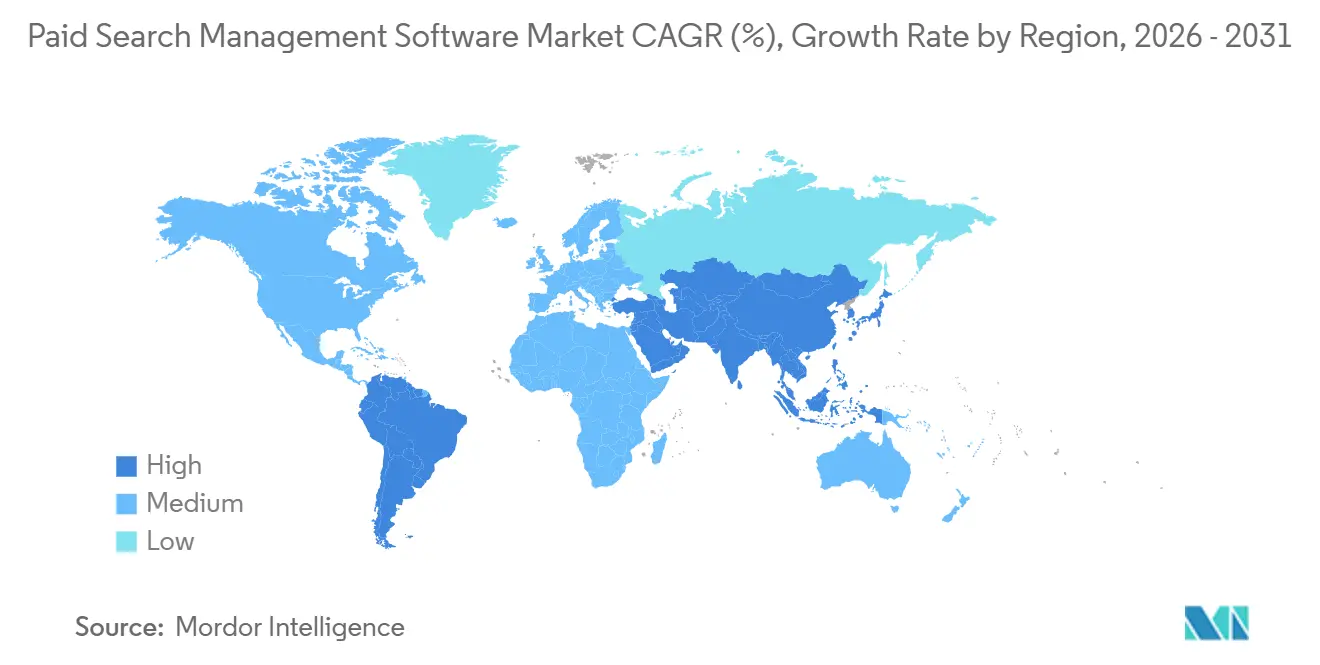
North America held 36.44% of the paid search management software market share in 2025. The region benefits from a mature digital advertising base and a concentration of advertising platforms, agencies, and enterprise buyers. The United States provides a major demand center for software that supports portfolio bidding and detailed reporting. North American buyers have also adopted incrementality testing, multi-network management, and AI-assisted query processes early. The paid search management software market in the region is also evolving as advertisers place greater emphasis on retail media alongside established search platforms, thereby expanding the practical value of tools that reconcile campaign information across multiple networks and provide agencies with an account-level view of performance.
Europe is the second-largest regional area, with Germany, the United Kingdom, and France supporting enterprise and agency demand. Google’s 2025 Privacy Sandbox progress report to the UK Competition and Markets Authority remains relevant to measurement planning in the region.[3]Google LLC, “Privacy Sandbox Q2 2025 Progress Report,” HM Government, gov.uk This regulatory environment supports demand for first-party analytics functions that are designed with consent and compliance in mind. South America is smaller in revenue but offers room for cloud software adoption among SMEs, and vendors can use localized products to address the operational needs of businesses in Brazil and Argentina.
Asia-Pacific is projected to grow at a 15.36% CAGR through 2031, the fastest rate among the regions. India, China, South Korea, Australia, and New Zealand are expanding the base of advertisers that require search management tools. India creates demand for local-language keyword intelligence and regional bidding support. China requires a distinct product approach because Baidu, Alibaba, and Tencent operate on different technology stacks than Western platforms. This localization requirement can limit simple expansion by global vendors while creating an opening for adapted products.

Competitive Landscape
The paid search management software market includes multi-function platforms, specialized tools, and native automation products from major advertising platforms. Optmyzr, Skai, Adobe, following the Semrush integration, Microsoft Corporation, and Smartly compete across different parts of the workflow. Adobe completed its acquisition of Semrush for USD 1.87 billion in April 2026.[4]Adobe Inc., “Adobe to Acquire Semrush,” Adobe Newsroom, news.adobe.com The transaction combines paid media intelligence, search engine optimization, and agentic search functions within a wider enterprise platform. Marin Software’s 2025 dissolution process reduced the number of legacy competitors serving the mid-market.
Product strategy is centered on AI-supported workflows, but vendors need more than automated bidding to stand out. Optmyzr released intent-based search term matching in March 2026, using a similarity score to assess semantic intent. Smartly introduced Smartly Synapse in June 2026 as an AI orchestration and memory layer for its advertising platform. Microsoft Advertising expanded its migration and cross-account bidding tools in May 2026. These moves raise expectations for platforms that serve agencies and advertisers managing multiple networks.
Cross-platform incremental attribution remains a meaningful opportunity because many advertisers still need clearer evidence of causal lift across Google, Microsoft, and retail media networks. Smartly signed a letter of intent in March 2026 to acquire INCRMNTAL, an always-on incrementality measurement platform. Platforms that unite creative inputs, budget allocation, and measurement may be better suited to continuous optimization. The paid search management software industry is therefore likely to reward providers that offer aggregation, agency-specific controls, and measurement capabilities that are difficult to replicate within a single advertising platform, particularly when advertisers need common reporting rules and a documented process for allocating budgets across channels.
Paid Search Management Software Industry Leaders
Microsoft Corporation
Adobe Inc.
NinjaCat, Inc.
WordStream, Inc.
Optmyzr Corporation
- *Disclaimer: Major Players sorted in no particular order

Recent Industry Developments
- June 2026: Microsoft Advertising hosted its Activate 2026 partner event and announced the expansion of AI Max for Search into an open pilot, a Model Context Protocol server for custom AI workflows based on live campaign data, and Copilot Checkout enhancements for direct product transactions.
- May 2026: Microsoft Advertising launched a new Import Center to streamline campaign migration from Google Ads and Meta Ads, rolled out cross-account portfolio bidding for Search and Shopping campaigns, and confirmed the broader rollout of data-driven attribution for automated bid strategies.
- May 2026: Optmyzr published its MCP integration guide, allowing agency PPC teams to connect Claude and ChatGPT directly to live Optmyzr account data for recommendations, rule automation, and performance analysis without CSV exports.


Global Paid Search Management Software Market Report Scope
The Paid Search Management Software Market comprises software platforms that enable organizations to create, manage, automate, optimize, and measure paid search advertising campaigns across search engines and digital commerce platforms. These solutions offer capabilities such as campaign management, keyword bidding, budget allocation, bid optimization, ad performance tracking, attribution analytics, audience targeting, and conversion measurement. Advertisers use these platforms to maximize advertising effectiveness, improve return on ad spend (ROAS), increase customer acquisition, and optimize paid search marketing performance.
The Paid Search Management Software Market Report is Segmented by Component (Software and Services), Deployment Mode (Cloud and On-Premises), Organization Size (Large Enterprises and Small and Medium Enterprises [SMEs]), Application (Search Advertising Campaign Management, Bid Management and Budget Optimization, Performance Tracking and Attribution Analytics, and Audience Targeting and Keyword Intelligence), End-User Industry (Retail and E-Commerce, Banking, Financial Services, and Insurance [BFSI], Healthcare and Life Sciences, Information Technology and Telecommunication, Media and Entertainment, Travel and Hospitality, and Other End-User Industries), and Geography (North America, South America, Europe, Asia-Pacific, Middle East, and Africa). The Market Forecasts are Provided in Terms of Value (USD).
| Software |
| Services |
| Cloud |
| On-Premises |
| Large Enterprises |
| Small and Medium Enterprises (SMEs) |
| Search Advertising Campaign Management |
| Bid Management and Budget Optimization |
| Performance Tracking and Attribution Analytics |
| Audience Targeting and Keyword Intelligence |
| Retail and E-Commerce |
| Banking, Financial Services, and Insurance (BFSI) |
| Healthcare and Life Sciences |
| Information Technology and Telecommunication |
| Media and Entertainment |
| Travel and Hospitality |
| Other End-User Industries |
| North America | United States |
| Canada | |
| Mexico | |
| South America | Brazil |
| Argentina | |
| Rest of South America | |
| Europe | Germany |
| United Kingdom | |
| France | |
| Italy | |
| Spain | |
| Russia | |
| Rest of Europe | |
| Asia-Pacific | China |
| Japan | |
| India | |
| South Korea | |
| Australia and New Zealand | |
| Rest of Asia-Pacific | |
| Middle East | Saudi Arabia |
| United Arab Emirates | |
| Turkey | |
| Rest of Middle East | |
| Africa | South Africa |
| Nigeria | |
| Rest of Africa |
| By Component | Software | |
| Services | ||
| By Deployment Mode | Cloud | |
| On-Premises | ||
| By Organization Size | Large Enterprises | |
| Small and Medium Enterprises (SMEs) | ||
| By Application | Search Advertising Campaign Management | |
| Bid Management and Budget Optimization | ||
| Performance Tracking and Attribution Analytics | ||
| Audience Targeting and Keyword Intelligence | ||
| By End-User Industry | Retail and E-Commerce | |
| Banking, Financial Services, and Insurance (BFSI) | ||
| Healthcare and Life Sciences | ||
| Information Technology and Telecommunication | ||
| Media and Entertainment | ||
| Travel and Hospitality | ||
| Other End-User Industries | ||
| By Geography | North America | United States |
| Canada | ||
| Mexico | ||
| South America | Brazil | |
| Argentina | ||
| Rest of South America | ||
| Europe | Germany | |
| United Kingdom | ||
| France | ||
| Italy | ||
| Spain | ||
| Russia | ||
| Rest of Europe | ||
| Asia-Pacific | China | |
| Japan | ||
| India | ||
| South Korea | ||
| Australia and New Zealand | ||
| Rest of Asia-Pacific | ||
| Middle East | Saudi Arabia | |
| United Arab Emirates | ||
| Turkey | ||
| Rest of Middle East | ||
| Africa | South Africa | |
| Nigeria | ||
| Rest of Africa | ||


Key Questions Answered in the Report
What is the paid search management software market size?
The paid search management software market size is projected to rise from USD 4.02 billion in 2026 to USD 7.68 billion by 2031, at a 13.81% CAGR.
What is driving demand for paid search management software?
Automated bid management, first-party performance analytics, retail media integration, and agency workflow needs are supporting adoption.
Which deployment model is growing fastest for paid search tools?
Cloud is projected to grow at a 16.05% CAGR through 2031, while holding 70.21% of revenue in 2025.
Which users account for the largest share of demand?
Large enterprises held 72.68% of revenue in 2025 because they manage complex, multi-account advertising programs.
Which application is growing fastest in paid search platforms?
Performance tracking and attribution analytics is projected to expand at a 15.77% CAGR through 2031.
Which region is expected to grow fastest?
Asia-Pacific is projected to grow at a 15.36% CAGR through 2031, supported by demand across major digital advertising markets.
Page last updated on:






