
OTT Streaming Cloud Platform Market Size and Share
Market Overview
| Study Period | 2020 - 2031 |
|---|---|
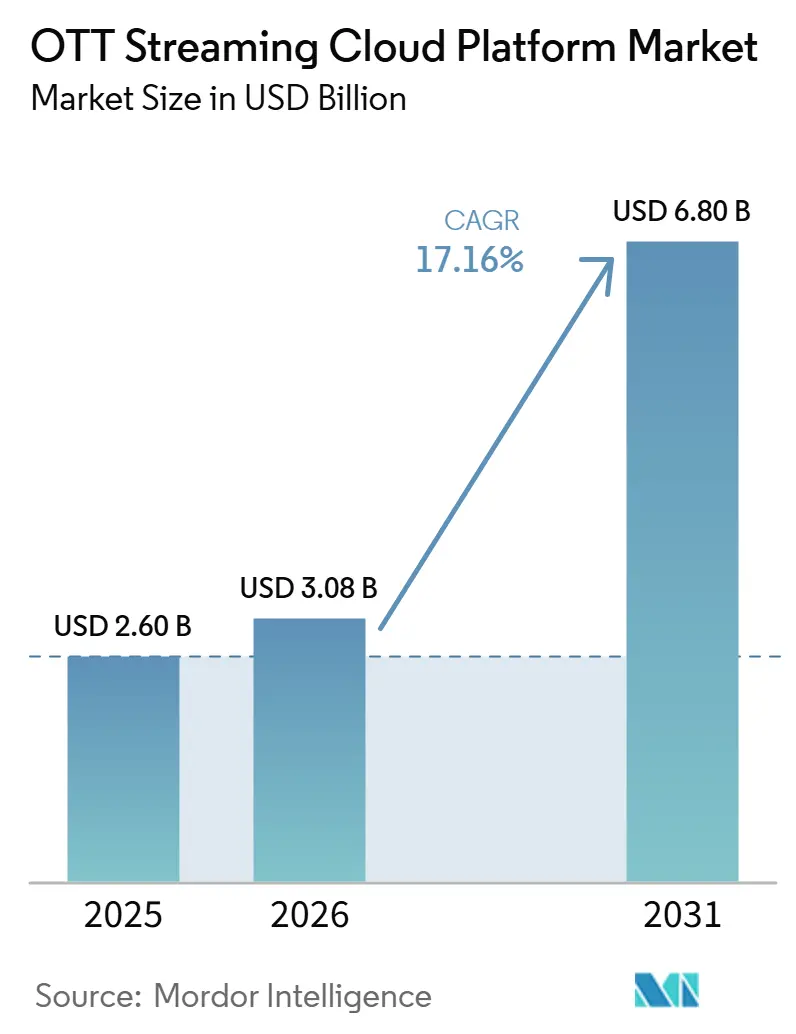
| Market Size (2026) | USD 3.08 Billion |
| Market Size (2031) | USD 6.80 Billion |
| Growth Rate (2026 - 2031) | 17.16 % |
| Fastest Growing Market | Asia-Pacific |
| Largest Market | North America |
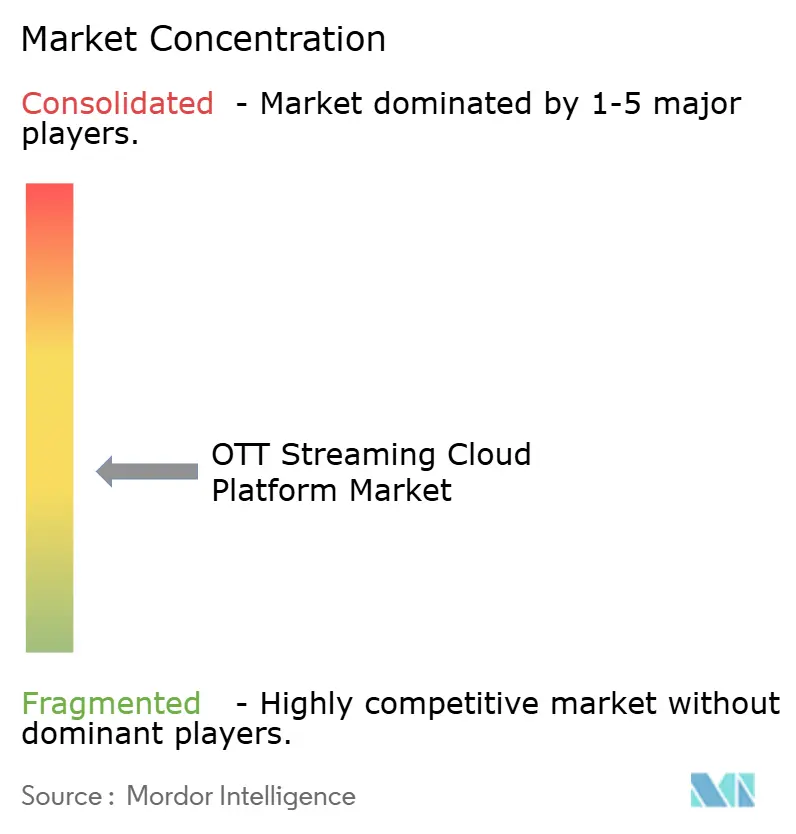
| Market Concentration | Medium |
Major Players *Disclaimer: Major Players sorted in no particular order Image © Mordor Intelligence. Reuse requires attribution under CC BY 4.0. | |
OTT Streaming Cloud Platform Market Analysis by Mordor Intelligence
The OTT streaming cloud platform market size is projected to expand from USD 2.60 billion in 2025 and USD 3.08 billion in 2026 to USD 6.80 billion by 2031, registering a CAGR of 17.16% between 2026 to 2031. Growth reflects broadcasters and publishers moving from on-premises playout equipment to cloud-based delivery systems that can adjust capacity without long procurement cycles. Cloud services now support live channels through microservices, containers, and application programming interfaces, which makes advanced delivery capabilities available to smaller media operators. Automation, flexible billing models, and demand for reliable live delivery have made the platform layer more important to media operations. The OTT streaming cloud platform market also has room to grow in Asia-Pacific, the Middle East, and Africa, where the move away from hardware-led broadcasting remains incomplete.
Key Report Takeaways
- By streaming type, on-demand streaming held 45.50% of OTT streaming cloud platform market revenue in 2025, while live streaming is projected to expand at a 17.55% CAGR through 2031.
- By revenue model, subscription-based billing held 35.40% of OTT streaming cloud platform market revenue in 2025, while advertising-supported billing, including AVOD and FAST, is expected to grow at a 17.94% CAGR through 2031.
- By end user, OTT and digital streaming service providers accounted for 30.35% of OTT streaming cloud platform market revenue in 2025, while sports leagues and rights holders are projected to advance at a 17.83% CAGR through 2031.
- By geography, North America held 35.40% of revenue in 2025, while Asia-Pacific is expected to record the highest growth at a 17.88% CAGR through 2031.
Note: Market size and forecast figures in this report are generated using Mordor Intelligence’s proprietary estimation framework, updated with the latest available data and insights as of January 2026.
Global OTT Streaming Cloud Platform Market Trends and Insights
Drivers Impact Analysis*
| Driver | (~) % Impact on CAGR Forecast | Geographic Relevance | Impact Timeline |
|---|---|---|---|
| Cloud-Native OTT Platform Adoption | +3.8% | Global, with strong relevance in North America and Western Europe | Short term (≤ 2 years) |
| Growth of Hybrid Monetization and FAST Services | +3.2% | North America and South America, with expansion into Asia-Pacific and the Middle East and Africa | Short term (≤ 2 years) |
| Rising Demand for Low-Latency Live Streaming | +2.9% | Global, with the highest intensity in Asia-Pacific and North America | Medium term (2-4 years) |
| AI-Based Content Automation and Personalization | +2.5% | Global, led by North America, Europe, and Asia-Pacific | Medium term (2-4 years) |
| Expansion of Enterprise and Education Video Use Cases | +1.8% | North America, Europe, and Asia-Pacific | Medium term (2-4 years) |
| 5G Multicast and Broadcast Streaming Deployment | +1.4% | Asia-Pacific, with expansion into North America and the Middle East and Africa | Long term (≥ 4 years) |
| Source: Mordor Intelligence | |||
Cloud-Native OTT Platform Adoption Reshapes Broadcaster Economics
The OTT streaming cloud platform market is benefiting as broadcasters replace legacy playout equipment with container-based cloud workflows. Channels can be launched through configuration changes rather than lengthy equipment procurement, which can reduce time to air from months to days. JioHotstar used a cloud-native pipeline on Amazon EKS with more than 800 microservices and 8,000 CPU cores at peak to deliver the 2026 ICC T20 World Cup Final to 821 million concurrent viewers.[1]JioHotstar Engineering, “Orchestrating JioHotstar Traffic, The Difference Between a Loading Spinner and a Winning Six,” JioHotstar Engineering, jiohotstar.com. This approach allows operators to scale capacity for major events without building permanent infrastructure for peak traffic. It also makes advanced live delivery more accessible to regional broadcasters and smaller rights holders that previously faced high capital requirements.
Growth of Hybrid Monetization and FAST Services Redefines Platform Revenue Logic
The OTT streaming cloud platform market is also being shaped by the expansion of free ad-supported streaming television, known as FAST. Amagi reported that global viewing hours on its THUNDERSTORM platform increased 55% year over year in April through June 2026, while ad impressions increased 53% across nearly 6,500 channel deliveries. South America recorded the strongest regional expansion, with viewing hours up 190% and ad impressions up 124% during the same period. This growth increases the need for server-side ad insertion, yield management, and accurate content metadata. Platform suppliers that combine these capabilities can help channel owners improve advertising results while supporting subscription and transactional offers alongside free services.
Rising Demand for Low-Latency Live Streaming Drives Infrastructure Investment
The OTT streaming cloud platform market needs lower latency as sports wagering, social interaction, and live overlays make broadcast-like timing more important. The IBC2025 Accelerator Project showed that hybrid unicast and broadcast delivery using CMAF chunked transfer encoding and multicast adaptive bitrate streaming could achieve sub-1-second glass-to-glass latency under 20% packet loss conditions.[2]IBC, “Accelerator Project 2025, Ultra-Low Latency Live Streaming at Scale,” IBC, ibc.org. ETSI Release 19 specifications provide a standards framework for 5G multicast-broadcast services that can serve dense audiences without increasing unicast bandwidth for every viewer. Verizon used private 5G and fiber for broadcast contribution across 104 matches at 16 stadiums during the 2026 FIFA World Cup. These deployments show why low-latency workflows are becoming a core requirement for sports and event streaming platforms.
AI-Based Content Automation and Personalization Compresses Operational Costs
The OTT streaming cloud platform market is adopting artificial intelligence beyond viewer recommendations and into production, enrichment, and distribution tasks. AWS made Elemental Inference generally available in February 2026 to generate vertical video formats and highlight clips alongside encoding workflows.[3]Amazon Web Services, “Amazon IVS Low-Latency Streaming Now Supports Server-Side Ad Insertion,” AWS What’s New, aws.amazon.com. Kaltura launched TV Genie in March 2025 with personalized recommendations, content enrichment, and automated production functions, while Reshet 13 used the platform to create news segments from long-form content. Amagi found that 86% of surveyed senior practitioners identified metadata reformatting as their largest operational issue, while 57% trusted artificial intelligence to generate synopses and tags with spot-check review. Better metadata can improve search, content discovery, ad placement, and operational efficiency across the platform.
Restraints Impact Analysis*
| Restraint | (~) % Impact on CAGR Forecast | Geographic Relevance | Impact Timeline |
|---|---|---|---|
| Escalating Bandwidth, Storage, and Transcoding Costs | -2.8% | Global, with high pressure in cost-sensitive Asia-Pacific and South American markets | Short term (≤ 2 years) |
| Privacy, Rights Management, and Data Residency Constraints | -2.1% | Europe, North America, and Asia-Pacific markets with data sovereignty rules | Medium term (2-4 years) |
| Fragmented Device, Codec, and Player Ecosystems | -1.6% | Global | Medium term (2-4 years) |
| AI-Enabled Piracy, Deepfakes, and Content Integrity Risks | -1.3% | Global, especially premium sports and live content | Long term (≥ 4 years) |
| Source: Mordor Intelligence | |||
Escalating Bandwidth, Storage, and Transcoding Costs Compress Platform Margins
The OTT streaming cloud platform market faces pressure from delivery, storage, and transcoding costs as audience volumes rise. Bandwidth represented 60-75% of total live streaming infrastructure spending, and its cost rises directly with audience size. Encoding and delivery together accounted for 35-45% of infrastructure spending for mid-sized operators, while subscription growth in mature North American and European markets has slowed. More efficient codecs such as HEVC and AV1 can reduce delivery costs by close to one-third without lowering video quality, but legacy contracts can restrict migration to better encoding profiles. This cost structure makes operational efficiency important for providers serving large live audiences or offering low-priced ad-supported services.
Privacy, Rights Management, and Data Residency Constraints Complicate Multi-Region Deployment
The OTT streaming cloud platform market must address different data, privacy, and rights requirements across operating regions. The European Union AI Act entered full enforcement in August 2026, and Article 10 data governance requirements for high-risk systems can result in penalties of up to EUR 15 million, or USD 16.5 million, or 3% of global turnover. These requirements add to GDPR and Schrems II obligations, which can require operators to maintain European inference infrastructure for personalization services. Qvest, Ateme, and Scaleway launched a sovereign OTT platform in July 2026 for European broadcasters seeking infrastructure outside U.S. hyperscaler environments. Regional deployment requirements can increase cost and complexity, but they also create demand for providers with compliant local infrastructure.
*Our forecasts treat driver/restraint impacts as directional, not additive. The impact forecasts reflect baseline growth, mix effects, and variable interactions.
Segment Analysis
By Streaming Type: Live Delivery Raises Infrastructure Requirements
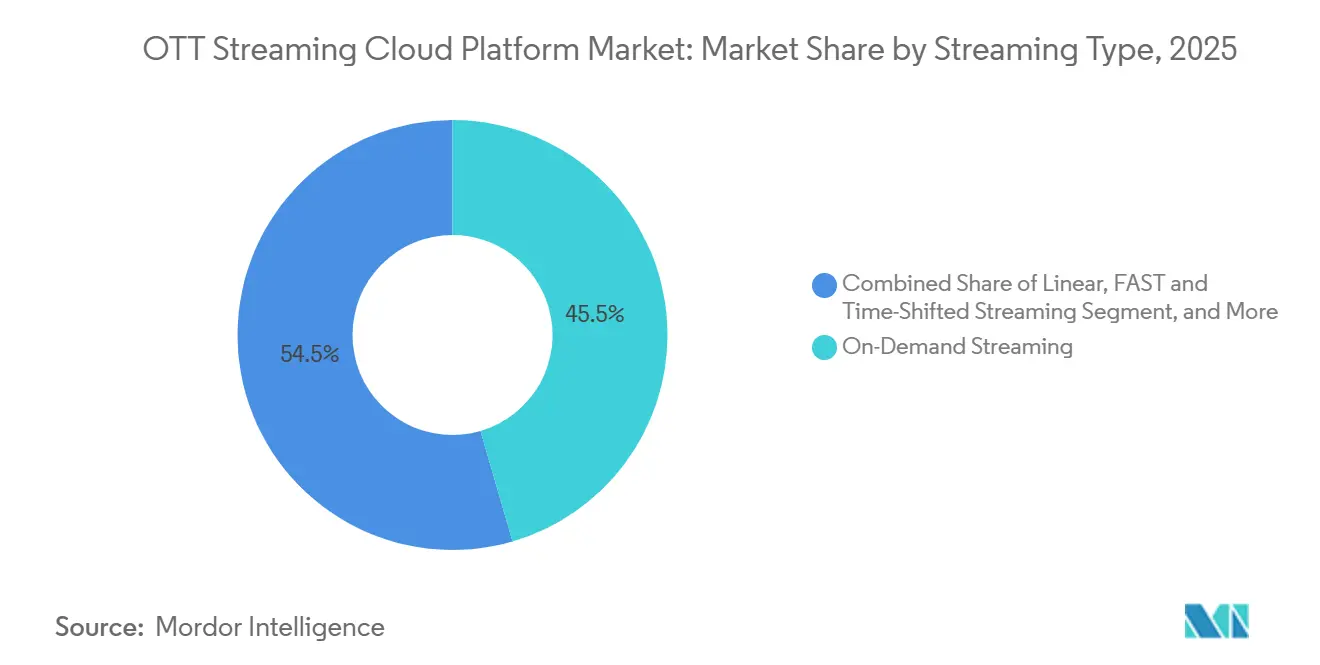
On-demand streaming held 45.50% of the OTT streaming cloud platform market share in 2025, supported by the installed base of video-on-demand services. Its position also reflects years of investment in adaptive bitrate delivery, content libraries, and multi-content delivery network arrangements. The OTT streaming cloud platform market size for on-demand services benefits when those systems are used across both recorded and live programming. Live streaming is projected to grow at a 17.55% CAGR from 2026 to 2031, driven by fragmented sports rights, esports audiences, and enterprise events. Linear, FAST, and time-shifted services are also gaining attention as broadcasters use scheduled programming within ad-supported streaming models.
FAST viewing hours rose 55% year over year in 2026, showing continued interest in linear-style experiences delivered through streaming applications. The boundaries between streaming formats are narrowing because providers increasingly use a shared encoder and delivery environment for live, on-demand, and time-shifted viewing. This requires systems that can move computing resources between workloads without manual intervention. ETSI 3GPP Release 19 supports multicast functions that allow a single encoded stream to reach many viewers without individual unicast delivery for each viewer. This capability is particularly relevant to live programming, where delivery cost can determine the profitability of a major event.



By Revenue Model: AVOD and FAST Growth Changes Platform Needs
Subscription-based billing, or SVOD, held 35.40% of OTT streaming cloud platform market revenue in 2025. Its leading position was built through the expansion of Netflix, Disney+, and regional subscription services across North America, Europe, and Asia-Pacific. Advertising-supported billing, including AVOD and FAST, is forecast to grow at a 17.94% CAGR through 2031. The shift is tied to consumer price sensitivity as ad-free streaming plan prices rose 77% between 2020 and 2025. Transactional billing through TVOD and pay-per-view retains a role for premium sports and theatrical releases where customers are willing to pay for access to a specific event or title.
Hybrid billing models are gaining use among mid-sized platforms that use FAST channels to attract viewers and subscription tiers to generate recurring revenue from committed audiences. The OTT streaming cloud platform market needs ad technology that can support this mix without harming playback quality or viewer experience. AVOD and FAST providers need server-side ad insertion, advertising yield tools, and accurate metadata to compete for programmatic inventory. Brightcove added AI Contextual Ads and Smart Ad Breaks in 2026 to identify brand-safe mid-roll positions from video context. The European Union Digital Services Act limits some behavioral targeting practices, making contextual advertising a more suitable option for services operating in Europe.
By End User: Sports and Event Operators Gain Momentum
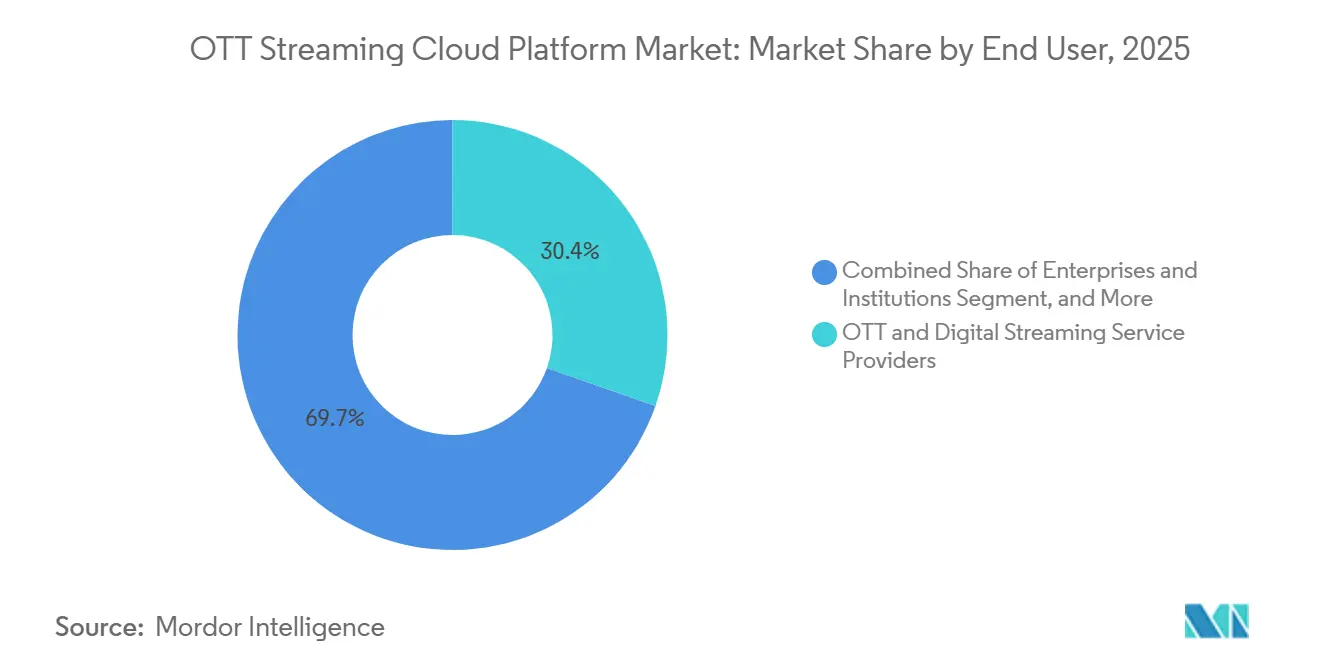
OTT and digital streaming service providers accounted for 30.35% of OTT streaming cloud platform market revenue in 2025. These providers require tools across content ingest, monetization, delivery, analytics, and customer management. Broadcasters and pay-TV operators are moving from hardware playout to cloud workflows because separate linear and OTT systems are increasingly costly to maintain. Telecom operators use streaming offers with broadband and 5G subscriptions to reduce customer churn and obtain value from media rights. Studios, content owners, and digital publishers are investing in direct-to-consumer platforms to reduce reliance on aggregator revenue-sharing models.
Sports leagues, rights holders, and live-event organizers are forecast to record the highest end-user growth at a 17.83% CAGR through 2031. LiveU provided an IP video backbone for non-rights coverage across 104 matches in 16 stadiums during the 2026 FIFA World Cup. The deployment demonstrated the operational use of cloud-based remote production at a large global event. Enterprises and institutions form another important user group as video becomes a searchable organizational resource for learning, communications, and internal knowledge. Kaltura’s ISO/IEC 42001 certification reflects the growing attention to responsible management of artificial intelligence in enterprise video environments.
Geography Analysis
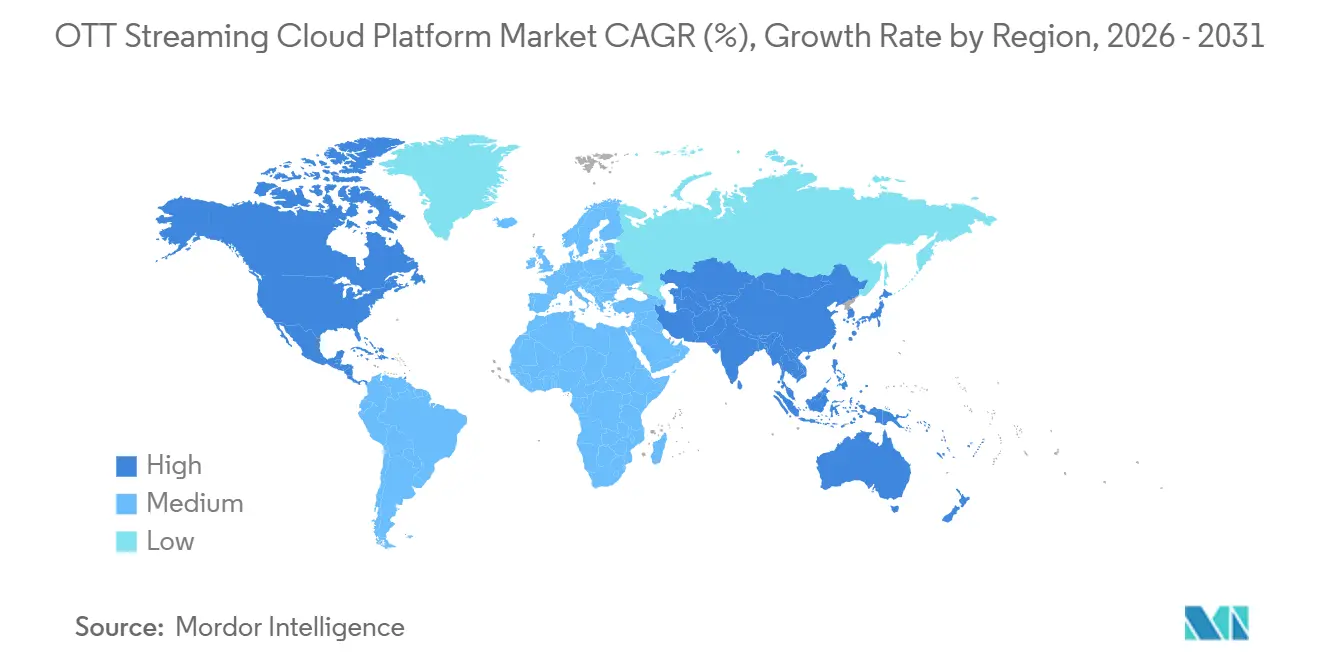
North America held 35.40% of the OTT streaming cloud platform market share in 2025, supported by hyperscale infrastructure, a large FAST ecosystem, and a high concentration of professional sports rights. The region has major suppliers of server-side ad insertion and advertising technology, which helps new capabilities reach commercial use quickly. FAST services in the United States are reaching a wide audience, which supports continued platform spending on advertising workflows and data management. Europe follows a different regulatory path, as the European Union AI Act has encouraged interest in sovereign cloud OTT deployments and local data handling requirements.
Asia-Pacific is forecast to be the fastest-growing region at a 17.88% CAGR from 2026 to 2031. India’s scale and Japan’s higher-value viewing model are important contributors to this growth. JioHotstar handled 821 million concurrent viewers during the 2026 ICC T20 World Cup Final and processed up to 5 million subscription requests per minute at peak. The event demonstrated the level of ingest, rights management, encoding, and multi-content delivery network coordination required by the regional OTT streaming cloud platform market.
South America, the Middle East, and Africa remain earlier-stage markets for cloud platform adoption, but their demand is increasing. South America recorded global FAST viewing-hour growth of 190% in April through June 2026, while ad impressions increased 124%. Brazil’s CazéTV model, which carried all 104 FIFA World Cup matches free of charge on YouTube, showed the commercial potential of ad-supported live sports in price-sensitive markets. Tencent Cloud and Rockstreamer partnered in July 2026 to offer OTT, artificial intelligence, and content delivery network solutions in Bangladesh, illustrating how infrastructure investment can shorten adoption cycles in frontier streaming markets.

Competitive Landscape
The OTT streaming cloud platform market has a tiered structure, with hyperscalers providing the underlying computing, content delivery network, and managed media layers. Amazon Web Services, Microsoft, and Alphabet compete at this infrastructure level, while specialized vendors compete through workflow depth, monetization tools, and media expertise. AWS added server-side ad insertion to Amazon IVS low-latency streaming in April 2026 through Amazon Elemental MediaTailor. This move shows how infrastructure providers are extending into functions previously supplied mainly by dedicated video platform companies. Harmonic’s VOS360 software as a service supports Akamai Media Services Live 5, combining specialized media workflows with large-scale infrastructure delivery.
Brightcove, Kaltura, Harmonic, Synamedia, Bitmovin, Wowza, and other specialist providers compete by integrating media operations, data, advertising, and user experience functions. Synamedia introduced Quortex PowerVu in April 2026, an IP-native software-based distribution architecture designed to reduce the cost and complexity of broadcast station delivery. Brightcove introduced Prism in May 2026 with interface changes, live 4K streaming, server-side ad insertion with DRM, vertical video, and animated thumbnails. Bitmovin partnered with Simplestream and Xperi in June 2026 to support OTT service launches on TiVo OS smart televisions.
European and Middle Eastern broadcasters facing data residency requirements offer an opportunity for sovereign OTT offerings. Sports rights holders building direct-to-consumer services also need production, low-latency delivery, rights management, and monetization tools in one environment. Synamedia’s just-in-time artificial intelligence plugin activates processing only when it can deliver measurable value, reflecting the focus on cost control in media workflows. Providers are also developing forensic watermarking and C2PA-aligned tools to address piracy and synthetic content risks that conventional DRM may not detect.
OTT Streaming Cloud Platform Industry Leaders
Amazon Web Services, Inc.
Microsoft Corporation
Akamai Technologies, Inc.
Brightcove Inc.
Kaltura, Inc.
- *Disclaimer: Major Players sorted in no particular order

Recent Industry Developments
- July 2026: LiveU set historic performance records during the 2026 FIFA World Cup, serving as the IP backbone for non-rights and unilateral coverage across 16 stadiums and 104 matches in 3 host nations using its LIQ and cloud service platform, marking the most complex broadcast footprint in the company’s history and validating cloud-based REMI at full World Cup scale.
- July 2026: Wowza launched the Video Intelligence Framework in general availability on July 20, 2026, integrating NVIDIA’s Synthetic Video Detector, capable of identifying AI-generated and deepfake video content in real time, alongside an RF-DETR object detection model and CLIP-based scene analysis, directly addressing artificial intelligence-enabled content integrity risks in live streaming.
- July 2026: Qvest, Ateme, and Scaleway partnered to deliver sovereign OTT platforms for European broadcasters seeking cloud infrastructure outside U.S. hyperscaler reach, combining Scaleway’s cloud, Ateme’s video technology, and Qvest’s systems integration in a full-stack offering covering ingest through DRM, analytics, and frontend delivery.
- July 2026: Amazon executive chairman Jeff Bezos initiated Project Lighthouse, a Prime Video platform redesign centered on artificial intelligence-driven content recommendations, generative artificial intelligence search through Alexa integration, and artificial intelligence-generated thumbnail optimization.


Global OTT Streaming Cloud Platform Market Report Scope
The Global OTT Streaming Cloud Platform Market refers to the industry encompassing cloud-based software, infrastructure, and platform solutions that enable over-the-top (OTT) content providers, broadcasters, media companies, and enterprises to deliver video, audio, and live-streaming services directly to consumers over the internet without relying on traditional cable, satellite, or terrestrial distribution networks.
The OTT Streaming Cloud Platform Market Report is Segmented by Streaming Type (On-Demand Streaming, Live Streaming, and Linear, FAST and Time-Shifted Streaming), Revenue Model (Recurring Subscription Billing (SVOD), Transactional Billing (TVOD/PPV), Advertising-Supported Billing (AVOD/FAST), and Hybrid Monetization Billing), End User (OTT and Digital Streaming Service Providers, Broadcasters and Pay-TV Operators, Telecom Operators, Studios, Content Owners and Digital Publishers, Sports Leagues, Rights Holders and Live-Event Organizers, and Enterprises and Institutions), and Geography (North America, South America, Europe, Asia-Pacific, Middle East, and Africa). The Market Forecasts Are Provided in Terms of Value (USD).
| On-Demand Streaming |
| Live Streaming |
| Linear, FAST and Time-Shifted Streaming |
| Recurring Subscription Billing (SVOD) |
| Transactional Billing (TVOD/PPV) |
| Advertising-Supported Billing (AVOD/FAST) |
| Hybrid Monetization Billing |
| OTT and Digital Streaming Service Providers |
| Broadcasters and Pay-TV Operators |
| Telecom Operators |
| Studios, Content Owners and Digital Publishers |
| Sports Leagues, Rights Holders and Live-Event Organizers |
| Enterprises and Institutions |
| North America | United States |
| Canada | |
| Mexico | |
| South America | Brazil |
| Argentina | |
| Rest of South America | |
| Europe | United Kingdom |
| Germany | |
| France | |
| Italy | |
| Spain | |
| Russia | |
| Rest of Europe | |
| Asia-Pacific | China |
| India | |
| Japan | |
| South Korea | |
| Australia and New Zealand | |
| Rest of Asia-Pacific | |
| Middle East | Saudi Arabia |
| United Arab Emirates | |
| Qatar | |
| Turkey | |
| Rest of Middle East | |
| Africa | South Africa |
| Nigeria | |
| Egypt | |
| Rest of Africa |
| By Streaming Type | On-Demand Streaming | |
| Live Streaming | ||
| Linear, FAST and Time-Shifted Streaming | ||
| By Revenue Model | Recurring Subscription Billing (SVOD) | |
| Transactional Billing (TVOD/PPV) | ||
| Advertising-Supported Billing (AVOD/FAST) | ||
| Hybrid Monetization Billing | ||
| By End User | OTT and Digital Streaming Service Providers | |
| Broadcasters and Pay-TV Operators | ||
| Telecom Operators | ||
| Studios, Content Owners and Digital Publishers | ||
| Sports Leagues, Rights Holders and Live-Event Organizers | ||
| Enterprises and Institutions | ||
| By Geography | North America | United States |
| Canada | ||
| Mexico | ||
| South America | Brazil | |
| Argentina | ||
| Rest of South America | ||
| Europe | United Kingdom | |
| Germany | ||
| France | ||
| Italy | ||
| Spain | ||
| Russia | ||
| Rest of Europe | ||
| Asia-Pacific | China | |
| India | ||
| Japan | ||
| South Korea | ||
| Australia and New Zealand | ||
| Rest of Asia-Pacific | ||
| Middle East | Saudi Arabia | |
| United Arab Emirates | ||
| Qatar | ||
| Turkey | ||
| Rest of Middle East | ||
| Africa | South Africa | |
| Nigeria | ||
| Egypt | ||
| Rest of Africa | ||


Key Questions Answered in the Report
What is the size of the OTT streaming cloud platform market?
The OTT streaming cloud platform market size is USD 3.08 billion in 2026 and is projected to reach USD 6.80 billion by 2031. The forecast represents a 17.16% CAGR during 2026-2031.
What is driving demand for cloud streaming platforms?
Broadcasters are replacing on-premises equipment with cloud workflows. Demand is driven by live sports streaming, FAST services, AI-powered automation, and the need to handle large audience peaks through scalable cloud infrastructure.
Which streaming format is growing the fastest?
Live streaming is projected to grow at a 17.55% CAGR through 2031. Growth is supported by sports rights fragmentation, esports, enterprise streaming, and increasing consumer expectations for low-latency viewing experiences.
Why are AVOD and FAST services important?
AVOD and FAST services are expected to grow at a 17.94% CAGR through 2031. Their expansion drives demand for server-side ad insertion (SSAI), yield management, contextual advertising, and rich metadata capabilities to maximize advertising revenue.
Which region will grow the fastest through 2031?
Asia-Pacific is projected to grow at a 17.88% CAGR through 2031. Key growth contributors include India's large streaming audience and Japan's high-value consumption model.
What are the main operating challenges for platform providers?
Major challenges include bandwidth, storage, and transcoding costs, which can affect profitability. Additional concerns include data residency regulations, device and platform fragmentation, and AI-enabled piracy, all of which increase compliance, delivery, and content protection requirements.
Page last updated on:





