
OTT For Education Market Size and Share
Market Overview
| Study Period | 2020 - 2031 |
|---|---|
| Market Size (2026) | USD 2.22 Billion |
| Market Size (2031) | USD 3.76 Billion |
| Growth Rate (2026 - 2031) | 11.16 % |
| Fastest Growing Market | Asia-Pacific |
| Largest Market | North America |
| Market Concentration | Medium |
Major Players *Disclaimer: Major Players sorted in no particular order Image © Mordor Intelligence. Reuse requires attribution under CC BY 4.0. | |
OTT For Education Market Analysis by Mordor Intelligence
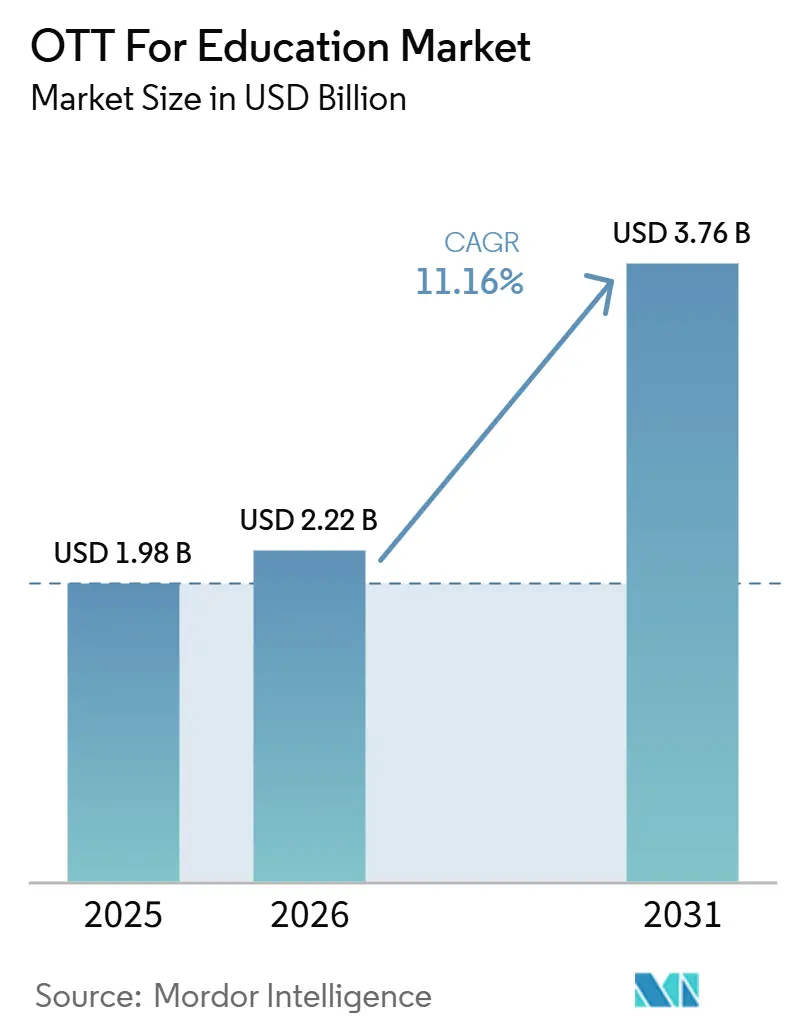
The OTT for education market size is projected to expand from USD 1.98 billion in 2025 and USD 2.22 billion in 2026 to USD 3.76 billion by 2031, registering a CAGR of 11.16% between 2026 to 2031. The OTT for education market is moving beyond its earlier role as a supplementary classroom tool and is becoming part of core content delivery across academic and enterprise learning settings. The long effect of the remote learning shift from 2020 to 2022 still shapes buying decisions, because institutions now treat streaming infrastructure as a durable requirement instead of a temporary fix. The pace of skill change is also reinforcing demand, since employers are under pressure to retrain workers quickly and at scale through flexible video-led formats. Competitive behavior is also shifting, with dedicated education video vendors, collaboration platform providers, and white-label OTT builders all trying to secure longer contracts by offering stronger integration, analytics, and content production features. The clearest opportunity now sits with platforms that can connect engagement data to measurable learning outcomes, because buyers are placing greater weight on return-on-investment evidence when renewing or expanding deployments.
Key Report Takeaways
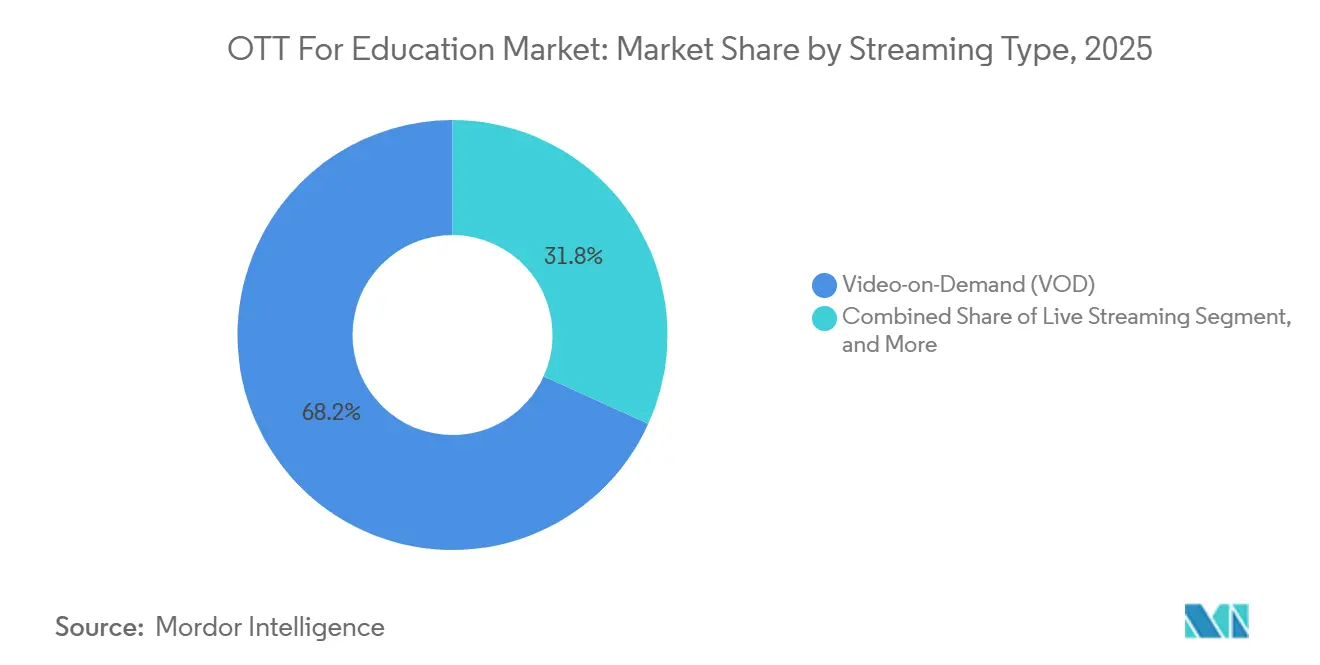
- By streaming type, video on demand held 68.23% share in 2025, while live streaming is projected to expand at a 12.52% CAGR through 2031 in the OTT for Education Market.
- By device type, laptops and desktops accounted for 46.44% share in 2025, while smartphones and tablets are projected to grow at a 12.30% CAGR through 2031 in the OTT for Education Market.
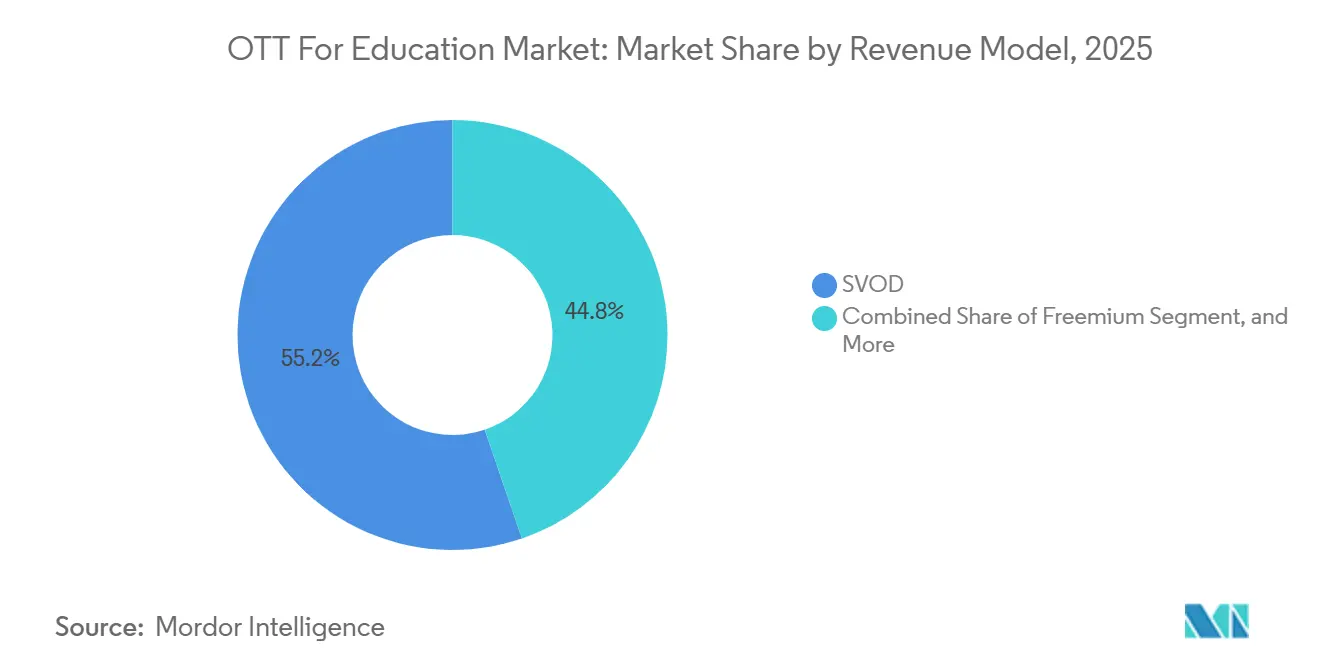
- By revenue model, SVOD captured 55.24% share in 2025, while hybrid revenue models are projected to advance at an 11.50% CAGR through 2031 in the OTT for Education Market.
- By geography, North America held 38.56% of the OTT for education market in 2025, while Asia-Pacific is projected to expand at an 11.80% CAGR through 2031 in the OTT for Education Market.
Note: Market size and forecast figures in this report are generated using Mordor Intelligence’s proprietary estimation framework, updated with the latest available data and insights as of January 2026.
Global OTT For Education Market Trends and Insights
Drivers Impact Analysis*
| Driver | (~) % Impact on CAGR Forecast | Geographic Relevance | Impact Timeline |
|---|---|---|---|
| Institutional Shift Toward Secure Branded Learning Portals | +2.4% | North America and Europe core, spill-over to Asia-Pacific | Medium term (2-4 years) |
| Rising Demand for Live, On-Demand, and Hybrid Delivery Workflows | +2.2% | Global | Short term (≤ 2 years) |
| Growth of Workforce Upskilling and Professional Certification Content | +2.1% | Global, with concentration in North America, Asia-Pacific, and Middle East | Medium term (2-4 years) |
| Expansion of LMS, SIS, and Identity Stack Integration Requirements | +1.6% | North America and Europe, early adoption in Asia-Pacific | Medium term (2-4 years) |
| Rising Need for Engagement Analytics and Learning Attribution | +1.4% | North America, Europe, and enterprise-heavy Asia-Pacific markets | Long term (≥ 4 years) |
| Increasing Content Localization and Multi-Language Delivery Expectations | +1.2% | Asia-Pacific, Middle East, Africa, South America | Long term (≥ 4 years) |
| Source: Mordor Intelligence | |||
Institutional Shift Toward Secure Branded Learning Portals
The OTT for education market is seeing institutions move away from generic video hosting and toward white-label portals with controlled access, institutional branding, and role-based permissions. Buyers now expect platforms to restrict content by learner cohort, limit concurrent sessions, and generate audit-ready access records without heavy customization. This shift is also tied to accreditation and review pressure, especially in North America, where institutions are being asked to show controlled access to video-based course material during program reviews. Kaltura stated in May 2026 that it launched Avatar Video Production Studio to help institutions create structured avatar-led course videos at scale, which pushes branded portals further into content production as well as delivery. In the OTT for education market, vendors that combine content creation, distribution, and access control in one environment are in a stronger position when institutions evaluate long-term contracts.
Rising Demand for Live, On-Demand, and Hybrid Delivery Workflows
The OTT for education market is being reshaped by the need to support live, on-demand, and hybrid learning inside one platform rather than across several disconnected tools. Faculty and trainers increasingly use a live class or session, followed by a replay with indexed chapters, embedded quizzes, and short AI-generated recap clips. That workflow requires stable encoding, CDN redundancy, and interactive playback, which raises the value of platforms built for more than one delivery mode. Brightcove announced in July 2025 that it added ultra-HD live streaming and a native recommendations engine, which showed how enterprise video vendors are trying to close the feature gap with consumer OTT experiences. In the OTT for education market, institutions are also paying closer attention to multi-CDN resilience, because a failure during a live assessment can create serious academic disruption. Platforms that cannot support low-latency, interactive live delivery face rising substitution risk from conferencing-led ecosystems, including Zoom, which introduced Zoom Video Management in 2026 as an LMS-aware video channel platform.
Growth of Workforce Upskilling and Professional Certification Content
The OTT for education market is gaining support from the steady expansion of workforce upskilling and professional certification programs. The World Economic Forum reported in 2025 that 63% of employers viewed skills gaps as the main barrier to business transformation, while 39% of core worker skills are expected to change by 2030.[1]World Economic Forum, “Future of Jobs Report 2025,” World Economic Forum, weforum.org The same report stated that 59 out of 100 workers globally will require reskilling or upskilling by 2030, which supports demand for scalable video-first learning systems that can deliver flexible training across large workforces. This is pushing enterprise buyers to spend more on video infrastructure that can host internal certification content, rather than relying only on third-party course licenses. Coursera completed its combination with Udemy in May 2026, creating a business with 290 million learners, 18,000 enterprise customers, and USD 1.5 billion in combined 2025 revenue, which raises competitive pressure for OTT deployments tied to enterprise skills programs. In the OTT for education market, platforms that can show skill outcomes instead of only completion rates are gaining an advantage in longer enterprise deals.
Expansion Of LMS, SIS, and Identity Stack Integration Requirements
The OTT for education market is no longer operating as a stand-alone streaming category, because institutions now expect it to fit directly into LMS, SIS, and single sign-on environments. Interoperability has become a contract condition rather than an optional feature, especially as learning workflows span course delivery, student records, and identity management. The 1EdTech LTI 1.3 standard has become a strong filter for institutional participation, and tools without compliance are increasingly excluded from RFPs that name the standard.[2]1EdTech, “Learning Tools Interoperability,” 1EdTech, 1edtech.org The same integration pressure is also reaching enterprise learning systems, where Panopto released version 17.0 in June 2026 with native Workday Learning integration to place video learning content directly inside the HR learning catalog. In the OTT for education market, compliance rules such as FERPA and GDPR are also shaping architecture choices because buyer concern now extends beyond usability and into data handling, data residency, and agreement structure.
Restraints Impact Analysis*
| Restraint | (~) % Impact on CAGR Forecast | Geographic Relevance | Impact Timeline |
|---|---|---|---|
| Institutional Procurement Friction and Slow Budget Cycles | -1.2% | North America and Europe (K-12 and higher education) | Short term (≤ 2 years) |
| Content Security, DRM, and Rights-Management Complexity | -0.9% | Global, more acute in higher education and premium certification markets | Medium term (2-4 years) |
| Fragmented Technology Stacks and Interoperability Gaps | -0.7% | Global | Medium term (2-4 years) |
| Faculty and Administrator Adoption Resistance | -0.5% | North America and Europe | Long term (≥ 4 years) |
| Source: Mordor Intelligence | |||
Institutional Procurement Friction and Slow Budget Cycles
The OTT for education market still faces slow adoption in the institutional channel because approvals often run through several stakeholders, fixed budget calendars, and cautious renewal processes. EDUCAUSE reported in April 2025 that 42% of higher education technology leaders expected IT budget decreases for the 2025-2026 academic year, with a median expected cut of 8%.[3]EDUCAUSE, “QuickPoll Results, Technology Budgets and Staffing,” EDUCAUSE Review, er.educause.edu The end of earlier stimulus-linked education spending has also returned many K-12 districts and higher education buyers to stricter base-budget reviews. This has made institutions more hesitant about platform migration, because change now carries both licensing cost and operational disruption. Virginia Tech announced in December 2025 that its shift from Kaltura to Panopto would run across two academic semesters in 2026, which highlights how migration testing, content transfer, and LMS reintegration can extend the decision cycle. In the OTT for education market, vendors that reduce switching pain through phased migration, flexible pricing, and transition support are better placed to win cautious accounts.
Content Security, DRM, and Rights-Management Complexity
The OTT for education market also faces restraint from the complexity of content security, rights management, and DRM enforcement across different device and licensing environments. Premium certifications, licensed course libraries, and compliance-heavy training programs often require support for Widevine, FairPlay, and PlayReady, which raises development and operating costs for smaller providers. Complexity rises further when institutions host a mix of internally produced content and licensed publisher material with separate playback limits, rights terms, and geographic restrictions. BuyDRM's 2024 work with Udemy, covering protection for more than 210,000 courses, showed that even large-scale e-learning platforms need substantial DRM infrastructure to balance access and rights-holder protection. In the OTT for education market, security gaps can create real liability concerns for medical, legal, and financial training programs where a breach can trigger formal review and remediation. Vendors that offer pre-integrated DRM services within the platform stack have a clearer advantage in premium and regulated learning environments.
*Our forecasts treat driver/restraint impacts as directional, not additive. The impact forecasts reflect baseline growth, mix effects, and variable interactions.
Segment Analysis
By Streaming Type: Live Streaming Gains Ground on On-Demand Dominance
Live streaming is the fastest-growing format in the OTT for education market, with a forecast CAGR of 12.52% through 2031. Video on demand still led with 68.23% of OTT for education market share in 2025, which shows that flexible, self-paced viewing remains the default mode for many academic and corporate users. This mix reflects a clear pattern, because buyers are not replacing on-demand delivery, they are adding live capability to support more interactive use cases. The OTT for education industry is responding with more real-time polls, breakout session tools, Q and A controls, and instructor-facing audience analytics that make live sessions more structured than standard web conferencing.
That shift is also lowering the gap between lecture capture, event streaming, and course delivery. Echo360 and Epiphan Video announced a partnership in March 2026 to expand hardware compatibility for lecture capture and live streaming in higher education, which helps institutions deploy live workflows at a lower infrastructure threshold. Hybrid streaming remains important in certification and compliance settings where providers may need documented proof of real-time learner participation. Video on demand continues to hold the advantage for global cohorts spread across time zones, because it allows reuse and flexible pacing without scheduling friction. In the OTT for education market, live delivery is increasingly the preferred tool for community building and high-touch assessment, while on-demand delivery remains the base format for scale.



By Device Type: Desktop Workflows Anchor Institutional Delivery
Laptops and desktops held 46.44% share by device type in 2025, which kept them as the leading access point in the OTT for education market. That position reflects the continued strength of structured coursework and scheduled employee training, where users access material through managed devices during planned sessions. The browser-based design of many LMS-embedded video environments also favors desktop use, especially for tasks such as annotation, quiz completion, and graded interaction. Even so, smartphones and tablets are the fastest-growing device segment, with OTT for education market size for this segment forecast to expand at a 12.30% CAGR through 2031.
This contrast shows a category in transition rather than replacement. Smart TVs are becoming more visible in residential and hospitality-linked learning settings where workforce training providers are testing living-room access for shift-based learners. Other devices, including streaming sticks and gaming consoles, continue to serve smaller groups in unconventional or underserved learning settings. The OTT for education industry is therefore being shaped by a dual requirement, because platforms must still perform well in desktop-centered institutional workflows while also serving mobile-first usage in Asia-Pacific and Africa. In the OTT for education market, responsive player design and offline download capability are now standard buying requirements as institutions prepare for a broader device mix.
By Revenue Model: Subscription Economics Define the Institutional Layer
SVOD held 55.24% share by revenue model in 2025, which made it the leading monetization structure in the OTT for education market. That share reflects the preference of universities and enterprises for predictable subscription terms tied to defined learner groups and recurring access to content libraries. Hybrid models are the fastest-growing revenue model, with a forecast CAGR of 11.50% through 2031, and this points to a gradual expansion of paid access beyond internal users. OTT for education market size for hybrid revenue models is rising as institutions start to sell selected content to alumni, continuing education learners, and external professional groups.
This shift shows that some buyers are using OTT infrastructure not only as a learning utility but also as a controlled commercial channel. AVOD is gaining relevance in budget-constrained K-12 and early-career settings where free access can still be supported through institutional or brand advertising. TVOD keeps a narrower but durable role in premium certification areas such as legal, medical, and financial preparation where learners accept one-time pricing for high-value content. Freemium models remain most useful as acquisition funnels for upskilling platforms that target individual professionals. BSI and Coursera announced a global partnership in May 2026 to deliver modular training in AI, health and safety, and business skills, which fits the broader move toward modular subscription and hybrid enterprise learning access.
Geography Analysis
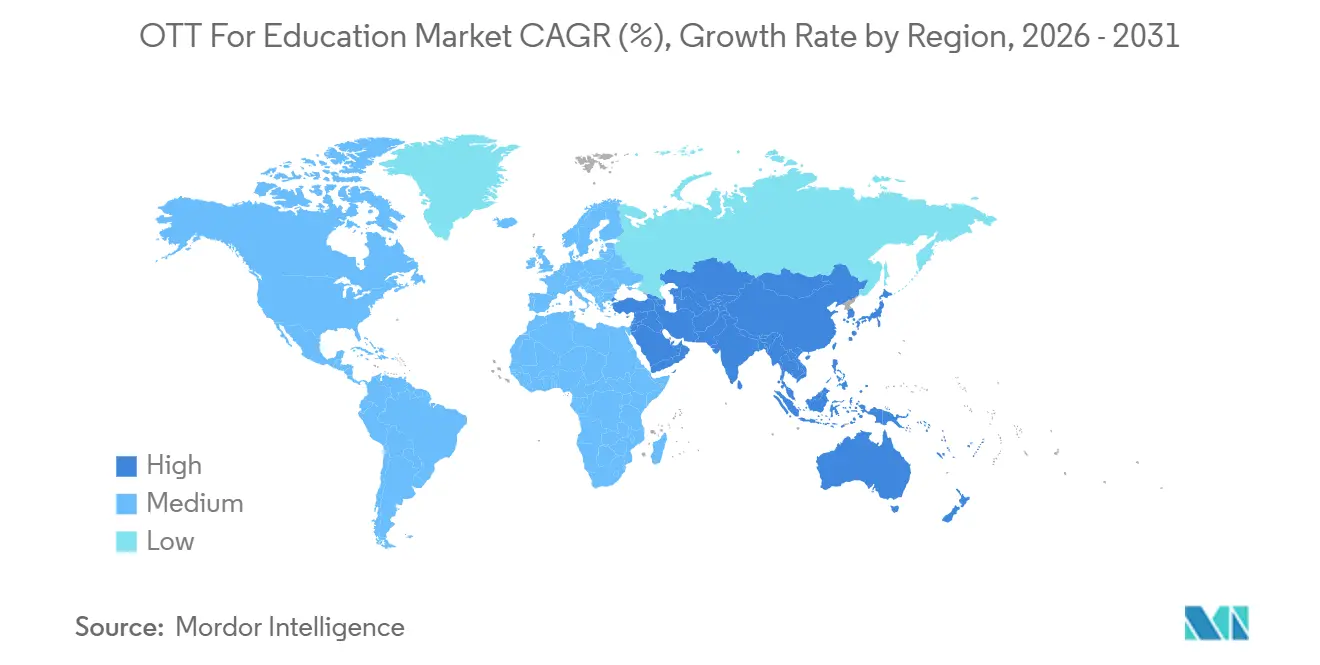
North America held 38.56% of OTT for education market share in 2025, which kept it as the largest regional base for the OTT for education market. That position is supported by dense higher education infrastructure, comparatively strong institutional IT budgets, and a mature vendor ecosystem centered in the United States. The region also benefits from recurring enterprise demand tied to compliance training, professional certification, and leadership development, which reduces reliance on academic enrollment cycles alone. Canada adds support through bilingual content needs and provincial workforce digitization programs. Mexico is also becoming more relevant in the OTT for education market as broadband access improves and a young working-age population increases demand for digital upskilling.
Asia-Pacific is the fastest-growing regional segment in the OTT for education market, with a forecast CAGR of 11.80% through 2031. Government-backed digital education programs in China and India, expanding mobile broadband access, and a large working-age population entering formal skilling programs are all supporting that pace. India’s tier-2 and tier-3 cities stand out because regional-language content and affordable mobile data are helping bring first-generation online learners onto cloud-hosted platforms. Japan and South Korea are showing strong demand for professional certification content, especially in technology-related enterprise learning tied to AI and cloud skills. Europe is also maintaining steady growth in the OTT for education market, led by Germany, the United Kingdom, and France, where corporate training rules, workforce digitization activity, and university investment in video lecture libraries continue to support demand. GDPR compliance remains a practical buying factor across the European Union, because data hosting and learner record management now influence vendor selection as much as feature breadth.
Middle East, Africa, and South America remain smaller today within the OTT for education market, but they represent high-potential expansion zones with very different operating conditions. In the Middle East, Saudi Arabia and the UAE are leading deployment activity as national digital skills agendas and higher education modernization programs create demand for OTT-delivered professional training. In Africa, South Africa and Egypt are the main sub-markets, supported by private higher education growth and digital literacy initiatives, while the South African Broadcasting Corporation’s use of Microsoft AI training content on SABC Plus shows how broadcaster infrastructure can also support workforce learning delivery. Brazil leads South America in the OTT for education market through its scale, corporate training base, and federal education technology investment. Argentina and the rest of South America are earlier in adoption but are gaining support from better mobile broadband access and growing interest in vocational certification platforms aimed at Spanish-speaking learners. Across all three regions, adaptive bitrate streaming and offline download remain essential because bandwidth quality outside major urban centers is still uneven.

Competitive Landscape
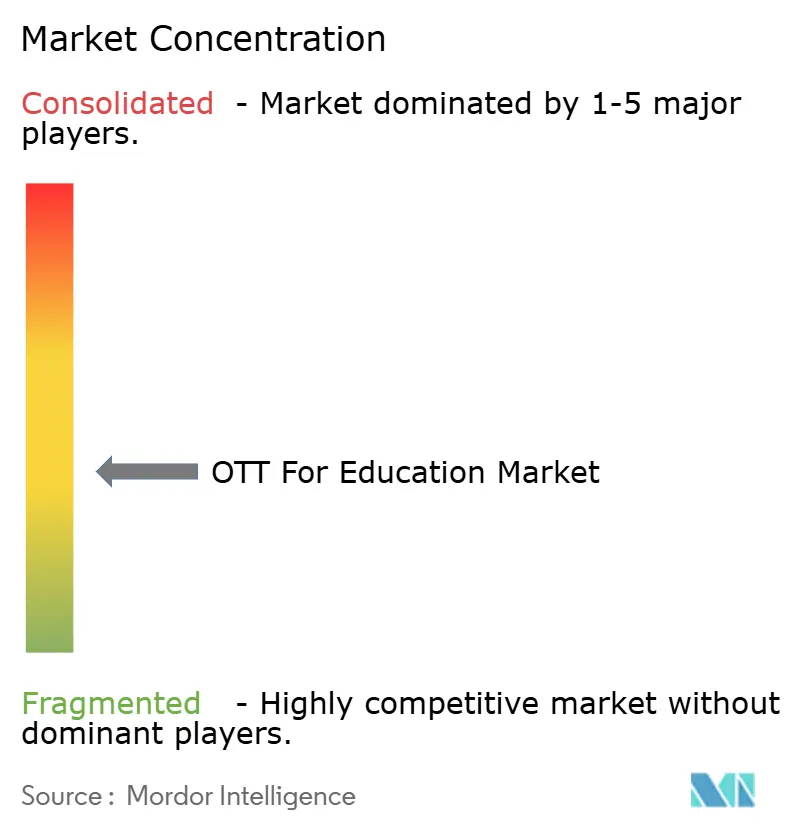
The OTT for education market is moderately fragmented, and no single company controls demand across academic institutions, corporate learning teams, and public-sector training environments. Purpose-built vendors such as Kaltura, Panopto, and Echo360 compete on LMS depth, lecture capture, and instructional analytics. General-purpose platforms such as Microsoft, Zoom, and Google compete by extending video capabilities through broader collaboration and productivity ecosystems that are already familiar to many institutions. Mid-tier providers such as Brightcove, VPlayed, Dacast, and Muvi are using white-label customization as a practical way to serve content owners that want branded delivery without building a system from scratch. In the OTT for education market, this mix creates strong rivalry because buyers can choose between specialized depth and wider ecosystem convenience.
Strategic moves in 2026 show how vendors are trying to secure a stronger place inside adjacent software environments. Kaltura announced a partnership with Cornerstone in March 2026 to bring AI-powered video learning into Cornerstone Galaxy, which linked OTT delivery more closely to enterprise talent and workforce systems. Panopto and Carahsoft announced in January 2026 that Panopto’s platform would be available to U.S. federal, state, and local government and education buyers through established procurement vehicles, which opened a new channel beyond private higher education. Coursera’s combination with Udemy in May 2026 also changed the demand side of the OTT for education market by creating a much larger skills platform with greater learner scale and stronger enterprise purchasing leverage. These moves matter because they raise the pressure on mid-tier vendors that rely on contract renewals in enterprise and institutional accounts.
AI-led content production and engagement analytics are becoming the most important feature battlegrounds in the OTT for education market. Avatar video generation, automated dubbing, AI-indexed chapters, and dropout prediction are moving from roadmap ideas into active product offers. Brightcove’s 2025 product direction around AI-generated metadata, intelligent clipping, and multi-language support showed that enterprise video platforms are building more proprietary intelligence into the video layer rather than treating it as a passive storage function. Research published in 2026 also noted that stronger links between video engagement data and measurable academic outcomes remain underdeveloped, which leaves room for the next wave of platform differentiation. In the OTT for education market, the clearest white-space areas remain government education, correctional education, and healthcare training, where access controls, offline playback needs, and compliance audits have historically limited the fit of general-purpose platforms.
OTT For Education Industry Leaders
Kaltura, Inc.
Panopto, Inc.
Brightcove Inc.
Echo360, Inc.
Vimeo, Inc.
- *Disclaimer: Major Players sorted in no particular order

Recent Industry Developments
- May 2026: Coursera completed its combination with Udemy on May 11, 2026, following stockholder approval on April 9, 2026. The combined entity serves 290 million learners and 18,000 enterprise customers, reported over USD 1.5 billion in combined 2025 revenue, and anticipates USD 115 million in annual cost synergies within 24 months, creating the world's largest skills platform for the AI era.
- May 2026: Kaltura launched the general availability of its Avatar Video Production Studio, enabling education and enterprise teams to transform institutional knowledge, lectures, training sessions, and webinar recordings, into structured, topic-specific avatar-led video modules that can be distributed at scale and extended into real-time interactive sessions.
- May 2026: BSI and Coursera announced a global training partnership to deliver modular professional development courses in AI, health and safety, and business skills to organizations worldwide, with the World Economic Forum projecting that nearly 40% of employee skill sets will require transformation by 2030 as context for the initiative.
- April 2026: Instructure announced an exclusive strategic partnership with K16 Solutions to streamline migrations of institutions from legacy LMS platforms to Canvas, a capability aimed directly at accelerating revenue from the growing number of higher education institutions seeking to modernize their digital learning infrastructure.


Global OTT For Education Market Report Scope
The Global OTT for Education Market refers to the worldwide industry focused on the delivery, distribution, and consumption of educational content through over-the-top (OTT) internet-based platforms that provide direct access to learning materials without relying on traditional broadcast or cable networks. The market includes video-based courses, lectures, tutorials, live classes, training programs, instructional series, and educational media offered through subscription-based, advertising-supported, transactional, or hybrid models to learners, educational institutions, corporations, and professional users. Content is accessed across smartphones, tablets, computers, smart TVs, and other connected devices, with revenue generated through subscriptions, pay-per-course offerings, advertising, licensing, and enterprise learning solutions.
The OTT for Education Market Report is Segmented by Streaming Type (Live Streaming, Video-on-Demand (VOD), and Hybrid Streaming (Live + VOD)), Device Type (Smartphones and Tablets, Smart TVs, Laptops and Desktops, and Other Device Types), Revenue Model (SVOD, AVOD, TVOD, Hybrid, and Freemium), and Geography (North America, Europe, Asia-Pacific, Middle East, Africa, and South America). The Market Forecasts are Provided in Terms of Value (USD).
| Live Streaming |
| Video-on-Demand (VOD) |
| Hybrid Streaming (Live + VOD) |
| Smartphones and Tablets |
| Smart TVs |
| Laptops and Desktops |
| Other Device Types |
| SVOD |
| AVOD |
| TVOD |
| Hybrid |
| Freemium |
| North America | United States |
| Canada | |
| Mexico | |
| Europe | United Kingdom |
| Germany | |
| France | |
| Spain | |
| Italy | |
| Rest of Europe | |
| Asia-Pacific | China |
| Japan | |
| India | |
| South Korea | |
| Australia | |
| Rest of Asia-Pacific | |
| Middle East | Saudi Arabia |
| United Arab Emirates | |
| Turkey | |
| Rest of Middle East | |
| Africa | South Africa |
| Egypt | |
| Rest of Africa | |
| South America | Brazil |
| Argentina | |
| Rest of South America |
| By Streaming Type | Live Streaming | |
| Video-on-Demand (VOD) | ||
| Hybrid Streaming (Live + VOD) | ||
| By Device Type | Smartphones and Tablets | |
| Smart TVs | ||
| Laptops and Desktops | ||
| Other Device Types | ||
| By Revenue Model | SVOD | |
| AVOD | ||
| TVOD | ||
| Hybrid | ||
| Freemium | ||
| By Geography | North America | United States |
| Canada | ||
| Mexico | ||
| Europe | United Kingdom | |
| Germany | ||
| France | ||
| Spain | ||
| Italy | ||
| Rest of Europe | ||
| Asia-Pacific | China | |
| Japan | ||
| India | ||
| South Korea | ||
| Australia | ||
| Rest of Asia-Pacific | ||
| Middle East | Saudi Arabia | |
| United Arab Emirates | ||
| Turkey | ||
| Rest of Middle East | ||
| Africa | South Africa | |
| Egypt | ||
| Rest of Africa | ||
| South America | Brazil | |
| Argentina | ||
| Rest of South America | ||


Key Questions Answered in the Report
What is the current and forecast value of the OTT for education space?
The OTT for education market size is projected to expand from USD 1.98 billion in 2025 and USD 2.22 billion in 2026 to USD 3.76 billion by 2031, at an 11.16% CAGR over 2026-2031.
Which streaming format leads demand in education-focused OTT platforms?
Video on demand led with 68.23% share in 2025 because institutions and enterprises still value flexible, reusable content that fits different schedules and time zones.
Which device category is growing fastest for education streaming use cases?
Smartphones and tablets are the fastest-growing device segment, with a 12.30% CAGR through 2031, supported by mobile-first learners and short-form credential content.
Why are institutions shifting toward branded learning portals?
Institutions want stronger access control, audit logs, learner segmentation, and institutional branding, which makes secure white-label portals more attractive than generic video hosting.
Which region is expanding fastest through 2031?
Asia-Pacific is the fastest-growing regional segment at an 11.80% CAGR, supported by digital education investment, lower data costs, and a large upskilling population.
What is shaping competition among leading platform providers?
Competition is centered on LMS integration, live and hybrid delivery quality, AI-led content production, and the ability to connect learner engagement with measurable outcomes.
Page last updated on:





