
OTT For Corporate Communications Market Size and Share
Market Overview
| Study Period | 2020 - 2031 |
|---|---|
| Market Size (2026) | USD 3.23 Billion |
| Market Size (2031) | USD 5.59 Billion |
| Growth Rate (2026 - 2031) | 11.59 % |
| Fastest Growing Market | Asia-Pacific |
| Largest Market | North America |
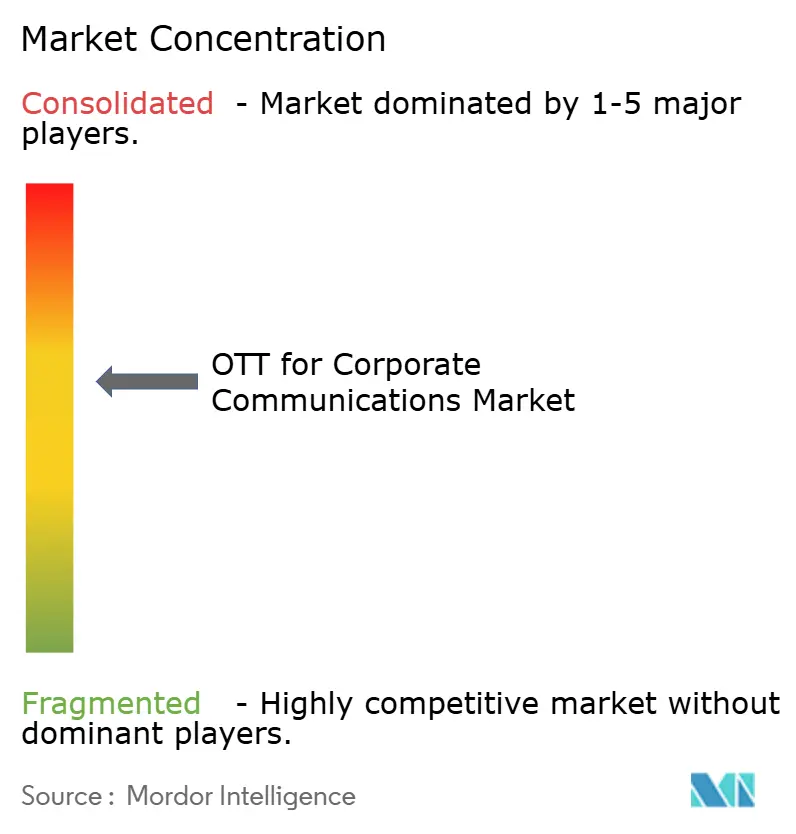
| Market Concentration | Medium |
Major Players *Disclaimer: Major Players sorted in no particular order Image © Mordor Intelligence. Reuse requires attribution under CC BY 4.0. | |
OTT For Corporate Communications Market Analysis by Mordor Intelligence
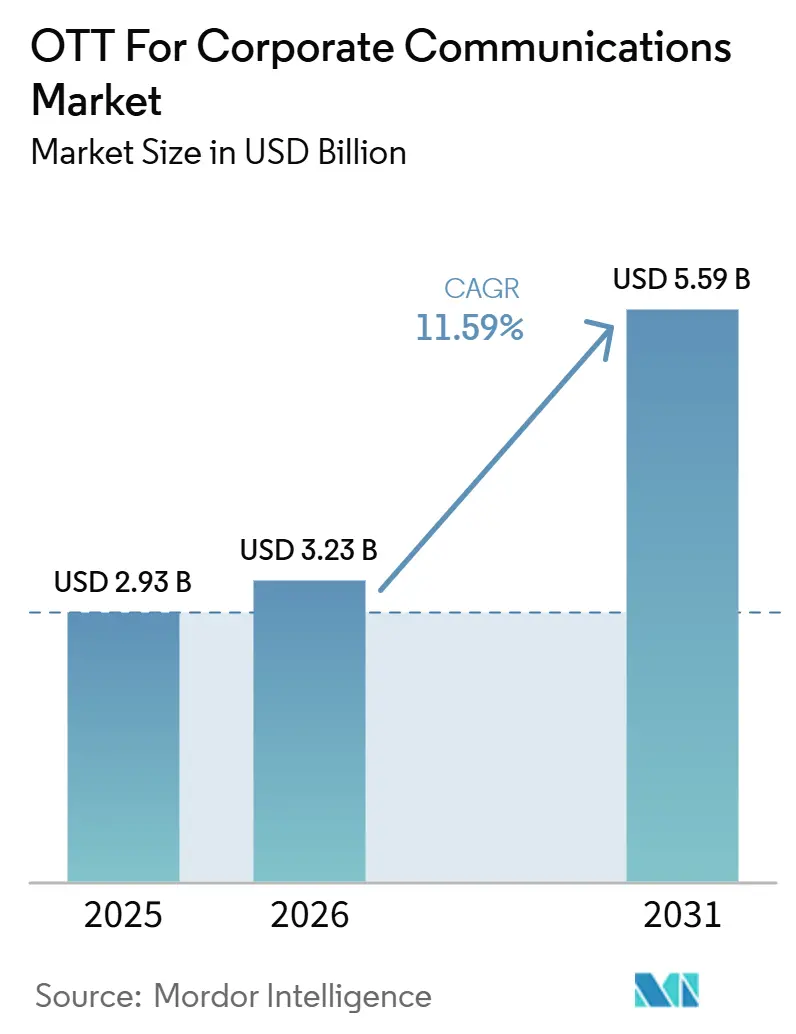
The OTT for corporate communications market size is projected to expand from USD 2.93 billion in 2025 and USD 3.23 billion in 2026 to USD 5.59 billion by 2031, registering a CAGR of 11.59% between 2026 and 2031. The market has moved well beyond its consumer streaming roots, as enterprises now use broadcast-grade video systems for town halls, regulatory updates, onboarding, and knowledge distribution at a much larger scale. Hybrid work has made dependable live and on-demand video a routine business need, especially when employees work across time zones and devices. AI features in enterprise video platforms are also accelerating adoption by reducing production time and making stored content easier to search, summarize, and reuse. Security, auditability, and compliance are raising the value of purpose-built platforms, especially in regulated environments where generic conferencing tools do not fully meet operational requirements. Competition is strengthening as large, unified communications vendors extend their platforms while specialist providers focus on content governance, analytics, and flexible deployment models.
Key Report Takeaways
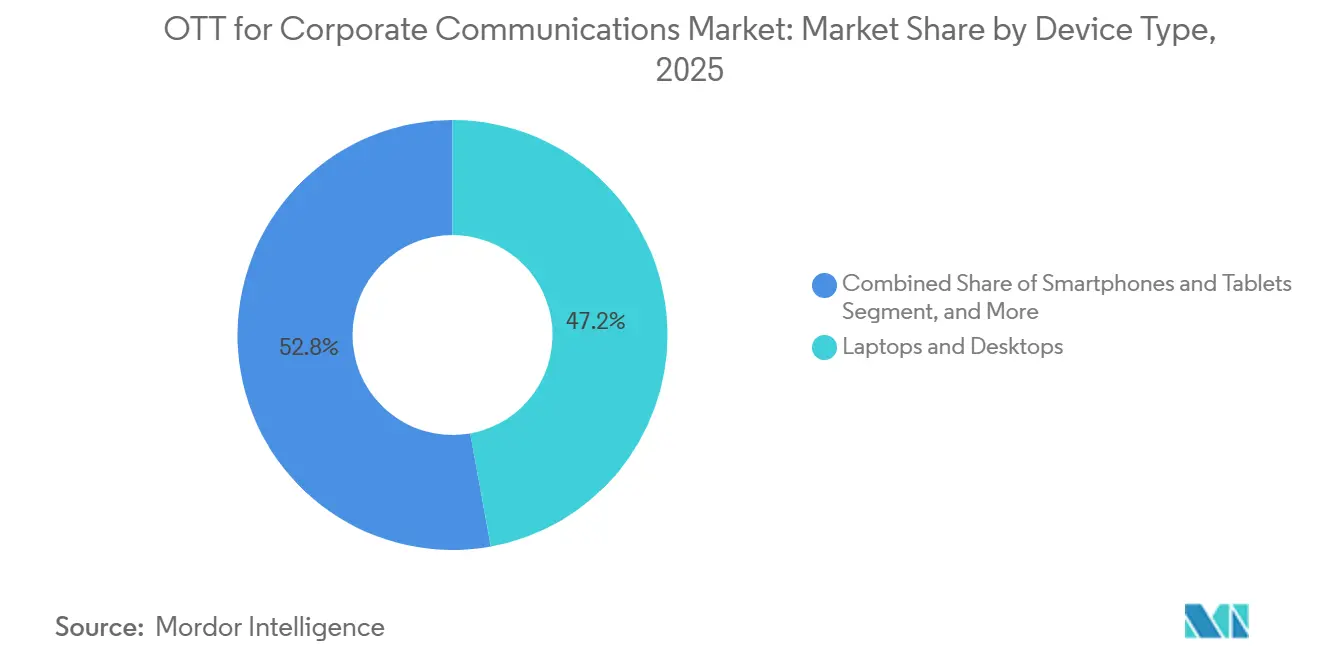
- By device type, laptops and desktops accounted for 47.16% of the OTT for corporate communications market in 2025, while smart TVs are projected to expand at a 12.57% CAGR through 2031.
- By content type, on-demand video accounted for 66.59% share in 2025, while live streaming is projected to grow at a 12.36% CAGR through 2031.
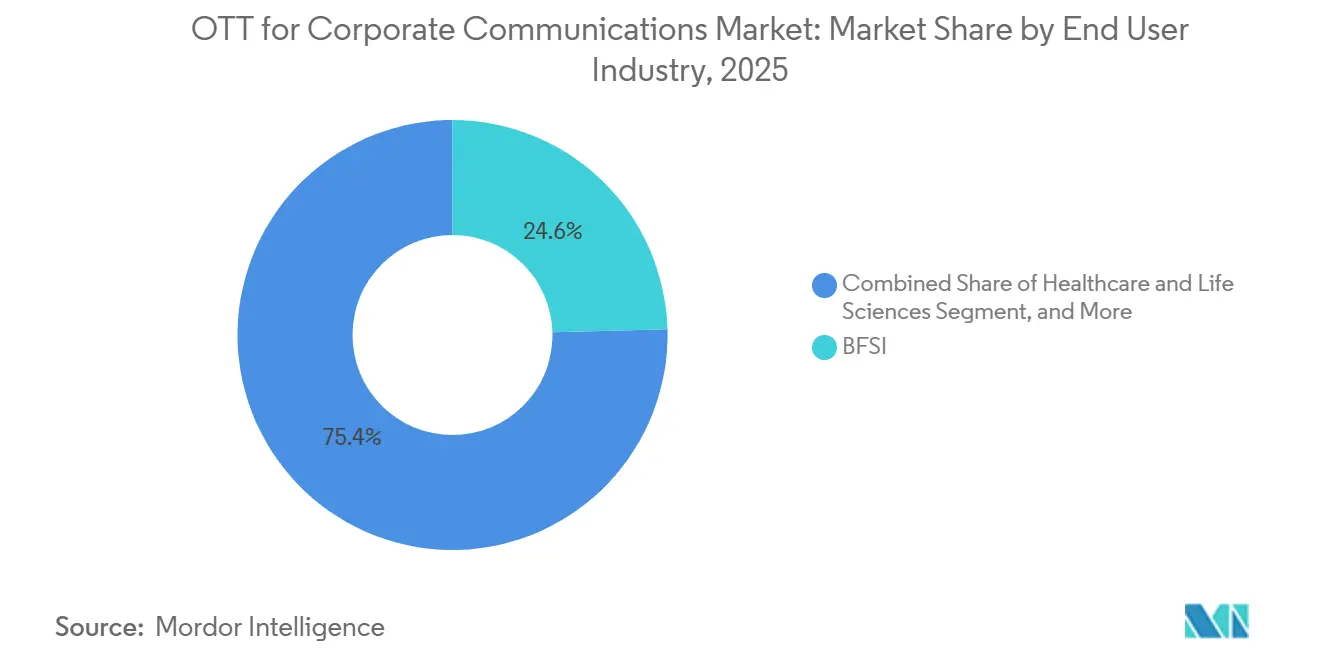
- By end user industry, BFSI accounted for 24.58% of the OTT for corporate communications market in 2025, while information technology and telecommunications are projected to grow at a 12.13% CAGR through 2031.
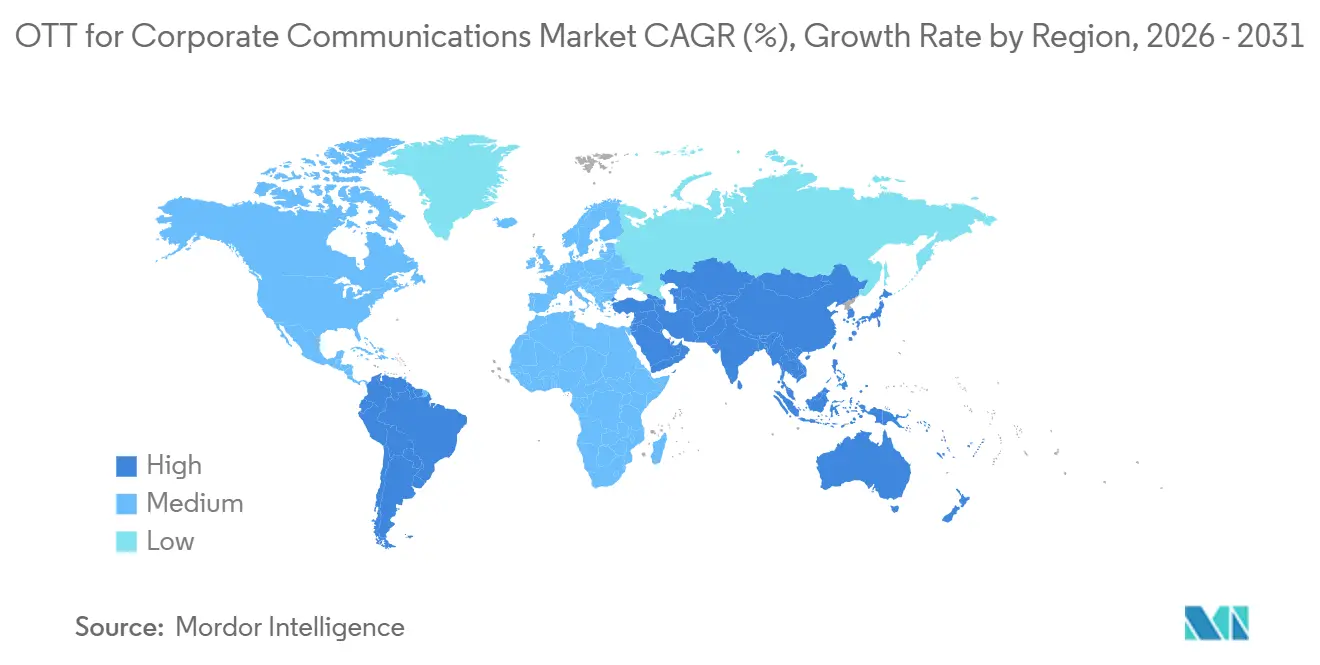
- By geography, North America held 38.14% share in 2025, while Asia-Pacific is projected to expand at a 12.08% CAGR through 2031.
Note: Market size and forecast figures in this report are generated using Mordor Intelligence’s proprietary estimation framework, updated with the latest available data and insights as of January 2026.
Market Trends and Insights
Drivers Impact Analysis of OTT For Corporate Communications Market*
| Driver | (~) % Impact on CAGR Forecast | Geographic Relevance | Impact Timeline |
|---|---|---|---|
| Rising Demand for Secure Internal and External Video Communications | +3.5% | Global, concentrated in North America and Europe | Short term (≤ 2 years) |
| Growth of Hybrid and Distributed Workforce Communication Needs | +2.8% | Global, particularly the United States, the United Kingdom, India, and Australia | Short term (≤ 2 years) |
| AI-Enabled Video Search, Transcription, and Summarization | +2.1% | North America and APAC tech hubs, with spillover to Europe | Medium term (2-4 years) |
| Expansion of Branded Corporate Video Portals and Apps | +1.6% | North America and Europe, with spillover to APAC | Medium term (2-4 years) |
| Content Governance, Archiving, and Compliance Requirements | +1.0% | North America, the European Union, and Australia | Short term (≤ 2 years) |
| Shift Toward Measurable Communications Analytics | +0.7% | North America and Western Europe | Long term (≥ 4 years) |
| Source: Mordor Intelligence | |||
Rising Demand for Secure Internal and External Video Communications
Security has become a core buying factor in the OTT for corporate communications market, as regulated enterprises now expect video systems to meet the same standards as other controlled business records. Financial firms covered by MiFID II must record relevant electronic communications, retain them for at least 5 years, and keep them searchable and accessible for regulators.[1]Digital Samba, “MiFID II Video Recording: Financial Compliance Guide 2026,” Digital Samba, digitalsamba.com The same compliance logic is expanding the addressable base for the OTT corporate communications market, as healthcare, legal, and professional services teams also need stronger access controls, audit logs, and defined retention rules. Digital Samba states that compliant deployments require encryption at rest and in transit, role-based access control, audit logging, and archival integration, thereby enhancing the value of specialized enterprise platforms. This is also pushing the OTT for corporate communications market toward private cloud, sovereign hosting, and on-premises options, as many enterprises do not want all sensitive internal video traffic to reside in a standard multi-tenant setup.
Growth of Hybrid and Distributed Workforce Communication Needs
Hybrid work remains a structural demand driver for the OTT corporate communications market, as remote-capable employees continue to work across a mix of office and remote work patterns. Gallup reported that 53% of remote-capable U.S. employees worked in hybrid arrangements in 2026, which underscores the importance of asynchronous internal video for communication across time zones and schedules. The OTT for corporate communications market benefits from this pattern because live attendance is no longer the only expectation for all-hands meetings, onboarding, and executive updates. Microsoft also shows that AI adoption at work is tied closely to system integration and manager support, which means video tools now need to fit naturally into daily workflows rather than stand apart as isolated channels. As a result, enterprises are spending more on persistent video hubs that support both live events and replay access, which gives the OTT for corporate communications market a steadier usage pattern than one-time event software.
AI-Enabled Video Search, Transcription, and Summarization
AI functions are changing the OTT for corporate communications market because enterprises now expect video content to be searchable, reusable, and easier to produce at scale. HeyGen reported that 77% of organizations already use AI video in some capacity, with 50% using it regularly or extensively, indicating that video is moving closer to everyday operational use. The OTT for corporate communications market is benefiting from this shift, as search, transcription, review, and summarization reduce the friction of managing large internal video libraries. HeyGen also found that 72% of organizations can produce a finished video within 3 days, and 59% are likely or very likely to increase AI video investment in 2026. This favors OTT platforms in the corporate communications market that combine creation, governance, and retrieval features within a single workflow, rather than treating video delivery as a stand-alone utility.
Expansion of Branded Corporate Video Portals and Apps
Enterprises are building branded portals because the OTT market for corporate communications is no longer centered on one-off meeting tools. HeyGen found that 67% of organizations said distributed teams can only sometimes, rarely, or never produce on-brand video without central support, underscoring the importance of templates, approvals, and shared asset control. This need is widening the scope of the OTT for the corporate communications market from internal streaming to managed content environments that resemble consumer media libraries but operate under enterprise rules. Workvivo launched Workvivo HQ in June 2026 with AI-generated summaries, personalized updates, and connections to more than 60 enterprise systems, demonstrating how vendors are linking video, knowledge, and action into a single employee-facing layer. As this model spreads, the OTT for the corporate communications market is likely to favor vendors that support branded experiences across desktop and mobile rather than simple event pages alone.
Restraints Impact Analysis of OTT For Corporate Communications Market*
| Restraint | (~) % Impact on CAGR Forecast | Geographic Relevance | Impact Timeline |
|---|---|---|---|
| Integration Complexity with Legacy Enterprise Systems | -1.5% | Global, most acute in North America and APAC enterprise accounts | Medium term (2-4 years) |
| Data Privacy, Security, And Access Control Challenges | -1.2% | European Union under GDPR, North America under NYDFS and GLBA, and APAC under national data sovereignty rules | Short term (≤ 2 years) |
| High Cost of Managed Streaming and Broadcast-Grade Workflows | -0.8% | Global, most constraining in South America and Africa | Long term (≥ 4 years) |
| User Adoption Friction Across Multiple Communication Channels | -0.5% | Global, particularly in fragmented enterprise environments | Medium term (2-4 years) |
| Source: Mordor Intelligence | |||
Integration Complexity with Legacy Enterprise Systems
Integration work remains a major brake on the OTT for corporate communications market because video platforms need to connect with identity systems, HR tools, learning systems, and archiving environments. Microsoft shows that successful AI adoption depends heavily on how well tools integrate with existing systems, reinforcing the need for deep workflow integration rather than isolated deployment. This slows the OTT for the corporate communications market when enterprises lack the technical resources to link SSO, compliance archives, and employee directories into a single experience. It is a sharper issue for mid-sized companies because they often want enterprise-grade capabilities but lack the same internal integration teams as large global buyers. Vendors can reduce some of this friction with prebuilt connectors, but the OTT for corporate communications market still faces slower rollouts wherever legacy environments remain heavily customized.
Data Privacy, Security, and Access Control Challenges
Privacy and access control remain a direct restraint on the OTT for corporate communications market, as multinational deployments must comply with different legal and retention rules across regions. Digital Samba notes that a compliant enterprise video infrastructure needs audit logging, role-based access, archival integration, and clear data residency controls, which adds cost and operational overhead to global rollouts. The OTT for corporate communications market is affected because purchasing decisions often move beyond IT and into legal, compliance, and risk teams when internal video is treated as a formal record. Digital Samba also points out that firms cannot simply rely on participant devices and must maintain controlled recording infrastructure, which lengthens sales cycles and narrows the pool of vendors that can qualify. This means the OTT for corporate communications market may grow more slowly in accounts that need cross-border governance but do not yet have a clear operating model for secure enterprise video.
*Our forecasts treat driver/restraint impacts as directional, not additive. The impact forecasts reflect baseline growth, mix effects, and variable interactions.
OTT For Corporate Communications Market Segment Analysis
By Device Type:
Smart TV Adoption Is Expanding Enterprise Viewing SurfacesLaptops and desktops accounted for 47.16% of OTT for corporate communications market in 2025, indicating that managed workstations remained the primary access point for enterprise video. In the OTT for corporate communications market, these devices still suit on-demand training, replay viewing, policy updates, and routine internal communications because they fit established office workflows. Smartphones and tablets formed the second access tier, especially for frontline teams in manufacturing, logistics, and retail that do not rely on assigned desktop setups. This keeps the OTT for corporate communications market relevant outside desk-based roles, even when viewing sessions are shorter and more task-driven.
Smart TVs are projected to grow at a 12.57% CAGR from 2026 to 2031, and the OTT for corporate communications market for this device segment is growing as enterprises extend video to conference rooms, executive briefing spaces, and shared employee areas. The shift matters because smart TVs enable companies to distribute leadership messages and corporate news to groups without requiring individual logins at every moment. In the OTT for corporate communications market, this also supports a broader move from personal viewing to shared-screen communication in operational settings. Vendors that optimize app delivery, device management, and playback consistency across multiple screen types are likely to strengthen their position as enterprise viewing habits become more mixed.



By Content Type:
On-Demand Video Leads While Live Streaming Gains SpeedOn-demand video accounted for 66.59% of the OTT for corporate communications market in 2025, reflecting the steady preference for content employees can watch when schedules allow. In the OTT for corporate communications market, this format works well for onboarding, leadership updates, policy training, and product education because it reduces the need to gather all employees at once. Large video libraries built over the past few years have made replay access a standard expectation rather than an extra feature. The same pattern has made the OTT market for corporate communications more durable, as each new video asset adds longer-term value after the live event ends.
Live streaming is projected to grow at a 12.36% CAGR through 2031, and the OTT corporate communications market for this format is growing as companies shift important internal events to broadcast-style delivery. HeyGen found that 84% of organizations considered pre-publication review essential, while 37% still published video without formal review at least sometimes, which shows why companies want better live-to-library governance.[2]HeyGen, “The State of Enterprise Video in 2026,” HeyGen, heygen.com In the OTT for corporate communications market, vendors are being pushed to link live events with fast editing, review, approval, and replay publishing in a single process. The result is a stronger bridge between real-time communication and long-term knowledge storage, which makes live video more valuable after the event itself has ended.
By End User Industry:
Regulated Buyers Lead Revenue While Technology Teams Grow FastBFSI held a 24.58% share in 2025, and that leadership reflects the stringent recordkeeping, retention, and audit requirements tied to financial communications. Digital Samba notes that regulated financial video environments require controlled recording, searchable retention, access logs, and secure archival workflows, which align closely with the demands of the OTT for corporate communications market. In the OTT for corporate communications market, healthcare and life sciences also remain important because staff education and the distribution of sensitive information require stronger governance than generic public video tools typically provide. This keeps revenue concentrated in sectors where video is tied directly to compliance, policy control, and enterprise risk management.
Information technology and telecommunications are projected to expand at a 12.13% CAGR through 2031, and the OTT for corporate communications market is poised to grow here because technology firms depend heavily on fast internal knowledge transfer across global teams. Microsoft continues to frame hybrid work and AI-enabled workflows as central workplace issues, which supports continued internal demand for searchable, reusable enterprise video content. In the OTT for corporate communications market, manufacturing, retail, and education also represent meaningful expansion paths because they can use video for workforce training, product updates, and internal learning at wider scale. As AI-assisted production lowers effort and turnaround time, smaller internal communication teams can produce more useful content without needing a full broadcast operation.
Geography Analysis
North America OTT for Corporate Communications Market
North America held 38.14% of the OTT for corporate communications market share in 2025, which made it the largest regional contributor. The region benefits from a dense base of large enterprises, broad hybrid work adoption, and stronger demand for formal governance around internal video. Gallup and Microsoft both point to persistent hybrid work and growing AI-enabled workflows, which help explain why enterprises in this region continue to invest in video systems that support both live and asynchronous communication. In the OTT for corporate communications market, the United States remains the main source of demand because financial services, healthcare, and technology buyers have both budget capacity and compliance pressure. The OTT for corporate communications market in Canada and Mexico is smaller, but it still benefits from cross-border enterprise operations and distributed team structures that require stable internal video delivery.
Europe OTT for Corporate Communications Market
Europe remained the second-largest region, and the OTT for corporate communications market there is shaped strongly by GDPR and video recording obligations in regulated settings. Digital Samba states that compliant financial video deployments need clear retention, audit logging, and EU-centered infrastructure controls, which supports demand for region-specific hosting and governance features. The OTT for corporate communications market in Germany, the United Kingdom, and France is supported by enterprise buyers that place more weight on data control, certification, and formal archiving practices. This makes European procurement more compliance-led than convenience-led, which can favor vendors with stronger data residency and policy frameworks.
EMEA and APAC OTT for Corporate Communications Market
Asia-Pacific is projected to grow at a 12.08% CAGR through 2031, and the OTT for corporate communications market size for this region is strengthening as large service hubs and multinational employers scale internal video across dispersed workforces. The OTT for corporate communications market in India is supported by technology services and outsourcing activity that depends on rapid onboarding, training, and team alignment across locations. In several Asia-Pacific countries, mobile viewing matters more than desktop-first delivery, which affects design priorities such as lighter apps and adaptive streaming. The OTT for corporate communications market in the Middle East and Africa is earlier in development, but Mangomolo reported continued enhancement of its OTT platform in 2026 with AI personalization and workflow integration for clients across Europe, the Middle East, and Africa.[3]Mangomolo, “Mangomolo Enhances Its End-to-End Multimedia Platform for Broadcasters to Drive Audience Engagement and Retention,” Mangomolo, mangomolo.com That kind of platform expansion shows that regional infrastructure is becoming more capable, which should gradually improve the enterprise case for internal streaming across newer adoption markets.

Competitive Landscape
The OTT for corporate communications market is moderately concentrated because large unified communications vendors have broad installed bases, while specialist providers still compete well in focused use cases. Microsoft, Cisco, and Zoom benefit from existing enterprise relationships, which lets them extend internal video functions into accounts that already use their collaboration products. The OTT for corporate communications market still leaves room for specialists because buyers often need deeper governance, portal management, and content control than general-purpose meeting tools provide. This creates a two-layer structure where scale helps with distribution, but specialization still matters for product fit.
Zoom has strengthened its employee communications position through Workvivo, and Workvivo launched Workvivo HQ in June 2026 as an AI-native digital headquarters that links knowledge, communication, and action across more than 60 enterprise systems. That move matters in the OTT corporate communications market because it connects video content more directly to everyday work processes, rather than keeping it in a separate media library. Microsoft also continues to emphasize AI-driven work patterns and hybrid coordination in its Work Trend Index research, which supports the strategic logic of tighter integration between enterprise video and wider productivity stacks. The OTT for corporate communications market is therefore moving toward platforms that do more than stream content, because buyers increasingly want search, summaries, workflow access, and system connectivity in one environment. This direction raises pressure on smaller vendors that cannot match the integration depth or ecosystem reach of larger platforms.
Specialist vendors still have clear space in the OTT for corporate communications market when they solve targeted enterprise problems better than broad suites. Panopto and Epiphan launched the EC20 in May 2026 as the first Panopto-certified PTZ camera, directly tied to Panopto's Video Knowledge Platform for enterprise capture and knowledge sharing use cases.[4]Panopto, “Panopto and Epiphan Video Launch First PTZ Camera Certified as a Panopto Remote Recorder,” Panopto, panopto.com Mangomolo also expanded its platform with AI-driven personalization and workflow features in April 2026, which shows how regional players are improving platform intelligence rather than competing on basic delivery alone. In the OTT for corporate communications market, that means competition is likely to remain active across compliance-heavy sectors, frontline communication use cases, and region-specific deployment needs even as larger vendors retain broad enterprise reach.
OTT For Corporate Communications Industry Leaders
Microsoft Corporation
Zoom Video Communications, Inc.
Cisco Systems, Inc.
Kaltura, Inc.
Brightcove, Inc.
- *Disclaimer: Major Players sorted in no particular order
OTT For Corporate Communications Market Companies Covered in this Report
- Microsoft Corporation
- Zoom Video Communications, Inc.
- Cisco Systems, Inc.
- Kaltura, Inc.
- Brightcove, Inc.
- Panopto, Inc.
- Vimeo, Inc.
- Vidyard, Inc.
- Haivision Systems Inc.
- Kollective Technology, Inc.
- Vbrick Systems, Inc.
- MediaPlatform, Inc.
- Wistia, Inc.
- Dacast, Inc.
- IBM Corporation
- Adobe Inc.
- Amazon Web Services, Inc.
- Google LLC
- RingCentral, Inc.
- Staffbase GmbH
- Firstup, Inc.
- Poppulo
- Simpplr Inc.
- LumApps
- Workvivo Limited

Recent Industry Developments in OTT For Corporate Communications Market
- June 2026: Workvivo (a Zoom company) launched Workvivo HQ, an AI-native digital headquarters serving over 10 million users across more than 1,300 organizations in 200-plus countries and territories. The platform integrates communication, knowledge, and action across 60-plus enterprise systems, including Salesforce, Jira, Workday, and ServiceNow, using HQ Agent, an AI layer that can retrieve information and take action across connected business applications on behalf of employees.
- May 2026: Kaltura launched the Avatar Video Production Studio, enabling enterprises to convert existing knowledge assets into structured, avatar-led video experiences in minutes at scale. Self-serve purchasing is planned for Q3 2026. In the same month, Kaltura open-sourced a suite of AI agent skills enabling Claude Code, OpenAI Codex, Google Gravity, GitHub Copilot, and Cursor to build complete applications on the Kaltura platform.
- April 2026: Mangomolo enhanced its enterprise-grade OTT platform with AI-powered intelligence and personalization capabilities for broadcasters across Europe, the Middle East, and Africa, including the South African Broadcasting Corporation and NoorPlay, with additional updates planned throughout 2026.
- April 2026: Vidyard expanded its strategic partnership with Clari + Salesloft to embed AI-powered video and buyer engagement signals directly into revenue orchestration workflows, enabling go-to-market teams to deliver personalized video at scale with intent signals feeding directly into the revenue pipeline.


Global OTT For Corporate Communications Market Report Scope
The OTT for corporate communications market refers to the use of over-the-top platforms and services that enable enterprises to deliver voice, video, messaging, collaboration, and content-sharing capabilities over the internet, without relying on traditional telecom infrastructure. The market scope includes solutions used for internal communications, external stakeholder engagement, virtual meetings, webinars, team collaboration, and enterprise content distribution across industries and organization sizes.
The OTT for Corporate Communications Market Report is Segmented by Device Type (Smartphones and Tablets, Smart TVs, Laptops and Desktops, and Other Device Types), Content Type (Live Streaming, On-Demand Video, and Archived Video Libraries), End User Industry (BFSI, Healthcare and Life Sciences, Information Technology and Telecommunications, Manufacturing, Retail and Consumer Goods, Education, and Other End User Industries), and Geography (North America, South America, Europe, Asia-Pacific, Middle East, and Africa). The Market Forecasts are Provided in Terms of Value (USD).
| Smartphones and Tablets |
| Smart TVs |
| Laptops and Desktops |
| Other Device Types |
| Live Streaming |
| On-Demand Video |
| Archived Video Libraries |
| BFSI |
| Healthcare and Life Sciences |
| Information Technology and Telecommunications |
| Manufacturing |
| Retail and Consumer Goods |
| Education |
| Other End User Industries |
| North America | United States |
| Canada | |
| Mexico | |
| South America | Brazil |
| Argentina | |
| Chile | |
| Rest of South America | |
| Europe | Germany |
| United Kingdom | |
| France | |
| Italy | |
| Spain | |
| Rest of Europe | |
| Asia-Pacific | China |
| Japan | |
| India | |
| South Korea | |
| Australia | |
| Rest of Asia-Pacific | |
| Middle East | Saudi Arabia |
| United Arab Emirates | |
| Qatar | |
| Rest of Middle East | |
| Africa | South Africa |
| Egypt | |
| Nigeria | |
| Rest of Africa |
| By Device Type | Smartphones and Tablets | |
| Smart TVs | ||
| Laptops and Desktops | ||
| Other Device Types | ||
| By Content Type | Live Streaming | |
| On-Demand Video | ||
| Archived Video Libraries | ||
| By End User Industry | BFSI | |
| Healthcare and Life Sciences | ||
| Information Technology and Telecommunications | ||
| Manufacturing | ||
| Retail and Consumer Goods | ||
| Education | ||
| Other End User Industries | ||
| By Geography | North America | United States |
| Canada | ||
| Mexico | ||
| South America | Brazil | |
| Argentina | ||
| Chile | ||
| Rest of South America | ||
| Europe | Germany | |
| United Kingdom | ||
| France | ||
| Italy | ||
| Spain | ||
| Rest of Europe | ||
| Asia-Pacific | China | |
| Japan | ||
| India | ||
| South Korea | ||
| Australia | ||
| Rest of Asia-Pacific | ||
| Middle East | Saudi Arabia | |
| United Arab Emirates | ||
| Qatar | ||
| Rest of Middle East | ||
| Africa | South Africa | |
| Egypt | ||
| Nigeria | ||
| Rest of Africa | ||


Key Questions Answered in the Report
What is the current and forecast size of OTT for corporate communications?
The market was valued at USD 2.93 billion in 2025, stands at USD 3.23 billion in 2026, and is projected to reach USD 5.59 billion by 2031 at an 11.59% CAGR.
Which content format leads to enterprise demand?
On-demand video led with 66.59% share in 2025 because enterprises need flexible viewing for training, executive messages, and policy updates across time zones.
Which device category is growing fastest for internal video delivery?
Smart TVs are projected to grow at a 12.57% CAGR through 2031 as enterprises expand video viewing into conference rooms and shared employee spaces.
Which end-user group contributes the most revenue?
BFSI led with 24.58% share in 2025 because regulated communications need recording, retention, audit trails, and controlled access.
Which region is expanding the fastest through 2031?
Asia-Pacific is projected to grow at a 12.08% CAGR, supported by large technology services workforces, distributed teams, and rising enterprise video usage.
What is shaping competition among vendors?
Competition is being shaped by integration depth, governance features, AI-assisted search and summarization, and the ability to connect video with broader employee workflow systems.
Page last updated on:





