
OTT Cloud Infrastructure Market Size and Share
Market Overview
| Study Period | 2020 - 2031 |
|---|---|
| Market Size (2026) | USD 14.52 Billion |
| Market Size (2031) | USD 28.57 Billion |
| Growth Rate (2026 - 2031) | 14.49 % |
| Fastest Growing Market | Asia-Pacific |
| Largest Market | North America |
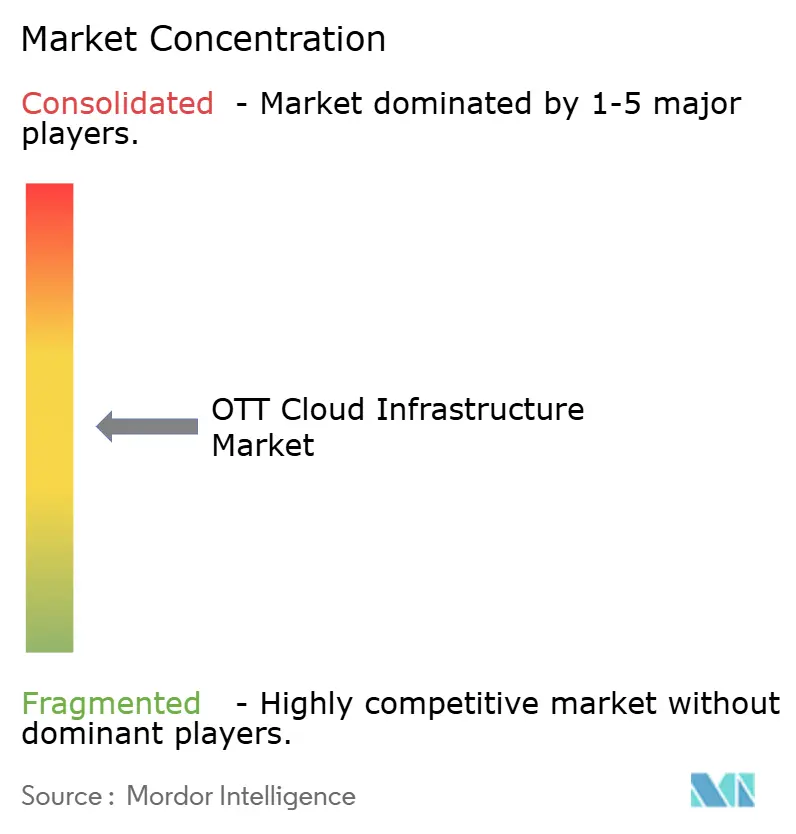
| Market Concentration | Medium |
Major Players *Disclaimer: Major Players sorted in no particular order Image © Mordor Intelligence. Reuse requires attribution under CC BY 4.0. | |
OTT Cloud Infrastructure Market Analysis by Mordor Intelligence
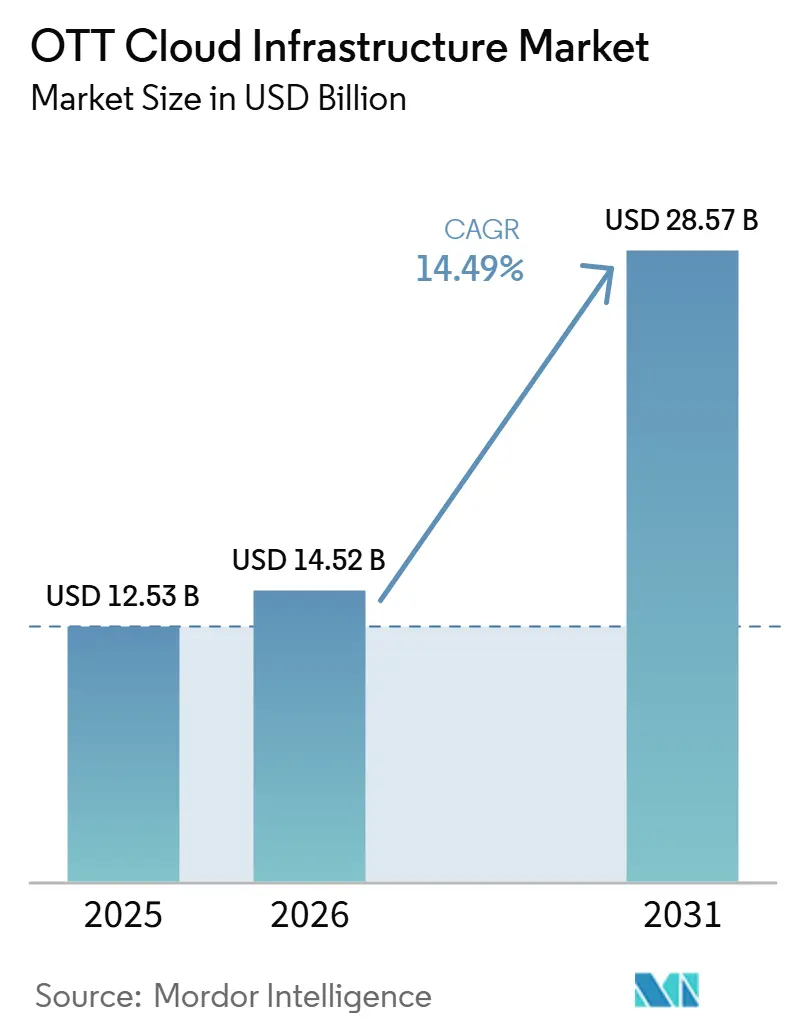
The OTT cloud infrastructure market size was valued at USD 12.53 billion in 2025 and estimated to grow from USD 14.52 billion in 2026 to reach USD 28.57 billion by 2031, at a CAGR of 14.49% during the forecast period (2026-2031). Streaming operators are moving workloads from fixed hardware to cloud systems that can scale up when audience demand rises. Premium live events require delivery systems that can limit delay and sustain service quality during sudden viewing peaks. AI-based processing is expanding the amount of cloud compute used for encoding, captioning, localization, and advertising workflows. Ad-supported services also require more stream versions, advertising insertion, and measurement for each viewer session. The OTT cloud infrastructure market, therefore, favors providers that combine flexible capacity, media tools, delivery reach, and cost controls.
Key Report Takeaways
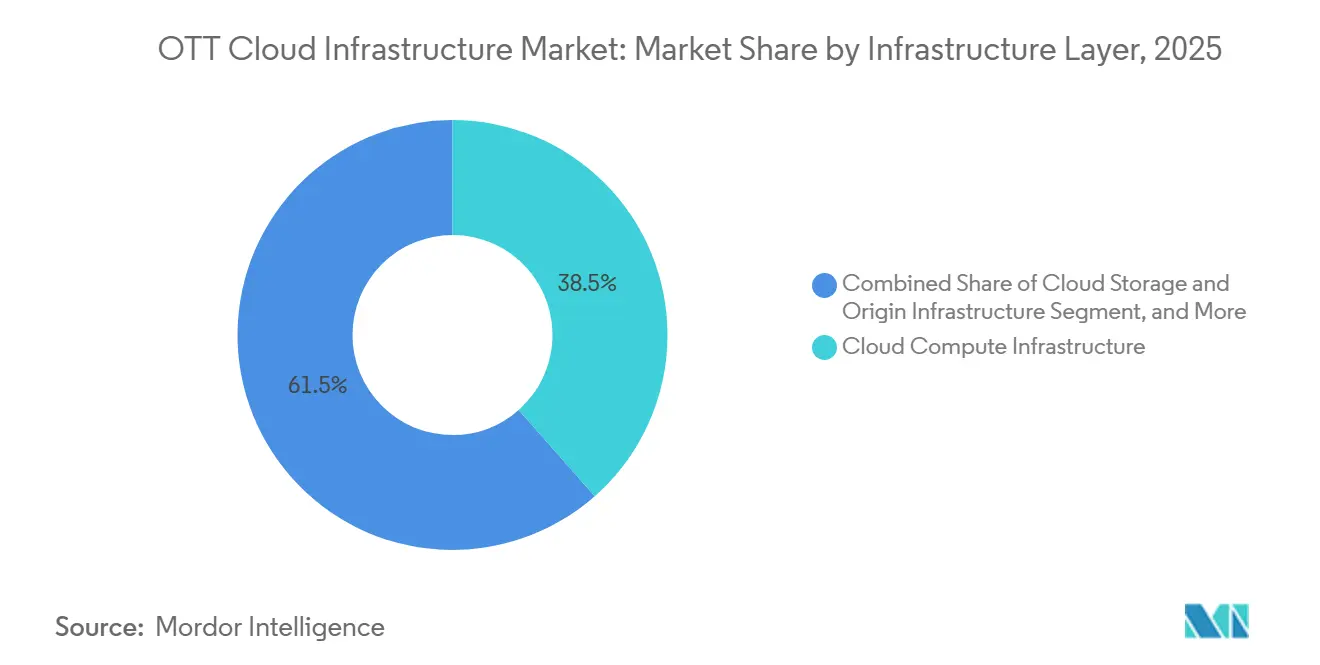
- By infrastructure layer, cloud compute infrastructure led with 38.49% of the OTT cloud infrastructure market share in 2025, while media processing and workflow infrastructure is projected to expand at a 14.91% CAGR through 2031.
- By deployment model, public cloud held 66.73% of the OTT cloud infrastructure market share in 2025 and is growing as the preferred operating model for large-scale operators, with a CAGR of 14.78% through 2031.
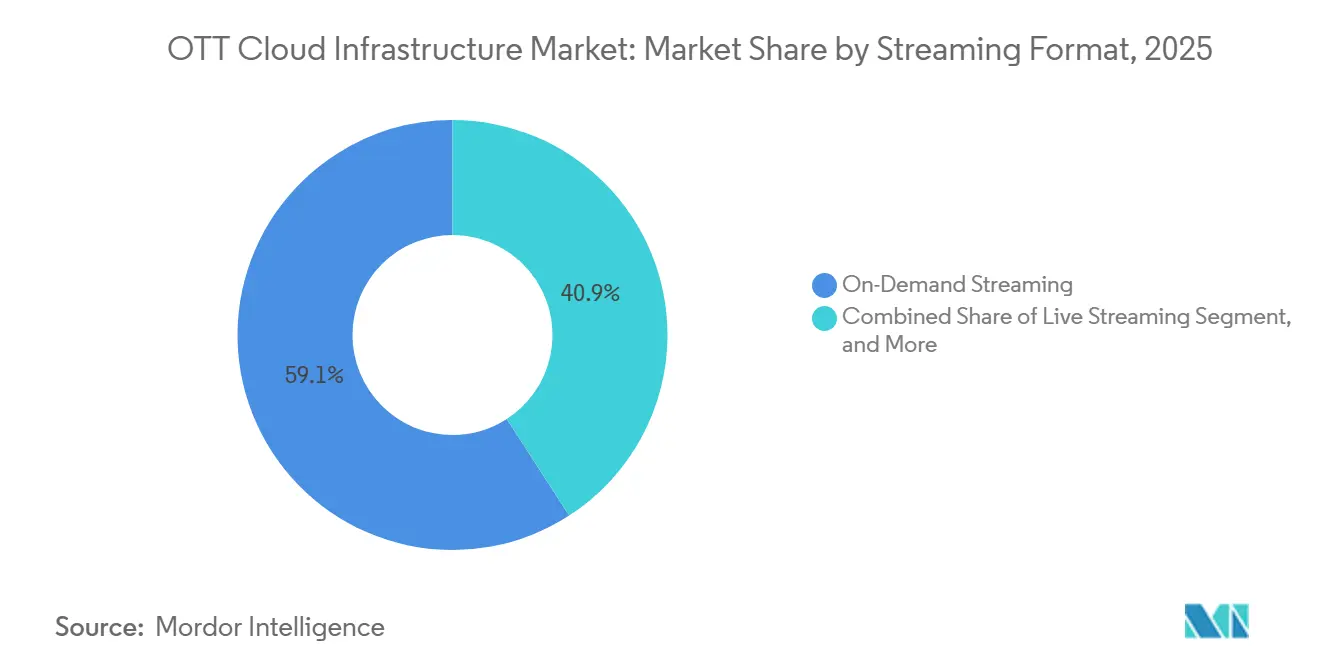
- By streaming format, on-demand streaming accounted for 59.13% of the over-the-top (OTT) cloud infrastructure market in 2025, while Live Streaming is projected to expand at a 15.06% CAGR through 2031.
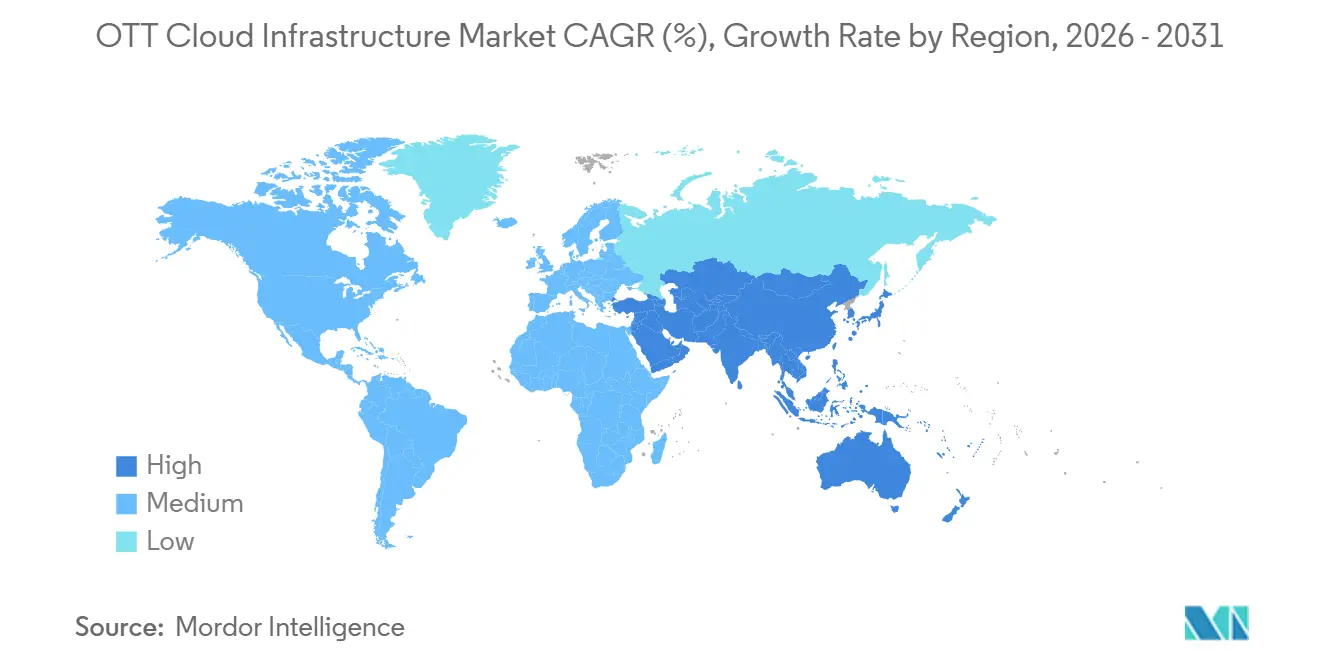
- By geography, North America held 43.61% of the global market in 2025, while Asia-Pacific is projected to expand at a 15.22% CAGR through 2031.
Note: Market size and forecast figures in this report are generated using Mordor Intelligence’s proprietary estimation framework, updated with the latest available data and insights as of January 2026.
Global OTT Cloud Infrastructure Market Trends and Insights
Drivers Impact Analysis*
| Driver | (~) % Impact on CAGR Forecast | Geographic Relevance | Impact Timeline |
|---|---|---|---|
| Cloud-Native Elasticity for Event-Driven Streaming Peaks | +2.8% | Global, with acute concentration in North America, India, and Southeast Asia | Short term (≤ 2 years) |
| Rising Low-Latency Live Sports and Interactive Streaming Demand | +2.5% | Global, led by North America, Europe, and Asia-Pacific | Short term (≤ 2 years) |
| AI-Based Video Workflow Automation and Localization | +2.2% | Global, with early adoption leadership in North America and Western Europe | Medium term (2-4 years) |
| Expansion of Edge Compute, Open Caching, and Multi-CDN Delivery | +1.8% | Global, with spillover to the Middle East and Africa | Medium term (2-4 years) |
| Ad-Supported and Hybrid Monetization Expanding Processing Volumes | +1.5% | North America and Europe, with emerging demand in South America and Asia-Pacific | Medium term (2-4 years) |
| 5G, Multicast, and Broadcast-Streaming Convergence | +1.2% | Asia-Pacific, with spillover to Europe and the Middle East | Long term (≥ 4 years) |
| Source: Mordor Intelligence | |||
Cloud-Native Elasticity for Event-Driven Streaming Peaks
Cloud auto-scaling supports the OTT cloud infrastructure market because live events create a wide gap between average and peak viewer demand. Operators can use multi-cloud designs that assign core compute, machine-learning workloads, and last-mile delivery to different providers. This approach has become important for national-scale events, where capacity must be ready before traffic rises. Predictive autoscaling uses historical traffic patterns to provision resources for large audiences before congestion occurs, rather than responding after congestion begins. Large cloud providers are continuing to expand their underlying capacity, supporting workloads that require low latency and high availability. Long-term volume commitments can give larger broadcasters better pricing before major events, while smaller operators may remain exposed to on-demand rates.
Rising Low-Latency Live Sports and Interactive Streaming Demand
Live sports are increasing the demand for delivery systems with very low delay. Low-Latency HLS and Low-Latency CMAF are narrowing the gap between a live event and the stream viewers receive. Delayed feeds can weaken the value of interactive features and live wagering services when viewers see action after it has occurred. Rising sports rights costs are also encouraging operators to improve encoding efficiency, delivery routing, and resource use. Harmonic launched an AI Orchestration Service in April 2026 to help broadcasters integrate AI applications into live workflows with redundancy and broadcast-grade reliability.[1]Harmonic Inc., “Harmonic Introduces Breakthrough AI Orchestration Service for Live Video Workflows,” Harmonic Newsroom, harmonicinc.com. The over-the-top (OTT) cloud infrastructure market benefits from the need for continuous processing and delivery capacity during each live session for sports, news, and interactive events.
AI-Based Video Workflow Automation and Localization
AI is changing the media processing layer by automating transcription, captioning, advertising break identification, and localization during content ingestion. Amagi introduced Agentic Media Operations across Amagi NOW in April 2026, with tools for ad-break placement, metadata enrichment, and multilingual captioning. Synamedia introduced AI by Quortex in April 2026 as a framework that activates processing when it creates measurable value. These systems can reduce the manual work required for larger catalogs and broader language coverage. Traditional dubbing and subtitle workflows become more expensive as a service expands into more language markets, making automated localization commercially important. The shift reallocates a share of operating costs from editorial and localization labor to cloud compute, underscoring the importance of cloud pricing and supplier relationships in the OTT cloud infrastructure market.
Expansion of Edge Compute, Open Caching, and Multi-CDN Delivery
Edge infrastructure is becoming a location for compute and application functions rather than only a cache for stored video. Processing closer to viewers can reduce origin-server load and support personalization without a round-trip to a central data center. Google Cloud stated that Media CDN had more than 100 Tbps of egress capacity in April 2025, and identified MLB and Warner Bros. Discovery as live-event users within multi-CDN designs. Oracle has extended Video Edge toward third-party CDN and internet service provider networks through Media over QUIC, which supports a coordinated relay approach for high-concurrency events. Real-time content steering now distributes active sessions among providers based on latency and load information, rather than serving solely as a backup. Open-caching deployments within telecom networks can lower transit costs and improve delivery for mobile-focused audiences across Asia-Pacific and Europe.
Restraints Impact Analysis*
| Restraint | (~) % Impact on CAGR Forecast | Geographic Relevance | Impact Timeline |
|---|---|---|---|
| Escalating Bandwidth, Egress, and Transcoding Cost Burden | -1.9% | Global, most acute for North America and Europe-based operators | Short term (≤ 2 years) |
| Fragmented Device, Codec, DRM, and Player Compatibility | -1.5% | Global, accentuated in heterogeneous device markets of Asia-Pacific and South America | Medium term (2-4 years) |
| Privacy, Content Rights, and Data Residency Constraints | -0.9% | Europe, India, the Middle East, and South America | Medium term (2-4 years) |
| Peak-Time Quality-of-Service Instability in Emerging Networks | -0.7% | Africa, South America, and parts of Southeast Asia | Long term (≥ 4 years) |
| Source: Mordor Intelligence | |||
Escalating Bandwidth, Egress, and Transcoding Cost Burden
Egress pricing remains a central constraint on the economics of the OTT cloud infrastructure market. Cloud providers charge for internet delivery by data volume, which can result in large recurring bills for services supporting hundreds of millions of concurrent viewers across regions. Large platforms are investing in their own delivery networks to reduce reliance on per-gigabyte cloud egress contracts. Transcoding increases costs because each language, resolution ladder, and entitlement-aware stream variant requires more processing. Akamai cited higher hardware, power, and infrastructure costs in its 2026 investor materials, which may place pressure on CDN pricing. Per-title encoding can reduce delivery volume by matching bitrate ladders to the complexity of individual assets, but it requires engineering resources that smaller broadcasters may not have.
Fragmented Device, Codec, DRM, and Player Compatibility
The OTT cloud infrastructure market must support multiple rights-management and playback environments simultaneously. Widevine serves Chrome and Android devices, FairPlay supports Apple platforms, and PlayReady serves Windows and Xbox environments. Older devices continue to require H.264/AVC delivery even where newer codecs offer stronger compression. ISO/IEC Common Encryption defines a common framework, but each DRM system still has distinct license-server and device-security requirements.[2]ISO/IEC, “ISO/IEC 23001-7:2023 Information Technology MPEG Systems Technologies Part 7 Common Encryption in ISO Base Media File Format Files,” ISO, iso.org. Live channels with key rotation generate heavy license-request activity, increasing the operational load during periods of high concurrent viewing. This compatibility burden increases processing and support requirements across the OTT cloud infrastructure market.
*Our forecasts treat driver/restraint impacts as directional, not additive. The impact forecasts reflect baseline growth, mix effects, and variable interactions.
Segment Analysis
By Infrastructure Layer: AI Processing Supports the Fastest-Growing Layer
Cloud Compute Infrastructure held 38.49% in 2025 and provided the core virtual machine and container layer for downstream media functions. Media Processing and Workflow Infrastructure is projected to expand at a 14.91% CAGR from 2026 to 2031. Automated encoding, localization, server-side ad insertion, and AI-supported processing are increasing its demand. The wider use of subscription and ad-supported tiers means that a single asset may need separate clean and ad-supported stream variants. This raises processing requirements for each title in the catalog and supports the OTT cloud infrastructure market.
Cloud Networking and CDN Infrastructure provide the path between content origins and audiences, while Cloud Storage and Origin Infrastructure retain source assets and support continuous feed ingest for live services. Their growth is moderated by improved compression and per-title encoding, which can reduce the bandwidth and storage required per viewer-hour. Observability, Analytics, and Measurement Infrastructure is gaining importance as operators monitor service quality in real time. Akamai and MediaMelon partnered in April 2026 to bring SmartSight quality-of-experience analytics to more than 4,400 Akamai edge locations. The service reflects growing demand for systems that connect network health, player performance, and viewer experience into a single operating view.



By Deployment Model: Public Cloud Leads While Hybrid Designs Address Control Needs
Public Cloud accounted for 66.73% of the OTT cloud infrastructure market in 2025 and is expected to grow with a CAGR of 14.78% over the forecast period. Hyperscalers offer media services for live encoding, packaging, advertising insertion, and content delivery that reduce the need for operators to buy and manage specialized hardware. Multi-year capacity commitments can lower unit costs and improve budgeting certainty, but they can also increase dependence on a single provider's tools and pricing structure. Private Cloud retains a strategic role for public-service broadcasters and regulated networks that have content sovereignty requirements. It is particularly relevant where production systems and subscriber data cannot be routed through externally hosted environments.
Hybrid Cloud is growing as a practical design for large-scale streaming operators. These operators can retain identity management, rights verification, and subscriber personal information in private environments while moving encode, package, and CDN workloads to public cloud services. Fox named AWS its preferred AI cloud provider in April 2026 and is using AWS media services with AI capabilities for highlights, enrichment, and vertical video versions of live sports.[3]Fox Corporation, “Fox Corporation Names Amazon Web Services Its Preferred AI Cloud Provider,” Fox Corporation, foxcorporation This relationship shows how closely premium content owners can integrate with public cloud providers while maintaining a need for hybrid configurations for technical and commercial flexibility. The over-the-top (OTT) cloud infrastructure market continues to reward providers that can support both cloud scale and control requirements.
By Streaming Format: Live Streaming Becomes the Main Growth Driver
On-Demand Streaming represented 59.13% of the OTT cloud infrastructure market in 2025, supported by the installed base of catalog-focused subscription services. These services were designed around content libraries rather than major concurrent audience peaks. Live Streaming is projected to expand at a 15.06% CAGR from 2026 to 2031. Sports rights holders and news organizations are moving primary distribution toward direct-to-consumer services that need full-capacity origin-to-edge pipelines during events. Unlike on-demand content, live delivery cannot use edge caching in the same way and requires capacity at the active bitrate for each viewing hour.
Hybrid Streaming combines scheduled linear free ad-supported television channels with on-demand libraries and requires continuous origin ingest while the same edge network responds to on-demand requests. Amagi reported that FAST viewing hours grew 55% year over year in June 2026. Bitmovin reported that advertising-supported video on demand accounted for 37%, and subscription video on demand accounted for 36%. These models increase the number of advertising events, stream versions, and reporting records processed for each session. The OTT cloud infrastructure market, therefore, has a growing demand for unified cache management and advertising-aware workflow systems.
Geography Analysis
North America held 43.61% of the OTT cloud infrastructure market in 2025. The region has a dense concentration of content rights owners, OTT platforms, cloud services, and CDN locations, and growth is driven more by technical upgrades for live sports, advertising-supported tiers, and catalog processing than by first-time platform launches. Fox named AWS its preferred AI cloud provider in April 2026, combining AWS Elemental media services with AI functions for highlights and social video reformatting. Telenor went live with a pan-Nordic TV platform enabled by AWS and Scalstrm in February 2026, using Direct Connect, large-scale storage, and cloud-native origin capabilities.[4]Amazon Web Services, “Telenor Goes Live with Nordic TV Platform Enabled by AWS and Scalstrm,” Amazon Web Services, press.aboutamazon.com.
Asia-Pacific is projected to expand at a 15.22% CAGR from 2026 to 2031, making it the fastest-growing geographic area in the OTT cloud infrastructure market. India, South Korea, and Japan support this expansion through mobile-focused consumption, sports services, and higher per-user spending. Cricket events in India have required multi-cloud deployments capable of handling major concurrent audience peaks. India’s Digital Personal Data Protection Rules, 2025, require operators to consider local handling of subscriber personal information when designing cloud infrastructure. China’s YD/T 7033-2026 standard sets technical requirements for 5G core network multicast and broadcast enhancements, which could reduce CDN demand during mass-viewing events.
South America recorded 190% growth in FAST viewing hours in Q2 2026, increasing demand for advertising-related processing and delivery capacity in the over-the-top (OTT) cloud infrastructure market. The region is gaining importance through the adoption of FAST services, which creates processing and CDN demand without the subscription revenue levels common in North America. Europe faces data sovereignty requirements that favor regional cloud locations and can slow the use of public hyperscalers for broadcast production workloads. The European Commission proposed a sovereign cloud computing services framework in 2026 with safeguards aligned with the General Data Protection Regulation. The Middle East, particularly Saudi Arabia and the UAE, combines premium streaming demand with in-country data requirements, while Africa’s development depends on mobile broadband reach and more affordable devices.

Competitive Landscape
The OTT cloud infrastructure market is moderately fragmented and has two main competitive layers. AWS, Microsoft Azure, and Google Cloud compete through broad cloud platforms, media tools, AI services, and global infrastructure. MediaKind, Akamai, Ateme, and other specialists compete through low-latency packaging, content protection, server-side advertising insertion, and broadcast-grade operations. This structure gives operators in the OTT cloud infrastructure market a choice between integrated cloud environments and specialized media capabilities. AWS held a 28% global cloud services share in Q1 2026, while Google and Microsoft are increasing spending on data center capacity and media-related capabilities, making it difficult for specialist providers to match their breadth of infrastructure.
Specialist suppliers in the OTT cloud infrastructure market are responding through product focus, partnerships, and consolidation. MediaKind completed its acquisition of Harmonic’s Video Business in June 2026 for USD 145 million, creating an independent provider with more than USD 250 million in annual revenue, more than USD 100 million in annual recurring revenue, and a combined portfolio of SaaS streaming, appliance platforms, and cloud video tools. Akamai’s partnership with MediaMelon adds real-time quality monitoring to its edge footprint, which responds to demand for easier operations across complex video systems. Fox’s AWS agreement is another example of a content owner using cloud media services and AI functions in a single supplier relationship.
Technical standards will influence which platforms can operate across devices and networks at scale. 3GPP Release 19 defines the architecture for 5G media streaming and establishes a technical basis for interoperable mobile delivery. Providers that combine encoder health, CDN telemetry, DRM license performance, and viewer quality data can reduce the burden on manual operations teams. Regional CDN providers may also compete by offering video delivery at lower data-transfer costs than general cloud egress. The competitive structure of the OTT cloud infrastructure market remains active because no single vendor combines the full breadth of hyperscale infrastructure with every specialist media function, so operators are likely to retain multiple supplier relationships.
OTT Cloud Infrastructure Industry Leaders
Amazon Web Services, Inc.
Microsoft Corporation
Alphabet Inc.
Akamai Technologies, Inc.
Cloudflare, Inc.
- *Disclaimer: Major Players sorted in no particular order

Recent Industry Developments
- July 2026: Broadpeak was selected by SIMBA to power a new high-performance content delivery network in Brazil, built on Broadpeak's Advanced CDN software and enabling SIMBA to deliver live and VoD streaming services for 3 of the country’s leading broadcasters while launching its own CDN-as-a-service offering. The deployment positions Broadpeak as the infrastructure backbone for Brazil's emerging third-party CDN market, which is being accelerated by live sports streaming demand from the 2026 FIFA World Cup.
- July 2026: Tencent Cloud and Rockstreamer Private Limited announced a strategic partnership to deliver cloud, AI, CDN, and enterprise OTT solutions for telecommunications operators, broadcasters, and media companies across Bangladesh and other emerging markets. The partnership expands Tencent Cloud's OTT infrastructure footprint across South Asia at a time when Bangladeshi and broader South Asian markets are accelerating digital broadcasting modernization.
- June 2026: MediaKind completed its merger with Harmonic's Video Business for USD 145 million in cash, creating an independent streaming infrastructure company with more than USD 250 million in annual revenue and more than USD 100 million in annual recurring revenue. The combined entity brings together SaaS streaming, appliance platforms, and cloud video technologies, positioning it as a direct alternative to hyperscaler-bundled media services for broadcasters seeking vendor independence and cloud-neutral deployment flexibility.
- June 2026: Akta's AI-first SaaS video platform achieved general availability on Oracle Cloud Infrastructure, showcased at StreamTV Show 2026. The deployment enables broadcasters to consolidate ingest, live channel management, and OTT distribution within a single cloud-native environment on OCI, reducing the integration complexity of multi-system media workflows for broadcast-to-streaming migrations.


Global OTT Cloud Infrastructure Market Report Scope
The OTT Cloud Infrastructure Market comprises the ecosystem of cloud-based infrastructure solutions and services that enable over-the-top (OTT) media providers to deliver video and audio content directly to consumers over the internet. This market includes the cloud computing, storage, networking, content delivery, media processing, workflow orchestration, and analytics infrastructure required to support content ingestion, transcoding, packaging, distribution, streaming, monitoring, and performance optimization across multiple devices and geographies. The infrastructure is designed to provide scalability, high availability, low-latency content delivery, operational flexibility, and cost efficiency for live, on-demand, and hybrid streaming applications.
The OTT Cloud Infrastructure Market Report is Segmented by Infrastructure Layer (Cloud Compute Infrastructure, Cloud Storage and Origin Infrastructure, Cloud Networking and CDN Infrastructure, Media Processing and Workflow Infrastructure, and Observability, Analytics, and Measurement Infrastructure), Deployment Model (Public Cloud, Private Cloud, and Hybrid Cloud), Streaming Format (Live Streaming, On-Demand Streaming, and Hybrid Streaming), and Geography (North America, South America, Europe, Asia-Pacific, Middle East, and Africa). The Market Forecasts are Provided in Terms of Value (USD).
| Cloud Compute Infrastructure |
| Cloud Storage and Origin Infrastructure |
| Cloud Networking and CDN Infrastructure |
| Media Processing and Workflow Infrastructure |
| Observability, Analytics, and Measurement Infrastructure |
| Public Cloud |
| Private Cloud |
| Hybrid Cloud |
| Live Streaming |
| On-Demand Streaming |
| Hybrid Streaming |
| North America | United States |
| Canada | |
| Mexico | |
| South America | Brazil |
| Argentina | |
| Rest of South America | |
| Europe | United Kingdom |
| Germany | |
| France | |
| Italy | |
| Spain | |
| Russia | |
| Rest of Europe | |
| Asia-Pacific | China |
| India | |
| Japan | |
| South Korea | |
| Australia | |
| Southeast Asia | |
| Rest of Asia-Pacific | |
| Middle East | United Arab Emirates |
| Saudi Arabia | |
| Turkey | |
| Rest of Middle East | |
| Africa | South Africa |
| Nigeria | |
| Egypt | |
| Rest of Africa |
| By Infrastructure Layer | Cloud Compute Infrastructure | |
| Cloud Storage and Origin Infrastructure | ||
| Cloud Networking and CDN Infrastructure | ||
| Media Processing and Workflow Infrastructure | ||
| Observability, Analytics, and Measurement Infrastructure | ||
| By Deployment Model | Public Cloud | |
| Private Cloud | ||
| Hybrid Cloud | ||
| By Streaming Format | Live Streaming | |
| On-Demand Streaming | ||
| Hybrid Streaming | ||
| By Geography | North America | United States |
| Canada | ||
| Mexico | ||
| South America | Brazil | |
| Argentina | ||
| Rest of South America | ||
| Europe | United Kingdom | |
| Germany | ||
| France | ||
| Italy | ||
| Spain | ||
| Russia | ||
| Rest of Europe | ||
| Asia-Pacific | China | |
| India | ||
| Japan | ||
| South Korea | ||
| Australia | ||
| Southeast Asia | ||
| Rest of Asia-Pacific | ||
| Middle East | United Arab Emirates | |
| Saudi Arabia | ||
| Turkey | ||
| Rest of Middle East | ||
| Africa | South Africa | |
| Nigeria | ||
| Egypt | ||
| Rest of Africa | ||


Key Questions Answered in the Report
What is the projected size of the OTT cloud infrastructure market?
The sector is estimated at USD 14.52 billion in 2026 and is forecast to reach USD 28.57 billion by 2031, at a 14.49% CAGR.
What is driving spending on OTT cloud infrastructure?
Live sports, AI-based media processing, advertising-supported services, and flexible cloud capacity are increasing demand for compute and delivery services.
Which infrastructure layer is growing fastest?
Media Processing and Workflow Infrastructure is projected to grow at a 14.91% CAGR from 2026 to 2031 as automation, localization, and advertising workflows expand.
Why are operators using hybrid cloud configurations?
Hybrid configurations allow operators to keep rights, identity, and subscriber data in controlled environments while using public cloud capacity for encoding and delivery.
Which streaming format is expanding fastest?
Live Streaming is projected to grow at a 15.06% CAGR through 2031 because sports and news services require continuous, low-delay delivery capacity.
Which region is growing fastest for OTT cloud infrastructure?
Asia-Pacific is projected to grow at a 15.22% CAGR through 2031, supported by mobile viewing and major live-event demand.
Page last updated on:





