
Organic Pea Protein Market Size and Share
Market Overview
| Study Period | 2021 - 2031 |
|---|---|
| Market Size (2026) | USD 1.13 Billion |
| Market Size (2031) | USD 1.96 Billion |
| Growth Rate (2026 - 2031) | 11.64 % |
| Fastest Growing Market | Asia-Pacific |
| Largest Market | North America |
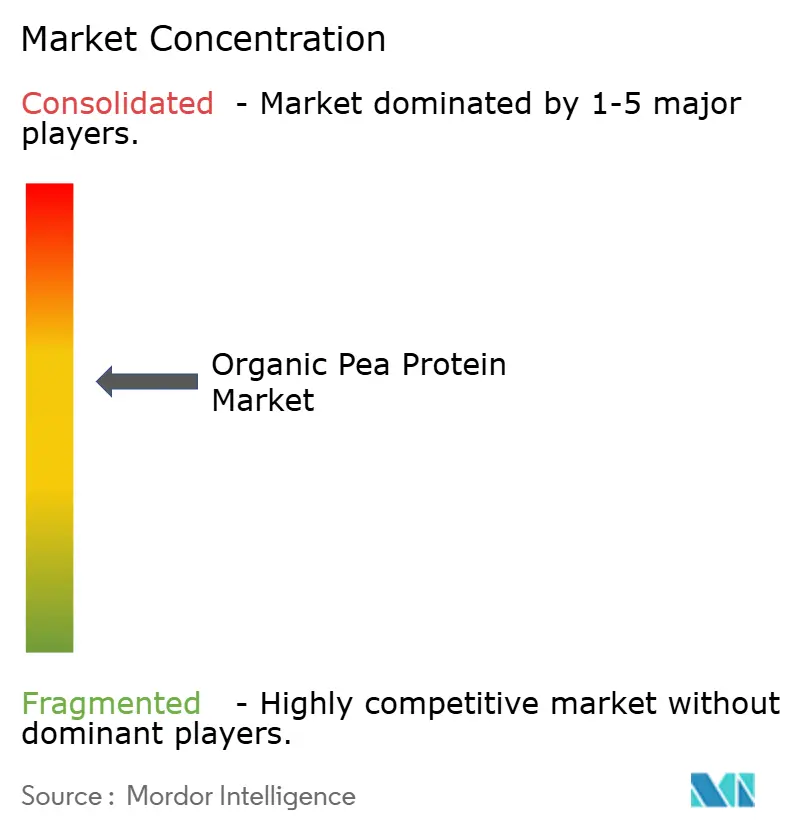
| Market Concentration | Medium |
Major Players *Disclaimer: Major Players sorted in no particular order Image © Mordor Intelligence. Reuse requires attribution under CC BY 4.0. | |
Organic Pea Protein Market Analysis by Mordor Intelligence
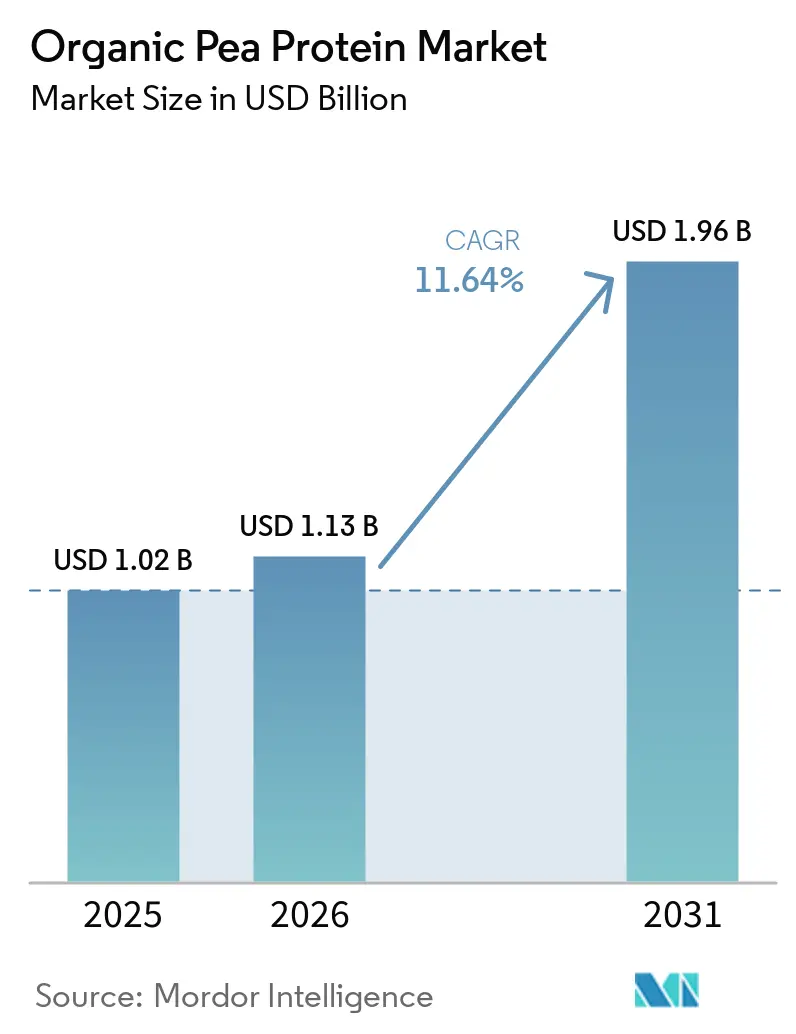
The Organic pea protein market size is projected to expand from USD 1.02 billion in 2025 and USD 1.13 billion in 2026 to USD 1.96 billion by 2031, registering a CAGR of 11.64% between 2026 and 2031. The Organic pea protein market is moving beyond demand from dedicated vegan consumers as food manufacturers develop products for flexitarian households seeking protein-rich foods with simple ingredient lists. Organic certification increasingly supports access to premium retail and specialized nutrition channels where product origin and ingredient documentation matter. Demand for protein and weight-management claims also supports interest in formats designed for consumers using GLP-1 medicines, especially ready-to-drink products and clinical nutrition. Processing investments, ingredient refinement, and farming contracts will determine whether suppliers can meet this demand while managing a concentrated supply base. The Organic pea protein market also faces a practical constraint because certified acreage cannot expand quickly after a weather-related supply disruption.
Key Report Takeaways
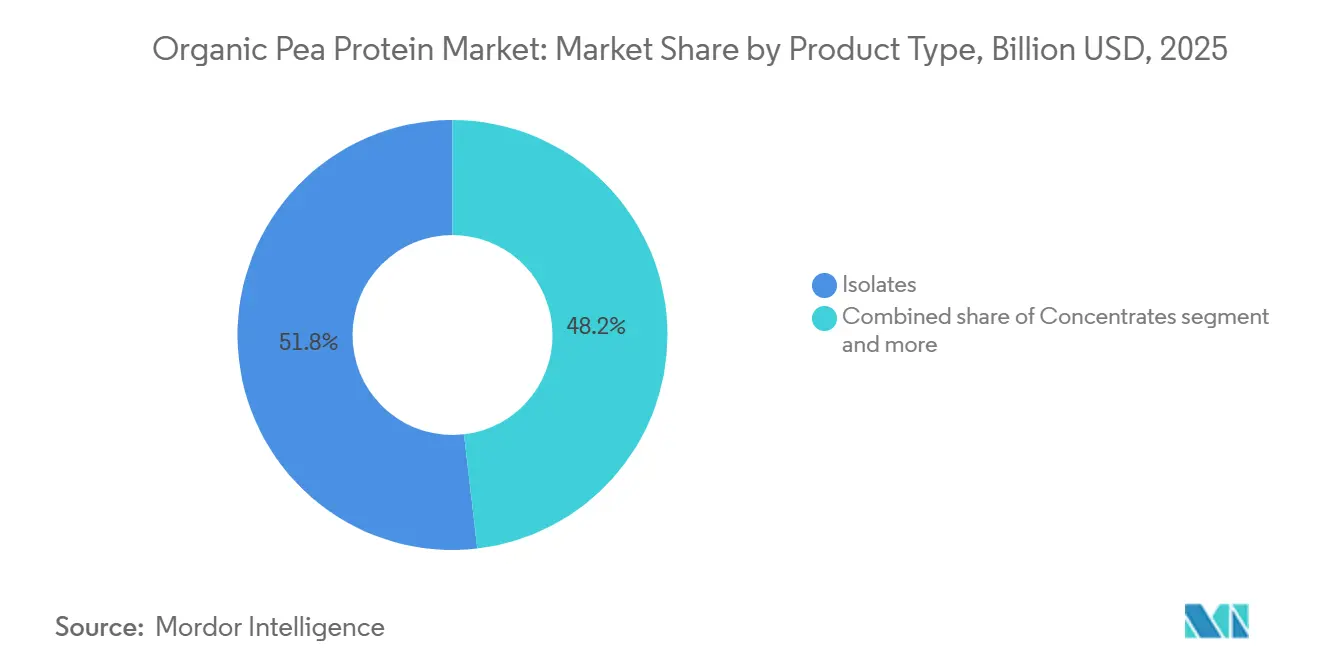
- By product type, isolates held 51.83% of the organic pea protein market share in 2025, while concentrates are forecast to expand at a 12.46% CAGR through 2031.
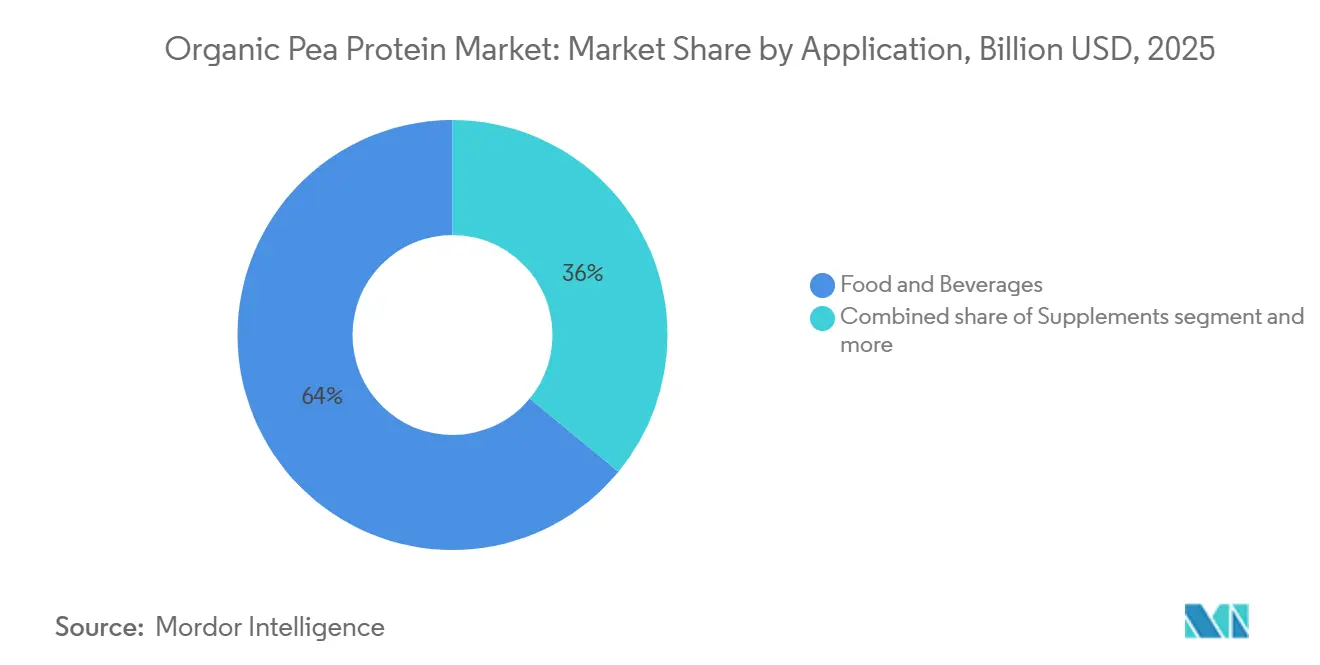
- By application, food and beverages accounted for 64.04% of the Organic pea protein market share in 2025, while supplements recorded the highest projected CAGR at 12.11% through 2031.
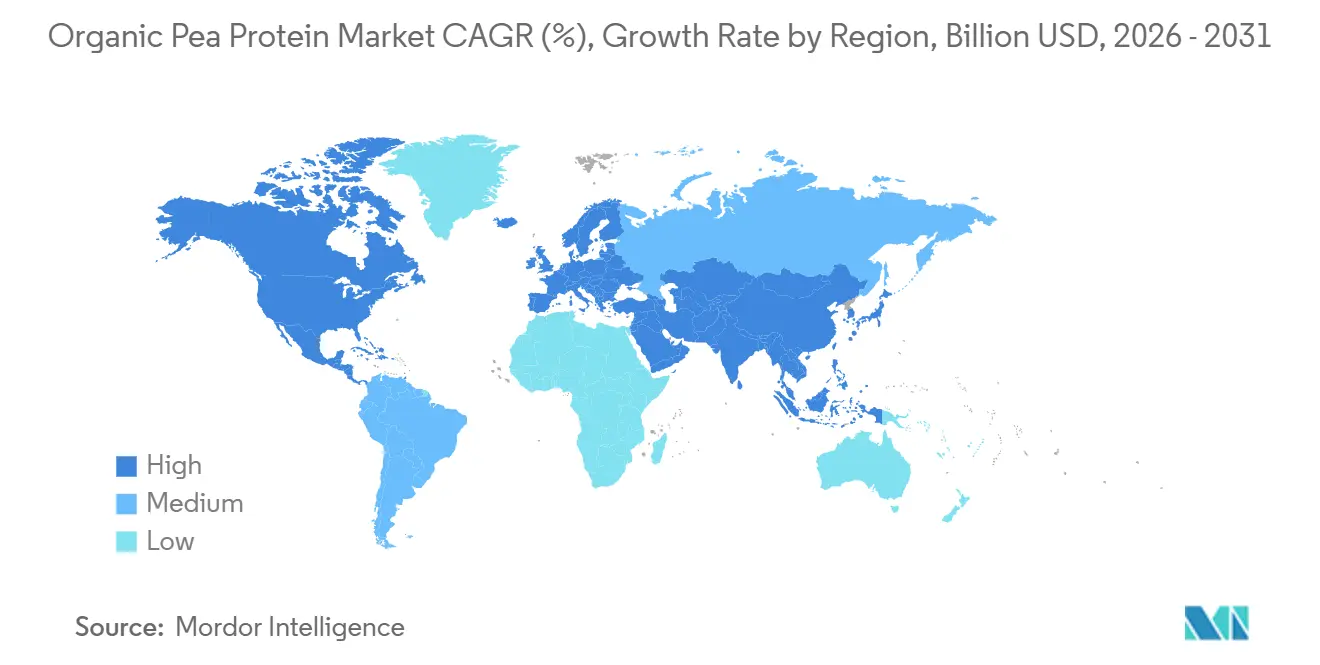
- By geography, North America held 38.90% of revenue in 2025, while Asia-Pacific is forecast to grow at a 12,98% CAGR through 2031.
Note: Market size and forecast figures in this report are generated using Mordor Intelligence’s proprietary estimation framework, updated with the latest available data and insights as of January 2026.
Market Trends and Insights
Drivers Impact Analysis of Organic Pea Protein Market*
| Driver | (~) % Impact on CAGR Forecast | Geographic Relevance | Impact Timeline |
|---|---|---|---|
| Expansion of plant-based and flexitarian diets | +2.5% | Global | Long term (≥ 4 years) |
| Clean-label, non-GMO, and allergen-free formulation demand | +2.0% | North America and Europe | Medium term (2–4 years) |
| Growth of organic sports nutrition and functional foods | +1.8% | North America and the Asia-Pacific | Long term (≥ 4 years) |
| Improved taste, solubility, and texturization technologies | +1.5% | Global | Short term (≤ 2 years) |
| Farm-to-ingredient traceability as a premium-product differentiator | +1.2% | North America and Europe | Medium term (2–4 years) |
| Organic pea protein use in pet food and specialized nutrition | +1.0% | North America and the Asia-Pacific | Medium term (2–4 years) |
| Source: Mordor Intelligence | |||
Expansion of plant-based and flexitarian diets
The pivotal structural shift for organic pea protein is not the growth of vegan consumers; it is the formulation migration by mainstream food manufacturers targeting flexitarian households that demand protein-rich, minimally processed options. Pea protein has become the leading plant protein ingredient in global food and beverage launches carrying plant-based or vegan claims, ahead of soy and wheat, a positioning advantage sustained by its hypoallergenic profile and compatibility with non-GMO supply chains. The overlooked second-order implication is that GLP-1 drug adoption is creating an entirely new high-value demand channel: GLP-1 users require high-density, easily absorbed protein inputs to offset muscle catabolism during caloric restriction, a nutritional brief that organic pea isolate, with a PDCAAS of 0.82–0.89 and solubility above 85–90%, is functionally calibrated to meet. A 2025 review in European Food Research and Technology confirmed that AI-driven formulation and computational modeling are now accelerating pea-protein application development, compressing the typical time-to-market for new product formats[1]. This technology convergence is likely to lift organic pea protein adoption into beverage categories previously dominated by whey.
Clean-label, non-gmo, and allergen-free formulation demand
Organic pea protein occupies a rare regulatory position: it is simultaneously USDA Organic-eligible, free from the 14 major allergens listed under EU Regulation 1169/2011, and not classified as a major allergen under the U.S. FDA's Food Allergen Labeling and Consumer Protection Act (FALCPA). This dual positioning, clean-label and allergen-free, makes it functionally irreplaceable in allergen-restricted product lines without requiring additional labeling burden. Retailers are deploying clean-label scorecards that reward short ingredient lists and certified-organic sourcing, creating a direct pathway for organic pea protein into previously conventional SKUs; organic variants in Europe command 40–50% price premiums over conventional grades, yet continue to capture shelf-space gains in premium retail. Germany and Austria, where organic food accounts for 12–14% of total food expenditure, roughly double the European average, are exhibiting the most accelerated reformulation cycles, particularly in dairy analogs and infant nutrition applications where non-GMO and organic claims carry the strongest consumer value. The compliance burden associated with USDA National Organic Program (NOP) certification and EU Organic Regulation 2018/848 acts as an effective market filter, deterring non-certified entrants from accessing premium distribution channels.
Growth of organic sports nutrition and functional foods
Sports and performance nutrition have historically been dominated by whey protein, but organic pea isolate is displacing whey in premium and clinical product lines where allergen-free and certified-organic labeling unlocks premium retail placement and institutional procurement contracts. Protein Industries Canada attracted a CAD 48.7 million collaborative investment in July 2025, specifically targeting pea protein commercialization in functional nutrition categories, a signal of institutional conviction in this demand shift. Roquette explicitly positioned its NUTRALYS Pea 850F isolate launch in February 2026 for GLP-1 user product segments and premium RTD formats, and Innova data cited in the launch confirms that protein-and-weight-management claim launches grew 29% in 2024/2025 versus the preceding year. The less-visible growth channel is elderly and medical nutrition, where certified-organic pea protein is increasingly specified in clinical dietetics protocols for oncology and post-surgical recovery patients who require hypoallergenic, easily digestible protein inputs. This channel is less price-sensitive than sports retail and sustains higher average selling prices, improving overall revenue mix for suppliers positioned in both segments.
Improved taste, solubility, and texturization technologies
Processing innovation dismantled the flavor and functionality barriers that historically constrained organic pea protein to bakery and meat-analog applications, with progress moving upstream from post-harvest processing to the genetic level. KWS and Berlin-based food-tech company vly jointly developed a taste-optimized organic pea variety through targeted plant breeding, showing that flavor remediation could be embedded into the crop before harvest rather than addressed downstream through masking or deodorization; the resulting protein was commercially deployed in vly's "vly Bio High Protein" and "vly Bio Barista" products. PURIS commercialized its 98% soluble ClearP Hydrolyzed Pea Protein in early 2026, the first organic-eligible format engineered for transparent, non-milky beverages, including protein sodas and functional RTD drinks, a category previously inaccessible to conventional pea isolates. As a result, taste innovation concentrated competitive advantage among processors investing in upstream breeding and downstream enzymatic or membrane-filtration technology, creating a capability gap for mid-tier processors without dedicated research and development investment. A 2025 review in European Food Research and Technology noted that AI-driven formulation tools supported real-time optimization of emulsification, foaming, and gelling properties in pea-protein applications, shortening commercialization timelines for next-generation formats.
Restraints Impact Analysis of Organic Pea Protein Market*
| Restraint | (~) % Impact on CAGR Forecast | Geographic Relevance | Impact Timeline |
|---|---|---|---|
| Organic yellow-pea supply and price volatility | -0.8% | Global, concentrated in Canada and France | Long term (≥ 4 years) |
| Beany flavor, grittiness, and beverage functionality constraints | -0.6% | Global | Medium term (2–4 years) |
| Organic certification, testing, and traceability cost burden | -0.5% | Global | Long term (≥ 4 years) |
| Limited certified-organic fractionation and processing capacity | -0.4% | North America and Europe | Medium term (2–4 years) |
| Source: Mordor Intelligence | |||
Organic yellow-pea supply and price volatility
Organic yellow-pea cultivation is concentrated in a narrow band of temperate geographies; Canada's Prairie provinces and northern France account for the majority of globally traded volumes, creating a supply chain that is structurally exposed to weather disruption without meaningful geographic redundancy. Yellow-pea prices surged 23% during the 2024 Canadian drought, demonstrating that even a single adverse growing season can materially compress processor margins and erode buyer confidence. The less-obvious constraint is that organic certification under USDA NOP and EU Organic Regulation 2018/848 requires a three-year land-transition period, meaning that rapid acreage expansion in response to price signals is structurally impossible, and supply responses to demand shocks always lag by multiple growing seasons[2]. This inertia concentrates pricing power among vertically integrated processors with long-term farm contracts: Roquette and Emsland Group have each committed contract acreage in France, Germany, and Poland totalling between 5,000 and 8,000 hectares, creating a supply buffer unavailable to smaller buyers who rely on spot market procurement. For emerging market entrants, this dynamic effectively imposes a capital-intensive requirement to secure agricultural contracts before processing capacity can be reliably monetized.
Beany flavor, grittiness, and beverage functionality constraints
The sensory profile of organic pea protein, characterized by vegetal, beany, and occasionally astringent notes, continues to impose a formulation ceiling in premium beverage and dairy-analog applications where consumer sensory tolerance is low, and repeat purchase is highly sensitive to taste. The constraint carries an ironic dimension: the same clean-label imperative that drives organic pea protein adoption limits the use of flavor-masking agents, leaving formulators with a narrower sensory remediation toolkit compared with conventional grades. PURIS's H2-IZO launch in January 2026 and Roquette's NUTRALYS Pea 850F in February 2026 specifically target this gap; both are engineered to deliver cleaner taste profiles without masking aids, but their commercial penetration among smaller contract manufacturers and private-label producers remains limited in the near term. Additionally, pea protein isolate's performance in acidic beverages, where solubility drops and precipitation risks increase, restricts its adoption in carbonated and citrus-based RTD formats without reformulation investment. Until sensory-optimized organic grades achieve commodity-level pricing, the beverage sub-segment will continue to absorb a smaller share of organic pea protein volume than its size would otherwise suggest.
*Our forecasts treat driver/restraint impacts as directional, not additive. The impact forecasts reflect baseline growth, mix effects, and variable interactions.
Organic Pea Protein Market Segment Analysis
By Product Type:
Isolates Lead Revenue and Concentrates Gain GroundIsolates held 51.83% of revenue in 2025, making them the leading format within the Organic pea protein market. Their position reflects protein purity of 83% to 85% on a dry-matter basis, strong solubility, and processing stability across a broad range of applications. These characteristics support use in dairy alternatives, ready-to-drink beverages, and specialized nutrition. Isolate producers also use blends with rice or sunflower protein to improve amino-acid balance in finished products. Research published in 2025 found that computational approaches can help optimize emulsification, foaming, and thermal gelation in plant-protein applications.
Concentrates are forecast to grow at a 12.46% CAGR through 2031, the fastest rate among product types. Their lower processing requirement can make them a more accessible option for food manufacturers seeking organic inputs. Improved high-moisture extrusion and membrane-filtration methods are narrowing the functional gap with isolates in bakery, snacks, and meal-kit applications. Textured and hydrolyzed formats remain smaller but are finding uses in meat alternatives, pet food, and aquafeed. The Organic pea protein industry can gain from these formats because they broaden demand beyond the most technically demanding applications. Product development will depend on whether processors can improve flavor and texture without weakening organic and clean-label credentials.

By Application:
Food and Beverages Lead While Supplements Expand FasterFood and beverages accounted for 64.04% of the Organic pea protein market size in 2025. The segment includes dairy and dairy-alternative foods, meat alternatives, bakery, beverages, snacks, cereals, ready-to-eat foods, and sauces. Plant-based milk provides a relevant example because Germany’s plant-based milk sales increased in 2025. Pet food also offers an adjacent outlet, with Pulse Canada reporting that 30% of new pet-food launches globally included a pulse ingredient in 2026. Personal care and cosmetics remain a smaller application, but they can use organic pea protein for film-forming and conditioning properties.
Supplements are projected to expand at a 12.11% CAGR through 2031. This application group includes sports nutrition, infant formula, and elderly and medical nutrition. Sport nutrition currently provides the largest supplement volume, while clinical products can create a less price-sensitive channel for suppliers. Infant nutrition requires extensive ingredient testing and origin documentation, which supports higher average selling prices. Roquette’s February 2026 launch and the 2025 Protein Industries Canada project both show investment in formats for functional and nutrition-focused uses[3]. The Organic pea protein industry will need tailored formulations to address the different performance and documentation needs of these buyers.
Geography Analysis
North America and Europe Organic Pea Protein Market
North America held 38.9% of revenue in 2025, the largest regional position in the Organic pea protein market. The region benefits from certified yellow-pea production in Canada, established processing infrastructure, and demand from U.S. food and nutrition manufacturers. The U.S. International Trade Administration’s July 2024 scope determination covered pea-derived protein with at least 65% protein on a dry-weight basis, in liquid or solid forms, in its antidumping investigation of imports from China. This trade action strengthened regional processors. Roquette states that its Manitoba facility can process 125,000 metric tons of peas each year. Europe is the second-largest regional market, supported by consumer demand and regulations favoring organic-certified plant proteins. France, Germany, and the Netherlands support legume processing and related agricultural capacity, while EU organic rules set a key compliance threshold for suppliers targeting premium food channels.
EMEA, APAC and South America Organic Pea Protein Market
Nordzucker canceled its planned pea-protein facility near Hannover in May 2025, citing slower market development and weak price levels. The decision showed that certification and consumer interest still require secure customer demand. The Organic pea protein market in Europe will continue to depend on strong supply contracts and viable pricing. Asia-Pacific is expected to register the fastest regional CAGR of 13.0% through 2031. India’s food fortification guidelines and large vegetarian population support plant-protein demand. China’s premium sports-nutrition demand is concentrated in major cities and e-commerce channels. Japan’s elderly nutrition segment favors mild sensory profiles, supporting improved pea isolate formats. South America is developing as pea cultivation expands beyond traditional production regions. The Middle East and Africa remain import-led opportunities centered on health-focused consumers in the UAE, Saudi Arabia, and South Africa.
North America and Europe Supply Chains Organic Pea Protein Market
The Organic pea protein market benefits in North America from an integrated supply chain connecting growers, processors, food manufacturers, and nutrition brands. This structure supports buyers that require documented origin and predictable ingredient specifications. Canadian production also supplies U.S. formulators using pea protein in beverages, dairy alternatives, and supplements. Trade protection reduces direct price pressure from covered imports but does not remove the need for cost control. The region remains exposed to crop conditions because supply comes from limited growing areas. In Europe, buyers link organic certification with ingredient transparency and non-GMO positioning. Suppliers must justify certified-input premiums through reliable taste, functionality, and finished-product performance. The Nordzucker cancellation showed that planned capacity requires customer commitments before construction, favoring established processors with customer relationships and farm supply arrangements.
Competitive Landscape
The organic pea protein market is moderately concentrated at the processing tier but fragmented among ingredient distributors and branded supplement manufacturers, creating a competitive dynamic in which scale, vertical integration from seed genetics through fractionation, and application-specific research and development capability determine durable margin positions. Roquette Frères and PURIS Proteins lead by processing capacity and product breadth: Roquette's NUTRALYS portfolio now spans pea, wheat, and fava-bean proteins alongside a range of organic-certified grades, while PURIS, backed by USD 250+ million in total capital raised, controls the largest organic pea protein manufacturing base in the United States and has systematically extended its product line from standard isolates into clear hydrolysates and high-protein beverage-grade concentrates. A Roquette-led CAD 24.5 million collaborative research and development project with Protein Industries Canada in 2024, targeting improved pea-processing efficiency and new fava-protein isolates, illustrates the strategy of defending organic pea leadership by simultaneously expanding into adjacent certified plant-protein formats.
This research and development posture, combined with a documented Roquette patent covering organic pea protein extraction methodology, represents a compliance and capability moat that smaller processors cannot replicate quickly. Second-tier specialists, Cosucra Groupe Warcoing, SOTEXPRO, Emsland Group, and Burcon NutraScience, compete on proprietary extraction technology or niche application expertise: Burcon's solvent-free extraction patents produce isolates with superior neutral flavor profiles without chemical processing-step disclosure, directly addressing the clean-label formulation requirement that defines the premium organic pea protein channel. Shandong Jianyuan Group and Yantai Shuangta Food dominate in Asian markets where organic certification requirements are less stringent, and cost competitiveness determines buyer decisions, but anti-dumping duties in the United States are redirecting their competitive focus toward intra-regional buyers across Southeast Asia and the Middle East.
White-space opportunities remain in three underpenetrated areas: precision-fermented pea-protein blends targeting clinical nutrition; certified-organic pea protein for premium aquafeed and pet food, where Pulse Canada research indicates pea protein-inclusive dry dog food reformulations could reduce climate impact by as much as 47% versus traditional formulations; and infant formula, where organic and allergen-free certification together command the highest average selling prices in the market.
Organic Pea Protein Industry Leaders
-
Roquette Frères
-
Ingredion Incorporated
-
PURIS Proteins LLC
-
Cargill, Incorporated
-
Cosucra Groupe Warcoing S.A.
- *Disclaimer: Major Players sorted in no particular order
Organic Pea Protein Market Companies Covered in this Report
- Roquette Frères
- Ingredion Incorporated
- PURIS Proteins LLC
- Cargill, Incorporated
- Cosucra Groupe Warcoing S.A.
- Axiom Foods, Inc.
- Emsland Group
- AGT Food and Ingredients
- NutriPea LP
- Vestkorn Milling AS
- SOTEXPRO S.A.
- Burcon NutraScience Corporation
- Glanbia plc
- Kerry Group plc
- The Scoular Company
- Shandong Jianyuan Group
- Yantai Shuangta Food Co., Ltd.
- Batory Foods
- Farbest-Tallman Foods Corporation
- Prolifiq Proteins
Recent Industry Developments in Organic Pea Protein Market
- July 2026: Louis Dreyfus Company (LDC) inaugurated its first dedicated pea protein isolate facility in Yorkton, Saskatchewan, Canada, on July 23, 2026. The plant processes up to 75,000 metric tonnes of yellow peas annually and produces non-GMO pea protein isolates, pea fiber, and starch. The pea and canola expansion is expected to raise total site employment to 260 by the end of 2026.
- March 2026: PURIS launched ClearP Hydrolyzed Pea Protein, designed for beverages, snacks, and nutrition products requiring superior solubility, clarity, and neutral taste. The ingredient targets the emerging transparent-beverage segment, including protein sodas and RTD functional drinks, a format category previously inaccessible to conventional pea protein isolates.
- February 2026: Roquette Frères launched NUTRALYS Pea 850F in Lille, France, a next-generation pea protein isolate delivering a clean, neutral taste profile without masking agents or processing aids. Finished products can label the ingredient as "pea protein" or "pea protein isolate," and the grade is positioned for GLP-1 user product lines and premium RTD beverages. The launch cited 29% growth in protein-and weight-management claim launches in 2024/2025 versus the prior year.
Global Organic Pea Protein Market Report Scope
Organic pea protein is a plant-based powder extracted from yellow split peas (Pisum sativum) grown without synthetic fertilizers or GMOs. The organic pea protein market report is segmented by product type, application, and geography. By product type, the market is segmented into concentrates, isolates, and textured/hydrolyzed. By application, the market is segmented into animal feed, personal care and cosmetics, food and beverages, and supplements. By geography, the market is segmented into North America, Europe, Asia-Pacific, South America, and the Middle East and Africa. The market forecasts are provided in terms of value (USD).
| Concentrates |
| Isolates |
| Textured/Hydrolyzed |
| Animal Feed | |
| Personal Care and Cosmetics | |
| Food and Beverages | Bakery |
| Beverages | |
| Breakfast Cereals | |
| Condiments/Sauces | |
| Dairy and Dairy Alternative Products | |
| Meat/Poultry/Seafood and Meat Alternative Products | |
| RTE/RTC Food Products | |
| Snacks | |
| Supplements | Baby Food and Infant Formula |
| Elderly Nutrition and Medical Nutrition | |
| Sport/Performance Nutrition |
| North America | United States |
| Canada | |
| Rest of North America | |
| Europe | United Kingdom |
| Germany | |
| France | |
| Italy | |
| Rest of Europe | |
| Asia-Pacific | China |
| Japan | |
| India | |
| Australia | |
| Rest of Asia-Pacific | |
| South America | Brazil |
| Argentina | |
| Rest of South America | |
| Middle East and Africa | United Arab Emirates |
| South Africa | |
| Saudi Arabia | |
| Rest of Middle East and Africa |
| Product Type | Concentrates | |
| Isolates | ||
| Textured/Hydrolyzed | ||
| Application | Animal Feed | |
| Personal Care and Cosmetics | ||
| Food and Beverages | Bakery | |
| Beverages | ||
| Breakfast Cereals | ||
| Condiments/Sauces | ||
| Dairy and Dairy Alternative Products | ||
| Meat/Poultry/Seafood and Meat Alternative Products | ||
| RTE/RTC Food Products | ||
| Snacks | ||
| Supplements | Baby Food and Infant Formula | |
| Elderly Nutrition and Medical Nutrition | ||
| Sport/Performance Nutrition | ||
| Geography | North America | United States |
| Canada | ||
| Rest of North America | ||
| Europe | United Kingdom | |
| Germany | ||
| France | ||
| Italy | ||
| Rest of Europe | ||
| Asia-Pacific | China | |
| Japan | ||
| India | ||
| Australia | ||
| Rest of Asia-Pacific | ||
| South America | Brazil | |
| Argentina | ||
| Rest of South America | ||
| Middle East and Africa | United Arab Emirates | |
| South Africa | ||
| Saudi Arabia | ||
| Rest of Middle East and Africa | ||
Key Questions Answered in the Report
What is the projected growth rate for organic pea protein?
The category is projected to grow at an 11.64% CAGR from 2026 to 2031 and reach USD 1.96 billion by 2031. Growth is supported by demand for food, beverages, supplements, and specialized nutrition applications.
Which organic pea protein format leads to revenue?
Isolates led revenue with a 51.83% share in 2025. Their broad use in dairy alternatives, ready-to-drink products, and technical nutrition formats supports this leading position.
Which application is growing fastest?
Supplements are projected to record the fastest growth at a 12.11% CAGR through 2031. The application includes sports nutrition, infant formula, and elderly and medical nutrition products.
Why is North America important for suppliers?
North America held 38.90% of revenue in 2025. The region combines Canadian pea supply, processing capacity, demand from U.S. manufacturers, and a trade setting that supports local processors.