
Organic Bedsheets Market Size and Share
Market Overview
| Study Period | 2020 - 2031 |
|---|---|
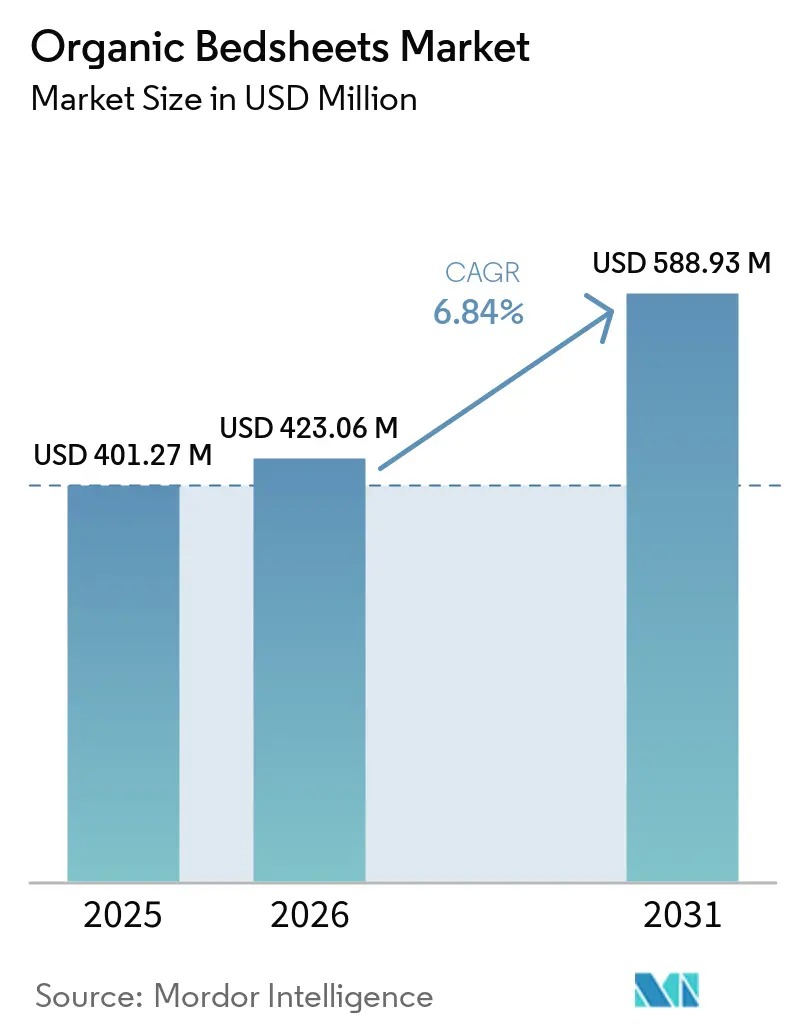
| Market Size (2026) | USD 423.06 Million |
| Market Size (2031) | USD 588.93 Million |
| Growth Rate (2026 - 2031) | 6.84 % |
| Fastest Growing Market | Asia-Pacific |
| Largest Market | North America |
| Market Concentration | Low |
Major Players *Disclaimer: Major Players sorted in no particular order Image © Mordor Intelligence. Reuse requires attribution under CC BY 4.0. | |
Organic Bedsheets Market Analysis by Mordor Intelligence
The global organic bedsheets market size was valued at USD 401.3 million in 2025 and estimated to grow from USD 423.1 million in 2026 to reach USD 588.9 million by 2031, at a CAGR of 6.8% during the forecast period (2026-2031). The global organic bedsheets market is supported by demand for certified materials among households that seek bedding with documented fiber content and production controls. Certification and traceability have become more important as retailers, institutional buyers, and consumers evaluate organic claims. Digital retail gives specialist brands a direct route to buyers, while hospitality and healthcare procurement creates a separate commercial channel. Supply conditions remain important because certified organic fiber production is concentrated in a limited number of sourcing regions. The global organic bedsheets market also faces pressure from certification costs, misleading environmental claims, and changes in cotton supply conditions.
Key Report Takeaways
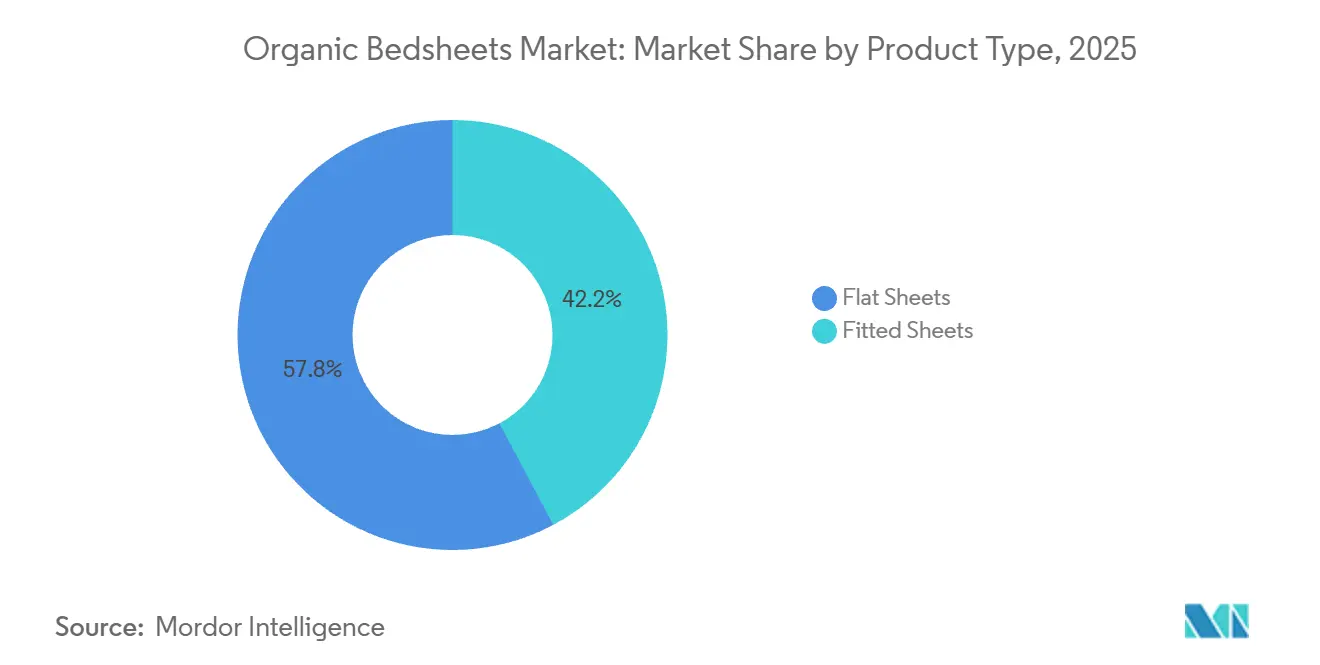
- By product type, fitted sheets held 42.2% of the global organic bedsheets market share in 2025 and are forecast to remain the fastest-growing format through 2031.
- By material, organic cotton led the material category in 2025, while organic hemp is forecast to register an 8.9% CAGR through 2031.
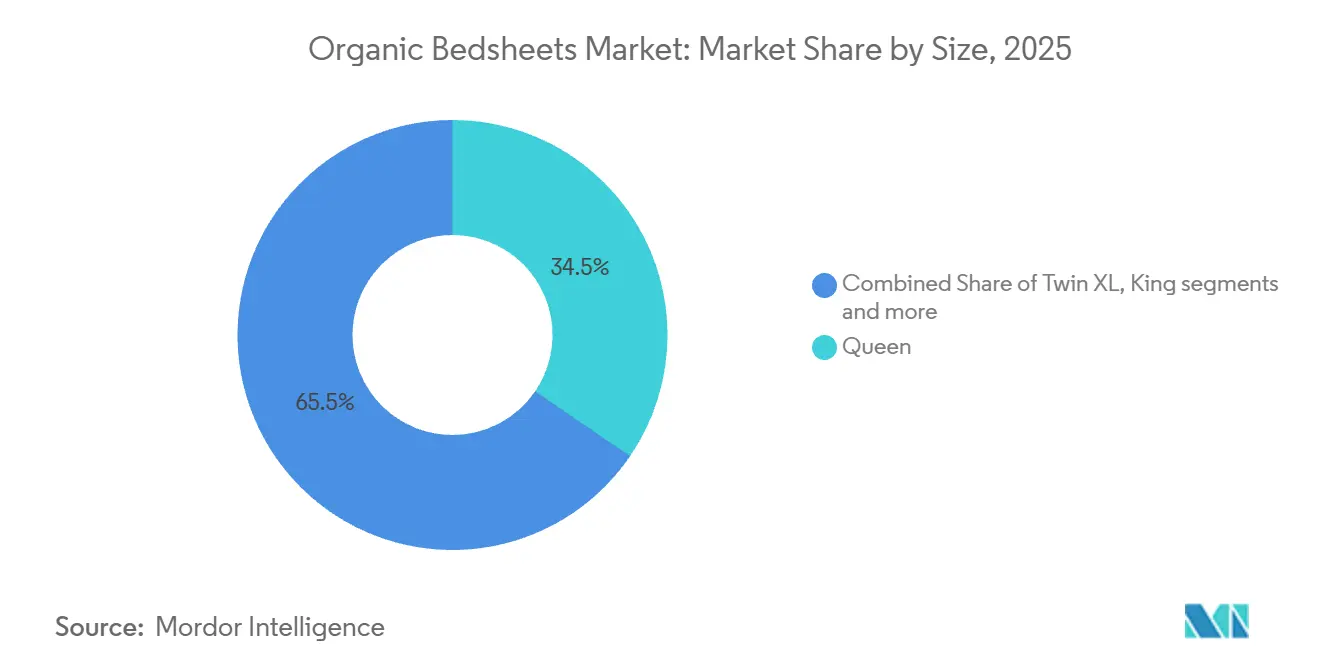
- By size, queen-sized sheets accounted for 34.5% of the global organic bedsheets market in 2025, while king-sized sheets are expected to register an 8.6% CAGR through 2031.
- By end-user, residential users held the leading share in 2025, while commercial demand is forecast to register an 8.1% CAGR through 2031.
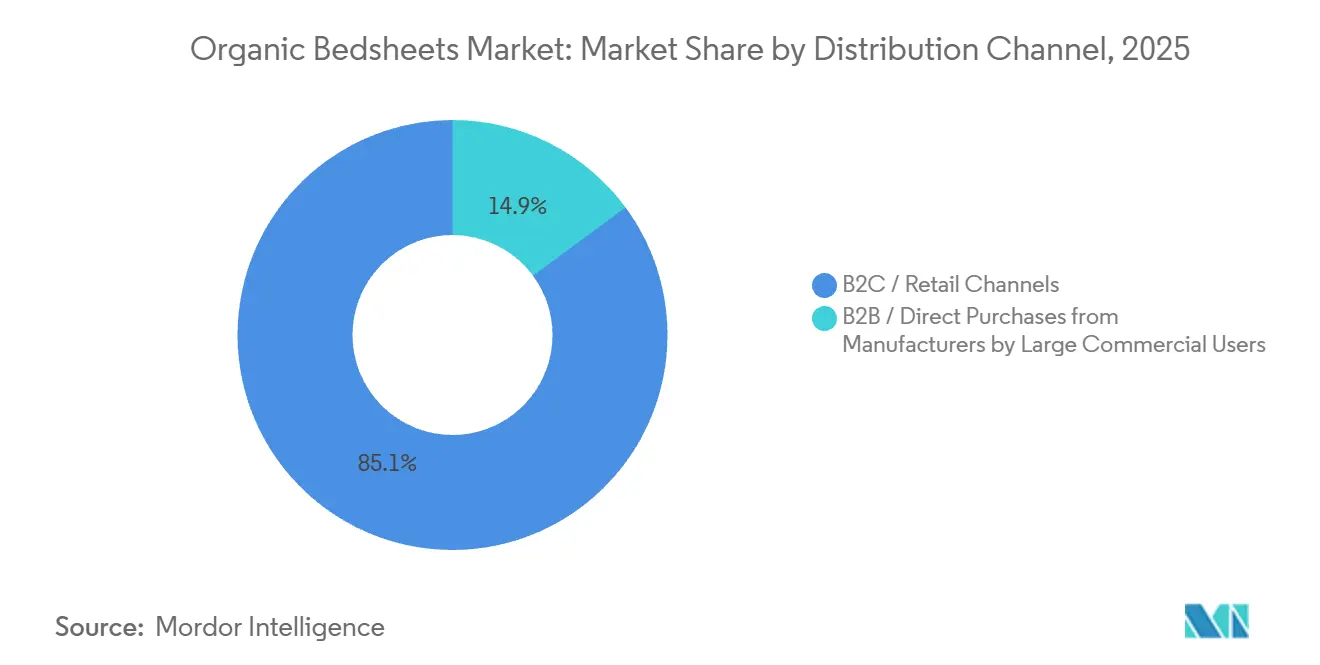
- By distribution channel, B2C and retail accounted for 85.1% of demand in 2025, while B2B direct purchasing served large-volume institutional buyers.
- By geography, North America held 32.3% of demand in 2025, while Asia-Pacific is projected to register an 8.3% CAGR through 2031.
Note: Market size and forecast figures in this report are generated using Mordor Intelligence’s proprietary estimation framework, updated with the latest available data and insights as of January 2026.
Global Organic Bedsheets Market Trends and Insights
Drivers Impact Analysis*
| Driver | (~) % Impact on CAGR Forecast | Geographic Relevance | Impact Timeline |
|---|---|---|---|
| Health and Chemical-Exposure Avoidance | +1.8% | Global, with strongest demand in North America and Northern Europe | Short term (≤ 2 years) |
| Certification-Led Trust and Traceability | +1.3% | North America and Europe, with spillover to the Asia-Pacific premium segment | Medium term (2-4 years) |
| E-Commerce and Direct-to-Consumer Access | +1.1% | Global, led by North America and Asia-Pacific e-commerce hubs | Short term (≤ 2 years) |
| Hospitality and Healthcare Procurement Shift | +1.0% | Global, with concentration in Asia-Pacific and Middle East luxury hospitality corridors | Medium term (2-4 years) |
| Organic Fiber Availability and Product Innovation | +0.8% | Asia-Pacific supply origins, especially India and Turkey, with consumption in North America and Europe | Medium term (2-4 years) |
| Climate-Responsive Comfort and Thermal Regulation | +0.6% | Tropical Asia-Pacific and the Middle East, with emerging demand in South America | Long term (≥ 4 years) |
| Source: Mordor Intelligence | |||
Health, Chemical Exposure, and Climate-Responsive Comfort
Health concerns affect how consumers assess bedding that remains in contact with the body for long periods. Conventional textile processing can involve pesticides, bleaching agents, and finishing chemicals, which has raised attention to fiber sourcing and chemical management. Certified organic cotton provides a documented alternative for households with sensitive-skin requirements. This consideration is especially relevant for children’s bedding, where parents often place greater weight on verified material claims. Breathability and thermal comfort also support demand in warm climates, where consumers value materials that manage moisture during sleep. These factors give the global organic bedsheets market a health and comfort rationale that extends beyond environmental positioning.
Certification, Traceability, and Organic Fiber Innovation
GOTS reported 17,800 certified facilities across 95 countries in 2025, an increase of 15.3% from 2024[1]https://global-standard.org/images/260504_RZ_GOTS_Annual_Report_2025_Screen.pdf. India accounted for 27.8% of those facilities, followed by China at 17.3% and Turkey at 11.7%. The expansion gives buyers a broader pool of audited suppliers, but it also makes verifiable certification a more visible requirement in premium retail and institutional purchasing. Global Standard’s CoCuRA monitoring initiative uses satellite-based analysis to distinguish organic and conventional cotton fields and expanded from India to Turkey in 2025. Traceability tools can reduce the risk of transaction-certificate manipulation and help brands document their sourcing decisions. Organic hemp adds another route for product development because its durability and water-use profile can appeal to commercial buyers and consumers seeking alternatives to cotton.
E-Commerce and Direct-to-Consumer Access
Online selling allows certified bedding brands to explain fiber sourcing, certification, and product care directly to consumers. The channel reduces reliance on wholesale markdowns, which can otherwise limit the ability to fund certification and traceability. Direct retail also enables smaller specialists to reach national buyers without building broad physical-store networks. Coyuchi stated in 2026 that discovery through large language model search had become its fastest-growing source of new customers[2]https://www.shopify.com/nz/blog/coychi-feeling-over-features. This change favors brands with established product information, clear certification records, and trusted public materials. As digital discovery becomes more important, the global organic bedsheets market may reward suppliers that make product claims simple to verify.
Hospitality and Healthcare Procurement
Hospitality companies increasingly include sustainability requirements within supplier selection and procurement reviews. Accor described a procurement approach that uses supplier controls, third-party risk assessments, and participation in the Hospitality Alliance for Responsible Procurement[3]https://skift.com/2025/12/04/how-accor-is-turning-procurement-into-a-force-for-sustainable-change. These practices support demand for bedding suppliers that can provide documented certification and a consistent supply. Healthcare, elderly-care, military, and dormitory buyers also offer larger order sizes and repeat replacement cycles. Their requirements can align with bedding that is marketed around chemical management, durability, and material documentation. Certification costs remain a barrier to entry, which can support established suppliers that already operate at the scale needed for audited production.
Restraints Impact Analysis*
| Restraint | (~) % Impact on CAGR Forecast | Geographic Relevance | Impact Timeline |
|---|---|---|---|
| Organic Fiber Supply Volatility and Conversion Periods | -0.7% | Global, with the highest exposure in India and Turkey | Medium term (2-4 years) |
| Certification Cost, Greenwashing, and Consumer Confusion | -0.6% | Global, with greater exposure in European and North American premium segments | Short term (≤ 2 years) |
| Price Premium and Discretionary-Spending Sensitivity | -0.5% | Global, with the greatest exposure in South America and emerging Asia-Pacific economies | Short term (≤ 2 years) |
| Yield, Weather, and Geopolitical Exposure in Cotton Supply Chains | -0.6% | South Asia, Turkey, and Central Asia, with spillover to European and North American buyers | Medium term (2-4 years) |
| Source: Mordor Intelligence | |||
Organic Fiber Supply Volatility, Conversion Periods, and Cotton Supply Risk
Organic conversion requires a multiyear process, which limits the pace at which growers can respond to higher demand. The USDA National Organic Program sets requirements for organic agricultural production and certification[4]https://www.ams.usda.gov/about-ams/programs-offices/national-organic-program. This creates a time gap between a demand signal and the availability of additional certified fiber. Weather events can interrupt harvests and may force manufacturers to seek fiber from alternative origins. Cotton transit routes also expose buyers to disruption when geopolitical conditions affect regional logistics. The global organic bedsheets market, therefore, remains dependent on resilient sourcing arrangements, supplier diversification, and stable conversion incentives for growers.
Certification Cost, Greenwashing, Consumer Confusion, and Price Sensitivity
Certification helps distinguish verified organic products, but audit, testing, and documentation requirements can increase supplier costs. These costs are difficult to absorb in lower-priced categories, especially when competing products use broad environmental claims without comparable verification. Global Standard reported that it investigated 12 fraud cases in 2025, demonstrating the importance of credible controls. Consumer confusion can narrow the visible difference between fully certified bedsheets and products labeled as natural or eco-friendly. Price-sensitive buyers may then choose lower-priced alternatives, even when those alternatives do not offer equivalent documentation. The planned Global Responsible Textile Standard is intended to broaden the certification framework, but adoption will take time.
*Our forecasts treat driver/restraint impacts as directional, not additive. The impact forecasts reflect baseline growth, mix effects, and variable interactions.
Segment Analysis
By Product Type: Fitted Sheets Lead on Skin Contact and Daily Use
Fitted sheets held 42.2% of the product category in 2025 and were also the fastest-growing format. Their close and regular contact with the sleeper makes material sourcing and chemical-management claims especially relevant. They also work well in accommodation settings that need quick linen changes between guest stays. Elasticated corners can simplify bed-making and create a practical advantage for hotel operations. Residential demand and commercial replacement needs, therefore, support the format through different purchasing patterns.
Flat sheets held the remaining product demand and remain relevant in European and South Asian bedding configurations. In these markets, flat sheets are often used with duvets and are part of familiar household routines. Luxury hotels may use them with fitted sheets in standardized bedding sets, which supports bundled procurement. North American households have increasingly favored fitted-sheet and duvet combinations, placing pressure on flat-sheet demand in some residential settings. Pre-washed and easier-care finishes could address laundry and ironing concerns for hospitality buyers.


By Material: Organic Cotton Holds the Base While Hemp Gains Ground
Organic cotton held the dominant material position in 2025 because it is familiar to consumers and supported by established manufacturing systems. The material is widely used in certified supply chains that serve North American and European customers. India’s 27.8% share of GOTS-certified facilities strengthens its role in the supply of organic cotton products. India’s Kasturi Cotton Program includes KCTrack, a traceability platform designed to provide origin verification. This infrastructure helps organic cotton remain central to the global organic bedsheets market.
Organic hemp is forecast to grow at an 8.9% CAGR through 2031, making it the fastest-growing material option. It offers durability that can be useful for bedding exposed to frequent washing in healthcare, dormitories, and other institutional settings. USDA data showed certified organic hemp cropland in the United States rising from 3,100 acres in 2019 to 15,400 acres in 2022. Organic linen serves buyers who value breathability and temperature regulation, while organic wool addresses therapeutic and cold-climate uses. Bamboo-derived and other cellulosic fibers remain specialized options, although labeling practices continue to receive regulatory scrutiny in the United States and Europe.
By Size: Queen-Sized Sheets Support Volume While King Sizes Reflect Premium Demand
Queen-sized sheets accounted for 34.5% of the global organic bedsheets market size in 2025. Their use as a common household and hotel bed format supports predictable production runs and broad retail availability. Hotels often standardize around queen configurations to serve both corporate and leisure travelers. This consistency can give suppliers a reliable replenishment base when guestrooms are renovated. The category’s scale also helps manufacturers reduce changeover complexity compared with specialty sizes.
King-sized sheets are forecast to grow at an 8.6% CAGR through 2031. Demand comes from households that treat larger beds as part of a broader sleep and home upgrade. These purchasers can be more willing to select certified materials as part of a full bedding replacement. Twin and single formats retain a stable role in dormitories, military facilities, and travel accommodations. Twin XL is closely linked to college housing, while crib and toddler sheets serve a smaller but important child-focused category.

By End-User: Residential Demand Anchors Sales While Commercial Buyers Grow Faster
Residential users held the largest end-user position in 2025, providing the principal volume base for the category. Household buying is shaped by comfort, certification confidence, material preference, and online access. Digital-first brands can build repeat demand by offering clear product information and consistent fabric specifications. Nursery and children’s bedding is a distinct residential opportunity because parents often prioritize the sleep environment. A 2025 in-home study examined children’s exposure to chemicals of concern in sleeping environments, including links with synthetic textile products.
Commercial demand is expected to grow at an 8.1% CAGR through 2031. Hospitality, healthcare, and institutional buyers increasingly review certification and supply-chain documentation within procurement decisions. Hotel groups can use certified linens as part of guest experience and sustainability programs. Healthcare and elderly-care settings also have regular replacement needs that can provide repeat purchasing patterns. The global organic bedsheets market benefits when suppliers can meet large order quantities while retaining documented product controls.
By Distribution Channel: B2C Leads While Direct Purchasing Serves Institutions
B2C and retail channels accounted for 85.1% of distribution demand in 2025. Specialty stores, department-store placements, online marketplaces, and direct brand websites all contribute to this position. Direct-to-consumer models allow brands to communicate certification details without relying on a retailer to explain the distinction. Boll & Branch reported revenue of USD 250 million in 2025 through a hybrid direct retail and experiential store approach. Physical stores can complement digital research by enabling buyers to feel fabrics and compare products before purchase.
B2B direct purchasing represents a smaller share but offers large-volume transactions. Hospitality groups, healthcare operators, and other institutions require contract pricing, supply continuity, and auditable documentation. Welspun Living states that its WelKrishi program supports more than 75,000 farmers through sustainable sourcing activities. Such programs give large manufacturers a route to address institutional requirements across purchasing cycles. Membership programs and sleep consultations at specialty stores may also help brands convert online researchers into higher-value customers.
Geography Analysis
North America held 32.3% of the global organic bedsheets market share in 2025. The region combines high spending on premium home goods with established imports from certified textile suppliers. The United States is the main demand center, supported by direct-to-consumer bedding brands and broad consumer awareness of third-party organic claims. Boll & Branch reported USD 250 million in revenue in 2025 and expanded its store network to 15 locations, showing continued investment in the United States premium bedding retail. Canada has comparable demand in urban areas, while Mexico offers room for more accessible certified products among upper-middle-income households.
Europe has a mature certification environment where GOTS and OEKO-TEX labels are widely recognized by consumers and business buyers. Germany, France, and the Nordic countries show strong attention to textile durability, material disclosure, and chemical management. The German Environment Agency published a 2026 study on ecodesign requirements for textiles under the Ecodesign for Sustainable Products Regulation. The European Commission identifies textiles as a priority product group in the 2025 to 2030 ESPR working plan. The global organic bedsheets market can benefit as suppliers build the product information and traceability systems needed for these rules.
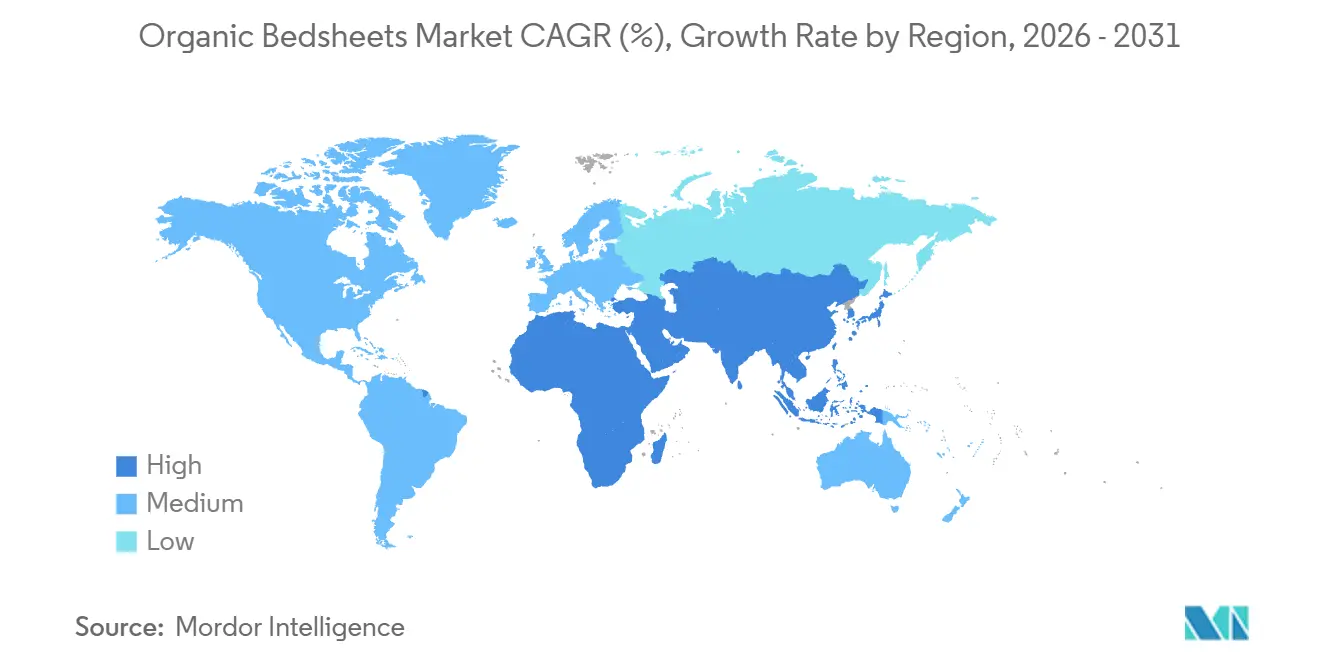
Asia-Pacific is projected to grow at an 8.3% CAGR through 2031. India and China are expanding beyond their production roles as domestic consumers gain access to certified bedding through digital channels. India’s urban households provide a local customer base for direct-to-consumer brands, while its certified manufacturing base supports export supply. China’s larger cities contain premium home-goods buyers that associate certification with quality and environmental performance. South America has more modest near-term demand, though Peru provides a credible cotton heritage and luxury hospitality supports early commercial activity. The Middle East and Africa are driven by luxury hotel demand in the UAE and Saudi Arabia, while South Africa remains an emerging retail location.

Competitive Landscape
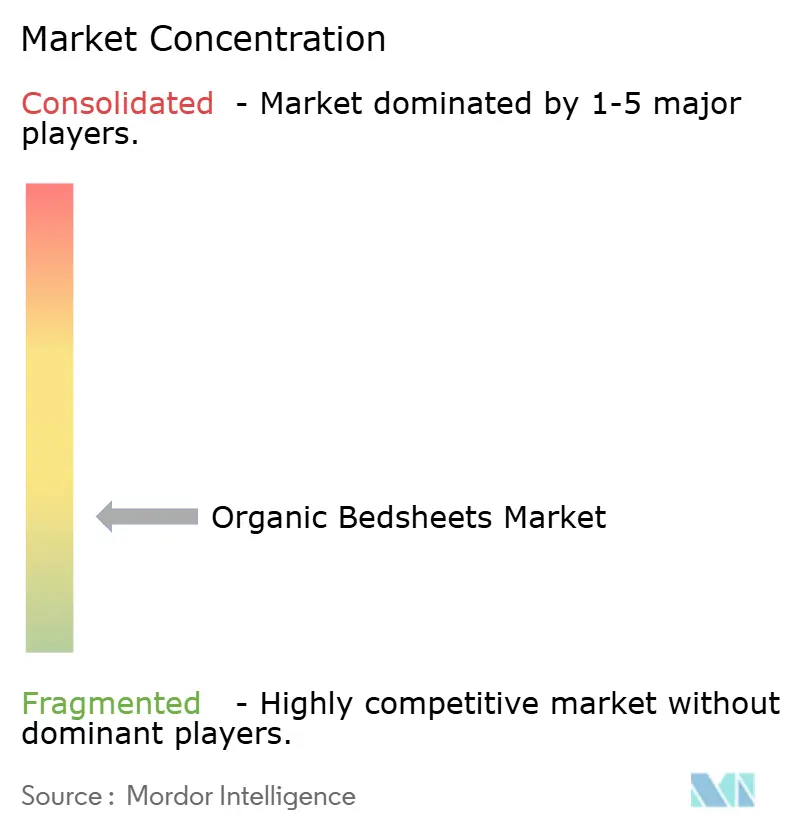
The global organic bedsheets market is fragmented. Certified specialist brands are prominent in premium residential and direct retail, while larger home-textile manufacturers supply institutional and broader retail programs. Specialist brands compete through clear certification, transparent sourcing, and product positioning. Large manufacturers compete through volume, production capacity, long-term buyer relationships, and sustainability programs. This division gives buyers a choice between focused premium brands and scale suppliers.
Welspun Living reported a score of 90 in the 2025 S&P Global Corporate Sustainability Assessment for Textile, Apparel, and Luxury Goods, compared with 66 in 2023. The company’s sustainability program and supplier activities can strengthen its position with institutional customers that need documented sourcing. Boll & Branch launched farm-level traceability in 2024, allowing customers to use a product code to review cotton origin details. That feature addresses concerns about unverifiable organic claims and raises expectations for premium competitors. IKEA’s GOTS-certified organic cotton ranges can make certified products more familiar to mainstream buyers, even as they place pressure on lower-end price premiums.
Opportunity remains in climate-adapted bedding for tropical Southeast Asian and Middle Eastern markets, where breathability and moisture control affect purchase decisions. Healthcare and elderly-care procurement also remains underdeveloped despite its alignment with documented materials and repeat replacement needs. Women-led direct-to-consumer brands in Jaipur combine GOTS certification with artisan product positioning for urban Indian and international ethical-luxury buyers. Upcoming Digital Product Passport requirements may favor manufacturers with established traceability systems. The European Commission expects a textile Digital Product Passport requirement through a future delegated act, which is tentatively planned for the fourth quarter of 2027. This may increase consolidation pressure among mid-market suppliers that lack supply-chain visibility.
Organic Bedsheets Industry Leaders
Welspun India Ltd.
Trident Group
American Textile Company
WestPoint Home LLC
Boll & Branch LLC
- *Disclaimer: Major Players sorted in no particular order

Recent Industry Developments
- June 2026: Welspun Living's Nevada manufacturing plant reached full commercial production on June 15, 2026, targeting USD 60 million in FY27 revenue from U.S.-based home textile output. The plant is operated through Welspun USA Inc. and supports a near-market manufacturing strategy that reduces transit lead times and strengthens the company’s ability to serve North American commercial bedding procurement contracts.
- February 2026: Naturepedic announced a retail partnership with Williams-Sonoma's GreenRow sustainable home platform. The arrangement made Naturepedic GreenRow’s exclusive mattress supplier and introduced 3 GOTS-certified organic models. The partnership extended the company’s certified organic sleep products into a premium retail channel with broad reach in the North American sustainable-home category.
- September 2025: Coyuchi and Avocado Green Mattress announced a cross-distribution partnership. The agreement brought Coyuchi’s organic bedding collections to more than 800 Avocado retail doors and Avocado’s certified organic sleep products to Coyuchi.com. It gave Coyuchi a larger physical retail presence while widening access to certified organic bedsheets among Avocado’s health-conscious customer base.
- September 2025: Boll & Branch opened its 14th and 15th retail locations in Charlotte, North Carolina, and Bethesda, Maryland. The company reported USD 250 million in revenue in 2025 and stated that in-store customers spent 4 to 5 times more than online shoppers. It also launched a retail partnership with Over The Moon for its certified organic bedding collection, which placed its products in a gifting and registry channel for premium household-formation consumers.


Global Organic Bedsheets Market Report Scope
| Flat Sheets |
| Fitted Sheets |
| Organic Cotton |
| Organic Linen |
| Organic Hemp |
| Organic Wool |
| Bamboo-Derived Cellulosic Fibers |
| Other Certified Natural Fibers |
| Twin and Single |
| Twin XL |
| Full and Double |
| Queen |
| King |
| Rest of Sizes, California King, Super King, Crib, and Toddler |
| Residential | |
| Commercial | Hospitality, Hotels and Resorts |
| Healthcare and Elderly-Care Facilities | |
| Institutional, Dormitories and Military | |
| Other Commercial End Users |
| B2C / Retail Channels | Multi-Brand Stores |
| Specialty Bedding Stores, Including Exclusive Brand Outlets | |
| Online | |
| Other Distribution Channels | |
| B2B / Direct Purchases from Manufacturers by Large Commercial Users |
| North America | Canada |
| United States | |
| Mexico | |
| South America | Brazil |
| Peru | |
| Chile | |
| Argentina | |
| Rest of South America | |
| Europe | United Kingdom |
| Germany | |
| France | |
| Spain | |
| Italy | |
| BENELUX (Belgium, Netherlands, and Luxembourg) | |
| NORDICS (Denmark, Finland, Iceland, Norway, and Sweden) | |
| Rest of Europe | |
| Asia-Pacific | India |
| China | |
| Japan | |
| Australia | |
| South Korea | |
| South East Asia (Singapore, Malaysia, Thailand, Indonesia, Vietnam, and the Philippines) | |
| Rest of Asia-Pacific | |
| Middle East and Africa | United Arab Emirates |
| Saudi Arabia | |
| South Africa | |
| Nigeria | |
| Rest of the Middle East and Africa |
| By Product Type | Flat Sheets | |
| Fitted Sheets | ||
| By Material | Organic Cotton | |
| Organic Linen | ||
| Organic Hemp | ||
| Organic Wool | ||
| Bamboo-Derived Cellulosic Fibers | ||
| Other Certified Natural Fibers | ||
| By Size | Twin and Single | |
| Twin XL | ||
| Full and Double | ||
| Queen | ||
| King | ||
| Rest of Sizes, California King, Super King, Crib, and Toddler | ||
| By End-User | Residential | |
| Commercial | Hospitality, Hotels and Resorts | |
| Healthcare and Elderly-Care Facilities | ||
| Institutional, Dormitories and Military | ||
| Other Commercial End Users | ||
| By Distribution Channel | B2C / Retail Channels | Multi-Brand Stores |
| Specialty Bedding Stores, Including Exclusive Brand Outlets | ||
| Online | ||
| Other Distribution Channels | ||
| B2B / Direct Purchases from Manufacturers by Large Commercial Users | ||
| By Geography | North America | Canada |
| United States | ||
| Mexico | ||
| South America | Brazil | |
| Peru | ||
| Chile | ||
| Argentina | ||
| Rest of South America | ||
| Europe | United Kingdom | |
| Germany | ||
| France | ||
| Spain | ||
| Italy | ||
| BENELUX (Belgium, Netherlands, and Luxembourg) | ||
| NORDICS (Denmark, Finland, Iceland, Norway, and Sweden) | ||
| Rest of Europe | ||
| Asia-Pacific | India | |
| China | ||
| Japan | ||
| Australia | ||
| South Korea | ||
| South East Asia (Singapore, Malaysia, Thailand, Indonesia, Vietnam, and the Philippines) | ||
| Rest of Asia-Pacific | ||
| Middle East and Africa | United Arab Emirates | |
| Saudi Arabia | ||
| South Africa | ||
| Nigeria | ||
| Rest of the Middle East and Africa | ||


Key Questions Answered in the Report
What is driving demand for organic bedsheets?
Demand is supported by interest in certified materials, documented sourcing, direct online access, and commercial procurement requirements. Buyers are increasingly looking for clear information on fiber origin, chemical management, and third-party certification. Hotels and institutions also assess audited supply chains when they select bedding suppliers. These factors connect household wellness preferences with more formal purchasing requirements.
How large is the global organic bedsheets market?
The category is estimated at USD 423.1 million in 2026 and is forecast to reach USD 588.9 million by 2031 at a 6.8% CAGR. The estimate reflects demand from residential customers and a faster-growing commercial segment. Certification, traceability, and digital retail access are important parts of the outlook. Supply reliability remains a key consideration because certified fiber capacity is not easily expanded.
Which product type leads demand for organic bedsheets?
Fitted sheets led product demand with 42.2% in 2025 and were also the fastest-growing format. Their regular and close contact with the sleeper makes the choice of certified materials particularly relevant. Hotels also value the format because it can support faster bed changes during room turnover. Flat sheets remain important in regions where duvet and flat-sheet combinations are widely used.
Which material is growing fastest in organic bedding?
Organic hemp is projected to grow at an 8.9% CAGR through 2031, while organic cotton remained the leading material. Hemp provides a durable alternative for buyers that expect frequent washing and use. Organic cotton retains a wide base because consumers know the material and certified supply chains are already established. Linen, wool, and bamboo-derived fibers serve more specialized comfort and climate needs.
Page last updated on:


 Your data is secure and never sold or shared.


