
Organic Bedding Market Size and Share
Market Overview
| Study Period | 2020 - 2031 |
|---|---|
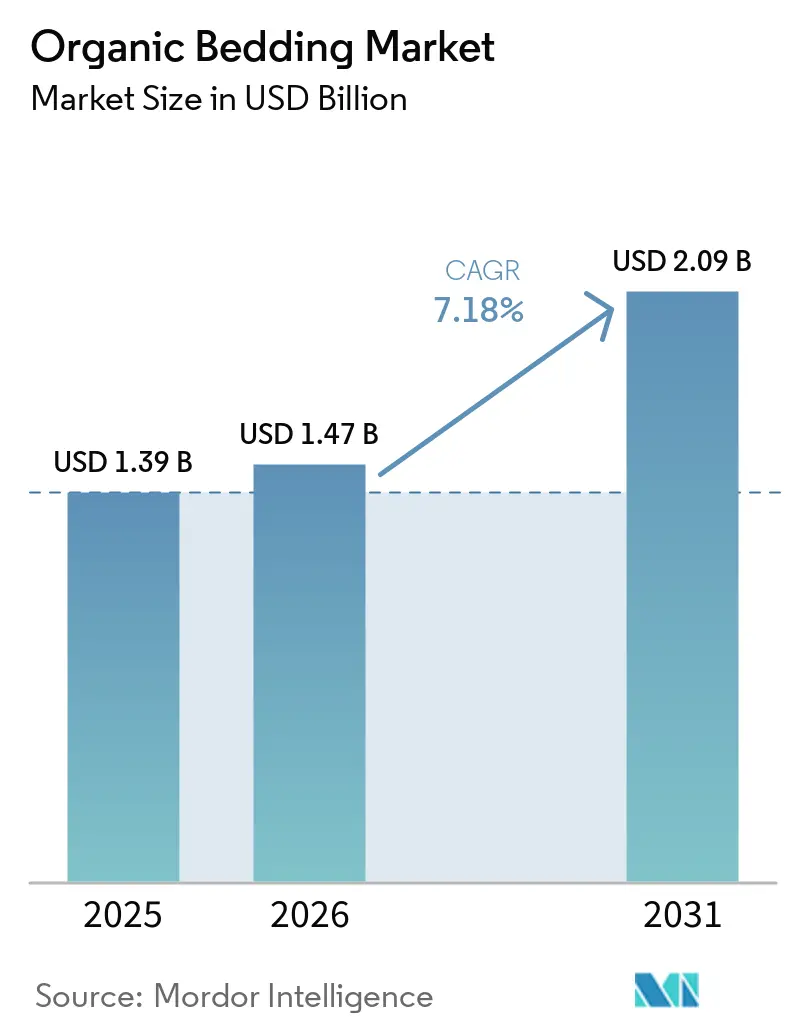
| Market Size (2026) | USD 1.47 Billion |
| Market Size (2031) | USD 2.09 Billion |
| Growth Rate (2026 - 2031) | 7.18 % |
| Fastest Growing Market | Asia-Pacific |
| Largest Market | Asia-Pacific |
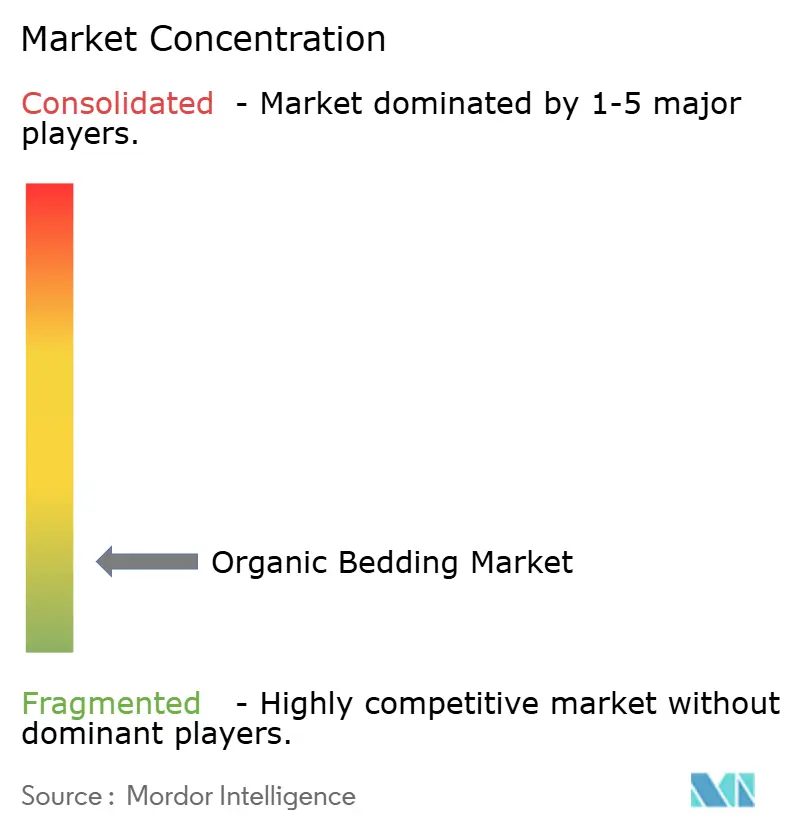
| Market Concentration | Low |
Major Players *Disclaimer: Major Players sorted in no particular order Image © Mordor Intelligence. Reuse requires attribution under CC BY 4.0. | |
Organic Bedding Market Analysis by Mordor Intelligence
The organic bedding market size was valued at USD 1.39 billion in 2025 and is estimated to grow from USD 1.5 billion in 2026 to reach USD 2.09 billion by 2031, at a CAGR of 7.2% during the forecast period (2026-2031). The organic bedding market is expanding as households place greater weight on sleep quality, material safety, and traceable sourcing. Bedding made with certified fibers has moved beyond a narrow wellness purchase and into more mainstream consideration for home furnishing decisions. Concerns around chemical finishes, flame retardants, and pesticide residues have increased the value placed on products with credible certification. Manufacturers are responding through broader product ranges, stronger material traceability, and selective retail partnerships. The organic bedding market also has an opportunity in commercial procurement, where hotels and wellness properties can use certified products as part of a guest experience.
Key Report Takeaways
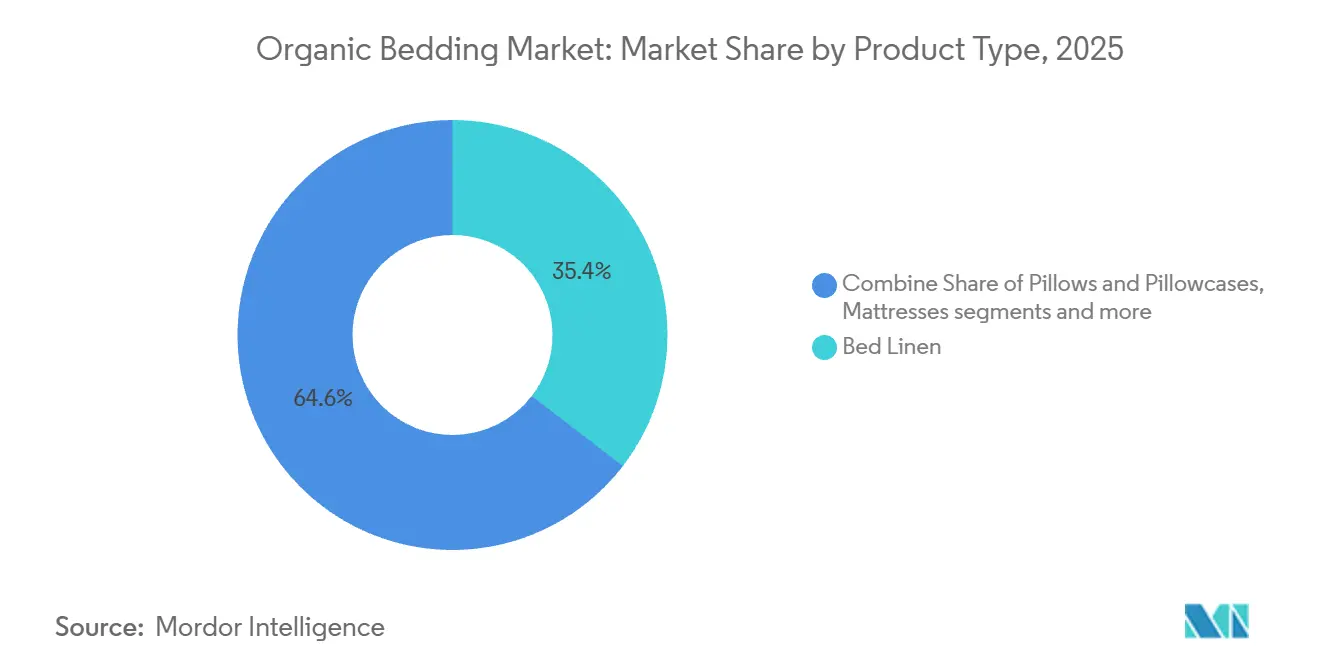
- By product type, bed linen held 35.4% of the organic bedding market share in 2025, while mattresses are forecast to register a 7.9% CAGR through 2031.
- By material, organic cotton accounted for 62.7% of the organic bedding market share in 2026, while organic hemp is projected to register an 8.8% CAGR through 2031.
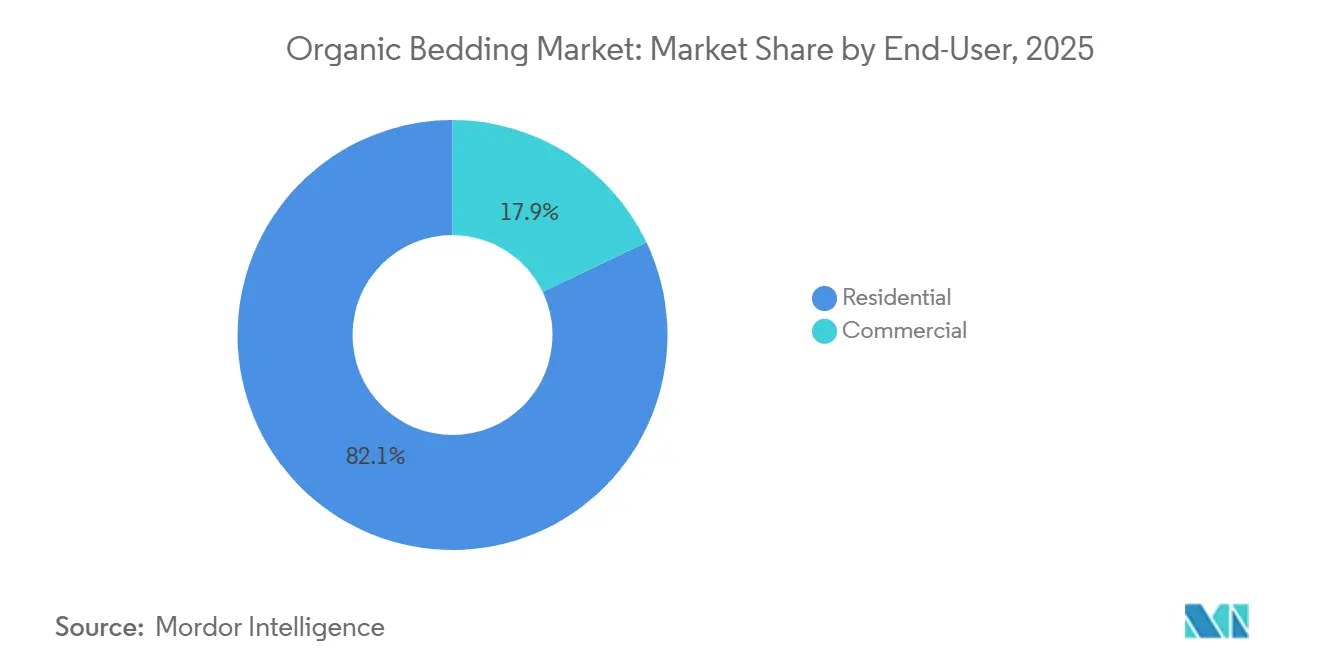
- By end-user, residential users held 82.2% of revenue in 2025, while commercial users are forecast to register the highest CAGR, at 8.5%, through 2031.
- By distribution channel, B2C and retail channels held 91.4% of revenue in 2025, while B2B and direct purchases are forecast to register an 8.2% CAGR through 2031.
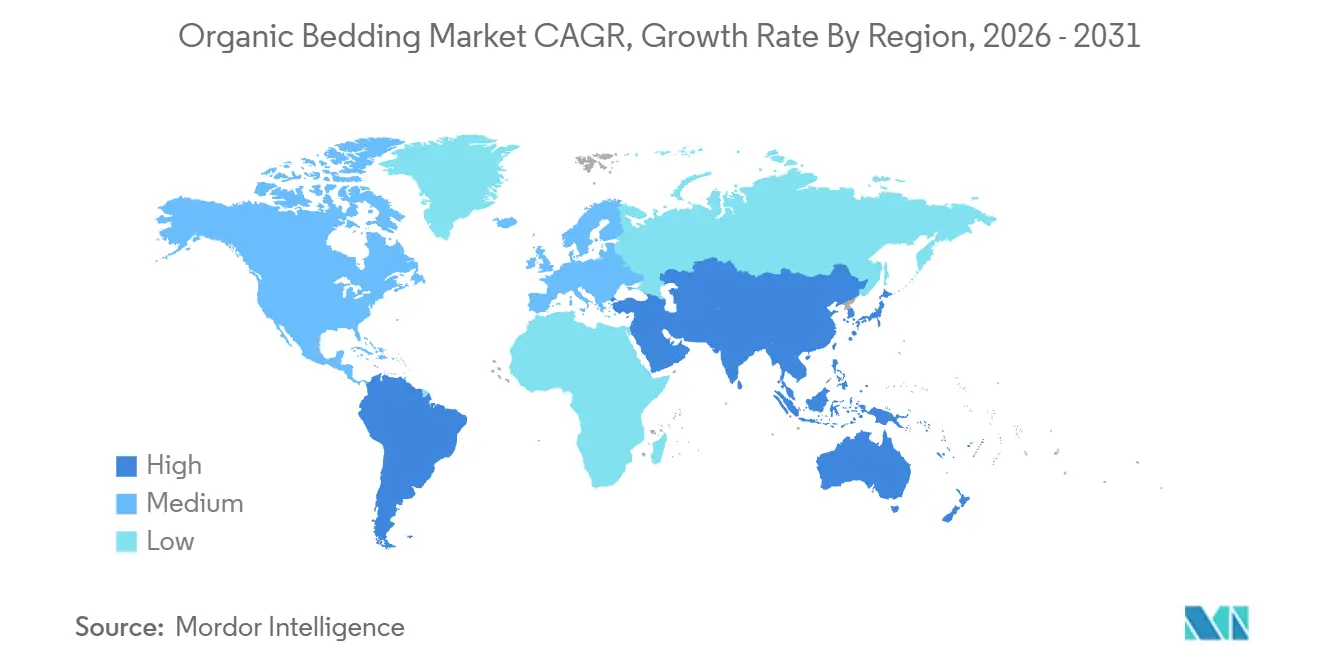
- By geography, Asia-Pacific held 36.5% of revenue in 2025 and is forecast to register a 7.6% CAGR through 2031.
Note: Market size and forecast figures in this report are generated using Mordor Intelligence’s proprietary estimation framework, updated with the latest available data and insights as of January 2026.
Global Organic Bedding Market Trends and Insights
Drivers Impact Analysis*
| Driver | (~) % Impact on CAGR Forecast | Geographic Relevance | Impact Timeline |
|---|---|---|---|
| Sleep-health and indoor chemical-exposure awareness | +2.5% | Global; North America & Europe leading adoption | Short term (≤ 2 years) |
| Sustainability-led premiumization of home textiles | +2.0% | North America, Europe, APAC core | Medium term (2–4 years) |
| Certification-led consumer trust and retail conversion | +1.5% | EU, North America, Australia | Short-medium term (≤ 3 years) |
| E-commerce and direct-to-consumer access to niche organic assortments | +1.2% | North America, Europe, APAC | Short term (≤ 2 years) |
| Hospitality and wellness properties adopting certified bedding | +1.0% | APAC, Middle East, Europe | Short-medium term (≤ 3 years) |
| Product innovation in breathable, temperature-regulating and regenerative fibres | +0.8% | North America, Europe | Medium-long term (≥ 3 years) |
| Source: Mordor Intelligence | |||
Sleep-Health Awareness Is Driving Category Entry at Scale
Sleep health has become a more important part of household wellness decisions, bringing the organic bedding market into regular replacement cycles. Buyers are paying closer attention to conventional flame retardants, formaldehyde-based finishes, and pesticide residues in products that remain in close contact with the body. The Global Wellness Institute identified deep rest as one of the fastest-growing parts of the wellness economy in 2026, which supports the increasing focus on sleep as a health priority. Certified bedding gives consumers a way to address these concerns through a visible product choice. Once a household changes bedding for health-related reasons, future purchases may continue to favor certified materials. This pattern supports repeat demand for brands that maintain clear certification credentials.
Certification Ecosystems Are Raising the Bar for Brand Credibility
Certification has become more important for product credibility and retail access in the organic bedding market. GOTS-certified facilities increased 15.3% in 2025 to 17,800 sites across 95 countries[1]Global Standard, “GOTS Annual Report 2025: Certified Facilities Grow 15.3% Globally,” Global Standard, global-standard.org. India accounted for 27.8% of certified facilities, followed by China at 17.3% and Turkey at 11.7%. GOTS Version 8.0, released in March 2026, added circular economy principles and due diligence expectations, with mandatory adherence beginning in March 2027. OEKO-TEX ORGANIC COTTON certifications grew by more than 200% in the 2025/26 financial year, with more than 33 million kg certified at the ginning level across 20 countries[2]OEKO-TEX, “Annual Report 2025/26: Traceability Becomes a Market Requirement,” OEKO-TEX Association, oeko-tex.com. These developments make documented certification more important for brands seeking consumer trust and retailer acceptance.
E-Commerce and DTC Are Reshaping the Competitive Boundary
Digital channels have changed how consumers discover and purchase organic bedding products. Brands such as Coyuchi, Avocado Green Brands, and Boll & Branch use direct-to-consumer channels to explain product materials and certification details. This model allows brands to keep closer control over product information and the customer relationship. Online content can help buyers compare certifications before purchasing products that often require more research than conventional bedding. Specialty stores remain important because shoppers can assess comfort, texture, and fit before buying a premium mattress or pillow. The organic bedding market is therefore developing through both direct digital sales and selected physical retail access.
Hospitality Is Emerging as a Structural Commercial Volume Driver
Hotels and wellness properties are increasingly using certified bedding to support premium guest experiences in the organic bedding market. Huvafen Fushi partnered with Heveya in September 2026 to provide personalized sleep wellness experiences that include organic-latex mattresses, organic bamboo-cotton bedding, and French linen options. The partnership shows how bedding can be presented as an amenity rather than only as an operating expense. Commercial buyers tend to require evidence on materials, sourcing, and certification. This makes detailed documentation more important for suppliers serving hospitality customers. It also favors companies that can support larger orders with reliable, certified supply chains.
Restraints Impact Analysis*
| Restraint | (~) % Impact on CAGR Forecast | Geographic Relevance | Impact Timeline |
|---|---|---|---|
| Certified organic fibre supply scarcity and price volatility | -0.9%% | Global; acute in India, Bangladesh, Turkey | Short-medium term (≤ 3 years) |
| Certification, audit, and chain-of-custody cost burden | -0.5% | Global, with disproportionate impact on smaller brands | Short-medium term (≤ 3 years) |
| Premium price gap versus conventional bedding | -0.3% | Emerging markets; price-sensitive segments globally | Long term (≥ 4 years) |
| Greenwashing, claim inconsistency, and consumer confusion | -0.12% | EU primary; North America secondary | Short term (≤ 2 years) |
| Source: Mordor Intelligence | |||
Certified Organic Fiber Supply Remains a Chronic Bottleneck
Certified organic fiber supply remains limited even as demand from brands expands. U.S. organic cotton production reached 57,802 bales in 2025, while the 2026 outlook showed declining organic acreage as growers moved toward rotation crops[3]OEKO-TEX, “Annual Report 2025/26: Traceability Becomes a Market Requirement,” OEKO-TEX Association, oeko-tex.com. India represented 27.8% of GOTS-certified facilities in 2025, so weather, logistics, or regulatory disruptions there can affect certified supply chains serving other regions. Limited availability can make it harder for brands to secure stable input volumes and manage product margins. Certification, auditing, and chain-of-custody requirements add further costs, especially for smaller companies. The premium price of certified products can also limit adoption among more price-sensitive buyers.
Greenwashing Regulation Is Reshaping Brand Communication Globally
Unclear organic claims can weaken consumer confidence in products that depend on verified sourcing. Global Standard reported that Amazon’s U.S. and German platforms were major sources of GOTS labeling fraud complaints in its 2025 reporting. This highlights the importance of reliable certification information in online sales channels. Products supported by GOTS or OEKO-TEX documentation can provide a clearer basis for consumer comparison. Brands without recognized certification can face a more difficult path to building trust with retailers and buyers. Stronger verification requirements may improve product transparency, but they can also raise compliance demands for suppliers.
*Our forecasts treat driver/restraint impacts as directional, not additive. The impact forecasts reflect baseline growth, mix effects, and variable interactions.
Segment Analysis
By Product Type: Bed Linen Leads While Mattresses Grow Faster
Bed linen held 35.4% of the organic bedding market share in 2025, supported by its role as the most frequently replaced product category. Sheets, duvet covers, and pillowcases provide an accessible entry point for buyers who want to try certified bedding before making a larger purchase. Their lower cost relative to mattresses can reduce the initial purchase barrier for first-time customers. Mattresses are the fastest-growing product type, with the organic bedding market size for mattresses projected to grow at a 7.9% CAGR from 2026 to 2031. Consumers are increasingly applying organic material standards to long-use sleep surfaces where direct contact and chemical exposure are central concerns.
Coyuchi launched the Marin REM Mattress in February 2026 with GOTS-certified organic cotton and GOLS-certified Dunlop latex. Pillows and pillowcases serve gifting and allergy-related demand, while blankets and quilts benefit from seasonal purchasing patterns. Mattress toppers and pads can appeal to consumers who want a lower-cost route into certified sleep products before replacing a mattress. Avocado Green Brands has offered a topper line with OEKO-TEX STANDARD 100 Class I certification, demonstrating the role of toppers in this transition. Other products include certified crib bedding and baby textiles, where parental safety concerns can support a higher willingness to pay.



By Material: Organic Cotton Leads While Organic Hemp Gains Attention
Organic cotton accounted for 62.7% of the organic bedding market share in 2026, reflecting established supply chains, familiar certification systems, and broad consumer awareness. Its breathability, softness, and compatibility with commercial laundering support demand from both homes and commercial buyers. Organic linen and organic wool fill more specialized needs within the product range. Linen is used for temperature regulation and durability in temperate climates. Wool offers natural flame resistance, which can reduce the need for chemical flame retardants in certified mattresses.
Organic hemp is the fastest-growing material, with the organic bedding market size for hemp forecast to expand at an 8.8% CAGR from 2026 to 2031. The material is gaining attention as textile-grade supply infrastructure improves and consumers look for durable natural fibers. Bamboo-derived cellulosic fibers also have a notable presence, especially in the Asia-Pacific region. However, chemical processing can complicate organic certification claims for many bamboo textiles. Coyuchi has also added organic silk to premium collections, extending natural fiber options into luxury gifting and sleep wellness products.
By End-User: Residential Demand Leads While Commercial Use Expands
The residential segment held 82.2% of the organic bedding market share in 2025, confirming that household demand remains the main source of revenue. Consumers are moving from conventional bedding for health-related reasons and are also buying certified products for weddings and new-parent occasions. Residential shoppers may begin with sheets or pillowcases before moving to higher-priced mattresses and toppers. This staged purchasing path can help brands build long-term customer relationships. The residential organic bedding industry remains closely tied to product comfort, material safety, and certification visibility.
The commercial segment is forecast to grow at an 8.5% CAGR from 2026 to 2031, faster than the overall organic bedding market. Hospitality, hotels, and resorts are the most important commercial growth areas in the supplied analysis. Heveya’s collaboration with Huvafen Fushi shows how organic bedding can become part of a personalized guest sleep program. Healthcare and elderly-care facilities may also value hypoallergenic and low-VOC attributes in certified bedding. These buyers can place more emphasis on documentation and product consistency than on visual styling.
By Distribution Channel: B2C Retains Scale While Direct Procurement Advances
B2C and retail channels accounted for 91.4% of the organic bedding market size in 2025 because residential users remain the category’s main demand base. Online channels are especially important for direct-to-consumer brands that use product content to explain certification and material differences. Multi-brand stores and specialty bedding stores still provide value for tactile purchases. This is particularly true for mattresses and pillows, where physical trials can affect conversion. Naturepedic’s February 2026 partnership with GreenRow brought certified mattresses and organic crib mattresses to Williams-Sonoma’s sustainable home platform.
B2B and direct purchases from manufacturers are the fastest-growing channel, with a projected CAGR of 8.2% from 2026 to 2031. Procurement teams at hotels and healthcare organizations use different decision criteria than individual consumers. They may assess certification records, supply-chain traceability, carbon information, and audit requirements alongside price. Direct purchasing can allow commercial users to negotiate volume-based terms that reduce the gap with conventional bedding. GOTS chain-of-custody documentation and OEKO-TEX supply-chain records can support these purchasing decisions.
Geography Analysis
Asia-Pacific held 36.5% of the organic bedding market share in 2025 and is forecast to expand at a 7.6% CAGR through 2031. India is important to the region because it accounted for 27.8% of global GOTS-certified facilities in 2025. Its role combines certified textile production with growing domestic demand for chemical-free home products. China also contributes by expanding luxury wellness spending and support for organic farming. Internationally certified brands can use recognized standards to distinguish their products among premium Chinese consumers.
North America and Europe were the second- and third-largest regional markets, respectively, in the supplied analysis. Germany, the United Kingdom, and the Nordic countries have high per-capita demand for organic bedding products. Their retail systems provide established channels for GOTS and OEKO-TEX-certified goods. France, Spain, Italy, and the BENELUX region have lower but growing market penetration. Italy also offers a hospitality-led opportunity as premium hotels increase interest in certified guest amenities.
South America, the Middle East, and Africa remain earlier-stage parts of the organic bedding market. Brazil supports South American demand through premium retail expansion and wider e-commerce access to organic home goods. In the Middle East, the UAE and Saudi Arabia are important commercial centers because luxury resorts and hotels are expanding. International hotel groups can apply global ESG sourcing requirements to regional bedding procurement. South Africa and Nigeria have low certified bedding penetration, but improving incomes and a growing wellness customer base support longer-term demand.

Competitive Landscape
The organic bedding market is moderately fragmented, with specialized certified brands competing alongside larger home goods retailers. Avocado Green Brands, Coyuchi, Naturepedic, Birch Living, and SOL Organics have advantages in certification depth, brand identity, and direct-to-consumer operations. Certification remains a key point of differentiation for premium mattress and bedding suppliers. Avocado Green Brands reported simultaneous GOTS, OEKO-TEX STANDARD 100 Class I, MADE SAFE, EWG VERIFIED, GREENGUARD Gold, and B Corp credentials for its products. A broad certification record can make it more difficult for new entrants to establish comparable credibility.
Leading companies are extending portfolios into new product categories and expanding beyond direct sales. Coyuchi’s move from linens into mattresses is one example of a brand seeking a larger role in sleep products. Avocado has broadened its offer from mattresses into pillows, toppers, and related certified products. Channel partnerships also allow specialist brands to improve reach without building large standalone retail networks. The Avocado and Coyuchi collaboration announced in September 2025 placed Coyuchi bedding on Avocado’s e-commerce platform and in selected stores.
Commercial hospitality, certified baby bedding, organic hemp, and washable organic silk remain areas with room for differentiated offerings. Coyuchi introduced its first complete certified organic baby collection in September 2025, including crib sheets, quilts, blankets, towels, and a certified crib mattress. The company also introduced a washable organic silk line in September 2026. Avocado Green Brands launched the Green Firm Tight-Top Mattress in March 2026 with GOTS finished-product certification and 5 additional nontoxic standards. These actions show that product expansion and certification remain central competitive tools in the organic bedding market.
Organic Bedding Industry Leaders
Coyuchi
Boll & Branch LLC
Parachute Home Inc.
Naturepedic
Avocado Green Brands
- *Disclaimer: Major Players sorted in no particular order

Recent Industry Developments
- September 2026: Coyuchi unveiled its Fall 2026 "Art of Living Deeply" collection, featuring the brand’s first-ever washable organic silk line, Selene, including certified silk pillowcases, eye masks, and apparel. The launch expands the company’s material portfolio beyond organic cotton and brings it into luxury sleep-adjacent textiles.
- September 2026: Maldives luxury resort Huvafen Fushi partnered with certified B Corp bedding brand Heveya to introduce a personalized sleep wellness experience across premium suites. The offering includes organic latex mattresses, organic bamboo cotton, and French linen bedding, and a curated sleep concierge service.
- March 2026: Avocado Green Brands launched the Green Firm Tight-Top Mattress, combining GOTS finished-product certification with 5 independent nontoxic standards. The product is hand-assembled at the company’s Fullerton, California, facility, and was positioned for back sleepers, athletes, and heavier body types
- February 2026: Coyuchi launched the Marin REM Mattress, a GOTS-certified organic cotton and GOLS-certified Dunlop latex hybrid made to order in the United States. The launch represented the company’s move into sleep infrastructure after decades centered on certified organic linens


Global Organic Bedding Market Report Scope
| Bed Linen |
| Pillows and Pillowcases |
| Blankets and Quilts |
| Mattresses |
| Mattress Toppers and Pads |
| Other Organic Bedding Products |
| Organic Cotton |
| Organic Linen |
| Organic Hemp |
| Organic Wool |
| Bamboo-Derived Cellulosic Fibres |
| Other Certified Natural Fibres |
| Residential | |
| Commercial | Hospitality, Hotels and Resorts |
| Healthcare and Elderly-Care Facilities | |
| Institutional, Dormitories and Military | |
| Other Commercial End Users |
| B2C/Retail Channels | Multi-Brand Stores |
| Specialty Bedding Stores, Including Exclusive Brand Outlets | |
| Online | |
| Other Retail Distribution Channels | |
| B2B/Direct Purchases from Manufacturers by Large Commercial Users |
| North America | Canada |
| United States | |
| Mexico | |
| South America | Brazil |
| Peru | |
| Chile | |
| Argentina | |
| Rest of South America | |
| Europe | United Kingdom |
| Germany | |
| France | |
| Spain | |
| Italy | |
| BENELUX (Belgium, Netherlands, and Luxembourg) | |
| NORDICS (Denmark, Finland, Iceland, Norway, and Sweden) | |
| Rest of Europe | |
| Asia-Pacific | India |
| China | |
| Japan | |
| Australia | |
| South Korea | |
| South East Asia (Singapore, Malaysia, Thailand, Indonesia, Vietnam, and the Philippines) | |
| Rest of Asia-Pacific | |
| Middle East and Africa | United Arab Emirates |
| Saudi Arabia | |
| South Africa | |
| Nigeria | |
| Rest of the Middle East and Africa |
| By Product Type | Bed Linen | |
| Pillows and Pillowcases | ||
| Blankets and Quilts | ||
| Mattresses | ||
| Mattress Toppers and Pads | ||
| Other Organic Bedding Products | ||
| By Material | Organic Cotton | |
| Organic Linen | ||
| Organic Hemp | ||
| Organic Wool | ||
| Bamboo-Derived Cellulosic Fibres | ||
| Other Certified Natural Fibres | ||
| By End-User | Residential | |
| Commercial | Hospitality, Hotels and Resorts | |
| Healthcare and Elderly-Care Facilities | ||
| Institutional, Dormitories and Military | ||
| Other Commercial End Users | ||
| By Distribution Channel | B2C/Retail Channels | Multi-Brand Stores |
| Specialty Bedding Stores, Including Exclusive Brand Outlets | ||
| Online | ||
| Other Retail Distribution Channels | ||
| B2B/Direct Purchases from Manufacturers by Large Commercial Users | ||
| By Geography | North America | Canada |
| United States | ||
| Mexico | ||
| South America | Brazil | |
| Peru | ||
| Chile | ||
| Argentina | ||
| Rest of South America | ||
| Europe | United Kingdom | |
| Germany | ||
| France | ||
| Spain | ||
| Italy | ||
| BENELUX (Belgium, Netherlands, and Luxembourg) | ||
| NORDICS (Denmark, Finland, Iceland, Norway, and Sweden) | ||
| Rest of Europe | ||
| Asia-Pacific | India | |
| China | ||
| Japan | ||
| Australia | ||
| South Korea | ||
| South East Asia (Singapore, Malaysia, Thailand, Indonesia, Vietnam, and the Philippines) | ||
| Rest of Asia-Pacific | ||
| Middle East and Africa | United Arab Emirates | |
| Saudi Arabia | ||
| South Africa | ||
| Nigeria | ||
| Rest of the Middle East and Africa | ||


Key Questions Answered in the Report
What is the projected growth rate for organic bedding through 2031?
The organic bedding market is forecast to grow at a 7.2% CAGR from 2026 to 2031 and reach USD 2.09 billion by 2031. The forecast reflects broader attention to certified materials, sleep health, and traceable sourcing.
Which organic bedding product category is the largest?
Bed linen was the largest product category, holding 35.4% of revenue in 2025. Its frequent replacement cycle makes it an accessible starting point for households entering the organic bedding market.
Which material is growing fastest in certified bedding?
Organic hemp is the fastest-growing material, with a projected CAGR of 8.8% through 2031. It is gaining attention as textile-grade supply improves and buyers consider durable natural fiber options.
Why do buyers look for certified organic bedding?
Buyers seek verified materials, clearer information on chemical exposure, and traceable sourcing for products used during sleep. Certification helps distinguish products in the organic bedding market from items carrying unsupported environmental claims.
Which region leads demand for certified bedding products?
Asia-Pacific led with 36.5% of revenue in 2025 and is also the fastest-growing region at a 7.6% CAGR through 2031. India’s certified textile base and China’s wellness consumption support the region’s position.
Page last updated on:


 Your data is secure and never sold or shared.


