
Optical Brighteners Market Size and Share
Market Overview
| Study Period | 2021 - 2031 |
|---|---|
| Market Size (2026) | USD 1.92 Billion |
| Market Size (2031) | USD 2.55 Billion |
| Growth Rate (2026 - 2031) | 5.85 % |
| Fastest Growing Market | Middle East and Africa |
| Largest Market | Asia Pacific |
| Market Concentration | Medium |
Major Players *Disclaimer: Major Players sorted in no particular order Image © Mordor Intelligence. Reuse requires attribution under CC BY 4.0. | |
Optical Brighteners Market Analysis by Mordor Intelligence
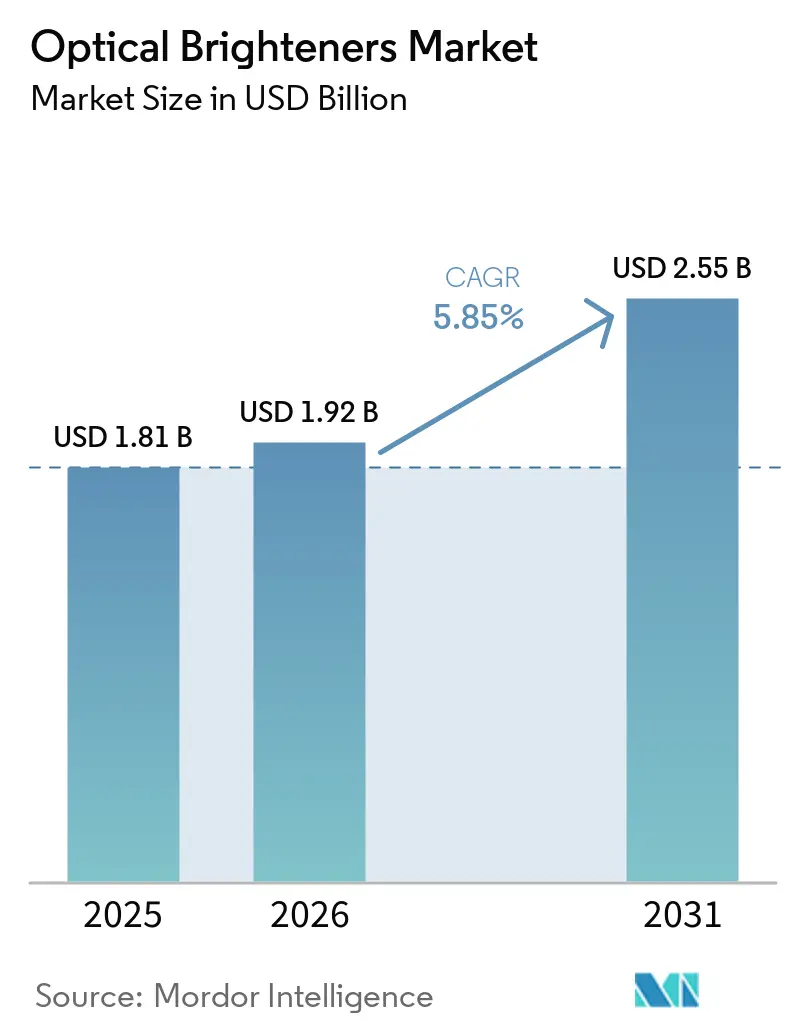
The Optical Brighteners Market size is projected to expand from USD 1.81 billion in 2025 and USD 1.92 billion in 2026 to USD 2.55 billion by 2031, registering a CAGR of 5.85% between 2026 to 2031. A steady growth trajectory reflects rising detergent and recycled-packaging demand that outweighs softness in printing paper. Liquid detergents formulated for cold-wash performance, recycled PET and paper substrates that must mask yellowing, and tighter circular-economy targets in Europe and Asia are each amplifying per-unit consumption of fluorescent whitening agents. Trade defense measures in North America and the European Union are simultaneously reshaping sourcing toward domestic or fully compliant chemistries, prompting suppliers to invest in low-migration or bio-based grades. Consolidation among top producers, exemplified by BASF’s 2026 business sale and Archroma’s 2023 purchasing of Huntsman Textile Effects, is concentrating technology, regulatory competence, and capacity at the upper end of the value chain.
Key Report Takeaways
- By chemical type, triazine-stilbenes led with 58.15% of the optical brighteners market share in 2025, while coumarins are forecast to post the fastest 6.61% CAGR through 2031.
- By application, textile whitening accounted for 44.19% of the optical brighteners market share in 2025, whereas detergent brightener is advancing at a 6.78% CAGR through 2031.
- By end-user industry, textile and apparel held 47.65% of the optical brighteners market share in 2025, while consumer products are set to grow at a 6.39% CAGR through 2031.
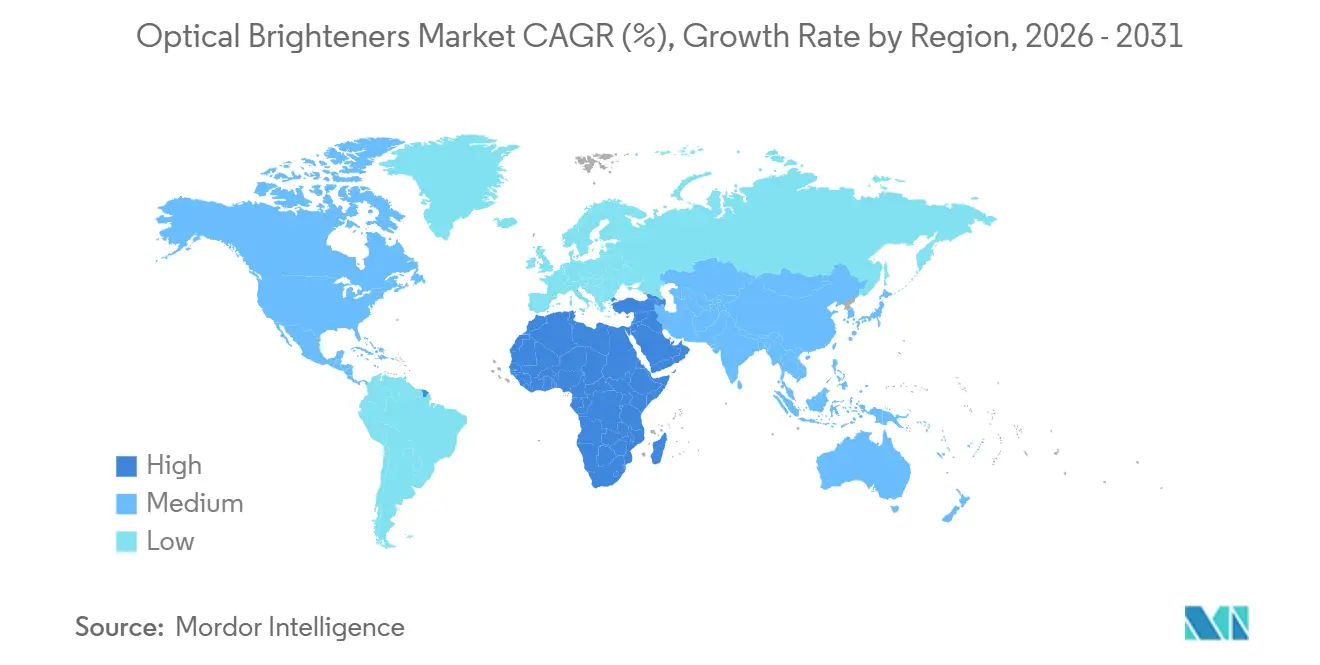
- By geography, Asia-Pacific dominated with 58.76% of the optical brighteners market share in 2025; Middle-East and Africa is the fastest-growing region at a 6.87% CAGR through 2031.
Note: Market size and forecast figures in this report are generated using Mordor Intelligence’s proprietary estimation framework, updated with the latest available data and insights as of January 2026.
Market Trends and Insights
Drivers Impact Analysis of Optical Brighteners Market*
| Driver | (~) % Impact on CAGR Forecast | Geographic Relevance | Impact Timeline |
|---|---|---|---|
| Rising demand for optical brighteners in laundry detergents | +1.8% | Global, with concentration in Asia-Pacific and North America | Medium term (2–4 years) |
| Expansion of textile and apparel manufacturing in Asia-Pacific | +1.5% | Asia-Pacific core (China, India, Vietnam, Bangladesh), spill-over to Middle-East | Long term (≥ 4 years) |
| Growth in recycled-paper and packaging brightness requirements | +1.2% | Europe and North America, expanding to Asia-Pacific | Medium term (2–4 years) |
| Adoption to mask discoloration in recycled plastics streams | +1.0% | Global, led by Europe circular-economy mandates | Short term (≤ 2 years) |
| Use in security printing/anti-counterfeiting inks | +0.4% | Global, niche but high-value applications | Long term (≥ 4 years) |
| Source: Mordor Intelligence | |||
Rising Demand for Optical Brighteners in Laundry Detergents
Liquid detergents now generate more than half of global household laundry revenue, and the trend toward compact concentrates increases optical brightener intensity per wash. Formulators typically dose 0.1–0.5% by volume, yet colder cycles and phosphate-free builders require higher-purity triazine-stilbenes such as CBS-X to maintain fluorescence. The four largest home-care multinationals collectively command about 60% of detergent sales, creating oligopsonistic buying power that forces brightener suppliers to meet stringent biodegradability criteria without eroding margins. Novonesis introduced “Luminous” in 2024, a cross-matrix brightener designed for both liquids and powders, signaling renewed R&D aimed at reducing Stock Keeping Units (SKUs) for multinational brands. Retailers’ private-label premium ranges in Europe and the U.S. are also adopting optical brighteners to match brand-leader aesthetics, cementing a durable volume base for the optical brighteners market.
Expansion of Textile and Apparel Manufacturing in Asia-Pacific
Regional value chains in Vietnam, India, and Bangladesh are scaling finishing capacity faster than spinning, shifting brightener consumption downstream into dyeing and wash-houses. Government programs such as Vietnam’s net-zero road map and India’s Production Linked Incentive for technical textiles are spurring investment in water-efficient dyeing lines that still depend on fluorescent agents to restore whiteness lost during recycled-fiber processing. Egypt’s Sokhna industrial zone will add 15, 000 tons of fabric output from 2026, further widening Middle Eastern pull. Suppliers that localize technical-service labs near these clusters gain a defensible share of the optical brighteners market because shade matching and process troubleshooting remain relationship-driven.
Growth in Recycled-Paper and Packaging Brightness Requirements
Brand owners now demand that recycled boards rival virgin grades for shelf appeal. ISO 2470 and TAPPI T560 mandate UV-adjusted calibration when testing optically brightened sheets, formalizing the role of fluorescent whitening agents in meeting CIE whiteness targets[1]ISO, “ISO 2470-1:2023 Paper, board and pulps—Measurement of brightness,” iso.org. European recycled-content rules for food contact have tightened delta-whiteness thresholds, forcing mills to raise addition rates to 0.2–1%. Large containerboard groups in Germany and the Nordic region have migrated to on-site optical-brightener dosing systems that minimize batch variation, cutting rejects, and supporting the optical brighteners market’s steady tonnage growth in packaging.
Adoption to Mask Discoloration in Recycled Plastics Streams
Yellowing and haze in rPET, rPP, and rPE lower resale prices unless corrected. Optical brightener OB-1 withstands extrusion temperatures above 280 °C, making it suitable for high-recycle blends used in automotive and appliance housings. Kasakata Masterbatch commercialized an additive in 2026 that imparts a subtle bluish-violet hue at 0.02% loading, enabling bottle-grade rPET to meet new clarity benchmarks in EU deposit-return schemes. As chemical-recycling volumes accelerate, demand for brighteners that survive multiple melt passes will reinforce the optical brighteners market upcycle.
Restraints Impact Analysis of Optical Brighteners Market*
| Restraint | (~) % Impact on CAGR Forecast | Geographic Relevance | Impact Timeline |
|---|---|---|---|
| Stringent global regulations on stilbene-based toxicity and persistence | -1.3% | Global, with strictest enforcement in EU and North America | Medium term (2–4 years) |
| Digitalization cutting printing-paper demand | -0.8% | North America and Europe, moderate impact in Asia-Pacific | Long term (≥ 4 years) |
| R&D cost of eco-friendly bio-based substitutes | -0.5% | Global, concentrated in developed markets with premium pricing | Short term (≤ 2 years) |
| Source: Mordor Intelligence | |||
Stringent Global Regulations on Stilbene Toxicity and Persistence
The European Commission added UV-328 to Annex I of Regulation (EU) 2019/1021 in 2025, introducing staged trace limits that cascade to 1 mg/kg by 2029. China’s MEE Order 12 compels public disclosure of formulations by 2026, eroding intellectual-property shields for legacy products. The U.S. decision to retain antidumping duties on Chinese and Taiwanese stilbenes lengthens supply chains and raises landed costs[2]Federal Register, “Certain Stilbenic Optical Brightening Agents: Continuation of Antidumping Duty Orders,” federalregister.gov. Collectively, these measures require comprehensive impurity profiling and life-cycle dossiers, expenses that smaller firms struggle to absorb, thereby tempering the optical brighteners market’s otherwise healthy expansion.
Digitalization Cutting Printing-Paper Demand
Uncoated wood-free paper shipments in Europe have fallen 4% annually as enterprises digitize invoicing and recordkeeping. Lower print volumes reduce demand for brightened copy paper, historically a 25% sink for stilbene tonnage. While packaging offsets some volume, corrugated and recycled boards often run lower whiteness specifications, consuming fewer brighteners per ton. Mills are consolidating, creating buyer power that forces annual price concessions, squeezing optical brighteners market margins tied to pulp and paper.
*Our forecasts treat driver/restraint impacts as directional, not additive. The impact forecasts reflect baseline growth, mix effects, and variable interactions.
Optical Brighteners Market Segment Analysis
By Chemical Type:
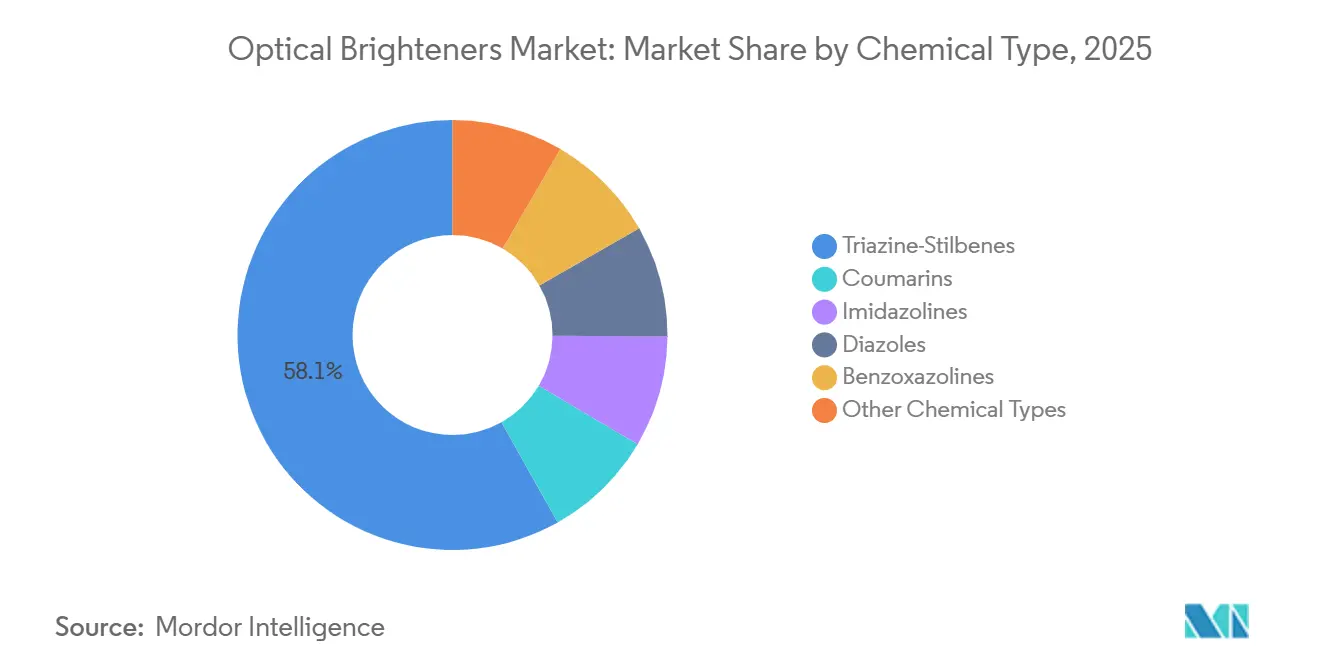
Triazine-Stilbenes Retain Scale Advantage While Coumarins AccelerateTriazine-stilbenes captured 58.15% of the 2025 optical brighteners market share on the strength of broad formulary compatibility and high fluorescence quantum yields. Detergent-grade CBS-X can reach whiteness indexes above 130 and maintains stability from pH 7 to 11, ensuring continued volume leadership. Coumarins are forecast to advance at a 6.61% CAGR through 2031 as formulators prefer their lower-temperature processing thresholds for cosmetics and low-melt packaging coatings. Beyond the two headline groups, benzoxazolines such as OB-1 serve recycled-plastic compounding where more than 280 °C thermal stability is mandatory, sustaining a reliable niche.
Second-tier chemistries, such as imidazolines, diazoles, and pyrazolines, collectively keep a foothold in specialty textile finishing, especially chlorine-resistant sportswear. Pilot microreactor projects in Jiangxi Province demonstrate 96% yields for pyrazoline intermediates, suggesting technology headroom for cost parity with stilbenes. As emission caps tighten, suppliers able to retrofit legacy plants with continuous-flow systems may unlock incremental optical brighteners market share by marketing low-carbon product lines.



By Application:
Detergent Brightener Outpaces Textile WhiteningTextile whitening commanded 44.19% of 2025 revenue, mirroring the historical dominance of cotton and polyester finishing. However, detergent brightener pulls the fastest 6.78% CAGR through 2031. Concentrated liquids increase brightener concentration per kilogram of formulated product, offsetting any volume loss from powder dilution or fabric-care market maturity.
Paper brightness remains significant in mature regions, but digital substitution trims long-run tonnage. Plastics applications, especially rPET bottles, are emerging as high-value outlets where brighteners and clarifiers jointly restore transparency and whiteness. Security inks yield premium EBITDA margins that attract R&D investment from vertically integrated suppliers.
By End-User Industry:
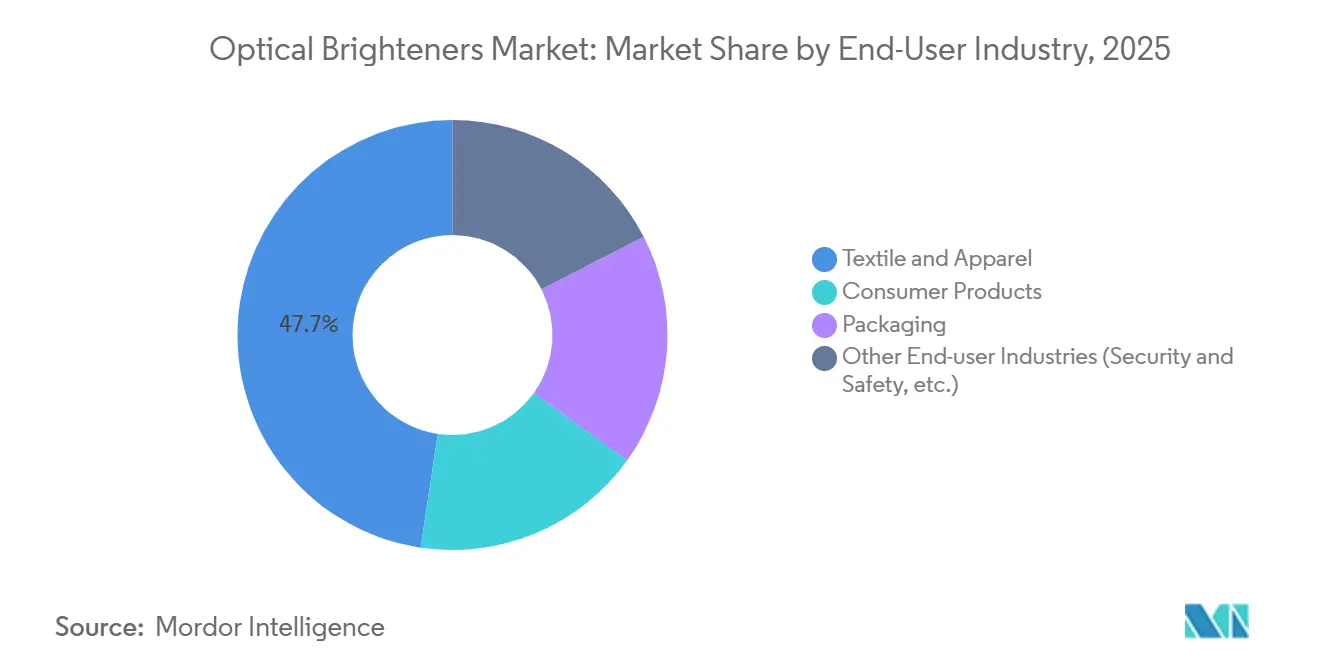
Textile and Apparel Largest, Consumer Products FastestThe textile and apparel segment accounted for 47.65% of the market share in 2025. However, consumer products are projected to grow at a CAGR of 6.39% through 2031, surpassing the textile base. This growth is driven by factors such as detergent premiumization, innovations in personal care, and anti-counterfeiting applications, which contribute to incremental volume increases. Vietnam's textile and garment exports reached approximately USD 46 billion in 2025, with apparel contributing USD 38 billion and employing a workforce of 2.7 million. Despite this, Vietnam imports 95–100% of its fibers and over 60% of its fabrics, creating a significant demand for optical brighteners in textile finishing and washing processes. In Egypt, the USD 15 million Infinity Fabric factory in Sokhna is set to commence operations in Q3 2026, with an annual output capacity of 6,000 tons of yarn and 15,000 tons of fabric. This initiative aligns with the Egyptian Apparel Export Council's objective to boost garment exports.
The consumer products segment is experiencing the fastest growth, with a 6.39% CAGR projected through 2031. This expansion is fueled by the increasing adoption of concentrated liquid formulations, which require high-efficacy optical brighteners at dosing levels of 0.1–0.5%. In the packaging sector, end-users such as paper, board, and flexible packaging converters are incorporating optical brighteners to meet brightness standards for recycled content. Standards like ISO 2470 and TAPPI T560 necessitate UV-adjusted calibration for optically brightened grades. Converters report that adding 0.2–1% optical brighteners enhances the whiteness of recycled paper. Additionally, other end-user industries, including security and safety, are benefiting from the growth of optical brighteners in smartphone display applications.
Geography Analysis
APAC Optical Brighteners Market
Asia-Pacific accounted for 58.76% of the global optical brighteners market revenue in 2025, driven by China’s 116,000-ton annual consumption and sustained detergent premiumization. Capacity rationalization in Jiangsu and Zhejiang, spurred by dual-carbon targets and stricter wastewater rules, has already shuttered an estimated 12% of low-end output, tightening regional balances. India’s ongoing 22,100 tonnes per annum (tpa) expansion by Rossari Biotech will provide incremental supply from 2026, yet is largely earmarked for local textile hubs. ASEAN’s garments sector, especially in Vietnam, is investing in advanced finishing, which lifts per-meter brightener demand.
Europe and North America Optical Brighteners Market
Europe and North America collectively hold a modest optical brighteners market share but wield outsized regulatory influence. The continuation of U.S. antidumping duties through 2030 locks in a two-tier price system that favors domestic output and diversified supply chains. In the EU, Annex I Persistent Organic Pollutants (POP) restrictions on UV-328 and impending Per- and Polyfluoroalkyl Substances (PFAS) legislation are persuading converters to prequalify low-migration stilbene replacements, granting early-mover advantage to producers with robust analytical labs.
MEA and South America Optical Brighteners Market
The Middle-East and Africa post the fastest 6.87% CAGR to 2031, led by Saudi Arabia’s woven-fabric projects under Vision 2030 and Egypt’s Sokhna zone. Growth, though from a smaller base, is amplified by regional detergent factories that increasingly adopt liquid formats suitable for warmer climates. Brazil anchors South American demand, where Solvay’s USD 20 million modernization of Santo André is designed to capture specialty polyamide finishing demand, indirectly stimulating the regional optical brighteners market volumes.

Competitive Landscape
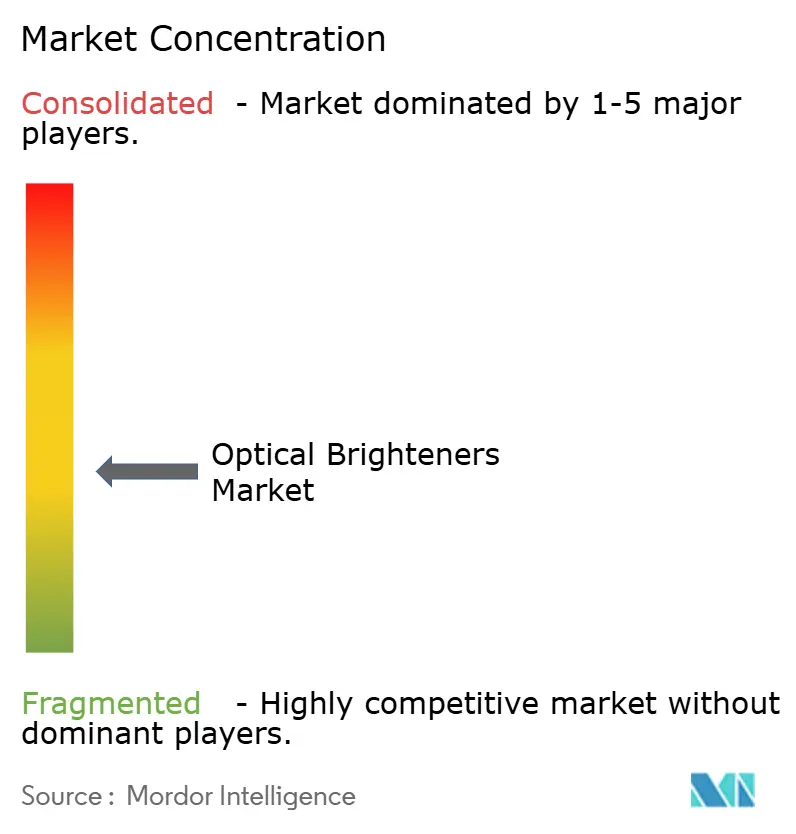
The market is moderately concentrated, with the five largest firms including BASF, Clariant, Archroma, Milliken, and Eastman Chemical Company. BASF’s February 2026 sale of its optical brightener unit to Catexel marks a strategic retreat from commoditized stilbenes, while providing Catexel with an immediate European asset base and 80 skilled staff to scale specialty output. Archroma’s earlier USD 593 million purchase of Huntsman Textile Effects created a supply chain that bundles brighteners with disperse dyes and finishing aids, an integrated model now emulated by Clariant and Sumitomo.
Process innovation is emerging as the next competitive frontier. Continuous-flow microreactors claim 45% lower chemical oxygen demand (COD) emissions and faster debottlenecking but demand high capital. Firms adopting the technology secure low-carbon certifications that resonate with brand owner sustainability scorecards, reinforcing customer stickiness. Mid-tier producers unable to finance reactors are instead carving out niches, such as food-contact paper, medical packaging, or anti-counterfeit inks, where technical service trumps volume.
Regulatory acumen now differentiates suppliers as much as the cost curve. Companies that can preemptively map impurities to below the EU’s tightening unintentional-trace thresholds are capturing long-term contracts, especially for export-oriented Asian mills bound for OECD markets. As a result, competitive intensity is forecast to rise in specialty niches even while overall capacity consolidation continues.
Optical Brighteners Industry Leaders
BASF
CLARIANT
Archroma
Eastman Chemical Company
Milliken
- *Disclaimer: Major Players sorted in no particular order
Optical Brighteners Market Companies Covered in this Report
- 3V Sigma S.p.A.
- Archroma
- Aron Universal Limited
- BASF
- Blankophor GmbH & Co. KG
- Brilliant Group Inc.
- CLARIANT
- DayGlo Color Corp.
- Deepak Nitrite Limited
- Eastman Chemical Company
- Keystone Aniline Corp.
- KISCO (Kyung-In Synthetic Corp.)
- Kolorjet Chemicals Pvt Ltd
- Meghmani Organics Ltd
- Milliken & Company
- RPM International Inc.
- Sarex Chemicals
- Shandong Raytop Chemical Co. Ltd
- Teh Fong Min International Co. Ltd
- United Specialities Pvt Ltd
- Zhejiang Transfar Whyyon Chemical Co Ltd

Recent Industry Developments in Optical Brighteners Market
- March 2026: Catexel completed the acquisition of BASF’s optical brightening agent (OBA) business. The acquisition included global business operations and the dedicated production facility for optical brighteners in Monthey, Switzerland.
- November 2024: Novonesis introduced "Luminous," a broad-spectrum detergent brightener compatible with both liquid and powder formulations. This product provided a sustainable alternative to traditional optical brighteners and polymers, which faced growing scrutiny due to their poor biodegradability and reliance on non-renewable petrochemical sources.


Global Optical Brighteners Market Report Scope
Optical brighteners, also known as fluorescent whitening agents (FWAs), are chemical compounds used in detergents, paper, and textiles to enhance the appearance of whiteness and brightness. These compounds function by absorbing ultraviolet (UV) light and re-emitting it as blue visible light, effectively masking yellowing.
The Optical Brighteners Market is segmented into chemical type, application, end-user industry, and geography. By chemical type, the market is segmented into triazine-stilbenes, coumarins, imidazolines, diazoles, benzoxazolines, and other chemical types. By application, the market is segmented into textile whitening, detergent brightener, paper brightening, fiber whitening, cosmetics and personal care, and other applications. By end-user industry, the market is segmented into textile and apparel, consumer products, packaging, and other end-user industries (e.g., security and safety). The report also covers the market size and forecasts for optical brighteners in 17 countries across major regions. For each segment, the market sizing and forecasts have been done on the basis of value (USD).
| Triazine-Stilbenes |
| Coumarins |
| Imidazolines |
| Diazoles |
| Benzoxazolines |
| Other Chemical Types |
| Textile Whitening |
| Detergent Brightener |
| Paper Brightening |
| Fiber Whitening |
| Cosmetics and Personal Care |
| Other Applications |
| Textile and Apparel |
| Consumer Products |
| Packaging |
| Other End-user Industries (Security and Safety, etc.) |
| Asia-Pacific | China |
| India | |
| Japan | |
| South Korea | |
| ASEAN Countries | |
| Rest of Asia-Pacific | |
| North America | United States |
| Canada | |
| Mexico | |
| Europe | Germany |
| United Kingdom | |
| France | |
| Italy | |
| Spain | |
| Russia | |
| NORDIC Countries | |
| Rest of Europe | |
| South America | Brazil |
| Argentina | |
| Rest of South America | |
| Middle-East and Africa | Saudi Arabia |
| South Africa | |
| Rest of Middle-East and Africa |
| By Chemical Type | Triazine-Stilbenes | |
| Coumarins | ||
| Imidazolines | ||
| Diazoles | ||
| Benzoxazolines | ||
| Other Chemical Types | ||
| By Application | Textile Whitening | |
| Detergent Brightener | ||
| Paper Brightening | ||
| Fiber Whitening | ||
| Cosmetics and Personal Care | ||
| Other Applications | ||
| By End-User Industry | Textile and Apparel | |
| Consumer Products | ||
| Packaging | ||
| Other End-user Industries (Security and Safety, etc.) | ||
| By Geography | Asia-Pacific | China |
| India | ||
| Japan | ||
| South Korea | ||
| ASEAN Countries | ||
| Rest of Asia-Pacific | ||
| North America | United States | |
| Canada | ||
| Mexico | ||
| Europe | Germany | |
| United Kingdom | ||
| France | ||
| Italy | ||
| Spain | ||
| Russia | ||
| NORDIC Countries | ||
| Rest of Europe | ||
| South America | Brazil | |
| Argentina | ||
| Rest of South America | ||
| Middle-East and Africa | Saudi Arabia | |
| South Africa | ||
| Rest of Middle-East and Africa | ||


Key Questions Answered in the Report
What is the size of the optical brighteners market?
The optical brighteners market size stands at USD 1.92 billion in 2026 and is forecast to reach USD 2.55 billion by 2031.
Which chemical type dominated volume in 2025?
Triazine-stilbene derivatives such as CBS-X held 58.15% of optical brighteners market share in 2025 owing to their wide applicability in detergents, textiles, and paper.
What is the fastest-growing region through 2031?
The Middle-East and Africa is projected to post a 6.87% CAGR through 2031, buoyed by Saudi and Egyptian textile investments.
Why is detergent brightener outpacing textile whitening in growth?
Concentrated liquid formats require higher brightener intensity to offset cold-wash cycles, driving a 6.78% CAGR through 2031 for detergent brightener.
Page last updated on:


 Your data is secure and never sold or shared.


