
Online Dispute Resolution (ODR) Platform Market Size and Share
Market Overview
| Study Period | 2020 - 2031 |
|---|---|
| Market Size (2026) | USD 2.06 Billion |
| Market Size (2031) | USD 4.54 Billion |
| Growth Rate (2026 - 2031) | 17.12 % |
| Fastest Growing Market | Asia-Pacific |
| Largest Market | North America |
| Market Concentration | Medium |
Major Players *Disclaimer: Major Players sorted in no particular order Image © Mordor Intelligence. Reuse requires attribution under CC BY 4.0. | |
Online Dispute Resolution (ODR) Platform Market Analysis by Mordor Intelligence
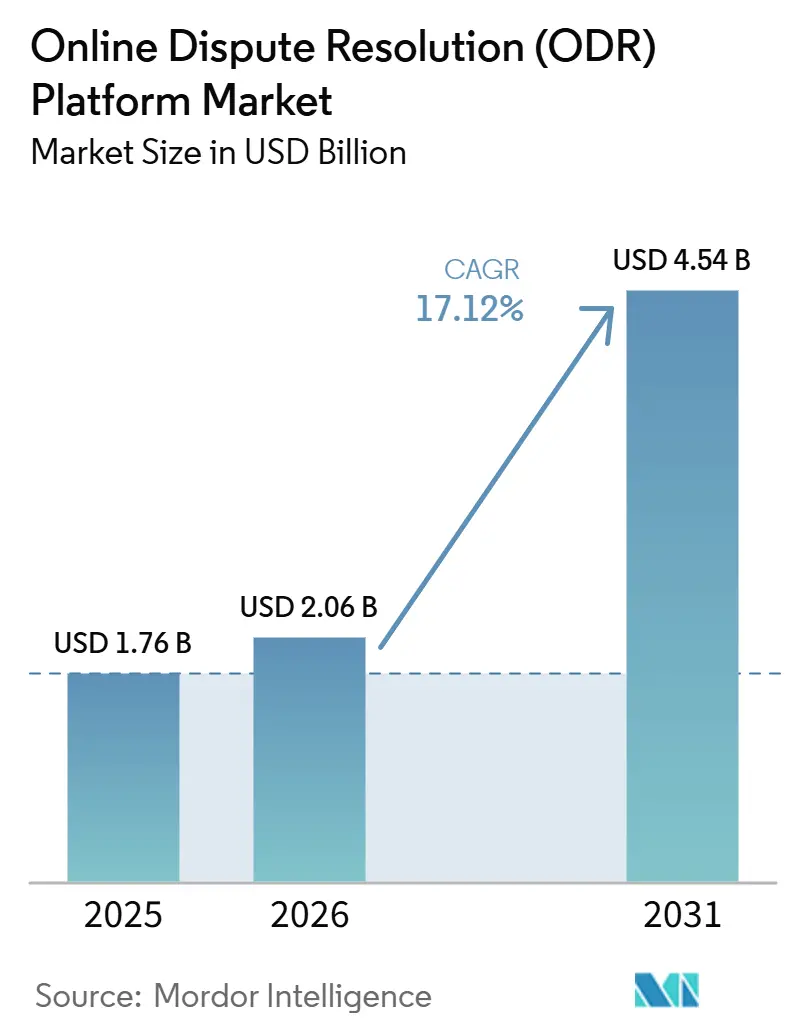
The online dispute resolution (ODR) platform market size is projected to expand from USD 1.76 billion in 2025 and USD 2.06 billion in 2026 to USD 4.54 billion by 2031, registering a CAGR of 17.12% between 2026 to 2031. The online dispute resolution (ODR) platform market is gaining momentum because digital commerce keeps creating more low-value and cross-border disputes than traditional channels can handle efficiently. Public funding for court digitization is also widening the buyer base, as judicial systems are moving from small pilots to broader procurement and long-term workflow integration. Enterprise users are adding to demand because digital dispute tools reduce case handling costs, shorten resolution time, and fit better with high-volume claim environments than litigation or standard arbitration. AI-supported intake, triage, and settlement workflows are improving platform throughput, while cloud delivery is making upgrades and deployment easier across multiple jurisdictions. The online dispute resolution market still faces uneven adoption because settlement recognition rules differ by country, and many users remain cautious when disputes involve high values, sensitive facts, or procedural fairness concerns.
Key Report Takeaways
- By component, platforms accounted for 58.23% share of the online dispute resolution (ODR) platform market size in 2025, while services are projected to expand at an 18.41% CAGR through 2031.
- By deployment model, cloud-based deployments held 62.91% of the online dispute resolution software market share in 2025, and the same segment is projected to advance at a 21.24% CAGR through 2031.
- By dispute type, commercial and contract disputes led with 37.46% revenue share in 2025, while cross-border disputes are projected to grow at a 22.94% CAGR through 2031.
- By end user industry, courts and tribunals held 34.71% revenue share in 2025, while e-commerce and digital marketplace platforms are projected to expand at a 19.86% CAGR through 2031.
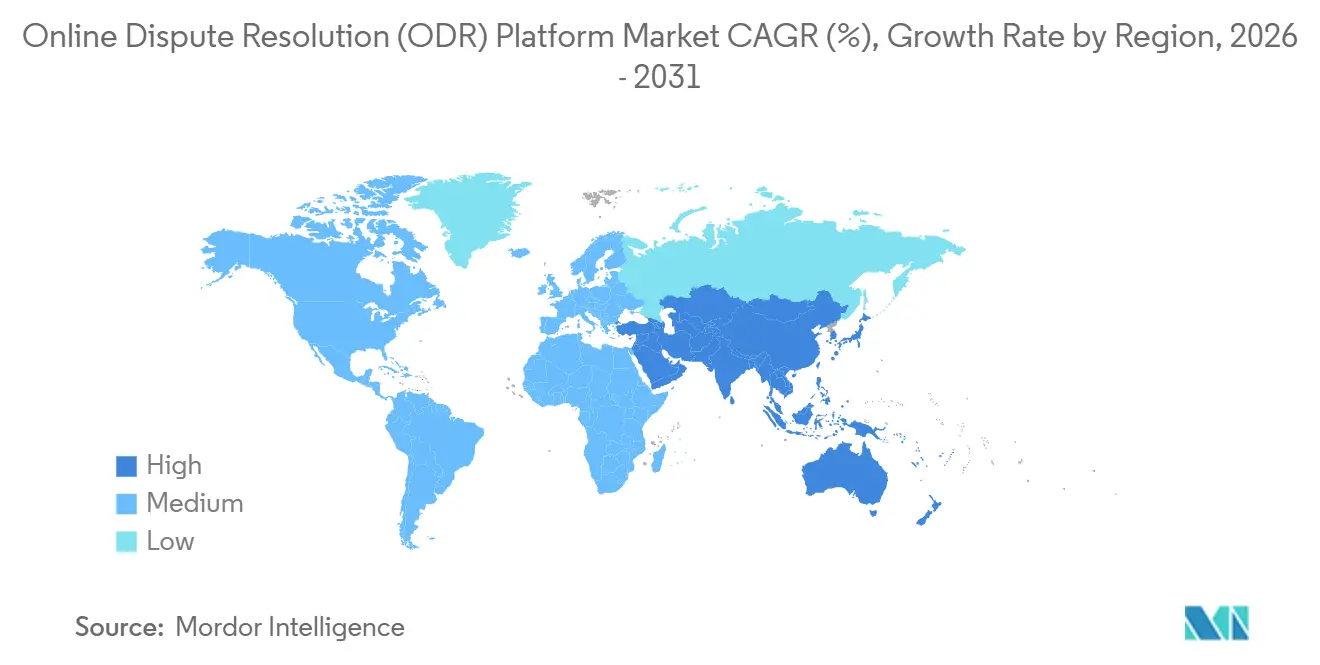
- By geography, North America held 36.72% revenue share in 2025, while Asia-Pacific is projected to expand at a 21.18% CAGR through 2031.
Note: Market size and forecast figures in this report are generated using Mordor Intelligence’s proprietary estimation framework, updated with the latest available data and insights as of January 2026.
Market Trends and Insights
Drivers Impact Analysis of Online Dispute Resolution (ODR) Platform Market*
| DRIVER | (~) % IMPACT ON CAGR FORECAST | GEOGRAPHIC RELEVANCE | IMPACT TIMELINE |
|---|---|---|---|
| Rising Cross-Border E-Commerce Disputes | +3.5% | Global | Medium term (2-4 years) |
| Court Backlogs and ADR Digitization Programs | +3.0% | Global | Medium term (2-4 years) |
| Enterprise Demand for Low-Cost, High-Volume Case Handling | +2.5% | North America and Europe | Medium term (2-4 years) |
| AI-Enabled Triage, Negotiation, and Settlement Workflows | +2.0% | Global | Long term (≥ 4 years) |
| Embedded ODR in Digital Marketplaces and Fintech Apps | +1.8% | Asia-Pacific and North America | Medium term (2-4 years) |
| Privacy-Preserving Remote Resolution for Sensitive Claims | +1.5% | Europe and North America | Long term (≥ 4 years) |
| Source: Mordor Intelligence | |||
Rising Cross-Border E-Commerce Disputes
The online dispute resolution (ODR) platform market is benefiting from the simple fact that low-value international claims are growing faster than conventional resolution systems can absorb. Cross-border trade creates disputes around delivery failure, product authenticity, payment reversals, and customs friction, and many of these claims are too small to justify formal arbitration or court action. China’s national courts received 6.791 million first-instance civil and commercial cases in 2025, which showed how quickly commercial case volumes were rising inside a major digital economy. The same system reported a mediation and withdrawal rate of 42.33%, which points to the value of faster resolution channels for matters that do not need a full trial path.[1] ISO 32122:2025 gave service providers a recognized framework for offering online dispute services in low-value e-commerce settings, which supports more consistent design and interoperability across jurisdictions. As these trade corridors keep expanding, the online dispute resolution (ODR) platform market will keep finding demand where case frequency is high and claim value is modest.
Court Backlogs and ADR Digitization Programs
The online dispute resolution (ODR) platform market is also being lifted by court systems that now view digital diversion as an operating necessity rather than a policy experiment. The American Arbitration Association and the National Center for State Courts launched an AI-enhanced court diversion eligibility screener and case management system in 2025 for Lancaster County’s consumer credit docket. That program mattered because the white-labeled version was made available through the National Center for State Courts, which reduced adoption friction for other courts with limited budgets and staff capacity. Resolution 3-2024 from the Conference of Chief Justices and the Conference of State Court Administrators formally encouraged diversion program adoption, which gave vendors a stronger policy signal across U.S. state court systems.[2] The National Center for State Courts also reported in 2025 that large language model tools were beginning to enter state court operations, which extends the value of earlier digital integrations. Once courts endorse a platform publicly, the online dispute resolution (ODR) platform market often sees faster follow-on demand from insurers, lenders, and other regulated buyers that read judicial adoption as a credibility signal.
Enterprise Demand for Low-Cost, High-Volume Case Handling
The online dispute resolution (ODR) platform market is seeing concentrated commercial demand from enterprises that manage large claim volumes and cannot afford slow, manual dispute workflows. Cognizant and ServiceNow launched an AI-powered dispute management solution for mid-market banks in North America in March 2025, which targeted institutions that had been constrained by rigid legacy setups. ServiceNow also expanded its alliance with Visa in January 2025, and Visa deployed ServiceNow Dispute Management to support the Visa Dispute Management Service and the DPS Dispute Analysis and Support tool. When a network at Visa’s scale standardizes a workflow layer, banks within that ecosystem face a stronger practical incentive to align with the same integration path. Jupitice reported that implementations across Indian banks and non-banking financial companies reduced resolution time by as much as 90% against traditional arbitration timelines, which materially changes enterprise procurement benchmarks. This is why the online dispute resolution (ODR) platform market is moving beyond legal departments and deeper into revenue operations, card disputes, loan recovery, and claims administration.
AI-Enabled Triage, Negotiation, and Settlement Workflows
The online dispute resolution (ODR) platform market is entering a phase where AI is not just assisting staff but directly shaping the speed and economics of case handling. The AAA-ICDR launched its AI arbitrator in November 2025 for two-party, documents-only construction cases, using training based on more than 1,500 construction awards. Early results showed resolution times that were 20-25% faster and cost savings of 35% or greater compared with traditional arbitration processes. The design remained cautious because every AI-generated draft award still required review by a certified human arbitrator, which helps address due process and enforceability concerns in digitally assisted proceedings. ServiceNow’s March 2026 Legal Service Delivery release added conversational AI intake and automated risk assessment for conflict-of-interest disclosure, which pushed similar automation further upstream in enterprise workflows. As this coverage widens, the online dispute resolution (ODR) platform market should become more attractive for subscription-based pricing because vendors can improve throughput without increasing staffing in direct proportion to case volume.
Restraints Impact Analysis of Online Dispute Resolution (ODR) Platform Market*
| RESTRAINT | (~) % IMPACT ON CAGR FORECAST | GEOGRAPHIC RELEVANCE | IMPACT TIMELINE |
|---|---|---|---|
| Fragmented Jurisdictional Recognition of Online Settlements | -1.5% | Global, acute in cross-border markets | Medium term (2-4 years) |
| Trust Deficit for High-Value or Emotionally Sensitive Disputes | -1.2% | Global, pronounced in Middle East and Africa and South America | Long term (≥ 4 years) |
| Integration Friction With Legacy Court and Case-Management Systems | -0.9% | North America and Europe | Medium term (2-4 years) |
| Limited Digital Literacy Among Small Claimants and Small Businesses | -0.7% | Middle East and Africa, South Asia, parts of South America | Long term (≥ 4 years) |
| Source: Mordor Intelligence | |||
Fragmented Jurisdictional Recognition of Online Settlements
The online dispute resolution (ODR) platform market still faces a major structural limit because digitally generated settlements do not move through every jurisdiction with the same legal certainty. The European Union repealed its centralized ODR portal framework through Regulation (EU) 2024/3228, and that portal was discontinued in July 2025. The European Union then adopted Directive (EU) 2025/2647 in December 2025 to update the wider consumer ADR framework, but the shift still created a transition period for operators that had built complaint flows around the older system. Cross-border awards also face due process scrutiny under Article V(1)(b) of the New York Convention, and that means document-only or AI-assisted processes must show that each party had a fair chance to present its case. Vendors, therefore, need jurisdiction-by-jurisdiction compliance maps, which raises operating costs and slows international rollout for smaller providers. Until legal recognition becomes more uniform, the online dispute resolution (ODR) platform market will keep expanding unevenly across trade corridors and case types.[3]
Trust Deficit for High-Value or Emotionally Sensitive Disputes
The online dispute resolution (ODR) platform market is advancing fastest in document-heavy matters, but adoption stays slower where users want visible human oversight and procedural reassurance. Research in the International Journal of Law and Information Technology found in 2025 that technical auditability alone does not create legitimacy unless fairness is built into the process design. That matters commercially because platforms with transparent audit trails, neutral certification, and clear appeal paths are better positioned than vendors that rely only on automation claims. The U.S. Federal Trade Commission finalized its order against DoNotPay in February 2025, which showed how quickly exaggerated AI legal claims can damage trust and trigger regulatory action. The National Center for State Courts reported that at least 75% of family law cases in Massachusetts involved at least one self-represented party, which highlights how important support and confidence are in sensitive dispute settings. For that reason, the online dispute resolution (ODR) platform market will remain more selective in high-value commercial, family, and emotionally charged matters unless vendors invest in strong human review and clearer governance.
*Our forecasts treat driver/restraint impacts as directional, not additive. The impact forecasts reflect baseline growth, mix effects, and variable interactions.
Online Dispute Resolution (ODR) Platform Market Segment Analysis
By Component:
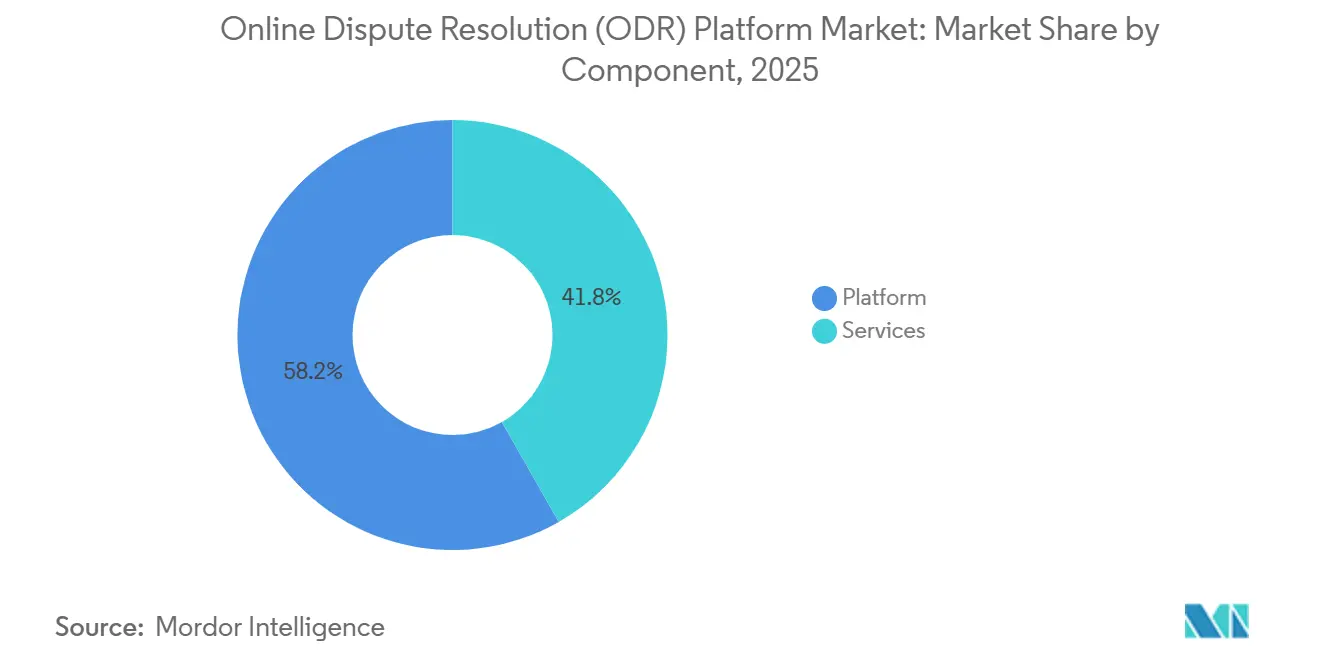
Platform Revenue Leads While Services Gain PacePlatform solutions accounted for 58.23% of 2025 revenue, indicating that the core software layer still captured the majority of spending across the online dispute resolution (ODR) platform market. This lead reflected the role of licensing and subscription contracts in courts, insurers, and fintech institutions that needed repeatable workflows and durable integration with existing processes. Buyers in the online dispute resolution (ODR) platform market continued to prioritize platform capabilities such as case intake, workflow routing, document handling, and user communication because these functions sit at the center of day-to-day dispute administration. Platform revenue also benefited from software lock-in, since replacing an embedded system inside a judicial or regulated enterprise setting is costly and operationally disruptive. That made the platform layer the current anchor of the online dispute resolution industry, even as buyer expectations started to shift.
Services are projected to grow at an 18.41% CAGR from 2026 to 2031, which means the faster change is now happening around implementation, configuration, and managed support. Many buyers are discovering that standard deployments do not fit local procedure rules, language needs, or evidence-handling requirements without meaningful adaptation. Vendors have responded by broadening delivery teams so they can defend accounts with workflow customization, onboarding support, and change management rather than software alone. LegalZoom’s February 2026 launch inside the Claude ecosystem showed how attorney-backed service delivery can be embedded directly into a digital workflow environment instead of being sold as a separate layer.[4] As this pattern spreads, the online dispute resolution (ODR) platform market is likely to reward firms that can package product depth and service execution in one commercial relationship.
By Deployment Model:
Cloud Sets the Operating StandardCloud-based deployment held 62.91% of 2025 revenue and is projected to expand at a 21.24% CAGR through 2031, which gave it both the largest and fastest-growing position in the online dispute resolution (ODR) platform market. That dual lead reflects the operating fit of multi-tenant delivery in a field where case volumes can change sharply by client, region, and dispute category. Shared infrastructure reduces the burden of maintaining separate environments for each customer and makes updates easier to deliver across the court and enterprise accounts. Faster setup also matters because many judicial and regulated users need visible progress soon after procurement to justify digitization budgets and policy backing. These factors are turning cloud delivery into the default commercial model across much of the online dispute resolution (ODR) platform market.
Tyler Technologies’ Modria ODR solution, which sits within the Odyssey Case Management System and serves more than 25 U.S. states, entered a strategic cloud collaboration with AWS in 2025. That move widened cloud-native delivery options for judicial customers that had previously leaned more heavily on localized infrastructure. On-premises systems still retain relevance where data sovereignty, public records rules, or institutional policy make third-party hosting more difficult. The longer-term path therefore looks hybrid, with sensitive processing kept locally while analytics, AI triage, and user-facing layers run in the cloud. This balance allows the online dispute resolution (ODR) platform market to keep scaling without forcing every buyer to choose the same compliance model.
By Dispute Type:
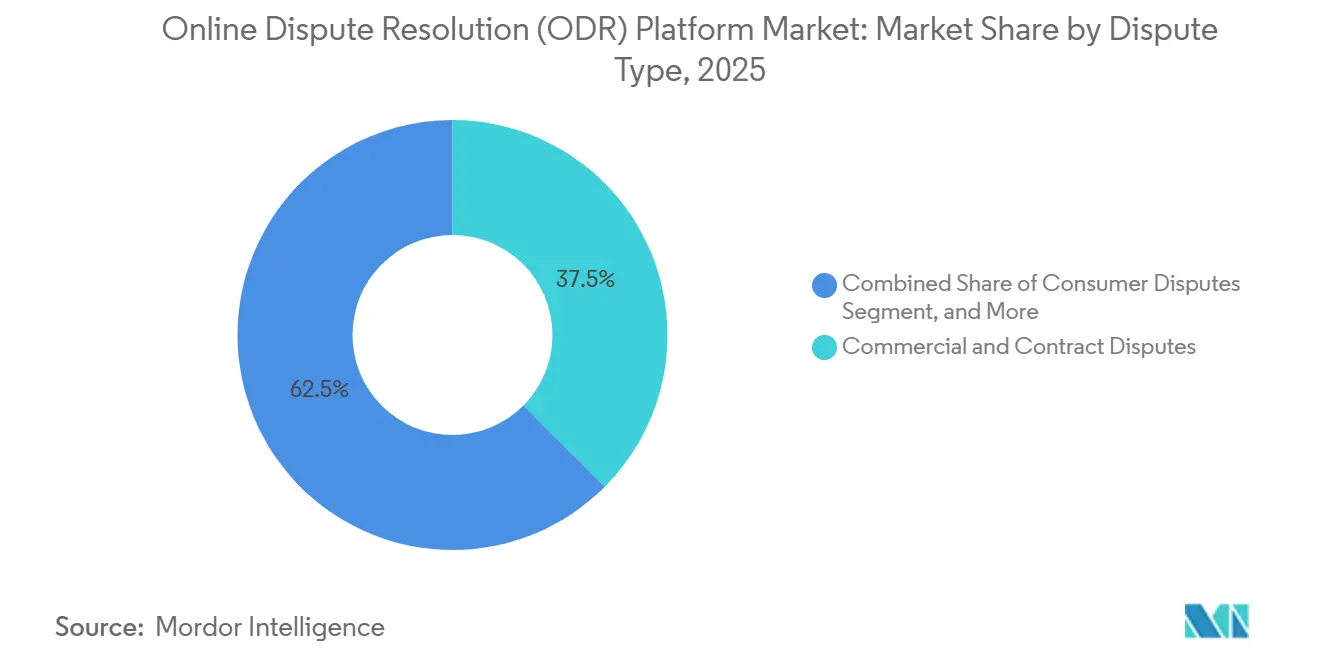
Commercial Volume Leads While Cross-Border Cases Rise FastCommercial and contract disputes accounted for 37.46% of 2025 revenue, which kept them at the center of the online dispute resolution (ODR) platform market. These cases fit digital handling well because documentation is usually structured, counterparties are identifiable, and contractual dispute clauses often already define a formal path for resolution. The International Chamber of Commerce reported 881 new arbitration cases in 2025, involving 2,531 parties from 147 countries and territories. The same update placed the aggregate value of pending disputes at USD 299 billion, which confirms the scale of commercial conflict still flowing through formal channels.[5] Those volumes leave room for the online dispute resolution (ODR) platform market to capture business disputes that require speed, structured evidence review, and lower administrative friction than conventional arbitration.
Cross-border disputes are projected to expand at a 22.94% CAGR from 2026 to 2031, which makes them the fastest-growing dispute category in the online dispute resolution (ODR) platform market. Growth is strongest where digital trade is rising, but enforcement arrangements across countries remain uneven, because the gap between claim value and resolution cost becomes more severe in that setting. ISO 32122:2025 supports this direction by offering recognized guidance for online dispute services in low-value e-commerce transactions that cross borders. Consumer disputes and employment matters remain important recurring categories because rights-based frameworks generate a stable flow of claims that can be processed through standardized digital steps. Family and civil cases remain more constrained because trust, sensitivity, and the need for visible neutrality often outweigh the benefits of full automation.

By End User Industry:
Courts Hold Scale While Marketplaces Expand FastCourts and tribunals accounted for 34.71% of 2025 revenue, which made them the largest end-user group in the online dispute resolution (ODR) platform market. Their lead reflected long-cycle contracts for case management, filing, and embedded resolution tools that become difficult to replace once operational and procedural dependencies build around them. FINRA reported 16,343 arbitration cases in 2025 across its forum, which underscores the scale of institutional dispute handling in a regulated environment. The same notice stated that 71% of the 10,393 customer dispute cases were settled before an award, while 496 mediation cases concluded at an 83% successful settlement rate. This record supports the view that judicial and quasi-judicial channels still provide the most stable demand base inside the online dispute resolution (ODR) platform market.
E-commerce and digital marketplace platforms are projected to grow at a 19.86% CAGR through 2031, which makes them the fastest-expanding end-user segment. Their growth follows the rise of buyer-seller conflicts that must be resolved quickly to protect platform trust, transaction flow, and repeat usage. Government and public-sector buyers remain an adjacent source of steady demand as national and state systems look for ways to reduce case pendency and improve citizen access. Law firms and legal service providers are also becoming more active users as AI-native tools narrow the gap between digital workflow management and traditional case handling, while insurers continue to adopt these systems for claims-related disputes. Jupitice’s February 2026 launch of e-Samadhan for the Rajasthan State Legal Services Authority showed how a court-led deployment can support broader commercial pathways without losing institutional legitimacy.
Geography Analysis
North America Online Dispute Resolution (ODR) Platform Market
North America held 36.72% of 2025 revenue and represented 36.72% of the online dispute resolution (ODR) platform market share, which kept it in the leading regional position. The region benefited from broad institutional acceptance of digital dispute tools in courts, financial services, and regulated commercial channels. FINRA’s formal dispute resolution structure remained an important validation point because its 2025 case volumes showed that large-scale digital and hybrid dispute management already sits inside a mature regulatory setting. The online dispute resolution (ODR) platform market in North America also gained from court-connected diversion programs, as the AAA and the National Center for State Courts advanced deployable models that other jurisdictions can adopt with less policy and procurement friction.
APAC Online Dispute Resolution (ODR) Platform Market
Asia-Pacific enters 2026 as the fastest-growing region with a projected 21.18% CAGR through 2031, which gives the online dispute resolution (ODR) platform market its strongest growth runway. Demand is being driven by large judicial backlogs, rapid digital commerce growth, and a more active policy push around formal ODR frameworks. China’s courts reported a 22.0% year-over-year increase in first-instance civil and commercial cases in 2025, which supports the view that digital case handling capacity needs to expand materially. Japan’s OneNegotiation platform surpassed 25,000 cumulative case filings by January 2026 and handled 85% of all closed ODR cases tracked by Japan’s Ministry of Justice in fiscal year 2024, which showed how quickly a certified platform can consolidate activity in a government-accredited niche. Japan’s leadership in publishing ISO 32122:2025 also gives the online dispute resolution (ODR) platform market in Asia-Pacific a stronger standards base for interoperability and service design across varied legal systems.[6]
EMEA and South America Online Dispute Resolution (ODR) Platform Market
Europe, the Middle East and Africa, and South America accounted for the remaining revenue across the online dispute resolution (ODR) platform market. Europe is reshaping its framework after the discontinuation of the centralized ODR portal in July 2025 and the adoption of Directive (EU) 2025/2647 in December 2025, which means providers must adapt to a revised consumer ADR structure. In the Middle East, the United Arab Emirates and Saudi Arabia are investing in digital justice programs, which supports long-term opportunity even though market structures are still forming. South Africa and Kenya stand out as promising African markets, but infrastructure limits and legal framework maturity still slow wider deployment. South America shows comparable promise, yet adoption remains uneven because cross-border demand is rising faster than technical infrastructure and settlement recognition mechanisms are improving.
Competitive Landscape
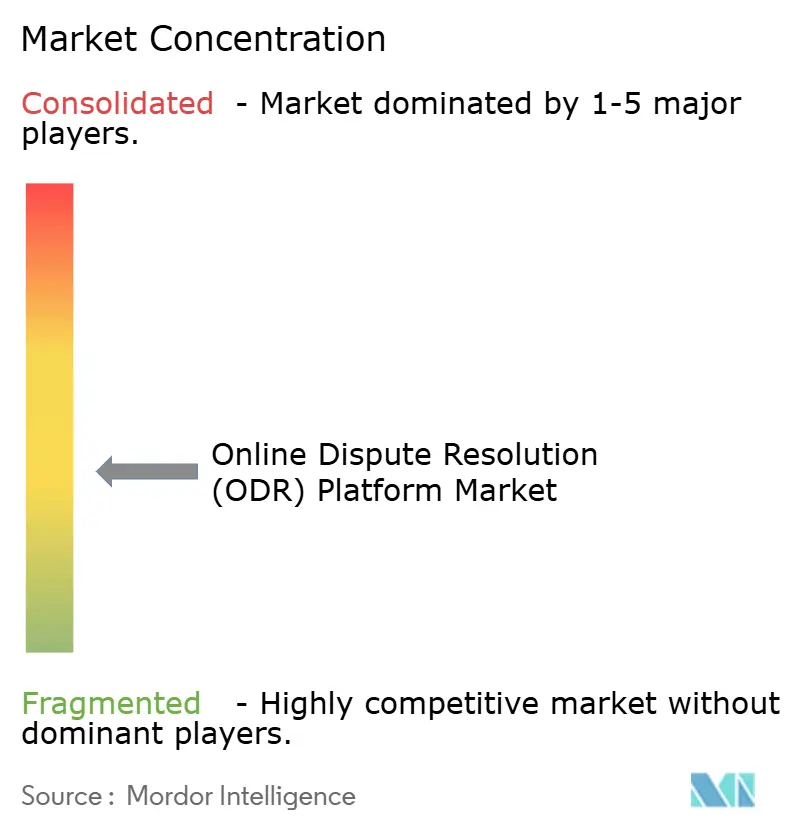
The online dispute resolution (ODR) platform market remains moderately fragmented, and no single vendor is shown to hold enough share to set pricing or dictate technical standards across the field. Incumbent court technology vendors still hold strong positions in judicial channels because they are deeply integrated into existing case management and filing infrastructure. Large workflow software providers are also expanding into adjacent dispute functions by using relationships they already have in banking, legal operations, and enterprise administration. Some names fall outside the competitive scope of the online dispute resolution (ODR) platform market, because eBay’s resolution tools serve its own marketplace rather than external buyers, Trilegal is a law firm rather than a platform developer, and FairClaims closed in February 2026.
A major structural shift is platform convergence, where dispute resolution capability is being embedded into broader legal and enterprise workflow environments instead of being sold only as a standalone product. ServiceNow’s expanded alliance with Visa in January 2025 is a strong example because the deployment tied dispute management into a large payment network’s operating stack. Tyler Technologies’ cloud push around Modria and Odyssey also strengthened the position of established court technology suppliers that can extend digital resolution through systems already trusted by public-sector buyers. The AAA-ICDR’s AI arbitrator launch added a different kind of advantage, because proprietary case data and institutional legitimacy created a barrier that smaller vendors may struggle to match.
Another strategic pattern is the blending of digital workflow and expert service, which broadens distribution without removing human support. LegalZoom’s February 2026 connector inside the Claude ecosystem showed how attorney-backed execution can be inserted directly into user workflows rather than sold through a separate channel. Jupitice’s e-Samadhan launch in February 2026 also illustrated how a judicially anchored deployment can help a provider expand credibility across additional institutional and commercial use cases. The online dispute resolution (ODR) platform market still has open space in high-trust, high-value categories where procedural confidence matters as much as speed, and that favors vendors that keep humans visibly involved in sensitive matters. The online dispute resolution (ODR) platform market is therefore most likely to reward companies that combine regulatory credibility, integration depth, and sector-specific execution instead of relying on generic automation claims alone.
Online Dispute Resolution (ODR) Platform Industry Leaders
-
Tyler Technologies, Inc.
-
Court Innovations, Inc.
-
Smartsettle Solutions Inc.
-
ODR.com
-
Immediation Pty Ltd
- *Disclaimer: Major Players sorted in no particular order
Online Dispute Resolution (ODR) Platform Market Companies Covered in this Report
- Tyler Technologies, Inc.
- Court Innovations, Inc.
- Smartsettle Solutions Inc.
- ODR.com
- Immediation Pty Ltd
- JAMS, Inc.
- Jupitice Justice Technologies Pvt. Ltd.
- Presolv360 Private Limited
- ODRWays Solutions Private Limited
- WEVAAD Solutions Private Limited
- WEBNYAY Solutions Private Limited
- EBRAM International Online Dispute Resolution Centre Limited
- Resolve Disputes Online (RDO)
- SAMA
- Online Legal India
- Modria
- Smartsettle
- Cybersettle
- Matterhorn
- ADR ODR International
Recent Industry Developments in Online Dispute Resolution (ODR) Platform Market
- February 2026: Jupitice launched its Digital Mediation Platform and Digital Lok Adalat (e-Samadhan) for the Rajasthan State Legal Services Authority, officially unveiled by Chief Justice of India, Justice Surya Kant, during the National Cyber Security Conference on February 20, 2026.
- November 2025: The AAA-ICDR launched its AI arbitrator for two-party, documents-only construction cases, trained on more than 1,500 construction awards, delivering 20-25% faster resolution times and 35% or greater cost savings compared with traditional arbitration processes.
- May 2025: Coforge announced successful implementation of ServiceNow's AI-powered Financial Services Operations Dispute Management module at Knowledge 2025, building on the Cognizant-ServiceNow mid-market bank launch and extending the platform's financial sector footprint.
- January 2025: ServiceNow expanded its strategic alliance with Visa, with Visa deploying ServiceNow Dispute Management, Built with Visa, to power the Visa Dispute Management Service and DPS Dispute Analysis and Support tools, including PCI-compliant cardholder data protection via Skyflow.
Global Online Dispute Resolution (ODR) Platform Market Report Scope
The online dispute resolution (ODR) platform market comprises digital platforms and software solutions that support the resolution of legal, commercial, and consumer disputes through online channels. These platforms provide capabilities such as virtual mediation, arbitration, case management, and secure communication, enabling faster, more cost-effective, and more accessible dispute resolution across borders without the need for physical court proceedings.
The Online Dispute Resolution (ODR) Platform Market Report is Segmented by Component (Platform, and Services), Deployment Model (Cloud-Based, and On-Premises), Dispute Type (Commercial and Contract Disputes, Consumer Disputes, Employment and Workplace Disputes, Family and Civil Disputes, and Other Dispute Types), End User Industry (Courts and Tribunals, Government and Public Sector, Law Firms and Legal Service Providers, Insurance Companies, E-Commerce and Digital Marketplace Platforms, and Other End User Industries), and Geography (North America, South America, Europe, Asia-Pacific, and Middle East and Africa). The Market Forecasts are Provided in Terms of Value (USD).
| Platform |
| Services |
| Cloud-Based |
| On-Premises |
| Commercial and Contract Disputes |
| Consumer Disputes |
| Employment and Workplace Disputes |
| Family and Civil Disputes |
| Other Dispute Types |
| Courts and Tribunals |
| Government and Public Sector |
| Law Firms and Legal Service Providers |
| Insurance Companies |
| E-Commerce and Digital Marketplace Platforms |
| Other End User Industries |
| North America | United States | |
| Canada | ||
| Mexico | ||
| South America | Brazil | |
| Argentina | ||
| Rest of South America | ||
| Europe | United Kingdom | |
| Germany | ||
| France | ||
| Rest of Europe | ||
| Asia-Pacific | China | |
| Japan | ||
| India | ||
| South Korea | ||
| Australia | ||
| Rest of Asia-Pacific | ||
| Middle East and Africa | Middle East | United Arab Emirates |
| Saudi Arabia | ||
| Rest of Middle East | ||
| Africa | South Africa | |
| Kenya | ||
| Rest of Africa | ||
| By Component | Platform | ||
| Services | |||
| By Deployment Model | Cloud-Based | ||
| On-Premises | |||
| By Dispute Type | Commercial and Contract Disputes | ||
| Consumer Disputes | |||
| Employment and Workplace Disputes | |||
| Family and Civil Disputes | |||
| Other Dispute Types | |||
| By End User Industry | Courts and Tribunals | ||
| Government and Public Sector | |||
| Law Firms and Legal Service Providers | |||
| Insurance Companies | |||
| E-Commerce and Digital Marketplace Platforms | |||
| Other End User Industries | |||
| By Geography | North America | United States | |
| Canada | |||
| Mexico | |||
| South America | Brazil | ||
| Argentina | |||
| Rest of South America | |||
| Europe | United Kingdom | ||
| Germany | |||
| France | |||
| Rest of Europe | |||
| Asia-Pacific | China | ||
| Japan | |||
| India | |||
| South Korea | |||
| Australia | |||
| Rest of Asia-Pacific | |||
| Middle East and Africa | Middle East | United Arab Emirates | |
| Saudi Arabia | |||
| Rest of Middle East | |||
| Africa | South Africa | ||
| Kenya | |||
| Rest of Africa | |||
Key Questions Answered in the Report
What is the current and forecast value of the online dispute resolution (ODR) platform market?
The online dispute resolution (ODR) platform market was valued at USD 1.76 billion in 2025, stands at USD 2.06 billion in 2026, and is forecast to reach USD 4.54 billion by 2031 at a 17.12% CAGR.
Which region is growing the fastest in online dispute resolution?
Asia-Pacific is the fastest-growing region, with a projected 21.18% CAGR through 2031, supported by court backlogs, formal pilots, and standards activity in major economies.
Which dispute category is expanding most quickly?
Cross-border disputes are projected to grow at a 22.94% CAGR through 2031, because digital trade keeps increasing the volume of low-value claims that need faster and lower-cost handling.
Why are courts still the largest buyer group for ODR platforms?
Courts and tribunals held 34.71% of 2025 revenue because they rely on integrated case management, filing, and diversion workflows that are hard to replace once deployed, and large institutional systems such as FINRA reinforce that demand base
Why is cloud deployment leading adoption?
Cloud-based deployment held 62.91% of 2025 revenue and is also the fastest-growing model at 21.24% CAGR, because it lowers infrastructure burden and supports easier scaling across courts and enterprises
What is the biggest barrier to wider adoption of online dispute resolution?
Fragmented legal recognition of online settlements remains the main barrier, especially in cross-border use cases, because providers still need to manage different compliance rules and enforcement expectations across jurisdictions.