
On-Trade Red Meat Market Size and Share
Market Overview
| Study Period | 2022 - 2032 |
|---|---|
| Market Size (2027) | USD 0.37 Trillion |
| Market Size (2032) | USD 0.43 Trillion |
| Growth Rate (2027 - 2032) | 2.98 % |
| Fastest Growing Market | Asia-Pacific |
| Largest Market | North America |
| Market Concentration | Low |
Major Players *Disclaimer: Major Players sorted in no particular order Image © Mordor Intelligence. Reuse requires attribution under CC BY 4.0. | |
On-Trade Red Meat Market Analysis by Mordor Intelligence
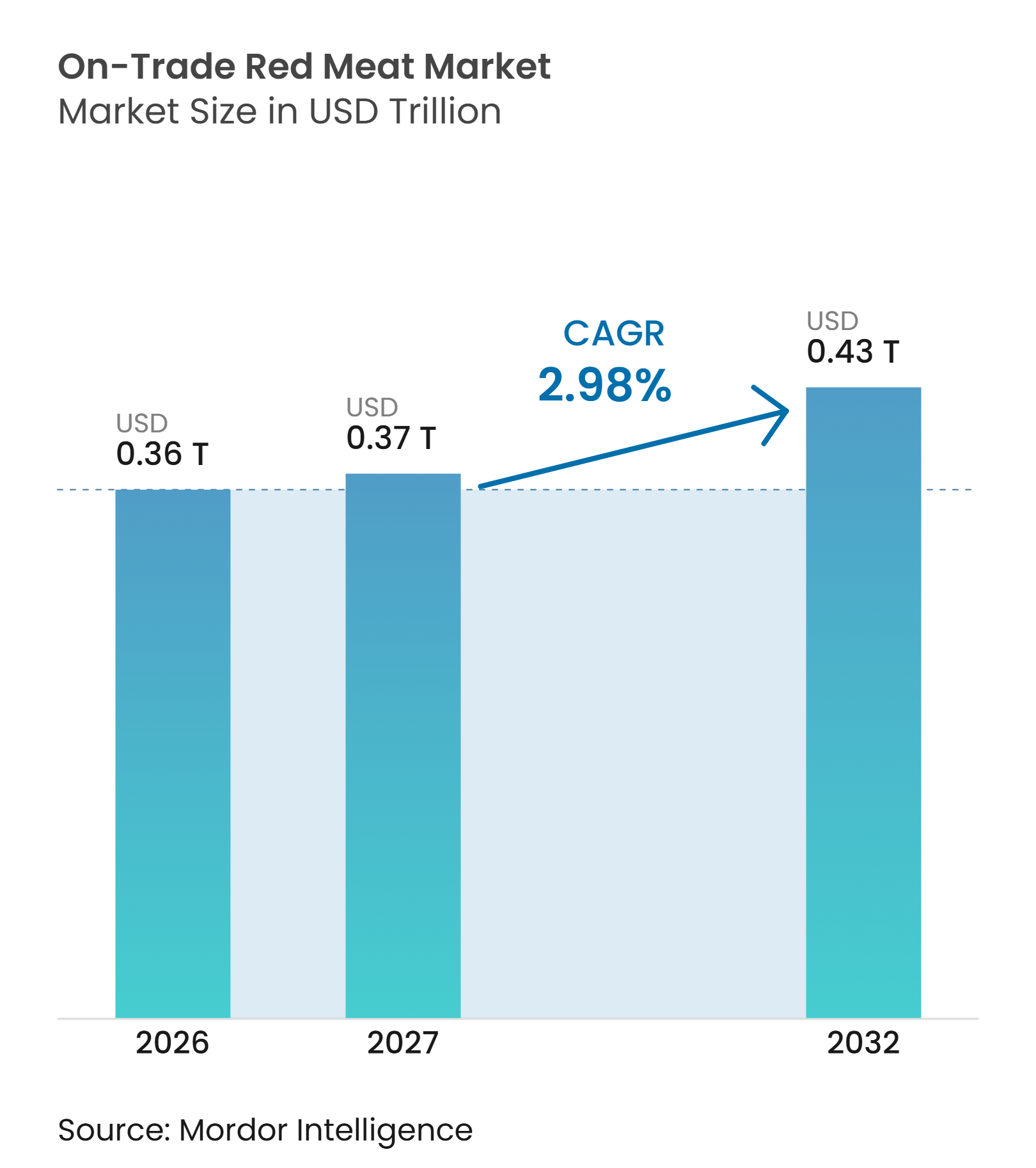
The on-trade red meat market size was valued at USD 0.36 trillion in 2026 and estimated to grow from USD 0.37 trillion in 2027 to reach USD 0.43 trillion by 2032, at a CAGR of 2.98% during the forecast period (2027-2032). The on-trade red meat market is supported by the growing share of meals purchased from restaurants, hotels, caterers, and delivery platforms rather than prepared at home. Restaurant chains are expanding their presence across several regions, increasing purchasing volumes and favoring standardized meat specifications. Delivery platforms also enable operators to sell burgers, kebabs, sandwiches, and grilled dishes beyond dine-in occasions.
Key Report Takeaways
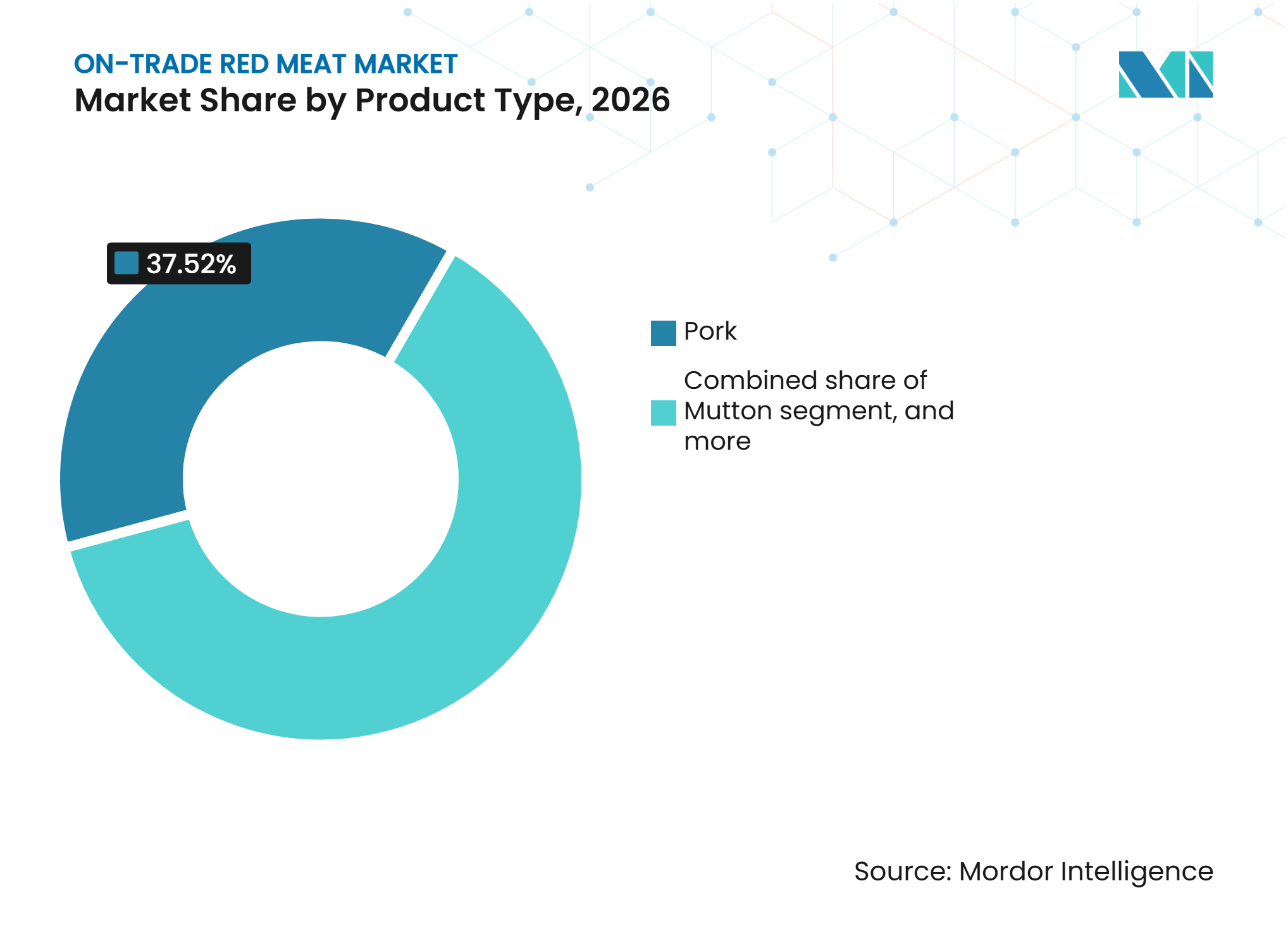
- By product type, pork dominated the market with a share of 37.52% in 2026, while mutton is anticipated to register the fastest CAGR of 4.02% during 2027-2032.
- By category, traditional meat dominated the market with a share of 92.31% in 2026, while organic meat is anticipated to register the fastest CAGR of 4.35% during 2027-2032.
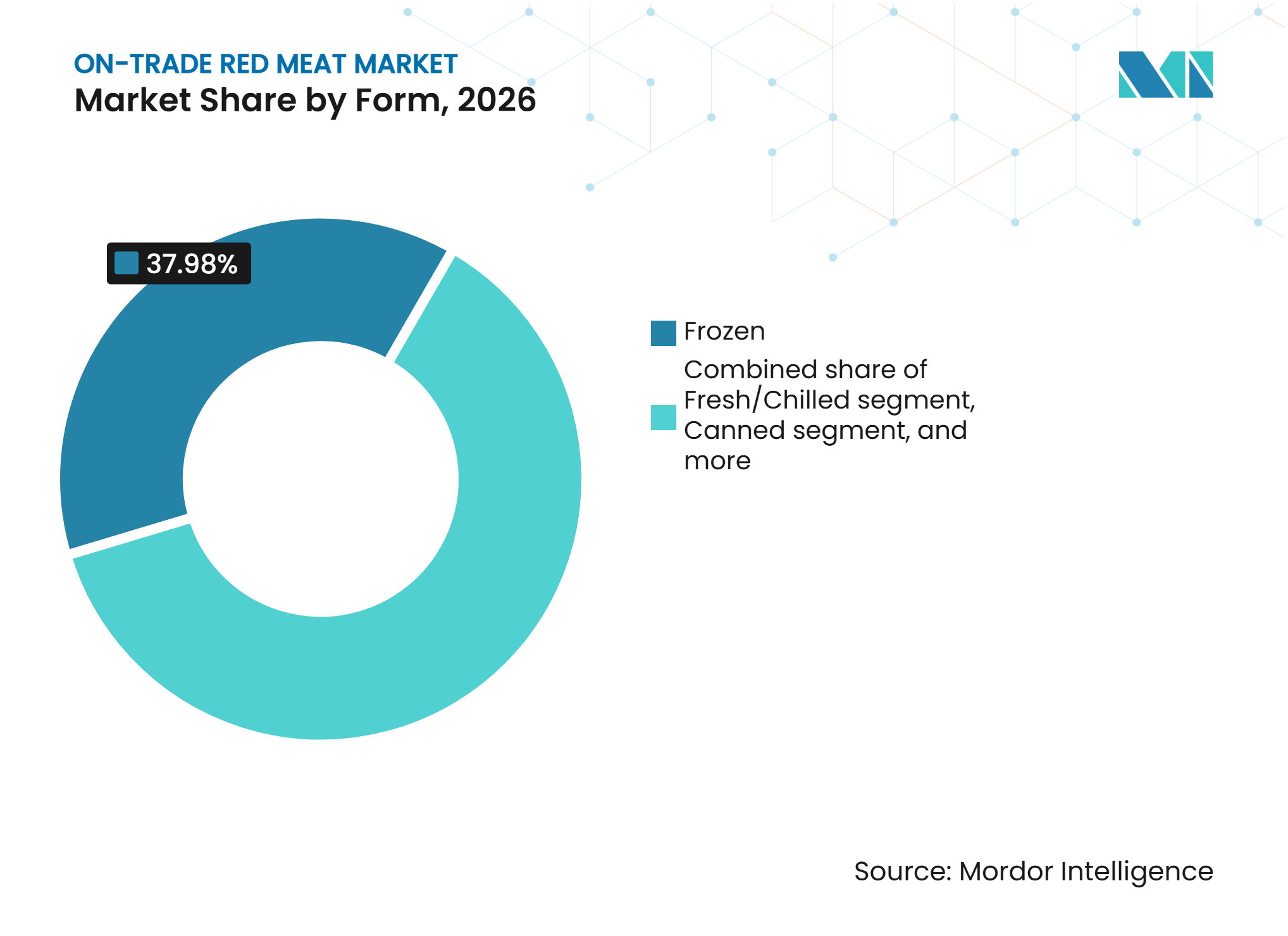
- By form, frozen dominated the market with a share of 37.98% in 2026, while fresh/chilled is anticipated to register the fastest CAGR of 4.18% during 2027-2032.
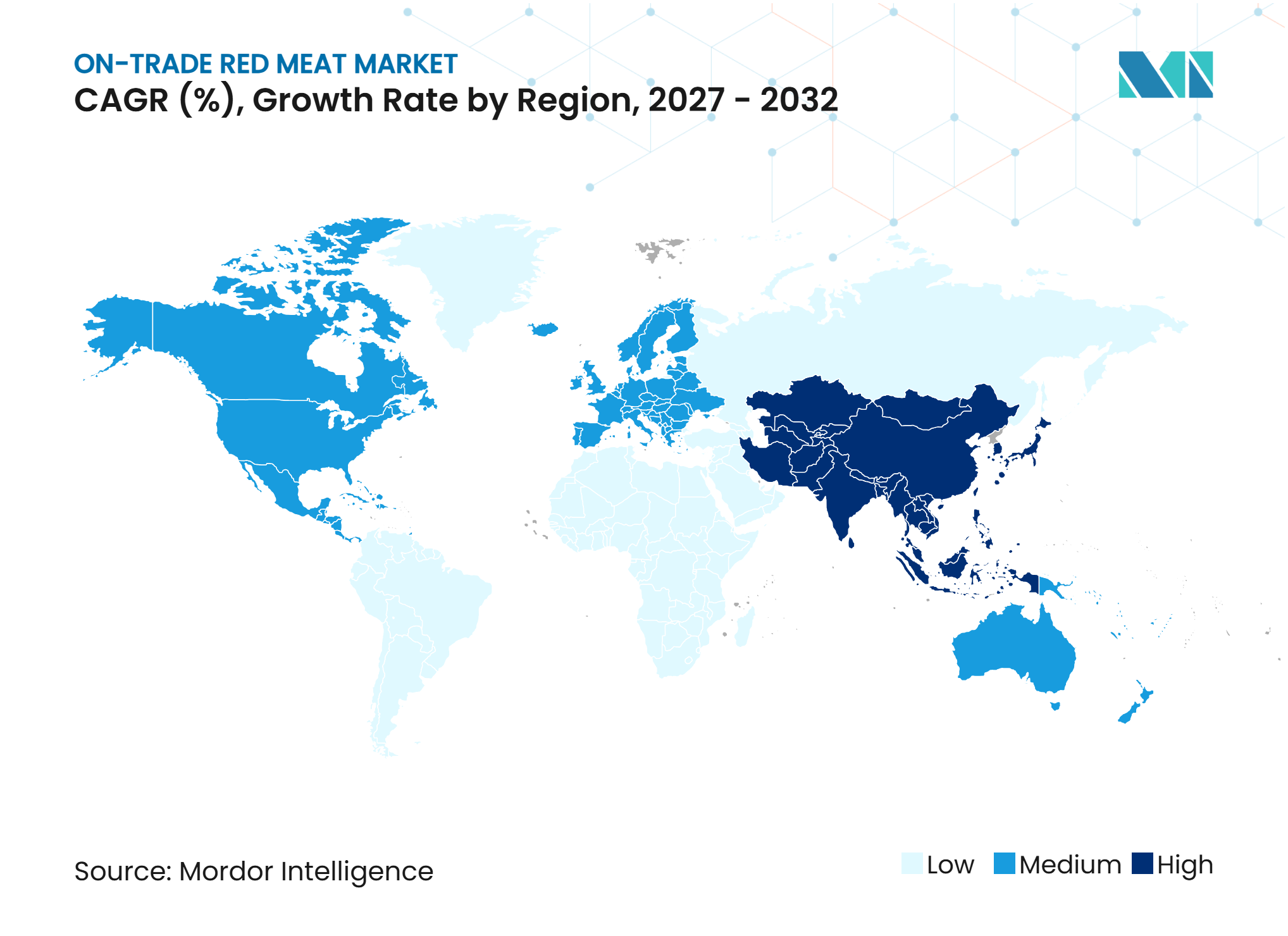
- By geography, North America dominated the on-trade red meat market with a share of 39.42% in 2026, while Asia-Pacific is anticipated to register the fastest CAGR of 4.76% during 2027-2032.
Note: Market numbers in this report are based on Mordor Intelligence's proprietary estimation framework, which combines nine months of actuals with Q4 projections for base year 2026.
Market Trends and Insights
Drivers Impact Analysis of On-Trade Red Meat Market*
| Driver | (~) % Impact on CAGR Forecast | Geographic Relevance | Impact Timeline |
|---|---|---|---|
| Expansion of quick-service restaurant chains | +0.8% | Global | Short term (≤ 2 years) |
| Rising consumer preference for protein-rich meals | +0.6% | Global | Medium term (2-4 years) |
| Increasing urbanization and out-of-home food consumption | +0.5% | Asia-Pacific, Middle East and Africa, South America | Medium term (2-4 years) |
| Popularity of regional and ethnic meat-based cuisines | +0.4% | Global, with Asia-Pacific and Middle East and Africa focus | Medium term (2-4 years) |
| Growth of food delivery and online ordering | +0.4% | Asia-Pacific, Middle East and Africa, North America | Short term (≤ 2 years) |
| Expansion of organized catering and institutional foodservice | +0.3% | Asia-Pacific, South America, Middle East and Africa | Long term (≥ 4 years) |
| Source: Mordor Intelligence | |||
Expansion of Quick-Service Restaurant Chains
The expansion of quick-service restaurant (QSR) chains is supporting the global on-trade red meat market by increasing demand for beef, pork, and other meat products used in burgers, sandwiches, wraps, and fast-food meals. The growth of international fast-food brands, new outlet openings, and menu diversification is increasing bulk procurement requirements across foodservice supply chains. In July 2026, the United States Department of Agriculture (USDA) reported that inflation-adjusted food sales at limited-service establishments in the United States reached USD 516.1 billion in 2025, highlighting the substantial scale of this foodservice segment[1]. This expansion is creating additional procurement opportunities for meat processors, distributors, and foodservice suppliers that serve QSR operators. Consequently, the growing presence of QSRs is driving recurring demand for standardized red meat products across the global foodservice industry.
Rising Consumer Preference for Protein-Rich Meals
Protein remains a key consideration for diners when selecting meals, giving restaurants a reason to emphasize meat quality, cut type, and sourcing practices. Cargill reported that one in four steak diners was dissatisfied with their most recent restaurant steak, primarily due to inconsistent cuts and doneness. This highlights an opportunity for operators to improve execution. The on-trade red meat market gains value from specifications that signal quality, including recognized grades and verified production claims. Restaurants also use smaller portions of premium cuts to address consumer demand for protein while accommodating preferences for manageable meal sizes. Clear menu descriptions and consistent cooking standards remain essential, as restaurant guests can assess meat quality immediately. These factors support value creation in the on-trade red meat market.
Increasing Urbanization and Out-of-Home Food Consumption
Increasing urbanization supports the global on-trade red meat market by concentrating consumers in cities, where access to restaurants, hotels, quick-service restaurants, and organized foodservice establishments is generally greater. Urban lifestyles, longer commuting hours, and limited time for home meal preparation encourage consumers to rely on restaurants and other out-of-home dining options. The United Nations Department of Economic and Social Affairs (UN DESA) published its World Urbanization Prospects 2025 report on November 2025. The report indicated that cities are home to 45% of the global population of 8.2 billion[2]. This urban concentration expands the potential customer base for foodservice operators and supports demand for convenient, restaurant-prepared meals. Consequently, the growing number of urban dining occasions creates additional consumption opportunities for red meat-based dishes, including burgers, steaks, kebabs, and grilled meat preparations.
Growth of Food Delivery and Online Ordering
Online ordering expands restaurant demand beyond dine-in seating and enables more frequent consumption across multiple dayparts. In April 2025, the National Restaurant Association reported that nearly 75% of restaurant traffic in the United States occurs off-premises, while 37% of adults order delivery at least once per week[3]. This trend increases the importance of packaging, holding quality, menu engineering, and portion consistency for meat-based restaurant dishes. Burgers, grilled meat platters, sandwiches, and prepared pork dishes are well suited for delivery when operators preserve product quality during transit. The on-trade red meat market benefits as restaurants develop delivery menus around products that travel well and can be produced at scale. Delivery platforms also expand restaurants’ reach into suburban and peri-urban areas, where consumers may not otherwise visit physical outlets.
Restraints Impact Analysis of On-Trade Red Meat Market*
| Restraint | (~) % Impact on CAGR Forecast | Geographic Relevance | Impact Timeline |
|---|---|---|---|
| Rising plant-based food preferences | -0.3% | North America, Europe | Short term (≤ 2 years) |
| Health concerns associated with red meat consumption | -0.2% | Global | Medium term (2-4 years) |
| Fluctuating red meat prices and procurement costs | -0.4% | North America, Global | Short term (≤ 2 years) |
| Stringent food safety and handling regulations | -0.1% | North America, Europe | Medium term (2-4 years) |
| Source: Mordor Intelligence | |||
Fluctuating Red Meat Prices and Procurement Costs
Fluctuations in red meat prices and procurement costs restrain the global on-trade red meat market by creating financial uncertainty for restaurants, hotels, and catering operators. Changes in livestock availability, animal feed prices, transportation expenses, energy costs, and processing charges can raise the procurement costs of beef, pork, and mutton. These cost variations make it difficult for foodservice operators to maintain stable purchasing budgets and consistent menu prices. Smaller restaurants and independent foodservice businesses are particularly vulnerable, as they often have lower purchasing power and weaker negotiating capabilities than large restaurant chains. Higher procurement costs may also compel operators to raise menu prices, adjust portion sizes, or replace expensive red meat products with more affordable protein alternatives.
Rising Plant-Based Food Preferences
Plant-based food preferences constrain demand in some restaurant settings, particularly among diners seeking lower-cost or non-meat options. For restaurant operators, the challenge is not complete substitution but meeting the needs of customers whose purchasing decisions depend on price, health considerations, and menu choices. Restaurants can sustain red meat demand by offering clear value, appropriate portion sizes, and sourcing information that builds guest confidence. Food safety requirements also increase operational complexity. Inspection requirements, European food hygiene regulations, and Codex labeling guidance influence procurement and handling practices across borders. These compliance factors are especially relevant for multi-country restaurant operators and suppliers supporting imported meat programs.
*Our forecasts treat driver/restraint impacts as directional, not additive. The impact forecasts reflect baseline growth, mix effects, and variable interactions.
On-Trade Red Meat Market Segment Analysis
By Product Type:
Pork Leads Volume, While Mutton Builds DemandPork accounted for 37.52% of the on-trade red meat market in 2026, making it the leading product type. Its leading position reflects its use in high-volume restaurant offerings, including sandwiches, sausages, breakfast menus, and Asian cuisine dishes. Pork also has a shorter production cycle than beef, which can support procurement continuity when cattle costs increase. As high-income markets offer limited per-capita growth potential, restaurant demand is increasingly driven by emerging foodservice markets and menu diversification. The on-trade red meat industry uses pork as a versatile protein across value menus, regional dishes, and processed formats. Pork suppliers can benefit when restaurants seek alternatives to premium beef without altering their operating formats.
Mutton is forecast to grow at a CAGR of 4.02% through 2032, the highest rate among the product types. Halal dining, Middle Eastern cuisine, South Asian dishes, and diaspora restaurants support mutton demand across several regions. Although beef remains a premium menu item in many full-service restaurants, rising cattle costs can encourage greater use of mutton and other red meat types. Goat meat also serves halal and African cuisine formats, although it remains more specialized than pork or beef. Product portfolios that meet these requirements can help restaurants serve distinct customer groups without relying on a single meat type.



By Category:
Traditional Meat Retains Scale, While Organic Meat ExpandsTraditional meat accounted for 92.31% of the on-trade red meat market size in 2026, reflecting the extensive reach of established supply chains across quick-service and full-service restaurants. Conventional procurement remains essential for operators requiring large volumes, standardized specifications, and efficient distribution. The scale of traditional meat also means that most restaurant menus continue to rely on standard products rather than certified niche offerings. The on-trade red meat market still depends on these systems, as they support frequent purchases across diverse restaurant formats. Suppliers that improve sourcing transparency can strengthen their position among restaurants seeking differentiation without fully transitioning to organic products.
Organic meat is forecast to grow at a CAGR of 4.35% through 2032, the fastest rate among the category segments. Organic offerings enable operators to use certification and provenance as part of their menu positioning rather than competing solely on price. The on-trade red meat industry can benefit as fast-casual concepts incorporate organic or grass-fed meat into their core offerings. Younger diners may respond positively to clear claims when they are supported by consistent eating quality. However, restaurant programs require reliable availability, as premium claims are difficult to sustain when supply is inconsistent.
By Form:
Frozen Supports Scale, While Fresh/Chilled Gains ValueFrozen red meat accounted for 37.98% of the on-trade red meat market size in 2026, driven by demand from chain restaurants and institutional foodservice operators. These operators value frozen products for their longer shelf life, consistent portion sizes, and reliable logistics across multiple locations. Frozen supply is particularly beneficial in areas with less developed fresh cold-chain infrastructure or where restaurants require stable inventory availability. Canned red meat represents a smaller on-trade format and is primarily used in selected processed dishes and institutional settings. Reliable freezing and distribution infrastructure remains critical, as product quality depends on proper storage throughout the supply chain.
Fresh/chilled red meat is forecast to grow at a CAGR of 4.18% through 2032, the fastest growth rate among the form segments. Fresh products can support premium menu pricing when restaurants clearly communicate cut quality, grade, and preparation methods. Processed formats, including pre-marinated and portion-controlled products, help caterers and restaurants reduce preparation time. However, fresh supply requires more stringent temperature control and shorter delivery cycles than frozen products. Suppliers that offer reliable fresh distribution and recognizable cuts can strengthen their value proposition in premium dining and fast-casual formats.

Geography Analysis
North America
North America is projected to account for 39.42% of the on-trade red meat market share in 2026, representing the largest regional share in the supplied estimates. The region has an established restaurant culture centered on beef, burgers, steaks, barbecue, pork dishes, and other meat-based menu formats. Certified Angus Beef licensed 601 restaurants in fiscal 2025 and recorded foodservice sales of 40.3 million pounds for March 2025, indicating continued interest in differentiated beef programs. Demand for United States beef in Mexico’s foodservice sector remains strong in Cancun, Mexico City, and Baja California. United States Department of Agriculture inspection requirements and food-handling systems remain key compliance considerations, positioning suppliers that combine quality assurance with stable availability favorably.
Asia-Pacific
Asia-Pacific is forecast to grow at a CAGR of 4.76% through 2032, the highest rate among the regions covered in the estimates. The on-trade red meat market benefits from expanding urban foodservice networks, increased food delivery orders, regional cuisines, and growing organized restaurant activity across China, India, and the Philippines. The growth of delivery ordering increases the importance of food quality after transit and standardized preparation. Halal requirements, local taste preferences, and national food safety regulations influence supplier selection. These factors favor companies that can localize cuts, formats, and certifications while maintaining reliable distribution networks.
Europe, South America, Middle East, and Africa
Europe's on-trade red meat market benefits from well-established restaurant, hotel, and catering industries, supported by strong demand for beef, pork, and lamb in countries including Germany, France, the United Kingdom, Spain, and Italy. South America has a strong beef consumption culture, particularly in Brazil and Argentina, where steakhouses, churrascarias, and barbecue restaurants drive demand for red meat products. In the Middle East, expanding hospitality infrastructure, growing tourism, and the popularity of traditional meat-based cuisines are increasing demand in Saudi Arabia, the United Arab Emirates, and Qatar. The expansion of international restaurant chains, premium dining establishments, and organized foodservice distribution networks across these regions is creating additional procurement opportunities for red meat suppliers.
Competitive Landscape
Market Concentration
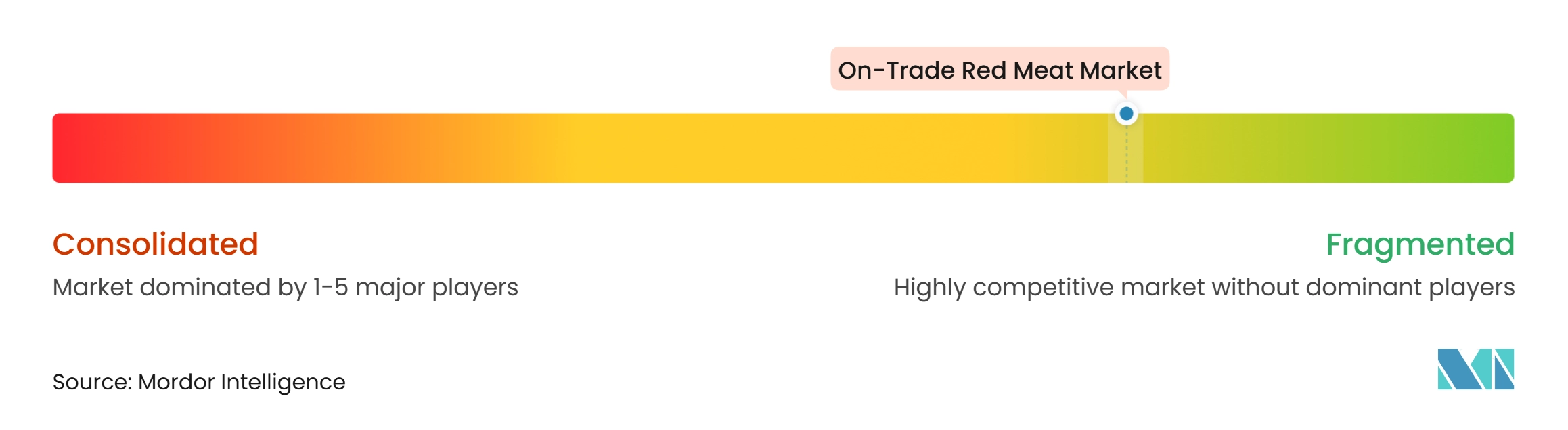
The on-trade red meat market is fragmented and competitive across processors, foodservice distributors, and restaurant operators, with participants serving distinct roles. Tyson Foods, Cargill, JBS, and Marfrig-controlled National Beef account for a significant share of United States beef processing capacity. However, this upstream concentration does not translate into comparable control over restaurant purchasing, as distribution and restaurant operations remain widely fragmented. Cattle supply constraints also increase the value of suppliers that can consistently provide reliable volumes and meet quality specifications.
Distribution capabilities and product differentiation shape competition at the restaurant supply level. Danish Crown supplied beef patties to McDonald’s restaurants in Denmark and other Nordic markets beginning in summer 2026, supported by a dedicated production line in Vejen. This agreement demonstrates how quality standards and dedicated production capacity can help suppliers secure long-term foodservice relationships. Certified product claims also enable restaurant operators to communicate premium quality to diners. Suppliers gain a competitive advantage by meeting product specifications, delivery requirements, verified sourcing expectations, and operational requirements related to portion sizes and cold-chain performance.
Product innovation represents another competitive strategy, particularly as restaurant customers seek menu differentiation and reduced operational risk. MBRF expanded its regional presence to address halal foodservice demand, including through a Saudi Arabia-focused platform and additional processing activities. Organic, grass-fed, and halal-certified products provide further opportunities to address distinct sourcing requirements. The on-trade red meat market remains fragmented at the restaurant level, requiring suppliers to compete locally even when they operate large-scale processing facilities.
On-Trade Red Meat Industry Leaders
-
Tyson Foods, Inc.
-
Sysco Corporation
-
WH Group Limited
-
Marfrig Global Foods S.A.
-
Smithfield Foods
- *Disclaimer: Major Players sorted in no particular order
On-Trade Red Meat Market Companies Covered in this Report
- Tyson Foods, Inc.
- Cargill, Incorporated
- Sysco Corporation
- WH Group Limited
- Marfrig Global Foods S.A.
- Hormel Foods Corporation
- BRF S.A.
- Smithfield Foods
- Minerva Foods S.A.
- OSI Group
- National Beef Packing Company, LLC
- Maple Leaf Foods Inc.
- Danish Crown
- Vion Food Group
- NH Foods Ltd.
- Tönnies Holding ApS and Co. KG
- Perdue Farms LLC
- Clemens Food Group
- Australian Agricultural Company Limited
- Silver Fern Farms Limited
Recent Industry Developments in On-Trade Red Meat Market
- September 2025: Smithfield Culinary launched three fully cooked, smoked meat products for foodservice operators: Shredded Beef Birria, Chopped Beef Brisket, and Pork Shoulder Burnt Ends. These offerings help restaurants, hotels, and catering businesses incorporate slow-cooked barbecue flavors into their menus.
- August 2025: Brakes launched a range of 100% British Farm Assured mutton products, including racks, joints, chops, mince, and diced mutton, offering foodservice operators an alternative to lamb.
- March 2025: KFF launched an extensive fresh meat range featuring more than 30 premium and value options across beef, pork, and poultry. The range included beef products, such as steaks and mince, and pork products, such as joints and bacon, enabling foodservice operators to source a broader selection of fresh meat from a single supplier.
Global On-Trade Red Meat Market Report Scope
Red meat is defined as the muscle meat from mammals, such as beef, pork, lamb, mutton, horse, and goat.
The on-trade red meat market is segmented by product type, category, and form. By product type, the market is segmented into beef, mutton, pork, and other meat. By category, the market is segmented into traditional meat and organic meat. By form, the market is segmented into fresh/chilled, frozen, canned, and processed red meat. By geography, the market is segmented into North America, South America, Europe, Asia-Pacific, and the Middle East and Africa. The market forecasts are provided in terms of value (USD).
Segmentation Overview
| Beef |
| Mutton |
| Pork |
| Other Meat |
| Traditional Meat |
| Organic Meat |
| Fresh/Chilled |
| Frozen |
| Canned |
| Processed |
| North America | United States |
| Canada | |
| Mexico | |
| Rest of North America | |
| Europe | Germany |
| United Kingdom | |
| Italy | |
| France | |
| Spain | |
| Netherlands | |
| Rest of Europe | |
| Asia-Pacific | China |
| India | |
| Japan | |
| Australia | |
| Thailand | |
| Indonesia | |
| Rest of Asia-Pacific | |
| South America | Brazil |
| Argentina | |
| Peru | |
| Rest of South America | |
| Middle East and Africa | South Africa |
| Saudi Arabia | |
| United Arab Emirates | |
| Turkey | |
| Egypt | |
| Rest of Middle East and Africa |
| By Product Type | Beef | |
| Mutton | ||
| Pork | ||
| Other Meat | ||
| By Category | Traditional Meat | |
| Organic Meat | ||
| By Form | Fresh/Chilled | |
| Frozen | ||
| Canned | ||
| Processed | ||
| By Geography | North America | United States |
| Canada | ||
| Mexico | ||
| Rest of North America | ||
| Europe | Germany | |
| United Kingdom | ||
| Italy | ||
| France | ||
| Spain | ||
| Netherlands | ||
| Rest of Europe | ||
| Asia-Pacific | China | |
| India | ||
| Japan | ||
| Australia | ||
| Thailand | ||
| Indonesia | ||
| Rest of Asia-Pacific | ||
| South America | Brazil | |
| Argentina | ||
| Peru | ||
| Rest of South America | ||
| Middle East and Africa | South Africa | |
| Saudi Arabia | ||
| United Arab Emirates | ||
| Turkey | ||
| Egypt | ||
| Rest of Middle East and Africa | ||
Key Questions Answered in the Report
What is the current size and future growth outlook of on-trade red meat market?
The on-trade red meat market was valued at USD 0.36 trillion in 2026 and is estimated to reach USD 0.37 trillion in 2027. The market is projected to grow to USD 0.43 trillion by 2032, registering a CAGR of 2.98% during 2027–2032.
Which product type held the largest share of on-trade red meat market in 2026?
Pork was the largest product type segment in 2026, accounting for 37.52% of on-trade red meat market.
Which category dominated the on-trade red meat market in 2026?
Traditional meat dominated the category segment in 2026, accounting for 92.31% of market.
Which form held the largest share of on-trade red meat market in 2026?
Frozen red meat was the largest form segment in 2026, accounting for 37.98% of market.
Which region dominated the on-trade red meat market in 2026?
North America dominated the on-trade red meat market in 2026, accounting for 39.42% of the market share.