
On-Load Tap Changer (OLTC) Equipment Market Size and Share
Market Overview
| Study Period | 2021 - 2031 |
|---|---|
| Market Size (2026) | USD 0.91 Billion |
| Market Size (2031) | USD 1.18 Billion |
| Growth Rate (2026 - 2031) | 5.33 % |
| Fastest Growing Market | Asia-Pacific |
| Largest Market | Asia-Pacific |
| Market Concentration | High |
Major Players *Disclaimer: Major Players sorted in no particular order Image © Mordor Intelligence. Reuse requires attribution under CC BY 4.0. | |
On-Load Tap Changer (OLTC) Equipment Market Analysis by Mordor Intelligence
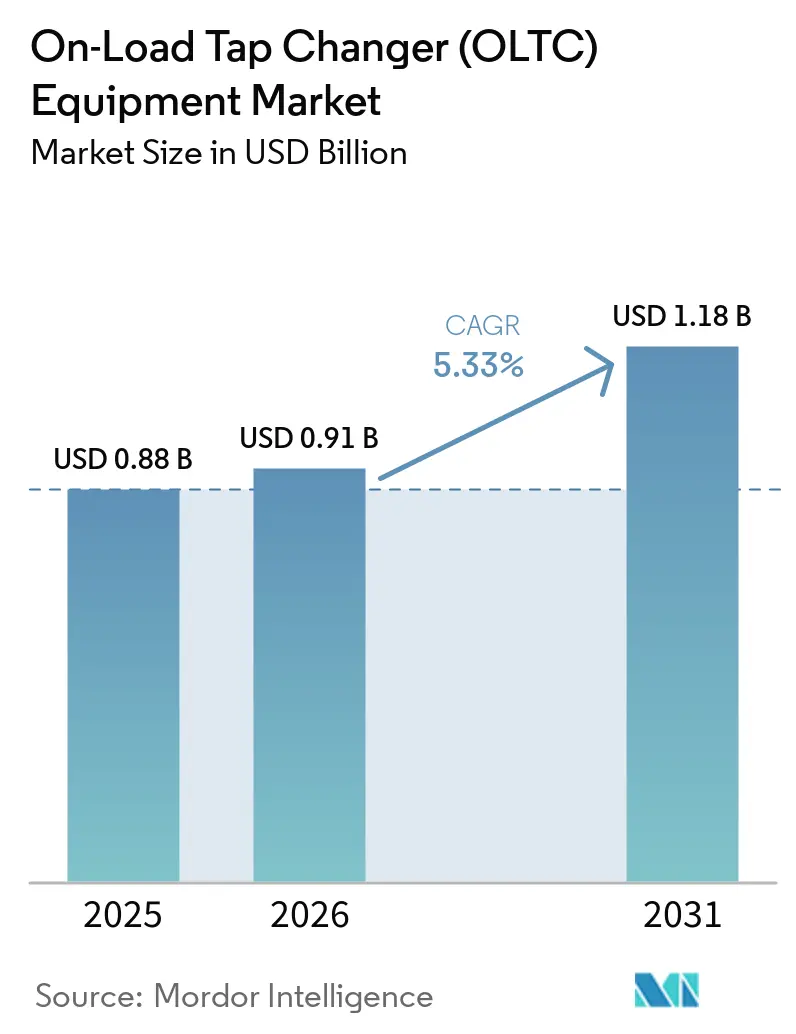
The On-Load Tap Changer Equipment Market size is expected to increase from USD 0.88 billion in 2025 to USD 0.91 billion in 2026 and reach USD 1.18 billion by 2031, at a CAGR of 5.33% over 2026-2031. The on-load tap changer market is supported by grid investment and the replacement of aging transformer fleets, which bring voltage-control requirements into procurement decisions. Renewable generation changes power flows and increases the need for equipment that can adjust voltage during operation. Utilities remain central to demand because they operate the largest installed transformer fleets and are managing replacement programs over several years. Compact vacuum designs are creating pressure on conventional equipment because they address maintenance and space constraints. Material availability, component lead times, and the gradual development of solid-state alternatives will shape how suppliers convert demand into deliveries.
Key Report Takeaways
- By type, oil-immersed products held 61.4% of the on-load tap changer market share in 2025, while vacuum products are forecast to grow at a 6.2% CAGR through 2031.
- By phase, the three-phase held 72.8% of the on-load tap changer market share in 2025 and is projected to grow at a 6.7% CAGR through 2031, supported by utility transmission, bulk distribution, and renewable connection requirements.
- By transformer, power transformers held 52.6% of the on-load tap changer market share in 2025, while distribution transformers are projected to grow at a 6.9% CAGR through 2031.
- By application, utilities held 56.2% of demand in 2025, while renewable energy developers are forecast to grow at a 7.8% CAGR through 2031.
- By geography, Asia-Pacific held 38.7% of revenue in 2025 and is forecast to grow at an 8.1% CAGR through 2031.
Note: Market size and forecast figures in this report are generated using Mordor Intelligence’s proprietary estimation framework, updated with the latest available data and insights as of January 2026.
Market Trends and Insights
Drivers Impact Analysis of On-Load Tap Changer (OLTC) Equipment Market*
| Driver | (~) % Impact on CAGR Forecast | Geographic Relevance | Impact Timeline |
|---|---|---|---|
| Grid Modernization and Transformer Replacement | +1.50% | Global; concentrated in North America, Western Europe, and APAC | Medium term (2-4 years) |
| Renewable Integration and Bidirectional Power Flow | +1.20% | Global; strongest in APAC, Europe, and North America | Medium term (2-4 years) |
| Digital Voltage Regulation and Predictive Maintenance | +0.70% | North America and Europe early adopters; expanding to APAC | Long term (≥ 4 years) |
| Railway, HVDC and Energy-Intensive Electrification | +0.50% | Europe and APAC (China, India); North America emerging | Long term (≥ 4 years) |
| Compact Vacuum OLTC Retrofits for Space-Constrained Transformers | +0.40% | Global; higher penetration in dense urban grids in Europe and APAC | Medium term (2-4 years) |
| OLTC Monitoring Data as a New Asset-Health Revenue Stream | +0.30% | North America and Europe initially; expanding to APAC | Long term (≥ 4 years) |
| Source: Mordor Intelligence | |||
Grid Modernization and Transformer Replacement
The on-load tap changer market benefits when utilities replace transformers because voltage-control equipment is part of the transformer operating system. OLTC-related issues are a significant contributor to transformer failures, making replacement programs relevant to tap-changer purchasing decisions. Utilities are planning equipment purchases earlier because transformer lead times have become longer. Eugene Water and Electric Board approved a USD 22.4 million power-transformer contract in May 2026 within a USD 444 million capital plan for 2026 to 2030. That procurement shows how utilities are reserving capacity before individual assets reach the end of service. Vacuum retrofits can extend transformer service life when the transformer body remains usable, which gives utilities a lower-disruption option than full replacement. Compact retrofit designs also make upgrades more practical where space limits a conventional replacement.[1]
Renewable Integration and Bidirectional Power Flow
Solar and wind generation can create voltage swings in both directions as output and local demand change. Fixed-tap transformers cannot make the repeated adjustments that these operating conditions require. The on-load tap changer market, therefore, gains support when renewable projects require voltage regulation at their grid connection points. European grid plans have increased attention on reactive-power capability at large renewable connections. Reinhausen states that its ECOTAP VPD is designed for dynamic voltage regulation in medium-voltage distribution transformers. This approach can reduce the need for separate reactive-compensation equipment at renewable sites. It also places voltage-control performance closer to the connection transformer, where developers and utilities can address local network conditions.[2]
Digital Voltage Regulation and Predictive Maintenance
Digital monitoring is broadening the role of OLTC equipment from mechanical switching toward asset-condition management. Sensors, dissolved gas analysis, and diagnostic tools can help utilities identify operating changes between planned maintenance visits. A 2025 study in Energies evaluated a method for predicting gas concentrations in OLTC oil before conventional alarm thresholds were reached. OMICRON describes vibro-acoustic monitoring as a non-invasive way to assess an on-load tap changer while the transformer stays in service. These capabilities support condition-based maintenance decisions and can help suppliers offer monitoring and service tools alongside hardware. The on-load tap changer market also gains a longer-term service opportunity when equipment data is used in commissioning, monitoring, and maintenance workflows. Digital adoption is most established in North America and Europe, while the supplied research expects wider adoption in the Asia-Pacific.
Railway, HVDC, and Energy-Intensive Electrification
Railway electrification requires upgrades to traction power infrastructure and the transformers used at substations. The European Union Agency for Railways has examined the harmonization of railway electrification systems, including the move from legacy configurations toward interoperable systems. This work supports the demand for specialized transformer equipment in converted rail corridors. GE Vernova has also described the role of modular multilevel converter technology in rail electrification. In HVDC applications, flexible voltage settings can support converter operating margins. Reinhausen published research on OLTC use in HB-MMC converter configurations, where it reported lower converter losses under the examined conditions. Green hydrogen, electric arc furnaces, and large data centers add further industrial load requirements that require dependable voltage management.[3]
Restraints Impact Analysis of On-Load Tap Changer (OLTC) Equipment Market*
| Restraint | (~) % Impact on CAGR Forecast | Geographic Relevance | Impact Timeline |
|---|---|---|---|
| High-Grade Electrical Steel, Copper and Vacuum-Component Constraints | -0.80% | Global; most acute in North America where GOES supply is extremely concentrated | Short term (≤ 2 years) |
| Specialist Skills Shortage and Extended Qualification Cycles | -0.50% | North America and Europe primarily; APAC manufacturers less constrained | Medium term (2-4 years) |
| Legacy Fleet Interface and Cybersecurity Retrofit Complexity | -0.30% | Developed markets: North America, Western Europe | Medium term (2-4 years) |
| Solid-State Voltage Regulation as a Long-Term Substitute | -0.20% | Data center clusters in North America and Western Europe initially | Long term (≥ 4 years) |
| Source: Mordor Intelligence | |||
High-Grade Electrical Steel, Copper, and Vacuum-Component Constraints
Material availability can limit on-load tap changer market deliveries even when transformer order books are strong. U.S. Congressional Research Service (CRS) reported higher prices for grain-oriented electrical steel and transformer-grade copper during 2024 and 2025. It also noted that North American supply is vulnerable when production is concentrated. The U.S. Congressional Research Service documented policy issues around distribution transformer supply, tariffs, and electrical steel. Supply restrictions affect equipment makers through input costs, component availability, and the time required to qualify alternatives. Skilled labor and long qualification cycles add another constraint because tap-changer systems require specialized manufacturing and testing. Legacy fleet interfaces and cybersecurity requirements can also make digital retrofit projects more complex in mature utility systems.[4]
Solid-State Voltage Regulation as a Long-Term Substitute
Solid-state voltage regulation could create a long-term substitute in selected applications, although the supplied research did not present it as a near-term replacement for utility-scale OLTC equipment. A 2026 Nature Scientific Reports study assessed an intelligent solid-state voltage regulator in rural low-voltage networks. The reported field findings supported its use in that network setting while limiting its relevance to utility-scale transmission. An IEEE article from ETH Zurich discussed solid-state transformers for artificial-intelligence data centers and addressed efficiency and power-density considerations. These technologies may be relevant for microgrids and data-center clusters where compact power conversion has distinct value. Conventional transformer and OLTC configurations retain an advantage in the high-power utility applications covered by the forecast period. The on-load tap changer market will therefore face an application-specific, rather than uniform, substitution risk through 2031.
*Our forecasts treat driver/restraint impacts as directional, not additive. The impact forecasts reflect baseline growth, mix effects, and variable interactions.
On-Load Tap Changer (OLTC) Equipment Market Segment Analysis
By Type:
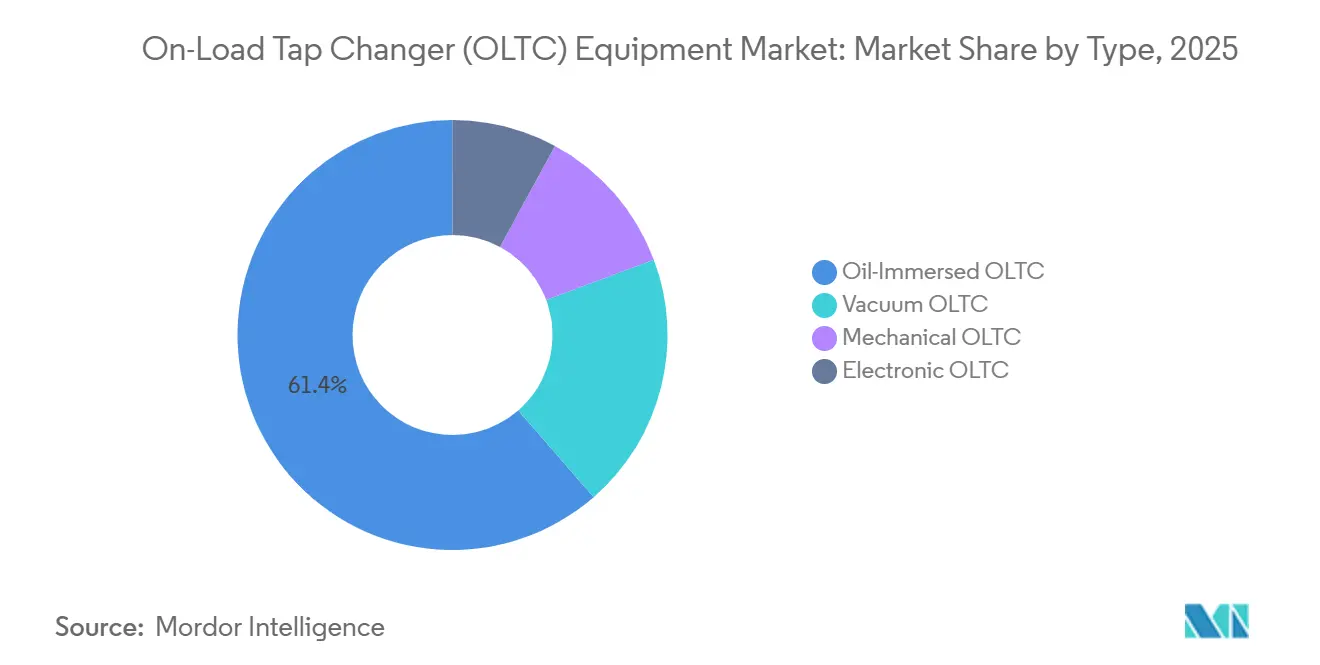
Vacuum Technology Gaining Ground Against an Entrenched Oil-Immersed BaseOil-immersed equipment held 61.4% of revenue in 2025, while vacuum products are projected to grow at a 6.2% CAGR through 2031. The installed base, established supply chains, and lower unit cost support the continued position of oil-immersed designs in large power transformers. These designs remain suitable where established maintenance practices and transformer layouts favor conventional configurations. Vacuum technology is gaining adoption because it removes arc contact with transformer oil. Reinhausen states that vacuum interrupter contacts can operate for 300,000 to 500,000 switching operations without maintenance. The design can also remove the need for online oil filtration associated with switching contacts. Mechanical products remain relevant to legacy fleet retrofits where utilities need compatibility with existing equipment. Electronic products serve industrial use cases that require precise voltage control.
The on-load tap changer market size for vacuum equipment is supported by compact transformer designs used in urban and renewable applications. Hitachi Energy introduced the VUBB Compact OLTC in June 2025 with 4 variants for different voltage classes. The company presented the product as a component for smaller and lighter transformer designs. Reinhausen began series production of VACUTAP VI in August 2025. The company states that the product requires up to 13% less space than conventional designs. It shares the transformer oil reservoir and removes spring energy storage from the construction. These features extend vacuum technology toward distribution and medium-voltage regulator applications above 3.3 MVA. Oil-immersed equipment is still expected to retain leadership during the forecast period because the largest power-transformer orders use mature configurations.

By Phase:
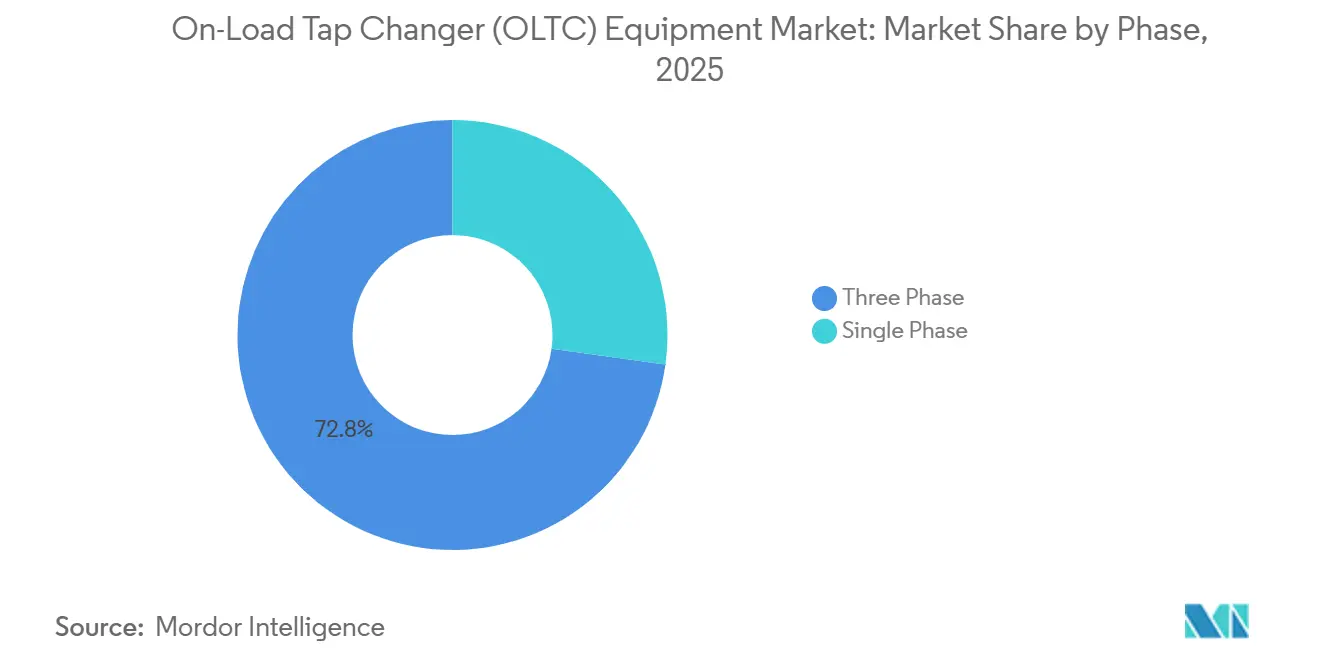
Three-Phase Architecture Sustains Commanding Market PositionThree-phase equipment held 72.8% of revenue in 2025 and is projected to grow at a 6.7% CAGR through 2031. Utility transmission transformers, bulk distribution equipment, and renewable step-up transformers use three-phase architecture. This architecture aligns with the standard configuration of high-voltage substations and large grid connections. The expected growth reflects the scope of utility and renewable procurement pipelines. Three-phase products also serve industrial facilities that require a high-capacity power supply. Their role is tied to the scale of the transformer rather than a separate equipment preference. The on-load tap changer industry depends on this architecture for its largest utility applications. Three-phase equipment is therefore expected to retain a commanding position through the forecast period.
Single-phase equipment serves a narrower set of applications, including rail traction power and industrial isolation systems. Rail conversion projects can create specialized demand when substations shift toward 25 kV AC supply. The European Union Agency for Railways has assessed electrification-system harmonization across rail networks. IEC 62590-2-2:2026 specifies requirements for controlled converters used in DC electric traction power supply systems. These requirements increase the importance of supplier qualification in traction applications. Suppliers with relevant certification and reference installations can benefit from pre-qualified sourcing practices. The addressable base is smaller than for utility-scale three-phase equipment. It remains a relevant niche because rail systems need dedicated voltage-control configurations.
By Transformer:
Distribution Transformers Emerge as the Fastest-Growth TierPower transformers held 52.6% of the on-load tap changer market size in 2025. Their high unit value and near-universal OLTC specification for larger assets support this position. They are used in transmission and large substation applications where voltage adjustment is a core requirement. Aging fleets add replacement demand for high-value power transformers. The supplied research indicated that a large share of older U.S. power transformers had been in service for more than 40 years. This replacement cohort extends demand beyond new grid connections. Large transformer orders also tend to have long procurement cycles and detailed technical qualification requirements. These conditions favor established equipment suppliers with field experience.
Distribution transformers are projected to grow at a 6.9% CAGR through 2031, the highest rate among transformer categories in the supplied draft. Distributed solar, EV charging, and bidirectional feeder flows create voltage variability at medium-voltage levels. Fixed-tap equipment has less ability to address repeated changes in these operating conditions. The on-load tap changer market gains a new growth path as regulated distribution networks use more voltage-control equipment. Furnace transformers continue to serve industrial loads that require controlled power supply. Other transformers include HVDC converter applications that support offshore wind and transmission projects. These categories are smaller than power transformers but add application diversity. The on-load tap changer industry is therefore extending from its established high-voltage base into more distribution-level use cases.
By Application:
Renewables and Data Centers Rebalance the Demand MixUtilities held 56.2% of application demand in 2025. Their transformer fleets and asset-replacement programs make them the largest customer group in the on-load tap changer market. Utility buyers evaluate equipment reliability, installation compatibility, service access, and delivery timing. Their long planning cycles create demand visibility for qualified suppliers. Utilities also use OLTC monitoring to support maintenance decisions. Grid modernization programs make voltage management more important in both transmission and distribution systems. This customer group remains the main base of demand through the forecast period. Its procurement scale also shapes supplier investment in capacity and local service.
Renewable energy developers are projected to grow at a 7.8% CAGR through 2031, the highest rate among applications. Each grid-connected plant needs equipment that can meet connection and voltage-control requirements. Developers favor components that support stable output and reduce the need for separate compensation equipment. Data centers are an emerging source of transformer demand as their power requirements increase. Industrial users maintain baseline demand for furnace and rectifier applications. Railway operators add demand through electrification programs and traction substations. Other applications include HVDC interface equipment for offshore wind projects. Together, these customers broaden the on-load tap changer market beyond its historical utility concentration.
Geography Analysis
APAC On-Load Tap Changer (OLTC) Equipment Market
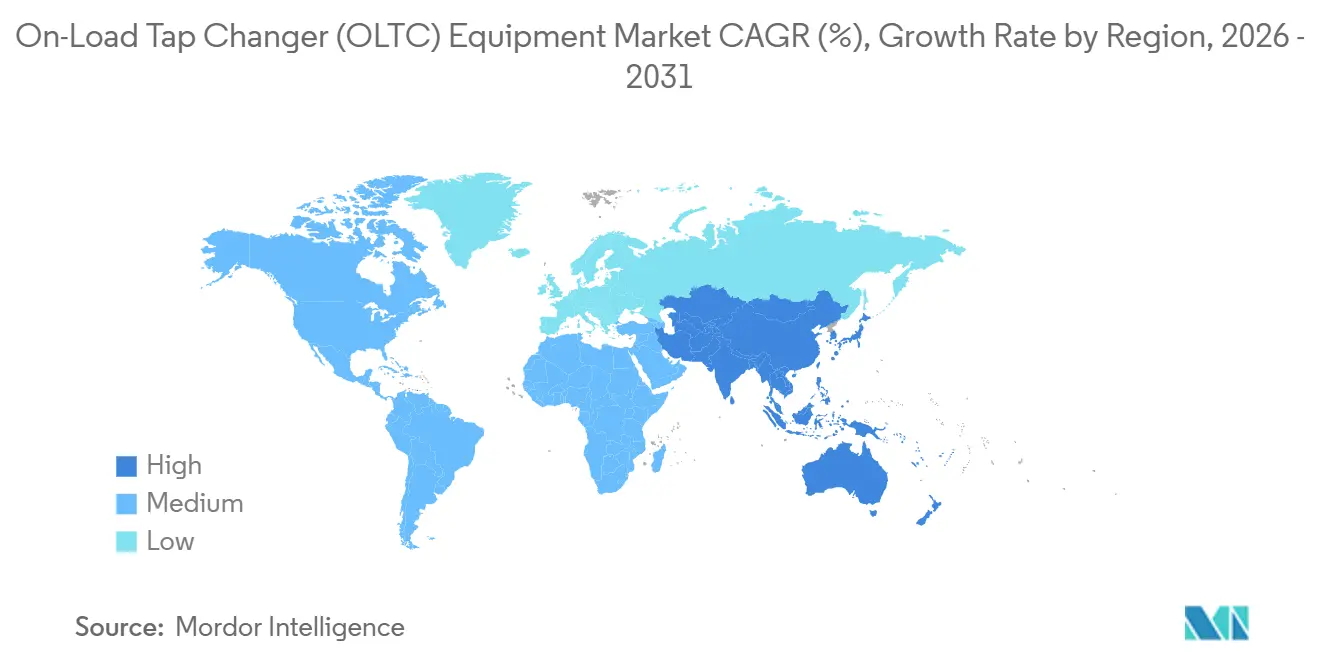
Asia-Pacific held 38.7% of regional revenue in 2025 and is forecast to grow at an 8.1% CAGR through 2031. China’s State Grid designated CNY 650 billion, equivalent to USD 92.9 billion, for 2025 transmission upgrades in the supplied research. These upgrades include ultra-high-voltage infrastructure where transformer voltage control is part of system design. India’s National Electricity Plan targets 776,330 MVA of added transformer capacity at 220 kV and above through fiscal 2027. India also supports grid expansion through transmission and distribution programs. Japan, South Korea, Australia, and Southeast Asian countries add demand through renewable evacuation and broader electrification. The on-load tap changer market benefits from the region’s combined demand, manufacturing, and supply advantages.
North America On-Load Tap Changer (OLTC) Equipment Market
North America is the second-largest regional market in the supplied draft. Replacement of aging equipment remains an important demand driver across U.S. utility systems. Data-center load growth is another source of transformer and voltage-control demand. Canada and Mexico add transmission and distribution upgrades as well as cross-border interconnection projects. Material costs and import-policy changes can pressure equipment makers in the short term. Longer procurement lead times make utilities more likely to plan replacements earlier. This favors suppliers that can meet technical requirements and provide predictable delivery schedules. The region, therefore, combines strong demand with meaningful supply and cost constraints.
EMEA and South America On-Load Tap Changer (OLTC) Equipment Market
Europe supports the on-load tap changer market through grid investment, offshore wind connections, and rail electrification. The European Commission’s Grid Action Plan identifies the scale of network investment required by 2030. National Grid awarded a major HVDC supply agreement in March 2025 for North Sea grid connections. Hitachi Energy and E.ON signed a framework agreement in July 2025 for power and distribution transformers in Germany. South America adds demand led by Brazil, while grid programs in Saudi Arabia and the United Arab Emirates support the Middle East and Africa. These regions are smaller than Asia-Pacific and North America in the supplied analysis. They still provide project-based demand for transformers and voltage-control equipment through 2031.
Competitive Landscape
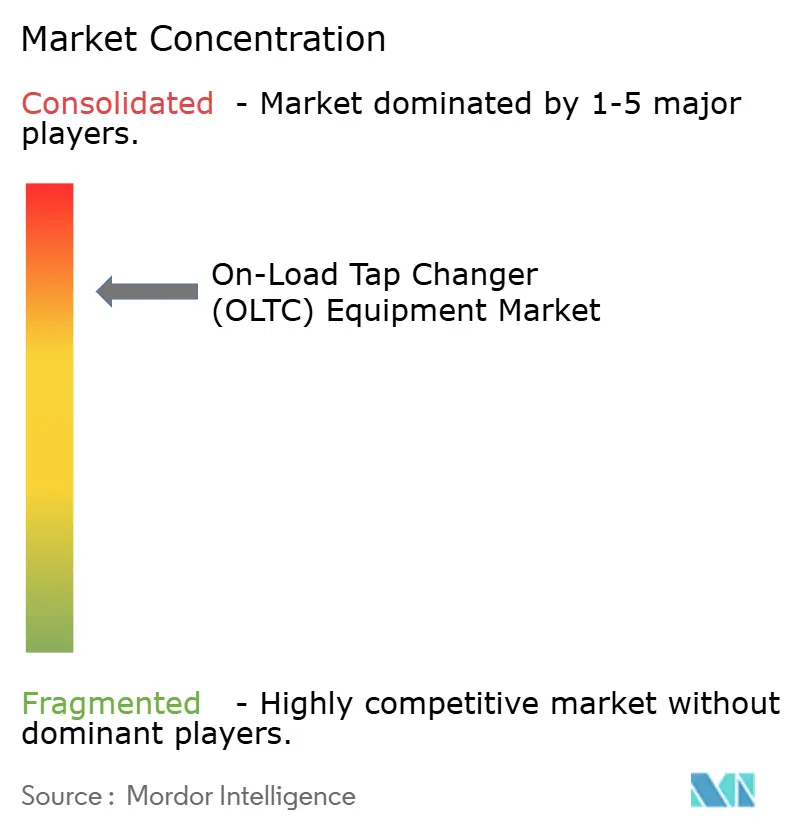
The on-load tap changer market is concentrated in premium technology and fragmented across volume-oriented mid-market supply. Maschinenfabrik Reinhausen has an installed base and manufacturing advantage in premium OLTC equipment. The company announced stable 16-week delivery times in April 2026 after investment across Regensburg, Humboldt, and Suzhou. That commitment addresses a supply issue that matters to transformer manufacturers with tightly scheduled production plans. Hitachi Energy is expanding transformer manufacturing capacity under a global investment program. Its E.ON framework agreement illustrates how major suppliers secure longer-term positions in utility procurement. Siemens Energy also announced an investment in transformer capacity in North Carolina. These moves show that availability and delivery capability remain major competitive factors.
Chinese manufacturers, including Jiangsu Huaming Power Equipment, Shandong Taikai Transformer, Liaoning Jinli Electric Power, and Zhejiang Tenglong Electrical Apparatus, compete for mid-tier and export opportunities. Their position is associated with price and lead-time competition in the supplied draft. Indian suppliers, including CTR Manufacturing, Easun MR Tap Changers, On Load Gears, and CG Power, benefit from India’s growing transformer production base. The on-load tap changer market also includes global electrical-equipment companies that serve transformer and grid projects. Product qualification, installed experience, and service support matter more in critical utility applications. Cost and lead time remain more prominent in the mid-market. Supplier strategies, therefore, differ between premium technology and volume-oriented equipment. The competitive field does not include a supplied combined share for the leading firms.
Digital services are creating another area of competition. Reinhausen’s ETOS platform and myReinhausen tools combine logic editing, commissioning, and monitoring functions. This strategy extends the supplier relationship beyond the equipment sale. Condition-monitoring tools can support aftermarket work when utilities use sensor data in maintenance planning. Trench Group signed long-term framework agreements with Hitachi Energy, GE Vernova, and Siemens Energy for high-voltage grid components. These agreements show how component suppliers seek preferred positions before future capacity requirements peak. Competitive strength in the on-load tap changer market is therefore linked to hardware design, manufacturing capacity, delivery performance, and digital service capability. No concentration score can be calculated from the supplied information because it does not provide combined top-player market shares.
On-Load Tap Changer (OLTC) Equipment Industry Leaders
-
Maschinenfabrik Reinhausen GmbH (MR)
-
Jiangsu Huaming Power Equipment Co., Ltd.
-
Hitachi Energy Ltd.
-
Elprom Heavy Industries JSC
-
Shandong Taikai Transformer Co., Ltd.
- *Disclaimer: Major Players sorted in no particular order
On-Load Tap Changer (OLTC) Equipment Market Companies Covered in this Report
- Bharat Heavy Electricals Limited
- CG Power and Industrial Solutions Limited
- CTR Manufacturing Industries Pvt. Ltd.
- Easun MR Tap Changers Pvt. Ltd.
- Eaton Corporation plc
- Elprom Heavy Industries JSC
- Fuji Electric Co., Ltd.
- GE Vernova Inc.
- Hitachi Energy Ltd.
- Jiangsu Huaming Power Equipment Co., Ltd.
- Krishna Power Industries
- Liaoning Jinli Electric Power Electrical Appliance Co., Ltd.
- Maschinenfabrik Reinhausen GmbH
- Mitsubishi Electric Corporation
- On Load Gears Pvt. Ltd.
- Shandong Taikai Transformer Co., Ltd.
- Siemens Energy AG
- Suzhou Silver Technology Co., Ltd.
- Toshiba Energy Systems & Solutions Corporation
- Zhejiang Tenglong Electrical Apparatus Co., Ltd.
Recent Industry Developments in On-Load Tap Changer (OLTC) Equipment Market
- July 2026: Hitachi Energy and Larsen & Toubro received TenneT awards for HVDC links Nederwiek3 in the Netherlands and LanWin5 in Germany. Each link will transmit 2 GW of North Sea offshore wind to shore under an existing multi-year framework agreement.
- April 2026: Maschinenfabrik Reinhausen announced stabilized 16-week OLTC delivery times, enabled by investment across Regensburg, Humboldt in Tennessee, and Suzhou.
- February 2026: GE Vernova and Xcel Energy signed a Strategic Alliance Agreement covering gas turbines, wind capacity reservations, and grid equipment collaboration.
- December 2025: GE Vernova and Seatrium were awarded a TenneT contract for the BalWin5 2.2 GW HVDC offshore grid connection in the German North Sea.
Global On-Load Tap Changer (OLTC) Equipment Market Report Scope
On-Load Tap Changer (OLTC) equipment is a transformer voltage-regulation system that adjusts the transformer's winding turns ratio by changing tap positions while the transformer is energized and carrying load, without interrupting the power supply. It uses a tap selector and switching mechanism, typically with a diverter switch or vacuum interrupter, to regulate output voltage and maintain it within a desired range despite variations in load or input voltage. OLTC equipment is primarily used in power and distribution transformers, grid substations, and industrial electrical systems where continuous and precise voltage regulation is required.
The On-Load Tap Changer (OLTC) Equipment Market is segmented by type, phase, transformer, application, and geography. By type, the market is segmented into oil-immersed, vacuum, mechanical, and electronic OLTCs. By phase, the market is segmented into single-phase and three-phase. By transformer, the market is segmented into power, distribution, furnace, and other transformers. By application, the market is segmented into utilities, industrial, commercial, renewable energy developers, railway, data centers, and others. The report also covers the market size and forecasts for the global On-Load Tap Changer (OLTC) Equipment Market across 26 countries in key regions. For each segment, the market sizing and forecasts have been provided on the basis of value (USD).
Segmentation Overview
| Oil-Immersed OLTC |
| Vacuum OLTC |
| Mechanical OLTC |
| Electronic OLTC |
| Single Phase |
| Three Phase |
| Power Transformers |
| Distribution Transformers |
| Furnace Transformers |
| Other Transformers |
| Utilities |
| Industrial Users |
| Commercial Users |
| Renewable Energy Developers |
| Railway Operators |
| Data Center Operators |
| Others |
| North America | United States |
| Canada | |
| Mexico | |
| Europe | Germany |
| France | |
| Italy | |
| Spain | |
| United Kingdom | |
| Poland | |
| Russia | |
| Rest of Europe | |
| Asia-Pacific | China |
| India | |
| Japan | |
| South Korea | |
| Australia | |
| Indonesia | |
| Vietnam | |
| Thailand | |
| Rest of Asia-Pacific | |
| South America | Brazil |
| Argentina | |
| Chile | |
| Rest of South America | |
| Middle East and Africa | Saudi Arabia |
| United Arab Emirates | |
| Egypt | |
| South Africa | |
| Morocco | |
| Rest of Middle East and Africa |
| By Type | Oil-Immersed OLTC | |
| Vacuum OLTC | ||
| Mechanical OLTC | ||
| Electronic OLTC | ||
| By Phase | Single Phase | |
| Three Phase | ||
| By Transformer | Power Transformers | |
| Distribution Transformers | ||
| Furnace Transformers | ||
| Other Transformers | ||
| By Application | Utilities | |
| Industrial Users | ||
| Commercial Users | ||
| Renewable Energy Developers | ||
| Railway Operators | ||
| Data Center Operators | ||
| Others | ||
| By Geography | North America | United States |
| Canada | ||
| Mexico | ||
| Europe | Germany | |
| France | ||
| Italy | ||
| Spain | ||
| United Kingdom | ||
| Poland | ||
| Russia | ||
| Rest of Europe | ||
| Asia-Pacific | China | |
| India | ||
| Japan | ||
| South Korea | ||
| Australia | ||
| Indonesia | ||
| Vietnam | ||
| Thailand | ||
| Rest of Asia-Pacific | ||
| South America | Brazil | |
| Argentina | ||
| Chile | ||
| Rest of South America | ||
| Middle East and Africa | Saudi Arabia | |
| United Arab Emirates | ||
| Egypt | ||
| South Africa | ||
| Morocco | ||
| Rest of Middle East and Africa | ||
Key Questions Answered in the Report
How large is the on-load tap changer market?
The on-load tap changer market size is forecast to rise from USD 0.91 billion in 2026 to USD 1.18 billion by 2031 at a 5.33% CAGR.
What is driving demand for on-load tap changers?
Grid modernization, transformer replacement, renewable connections, and increasing voltage-control needs are the main factors supporting demand.
Which product type is growing fastest?
Vacuum OLTCs are forecast to grow at a 6.2% CAGR through 2031, while oil-immersed products held 61.4% of revenue in 2025.
Which transformer category has the strongest growth outlook?
Distribution transformers are projected to grow at a 6.9% CAGR through 2031 as distributed energy resources and EV charging increase voltage variability.
Which application will grow fastest through 2031?
Renewable energy developers are forecast to grow at a 7.8% CAGR through 2031 because grid-connected projects need reliable voltage regulation.
Which region leads demand and growth?
Asia-Pacific held 38.7% of revenue in 2025 and is forecast to grow at an 8.1% CAGR through 2031.