
North America Sump Pump Market Size and Share
Market Overview
| Study Period | 2022 - 2032 |
|---|---|
| Forecast Data Period | 2027 - 2032 |
| Base Year Market Size (2026) | USD 3.21 Billion |
| Market Size (2027) | USD 3.55 Billion |
| Market Size (2032) | USD 5.89 Billion |
| Growth Rate (2027 - 2032) | 10.67 % |
| Market Concentration | Medium |
Major Players *Disclaimer: Major Players sorted in no particular order Image © Mordor Intelligence. Reuse requires attribution under CC BY 4.0. | |
North America Sump Pump Market Analysis by Mordor Intelligence
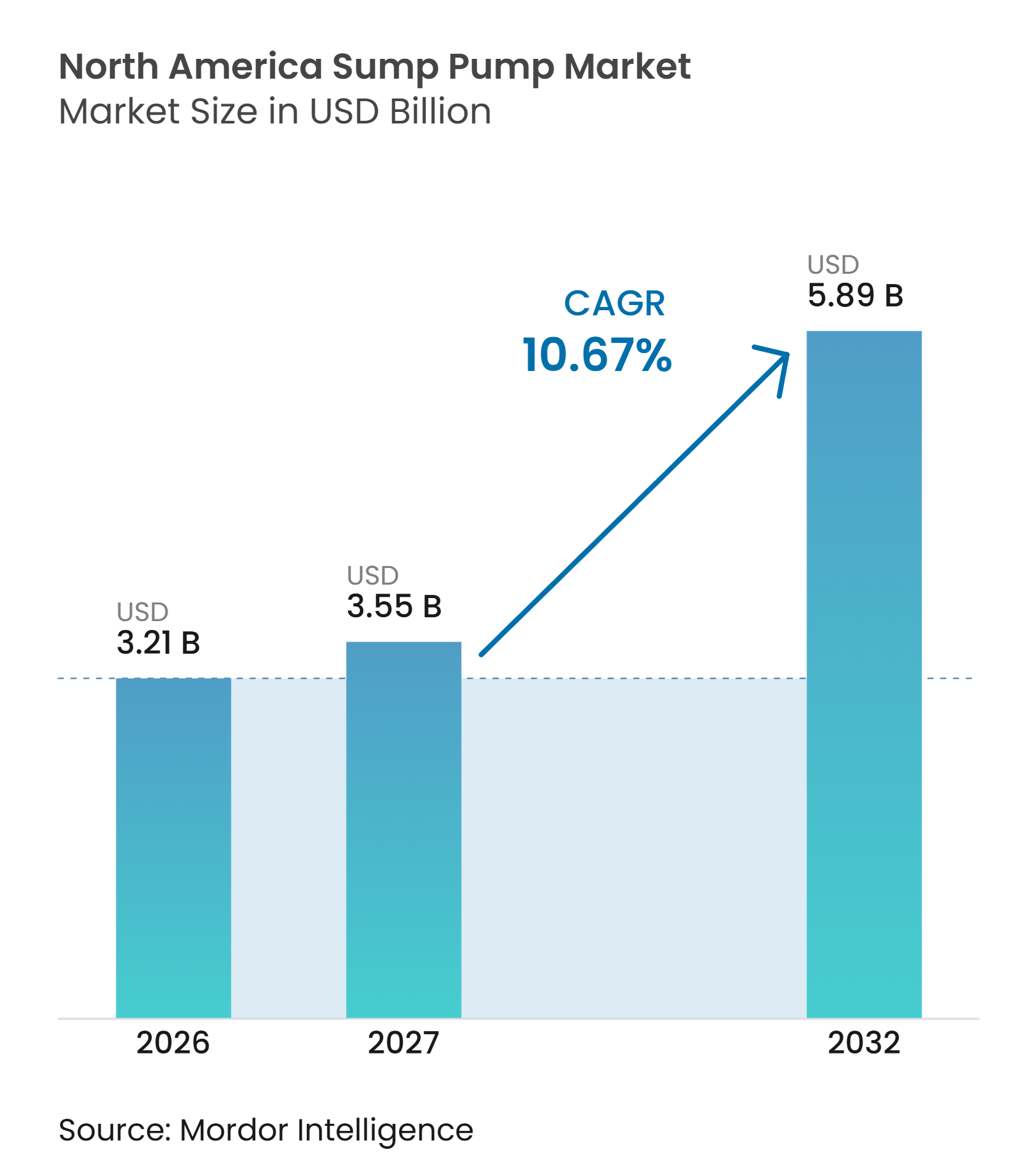
The North America sump pump market size was valued at USD 3.21 billion in 2026 and is estimated to grow from USD 3.55 billion in 2027 to reach USD 5.89 billion by 2032, at a CAGR of 10.7% during the forecast period (2027-2032). The forecast reflects the combined effect of recurring residential replacement, more demanding commercial specifications, and public works activity that addresses drainage capacity and system reliability across the region. The North America sump pump market is supported by rising flood exposure, aging drainage assets, and a broader shift toward preventive property protection. Demand is not dependent on one construction cycle because installed equipment must be replaced, upgraded, or supplemented when water conditions, property use, or protection expectations change. Public funding for wastewater and stormwater upgrades strengthens the municipal procurement base, while insurance losses are increasing attention to resilience measures. Municipal projects can also support suppliers through procurement needs that are tied to wastewater and stormwater infrastructure, rather than only to the timing of household renovation decisions. Battery-supported systems and remote monitoring are widening the role of a sump pump beyond basic water removal. This changes the product conversation from a basic pump purchase to a wider decision involving backup power, monitoring, maintenance access, and the practical consequences of a system outage during severe weather. The North America sump pump market also benefits from residential replacement demand, commercial compliance needs, and higher-capacity requirements at industrial sites. Suppliers that serve the market therefore need to balance product performance with channel support, straightforward installation requirements, and options that fit both standard residential use and more demanding facilities. These forces create opportunities for suppliers that combine dependable pumping equipment with backup power, controls, and service support, which keeps purchasing tied to drainage needs, routine replacement planning, and the preference for systems that continue working when site conditions become less predictable, rather than to one construction cycle or a single emergency purchase, while also reinforcing the practical value of routine inspection, correctly sized equipment, and support that helps property owners keep a drainage system ready for the conditions it is expected to manage, especially where the consequences of delayed action are visible to the property owner or facility manager. The resulting opportunity extends from new installations to planned replacement and retrofit work, where buyers can choose basic protection or configurations designed for longer operating periods and greater resilience, with each of these purchasing paths shaped by the same need for dependable water removal, clearer service expectations, and a system design that is appropriate for the basement, commercial space, or public asset where it will operate, allowing the category to serve a practical protection need across varied local drainage conditions and operating settings, including homes, facilities, and municipal sites that require continuous readiness, where dependable drainage is integral to property protection, operating continuity, and longer-term resilience planning.
Key Report Takeaways
- By type, submersible sump pumps led with 53.3% revenue share in 2026, while battery backup sump pumps are forecast to expand at an 11.7% CAGR through 2032.
- By capacity, medium-capacity units held 45.1% revenue share in 2026, while high-capacity equipment recorded the highest projected CAGR at 11.5% through 2032.
- By power rating, below-1-Horsepower (HP) units accounted for 59.6% revenue share in 2026, while 1–5-hp motors are projected to grow at a 10.9% CAGR through 2032.
- By end user, residential installations held 68.4% revenue share in 2026, while commercial applications are forecast to expand at a 10.8% CAGR through 2032.
- By geography, the United States held 72.5% revenue share in 2026, while Mexico is forecast to grow at an 11.1% CAGR through 2032.
Note: Market numbers in this report are based on Mordor Intelligence's proprietary estimation framework, which combines nine months of actuals with Q4 projections for base year 2026.
Market Trends and Insights
Drivers Impact Analysis of North America Sump Pump Market*
| Driver | (~) % Impact on CAGR Forecast | Geographic Relevance | Impact Timeline |
|---|---|---|---|
| Flood-Resilient Housing and Basement Protection Demand | +2.8% | United States Midwest and Northeast, Canada Ontario and British Columbia | Short term (≤ 2 years) |
| Smart Monitoring and Remote Failure Alerts | +1.9% | United States nationwide, Canada urban centers | Medium term (2-4 years) |
| Aging Stormwater and Wastewater Infrastructure Replacement | +2.3% | United States Mid-Atlantic and Great Lakes, Mexico City | Long term (≥ 4 years) |
| Commercial and Industrial Dewatering Requirements | +1.6% | United States, Mexico border industrial corridor | Medium term (2-4 years) |
| Extreme-Weather-Driven Insurance and Building-Resilience Spending | +2.0% | United States, Canada all provinces | Short term (≤ 2 years) |
| Battery-Backup Adoption During Grid Outages | +1.7% | United States hurricane-prone and rural areas, Canada storm-exposed provinces | Short term (≤ 2 years) |
| Source: Mordor Intelligence | |||
Flood-Resilient Housing and Basement Protection Demand
Flood exposure is increasing the need for reliable basement drainage across the North America sump pump market. Weather-related water-loss cost for U.S. home insurers rose 25.4% from 2023 to 2024, and claims severity increased 29.6%, according to the supplied LexisNexis report. The same report recorded 91 flash flood emergencies in 2024, which supports replacement demand in areas with repeated basement inundation. Insurers can encourage property-level measures when flood-related claims become more costly. Canadian guidance from the Institute for Catastrophic Loss Reduction recommends secondary pump systems and battery backups of at least 80 ampere-hours for new construction. The guidance gives builders and homeowners a defined benchmark for more resilient installations, a relationship that supports ongoing attention to equipment selection, installation quality, backup capability, and servicing over the operating life of the property, making it relevant not only to a new installation but also to replacement decisions, retrofit planning, and the selection of backup arrangements where continuous operation is important, while preserving the distinction between standard household needs and more demanding commercial or municipal requirements.[1]
Aging Stormwater and Wastewater Infrastructure Replacement
Municipal replacement programs provide a separate source of demand for the North America sump pump market. The U.S. Environmental Protection Agency documented USD 630.1 billion in wastewater, stormwater, and nonpoint-source investment needs over 20 years in its 2022 Clean Watersheds Needs Survey. The agency also announced USD 80 million in combined fiscal year 2025 and fiscal year 2026 grants for sewer overflow and stormwater reuse projects. These programs support upgrades to collection systems and related pumping equipment. Older pump stations are being replaced as municipalities modernize systems installed several decades ago. Mexico City allocated MXN 3,360 million for 318 drainage and pump-station projects in 2026, including rehabilitation work in Tláhuac and Gustavo A. Madero, keeping the decision focused on avoiding water damage, maintaining system availability, and matching pump capability to the conditions at a specific site, which supports a broader consideration of pump design, backup power, discharge performance, and service access in locations where water-management failures can have material consequences, and this makes product availability, contractor knowledge, and clear maintenance guidance relevant to the final choice.[2]
Extreme-Weather-Driven Insurance and Building-Resilience Spending
Insurance losses are directing more attention toward flood-mitigation equipment in the North America sump pump market. Supplied Swiss Re figures put insured natural catastrophe losses in North America at USD 90 billion in 2025, including USD 89 billion in the United States. The Insurance Bureau of Canada reported more than CAD 2.4 billion in Canadian severe-weather insured losses in 2025. It also reported CAD 37 billion in catastrophic weather losses from 2016 to 2025. These conditions strengthen the case for property upgrades before a damaging event occurs. Building-resilience programs can make the cost of prevention easier to compare with the cost of recovery, which gives installers and distributors a continuing role in specification, replacement, and maintenance as property owners weigh basic protection against a more resilient configuration, so the decision extends beyond the initial equipment cost and includes the way the system will perform through heavy rainfall, longer operating cycles, maintenance needs, and interruptions in utility power, with benefits that can be recognized through planned replacement as well as after a water-management failure.[3]
Battery-Backup Adoption During Grid Outages
Battery backup systems are expanding the resilience role of the North America sump pump market. Supplied Lawrence Berkeley National Laboratory data showed storage paired with 37% of new U.S. residential solar installations in 2025, compared with 25% in 2024. Outside California, the attachment rate increased from 7% to 17% over the same period. Households adopting battery storage are a logical audience for backup pumping equipment during a power interruption. Pentair’s cited patent covers wireless remote monitoring, power-outage alerts, and automated failure diagnostics. These functions connect backup protection with the wider movement toward residential energy management, reinforcing the importance of product reliability, practical installation requirements, and a clear explanation of the operating limits for each pumping configuration, with the result that buyers can compare a basic installation with configurations that add resilience, monitoring, higher capacity, or more suitable operating characteristics for the application, especially where the consequences of delayed action are visible to the property owner or facility manager.[4]
Restraints Impact Analysis of North America Sump Pump Market*
| Restraint | (~) % Impact on CAGR Forecast | Geographic Relevance | Impact Timeline |
|---|---|---|---|
| Installation and Retrofit Cost | -1.4% | United States cost-sensitive Midwest and rural South, Canada | Short term (≤ 2 years) |
| Motor Failure and High Troubleshooting Costs | -0.9% | United States nationwide, Canada | Medium term (2-4 years) |
| Skilled-Service Technician Shortages | -0.7% | United States suburban and rural markets | Long term (≥ 4 years) |
| Discharge, Noise, and Electrical-Code Compliance Burden | -0.5% | United States code-intensive Northeast and Pacific Coast | Medium term (2-4 years) |
| Source: Mordor Intelligence | |||
Installation and Retrofit Cost
Installation and retrofit costs can delay purchases in price-sensitive parts of the North America sump pump market. The supplied draft placed 2026 installation costs between USD 600 and USD 3,000, depending on the pump, excavation work, and labor conditions. Battery backup systems add USD 400 to USD 900 to an installation in the source material. This difference separates basic protection from a full backup configuration. Households with limited budgets may defer the work even when their flood exposure is clear. Deferred installation can leave a property exposed until damage makes replacement unavoidable, so demand is not limited to initial installation and can also arise when an existing unit no longer meets the property’s water-management needs, which brings the requirements of homeowners, facilities, installers, and public works departments into the same replacement and resilience cycle without making their purchasing conditions identical, while preserving the distinction between standard household needs and more demanding commercial or municipal requirements.
Motor Failure and High Troubleshooting Costs
Motor and impeller problems create recurring ownership costs for the North America sump pump market. The supplied draft placed component-level repair costs at USD 200 to USD 450 and complete replacement with labor at USD 400 to USD 1,200. Failures can occur during heavy rain, when a system is operating under sustained stress. Impeller degradation, capacitor problems, and float-switch jamming were identified as common service issues. Delays in diagnosis can be more difficult in suburban and rural locations with fewer available technicians. Backup systems can limit disruption, but repair burdens can still discourage some new installations, which links equipment demand with the need for dependable operation during periods when water intrusion, power availability, and facility use can change quickly, keeping attention on the operating environment, the reliability of the equipment, and the value of a system that can respond before a small drainage problem becomes a costly property event, and this makes product availability, contractor knowledge, and clear maintenance guidance relevant to the final choice.
*Our forecasts treat driver/restraint impacts as directional, not additive. The impact forecasts reflect baseline growth, mix effects, and variable interactions.
North America Sump Pump Market Segment Analysis
By Type:
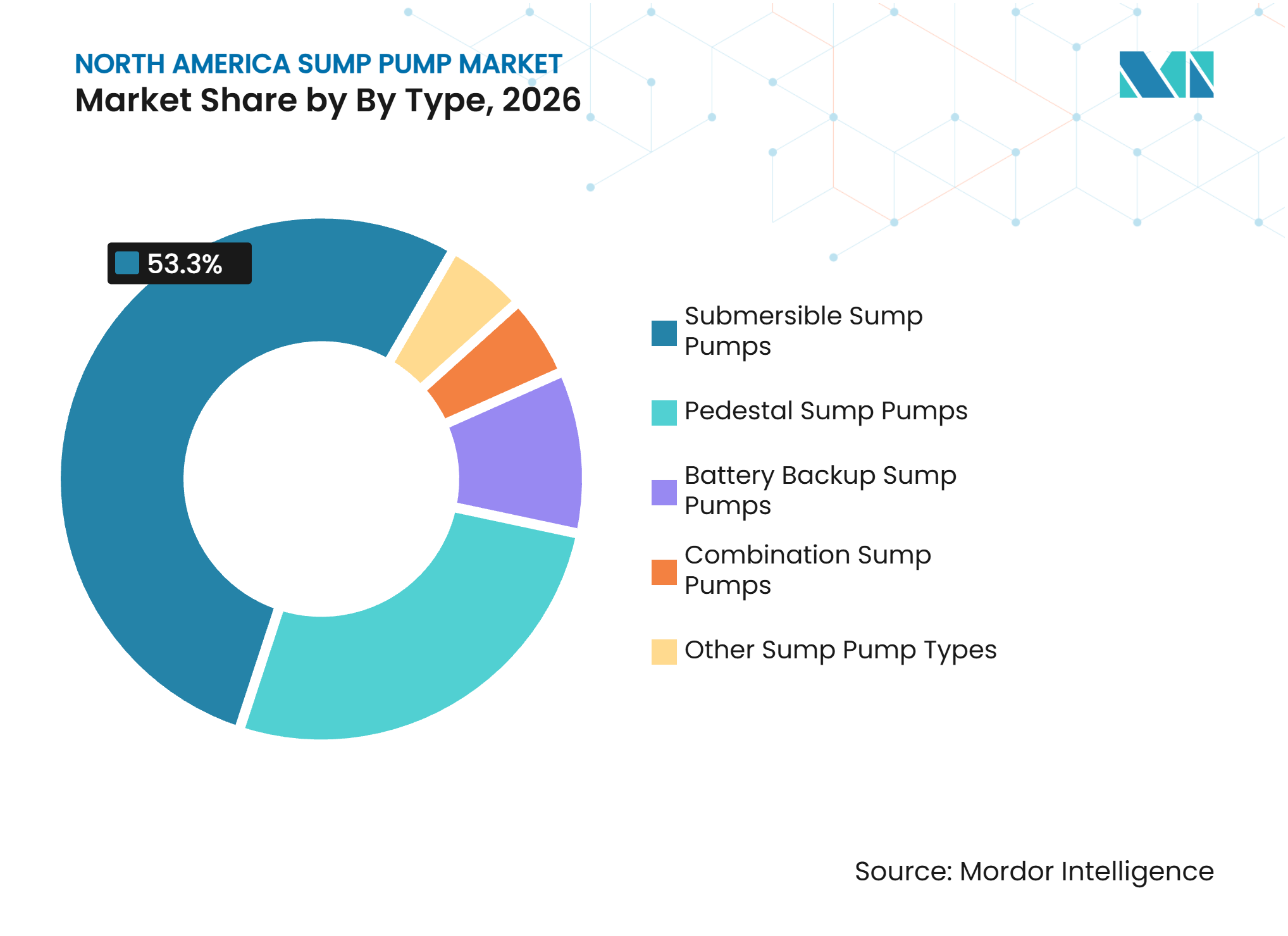
Submersible Pumps Lead While Backup Systems ExpandSubmersible pumps held 53.3% of regional revenue share in 2026, and battery backup sump pumps are forecast to grow at an 11.7% CAGR through 2032. The large installed base of submersible units supports dependable replacement demand. U.S. and Canadian builders commonly select these pumps for new basement construction. Their expected service life of 7–10 years helps maintain a repeat-purchase cycle in the supplied draft. Pedestal pumps retain a role in crawl spaces and shallow pits where a submersible design is less suitable, adding weight to decisions that consider total ownership needs, including installation, monitoring, replacement timing, and the consequences of pump failure. The North America sump pump market continues to reflect a blend of residential protection and larger drainage applications, and this gives suppliers a reason to explain maintenance requirements, operating limits, and the use of secondary protection as part of a complete pumping solution rather than as an optional afterthought, with benefits that can be recognized through planned replacement as well as after a water-management failure.
Battery backups add protection when storms and power failures occur together. Combination systems are gaining interest in higher-value residential renovations, although their price limits wider use. INSTITUTE FOR CATASTROPHIC LOSS REDUCTION (ICLR) guidance recommends battery ratings of at least 80 ampere-hours and secondary pumping arrangements for Canadian new construction. Franklin Electric expanded its FPS lineup with the FBSE33 sump and effluent pump and the FG100 grinder pump. The expanded lineup shows how suppliers can address adjoining sump, effluent, and light commercial needs within the North America sump pump industry, which makes the application fit, expected operating load, and access to qualified service important parts of the purchasing decision, while also reinforcing the practical value of routine inspection, correctly sized equipment, and support that helps property owners keep a drainage system ready for the conditions it is expected to manage, especially where the consequences of delayed action are visible to the property owner or facility manager.



By Capacity:
Medium Units Lead While High-Capacity Demand RisesMedium-capacity units held 45.1% of the North America sump pump market in 2026, while high-capacity equipment is forecast to advance at an 11.5% CAGR through 2032. Medium units fit typical household basement requirements without the extra cost of larger systems. This balance supports their position across standard residential applications. Low-capacity units serve crawl spaces, vacation properties, and budget-constrained buyers. High-capacity equipment addresses continuous dewatering needs in parking garages, data centers, and manufacturing sites, supporting a demand pattern shaped by recurring maintenance needs as well as new project activity across residential, commercial, and municipal settings. The North America sump pump market continues to reflect a blend of residential protection and larger drainage applications, making it relevant not only to a new installation but also to replacement decisions, retrofit planning, and the selection of backup arrangements where continuous operation is important, while preserving the distinction between standard household needs and more demanding commercial or municipal requirements.
Commercial and industrial buyers are replacing undersized units with equipment designed for longer operating cycles. The North America sump pump industry gains from this shift because higher-capacity applications often require more specialized specifications. Xylem announced its USD 1.46 billion acquisition of Cornell Pump and Roper Pump in 2026. The acquisition adds self-priming and slurry-handling capabilities used in broader dewatering applications. Nearshoring activity along the U.S.-Mexico border also supports demand at logistics and manufacturing facilities, which keeps purchasing tied to drainage needs, routine replacement planning, and the preference for systems that continue working when site conditions become less predictable, rather than to one construction cycle or a single emergency purchase, which supports a broader consideration of pump design, backup power, discharge performance, and service access in locations where water-management failures can have material consequences, and this makes product availability, contractor knowledge, and clear maintenance guidance relevant to the final choice.
By Power Rating:
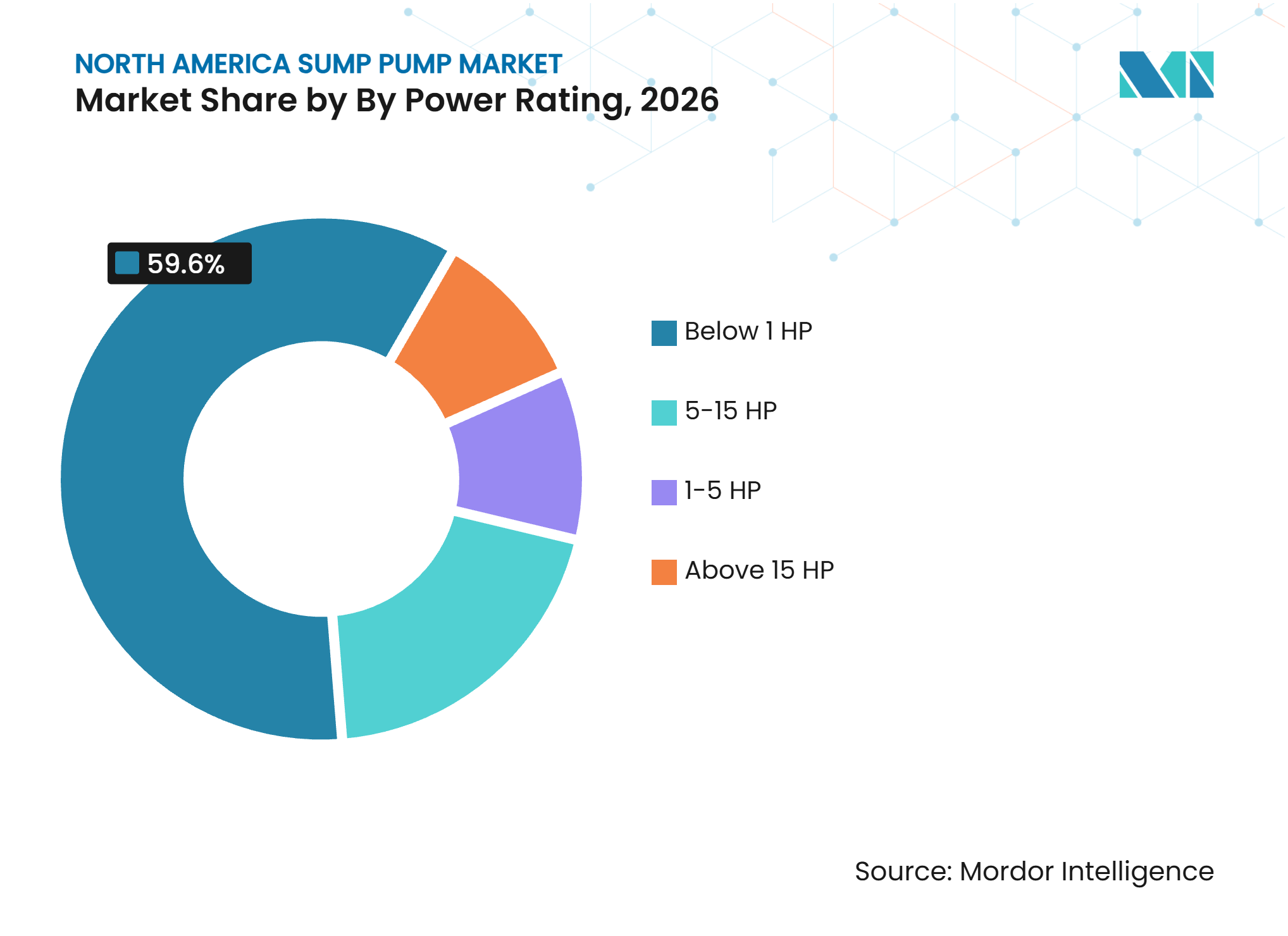
Lower-Power Units Remain Largest While Commercial Ratings GainBelow-1-Horsepower (HP) units held 59.6% of the North America sump pump market share in 2026, while the 1–5-HP range is projected to expand at a 10.9% CAGR through 2032. Most household basement installations use 1/3-HP to 1/2-hp motors on standard household current. Zoeller, WAYNE, and Liberty Pumps have core product lines in this range. Five-year warranties are part of the competitive offer in this residential tier. The large residential base keeps lower-power products important to total unit demand, a relationship that supports ongoing attention to equipment selection, installation quality, backup capability, and servicing over the operating life of the property The North America sump pump market continues to reflect a blend of residential protection and larger drainage applications, so the decision extends beyond the initial equipment cost and includes the way the system will perform through heavy rainfall, longer operating cycles, maintenance needs, and interruptions in utility power, with benefits that can be recognized through planned replacement as well as after a water-management failure.
Commercial facility managers increasingly need equipment that can meet discharge-capacity requirements. This supports the 1–5-HP range as legacy household-grade pumps are replaced with better-rated equipment. WAYNE released the 1-HP CDU1000ET in July 2025 with a stated 6,100-gallons-per-hour rating. The product is assembled in the United States and has a switch tested for more than 1 million cycles. Higher power bands serve municipal stations and construction dewatering, linking their demand to public infrastructure work, keeping the decision focused on avoiding water damage, maintaining system availability, and matching pump capability to the conditions at a specific site, with the result that buyers can compare a basic installation with configurations that add resilience, monitoring, higher capacity, or more suitable operating characteristics for the application, especially where the consequences of delayed action are visible to the property owner or facility manager.

By End User:
Residential Volume Persists While Commercial Demand AcceleratesResidential installations accounted for 68.4% of the North America sump pump market size in 2026, while commercial applications are forecast to grow at a 10.8% CAGR through 2032. The supplied draft estimated that 40 million U.S. households with basements require active groundwater management. This installed base creates recurring replacement demand beyond new housing construction. Residential buyers also respond to insurance concerns and flood-prevention needs. The North America sump pump industry therefore maintains a broad household demand base even when construction cycles change, which gives installers and distributors a continuing role in specification, replacement, and maintenance as property owners weigh basic protection against a more resilient configuration. The North America sump pump market continues to reflect a blend of residential protection and larger drainage applications, which brings the requirements of homeowners, facilities, installers, and public works departments into the same replacement and resilience cycle without making their purchasing conditions identical, while preserving the distinction between standard household needs and more demanding commercial or municipal requirements.
Commercial growth is supported by dewatering needs in hospitals, logistics facilities, parking structures, and underground transit assets. Local requirements can define pump capacity, discharge routing, and backup-power needs for below-grade spaces. These requirements can create a replacement cycle that is less dependent on consumer confidence. Industrial users purchase higher-value systems and influence demand for high-capacity and high-power equipment. FEMA’s cited finding that 40% of small businesses do not reopen after a flood supports the focus on more reliable protection, reinforcing the importance of product reliability, practical installation requirements, and a clear explanation of the operating limits for each pumping configuration, keeping attention on the operating environment, the reliability of the equipment, and the value of a system that can respond before a small drainage problem becomes a costly property event, and this makes product availability, contractor knowledge, and clear maintenance guidance relevant to the final choice.
Geography Analysis
The United States held 72.5% of the North America sump pump market share in 2026. Its position reflects widespread basement construction, established retail and wholesale channels, and detailed insurance pricing for flood-related risk. Illinois, Ohio, Indiana, and Michigan have recurring demand from runoff, aging sewers, and seasonal water conditions. Southeastern coastal areas also support commercial installations as requirements evolve. The supplied LexisNexis data recorded a 25.4% rise in weather-related water-loss cost for U.S. home insurers from 2023 to 2024, so demand is not limited to initial installation and can also arise when an existing unit no longer meets the property’s water-management needs, and this gives suppliers a reason to explain maintenance requirements, operating limits, and the use of secondary protection as part of a complete pumping solution rather than as an optional afterthought, with benefits that can be recognized through planned replacement as well as after a water-management failure.
Canada accounts for the remaining regional value outside the United States and Mexico, with Ontario and British Columbia leading provincial volumes. The Insurance Bureau of Canada reported CAD 37 billion in catastrophic weather losses from 2016 to 2025. Its 2025 severe-weather loss figure exceeded CAD 2.4 billion. INSTITUTE FOR CATASTROPHIC LOSS REDUCTION (ICLR) guidance on battery-backed systems gives provinces a reference point for tighter construction standards, which links equipment demand with the need for dependable operation during periods when water intrusion, power availability, and facility use can change quickly, while also reinforcing the practical value of routine inspection, correctly sized equipment, and support that helps property owners keep a drainage system ready for the conditions it is expected to manage, especially where the consequences of delayed action are visible to the property owner or facility manager.
Mexico is forecast to be the fastest-growing country at an 11.1% CAGR through 2032. The North America sump pump market size in Mexico is supported by urban growth and replacement needs in municipal drainage assets. Mexico City committed MXN 3,360 million to 318 drainage and pump-station projects in 2026. The program includes rehabilitation work at stations handling flows beyond their original design capacity. Industrial expansion along the U.S.-Mexico border adds commercial dewatering needs in northern manufacturing and logistics locations, adding weight to decisions that consider total ownership needs, including installation, monitoring, replacement timing, and the consequences of pump failure, making it relevant not only to a new installation but also to replacement decisions, retrofit planning, and the selection of backup arrangements where continuous operation is important, while preserving the distinction between standard household needs and more demanding commercial or municipal requirements.
Competitive Landscape
Market Concentration
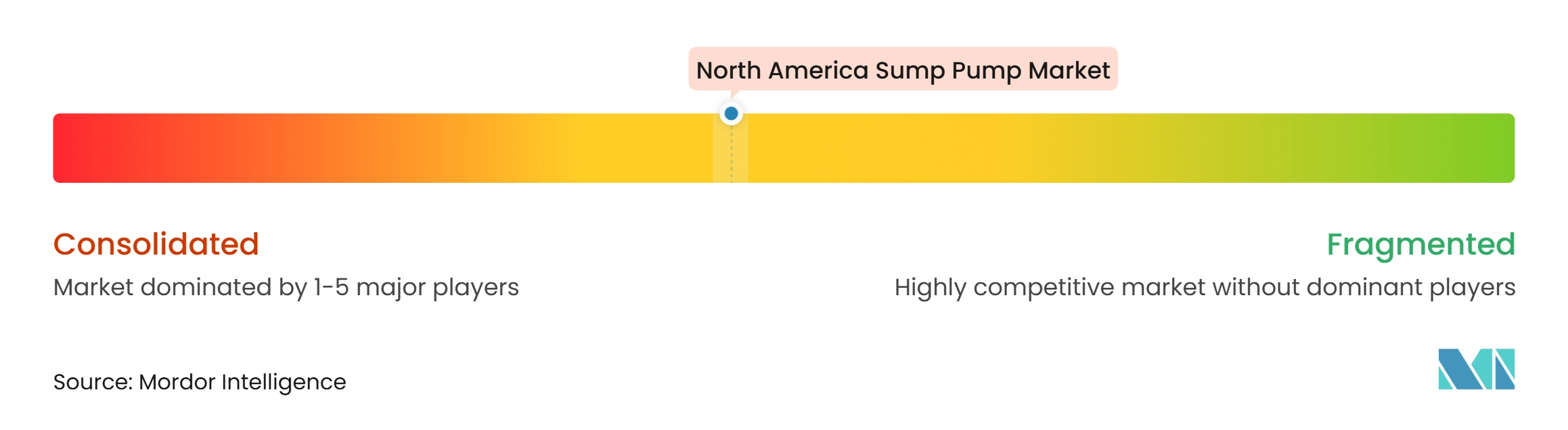
The North America sump pump market is moderately concentrated, with Xylem, Franklin Electric, Grundfos, Pentair, and Liberty Pumps active in commercial and premium residential applications. Zoeller, WAYNE, and Superior Pump maintain established positions in the residential channel through installer relationships and retail availability. The leading suppliers compete through performance, reliability, channel reach, and product breadth. Their portfolios cover household pumping, backup arrangements, wastewater handling, and larger dewatering applications. This mix leaves room for specialized brands even as large companies broaden their offerings, which makes the application fit, expected operating load, and access to qualified service important parts of the purchasing decision, which supports a broader consideration of pump design, backup power, discharge performance, and service access in locations where water-management failures can have material consequences, and this makes product availability, contractor knowledge, and clear maintenance guidance relevant to the final choice.
Franklin Electric completed the acquisition of Cat Pumps in September 2026 for USD 350 million in cash plus a potential USD 50 million earnout. The transaction adds high-pressure plunger and piston pump capabilities to its commercial and industrial flow-control platform. Franklin Electric also acquired PumpEng in February 2025 and Barnes de Colombia in March 2025. These steps expand its hydraulic capability beyond its core water-systems business, supporting a demand pattern shaped by recurring maintenance needs as well as new project activity across residential, commercial, and municipal settings, so the decision extends beyond the initial equipment cost and includes the way the system will perform through heavy rainfall, longer operating cycles, maintenance needs, and interruptions in utility power, with benefits that can be recognized through planned replacement as well as after a water-management failure.
Xylem announced an agreement in October 2026 to acquire Cornell Pump and Roper Pump for USD 1.46 billion. The deal adds self-priming and slurry-handling pumps for construction, mining, food and beverage, and municipal dewatering. Pentair’s remote monitoring patent highlights the importance of alerts and diagnostics in product differentiation. Smaller suppliers including SJE and Glentronics focus on controls and retrofit monitoring devices. The North America sump pump market can gain recurring service opportunities when monitoring is added to existing equipment, which keeps purchasing tied to drainage needs, routine replacement planning, and the preference for systems that continue working when site conditions become less predictable, rather than to one construction cycle or a single emergency purchase, with the result that buyers can compare a basic installation with configurations that add resilience, monitoring, higher capacity, or more suitable operating characteristics for the application, especially where the consequences of delayed action are visible to the property owner or facility manager.
North America Sump Pump Industry Leaders
-
Zoeller Pump Company
-
Pentair plc
-
Liberty Pumps Inc.
-
Wayne Water Systems
-
Xylem Inc.
- *Disclaimer: Major Players sorted in no particular order
North America Sump Pump Market Companies Covered in this Report
- Ashland Water Group, Inc.
- Crane Pumps & Systems, Inc.
- DAB Pumps S.p.A.
- Dover Corporation
- EBARA Pumps Americas Corporation
- Franklin Electric Co., Inc.
- Franklin Electric Co., Inc.
- Glentronics, Inc.
- Grundfos Holding A/S
- HOMA Pumpenfabrik GmbH
- KSB, Inc.
- Liberty Pumps, Inc.
- Pentair plc
- RIDGID
- SJE, Inc.
- Sulzer Ltd.
- Superior Pump
- The Gorman-Rupp Company
- Tsurumi Manufacturing Co., Ltd.
- WAYNE Water Systems
- WILO USA LLC
- Xylem Inc.
- Zoeller Pump Company
Recent Industry Developments in North America Sump Pump Market
- September 2026: Franklin Electric Co., Inc. completed the acquisition of Cat Pumps Corporation for USD 350 million in cash plus a potential USD 50 million earnout, adding market-leading high-pressure plunger and piston pumps generating USD 115 million in annual revenue. The deal expands Franklin Electric’s commercial and industrial flow control platform beyond its core water-systems business.
- April 2026: The U.S. Environmental Protection Agency announced USD 80 million in combined fiscal year 2025 and fiscal year 2026 grants through the Sewer Overflow and Stormwater Reuse Municipal Grant program. The funds support communities upgrading stormwater collection and sewer infrastructure.
- February 2026: Franklin Electric reported full-year 2025 net sales of USD 2.1 billion, compared with USD 2 billion in 2024. The company provided 2026 net-sales guidance of USD 2.17 billion to USD 2.24 billion.
- January 2026: Pentair launched the XRW Series wastewater pumps with Xcentric Impeller technology in the United States. The clog-resistant impeller design addresses maintenance needs in commercial and municipal lift-station applications
North America Sump Pump Market Report Scope
Sump pumps are electromechanical pumping devices designed to collect and remove accumulated water from sump pits, basements, crawl spaces, and other low-lying areas to prevent flooding, water damage, and moisture-related issues. These pumps are typically powered by electricity or supported by battery backup systems and are commonly installed in residential buildings, commercial properties, industrial facilities, and other structures requiring water management and drainage. Sump pumps are available in different configurations, including submersible, pedestal, battery backup, and combination pumps, to accommodate varying installation requirements, water volumes, and operating conditions. They help maintain dry building foundations, manage groundwater infiltration, and support drainage operations in areas exposed to heavy rainfall, rising groundwater levels, and flooding.
The North America Sump Pump Market is segmented by type, capacity, power rating, end user, and geography. By type, the market is segmented into submersible sump pumps, pedestal sump pumps, battery backup sump pumps, combination sump pumps, and other sump pump types. By capacity, the market is segmented into low-capacity, medium-capacity, and high-capacity sump pumps. By power rating, the market is segmented into below 1 HP, 1–5 HP, 5–15 HP, and above 15 HP. By end user, the market is segmented into residential, commercial, and industrial sectors. The report also covers the market size and forecasts for the North America sump pump market across three countries: the United States, Canada, and Mexico. For each segment, market sizing and forecasts are provided on the basis of value (USD).
Segmentation Overview
| Submersible Sump Pumps |
| Pedestal Sump Pumps |
| Battery Backup Sump Pumps |
| Combination Sump Pumps |
| Other Sump Pump Types |
| Low Capacity |
| Medium Capacity |
| High Capacity |
| Below 1 HP |
| 1-5 HP |
| 5-15 HP |
| Above 15 HP |
| Residential |
| Commercial |
| Industrial |
| United States |
| Canada |
| Mexico |
| By Type | Submersible Sump Pumps |
| Pedestal Sump Pumps | |
| Battery Backup Sump Pumps | |
| Combination Sump Pumps | |
| Other Sump Pump Types | |
| By Capacity | Low Capacity |
| Medium Capacity | |
| High Capacity | |
| By Power Rating | Below 1 HP |
| 1-5 HP | |
| 5-15 HP | |
| Above 15 HP | |
| By End User | Residential |
| Commercial | |
| Industrial | |
| By Geography | United States |
| Canada | |
| Mexico |
Key Questions Answered in the Report
What is the projected value of the North America sump pump market by 2032?
The North America sump pump market is forecast to reach USD 5.89 billion by 2032, growing at a 10.67% CAGR from 2027.
Which sump pump type has the largest share?
Submersible sump pumps held 53.3% revenue share in 2026, making them the largest type segment.
Which product category is growing fastest?
Battery backup sump pumps are forecast to grow at an 11.7% CAGR through 2032.
Why are battery backup systems gaining use?
Flood risk, grid outages, and greater adoption of household battery storage are increasing interest in backup pumping configurations.
Which country is growing fastest in the region?
Mexico is forecast to grow at an 11.1% CAGR through 2032, supported by urban drainage and infrastructure needs.
What is the largest end-user group?
Residential installations held 68.4% revenue share in 2026, supported by the region’s large base of homes with basements.