
North America Hydraulic Presses Market Size and Share
Market Overview
| Study Period | 2020 - 2031 |
|---|---|
| Forecast Data Period | 2026 - 2031 |
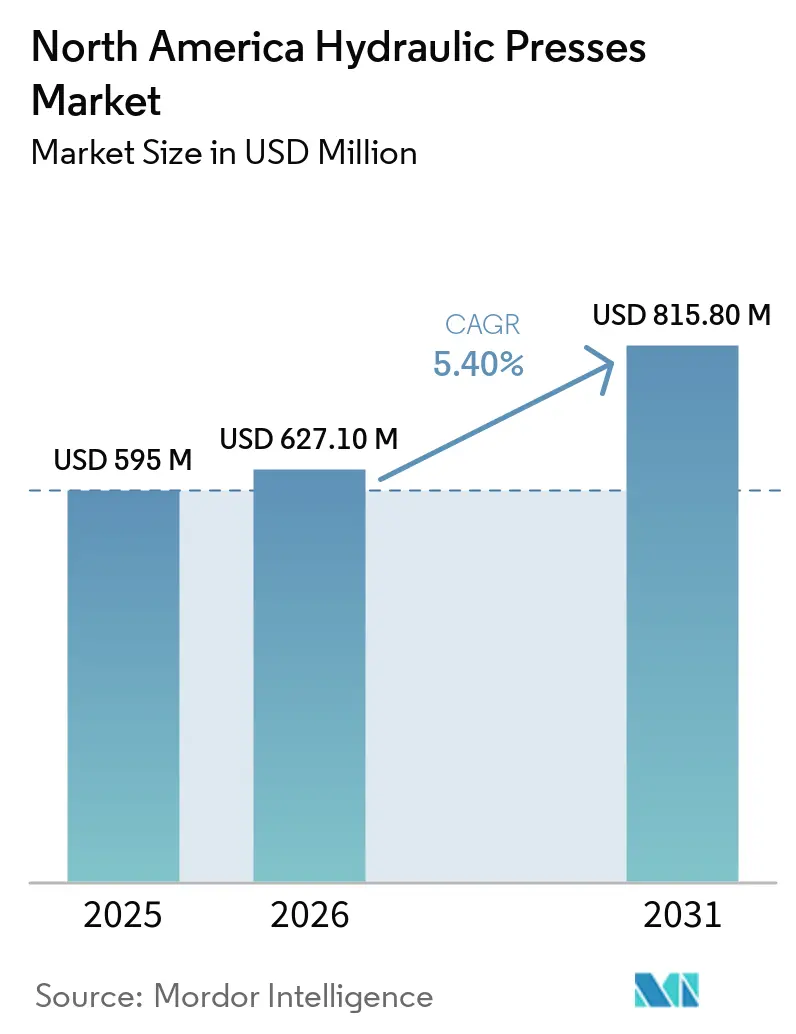
| Base Year Market Size (2025) | USD 595 Million |
| Market Size (2026) | USD 627.10 Million |
| Market Size (2031) | USD 815.80 Million |
| Growth Rate (2026 - 2031) | 5.40 % |
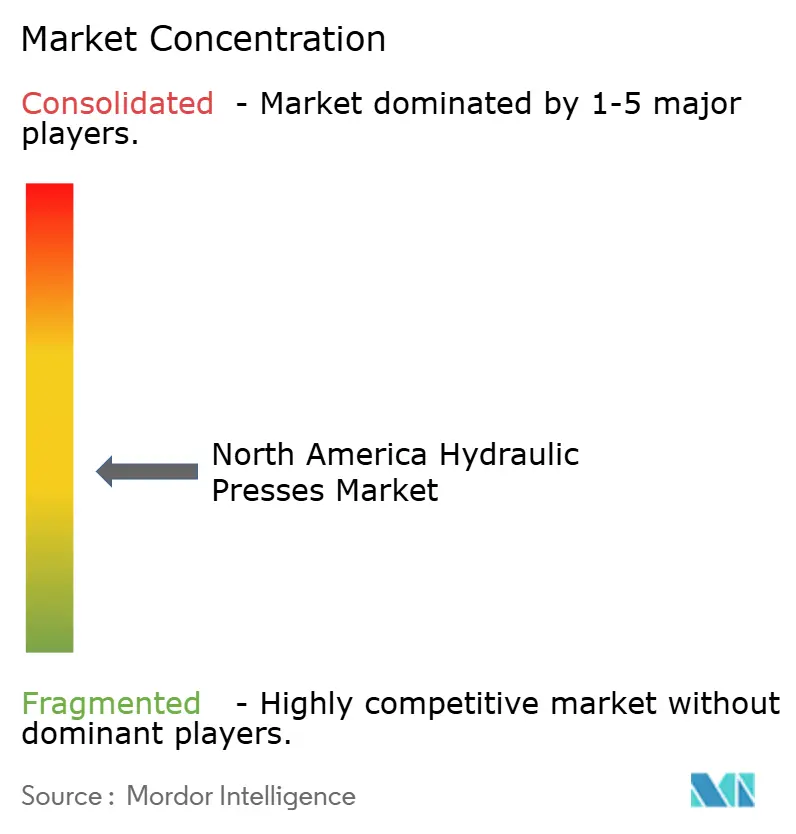
| Market Concentration | Medium |
Major Players *Disclaimer: Major Players sorted in no particular order Image © Mordor Intelligence. Reuse requires attribution under CC BY 4.0. | |
North America Hydraulic Presses Market Analysis by Mordor Intelligence
The North America Hydraulic Presses Market size was valued at USD 595 million in 2025 and is estimated to grow from USD 627.10 million in 2026 to reach USD 815.80 million by 2031, at a CAGR of 5.40% during the forecast period (2026-2031).
Demand is supported by new manufacturing capacity in the United States, Mexico, and Canada, especially where producers need reliable forming equipment for automotive, aerospace, energy, and advanced-material applications. Vehicle electrification is changing press requirements because battery enclosures, structural rails, and crash-management parts often use aluminum and high-strength steel. Manufacturers are also placing more value on force monitoring, process records, and connected controls when they select equipment for regulated production. Larger suppliers can compete through integrated automation and broader technology portfolios, while local builders remain relevant because installation, rebuilding, and service response matter to press-shop operators. Steel costs, hydraulic-component pricing, tariffs, and technician shortages can delay purchasing decisions even when planned manufacturing investment remains strong.
Key Report Takeaways
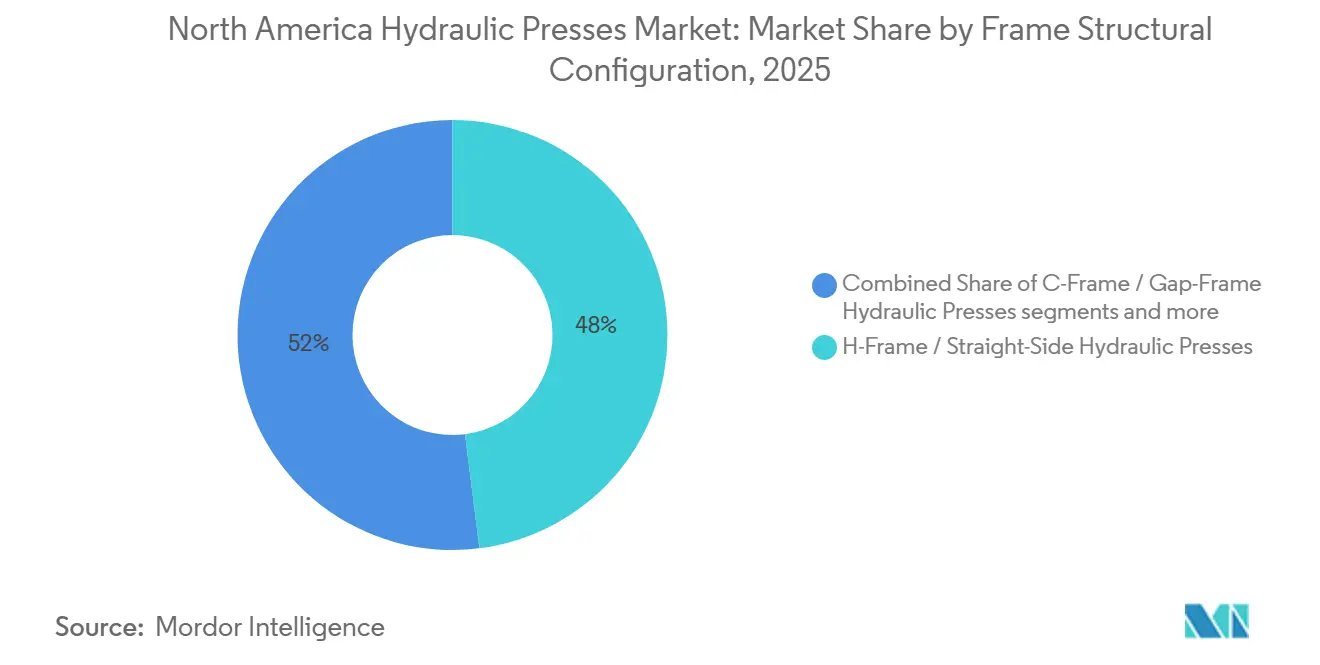
- By frame and structural configuration, H-frame and straight-side presses held 48% of revenue in 2025, while C-frame and gap-frame presses recorded the highest projected CAGR at 8.2% through 2031.
- By tonnage and press force, the 101–500 ton class accounted for 48.3% of North America hydraulic presses market size in 2025, while presses above 2,000 tons are projected to grow at a 6.8% CAGR through 2031.
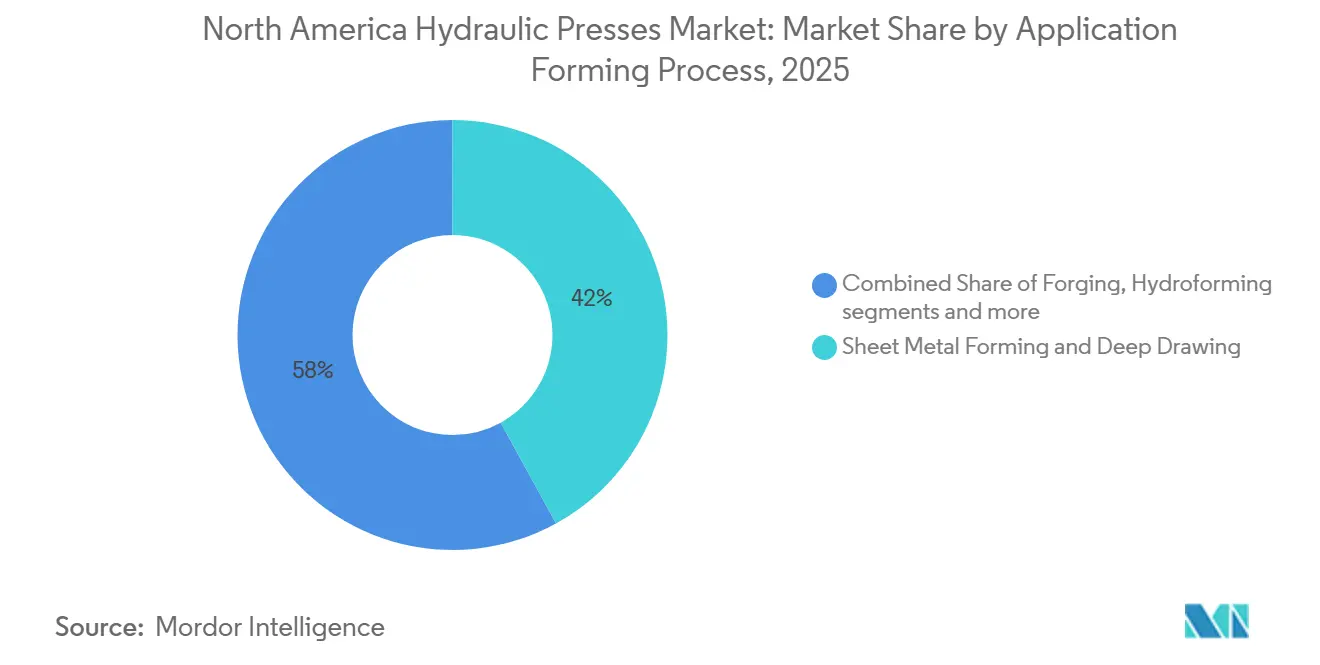
- By application and forming process, sheet metal forming and deep drawing retained 42% of North America hydraulic presses market share in 2025, while compression molding is forecast to expand at an 8.4% CAGR through 2031.
- By end-use industry, automotive and transportation commanded 50% of revenue in 2025, while electrical and electronics manufacturing is forecast to advance at an 8% CAGR through 2031.
Note: Market size and forecast figures in this report are generated using Mordor Intelligence’s proprietary estimation framework, updated with the latest available data and insights as of January 2026.
North America Hydraulic Presses Market Trends and Insights
Drivers Impact Analysis*
| Driver | (~) % Impact on CAGR Forecast | Geographic Relevance | Impact Timeline |
|---|---|---|---|
| Automotive Lightweighting and Advanced Material Forming | +1.7% | United States, Canada, and Mexico automotive hubs | Medium term (2-4 years) |
| Reshoring and Domestic Manufacturing Capacity Expansion | +1.3% | United States, with secondary relevance in Canada | Short term (≤ 2 years) |
| Automation, Robotics, and Smart-Press Integration | +1% | North America, led by the United States and Canada | Long term (≥ 4 years) |
| Demand for High-Force Forming in Aerospace and Defense | +0.7% | United States | Long term (≥ 4 years) |
| Retrofit Demand from Installed Press Bases and Local Service Requirements | +0.4% | United States and Canada, with spillover to Mexico | Short term (≤ 2 years) |
| Energy Efficiency Mandates and Demand for Servo-Hydraulic Press Upgrades | +0.2% | United States and Canada | Medium term (2-4 years) |
| Source: Mordor Intelligence | |||
Automotive Lightweighting and Advanced Material Forming
The North America hydraulic presses market benefits from vehicle programs that use aluminum, ultra-high-strength steel, and other materials in body structures and battery systems. Battery trays, side sills, and crash-management parts need controlled force and dwell time during forming. Novelis stated that aluminum battery enclosures can reduce weight by up to 50% compared with equivalent steel designs and improve energy density by 30% per unit. Hydraulic systems can use programmed ram speed, full-stroke tonnage, and controlled dwell to support these requirements. Tier 1 and Tier 2 suppliers in Michigan, Ontario, and Coahuila are updating older lines to process 1,200 MPa advanced high-strength steel grades. The North America hydraulic presses market, therefore, faces specifications that increasingly involve battery-pack engineers as well as press-shop tooling teams, which can extend procurement while raising equipment requirements.
Reshoring and Domestic Manufacturing Capacity Expansion
New factory investment is increasing the need for forming equipment in North American production locations. The Reshoring Initiative reported that 63% of surveyed original equipment manufacturers planned United States capital expenditure in 2026 or 2027 for reshoring or domestic expansion.[1]Reshoring Initiative, “2026 USA Reshoring Survey Report,” Reshoring Initiative, reshorenow.org. John Deere announced a USD 70 million excavator factory in Kernersville, North Carolina, within a USD 20 billion United States manufacturing commitment over 10 years. Contract manufacturers that supply expanding original equipment manufacturers may need press capacity before final vehicle or equipment production reaches scale. This sequence makes new plant plans relevant to the North America hydraulic presses market before equipment orders are placed. It also supports demand for H-frame and four-column systems used in structural stamping and forging lines.
Automation, Robotics, and Smart-Press Integration
Buyers in the North America hydraulic presses market increasingly assess connectivity, repeatability, and maintenance features alongside rated force. Bosch Rexroth reported that servo-hydraulic platforms can provide 30% to 55% energy savings compared with fixed-displacement systems while supporting sub-millimeter repeatability. Sutherland Presses introduced its I-PRESS® control system for servo-hydraulic and mechanical presses from 60 to 6,000 tons, with Category 3 PL-d safety functions. Automated material handling, robotic loading, and in-die sensing can add high cost to a press project. These elements also make it harder for a customer to switch equipment providers after an automated cell has been installed. Retrofit automation offers a separate path for operators who want better production control without replacing the entire press.
Demand for High-Force Forming in Aerospace and Defense
Aerospace and defense work is supporting demand for high-force presses that can form titanium and high-performance alloys. The United States Department of Defense requested USD 205.2 billion for procurement in its fiscal year 2026 budget, including funding for aircraft, shipbuilding, and other equipment programs.[2] U.S. Department of Defense, “FY2026 Defense Budget Request,” Office of the Under Secretary of Defense Comptroller, comptroller.defense.gov. The Congressional Research Service noted that titanium forgings for some fighter-aircraft structures have buy-to-fly ratios of 5:1 to 7:1.[3]Congressional Research Service, “FY2026 Defense Budget, Funding for Selected Weapon Systems,” Congressional Research Service, congress.gov. Beckwood Press Company received 2025 orders for a 100-ton hot-forming press and a 500-ton hot-form retrofit for titanium aerospace components. Flight-critical work also requires process records, which makes analog equipment less suitable for qualified aerospace and defense supply chains. This need can support upgrades even when an older press still has adequate physical forming capability.
Restraints Impact Analysis*
| Restraint | (~) % Impact on CAGR Forecast | Geographic Relevance | Impact Timeline |
|---|---|---|---|
| High Initial Investment and Long Equipment Payback | -1.2% | North America, most acute among U.S. mid-sized manufacturers | Long term (≥ 4 years) |
| Hydraulic Component, Steel, and Energy Cost Volatility | -0.9% | North America | Short term (≤ 2 years) |
| Tariff, Trade-Policy, and Cross-Border Supply-Chain Uncertainty | -0.7% | United States, Canada, and Mexico | Short term (≤ 2 years) |
| Skilled Workforce Shortage and Technician Availability Constraints | -0.5% | United States, with secondary relevance in Canada | Long term (≥ 4 years) |
| Source: Mordor Intelligence | |||
High Initial Investment and Long Equipment Payback
High capital requirements can limit purchases by small and medium-sized fabricators. Custom high-tonnage systems that include automation, tooling, and installation can require multi-million-dollar commitments and payback periods of 7 to 12 years. NIST identified capital-cost predictability and equipment payback horizons as important competitiveness constraints for United States manufacturers. Staffing concerns can compound this issue when a buyer cannot secure operators and maintenance personnel for a new line. Leasing, pay-per-part arrangements, and public equipment financing can reduce the initial barrier, although their use remains limited in many mid-sized businesses. The North America hydraulic presses market can therefore have a strong project pipeline, while some planned investments take longer to become firm orders.
Hydraulic Component, Steel, and Energy Cost Volatility
Input costs affect press builders because frames, platens, and tie rods rely on heavy steel plate and hydraulic components. The White House restored a 25% tariff on steel imports and raised aluminum tariffs to 25% in February 2025. The National Association of Manufacturers reported that United States manufacturers rely on nearly USD 297 billion in imported machinery and warned that layered tariffs can increase the cost of capital investment. Canada’s Parliament reported that the April 2026 Section 232 modification included the full customs value of derivative articles, including tool and die products. Builders must manage higher and less predictable inputs while buyers resist machine-price increases. This pressure is particularly difficult for smaller suppliers that have limited ability to hedge materials costs.
*Our forecasts treat driver/restraint impacts as directional, not additive. The impact forecasts reflect baseline growth, mix effects, and variable interactions.
Segment Analysis
By Frame / Structural Configuration: H-Frame Leads High-Volume Forming, While Gap-Frame Supports Flexible Cells
H-Frame and Straight-Side presses held 48% of the North America hydraulic presses market share in 2025. Their gib-guided ram architecture helps maintain parallelism under eccentric loading. This makes the configuration suitable for high-volume automotive stamping and aerospace structural parts that need consistent dimensions. ANDRITZ Schuler launched the HFA plus+ fineblanking press series in January 2026, with force ratings from 3,200 to 15,500 kN and a servo-controlled hydraulic-pump drive. The company stated that the new drive provides double-digit energy-efficiency improvements. H-frame scale also makes rebuilds and control upgrades more economical over longer equipment lifecycles.
C-Frame and Gap-Frame presses represent the fastest-growing configuration, with an 8.2% CAGR from 2026 to 2031. Their open-throat design provides access from 3 sides, which supports manual work and robot-loaded manufacturing cells. The smaller footprint can suit electronics, medical-device, and small-batch automotive supplier facilities. Battery-cell component assembly, connector staking, and sensor-housing forming are adding demand for C-frame presses in the 20 to 150 ton range. Four-Post and Two-Post configurations remain relevant for composite molding, powder compaction, and rubber forming. Benchtop presses serve research and prototype work, while specialized systems cover isothermal and superplastic aerospace forming.



By Tonnage / Press Force: Mid-Range Capacity Provides Most Revenue, While Very Large Presses Expand
The 101–500 ton class accounted for 48.3% of segment revenue in 2025. This capacity range serves sheet-metal stamping, deep drawing, bending, and general fabrication. It can handle many aluminum and advanced high-strength steel applications used by automotive Tier 1 and Tier 2 suppliers. The range is a common specification for new stamping lines across the North America hydraulic presses market. Domestic builders and European integrators both offer equipment in this range, which keeps competition active and prices relatively transparent. Its broad customer base helps stabilize demand even when a single end-use sector slows.
Presses above 2,000 tons are the fastest-growing tonnage segment, with a forecast 6.8% CAGR through 2031. Aerospace and defense customers use these systems for large titanium and aluminum structures formed in a single cycle. This approach can reduce fastener counts and assembly time on airframes and naval platforms. Programs for fighter aircraft, shipbuilding, and hypersonic systems support requirements from 2,000 to 30,000 tons. The 501–1,000 ton and 1,001–2,000 ton classes support forging and heavy structural forming. Presses up to 100 tons remain useful for bench assembly, coining, and low-volume prototype work, while safety requirements influence commissioning and installation costs across every force class.
By Application / Forming Process: Sheet Metal Forming Has the Largest Base, While Compression Molding Advances
Sheet Metal Forming and Deep Drawing retained 42% of the North America hydraulic presses market size in application revenue during 2025. The application supports vehicle body panels, electric-vehicle structural components, and appliance panels. Advanced high-strength steel increases both the required press force and die complexity for many of these parts. Cleveland-Cliffs described a one-piece steel battery tray that combines advanced high-strength steel with more formable lower-strength steel in tailor-welded blanks. This work shows how deep drawing is adapting to battery-pack geometries. The application has a large installed base because it remains relevant across multiple vehicle and durable-goods programs.
Compression Molding is the fastest-growing application segment, with an 8.4% CAGR from 2026 to 2031. It benefits from composite programs in automotive structures, aerospace interior panels, and electrical enclosures. ANDRITZ Schuler supplies automated hydraulic systems for sheet molding compound, glass mat thermoplastic, bulk molding compound, and high-pressure resin transfer molding. These applications need rapid closing and active RAM parallelism. Forging remains important for drivetrain and defense components, while hydroforming serves complex tubular chassis parts and battery trays. Powder compaction supports advanced ceramics and sintered metals, and assembly or press-fitting benefits from electronics and battery-module production.
By End-Use Industry: Automotive Remains the Largest User, While Electrical and Electronics Output Rises
Automotive and Transportation commanded 50% of end-use revenue in 2025. Body-panel stamping, chassis-rail forming, suspension forging, and drivetrain coining all require press operations. The transition from internal-combustion vehicles to battery electric vehicles adds requirements for battery enclosures, structural underbody parts, and crash-management systems. These components create demand beyond the parts used in earlier vehicle platforms. Mexico is becoming a secondary hub for press-intensive Tier 1 operations as suppliers regionalize their production networks. Automotive demand is therefore expected to remain central to the North America hydraulic presses industry, although program timing can affect orders for individual suppliers.
Electrical and Electronics manufacturing is the fastest-growing end-use segment, at an 8% CAGR through 2031. Semiconductor packaging, charging infrastructure, power transformers, and data-center power equipment all need formed metal parts. Hitachi announced a USD 1 billion United States manufacturing investment program in September 2025 that included a USD 457 million power-transformer facility in South Boston, Virginia. Such facilities can use presses for lamination stacks, busbars, and magnetic-core components. Aerospace and Defense remains strategically important because of high-value alloy forming. Industrial machinery, plastics and composites, construction equipment, energy systems, rail, marine, and powder metallurgy add specialized demand across the North America hydraulic presses market.
Geography Analysis
The United States held 80% of the regional demand in 2025. Its installed base spans the Midwest automotive corridor, the Southeast aerospace cluster, and the Texas energy-equipment belt. This installed base supports rebuilding and retrofitting activity that does not depend solely on new facilities. The fiscal year 2026 United States defense procurement request of USD 205.2 billion supports specifications for titanium hot forming and aluminum superplastic forming in aerospace supply chains. John Deere’s new North Carolina excavator factory, Volvo Construction Equipment’s United States expansion, and Hitachi’s United States energy investment each add manufacturing projects that can require structural forming equipment.
Mexico is forecast to record the fastest regional CAGR at 4% from 2026 to 2031. Automotive nearshoring and regional-content requirements are strengthening the country’s role in the North America hydraulic presses market. Demand is concentrated in stamping, deep drawing, and press-fitting operations for automotive original equipment manufacturers and Tier 1 suppliers. Chihuahua, Nuevo León, and the Bajío region remain important locations for those operations. New installations still require reliable power, civil works, and trained operators, which can slow the conversion of planned investment into operating capacity.
Canada’s press demand is smaller in volume but remains important for aerospace composite forming and heavy-press engineering. Macrodyne Technologies introduced its TRÜ Servo™ platform across production systems in 2025. Aerospace producers in Québec and Ontario need hot-forming and rubber-pad equipment for titanium and composite prepregs. Eagle Press & Equipment serves composite compression-molding customers through customized four-post systems. These uses support specialized orders that are distinct from the higher-volume automotive activity found elsewhere in the region. Canadian suppliers also face trade exposure when equipment or tooling is supplied to the United States customers.
Competitive Landscape
The North America hydraulic presses market exhibits a medium level of market concentration, with domestic specialists competing against European technology integrators and select Asian entrants. Suppliers compete through application knowledge, local service, customization, and digital controls. ANDRITZ Schuler competes through large automated-line capability and international scale. Macrodyne Technologies focuses on custom high-tonnage engineering and servo technology. Beckwood Press Company serves precision aerospace applications and has expanded its retrofit activity. Greenerd, French Oil Mill Machinery, HPM North America, and Sutherland Presses address specific applications with regional service support. These companies compete in the North America hydraulic presses market, where post-sale response can be as important as the original machine specification.
ANDRITZ Schuler launched the HFA plus+ series in January 2026, adding a servo-controlled hydraulic-pump drive and Industry 4.0 interfaces to its fineblanking equipment. Macrodyne’s TRÜ Servo™ platform uses direct servo-driven mechanics and eliminates hydraulic oil in relevant applications. Beckwood’s 2025 aerospace hot-form retrofit used heated platens to improve temperature uniformity and process control for titanium parts. These moves show that suppliers are using energy performance, controls, and retrofit services to differentiate their offers. Older analog presses can remain structurally sound, but users may still need control, data, and safety upgrades. This creates room for suppliers that can modernize installed systems without requiring a complete replacement.
The North America hydraulic presses market also has an opportunity in modernization packages for smaller press shops that lack in-house controls expertise. Such packages can combine connectivity, energy management, remote diagnostics, and service support. Compliance with hydraulic-system safety and functional-safety requirements is important for suppliers serving export, aerospace, and defense customers. Suppliers that provide the required documentation and safety integration with their equipment can reduce implementation work for buyers. This capability can be more difficult to replicate than the basic press frame alone. Competitive success will therefore depend on equipment performance and the ability to support installation, qualification, maintenance, and retrofits.
North America Hydraulic Presses Industry Leaders
ANDRITZ Schuler
Macrodyne Technologies Inc.
Beckwood Press Company
Greenerd Press & Machine Company, Inc.
French Oil Mill Machinery Co.
- *Disclaimer: Major Players sorted in no particular order

Recent Industry Developments
- July 2026: TRUMPF signed an agreement to acquire Mate Precision Technologies, a global leader in metal cutting and forming products. The partnership expands TRUMPF's punching and bending tool portfolio across machines from multiple manufacturers and strengthens the company's commercial position in the United States, Canada, and Mexico.
- January 2026: ANDRITZ Schuler launched the HFA plus+ fineblanking press series, developed with Feintool, covering press forces from 3,200 to 15,500 kN and achieving up to 85 strokes per minute. The new servo-controlled hydraulic-pump drive improves energy efficiency by a double-digit percentage versus predecessor models and includes integrated Industry 4.0 interfaces. Two 8,800 kN systems were deployed for Feintool's United States operations at the start of 2025.
- January 2026: John Deere announced plans for a USD 70 million excavator factory in Kernersville, North Carolina, part of its USD 20 billion, 10-year United States manufacturing investment program. The project transfers production of next-generation excavators from Japan to the United States and creates demand for high-tonnage structural forming equipment.


North America Hydraulic Presses Market Report Scope
The North America Hydraulic Presses Market Report is Segmented by Frame (C-Frame / Gap-Frame Hydraulic Presses, H-Frame / Straight-Side / Gib-Guided Hydraulic Presses and more), By Tonnage (Up to 100 Tons, 101–500 Tons and more), by Application (Forging, Hydroforming and more), by End-Use Industry (Automotive and Transportation and Electrical and Electronics and more), and Geography (United States, Canada, Mexico). The Market Forecasts are Provided in Terms of Value (USD).
| C-Frame / Gap-Frame Hydraulic Presses |
| H-Frame / Straight-Side / Gib-Guided Hydraulic Presses |
| Four-Post / Four-Column Hydraulic Presses |
| Two-Post / Column Hydraulic Presses |
| Benchtop / Workshop Hydraulic Presses |
| Other Specialized Hydraulic Press Configurations |
| Up to 100 Tons |
| 101–500 Tons |
| 501–1,000 Tons |
| 1,001–2,000 Tons |
| Above 2,000 Tons |
| Sheet Metal Forming and Deep Drawing |
| Forging |
| Bending and Straightening |
| Punching, Blanking and Coining |
| Compression Molding |
| Powder Compaction |
| Hydroforming |
| Assembly, Press-Fitting and General Pressing |
| Other Specialized Applications |
| Automotive and Transportation |
| Aerospace and Defense |
| Industrial Machinery and General Manufacturing |
| Electrical and Electronics |
| Plastics, Rubber and Composites |
| Construction and Heavy Equipment |
| Energy and Power Equipment |
| Rail and Marine |
| Powder Metallurgy, Ceramics and Advanced Materials |
| Other End-Use Industries |
| United States |
| Canada |
| Mexico |
| By Frame / Structural Configuration | C-Frame / Gap-Frame Hydraulic Presses |
| H-Frame / Straight-Side / Gib-Guided Hydraulic Presses | |
| Four-Post / Four-Column Hydraulic Presses | |
| Two-Post / Column Hydraulic Presses | |
| Benchtop / Workshop Hydraulic Presses | |
| Other Specialized Hydraulic Press Configurations | |
| By Tonnage / Press Force | Up to 100 Tons |
| 101–500 Tons | |
| 501–1,000 Tons | |
| 1,001–2,000 Tons | |
| Above 2,000 Tons | |
| By Application / Forming Process | Sheet Metal Forming and Deep Drawing |
| Forging | |
| Bending and Straightening | |
| Punching, Blanking and Coining | |
| Compression Molding | |
| Powder Compaction | |
| Hydroforming | |
| Assembly, Press-Fitting and General Pressing | |
| Other Specialized Applications | |
| By End-Use Industry | Automotive and Transportation |
| Aerospace and Defense | |
| Industrial Machinery and General Manufacturing | |
| Electrical and Electronics | |
| Plastics, Rubber and Composites | |
| Construction and Heavy Equipment | |
| Energy and Power Equipment | |
| Rail and Marine | |
| Powder Metallurgy, Ceramics and Advanced Materials | |
| Other End-Use Industries | |
| By Geography | United States |
| Canada | |
| Mexico |


Key Questions Answered in the Report
What is the projected value of the North America hydraulic presses market by 2031?
The North America hydraulic presses market is forecast to reach USD 815.80 million by 2031, growing at a 5.40% CAGR from 2026.
Which hydraulic press configuration has the largest revenue share in North America?
H-Frame and Straight-Side presses held 48% of revenue in 2025, supported by automotive stamping and aerospace structural forming.
Which application is forecast to grow fastest through 2031?
Compression Molding is projected to grow at an 8.4% CAGR, supported by composite parts used in automotive, aerospace, and electrical enclosures.
What end-use sector accounts for the largest share of hydraulic press demand?
Automotive and Transportation held 50% of revenue in 2025 because it uses presses for body panels, chassis parts, and drivetrain components.
Why are hydraulic presses important for electric-vehicle production?
In the North America hydraulic presses market, they provide the force control and dwell capability needed for aluminum battery enclosures, high-strength steel parts, and structural crash components.
Which country is expected to grow fastest in regional demand?
Mexico is projected to grow at a 4% CAGR through 2031 as automotive nearshoring expands stamping, deep drawing, and press-fitting operations.
Page last updated on:





