
North America Environmental Protection Technical Textile Market Size and Share
Market Overview
| Study Period | 2021 - 2032 |
|---|---|
| Forecast Data Period | 2027 - 2032 |
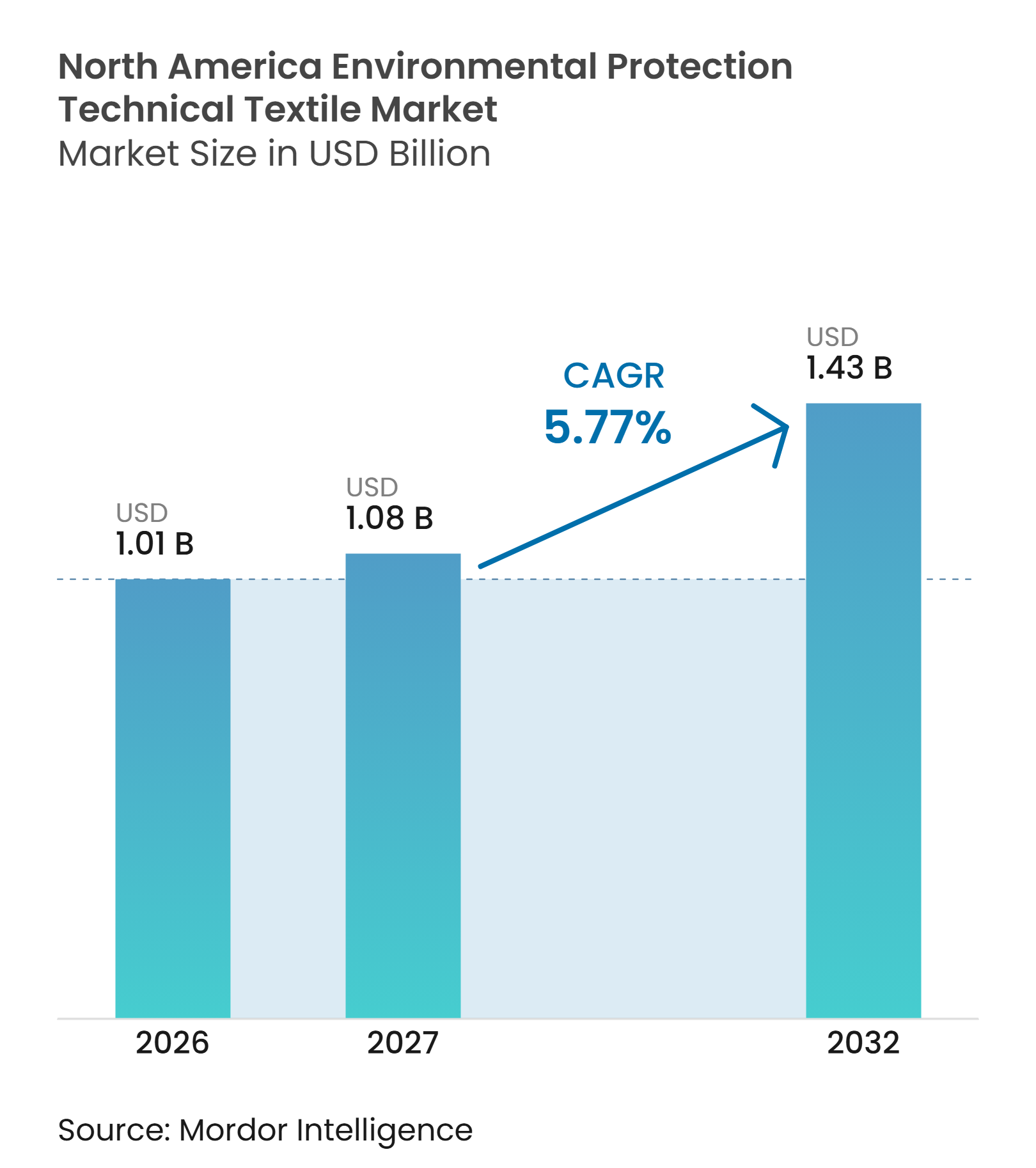
| Base Year Market Size (2026) | USD 1.01 Billion |
| Market Size (2027) | USD 1.08 Billion |
| Market Size (2032) | USD 1.43 Billion |
| Growth Rate (2027 - 2032) | 5.77 % |
| Market Concentration | Medium |
Major Players *Disclaimer: Major Players sorted in no particular order Image © Mordor Intelligence. Reuse requires attribution under CC BY 4.0. | |
North America Environmental Protection Technical Textile Market Analysis by Mordor Intelligence
The North America Environmental Protection Technical Textile Market size is expected to grow from USD 1.01 billion in 2026 to USD 1.08 billion in 2027 and is forecast to reach USD 1.43 billion by 2032 at 5.77% CAGR over 2027-2032.
Federal water funding, emission-control requirements, and recurring wildfire smoke events are shifting purchases from isolated projects toward recurring replacement and compliance demand. Infrastructure programs are strengthening demand for filtration, drainage, containment, and erosion-control materials across municipal and industrial projects, while making qualification and procurement capability more important for suppliers. Domestic-content rules can favor qualified North American suppliers when public projects move from design into procurement. Competition in the North America environmental protection technical textile market remains centered on media performance, approvals, delivery capability, and the ability to tailor products to operating conditions.
Key Report Takeaways
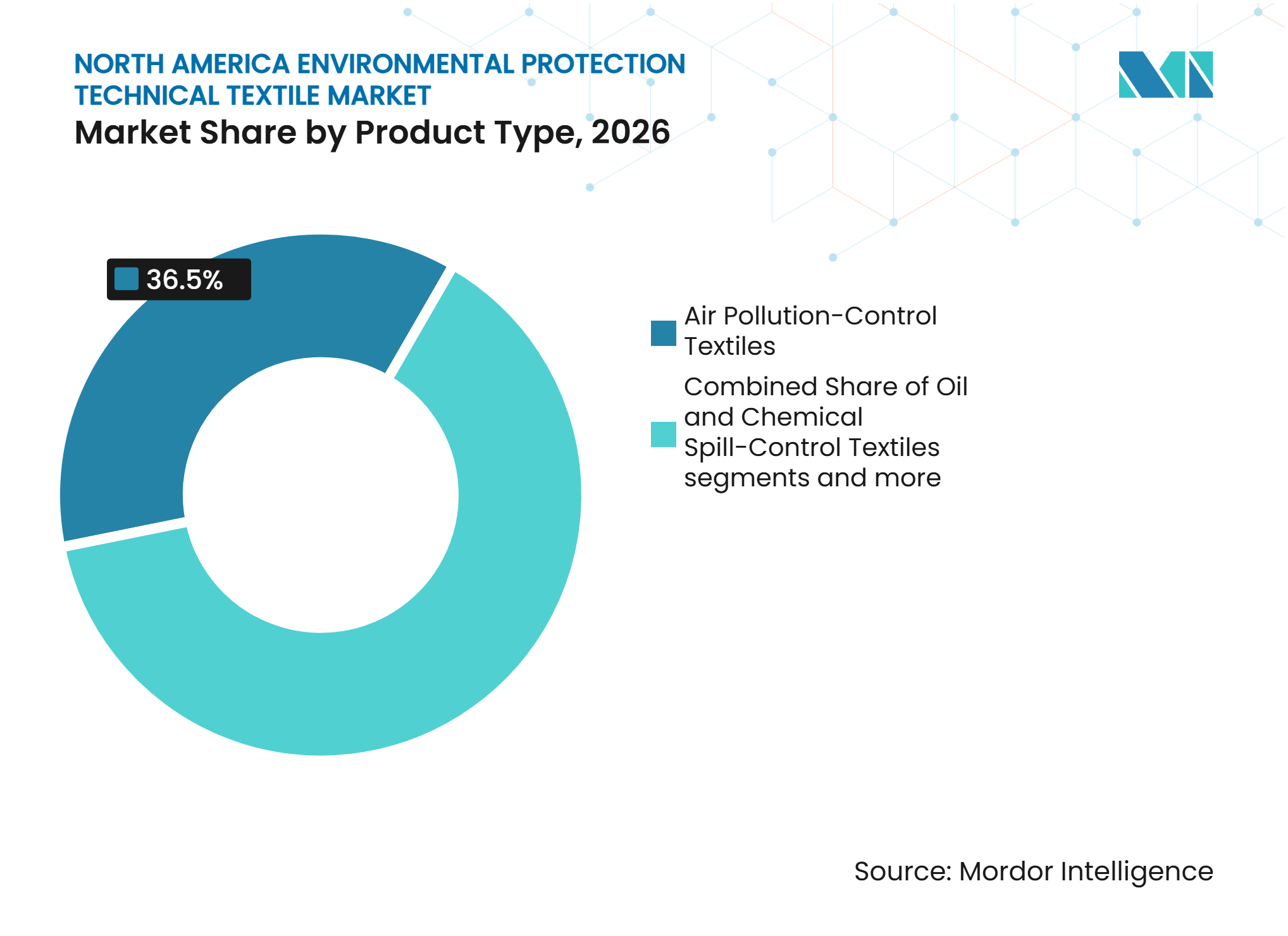
- By product type, air pollution-control textiles accounted for 36.5% of the North America environmental protection technical textile market size in 2026, while water and wastewater treatment textiles are forecast to grow at a 7% CAGR through 2032.
- By material type, polyester accounted for 30.5% of North America environmental protection technical textile market share in 2026, while high-performance synthetic fibers are forecast to grow at a 7.2% CAGR through 2032.
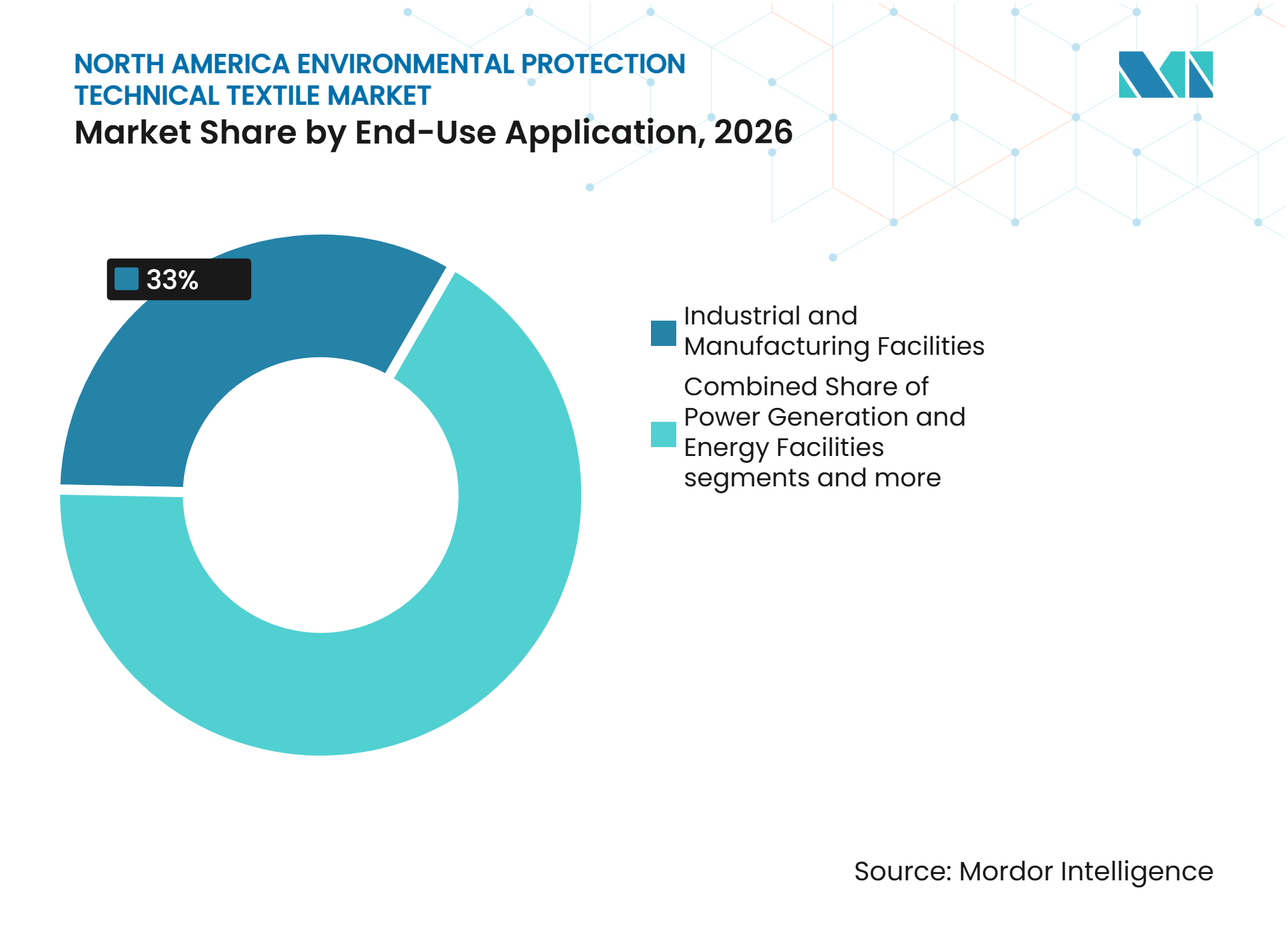
- By end-use application, industrial and manufacturing facilities accounted for 33% of revenue in 2026, while municipal water and wastewater utilities are forecast to grow at a 6.9% CAGR through 2032.
- By geography, the United States accounted for 80% of revenue in 2026, while Canada is forecast to grow at a 6.5% CAGR through 2032.
Note: Market numbers in this report are based on Mordor Intelligence's proprietary estimation framework, which combines nine months of actuals with Q4 projections for base year 2026.
Market Trends and Insights
Drivers Impact Analysis of North America Environmental Protection Technical Textile Market*
| Driver | (~) % Impact on CAGR Forecast | Geographic Relevance | Impact Timeline |
|---|---|---|---|
| Environmental Compliance for Water, Wastewater, and Landfills | +2.1% | National, with the United States at the core and spillover to Canada and Mexico | Medium term (2-4 years) |
| Infrastructure Modernization and Climate Resilience | +1.5% | National, strongest in the United States Southeast, Midwest, and Western Canada | Long-term (≥ 4 years) |
| Water Reuse, Stormwater Management, and Desalination Investment | +0.9% | United States Southwest and California, with expansion to Texas and Arizona | Long term (≥ 4 years) |
| Sustainable Infrastructure and Recycled Material Adoption | +0.6% | National, with early gains in California and Ontario | Medium term (2-4 years) |
| Domestic Content and Local Qualification Advantages | +0.4% | National, with direct relevance to EPA and Transport Canada-funded projects | Short term (≤ 2 years) |
| Wildfire Smoke and Episodic Air-Quality Filtration Demand | +0.3% | Western United States and Western Canada | Short term (≤ 2 years) |
| Source: Mordor Intelligence | |||
Environmental Compliance for Water, Wastewater, and Landfills
Federal compliance schedules are creating more predictable demand for filtration and containment textiles. The EPA finalized its National Primary Drinking Water Regulation for PFAS in April 2024, and affected public water systems must complete initial monitoring by 2027. Systems that exceed the maximum contaminant levels for PFOA or PFOS must implement treatment by 2029.[1] These deadlines favor advanced treatment systems that can use membrane or media-based processes. The North America environmental protection technical textile market also benefits when wastewater projects specify filter media during design, because those specifications support multi-year purchasing cycles. The Resource Conservation and Recovery Act framework requires municipal solid-waste landfill designs to satisfy federal criteria, which supports the use of geotextile elements in liner and drainage systems.[2]
Infrastructure Modernization and Climate Resilience
The United States faces USD 630 billion in wastewater and stormwater infrastructure needs over 20 years, alongside USD 625 billion in drinking-water needs.[3] This repair cycle supports demand for separation, filtration, drainage, and erosion-control products across public works projects. State revolving fund programs help bring these projects through planning, design, and construction for the North America environmental protection technical textile market. The North America environmental protection technical textile market can benefit when resilience standards call for materials that perform under wider hydraulic and thermal conditions. Climate-focused flood-control projects also use geotextiles for drainage, sediment control, and embankment protection. Manitoba’s multi-year infrastructure strategy documents continued investment planning for flood-management infrastructure.
Water Reuse, Stormwater Management, and Desalination Investment
Water reuse, stormwater management, and desalination projects are adding demand for filter cloth, membrane supports, drainage liners, and catch-basin filtration products. The Bureau of Reclamation made USD 120 million available through its FY2026 Title XVI desalination funding process for ocean and brackish-water projects in 17 western states. The EPA also announced USD 80 million for sewer overflow and stormwater reuse municipal grants covering FY2025 and FY2026. In constrained urban sites, textile-based products can be practical because they fit into retrofitted drainage systems without requiring large volumes of mineral media. This need for compact systems supports the North America environmental protection technical textile market. Water-scarcity programs in California, Arizona, Texas, and other western states can sustain demand beyond a single construction cycle.
Sustainable Infrastructure and Recycled Material Adoption
Public procurement programs are giving more attention to recycled content and lower-impact materials. Ahlstrom plans to begin operating its upgraded Taylorville, Illinois, production line in the fourth quarter of 2026. The line will make synthetic filtration materials for air pollution control, gas turbine intake, and liquid-process filtration. The North America environmental protection technical textile market has an opportunity in products that pair performance with longer service life or improved recovery options. At the same time, buyers are examining the risk that synthetic products used in water-contact applications could shed microplastics. California has added microplastics to its Candidate Chemicals List, increasing the likelihood that manufacturers will face closer scrutiny of product composition.
Restraints Impact Analysis of North America Environmental Protection Technical Textile Market*
| Restraint | (~) % Impact on CAGR Forecast | Geographic Relevance | Impact Timeline |
|---|---|---|---|
| High Qualification, Testing, and Specification Costs | -1.2% | National, most acute in United States federal and state procurement programs | Medium term (2-4 years) |
| Competition from Mineral, Granular, and Conventional Treatment Media | -0.8% | National, most pronounced in drinking-water PFAS treatment and industrial liquid filtration | Medium term (2-4 years) |
| End-of-Life and Microplastic Scrutiny of Synthetic Textiles | -0.5% | National, with concentrated regulatory pressure in California and state programs | Long term (≥ 4 years) |
| Fragmented Contractor, Specifier, and Standards Environment | -0.3% | National, most acute in rural and smaller municipalities | Short term (≤ 2 years) |
| Source: Mordor Intelligence | |||
High Qualification, Testing, and Specification Costs
Suppliers must complete several tests before their products can be specified for infrastructure and industrial applications. ASTM D737, ASTM F2299, ASTM D3776, and ASTM D1777 cover basic performance characteristics for different textile grades. Landfill-related applications can require further chemical resistance, tensile, and seam-performance testing under the federal solid-waste framework. These requirements can delay new product entry for 2 to 4 years in the North America environmental protection technical textile market. Smaller suppliers face a greater burden because laboratory, documentation, and validation costs are largely fixed. In the North America environmental protection technical textile market, qualified suppliers can retain a strong position on specification lists even when a newer alternative has strong technical performance.
Competition from Mineral, Granular, and Conventional Treatment Media
Textile solutions compete with granular activated carbon, ion-exchange resins, gravel, and other conventional materials. The choice depends on water quality, contaminant levels, footprint, operating requirements, and engineering practice. Some buyers continue to favor established mineral or granular methods when they have long operating records at local facilities. This competition is especially relevant in PFAS treatment and industrial liquid filtration within the North America environmental protection technical textile market. The North America environmental protection technical textile market must demonstrate service life, footprint, automation, and replacement advantages to win those applications. Technologies that combine membranes with textile supports can improve the comparison in projects where space and process control are important.
*Our forecasts treat driver/restraint impacts as directional, not additive. The impact forecasts reflect baseline growth, mix effects, and variable interactions.
North America Environmental Protection Technical Textile Market Segment Analysis
By Product Type:
Air Filtration Anchors Revenue, Water Textiles AccelerateAir pollution-control textiles accounted for 36.5% of revenue in 2026. Their position is supported by industrial operators that must maintain permitted particulate-emission levels under federal and state requirements. The Clean Air Act provides the statutory foundation for the EPA’s air pollution control programs. Baghouse filters also create repeat demand because they require replacement during normal operating life. Coal, natural gas, and cement facilities depend on these products to maintain control of particulate emissions. High-temperature filter bags are particularly important in cement, metal, and chemical applications. This part of the North America environmental protection technical textile industry is less exposed to individual project timing because installed systems need continuing maintenance. Catalytic and multifunctional materials are also gaining use where operators want to combine filtration with emissions-control functions.
Water and wastewater treatment textiles are forecast to grow at a 7% CAGR through 2032, giving them the fastest pace among product types. PFAS treatment deadlines, nutrient limits, and water-reuse requirements support the North America environmental protection technical textile market size for these products. DuPont launched IntegraTec XTP 100 IG ultrafiltration modules in October 2025, reporting up to 30% more flow per module than prior generations. Lower installed complexity can improve the case for membrane-based systems in smaller facilities across the North America environmental protection technical textile market. Spill-control textiles continue to serve marine and industrial users, although their demand can move with incident activity. Stormwater textiles, including drain-inlet filter bags, cartridge media, and filter mats, are supported by municipal grant programs and green-infrastructure rules. These products are useful where urban sites need a compact retrofit rather than a large treatment structure.



By Material Type:
Polyester Leads, High-Performance Synthetics OutpacePolyester accounted for 30.5% of revenue in 2026 because it combines chemical resistance, dimensional stability, and economical processing. It is widely used in woven filter cloth and needlepunched nonwoven constructions. The material can operate in many wastewater and industrial liquid-filtration systems without specialized manufacturing equipment. Polyester also has compatibility with standard wet-lay and dry-lay production processes. These features allow a broad base of suppliers to produce qualified media for the North America environmental protection technical textile market. Polypropylene remains important in spill-control sorbents and stormwater products because it is hydrophobic and low density. Glass and other inorganic fibers retain a role in applications that require temperatures above standard polyester or polypropylene limits.
High-performance synthetic fibers are forecast to grow at a 7.2% CAGR through 2032. This North America environmental protection technical textile market opportunity includes polyphenylene sulfide, aramid, and fluoropolymer media. Industrial customers use these materials where high temperatures or aggressive chemical streams shorten the life of conventional products. Polyphenylene sulfide can resist acids, alkalis, and sustained operating temperatures that would damage polyester media. PTFE membrane laminates and expanded PTFE fiber constructions are expanding in waste-to-energy, municipal incineration, and specialty chemical filtration. Tighter limits for dioxins, furans, and fine particulates strengthen the case for surface-filtration technology. Natural and regenerated cellulosic fibers remain smaller but can gain attention in bio-based sorbents and specified environmental products.
By End-Use Application:
Industrial Facilities Dominate, Municipal Utilities Gain GroundIndustrial and manufacturing facilities accounted for 33% of revenue in 2026. Chemicals, petrochemicals, metals processing, mining, and cement manufacturing make up a large share of this demand base. These operators often buy media to meet permit conditions or consent-decree requirements rather than through discretionary purchasing. That structure supports stable demand but makes it harder for new suppliers to displace qualified incumbents. Chemical and petrochemical facilities use chemically resistant woven cloth and PTFE membrane laminates. Metals, mining, and mineral-processing sites require high-temperature fabrics for baghouse and related applications. The North America environmental protection technical textile market benefits from the installed industrial base in the United States and from recurring replacement cycles.
Municipal water and wastewater utilities are forecast to grow at a 6.9% CAGR through 2032. The North America environmental protection technical textile market share for municipal utilities is smaller than industrial demand today, but compliance schedules and infrastructure replacement are strengthening their outlook. The EPA made USD 80 million available for sewer overflow and stormwater reuse municipal grants for FY2025 and FY2026. State revolving fund pipelines can help utilities move filtration projects from planning into procurement. Power generation, oil and gas, marine spill response, and urban stormwater systems also create recurring demand. Emergency response remains difficult to forecast because it depends on wildfires, industrial accidents, and extreme weather. However, the frequency of these events can make stockpiles and rapid-deployment products more important to buyers.

Geography Analysis
United States: Strong Market Position Supported by Infrastructure Investment and Regulatory Compliance Requirements
The United States held 80% of revenue in 2026. Its position reflects the scale of its industrial base, municipal water systems, and federal environmental requirements. FY2026 combined appropriations total USD 3.35 billion for the Clean Water State Revolving Fund and USD 3.01 billion for the Drinking Water State Revolving Fund. These funding channels support wastewater-treatment and drinking-water upgrades that require filtration and related materials. Western states also generate demand from wildfire smoke management, water reuse, and desalination planning. The Clean Air Act, Clean Water Act, and Resource Conservation and Recovery Act shape compliance requirements across major applications.
Canada: Infrastructure Investment and Climate-Resilience Initiatives
Canada is forecast to grow at a 6.5% CAGR through 2032. Federal Budget 2025 commits more than CAD 115 billion (USD 84 billion) to infrastructure over 5 years, which supports the country’s water, wastewater, and climate-resilience pipeline. The North America environmental protection technical textile market for Canada is shaped by municipal upgrades, flood control, and stormwater projects. Ontario’s water-infrastructure programs and Alberta’s water-management plans strengthen the project pipeline. Domestic procurement policy is also becoming more important for suppliers that serve public construction. The Government of Canada announced measures in September 2025 to extend Buy Canadian requirements to an additional CAD 70 billion (USD 51.1 billion) in grants and infrastructure programs. This can give qualified Canadian textile producers and fabricators a stronger position in bid processes. Climate adaptation projects create demand for drainage, erosion-control, and sediment-management materials alongside conventional water-treatment media.
Mexico and Cross-Border Demand: Wastewater Regulations and Nearshoring-Led Industrial Investment
Mexico's growth potential in the North America environmental protection technical textile market is supported by tightening wastewater regulations, expanding industrial activity, and increasing focus on shared water resources. NOM-001 sets wastewater discharge standards, encouraging industrial facilities to invest in treatment technologies and filtration solutions. Nearshoring is further strengthening this opportunity as manufacturing expansion increases requirements for process-water treatment and wastewater management. Textile and apparel manufacturers adopting membrane bioreactor and reverse-osmosis systems may create additional demand for nonwoven filtration media used in pretreatment applications. Meanwhile, cross-border environmental initiatives are supporting investments in municipal water infrastructure and wastewater treatment in border communities. Continued progress on United States-Mexico water-quality and wastewater projects could further support procurement, particularly for suppliers providing application-specific solutions, technical assistance, and shorter delivery lead times.
Competitive Landscape
Market Concentration
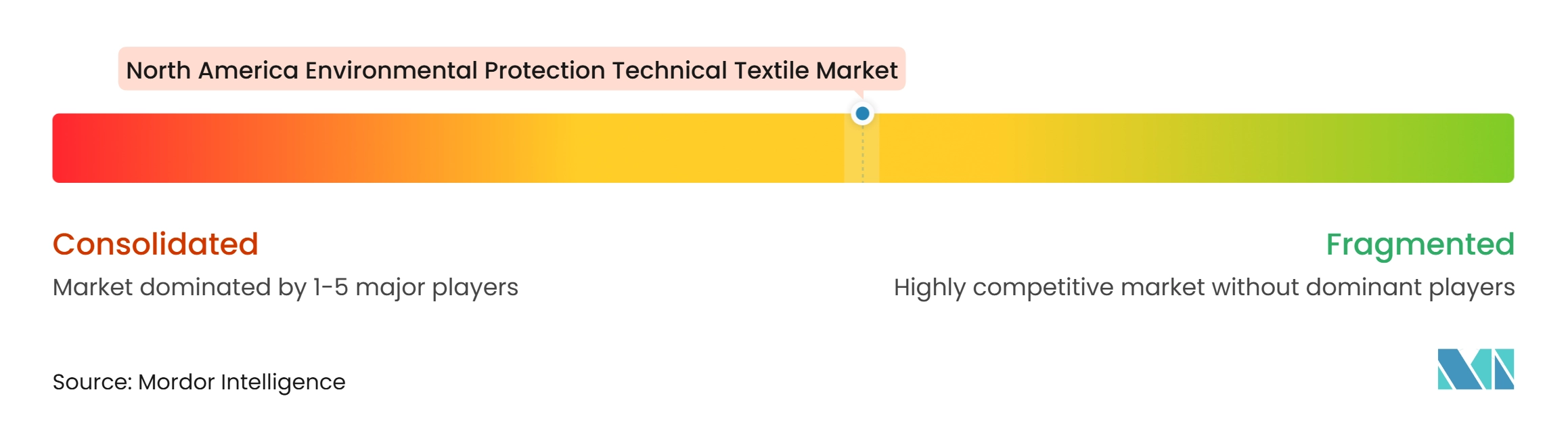
The North America environmental protection technical textile market exhibits a medium level of market concentration. Industrial air filtration is moderately concentrated because Donaldson, Freudenberg Performance Materials, and Hollingsworth & Vose hold long-standing qualifications and direct aftermarket relationships. Liquid filtration and membrane-integrated systems are more fragmented. DuPont, Toray Industries, Ahlstrom, Alkegen, regional converters, and system integrators compete through media performance, custom fabrication, and application support. This structure means that an established supplier may be strong in one type of media but not in every application. Qualification records, response time, and customer-specific design work remain important competitive tools. The North America environmental protection technical textile market also includes smaller fabricators that compete on local service and tailored products.
Parker Hannifin agreed in November 2025 to acquire Filtration Group Corporation for USD 9.25 billion and completed the acquisition on August 13, 2026. The acquisition expands Parker's portfolio of proprietary filtration technologies and strengthens its aftermarket capabilities across industrial and other critical applications. Separately, Filtration Group agreed to sell its Facet Filtration business to Donaldson for approximately USD 820 million in February 2026, with the transaction completed on May 4, 2026, before Parker's acquisition closed. Facet's addition strengthens Donaldson's fuel and fluid filtration portfolio and expands its exposure to aerospace, defense, and power generation applications. Together, these transactions show how broader filtration technology portfolios, specialized application capabilities, and recurring aftermarket revenues are strategically important. They may also increase competitive pressure on independent regional distributors as larger manufacturers expand their product offerings and customer relationships.
Technology development is shaping competition in advanced filtration segments. Electrospun nanofiber media, PTFE membrane laminates, and meltblown functionalized nonwovens can provide surface-filtration performance that previously depended on ceramic or sintered-metal products. Alkegen’s Chapter 11 reorganization plan was confirmed in September 2026 and is set to eliminate USD 3.1 billion in debt. North America environmental protection technical textile industry can reward companies that qualify fluoropolymer coatings, bio-based sorbents, and durable reusable products before regulatory change. Smaller competitors can still find openings in PFAS-selective media, low-microplastic stormwater products, and digital tools that help municipalities choose materials based on actual effluent conditions.
North America Environmental Protection Technical Textile Industry Leaders
-
Solmax International, Inc.
-
Berry Global Inc.
-
AGRU America, Inc.
-
Propex Operating Company, LLC
-
Tensar Corporation
- *Disclaimer: Major Players sorted in no particular order
North America Environmental Protection Technical Textile Market Companies Covered in this Report
- Solmax International, Inc.
- Berry Global Inc.
- AGRU America, Inc.
- Propex Operating Company, LLC
- Tensar Corporation
- SKAPS Industries
- HUESKER Group
- Tenax Corporation
- Texel Technical Materials, Inc.
- Hanes Geo Components
- American Excelsior Company
- DuPont de Nemours, Inc.
- Ahlstrom Holding 3 Oy
- Alkegen
- Hollingsworth and Vose Company
- Freudenberg Performance Materials SE and Co. KG
- Johns Manville
- Donaldson Company, Inc.
- Parker Hannifin Corporation
- Toray Industries, Inc.
Recent Industry Developments in North America Environmental Protection Technical Textile Market
- September 2026: The United States Bankruptcy Court for the Northern District of Texas confirmed Alkegen's Chapter 11 Plan of Reorganization, which will eliminate USD 3.1 billion in total debt and provide sufficient liquidity for continued operations, allowing the advanced fiber manufacturer to emerge as a leaner competitor in specialty filtration and high-temperature media segments.
- September 2026: H&V completed a USD 40+ million expansion of its Floyd, Virginia manufacturing plant, adding a new line for cutting-edge liquid filtration media serving large commercial buildings, hospitals, cabin air, and liquid microfiltration for food, beverage, and biopharma applications, expanding its North American manufacturing footprint ahead of infrastructure-driven demand growth.
- April 2026: The EPA announced availability of USD 80 million through the Sewer Overflow and Stormwater Reuse Municipal Grant program for FY2025 and FY2026 combined, supporting projects that design and construct stormwater management infrastructure that specifies textile filtration components across dozens of states.
- January 2026: The EPA finalized a USD 170 million WIFIA loan for the Carlsbad Desalination Plant Intake Modification project, supporting construction of a new intake facility and restoration of 125 acres of coastal wetlands.
North America Environmental Protection Technical Textile Market Report Scope
The North America Environmental Protection Technical Textiles Market is segmented by Product Type (Oil and Chemical Spill-Control Textiles, and More), by Material Type (Polypropylene, Polyester, and More), by End-Use Application (Municipal Water and Wastewater Utilities, Industrial and Manufacturing Facilities, and More), and by Geography (United States, Canada, Mexico). The Market Forecasts are Provided in Terms of Value (USD).
Segmentation Overview
| Air Pollution-Control Textiles | Particulate Emission-Control Filter Textiles |
| Catalytic and Multifunctional Emission-Control Textiles | |
| Other Specialized Air Pollution-Control Textiles | |
| Water and Wastewater Treatment Textiles | Water Purification and Fine-Filtration Textile Media |
| Wastewater and Effluent Filtration Textiles | |
| Wastewater Sludge Dewatering Textiles | |
| Oil and Chemical Spill-Control Textiles | Flat-Form Absorbent Textiles |
| Shaped Absorbent Textile Products | |
| Textile-Based Spill Containment Products | |
| Other Specialized Spill-Control Textiles | |
| Stormwater and Surface Runoff Pollution-Control Textiles | Drain-Inlet and Catch-Basin Textile Filter Bags |
| Stormwater Filter Mats and Textile Inserts | |
| Textile Media for Stormwater Filter Cartridges | |
| Other Dedicated Runoff Pollution-Removal Textiles | |
| Other Specialized Environmental Protection Textiles (Contaminant Remediation Products, etc.) |
| Polypropylene |
| Polyester |
| Polyamide |
| Polyethylene and Other Polyolefins |
| High-Performance Synthetic Fibers (Polyphenylene Sulfide, Aramid, etc.) |
| Fluoropolymer Textile Media |
| Glass and Other Inorganic Fibers |
| Natural and Regenerated Cellulosic Fibers |
| Other Materials |
| Municipal Water and Wastewater Utilities | Drinking Water Treatment |
| Municipal Wastewater Treatment | |
| Industrial and Manufacturing Facilities | Chemicals and Petrochemicals |
| Metals, Mining, and Mineral Processing | |
| Cement and Building Materials Manufacturing | |
| Other Industrial Manufacturing | |
| Power Generation and Energy Facilities | |
| Municipal Solid Waste and Recycling Facilities | |
| Oil and Gas, Marine, and Spill Response Operations | |
| Urban Stormwater and Drainage Infrastructure | |
| Environmental Remediation and Emergency Response Services | |
| Other Environmental Protection End Users |
| United States |
| Canada |
| Mexico |
| By Product Type | Air Pollution-Control Textiles | Particulate Emission-Control Filter Textiles |
| Catalytic and Multifunctional Emission-Control Textiles | ||
| Other Specialized Air Pollution-Control Textiles | ||
| Water and Wastewater Treatment Textiles | Water Purification and Fine-Filtration Textile Media | |
| Wastewater and Effluent Filtration Textiles | ||
| Wastewater Sludge Dewatering Textiles | ||
| Oil and Chemical Spill-Control Textiles | Flat-Form Absorbent Textiles | |
| Shaped Absorbent Textile Products | ||
| Textile-Based Spill Containment Products | ||
| Other Specialized Spill-Control Textiles | ||
| Stormwater and Surface Runoff Pollution-Control Textiles | Drain-Inlet and Catch-Basin Textile Filter Bags | |
| Stormwater Filter Mats and Textile Inserts | ||
| Textile Media for Stormwater Filter Cartridges | ||
| Other Dedicated Runoff Pollution-Removal Textiles | ||
| Other Specialized Environmental Protection Textiles (Contaminant Remediation Products, etc.) | ||
| By Material Type | Polypropylene | |
| Polyester | ||
| Polyamide | ||
| Polyethylene and Other Polyolefins | ||
| High-Performance Synthetic Fibers (Polyphenylene Sulfide, Aramid, etc.) | ||
| Fluoropolymer Textile Media | ||
| Glass and Other Inorganic Fibers | ||
| Natural and Regenerated Cellulosic Fibers | ||
| Other Materials | ||
| By End-Use Application | Municipal Water and Wastewater Utilities | Drinking Water Treatment |
| Municipal Wastewater Treatment | ||
| Industrial and Manufacturing Facilities | Chemicals and Petrochemicals | |
| Metals, Mining, and Mineral Processing | ||
| Cement and Building Materials Manufacturing | ||
| Other Industrial Manufacturing | ||
| Power Generation and Energy Facilities | ||
| Municipal Solid Waste and Recycling Facilities | ||
| Oil and Gas, Marine, and Spill Response Operations | ||
| Urban Stormwater and Drainage Infrastructure | ||
| Environmental Remediation and Emergency Response Services | ||
| Other Environmental Protection End Users | ||
| By Geography | United States | |
| Canada | ||
| Mexico | ||
Key Questions Answered in the Report
What is the forecast for environmental protection technical textiles in North America?
The sector is forecast to rise from USD 1.01 billion in 2026 to USD 1.43 billion by 2032, at a 5.77% CAGR from 2027 to 2032.
Which product category has the largest revenue position?
Air pollution-control textiles lead with 36.5% of revenue in 2026, supported by recurring industrial filter replacement and emission-control requirements.
Which application is growing fastest?
Water and wastewater treatment textiles are forecast to expand at a 7% CAGR through 2032, supported by PFAS treatment, reuse, and wastewater upgrades.
Why are municipal utilities becoming more important buyers?
Municipal water and wastewater utilities are forecast to grow at a 6.9% CAGR through 2032 as compliance deadlines and infrastructure replacement support project activity.
Which material has the strongest growth outlook?
High-performance synthetic fibers, including PPS, aramid, and fluoropolymer media, are forecast to grow at a 7.2% CAGR through 2032.
Which country has the fastest projected growth?
Canada is forecast to grow at a 6.5% CAGR through 2032, supported by infrastructure, water, and climate-resilience investment.