
North America Energy Retrofit Tools Market Size and Share
Market Overview
| Study Period | 2022 - 2032 |
|---|---|
| Forecast Data Period | 2027 - 2032 |
| Base Year Market Size (2026) | USD 3.45 Billion |
| Market Size (2027) | USD 3.82 Billion |
| Market Size (2032) | USD 6.40 Billion |
| Growth Rate (2027 - 2032) | 10.87 % |
| Market Concentration | Medium |
Major Players *Disclaimer: Major Players sorted in no particular order Image © Mordor Intelligence. Reuse requires attribution under CC BY 4.0. | |
North America Energy Retrofit Tools Market Analysis by Mordor Intelligence
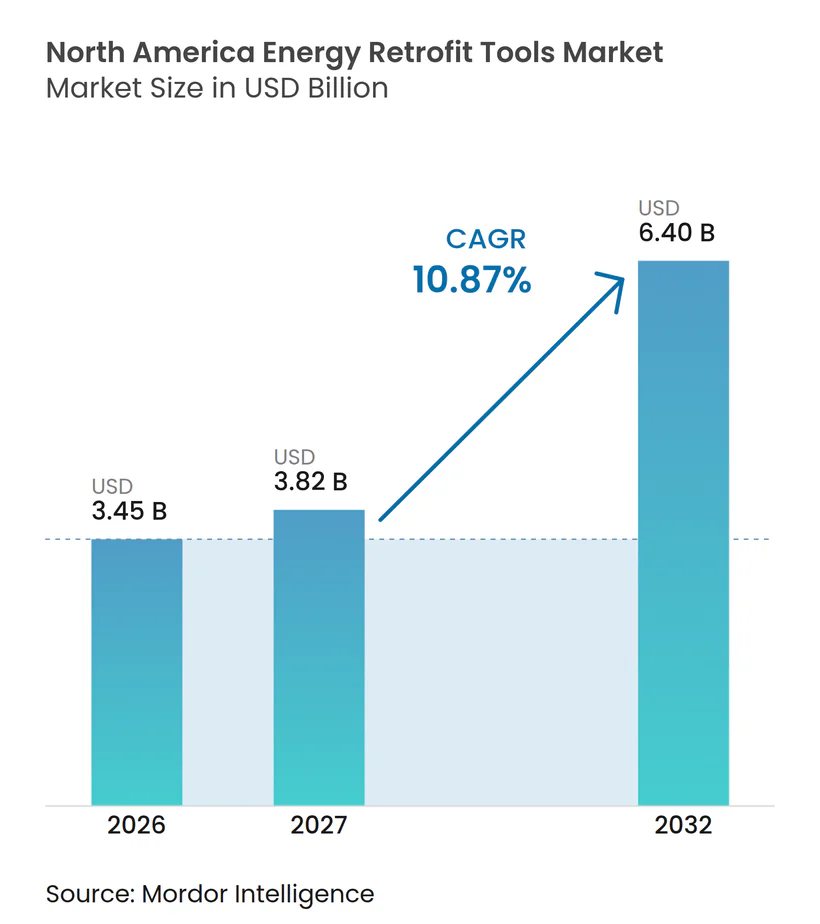
The North America Energy Retrofit Tools Market size is expected to grow from USD 3.45 billion in 2026 to USD 3.82 billion in 2027 and is forecast to reach USD 6.40 billion by 2032 at 10.87% CAGR over 2027-2032. The North America energy retrofit tools market is supported by an aging commercial building base and by building rules that require owners to measure, model, and document energy performance. Federal rebates connect reimbursement to qualified assessments, which gives auditors, modeling providers, and energy-management software a direct role in project delivery. The planned end of some federal tax incentives in June 2026 created a near-term pull-forward in commercial retrofit planning, while state green banks and local compliance rules provide continuity afterward. The North America energy retrofit tools market is also moving from periodic audits toward systems that monitor performance continuously and identify faults as they occur. This shift favors vendors that can combine building data, controls, diagnostics, and documentation within a practical workflow.[1] [2]
Key Report Takeaways
- By tool type, Energy Audit and Assessment Tools held 24.6% of the North America energy retrofit tools market share in 2026, while Smart Building Analytics and Energy Management Platforms are projected to grow at a 14.4% CAGR through 2032.
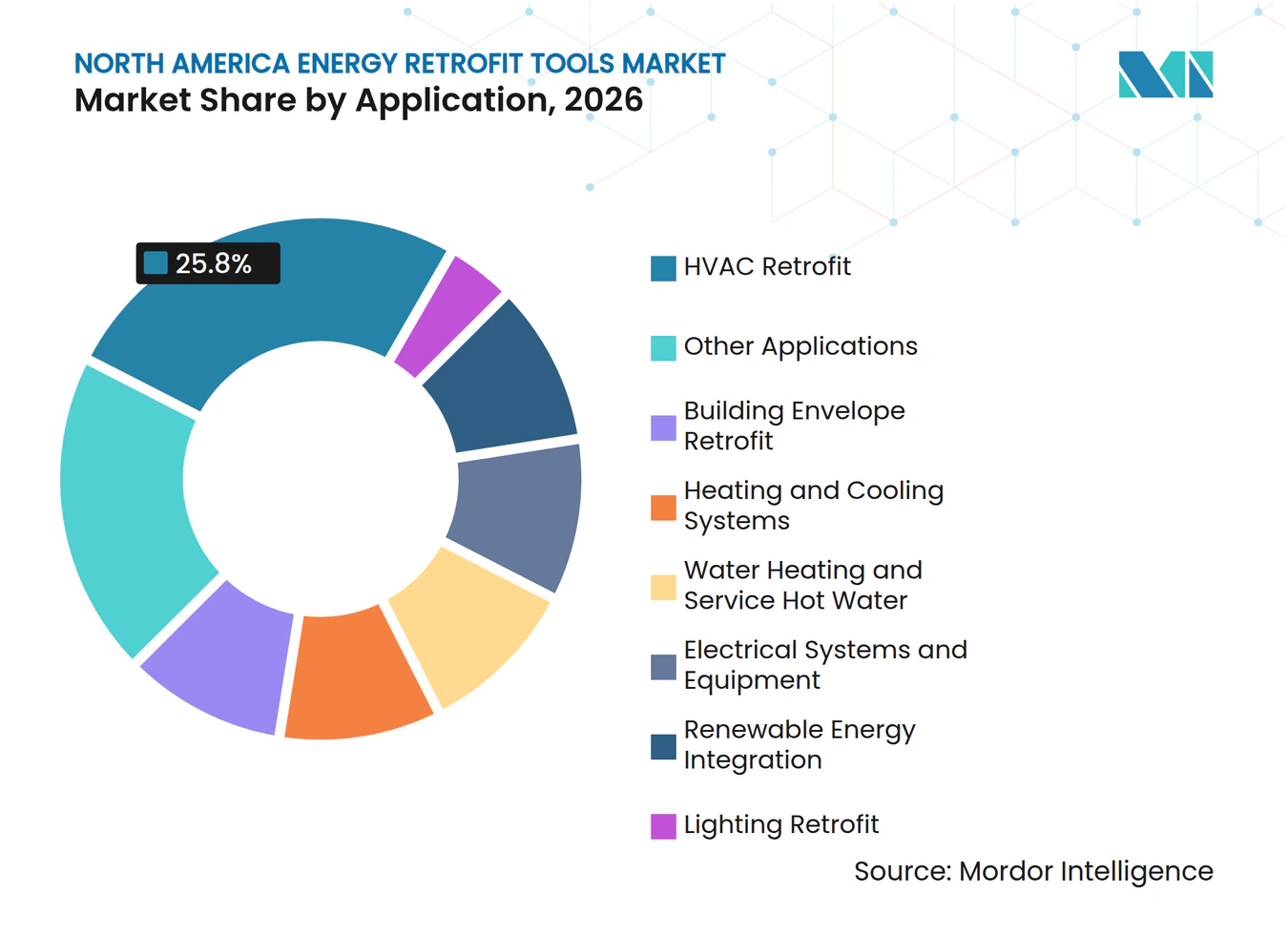
- By application, HVAC Retrofit accounted for 25.8% of the North America energy retrofit tools market size in 2026, while Renewable Energy Integration is expected to advance at a 12.6% CAGR through 2032.
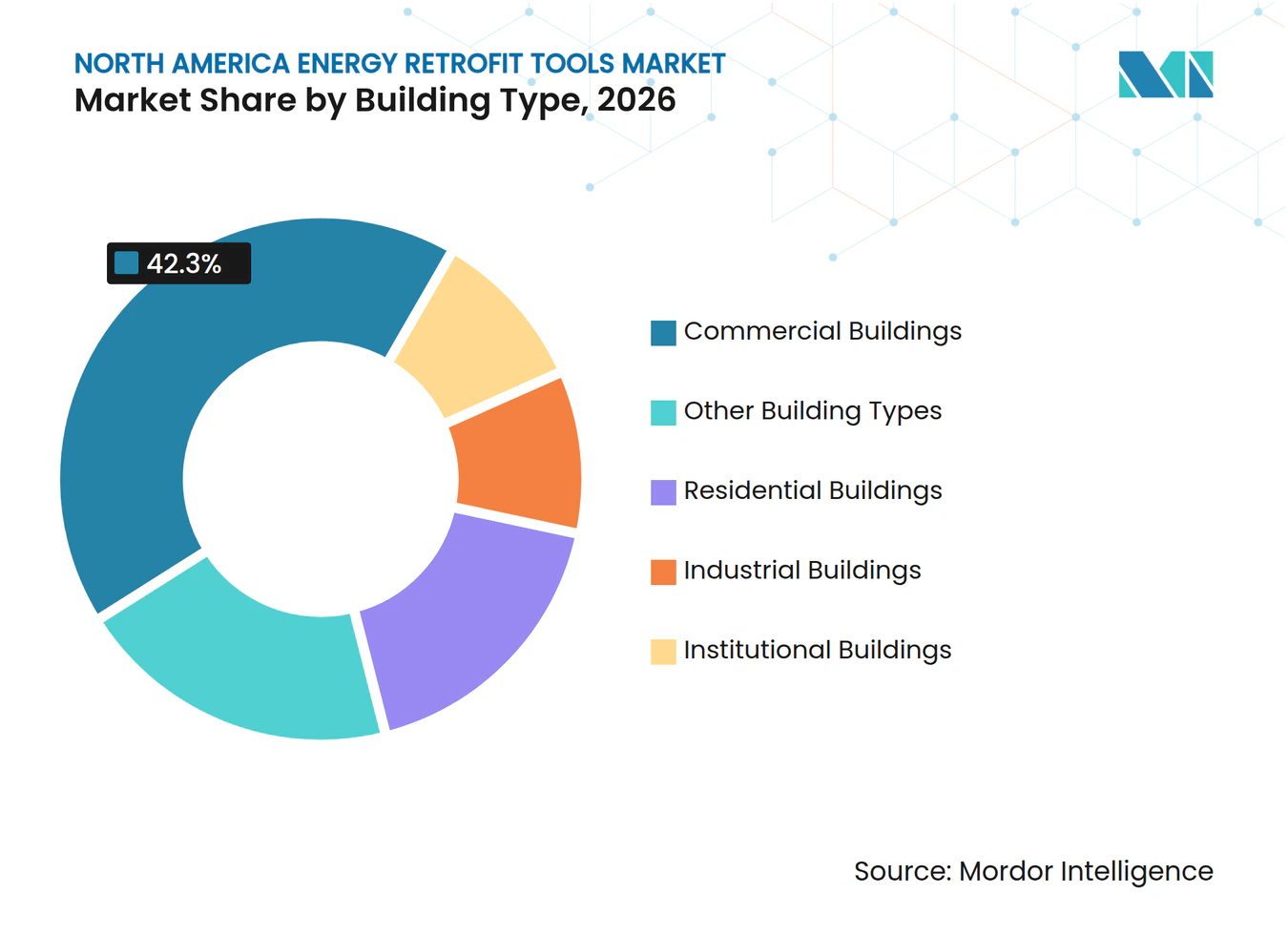
- By building type, commercial buildings held 42.3% of the North America energy retrofit tools market share in 2026, while institutional buildings are forecast to record an 11.1% CAGR through 2032.
- By geography, United States held 86.7% of he North America energy retrofit tools market share in 2026, while Mexico is forecast to record an 11.3% CAGR through 2032.
Note: Market numbers in this report are based on Mordor Intelligence's proprietary estimation framework, which combines nine months of actuals with Q4 projections for base year 2026.
Market Trends and Insights
Drivers Impact Analysis of North America Energy Retrofit Tools Market*
| Driver | (~) % Impact on CAGR Forecast | Geographic Relevance | Impact Timeline |
|---|---|---|---|
| Retrofit Incentives and Building Performance Standards | +2.8% | United States, Canada, with spillover to Mexico | Short term (≤ 2 years) |
| Aging Building Stock and HVAC Electrification | +2.2% | United States and Canada | Medium term (2-4 years) |
| Rising Energy Costs and Corporate Decarbonization Commitments | +1.5% | North America | Medium term (2-4 years) |
| Artificial Intelligence and Predictive Building Analytics | +2.1% | United States and Canada, with early gains in Mexico | Long term (≥ 4 years) |
| Legacy-System Interoperability and Phased Retrofits | +1.3% | United States and Canada | Medium term (2-4 years) |
| Automated Rebate Qualification and Measurement Documentation | +0.9% | United States, especially California, New York, and Massachusetts | Short term (≤ 2 years) |
| Source: Mordor Intelligence | |||
Retrofit Incentives and Building Performance Standards
The North America energy retrofit tools market gains a clear demand signal when building rules require owners to establish an energy baseline and submit verified performance records. The U.S. Department of Energy states that Home Energy Rebates support home energy upgrades, and the associated program structure relies on documented assessments and modeled savings. The Building Performance Association notes that state rebate programs use qualified professionals and program requirements, which places assessment capability at the start of the customer journey.[3] In Canada, the International Energy Agency reported Ontario’s USD 7.6 billion, 12-year efficiency commitment and Hydro-Québec’s USD 7 billion, 10-year efficiency strategy.[4] These programs make assessment, measurement, and reporting tools more relevant before equipment is selected. The North America energy retrofit tools market therefore benefits from recurring compliance tasks rather than only from one-time construction projects.
Aging Building Stock and HVAC Electrification
Aging heating and cooling equipment keeps the North America energy retrofit tools market tied to replacement cycles, but the work increasingly requires a detailed view of existing conditions. Legacy systems often lack complete sensor histories, so contractors need tools that can establish a credible pre-retrofit baseline from limited data. Trane Technologies completed its acquisition of BrainBox AI in January 2025, bringing autonomous HVAC controls and building analytics into its portfolio. The acquisition shows how equipment providers are seeking more control over diagnostics, operating data, and ongoing optimization. Refrigerant transitions and electrification also add commissioning work because replacement equipment must be sized, configured, and verified within an occupied building. The North America energy retrofit tools market can therefore serve both the planning stage and the post-installation validation stage of HVAC work.
Rising Energy Costs and Corporate Decarbonization Commitments
Higher energy costs make operating savings more important in capital planning and strengthen the case for tools that identify waste before a retrofit begins. Energy management systems also help owners translate facility data into documentation that can be shared with tenants, lenders, and corporate procurement teams. In December 2025, Amazon Web Services and Trane Technologies reported nearly 15% energy reductions at Amazon Grocery fulfillment facilities using BrainBox AI, with expansion planned to more than 30 U.S. sites. The project illustrates why customers increasingly look for performance evidence instead of a simple equipment recommendation. This approach broadens the North America energy retrofit tools market beyond audits because ongoing verification can remain useful after the project is complete. It also makes software adoption more relevant to facility operators who must manage energy performance across several locations.
Artificial Intelligence and Predictive Building Analytics
Artificial intelligence is changing the North America energy retrofit tools market from a service centered on periodic inspection into a service that can support continuous monitoring. Johnson Controls International plc expanded its OpenBlue capabilities in August 2026 with the OBI assistant and Nantum Energy and Comfort Intelligence, and the company said the system can reduce airside energy use by nearly 10%. Eaton introduced Brightlayer Energy in 2026 with energy forecasting, emissions monitoring, and weather-informed solar optimization. Such platforms can reduce manual review of operating data and help operators identify where field validation is needed. They may reduce demand for some standalone tools, but they also create a larger installed base that needs commissioning, cybersecurity review, and savings verification. The North America energy retrofit tools market is therefore likely to retain a role for specialists alongside integrated building platforms.
Restraints Impact Analysis of North America Energy Retrofit Tools Market*
| Restraint | (~) % Impact on CAGR Forecast | Geographic Relevance | Impact Timeline |
|---|---|---|---|
| High Upfront Capital Requirements and Long Payback Periods | -1.8% | United States and Canada, particularly mid-market commercial buildings | Medium term (2-4 years) |
| Shortage of Qualified Auditors, Integrators, and Commissioning Personnel | -1.3% | United States, particularly California, New York, and Massachusetts | Long term (≥ 4 years) |
| Model-to-Measurement Liability and Savings-Guarantee Risk | -0.8% | United States, with spillover to Canada | Medium term (2-4 years) |
| Occupied-Building Disruption and Fragmented Data Governance | -0.5% | U.S. commercial office and health care buildings | Short term (≤ 2 years) |
| Source: Mordor Intelligence | |||
High Upfront Capital Requirements and Long Payback Periods
High initial costs can delay comprehensive retrofits, especially for mid-sized owners without dedicated sustainability budgets. Performance contracts reduce this barrier, but they often require detailed audits, measurement plans, and savings documentation before financing is approved. Ameresco secured a USD 197 million Energy Savings Performance Contract with the U.S. Naval Research Laboratory in October 2025 for infrastructure modernization. Ameresco and CRC Innovations also announced a contract exceeding USD 200 million for capital improvements at 3 U.S. Army locations in February 2025. These examples show that financing structures can enable larger projects, although smaller owners may still struggle to fund the assessment and planning work required at the outset. Long payback periods can also discourage projects in locations with lower energy costs or uncertain ownership timelines.
Shortage of Qualified Auditors, Integrators, and Commissioning Personnel
The availability of trained auditors, integrators, and commissioning staff limits how quickly retrofit programs can be implemented. The Building Performance Association has identified a need for training pathways that prepare workers for building performance roles. A U.S. Department of Energy survey archived by the Office of Scientific and Technical Information found that building performance contractors reported hiring and training challenges. This constraint matters because advanced platforms still need qualified people to collect field data, interpret results, configure systems, and confirm savings. Limited technical capacity can extend project schedules and increase delivery costs for owners. The North America energy retrofit tools market must therefore support simpler workflows and more efficient fieldwork without weakening the credibility of measurement and verification.
*Our forecasts treat driver/restraint impacts as directional, not additive. The impact forecasts reflect baseline growth, mix effects, and variable interactions.
North America Energy Retrofit Tools Market Segment Analysis
By Tool Type:
Audit Tools Lead, While Analytics Platforms Extend the Addressable Use CaseEnergy Audit and Assessment Tools held 24.6% of the 2026 market, reflecting the need to assess existing conditions before an owner selects a retrofit measure. This gives the North America energy retrofit tools market a dependable base in compliance-driven assessment work. Smart Building Analytics and Energy Management Platforms are forecast to grow at 14.4% CAGR through 2032, the fastest rate among tool types, because they continue to measure performance after an audit. Johnson Controls International plc launched Metasys 16.0 in June 2026 with integrated views of peak load, energy use, indoor air quality, and emissions. The company said ASHRAE Guideline 36 sequences in the system can produce up to 30% energy savings.
Building energy modeling software and HVAC diagnostic and commissioning tools remain important where owners need a calibrated plan before work begins. Envelope inspection tools help ensure that mechanical upgrades are not undermined by overlooked building-fabric issues, while renewable energy tools support projects combining solar, storage, and electric vehicle charging. Eaton’s Brightlayer Energy illustrates the movement toward platforms that forecast energy use and monitor emissions from a common interface. Integrated platforms can absorb some standalone audit and measurement functions. The North America energy retrofit tools industry still needs specialized tools that provide reliable project-specific evidence alongside broader software platforms.
By Application:
HVAC Retrofit Sets the Volume Base, While Renewable Integration Grows FasterHVAC Retrofit accounted for 25.8% of 2026 application demand, making it the main volume base for the North America energy retrofit tools market. The application benefits from aging equipment, electrification goals, refrigerant transitions, and the need to recommission systems. Diagnostic tools help teams understand load conditions, equipment behavior, and control settings before an HVAC replacement is designed. They also verify performance after installation in occupied buildings, keeping assessment and commissioning relevant beyond equipment replacement. HVAC work gives suppliers an opportunity to connect controls, fault detection, and continuing energy management within one project scope.
Renewable Energy Integration is projected to grow at a 12.6% CAGR through 2032, the highest rate among applications. Corporate and institutional customers are combining solar, storage, and electric vehicle charging with HVAC and envelope upgrades instead of funding separate projects. This approach requires tools that model load, evaluate energy-use timing, and document results across several measures. Lighting Retrofit remains a substantial source of project activity, and Orion Energy Systems reported a USD 30 million backlog entering FY2027. Building envelope, water heating, heating and cooling, and electrical upgrades can be combined to reduce disruption, use more than one incentive program, and compare measures within one coordinated retrofit plan.


By Building Type:
Commercial Buildings Lead, While Institutions Support Larger ProgramsCommercial buildings held 42.3% of the 2026 market, supported by large energy loads, concentrated ownership, and compliance requirements in many jurisdictions. Their scale lets owners use common baselines and reporting systems across portfolios, which supports the North America energy retrofit tools market. The former Section 179D deduction supported commercial retrofit planning through early 2026, while local performance rules and green-bank financing remain relevant afterward. Owners must minimize disruption for tenants, making phased installation and interoperable tools valuable. They may defer deep projects when capital is tight, but still need documentation for compliance and asset management.
Institutional buildings are expected to grow at 11.1% CAGR through 2032, the fastest rate among building types. Universities, government agencies, and hospitals can pursue broad retrofit scopes through performance contracts and long-term facilities plans. Ameresco began a USD 30 million Phase 2 energy efficiency project at the University of Illinois Chicago in July 2025. Residential buildings remain linked to Home Energy Rebates that support upgrades when households meet program requirements, while industrial buildings are tied more directly to energy-cost management and high process energy use. These groups create different requirements for assessment depth, integration, financing documentation, and continuing verification.

Geography Analysis
United States Energy Retrofit Tools Market
The United States accounted for 86.7% of 2026 regional demand, making it the central source of scale for the North America energy retrofit tools market. Its large commercial building base, local building requirements, and established performance-contracting ecosystem support recurring assessment and reporting work. The Institute for Market Transformation has documented California’s strategy for building performance standards covering commercial and multifamily properties, while New York City’s Local Law 97 adds another compliance trigger for large buildings. The end of selected federal tax incentives in June 2026 may have slowed some near-term commercial commitments. Annual benchmarking and third-party verification requirements can still maintain recurring demand for audit, modeling, and reporting tools.
Canada Energy Retrofit Tools Market
Canada is the second-largest geography and is supported by provincial energy-efficiency programs. The International Energy Agency reported Ontario’s USD 7.6 billion, 12-year efficiency commitment, Hydro-Québec’s USD 7 billion strategy, and further support for the Oil to Heat Pump Affordability Program. These programs create work for tools that identify upgrades, document expected savings, and support longer planning horizons for utilities, owners, and service providers. Canada’s program structure gives suppliers a route to demand that is not solely dependent on U.S. federal incentives. It also increases the importance of tools that can support provincial reporting and financing requirements.
Mexico Energy Retrofit Tools Market
Mexico is forecast to grow at 11.3% CAGR through 2032, the fastest rate among the 3 North American geographies. Nearshoring-related industrial development and multinational tenant requirements support demand for documented energy performance. Mexico’s energy-efficiency financing program supports small and medium-sized companies that replace HVAC equipment, insulation, and solar photovoltaic systems. Its refrigerant transition creates a further need for diagnostic workflows that support low-global-warming-potential equipment and practical planning for industrial, commercial, and public-building projects.
Competitive Landscape
Market Concentration
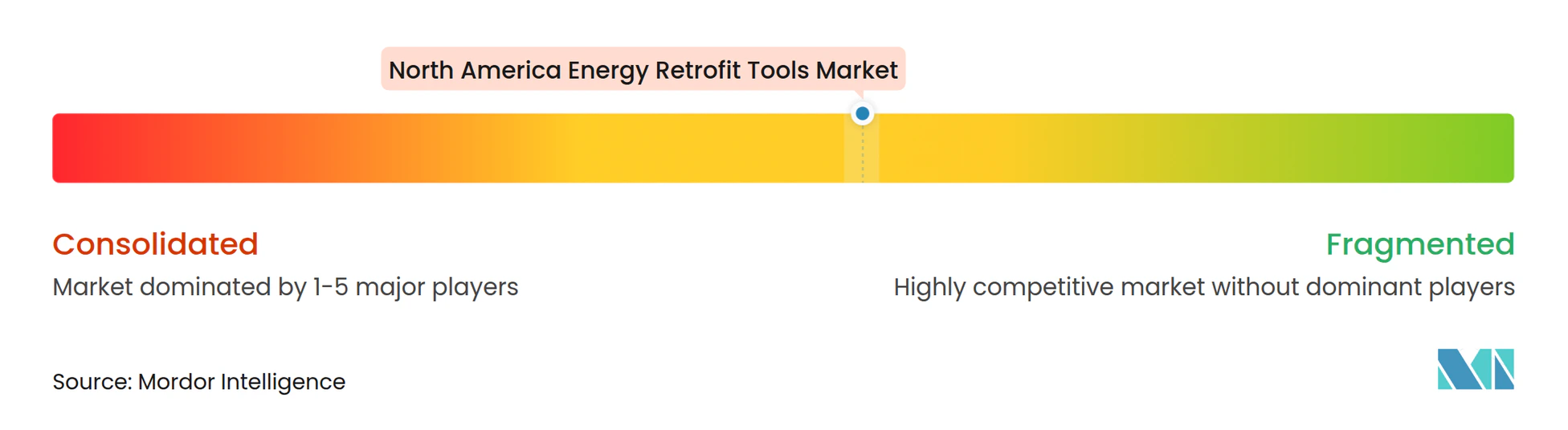
The North America energy retrofit tools market is moderately concentrated among broad building-platform providers, while many specialist tool categories remain fragmented. Johnson Controls International plc, Honeywell, and Schneider Electric compete through integrated building data, controls, and energy-management capabilities that connect equipment, operations, and reporting. Johnson Controls International plc expanded OpenBlue in August 2026 with artificial intelligence capabilities for building energy and comfort management. Schneider Electric introduced EcoStruxure Foresight Operation in November 2025 to bring energy, power, and building systems into one artificial intelligence platform. The company stated that it can resolve related mechanical and electrical faults 90% faster and reduce engineering workflow time by up to 40%.
Acquisitions show how established providers are adding analytics and controls capabilities. Trane Technologies completed its BrainBox AI acquisition in January 2025 after a two-year partnership, and reported that the platform was deployed across more than 14,000 commercial buildings globally. Carrier acquired 75F in July 2026 to expand its intelligent building offering for the light commercial and retrofit segment. The transaction brings wireless sensors, cloud-native controls, and artificial intelligence capabilities into Carrier’s QuantumLeap suite. Large vendors are seeking faster retrofit delivery, but customers still need providers that can address local conditions and existing system constraints.
Several areas remain open to specialists in the North America energy retrofit tools market, including automated rebate qualification, light commercial buildings under 50,000 square feet, and secure envelope-inspection data that works with existing building-management systems. Eaton collaborated with Autodesk on an artificial intelligence-powered digital energy twin to simulate infrastructure upgrade effects before a project commitment. Daikin Industries and Mitsubishi Electric have significant HVAC equipment positions, but their direct software presence in this tool scope is less distinct than that of platform and assessment-focused providers. Measurabl, CarbonSight, and Ameresco’s Energy Intelligence Software represent benchmarking, virtual-audit, and analytics tiers that support the North America energy retrofit tools market.
North America Energy Retrofit Tools Industry Leaders
-
Johnson Controls International plc
-
Schneider Electric SE
-
Siemens AG
-
Honeywell International Inc.
-
Trane Technologies plc
- *Disclaimer: Major Players sorted in no particular order
North America Energy Retrofit Tools Market Companies Covered in this Report
- Johnson Controls International plc
- Schneider Electric SE
- Siemens AG
- Honeywell International Inc.
- Ameresco, Inc.
- Trane Technologies plc
- Daikin Industries, Ltd.
- Carrier Global Corporation
- ABB Ltd.
- Eaton Corporation plc
- ENGIE SA
- AECOM
- Mitsubishi Electric Corporation
- Emerson Electric Co.
- Signify N.V.
- Danfoss A/S
- Veolia
- Kingspan Group plc
- ROCKWOOL A/S
- Orion Energy Systems, Inc.
Recent Industry Developments in North America Energy Retrofit Tools Market
- September 2026: Orion Energy Systems secured a follow-on USD 10–15 million LED lighting and IoT retrofit project from a major U.S. retailer, raising its FY2027 revenue outlook to USD 100–102 million; the engagement follows a January 2026 USD 14–15 million LED exterior lighting award from the same client, reflecting multi-phase, multi-year large-format retail retrofit contracting, per Orion's investor disclosures.
- August 2026: Johnson Controls International plc unveiled expanded AI capabilities for its OpenBlue ecosystem, including the OBI agentic assistant and Nantum AI-powered Energy & Comfort Intelligence; the platform reduces airside energy use by nearly 10%, with Forrester estimating up to 155% ROI for customers, and cuts deployment time by up to 95% through automated onboarding, per the company's press release.
- July 2026: Carrier Global Corporation acquired 75F, a cloud-native AI-enabled building automation startup; 75F's wireless sensors, intuitive controls, and agentic AI capabilities are being integrated into Carrier's QuantumLeap thermal management suite, strengthening Carrier's retrofit positioning in the under-50,000-square-foot light commercial segment, per Carrier's press release.
- June 2026: Johnson Controls International plc launched Metasys 16.0, featuring IEC 62443-4-2 Security Level 2 cybersecurity alignment, ASHRAE Guideline 36 energy sequences delivering up to 30% energy savings, and integration tools that reduce deployment costs by 60–70% and compress deployment timelines from months to days, per the company's press release.
North America Energy Retrofit Tools Market Report Scope
Energy retrofit tools refer to the physical equipment, digital software, and diagnostic technologies used by engineers, contractors, energy auditors, and facility managers to assess, plan, install, and optimize energy-saving upgrades in existing buildings. The energy retrofit tools market (also recognized in the industry as the energy retrofit systems market) refers to the global commercial market dedicated to upgrading existing buildings, industrial plants, and infrastructure with modern, energy-efficient technologies.
The energy retrofit tools market is segmented by tool type, which includes building energy modeling (BEM) software, audit tools, heating, ventilation, and air conditioning (HVAC) diagnostic equipment, envelope inspection systems, smart analytics platforms, renewable energy integration tools, and other specialized devices. In terms of application, the market is divided into HVAC upgrades, lighting systems, building envelope improvements, heating and cooling enhancements, water heating modifications, electrical system optimizations, renewable integration, and other miscellaneous applications. Based on building type, the sector is categorized into residential, commercial, industrial, institutional, and other building classifications. The report also covers the market size and forecasts for the North America energy retrofit tools market across 3 countries in the region. For each segment, the market sizing and forecasts have been provided on the basis of value (USD).
Segmentation Overview
| Building Energy Modeling (BEM) Software |
| Energy Audit and Assessment Tools |
| HVAC Diagnostic and Commissioning Tools |
| Building Envelope Inspection Tools |
| Smart Building Analytics and Energy Management Platforms |
| Renewable Energy Tools |
| Other Tools |
| HVAC Retrofit |
| Lighting Retrofit |
| Building Envelope Retrofit |
| Heating and Cooling Systems |
| Water Heating and Service Hot Water |
| Electrical Systems and Equipment |
| Renewable Energy Integration |
| Other Applications |
| Residential Buildings |
| Commercial Buildings |
| Industrial Buildings |
| Institutional Buildings |
| Other Building Types |
| United States |
| Canada |
| Mexico |
| By Tool Type | Building Energy Modeling (BEM) Software |
| Energy Audit and Assessment Tools | |
| HVAC Diagnostic and Commissioning Tools | |
| Building Envelope Inspection Tools | |
| Smart Building Analytics and Energy Management Platforms | |
| Renewable Energy Tools | |
| Other Tools | |
| By Application | HVAC Retrofit |
| Lighting Retrofit | |
| Building Envelope Retrofit | |
| Heating and Cooling Systems | |
| Water Heating and Service Hot Water | |
| Electrical Systems and Equipment | |
| Renewable Energy Integration | |
| Other Applications | |
| By Building Type | Residential Buildings |
| Commercial Buildings | |
| Industrial Buildings | |
| Institutional Buildings | |
| Other Building Types | |
| By Geography | United States |
| Canada | |
| Mexico |
Key Questions Answered in the Report
What is driving demand for energy retrofit tools in North America?
Building performance requirements, rebate documentation, aging HVAC equipment, and the need to verify energy savings are driving demand. These factors make baseline measurement, retrofit design, commissioning, and regular reporting useful throughout a project rather than only at its initial planning stage.
What is the projected growth rate through 2032?
The sector is forecast to grow at a 10.87% CAGR from 2027 to 2032, reaching USD 6.40 billion by 2032.
Which tool category is growing the fastest?
Smart Building Analytics and Energy Management Platforms are expected to grow at a 14.4% CAGR through 2032.
Why are HVAC retrofits important to this sector?
HVAC Retrofit held 25.8% of 2026 application demand because replacement, electrification, and commissioning require diagnostic and verification tools.
Which North American geography is growing the fastest?
Mexico is forecast to grow at an 11.3% CAGR through 2032, supported by industrial development and energy-performance requirements.
How concentrated is competition among suppliers?
The market concentration score is 5 out of 10 because broad platform suppliers have strong positions, but specialist categories remain fragmented and no combined top-player share was provided.