
North America Data Center Technical Workforce Market Size and Share
Market Overview
| Study Period | 2021 - 2032 |
|---|---|
| Forecast Data Period | 2027 - 2032 |
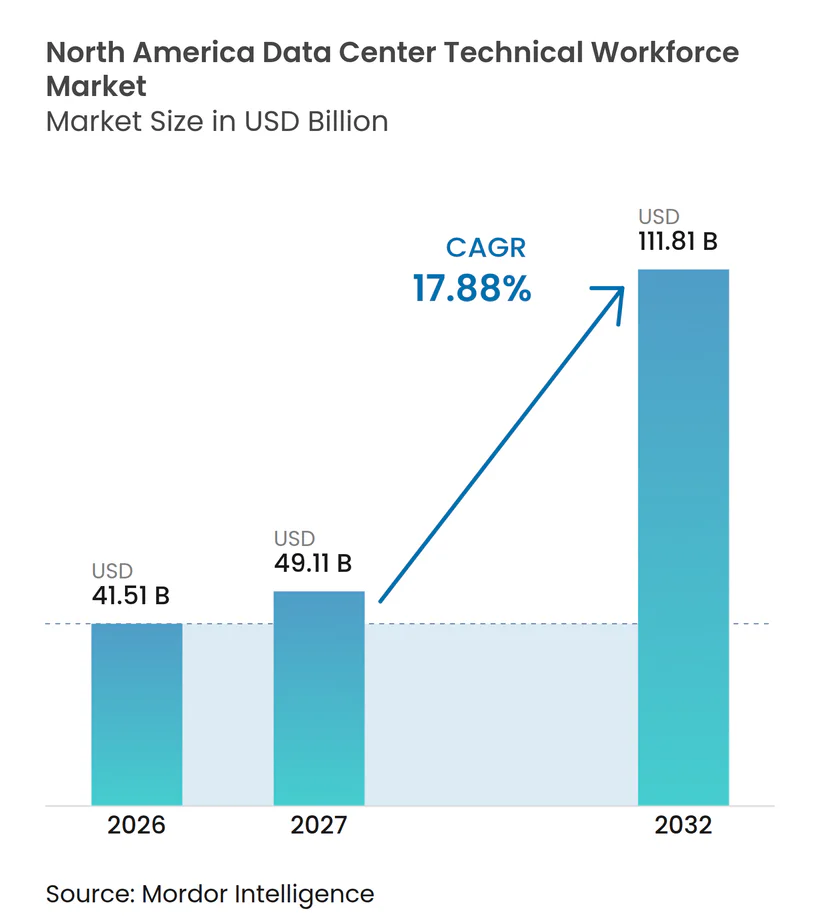
| Base Year Market Size (2026) | USD 41.51 Billion |
| Market Size (2027) | USD 49.11 Billion |
| Market Size (2032) | USD 111.81 Billion |
| Growth Rate (2027 - 2032) | 17.88 % |
| Market Concentration | Medium |
Major Players *Disclaimer: Major Players sorted in no particular order Image © Mordor Intelligence. Reuse requires attribution under CC BY 4.0. | |
North America Data Center Technical Workforce Market Analysis by Mordor Intelligence
The North America data center technical workforce market size is valued at USD 41.51 billion in 2026 and is projected to reach USD 111.81 billion by 2032, registering a CAGR of 17.88% from 2027 to 2032. AI computing demand and large campus construction programs are increasing the need for skilled people across design, installation, commissioning, and operations, while many projects require several specialist groups to work in sequence without disrupting the overall schedule. Low vacancy in established data center locations makes new capacity dependent on the timely availability of qualified technical teams, particularly during commissioning when facility systems must be tested together and handed over on schedule. This places recruiting, training, and retention alongside power, land, and equipment as core considerations for project delivery, particularly where several construction programs compete for the same trades and established labor pools cannot expand quickly. Providers that can build local training partnerships and deploy trained teams across several sites have an opening to improve project timing, labor continuity, and the reliability of planned handovers. The North America data center technical workforce market is also changing as operators use external services to handle short periods of intense construction activity without retaining large teams between projects, which can align staffing with the practical rhythm of build, test, and operational phases.
Key Report Takeaways
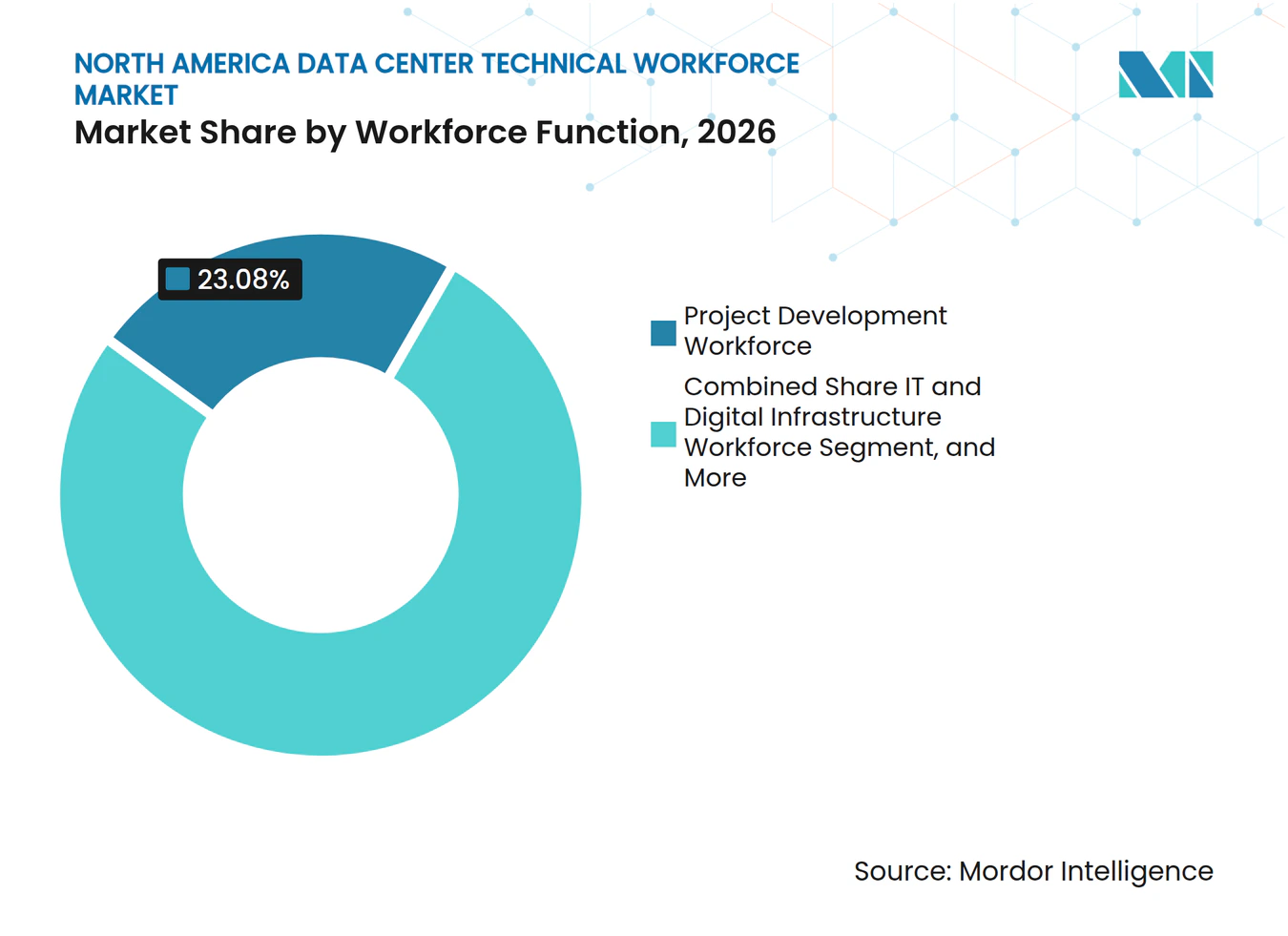
- By workforce function, Project Development Workforce held 23.08% of the North America data center technical workforce market share in 2026 and is projected to expand at an 18.15% CAGR through 2032.
- By employment model, In-house Workforce held 55.76% of the North America data center technical workforce market share in 2026, while External Workforce Services is projected to expand at an 18.38% CAGR through 2032.
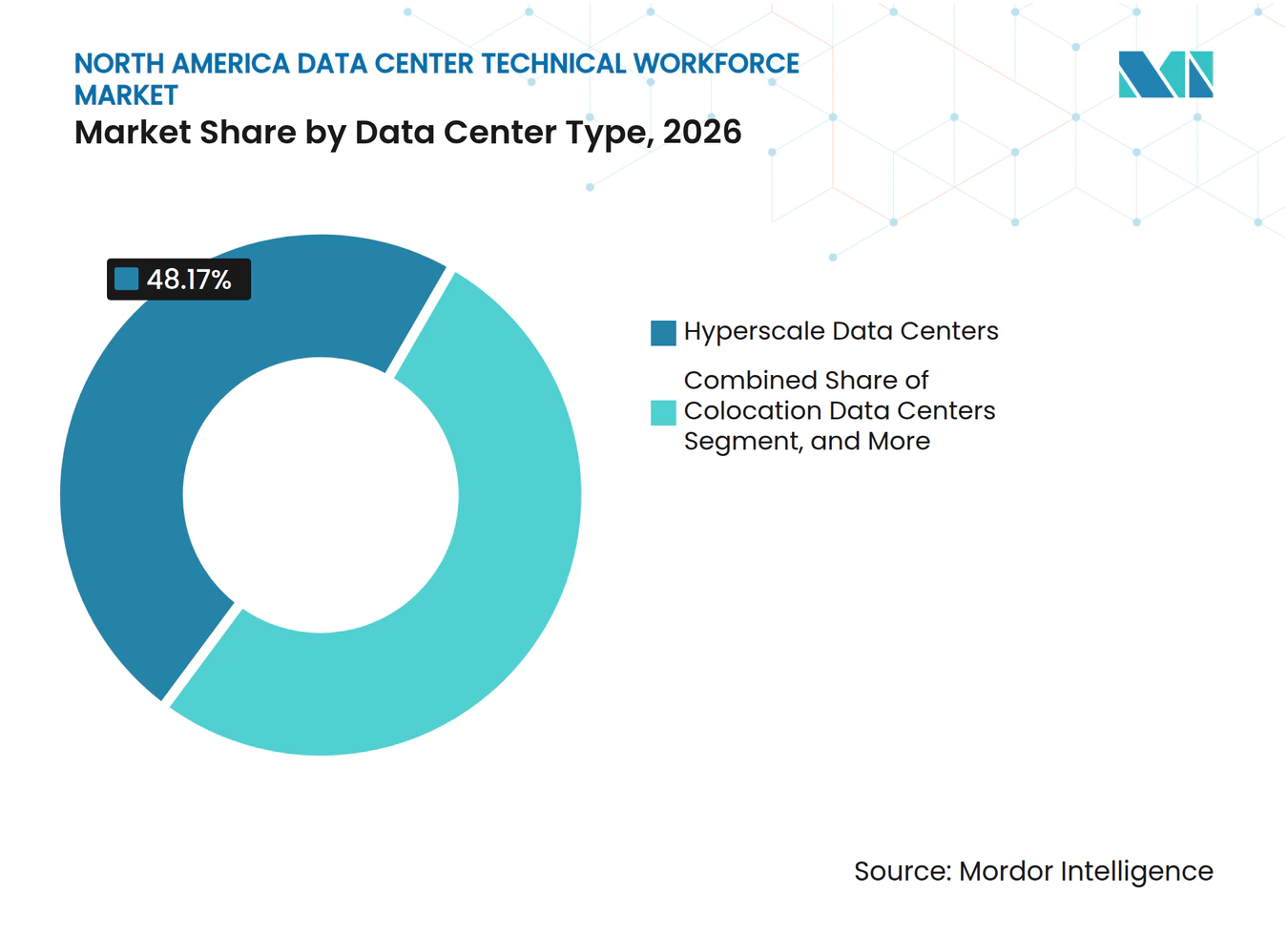
- By data center type, Hyperscale Data Centers accounted for 48.17% of the North America data center technical workforce market share in 2026 and are projected to expand at an 18.19% CAGR through 2032, reflecting the scale of their construction programs and the number of specialist roles required to complete them.
- By geography, the United States held 79.21% of the North America data center technical workforce market share in 2026, while Mexico is projected to expand at an 18.41% CAGR through 2032.
Note: Market numbers in this report are based on Mordor Intelligence's proprietary estimation framework, which combines nine months of actuals with Q4 projections for base year 2026.
Market Trends and Insights
Drivers Impact Analysis of North America Data Center Technical Workforce Market*
| Driver | (~) % Impact on CAGR Forecast | Geographic Relevance | Impact Timeline |
|---|---|---|---|
| AI and Hyperscale Capacity Expansion | +5.2% | Demand is concentrated in the United States, with spillover to Canada and Mexico. | Short term (≤ 2 years) |
| Low Vacancy and Accelerating Data Center Construction | +4.3% | Core United States locations and expanding markets in West Texas, Louisiana, and Indiana. | Short term (≤ 2 years) |
| Liquid Cooling and High-Density Infrastructure Complexity | +2.8% | The United States and Canada, with developing adoption in Mexico. | Medium term (2-4 years) |
| Workforce-as-a-Service Adoption for Rapid Project Mobilization | +2.1% | United States deployments, especially in Northern Virginia, Texas, Arizona, and Louisiana. | Medium term (2-4 years) |
| Persistent Skilled-Trades Shortage Increasing Demand for Specialized Technical Labor | +1.6% | North America, especially Northern Virginia, Dallas-Fort Worth, Phoenix, and Silicon Valley. | Long term (≥ 4 years) |
| Local Talent Partnerships and Apprenticeship Pathways | +0.9% | The United States, Canada, and areas with new campus construction. | Long term (≥ 4 years) |
| Source: Mordor Intelligence | |||
AI and Hyperscale Capacity Expansion Anchors Demand Growth
Large AI infrastructure programs make technical labor a more important input for the North America data center technical workforce market, because facilities require specialized work before computing capacity can be used. Hyperscale operators are building several campuses at once, which can draw commissioning engineers and electrical specialists from the same regional labor pool and limit the availability of replacements. The construction pace makes staffing decisions earlier and more consequential for developers, who must coordinate labor availability with equipment delivery and site readiness. A company that secures qualified technicians before construction reaches its peak can reduce the risk of delayed commissioning, rework, and gaps between construction completion and operations. The North America data center technical workforce market therefore favors employers that combine long-term recruiting with training and site readiness planning. The resulting competition is strongest in locations where several large campuses progress at the same time.
Low Vacancy and Accelerating Data Center Construction Intensify Labor Competition
Low vacancy means most new capacity is needed by customers before a facility enters service, which gives operators limited flexibility when commissioning schedules move. Construction teams must therefore meet tighter handover dates and have little room to replace experienced personnel during commissioning, especially when work requires site-specific credentials. This increases the value of electricians, controls specialists, and technicians who can work safely in mission-critical settings with strict process, safety, and availability requirements. The North America data center technical workforce market is affected because a delayed workforce mobilization can delay revenue-producing capacity and leave operators exposed to missed delivery commitments. Project managers are responding by recruiting beyond their traditional local areas and by creating local training relationships, although those steps require earlier planning and closer coordination with community providers. Those responses can help individual projects, but they also intensify competition for the same skilled trades in nearby markets.
Liquid Cooling and High-Density Infrastructure Complexity Drive New Skill Requirements
Liquid cooling is adding mechanical and thermal work to roles that previously centered on electrical and air-cooling systems. Schneider Electric states that NVIDIA-based GPU server racks can require up to 142 kW per rack, which increases the importance of specialized cooling design and maintenance.[1] ASHRAE identifies energy and thermal guidance for AI data centers, including the use of its Standard 90.4 and Thermal Guidelines. A 2025 peer-reviewed Applied Energy article describes how high-performance data center cooling requires knowledge across thermal systems, fluids, and control approaches. These requirements widen the training gap because standard apprenticeships do not always cover integrated liquid cooling systems, sensor controls, and the operating procedures used in dense AI environments. The North America data center technical workforce market benefits when employers develop roles that combine mechanical, electrical, and controls capabilities, rather than treating these skills as separate workstreams.
Workforce-as-a-Service Adoption Enables Faster Project Mobilization
External workforce services allow operators to add specialized teams for a limited project phase, giving project leaders a practical way to respond to fast changes in site requirements. This model is useful when a campus needs a rapid increase in fiber, power, rack installation, or commissioning work that its core operating team cannot absorb. ManpowerGroup describes data center workforce support across the lifecycle, including building, commissioning, operating, modernizing, and optimizing facilities.[2] Such services can shift credential checking, payroll, and staffing administration to a specialist provider, allowing internal managers to focus more closely on construction coordination and operational readiness. The North America data center technical workforce market gains flexibility from this approach because staffing can follow construction schedules rather than permanent headcount plans, a useful feature where multiple projects have uneven timelines. It does not remove the shortage of experienced personnel, but it can improve how available talent is allocated between projects.
Restraints Impact Analysis of North America Data Center Technical Workforce Market*
| Restraint | (~) % Impact on CAGR Forecast | Geographic Relevance | Impact Timeline |
|---|---|---|---|
| Scarcity of Experienced Mission-Critical Technical Professionals | -2.8% | North America, especially Northern Virginia, Dallas-Fort Worth, Phoenix, and Silicon Valley. | Long term (≥ 4 years) |
| Long Lead Times for Power, Permitting, and Facility Commissioning | -2.1% | Major United States locations, with the strongest pressure in grid-constrained areas. | Medium term (2-4 years) |
| High Burnout, Wage Inflation, and Talent Poaching | -1.8% | The United States, with spillover to Canada and Mexico. | Short term (≤ 2 years) |
| Regional Housing, Licensing, and Labor-Mobility Constraints | -1.5% | Frontier United States locations, Alberta, and Querétaro. | Medium term (2-4 years) |
| Source: Mordor Intelligence | |||
Scarcity of Mission-Critical Technical Professionals Constrains Market Expansion
The North America data center technical workforce market faces shortages in both AI-related roles and core physical infrastructure trades, which are each necessary for a facility to move from design to stable operations. The U.S. Bureau of Labor Statistics projects 9% employment growth for electricians from 2025 to 2035 and 72,200 openings each year.[3] Training a licensed electrician takes years of supervised work, which is much longer than the construction cycle for many new facilities and limits how quickly the supply response can occur. Uptime Institute reported in its 2025 staffing survey that operators continue to face problems finding qualified candidates and retaining staff. The shortage can increase wage pressure and make experienced workers more willing to change employers, which can interrupt continuity on active construction and operating sites. It also makes training partnerships important for maintaining the future supply of technicians.
Long Lead Times for Power, Permitting, and Facility Commissioning Delay Workforce Deployment
Power availability and permits can change when a project needs construction and operating staff, complicating recruitment plans for contractors, operators, and external service providers. The White House issued an executive order in July 2025 to accelerate federal permitting for qualifying data center infrastructure projects above 100 MW. Even with policy action, changing schedules create a challenge for firms that must recruit and retain people ahead of a facility opening, sometimes before the start date is fully certain. A team hired too early can raise project costs before operations start. A team hired too late can extend commissioning and delay customer delivery. The North America data center technical workforce market is consequently exposed to uncertainty that begins outside the labor pool itself, including dependencies on permitting, power access, and commissioning timing.
*Our forecasts treat driver/restraint impacts as directional, not additive. The impact forecasts reflect baseline growth, mix effects, and variable interactions.
North America Data Center Technical Workforce Market Segment Analysis
By Workforce Function:
Project Development Holds the Largest PositionProject Development Workforce accounted for 23.08% of the North America data center technical workforce market share in 2026 and is projected to expand at an 18.15% CAGR through 2032. This function includes design and engineering, construction and installation, and testing and commissioning roles, each of which must be available in the right sequence to avoid gaps during a complex campus build. It holds a large position because each new facility needs specialized teams before it can enter service, and many of those teams are needed before a customer can begin using the site. Design teams must specify power, cooling, network, and security systems for large and complex campuses, while taking account of the operating procedures needed when those systems are placed into service. Construction teams then need to install those systems while coordinating many subcontractors and local trades, often in locations where other large developments are competing for the same workers.
Turner Construction reports that the Richland Parish data center project in Louisiana required coordination across a workforce of more than 5,000 people at peak activity. The same project prompted collaboration with Louisiana Delta Community College on a workforce development cohort, according to Turner Construction. Facility Operations and Maintenance Workforce provides steadier demand after construction ends, but these roles still face retention pressure because experienced employees can be recruited by nearby facilities with similar needs. Uptime Institute found that junior and mid-level operations staff reported high salary spending increases and high turnover in its 2025 survey. IT and Digital Infrastructure Workforce roles are becoming more important as AI systems increase demand for network, hardware, cybersecurity, and infrastructure management skills, linking digital responsibilities more directly with the condition of physical site systems.



By Employment Model:
External Services Support Flexible StaffingIn-house Workforce held 55.76% of the North America data center technical workforce market share in 2026. Permanent staff remain important where security, facility knowledge, and operating continuity are priorities, because they retain familiarity with site procedures, customer requirements, and the operating history of critical equipment. Operators often rely on internal teams to run critical systems and maintain customer trust, especially after a facility has moved beyond the construction phase and enters continuous service. Within the North America data center technical workforce market, this structure can support consistent procedures and clearer responsibility for facility performance, but it requires regular investment in retention, career development, and skill renewal as infrastructure changes. It is less suited to a short period of intense construction or commissioning activity.
External Workforce Services are projected to expand at an 18.38% CAGR through 2032, the highest rate in this segmentation, as operators seek practical ways to manage short periods of higher labor demand without creating permanent overcapacity. These services include contractor staffing, statement-of-work delivery, employer-of-record arrangements, and contractor-to-hire models, which can be selected according to the duration, location, and technical scope of each assignment. They give operators a way to use qualified staff for defined stages of a project. ManpowerGroup presents its data center offering as support across build, commission, run, modernize, and optimize activities. This supports the move from short-term placement toward broader workforce management.
By Data Center Type:
Hyperscale Facilities Lead Technical Labor DemandHyperscale Data Centers accounted for 48.17% of the North America data center technical workforce market share in 2026 and are projected to expand at an 18.19% CAGR through 2032, reflecting the scale of their construction programs and the number of specialist roles required to complete them. Their large campuses require specialists in power distribution, cooling, network infrastructure, and commissioning, with coordination needed across technical disciplines before systems can be tested as a single operating environment. The scale of a hyperscale project can require several workstreams to proceed at the same time, placing more pressure on managers to secure people with the experience needed for each stage. This increases demand for people who understand both individual systems and their integration. It also raises the consequences of staffing gaps because a delay in one workstream can affect the entire schedule, including the timing of commissioning, customer delivery, and the start of routine operations.
Within the North America data center technical workforce market, Colocation Data Centers need a different mix of workforce capabilities because they serve several customers and require customer-facing operational coordination, alongside the technical discipline required to maintain shared and reliable infrastructure. Equinix's published workforce development initiative shows how operators are investing in data center technician training to broaden the supply of prepared entrants. Enterprise, edge, and modular sites present another challenge because projects are distributed across many locations, where staffing needs may be too small to sustain a deep local specialist pool. Smaller sites may not have access to the same local talent base as major hubs. This can make standardized staffing approaches harder to apply.

Geography Analysis
United States Data Center Technical Workforce Market
The United States accounted for 79.21% of the North America data center technical workforce market share in 2026, supported by the region’s broadest base of established data center locations and active project development. It has the region's largest concentration of hyperscale providers, established data center hubs, and construction activity, which creates sustained demand across both project delivery and long-term facility operations. Demand is spreading from Northern Virginia and Dallas-Fort Worth to locations such as West Texas, Louisiana, and Indiana, increasing the importance of localized recruitment in areas with less established technical labor bases. Google says its Skills Trades and Readiness Program provides short-term training tracks in Indiana, Missouri, Nebraska, Ohio, South Carolina, and Virginia.
Canada Data Center Technical Workforce Market
Canada has a smaller installed data center base than the United States but is developing workforce planning around provincial digital infrastructure programs, which can help connect regional education, employers, and infrastructure development priorities. The Information and Communications Technology Council launched a research initiative with the Government of Alberta to identify workforce requirements for the province's AI-enabled data center development. The focus on workforce mapping recognizes that new capacity requires a broad technical base, not only cloud and software roles, because sites also depend on power, cooling, controls, maintenance, and physical security capabilities. Regional strategies can help employers align training with the skills most needed at construction and operating sites. They may also help retain workers who might otherwise be recruited into major United States markets.
Mexico Data Center Technical Workforce Market
Mexico is projected to record an 18.41% CAGR through 2032, the fastest rate among the geographic segments, as new development increases the need for trained employees who can support both construction and ongoing operations. Its data center buildout creates demand for electrical, mechanical, and operating skills in a market that has limited experienced technical labor, making workforce preparation a central condition for converting planned capacity into functioning facilities. MEXDC reported in 2026 that data center employers have difficulties filling roles, especially in electrical and mechanical engineering and mid-level operations. Large data center investments in Querétaro are increasing the need for project and operations staff, particularly as facilities move from construction into service. These conditions make Mexico an important area for recruitment partnerships and workforce development in the North America data center technical workforce market.
Competitive Landscape
Market Concentration
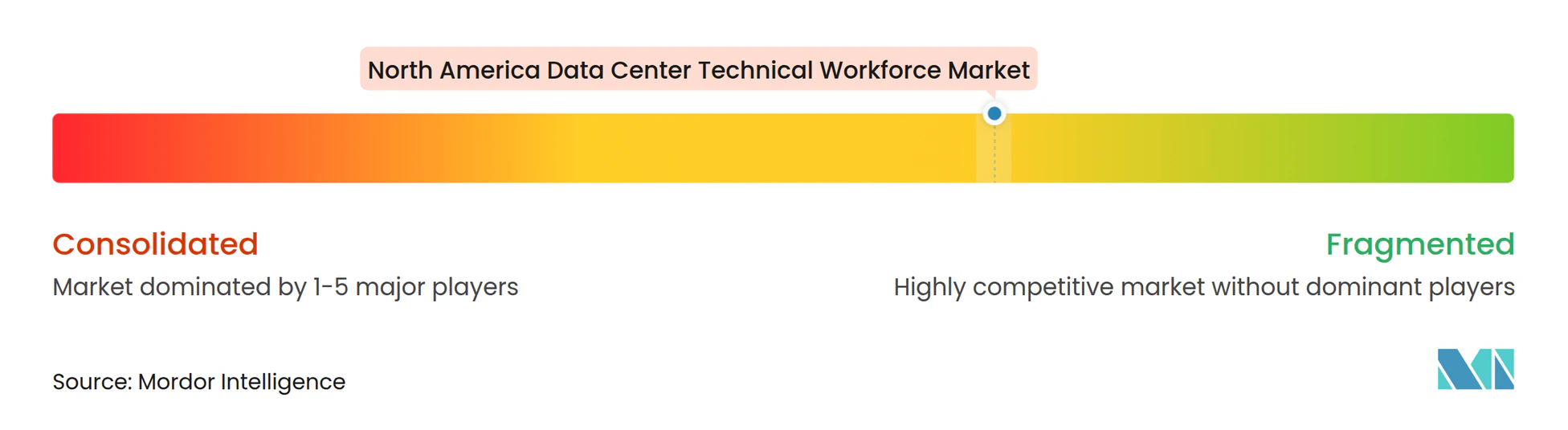
The North America data center technical workforce market is moderately fragmented because construction contractors, operators, hyperscalers, facilities firms, and staffing providers serve different parts of the value chain, with each group addressing different stages of site delivery and operation. No reported company share indicates control of total workforce spending. Contractors compete on project delivery, safety, specialist knowledge, and their ability to coordinate large workforces, which is especially important where labor must be mobilized across several sites and subcontractors. Operators compete for people who can maintain reliable facilities and meet customer commitments, with experienced operations personnel valued for their understanding of both equipment and standardized site processes. Hyperscalers can influence local labor availability when several large campuses are built in parallel.
In the North America data center technical workforce market, leading organizations are investing directly in training to improve access to technicians, treating workforce development as a way to build a more dependable future talent supply rather than relying only on external recruitment. Equinix launched the Data Center Technician Training Coalition in March 2026 with Generation, Cisco Systems, Vertiv, and ODATA. Google continues to offer Skills Trades and Readiness training in several United States states. Turner Construction partnered with a Louisiana community college on a workforce development cohort for the Richland Parish project. These actions show that workforce development is becoming part of how firms protect project schedules, reduce the risk of labor gaps, and develop entry routes into roles that require specific technical preparation.
Technical capability remains a key point of competition as AI facilities use more complex cooling and power infrastructure, increasing the value of teams that can safely install, test, and maintain interconnected equipment. Contractors that can work with liquid cooling, integrated controls, and high-density systems can compete for technically demanding assignments. The strongest openings are in liquid cooling skills and in the ability to mobilize trained crews to new locations, where employers can combine specialized knowledge with practical delivery capacity. Smaller staffing providers may find it difficult to match companies that have established training networks and broad geographic coverage, particularly when customers need certified personnel across more than one location.
North America Data Center Technical Workforce Industry Leaders
-
Turner Construction Company
-
DPR Construction
-
Equinix, Inc.
-
Digital Realty Trust, Inc.
-
Amazon Web Services, Inc.
- *Disclaimer: Major Players sorted in no particular order
North America Data Center Technical Workforce Market Companies Covered in this Report
- Turner Construction Company
- DPR Construction
- Whiting-Turner Contracting Company
- Mortenson Construction
- Holder Construction Company
- HITT Contracting Inc.
- Equinix, Inc.
- Digital Realty Trust, Inc.
- CyrusOne LLC
- Iron Mountain Incorporated
- QTS Data Centers, LLC
- Vantage Data Centers Management Company, LLC
- Switch, Inc.
- STACK Infrastructure
- Amazon Web Services, Inc.
- Microsoft Corporation
- Google LLC
- Meta Platforms, Inc.
- Oracle Corporation
- CBRE Group, Inc.
- Jones Lang LaSalle Incorporated
- System One
- Anistar Technologies, Inc.
- Releady, Inc.
- Broadstaff, LLC
Recent Industry Developments in North America Data Center Technical Workforce Market
- June 2026: HITT Contracting broke ground on Microsoft's Alviso datacenter campus in San Jose, California, delivering 48 MW of critical capacity, the greenfield development is scheduled for completion in 2028 and creates construction roles for skilled trades alongside full-time operational positions.
- June 2026: Microsoft completed construction of its first datacenter facility in Mount Pleasant, Wisconsin, with startup activities beginning in April 2026, a second adjacent facility is under construction and scheduled for 2028 completion, with the full campus expected to employ approximately 800 full-time staff.
- February 2026: STACK Infrastructure announced a coordinated multi-campus data center investment of approximately USD 12 billion across Caddo and Bossier Parishes in northwest Louisiana, developed with Amazon Web Services, construction is expected to generate more than 1,500 jobs, and the campuses will support more than 540 permanent full-time positions when operational.
- February 2026: Turner Construction was selected as one of the contractors for a USD 10 billion Meta data center campus in Lebanon, Indiana, the project broke ground immediately, marking a significant expansion of Meta's AI infrastructure footprint in the U.S. Midwest.
North America Data Center Technical Workforce Market Report Scope
The North America Data Center Technical Workforce Market refers to the ecosystem of skilled professionals responsible for designing, constructing, operating, maintaining, securing, and optimizing data center infrastructure across the United States, Canada, and Mexico.
The North America Data Center Technical Workforce Market is Segmented by Workforce Function (Project Development Workforce [Design and Engineering Workforce, Construction and Installation Workforce, and Testing and Commissioning Workforce], Facility Operations and Maintenance Workforce [Data Center Operations, Facility Management, and Maintenance and Reliability], and IT and Digital Infrastructure Workforce [IT Hardware and Cloud Infrastructure, Network Infrastructure, Cybersecurity and Technical Security, and AI Infrastructure]), Employment Model (In-house Workforce and External Workforce Services), Data Center Type (Hyperscale Data Centers, Colocation Data Centers, and Enterprise, Edge and Modular Data Centers), and Geography (United States, Canada, and Mexico). The Market Forecasts are Provided in Terms of Value (USD).
Segmentation Overview
| Project Development Workforce | Design and Engineering Workforce |
| Construction and Installation Workforce | |
| Testing and Commissioning Workforce | |
| Facility Operations and Maintenance Workforce | Data Center Operations Workforce |
| Facility Management Workforce | |
| Maintenance and Reliability Workforce | |
| IT and Digital Infrastructure Workforce | IT Hardware and Cloud Infrastructure Workforce |
| Network Infrastructure Workforce | |
| Cybersecurity and Technical Security Workforce | |
| AI Infrastructure Workforce |
| In-house Workforce |
| External Workforce Services |
| Hyperscale Data Centers |
| Colocation Data Centers |
| Enterprise, Edge and Modular Data Centers |
| United States |
| Canada |
| Mexico |
| By Workforce Function | Project Development Workforce | Design and Engineering Workforce |
| Construction and Installation Workforce | ||
| Testing and Commissioning Workforce | ||
| Facility Operations and Maintenance Workforce | Data Center Operations Workforce | |
| Facility Management Workforce | ||
| Maintenance and Reliability Workforce | ||
| IT and Digital Infrastructure Workforce | IT Hardware and Cloud Infrastructure Workforce | |
| Network Infrastructure Workforce | ||
| Cybersecurity and Technical Security Workforce | ||
| AI Infrastructure Workforce | ||
| By Employment Model | In-house Workforce | |
| External Workforce Services | ||
| By Data Center Type | Hyperscale Data Centers | |
| Colocation Data Centers | ||
| Enterprise, Edge and Modular Data Centers | ||
| By Geography | United States | |
| Canada | ||
| Mexico | ||
Key Questions Answered in the Report
What is the size of the North America data center technical workforce market?
The North America data center technical workforce market is valued at USD 41.51 billion in 2026 and is projected to reach USD 111.81 billion by 2032, reflecting strong growth driven by ongoing data center expansion and increasing technical staffing requirements.
What is driving demand for data center technical workers in North America?
Demand is being driven by AI computing expansion, hyperscale data center construction, low facility vacancy rates, and the growing complexity of high-density and advanced cooling infrastructure, all of which require specialized technical expertise.
Which workforce function has the largest position?
Project Development Workforce holds 23.08% of the market in 2026 and is projected to expand at a CAGR of 18.15% through 2032, supported by sustained construction, commissioning, and expansion activities.
Why are external workforce services becoming more important?
External Workforce Services are gaining importance because they enable operators to rapidly deploy credentialed and experienced teams for construction, commissioning, upgrades, and expansion projects without maintaining equivalent permanent staffing levels between project cycles.
Which country is expected to expand fastest through 2032?
Mexico is expected to be the fastest-growing country, recording a CAGR of 18.41% through 2032, supported by increasing data center investments, new facility development, and rising demand for skilled technical personnel.
What skills are most important for AI data center projects?
Key skills include expertise in electrical systems, commissioning, cooling technologies, controls and automation, networking, infrastructure operations, and mission-critical facility management, all of which are essential for supporting high-density AI environments.