
North America Data Center Climate Risk and Resilience Market Size and Share
Market Overview
| Study Period | 2021 - 2032 |
|---|---|
| Forecast Data Period | 2027 - 2032 |
| Base Year Market Size (2026) | USD 0.96 Billion |
| Market Size (2027) | USD 1.07 Billion |
| Market Size (2032) | USD 1.86 Billion |
| Growth Rate (2027 - 2032) | 11.69 % |
| Market Concentration | Low |
Major Players *Disclaimer: Major Players sorted in no particular order Image © Mordor Intelligence. Reuse requires attribution under CC BY 4.0. | |
North America Data Center Climate Risk and Resilience Market Analysis by Mordor Intelligence
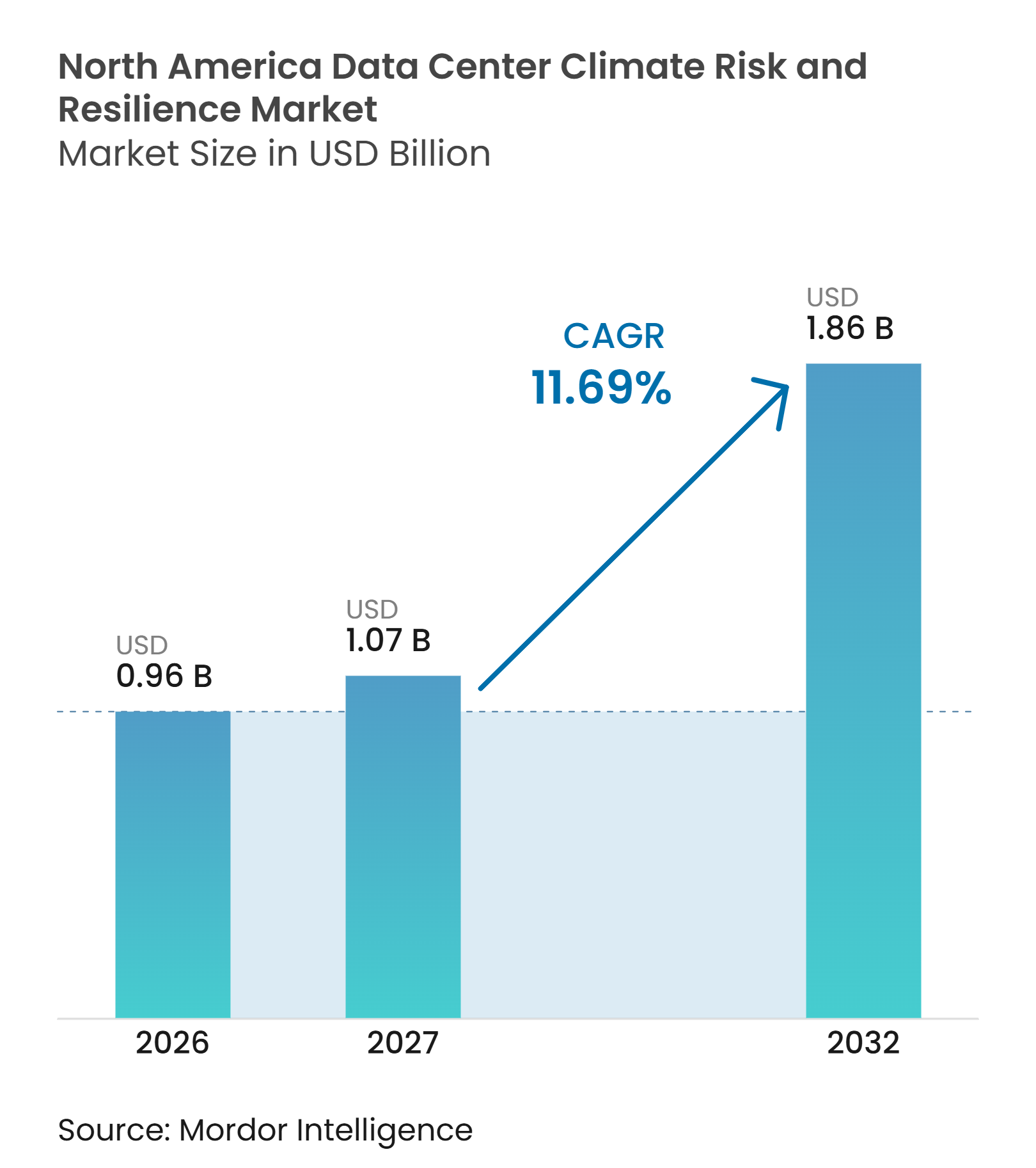
The North America Data Center Climate Risk And Resilience Market size was valued at USD 0.96 billion in 2026 and is estimated to grow from USD 1.07 billion in 2027 to reach USD 1.86 billion by 2032, at a CAGR of 11.69% during the forecast period (2027-2032). Demand is moving beyond voluntary planning as operators protect larger, more power-intensive facilities. The concentration of hyperscale capacity makes location-specific exposure a concern for boards, lenders, and insurers. Grid access, water availability, cooling design, and severe-weather preparedness are becoming linked investment decisions. Suppliers that connect hazard analysis with engineering and operating data are better placed to support both new construction and upgrades. The North America data center climate risk and resilience market also benefits from recurring work, as risk monitoring, disclosure, and resilience testing require regular updates.
Key Report Takeaways
- By solution type, Climate Risk Assessment and Analytics held 29.47% of the North America data center climate risk and resilience market share in 2026, while Climate Risk Monitoring and Early Warning is projected to expand at a 12.54% CAGR through 2032.
- By climate hazard, Hurricanes, Cyclones, and Severe Windstorms held a 32.68% share in 2026, while Compound and Multi-Hazard Events are projected to expand at a 12.46% CAGR through 2032.
- By assessment method, Physical Risk and Vulnerability Assessment held a 27.39% share in 2026, while Financial and Asset-Level Climate Risk Quantification is projected to expand at a 12.58% CAGR through 2032.
- By resilience strategy, Power Supply and Grid Resilience held a 31.26% share in 2026, while Water Availability and Conservation Measures is projected to expand at a 12.43% CAGR through 2032.
- By service type, Climate Risk Consulting held 36.83% share in 2026, while Climate Engineering and Design is projected to expand at a 12.62% CAGR through 2032.
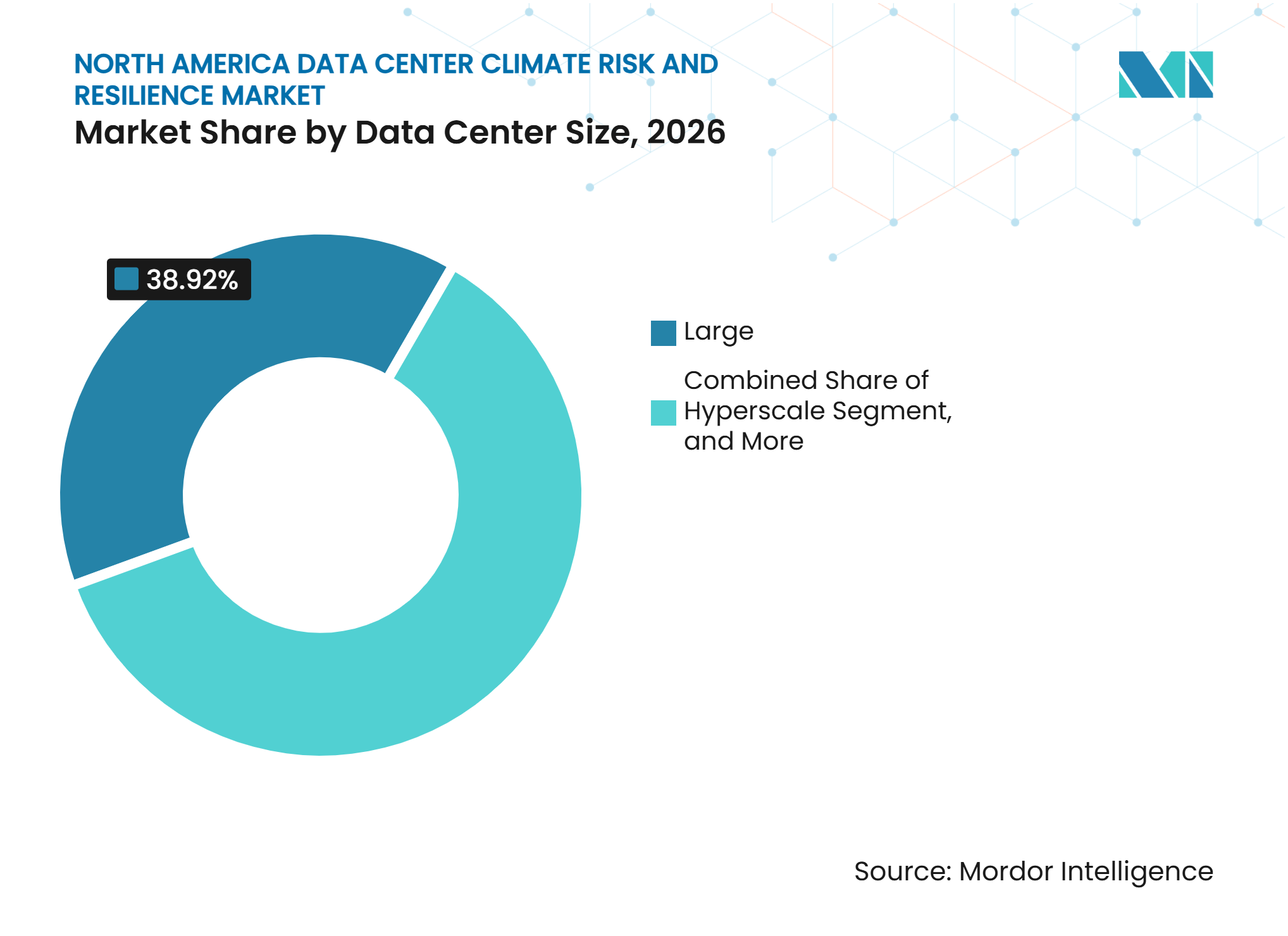
- By data center size, Large Data Centers held 38.92% share in 2026, while Hyperscale is projected to expand at a 12.49% CAGR through 2032.
- By data center type, Colocation Data Centers held 43.74% share in 2026, while Cloud Service Providers are projected to expand at a 12.52% CAGR through 2032.
- By geography, the United States held 83.59% share in 2026, while Mexico is projected to expand at a 12.57% CAGR through 2032.
Note: Market numbers in this report are based on Mordor Intelligence's proprietary estimation framework, which combines nine months of actuals with Q4 projections for base year 2026.
Market Trends and Insights
Drivers Impact Analysis of North America Data Center Climate Risk and Resilience Market*
| Driver | (~) % Impact on CAGR Forecast | Geographic Relevance | Impact Timeline |
|---|---|---|---|
| AI and Hyperscale Capacity Expansion | +3.8% | United States, Canada | Short term (≤ 2 years) |
| Increasing Physical Climate Hazard Exposure | +3.2% | United States Southeast, Gulf Coast, Southwest, Mexico, Canada | Short term (≤ 2 years) |
| Climate-Linked Insurance and Financing Requirements | +2.6% | United States, Canada, Mexico | Medium term (2-4 years) |
| Regulatory Pressure for Water, Energy, and Climate Disclosure | +2.1% | California, New York, multistate coalitions, Canada | Medium term (2-4 years) |
| Grid Resilience and Distributed Backup Investment | +1.7% | ERCOT, PJM, CAISO, Alberta, Ontario | Medium term (2-4 years) |
| Resilience Retrofits for Existing Data Centers | +1.3% | United States Northeast and Mid-Atlantic | Long term (≥ 4 years) |
| Source: Mordor Intelligence | |||
AI and Hyperscale Capacity Expansion
AI-focused construction is bringing climate exposure into earlier project decisions. Higher-density racks increase the consequences of cooling interruptions and local power failures. The U.S. Geological Survey identifies rising temperatures in Arizona, California, and Nevada as factors that can add energy and operating pressure for AI data centers. Large campuses therefore require site screening before capital is committed. This requirement expands demand for hazard assessment, thermal planning, and recovery procedures in the North America data center climate risk and resilience market. It also supports repeat engagements as developers move from one campus phase to the next.
Increasing Physical Climate Hazard Exposure
Physical exposure is becoming harder to assess through a single-hazard lens. A peer-reviewed assessment of 2,445 U.S. data centers found that the Southern Plains face combined heat and water-stress exposure. Research in the International Journal of Disaster Risk Reduction also found notable facility concentrations in areas exposed to hurricanes, earthquakes, and tornadoes. These overlapping conditions raise the value of continuous monitoring and integrated scenario planning. They also include equipment, water supply, and grid reliability in the same resilience discussion. The North America data center climate risk and resilience market gains from this shift because operators need decisions that reflect local combinations of hazards.
Climate-Linked Insurance and Financing Requirements
Insurance availability is increasingly linked to the quality of resilience documentation. Aon states that site selection, design, construction, and operations each affect whether data centers remain bankable and insurable. Lenders need a clearer view of physical exposure before they support long-lived assets. Operators also need evidence that backup systems, cooling equipment, and building protection can withstand foreseeable disruption. These requirements make climate analysis relevant to financing, not only to corporate reporting. In the North America data center climate risk and resilience market, this creates work for firms that can translate hazard data into practical engineering and risk controls.
Regulatory Pressure for Water, Energy, and Climate Disclosure
California is making climate-related disclosure more operational for large companies. The state requires covered businesses to begin reporting Scope 1 and Scope 2 emissions in 2026 under SB 253. California also requires climate-related financial risk reporting under SB 261, which can bring water and physical risk questions into governance cycles. The SEC's withdrawal of the defense of its federal climate-disclosure rules makes state obligations more important for many operators. Companies with facilities across several states must manage different reporting expectations. The resulting need for auditable risk information supports ongoing assessment and disclosure.
Restraints Impact Analysis of North America Data Center Climate Risk and Resilience Market*
| Restraint | (~) % Impact on CAGR Forecast | Geographic Relevance | Impact Timeline |
|---|---|---|---|
| Interconnection Queues and Utility Capacity Constraints | -1.9% | ERCOT, PJM, MISO, Alberta, Ontario | Short term (≤ 2 years) |
| High Upfront Cost of Climate-Hardened Infrastructure | -1.4% | North America | Medium term (2-4 years) |
| Scarcity of Liquid-Cooling and Resilience Skills | -0.8% | North America, especially Texas and Arizona | Medium term (2-4 years) |
| Uncertain Insurance Coverage and Climate-Model Standards | -0.6% | United States Gulf Coast and Southeast, Mexico | Long term (≥ 4 years) |
| Source: Mordor Intelligence | |||
Interconnection Queues and Utility Capacity Constraints
Grid queues can delay the construction schedule for climate-resilient facilities. The U.S. Department of Energy's Lawrence Berkeley National Laboratory reported that projects reaching commercial operation in 2025 had a median wait of more than 5 years from interconnection request to commissioning.[1] Delays postpone orders for site-specific engineering, monitoring, and protection systems. They can also force developers to reconsider locations after initial climate screening is complete. Large-load interconnection rules are under pressure as demand outpaces established connection processes. The restraint is strongest where large-load demand is growing faster than network planning and connection processes can keep pace.
High Upfront Cost of Climate-Hardened Infrastructure
Climate hardening can be difficult to fund for smaller operators. New fire protection, liquid-cooling safeguards, reinforced structures, and water systems can raise early project costs. The cost is more manageable for hyperscalers with large capital budgets. It is less manageable for enterprise and edge operators that must protect smaller facilities. Resilience investments may improve long-term insurance and financing outcomes, but that benefit does not remove the initial cash requirement. This gap limits adoption speed in parts of the North America data center climate risk and resilience market.
*Our forecasts treat driver/restraint impacts as directional, not additive. The impact forecasts reflect baseline growth, mix effects, and variable interactions.
North America Data Center Climate Risk and Resilience Market Segment Analysis
By Solution Type:
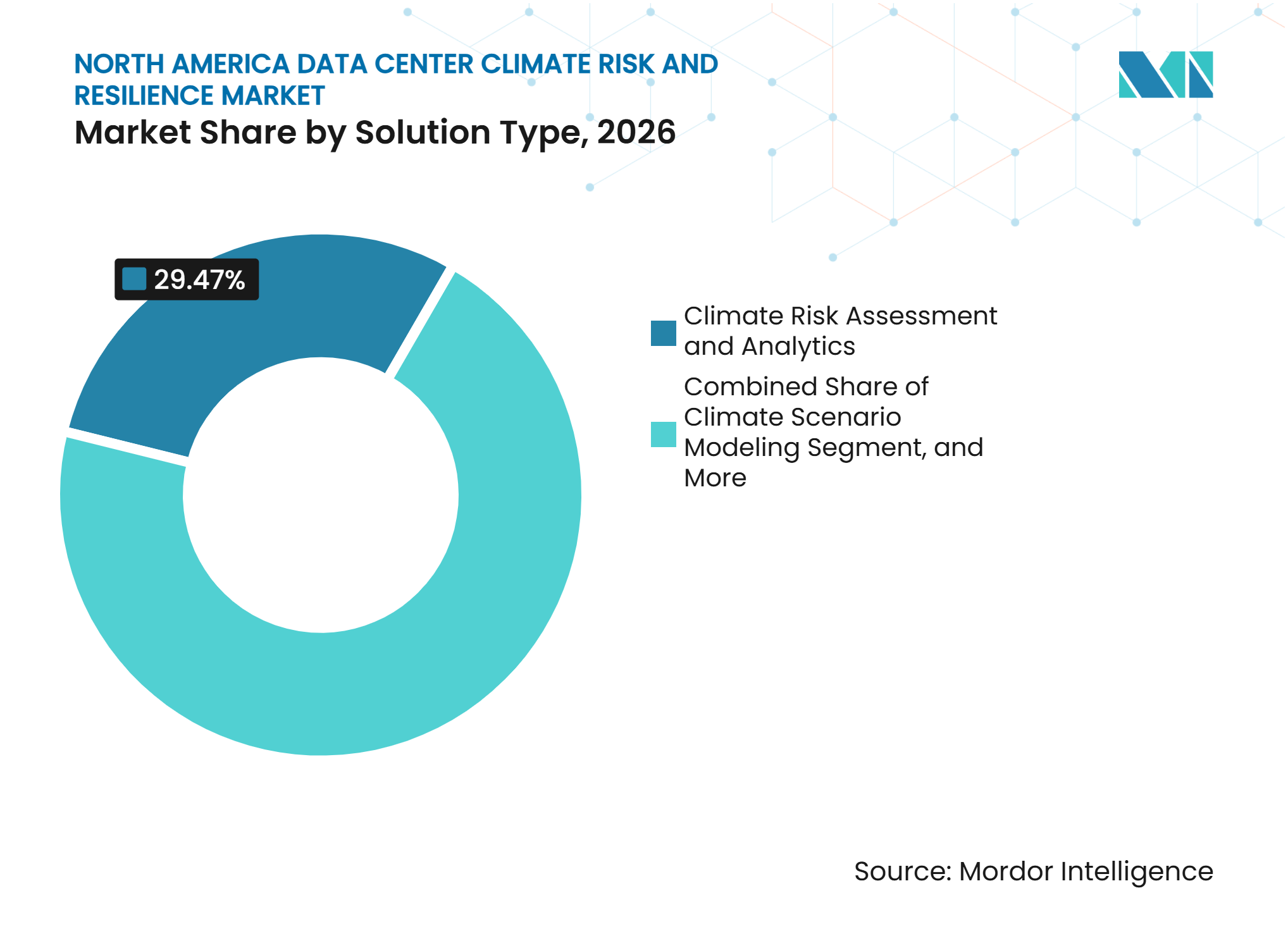
Analytics Anchor Early Resilience SpendingClimate Risk Assessment and Analytics held a 29.47% market share in 2026. Operators commonly begin with exposure mapping before they fund physical changes. Baseline work covers flood exposure, wind patterns, wildfire pathways, heat stress, and water availability. It also helps compare several locations using a consistent method. Climate Scenario Modeling extends this work by testing possible future conditions. Climate Risk Mapping and Geospatial Analysis add location detail for large portfolios. Advisory and engineering teams then use the findings to define actions for building, power, and cooling.
Climate Risk Monitoring and Early Warning is projected to expand at a 12.54% CAGR through 2032. The segment reflects a move from periodic reviews toward continuous operating awareness. Real-time weather feeds and on-site sensors can identify conditions before they disrupt cooling or power systems. The Pew Research Center reported that U.S. data centers consumed 183 TWh of electricity in 2024. Efficient monitoring can therefore support both resilience and facility performance. Operators are increasingly incorporating early-warning functions into operations and maintenance contracts. This makes monitoring a practical service layer instead of a stand-alone technology purchase.



By Climate Hazard:
Wind Exposure Leads While Compound Events Gain GroundHurricanes, Cyclones, and Severe Windstorms accounted for 32.68% of the North America data center climate risk and resilience market size in 2026. This position reflects the broad concentration of facilities in coastal and near-coastal U.S. areas. Wind exposure can damage buildings, interrupt power, and impair access to fuel and repair services. Windstorms also frequently coincide with flooding, complicating recovery planning. Extreme Heat and Heatwaves remain important because higher temperatures affect cooling demand. Flooding and Sea-Level Rise pose distinct risks to equipment placement and site access. Wildfires and Smoke Exposure matter in Western markets because smoke can affect sensitive equipment even beyond the fire perimeter.
Compound and Multi-Hazard Events are projected to expand at a 12.46% CAGR through 2032. The rapid growth reflects the limits of approaches that assess each hazard independently. The IOP Science study found co-occurring heat and water stress in the Southern Plains. Drought, wildfire, flooding, and grid stress can follow one another or occur together. Those sequences change the risk profile of cooling, water supply, logistics, and insurance coverage. The North America data center climate risk and resilience industry is therefore placing greater value on integrated scenarios. Providers that can combine physical and operational data are better aligned with this need.
By Assessment Method:
Physical Vulnerability Work Remains the Starting PointPhysical Risk and Vulnerability Assessment held a 27.39% share in 2026. Lenders and operators need a clear view of structural weaknesses before they decide on insurance, financing, or upgrades. This work considers the building envelope, equipment location, cooling design, fuel access, and site drainage. It can also identify dependencies that link a facility to nearby substations or water systems. The result provides a practical basis for prioritizing capital spending. Forward-Looking Climate Scenario Analysis is an important input because standard design assumptions may not reflect future conditions. Geographic and Geospatial Risk Mapping adds a consistent way to compare sites across a portfolio.
Financial and Asset-Level Climate Risk Quantification is projected to expand at a 12.58% CAGR through 2032. This method translates physical exposure into potential financial consequences for asset owners and lenders. It can support decisions on insurance limits, debt terms, and investment timing. The World Economic Forum and World Business Council for Sustainable Development identify climate resilience as part of the decision framework for data center planning.[2] Climate Stress Testing also helps users examine severe but plausible disruption scenarios. Historical Hazard Analysis remains useful, but it has less value when used alone. Demand is shifting toward methods that can support investment decisions across long facility lifetimes.
By Resilience Strategy:
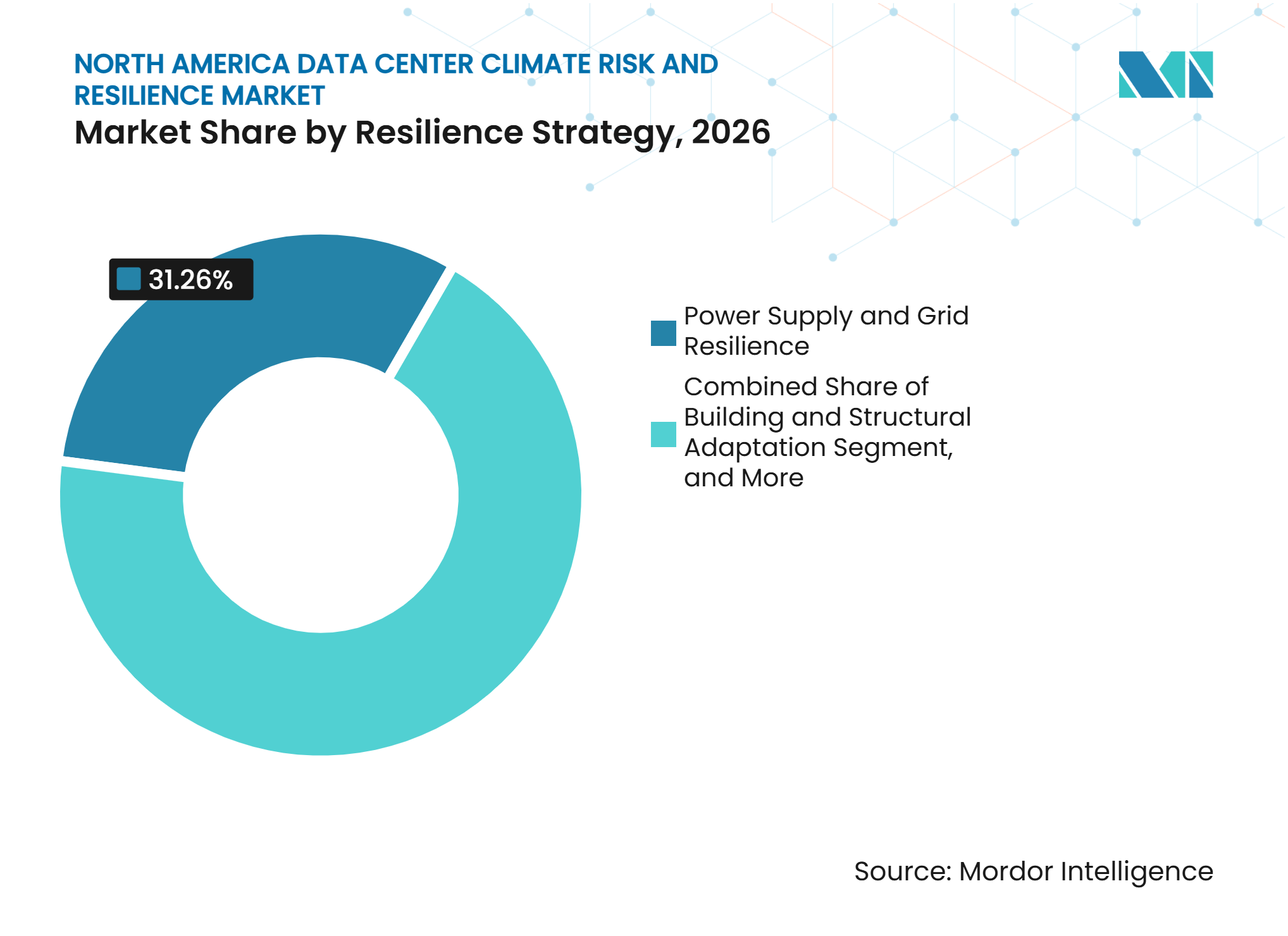
Power Continuity Defines Current PrioritiesPower Supply and Grid Resilience held a 31.26% share in 2026. Reliable power is fundamental because even a short interruption can violate customer uptime obligations. The Uptime Institute found that power supply issues were responsible for 45% of reported outages in its 2025 survey. The strategy includes backup generation, battery storage, distributed generation, and utility coordination. It also involves studying whether the local grid can support planned capacity. Site Selection and Climate-Informed Planning address these questions before construction starts. Building and Structural Adaptation supports continuity once a site is operating.
Water Availability and Conservation Measures is projected to expand at a 12.43% CAGR through 2032. Higher computing density can raise cooling needs in water-stressed areas. The University of California, Riverside reported that peak data center cooling demand could require 697 million to 1.45 billion gallons of additional daily water capacity by 2030 without new efficiency measures. Microsoft reported a fleet water-use effectiveness of 0.27 liters per kilowatt-hour in 2025. Amazon reported 0.12 liters per kilowatt-hour for its global data center operations in 2025. These disclosures show why water efficiency is becoming an operating and resilience priority.

By Service Type:
Consulting Leads as Design Work RisesClimate Risk Consulting held a 36.83% share in 2026. Consulting engagements support site screening, portfolio reviews, governance processes, and climate risk disclosures. The broad scope allows providers to work across planning and operating stages. Operators also use consultants to align technical teams, lenders, and board-level decision-makers. Monitoring and Early Warning Services support the operational stage after plans are implemented. Climate Adaptation Planning connects the findings with capital programs. Risk Auditing and Disclosure Support has become more relevant as state-level requirements grow.
Climate Engineering and Design is projected to expand at a 12.62% CAGR through 2032. This service turns risk findings into equipment, building, and operating specifications. Work may cover cooling redesign, drainage, flood protection, fire protection, and electrical redundancy. Engineering becomes more important when operators are ready to execute rather than only assess exposure. Arup notes that modern resilience requires preparation for a wider range of disruptions, including climate hazards and grid instability. The line between advisory and engineering is therefore narrowing. This supports providers with both climate and facility-design experience.
By Data Center Size:
Large Facilities Hold the Lead While Hyperscale ExpandsLarge Data Centers held a 38.92% share in 2026. These facilities often have dedicated sustainability, facilities, and risk-management teams. They can also allocate budgets for structured assessments and resilience programs. Large operators face growing pressure from customers, lenders, and insurers. Their facilities are material enough for a local outage to create significant contractual and financial consequences. Small and medium data centers remain important but have less flexibility to fund complex programs. Their spending can be limited by smaller budgets and lower regulatory visibility.
Hyperscale is projected to expand at a 12.49% CAGR through 2032. These campuses concentrate high-value equipment and very large electricity loads at individual locations. This concentration makes climate screening and resilient design important before capacity is built. The Center for Strategic and International Studies estimates that the United States will require 140,000 additional skilled-trades positions by 2030 for AI infrastructure. Labor constraints can increase the cost of rework after construction begins. Developers are therefore more likely to include resilience requirements in early design programs. This approach can reduce disruption and help preserve long-term asset value.
By Data Center Type:
Colocation Keeps the Largest PositionColocation Data Centers held a 43.74% share in 2026. These operators manage shared infrastructure for multiple customers with demanding uptime requirements. A climate-related outage can cause physical loss, contract penalties, and damage to customer relationships. This makes monitoring, early warning, and physical protection direct business priorities. Colocation providers also face lender expectations as they expand large portfolios. Enterprise facilities and edge sites remain relevant because they can be located in exposed coastal, desert, and flood-prone areas. Edge sites may have fewer on-site resources than larger campuses.
Cloud Service Providers are projected to expand at a 12.52% CAGR through 2032. Large cloud providers are using water, energy, and resilience disclosures as part of their operating approach. Microsoft reported a 25% reduction in average water use effectiveness from its 2020 baseline by 2025. Such measures can influence supplier selection and colocation requirements. Vendors may need stronger risk data and reporting capabilities to compete for these contracts. The North America data center climate risk and resilience market benefits as these expectations move through the supply chain. Climate planning becomes a commercial capability as well as a compliance requirement.
Geography Analysis
United States
The United States held 83.59% of the North America data center climate risk and resilience market share in 2026. Its scale reflects a large and geographically diverse base of data center assets. The Southern Plains also combine high heat and water stress, based on peer-reviewed spatial research. Gulf Coast and Southeast locations face added wind and flooding exposure. These conditions make local hazard knowledge important in project planning. California's SB 253 and SB 261 add regulatory influence by requiring covered companies to report on emissions and climate risk. The state rules make audit-ready physical-risk information more relevant for large operators. Long grid interconnection timelines in PJM, ERCOT, and MISO further increase interest in backup power and site-level resilience planning.
Mexico
Mexico is projected to expand at a 12.57% CAGR through 2032. Planned capacity additions are making resilience decisions more important for new projects. The Mexican Data Center Association documented plans for more than 1,500 MW of additional installed capacity and investments above USD 18 billion by 2030.[3] Querétaro combines rapid construction with heat and water pressure. Developers are responding with cooling designs that reduce dependence on water. Grid resilience is also important because energy security and climate resilience overlap in this location. CloudHQ's planned waterless cooling approach for its Querétaro facilities illustrates this direction. New investment is likely to favor suppliers that can address water, grid, and weather conditions together. The North America data center climate risk and resilience market size for Mexico is supported by this need for integrated project planning.
Canada and Regional Differences
Canada presents a different mix of climate and energy conditions. The UNDRR report states that more than 7% of Canadian data centers could reach high climate-damage risk by 2050. Ontario has surface-water flood exposure, while British Columbia faces rising climate damage risk. Ontario's Independent Electricity System Operator expects data centers to account for 13% of new electricity demand over the next decade. Alberta also has limits on the connection of proposed capacity. Deep-lake water cooling offers a practical regional response by linking cooling efficiency with resilience. The Canadian Climate Institute has warned that data center growth without coordinated energy planning may jeopardize provincial decarbonization goals. Across the region, the U.S. has broad asset concentration, Mexico has fast expansion, and Canada has distinct grid and cold-climate challenges.
Competitive Landscape
Market Concentration
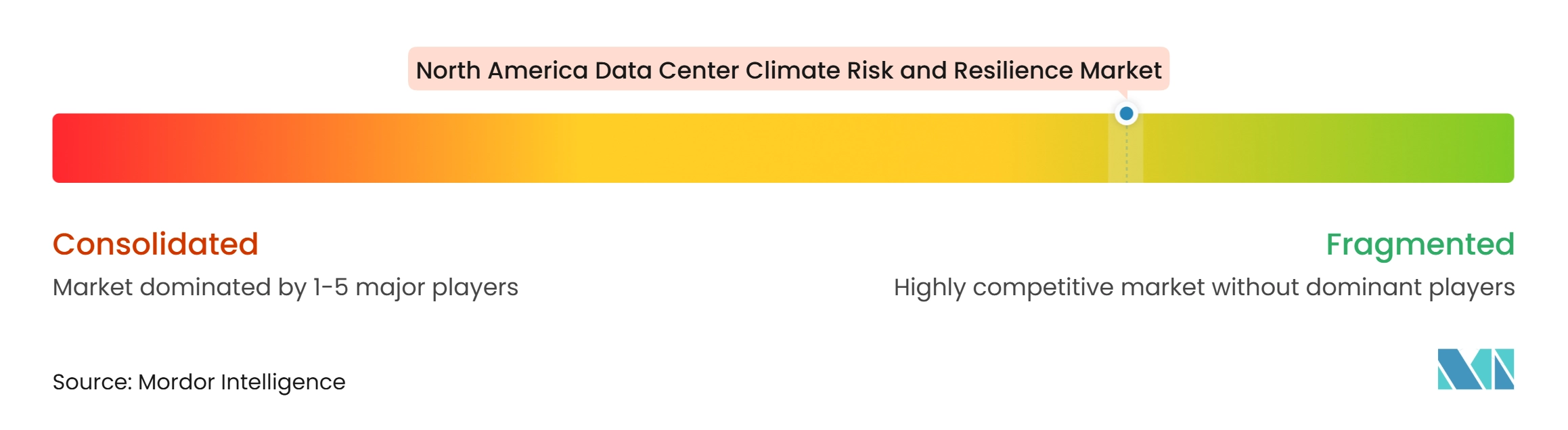
The North America data center climate risk and resilience market is fragmented. No single company leads across risk analytics, scenario modeling, power resilience, cooling systems, and ongoing monitoring. Competition is forming around three groups. Thermal-management suppliers are extending toward resilience design. Power-system specialists are linking equipment sales with grid and backup planning. Risk advisory firms are building specialized data center practices. Zurich Resilience Solutions launched its Data Center Risk Advisory practice in January 2026 with more than 100 risk engineers.[4] The practice supports planning, construction, operations, and extreme-weather resilience.
Equipment suppliers are seeking broader roles in high-density data center design. Schneider Electric announced a USD 1.9 billion supply capacity agreement with Switch in November 2025. The agreement includes prefabricated power modules and U.S. deployment of Uniflair chillers. Johnson Controls invested in Accelsius in October 2025 to strengthen its liquid-cooling offering. It also launched its Silent-Aire Coolant Distribution Unit platform in September 2025. These moves show that cooling has become part of resilience planning for AI-focused facilities.
White space remains in financial climate-risk quantification, multi-hazard modeling, and disclosure support. These services need climate science, geospatial analysis, and an understanding of facility operations. AI-based monitoring platforms may compete with conventional engineering firms by combining sensor data with weather and site information. Traditional firms still have an advantage in design authority and established client relationships. FM's revised data center guidance raises the relevance of specialized engineering and safety expertise. Strategic partnerships between advisory firms and equipment vendors may become more important. The North America data center climate risk and resilience industry remains open to specialists because customers need solutions that work across physical, financial, and operating risks. The North America data center climate risk and resilience market offers room for specialized providers that can link these needs in a clear operating model.
North America Data Center Climate Risk and Resilience Industry Leaders
-
Vertiv Group Corp.
-
Schneider Electric SE
-
Eaton Corporation plc
-
STULZ GmbH
-
Rittal GmbH & Co. KG
- *Disclaimer: Major Players sorted in no particular order
North America Data Center Climate Risk and Resilience Market Companies Covered in this Report
- Vertiv Group Corp.
- Schneider Electric SE
- Eaton Corporation plc
- STULZ GmbH
- Rittal GmbH & Co. KG
- Airedale International Air-Conditioning Ltd.
- Johnson Controls International plc
- Trane Technologies plc
- Munters Group AB
- Mitsubishi Electric Corporation
- Delta Electronics, Inc.
- Zurich Insurance Group AG
- Willis Towers Watson plc
- Arup Group Ltd.
- AECOM Technology Corporation
- Moody's Corporation
- Green Revolution Cooling, Inc.
- Bureau Veritas SA
- Piller Power Systems GmbH
- Socomec Group S.A.
- Riello Elettronica S.p.A.
Recent Industry Developments in North America Data Center Climate Risk and Resilience Market
- June 2026: Generac Power Systems announced a global supply agreement with a leading large-scale data center operator for backup power generators, reinforcing energy resilience as a core procurement priority for mission-critical facilities. The agreement followed a qualification process including factory visits, performance reviews, and supplier audits, underscoring the elevated engineering rigor now applied to resilience procurement in the sector.
- June 2026: Microsoft Corporation published water stewardship data showing its average water use effectiveness reached 0.27 liters per kilowatt-hour across its owned fleet in 2025, a 25% reduction from its 2020 baseline and meaningful progress toward its commitment to a 40% water intensity improvement by 2030, reflecting AI-era cooling innovations including zero-water direct-to-chip cooling designs introduced in 2024.
- June 2026: Amazon published sustainability disclosures showing its global data center operations achieved a water use effectiveness of 0.12 liters per kilowatt-hour in 2025, more than 7 times more efficient than the reported industry average of 0.84 liters per kilowatt-hour, positioning the company as a reference benchmark for water conservation in data center climate resilience.
- January 2026: Zurich Resilience Solutions, a unit of Zurich Insurance Group AG, launched a specialized Data Center Risk Advisory practice comprising more than 100 expert risk engineers. The practice supports hyperscalers, contractors, and developers across planning, construction, operational resilience, and extreme-weather resilience, with Zurich reporting current support for over USD 1 trillion in data center assets across more than 20 U.S. states.
North America Data Center Climate Risk and Resilience Market Report Scope
The North America data center climate risk and resilience market comprises solutions and services that help data center operators assess, mitigate, and manage climate-related risks, including extreme weather events, rising temperatures, flooding, wildfires, and power disruptions. These offerings support the development of resilient data center infrastructure and ensure business continuity across the region.
The North America Data Center Climate Risk and Resilience Market Report is Segmented by Solution Type (Climate Risk Assessment and Analytics, Climate Scenario Modeling, Climate Risk Mapping and Geospatial Analysis, Climate Adaptation and Resilience Planning, Climate Risk Monitoring and Early Warning, and Climate Risk Advisory and Engineering Services), Climate Hazard (Extreme Heat and Heatwaves, Flooding and Sea-Level Rise, Hurricanes, Cyclones, and Severe Windstorms, Wildfires and Smoke Exposure, Drought and Water Scarcity, Extreme Cold, Ice, and Snow Events, and Compound and Multi-Hazard Events), Assessment Method (Historical Hazard Analysis, Forward-Looking Climate Scenario Analysis, Physical Risk and Vulnerability Assessment, Geographic and Geospatial Risk Mapping, Climate Stress Testing, and Financial and Asset-Level Climate Risk Quantification), Resilience Strategy (Site Selection and Climate-Informed Planning, Building and Structural Adaptation, Cooling and Thermal Resilience, Water Availability and Conservation Measures, Power Supply and Grid Resilience, Flood, Fire, and Severe Weather Protection, and Multi-Hazard Adaptation Planning), Service Type (Climate Risk Consulting, Climate Engineering and Design, Climate Adaptation Planning, Monitoring and Early Warning Services, and Risk Auditing and Disclosure Support), Data Center Size (Small, Medium, Large, and Hyperscale), Data Center Type (Colocation, Cloud Service Providers (CSPs), and Enterprise and Edge), and Geography (United States, Canada, and Mexico). The Market Forecasts are Provided in Terms of Value (USD).
Segmentation Overview
| Climate Risk Assessment and Analytics |
| Climate Scenario Modeling |
| Climate Risk Mapping and Geospatial Analysis |
| Climate Adaptation and Resilience Planning |
| Climate Risk Monitoring and Early Warning |
| Climate Risk Advisory and Engineering Services |
| Extreme Heat and Heatwaves |
| Flooding and Sea-Level Rise |
| Hurricanes, Cyclones, and Severe Windstorms |
| Wildfires and Smoke Exposure |
| Drought and Water Scarcity |
| Extreme Cold, Ice, and Snow Events |
| Compound and Multi-Hazard Events |
| Historical Hazard Analysis |
| Forward-Looking Climate Scenario Analysis |
| Physical Risk and Vulnerability Assessment |
| Geographic and Geospatial Risk Mapping |
| Climate Stress Testing |
| Financial and Asset-Level Climate Risk Quantification |
| Site Selection and Climate-Informed Planning |
| Building and Structural Adaptation |
| Cooling and Thermal Resilience |
| Water Availability and Conservation Measures |
| Power Supply and Grid Resilience |
| Flood, Fire, and Severe Weather Protection |
| Multi-Hazard Adaptation Planning |
| Climate Risk Consulting |
| Climate Engineering and Design |
| Climate Adaptation Planning |
| Monitoring and Early Warning Services |
| Risk Auditing and Disclosure Support |
| Small |
| Medium |
| Large |
| Hyperscale |
| Colocation |
| Cloud Service Providers (CSPs) |
| Enterprise and Edge |
| United States |
| Canada |
| Mexico |
| By Solution Type | Climate Risk Assessment and Analytics |
| Climate Scenario Modeling | |
| Climate Risk Mapping and Geospatial Analysis | |
| Climate Adaptation and Resilience Planning | |
| Climate Risk Monitoring and Early Warning | |
| Climate Risk Advisory and Engineering Services | |
| By Climate Hazard | Extreme Heat and Heatwaves |
| Flooding and Sea-Level Rise | |
| Hurricanes, Cyclones, and Severe Windstorms | |
| Wildfires and Smoke Exposure | |
| Drought and Water Scarcity | |
| Extreme Cold, Ice, and Snow Events | |
| Compound and Multi-Hazard Events | |
| By Assessment Method | Historical Hazard Analysis |
| Forward-Looking Climate Scenario Analysis | |
| Physical Risk and Vulnerability Assessment | |
| Geographic and Geospatial Risk Mapping | |
| Climate Stress Testing | |
| Financial and Asset-Level Climate Risk Quantification | |
| By Resilience Strategy | Site Selection and Climate-Informed Planning |
| Building and Structural Adaptation | |
| Cooling and Thermal Resilience | |
| Water Availability and Conservation Measures | |
| Power Supply and Grid Resilience | |
| Flood, Fire, and Severe Weather Protection | |
| Multi-Hazard Adaptation Planning | |
| By Service Type | Climate Risk Consulting |
| Climate Engineering and Design | |
| Climate Adaptation Planning | |
| Monitoring and Early Warning Services | |
| Risk Auditing and Disclosure Support | |
| By Data Center Size | Small |
| Medium | |
| Large | |
| Hyperscale | |
| By Data Center Type | Colocation |
| Cloud Service Providers (CSPs) | |
| Enterprise and Edge | |
| By Geography | United States |
| Canada | |
| Mexico |
Key Questions Answered in the Report
What is the North America data center climate risk and resilience market size?
The sector is projected to increase from USD 0.96 billion in 2026 and USD 1.07 billion in 2027 to USD 1.86 billion by 2032, at a 11.69% CAGR.
What is driving demand for climate resilience services in data centers?
AI capacity buildouts, more complex physical hazards, insurance requirements, disclosure obligations, and grid constraints are increasing demand.
Which solution area holds the largest share?
Climate Risk Assessment and Analytics holds the largest solution-type share at 29.47% in 2026.
Which data center type leads resilience spending?
Colocation Data Centers lead with a 43.74% share in 2026 because uptime obligations and shared infrastructure raise the cost of disruption.
Which geography is expanding fastest?
Mexico is projected to expand at a 12.57% CAGR through 2032, supported by new capacity development and the need to address heat, water, and grid risks.
Why is water management important for data center resilience?
Higher-density computing can increase cooling needs, while water-stressed locations require more efficient cooling and conservation practices.