
North America Container Homes Market Size and Share
Market Overview
| Study Period | 2021 - 2032 |
|---|---|
| Forecast Data Period | 2027 - 2032 |
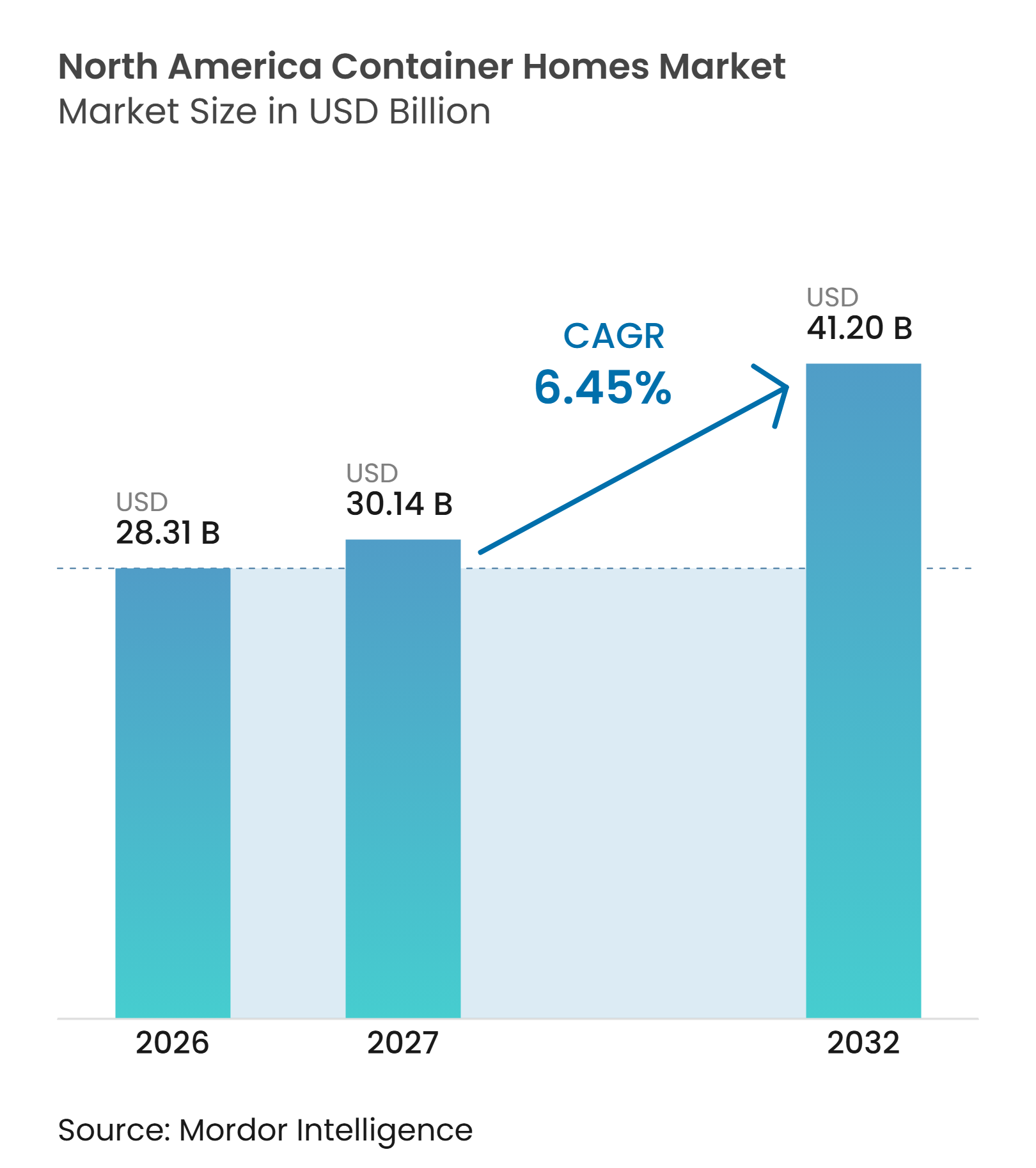
| Base Year Market Size (2026) | USD 28.31 Billion |
| Market Size (2027) | USD 30.14 Billion |
| Market Size (2032) | USD 41.20 Billion |
| Growth Rate (2027 - 2032) | 6.45 % |
| Market Concentration | Medium |
Major Players *Disclaimer: Major Players sorted in no particular order Image © Mordor Intelligence. Reuse requires attribution under CC BY 4.0. | |
North America Container Homes Market Analysis by Mordor Intelligence
The North America Container Homes Market size was valued at USD 28.31 billion in 2026 and is estimated to grow from USD 30.14 billion in 2027 to reach USD 41.20 billion by 2032, at a CAGR of 6.45% during the forecast period (2027-2032).
The North America container homes market is driven by housing affordability pressures, broader adoption of accessory dwelling unit regulations, and demand for rapidly deployable housing after disasters, particularly in areas where conventional construction involves longer on-site schedules. Factory production is becoming increasingly relevant as public housing programs seek consistent quality, documented processes, shorter construction timelines, and improved coordination across multiple units. Container reuse also provides developers with a practical sustainability proposition, as retired units can be converted into homes instead of undergoing energy-intensive scrap processing. However, this benefit depends on effective thermal insulation and corrosion-resistant design. Growth will remain uneven because municipal regulations, financing standards, insurance availability, and climate-performance requirements vary across the region, individual communities, and project types. Competition will likely favor operators that combine design capabilities, engineering documentation, permitting experience, manufacturing capacity, reliable installation support, and the ability to clearly communicate performance requirements to buyers and public agencies.
Key Report Takeaways
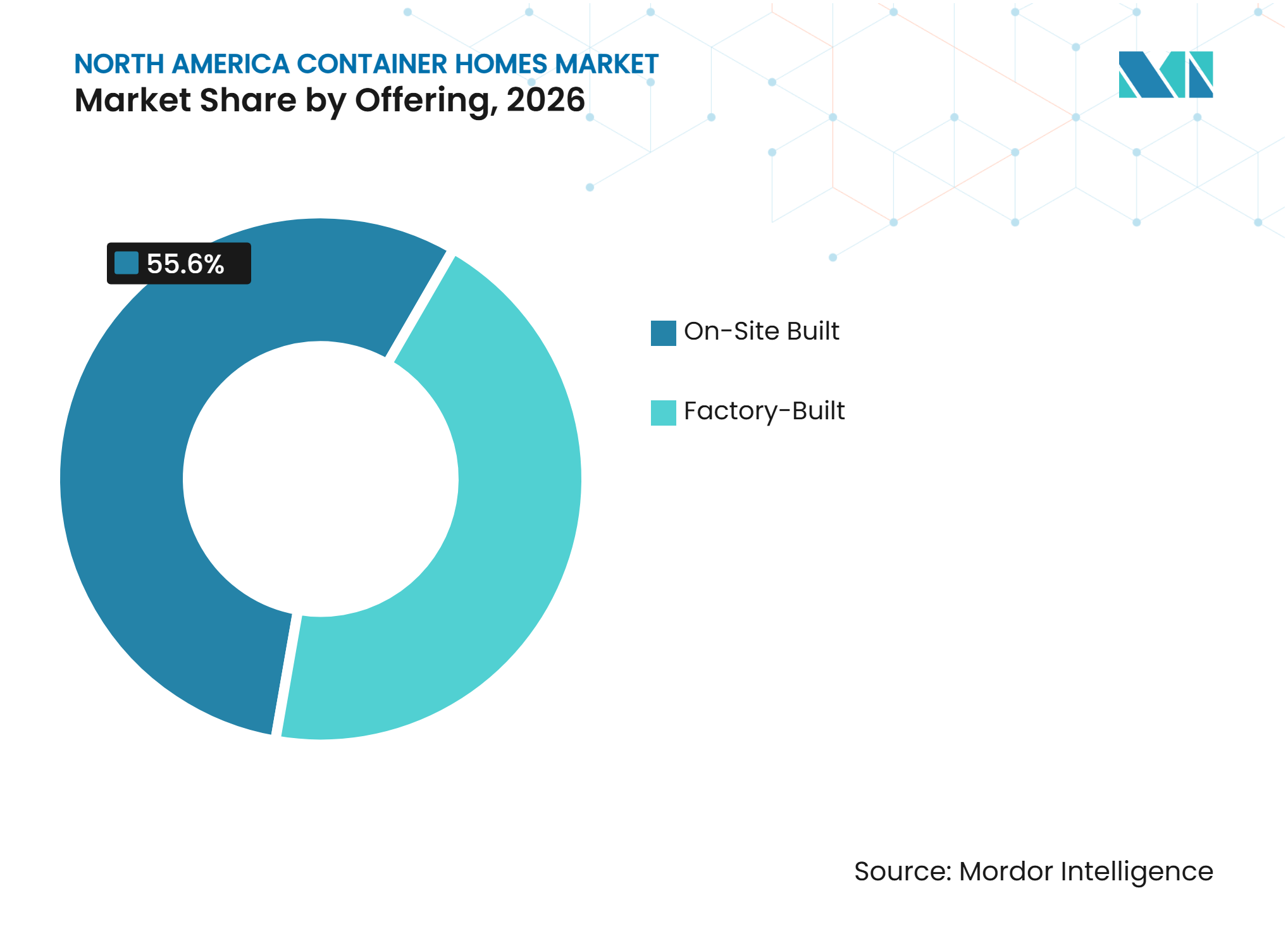
- By offering, On-Site Built held 55.6% of the North America container homes market in 2026, while Factory-Built delivery is forecast to grow at a 7.25% CAGR through 2032.
- By construction type, Fixed homes held a 59.1% share of the North America container homes market in 2026, while Movable homes are forecast to grow at a 7.7% CAGR through 2032.
- By end-use, Residential Homes accounted for 58.2% of the North America container homes market size in 2026, while Emergency Homes are forecast to grow at a 7.85% CAGR through 2032.
- By geography, the United States held 77.5% of the North America container homes market share in 2026, while Mexico is forecast to grow at a 7.4% CAGR through 2032.
Note: Market numbers in this report are based on Mordor Intelligence's proprietary estimation framework, which combines nine months of actuals with Q4 projections for base year 2026.
Market Trends and Insights
Drivers Impact Analysis of North America Container Homes Market*
| Drivers | (~) % Impact on CAGR Forecast | Geographic Relevance | Impact Timeline |
|---|---|---|---|
| Housing Affordability Pressure | +2.0% | United States, with early gains in California, Texas, and Florida | Short term (≤ 2 years) |
| Accessory Dwelling Unit Policy Reform | +1.4% | United States, including California, Washington, Oregon, and Florida | Medium term (2-4 years) |
| Modular and Prefabricated Manufacturing Expansion | +1.1% | North America, with early gains in Colorado, Pennsylvania, and Alberta | Medium term (2-4 years) |
| Disaster-Relief and Rapid-Deployment Housing Demand | +0.7% | United States Gulf Coast, Pacific Coast, and Hawaii | Short term (≤ 2 years) |
| Circular Use of Steel Containers | +0.4% | Global influence with spillover to North America | Long term (≥ 4 years) |
| Source: Mordor Intelligence | |||
Rising Housing Costs and Affordability Pressure in the United States
Housing affordability gives the North America container homes market a broad demand base because many households need smaller and lower-cost housing options that can be delivered without the full scale of a conventional detached-home project. High home prices and renter cost burdens can lead households to compare compact, lower-footprint formats with conventional new housing, especially in communities where available land and buildable lots are limited. In Buena Vista, Colorado, BV Basecamp used 21 intermodal steel building units for 16 rental homes, with furnished 160-square-foot units offered from USD 1,150 per month. The project demonstrates how compact container development can use shared space and repeatable units to serve renters, not only individual buyers, while making common infrastructure more manageable. Such examples help local developers assess whether a small-footprint project can work within available land, rental demand, local construction capacity, and the expectations of future tenants. This demand is most relevant when the finished unit, site work, local approvals, and ongoing property management can be coordinated within a budget that is realistic for the intended residents.
Accessory Dwelling Unit Policy Reform and Residential-Lot Intensification
Accessory dwelling unit reform expands the settings in which a container structure can be considered for residential use and rental income, including lots that already contain a primary residence. The supplied material states that 18 states had laws broadly permitting accessory dwelling units by July 2025, with 11 of those laws enacted in the prior 4 years. California legislation signed in October 2025 strengthened state action when local accessory dwelling unit ordinances do not comply with state standards. Florida legislation required local governments in single-family residential zones to adopt accessory dwelling unit ordinances by December 1, 2025. The Federal Housing Administration also allows projected accessory dwelling unit rental income to be considered in qualifying some primary-residence borrowers, which can make the economics easier to assess. These policy changes can reduce planning uncertainty for smaller factory-finished units and make a project more understandable for homeowners, contractors, lenders, municipal staff, and prospective tenants.
Expansion of Modular and Prefabricated Construction
A larger manufacturing base can make factory-completed container formats easier to procure, inspect, finance, and repeat across projects. Cleveland acquired the former General Electric site in Collinwood in July 2025 for a modular housing factory project, with factory construction targeted to begin in 2027[1]. Pennsylvania secured a USD 2.4 million investment commitment from Module Design, Inc. in 2025, creating 58 jobs at its Allegheny County operation[2]. In August 2025, Canada and Quebec selected 11 highly prefabricated multi-residential projects totaling 336 units for delivery by summer 2026. Public programs seeking repeatable quality and faster delivery can favor factory-built methods over project-by-project site work, especially when several similar units are required in the same program. This production shift gives the North America container homes market a route to scale where suppliers can standardize modules without losing the ability to adapt foundations, finishes, access arrangements, and utility connections to local requirements.
Growth in Disaster-Relief and Rapid-Deployment Housing
Disaster response has become an important use case for housing that can be transported, installed, and occupied quickly after a major event. The supplied material records that the January 2025 Los Angeles wildfire destroyed more than 16,000 structures, which made the need for replacement housing highly visible to public agencies and local communities. It also states that the Federal Emergency Management Agency commissioned 167 Alternative Transportable Temporary Housing Units after the Lahaina wildfires, while Liv-Connected delivered 109 Conexus units between November 2024 and January 2025[3]. Ka La'i Ola in Lahaina delivered 450 modular homes for wildfire survivors through a program supported by USD 185 million from Hawaii state and the Hawaii Community Foundation. These cases show how public procurement can move beyond individual dwelling purchases to larger programs that require coordinated siting, utility work, logistics, resident support, and a plan for using the completed units. The North America container homes market can benefit when suppliers demonstrate that their units meet transport, safety, installation, and occupancy requirements before an emergency occurs.
Restraints Impact Analysis of North America Container Homes Market*
| Restraints | (~) % Impact on CAGR Forecast | Geographic Relevance | Impact Timeline |
|---|---|---|---|
| Fragmented Zoning, Permitting, and Building Code Requirements | -1.6% | United States, especially suburban and rural municipalities | Medium term (2-4 years) |
| Limited Mortgage, Insurance, and Valuation Infrastructure | -1.2% | United States and Canada | Medium term (2-4 years) |
| Thermal, Corrosion, and Cold-Climate Performance Requirements | -0.6% | Canada, northern United States, and coastal zones | Long-term (≥ 4 years) |
| Source: Mordor Intelligence | |||
Fragmented Zoning, Permitting, and Building Code Requirements
Local land-use rules remain a direct barrier even where state policy has become more open, and buyer demand is present. The International Code Council included shipping-container structures in the 2021 and 2024 International Building Code under Section 3114, which sets requirements for structure, ventilation, and foundations. Adoption and interpretation still differ across jurisdictions, and the supplied research notes that San Antonio limits residential container use to temporary structures of no more than 60 days. Project teams may need engineering drawings, ISO 6346 data plate verification, foundation plans, and fire separation provisions for stacked or connected units. A supplier can therefore have a technically sound unit but still face delay if a jurisdiction lacks a clear process for reviewing the proposed use or if inspectors have limited experience with this form of housing. This raises legal, documentation, carrying, and coordination costs most sharply in lower-margin affordable and emergency projects where time and budget flexibility are limited.
Limited Mortgage, Insurance, and Valuation Infrastructure
Financing is difficult when a home does not fit standard lending, insurance, or appraisal categories. The supplied research states that many container homes lack a Department of Housing and Urban Development certification or a state modular insignia, which limits conventional underwriting pathways. It also notes that the Federal Housing Administration Title I home-only insurance program still relies on manual, paper-based underwriting procedures. Insurers may decline coverage, while specialty coverage can carry a higher premium because completed comparable transactions are limited and property characteristics may vary widely. The supplied Sioux Falls example showed a container home listed at USD 585,000 selling for USD 406,000, which illustrates why lenders and appraisers may be cautious when comparable sales are scarce. The North America container homes market will remain constrained until lenders, insurers, appraisers, and manufacturers develop a broader record of completed, financed, insured, resold, and consistently valued projects.
*Our forecasts treat driver/restraint impacts as directional, not additive. The impact forecasts reflect baseline growth, mix effects, and variable interactions.
North America Container Homes Market Segment Analysis
By Offering:
On-Site Built Remains the Leading Delivery FormatOn-Site Built delivery held 55.6% of the North America container homes market in 2026. The format remains established because many residential buyers expect site-specific layout choices, local contractor oversight, and the option to adjust wall openings or container stacking after delivery. Existing contractor networks can adapt familiar residential processes to container projects, particularly when those contractors already work with local trades and building departments. This is useful in locations where the project needs to respond to an unusual lot, a preferred exterior finish, or a local foundation requirement. The delivery approach therefore fits custom homes and smaller developments where the owner wants close control over design decisions, on-site coordination, landscaping, utilities, and internal finishes.
Factory-Built delivery is forecast to grow at a 7.25% CAGR through 2032 and is gaining support through public programs that request high levels of off-site completion. Cleveland's factory initiative and the 2025 Canada and Quebec program for 336 highly prefabricated units show how public buyers can encourage this format. The supplied material states that some programs specify 90% to 95% factory completion, which can shift a larger part of construction into a controlled production setting. A factory setting can make quality checks, repeat designs, materials planning, delivery scheduling, and site activities more consistent across multiple units. The North America container homes industry is likely to retain on-site work for customized projects while factory-built delivery becomes more important for repeatable public and affordable housing projects.



By Construction Type:
Fixed Homes Lead in 2026, While Movable Units Grow FastestFixed container homes held a 59.1% share in 2026 and remain the volume foundation because permanent foundations and utility connections are important for residential, nursing home, and institutionally financed projects. Their permanence also supports code compliance where building officials expect foundation design under International Building Code Section 3115. These homes are better suited to projects where mortgage eligibility, long-term occupation, utility reliability, and a conventional residential appearance matter to the buyer. Developers can use fixed designs for multi-unit layouts that need stable utility systems, consistent site access, and a clear relationship between the building and the parcel. These conditions make fixed homes the core construction type for established residential use.
Movable homes are forecast to grow at a 7.7% CAGR through 2032, above the total North America container homes market size growth rate of 6.4%. Demand comes from emergency management agencies, recreational buyers, and tourism-oriented accommodation in Mexico, where relocation can be a useful operating feature. The supplied research states that Boxhouse designed a foldable emergency unit that can place 2 complete homes inside one standard intermodal container and deploy in under 2 hours. Its stated 200-mile-per-hour wind resistance supports use in coastal emergency procurement, where transport efficiency and structural performance are both important. Better thermal systems can also improve the competitive case for movable units in difficult climates, helping address a concern that has limited some early designs.
By End-Use:
Residential Homes Anchor Demand While Emergency Homes ExpandResidential Homes held a 58.2% share in the North America container homes market in 2026. The segment benefits from affordability pressure in urban and peri-urban areas where a compact unit can meet rental, accessory dwelling unit, or smaller household needs without requiring a large residential footprint. BV Basecamp provides an example of a rental approach, using 21 containers around a shared courtyard for 16 furnished units. The supplied research priced 160-square-foot furnished units from USD 1,150 per month. This model shows that residential developments can be designed as income-producing rentals, with shared-site planning and a repeated unit layout, rather than only as owner-occupied homes.
Emergency Homes are forecast to grow at a 7.85% CAGR through 2032. Federal and state disaster procurement after the Hawaii wildfires and the 2025 California fires created a practical reference point for rapid-deployment housing. Demand is linked to individual events, but the procurement systems, site planning practices, and supplier qualifications can remain in place after the immediate emergency phase ends. Recreational Homes provide a separate use case in Canada and Mexico, where buyers may value a compact unit that can serve a tourism or vacation setting. The North America container homes market can address emergency, recreational, and early-stage senior-care uses through different product designs, services, and installation methods rather than relying on a single residential format.


Geography Analysis
United States
The United States held 77.5% of the North America container homes market share in 2026. Housing affordability, accessory dwelling unit reforms, and a broad base of manufacturers support this position, while the supplied research describes a persistent need for additional housing. California's October 2025 law improved state oversight of noncompliant local accessory dwelling unit rules, and wildfire rebuilding added demand after the January 2025 Los Angeles fires. Plant Prefab's Teton Ranch facility can produce up to 2,000 homes annually and received nearly 300 inquiries after those fires, according to the supplied research. Building code interpretation still differs across jurisdictions, which favors companies that can provide engineering records, permit support, clear installation documents, and a predictable way to coordinate foundations, utility connections, and final inspections.
Mexico
Mexico is forecast to grow at a 7.4% CAGR through 2032. The supplied research connects this growth with a housing deficit, competitive land values, cross-border manufacturing investment, and tourism demand. It records Vessel Modular's announced USD 300 million investment in a Pesquería, Nuevo León facility, with potential for up to 3,000 jobs. Basic container homes were reported at USD 10,000, while movable one- and two-bedroom layouts are relevant in Nuevo León, Jalisco, and Quintana Roo. Municipal rules remain unclear in many locations, but this gives prepared manufacturers a chance to build permitting capability for housing and tourism projects, establish relationships with local installers, and offer formats that can be adapted to different site conditions.
Canada and the Rest of the Region
Canada has a government-identified housing shortfall of 3.5 million units through 2030, while Build Canada Homes targets an initial 4,000 prefabricated homes on government-owned land. Canada and Quebec also announced 11 highly prefabricated multi-residential projects totaling 336 units for delivery by summer 2026. A Quebec City transitional housing project used USD 1.23 million in public funding and was reported at USD 85,600 per residential door, while HONOMOBO tested robotic truss prefabrication in March 2026. Cold-weather performance makes insulation, glazing, and moisture management central to design, while other regional markets support recreational, disaster, and tourism uses that can share a common manufacturing base.
Competitive Landscape
Market Concentration
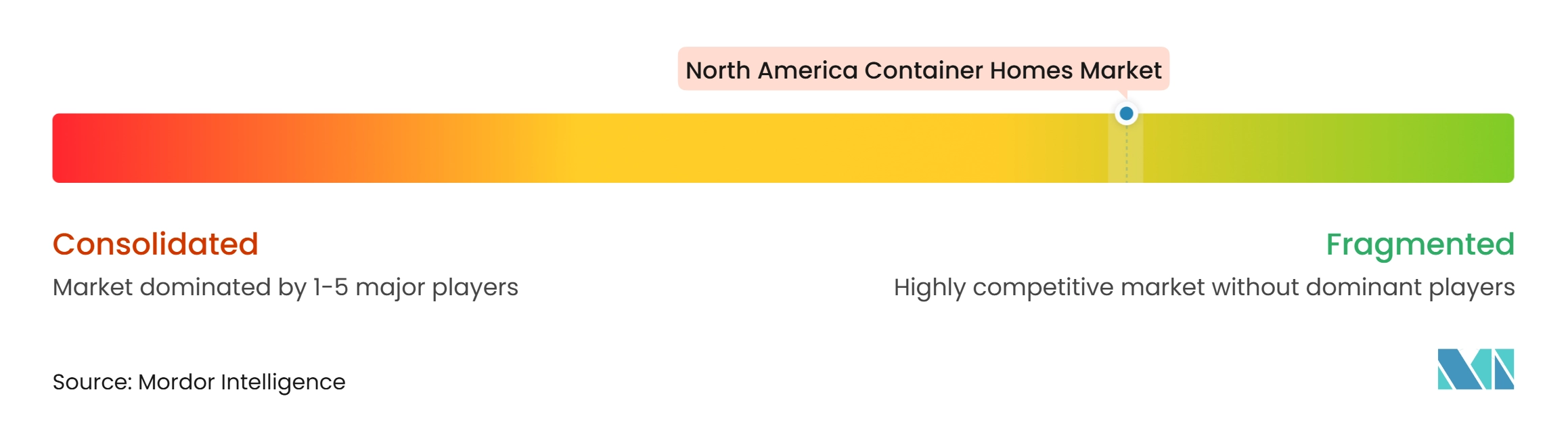
The North America container homes market is fragmented because no operator in the supplied research held a decisive regional share. Competition includes specialist container home manufacturers, broader modular construction firms with container offerings, and design-build businesses serving premium or customized projects. Smaller firms can source retired containers, but installed homes still require engineering capability, code knowledge, local permits, dependable subcontractors, and a process for managing transport and placement. This separates simple conversion work from housing that can satisfy public buyers and repeat developers. Companies that manage manufacturing and documentation together are better positioned to compete because their customers need both a product and a reliable project-delivery process.
SG Blocks, Inc., operating through Safe & Green Holdings Corp., uses its GreenSteel approach to position container structures for code-compliant hospitality, military, and residential uses. HONOMOBO has expanded through a dealer-based model in the United States and began a robotic truss-prefabrication pilot with RoBIM Technologies in March 2026. The pilot shows a move toward more consistent component production and lower variable labor exposure, which can matter when a supplier needs to deliver the same design in several locations. The company also placed its fifth-generation HO3 accessory dwelling unit in Hillsborough, California, in March 2026, according to the supplied research. These moves show that leading suppliers are competing through manufacturing systems, regional delivery networks, product development, and the ability to build confidence among local contractors and customers.
The supplied research identifies an opening for companies that can deliver International Building Code-compliant homes below USD 300,000 within 60-day project cycles. Disaster relief is likely to have a smaller group of qualified suppliers because units must be suitable for transport, rapid installation, and public procurement requirements. Flat-pack expandable designs and 3D-printed modules also compete for entry-level recreational and emergency projects, so the North America container homes market cannot assume it owns those lower-price applications. Suppliers will need stronger performance data, financing relationships, reliable permitting support, and a clear service model after installation to respond to these pressures.
North America Container Homes Industry Leaders
-
SG Blocks, Inc. (Safe & Green Holdings Corp.)
-
HONOMOBO
-
Giant Containers
-
Meka Modular
-
Kubed Living
- *Disclaimer: Major Players sorted in no particular order
North America Container Homes Market Companies Covered in this Report
- SG Blocks, Inc. (Safe & Green Holdings Corp.)
- HONOMOBO
- Giant Containers
- Meka Modular
- Kubed Living
- Backcountry Containers
- Alternative Living Spaces
- Rhino Cubed
- Stackhouse Container Homes
- Nova Deko
- Mods-Integral Solutions
- Falcon Structures
- Custom Container Living
- IndieDwell
- Boxhouse
- Container One
- Ark Container Homes
- CW Dwellings
- EcoMod LLC
- NRB Modular Solutions
Recent Industry Developments in North America Container Homes Market
- September 2026: MODUS Structures Inc. completed the acquisition of ROC Modular Inc., combining two established Canadian modular construction companies under the MODUS Structures brand. The combined business has more than 460 employees and approximately 260,000 square feet of certified manufacturing space across three facilities in Crossfield and Bow Island, Alberta. The expanded platform offers capabilities across social and affordable housing, Indigenous community projects, multi-family residential, hospitality, workforce accommodation, and emergency-response facilities.
- July 2026: S2A Modular and The Launchpad Collective broke ground on a 48-unit, four-storey affordable modular housing development with ground-floor commercial space in San Bernardino, California. The project evolved from an original eight-unit, two-storey container-home concept into a larger multi-family development. According to the project team, factory construction of the upper three residential floors can reduce their construction costs by approximately 50% compared with conventional on-site methods.
- May 2026: The Ontario government, through the Northern Ontario Heritage Fund Corporation (NOHFC), invested CAD 1 million (approximately USD 730,000) in ModBox Modular, a Thunder Bay-based manufacturer of custom modular container homes and other structures primarily serving First Nations communities. The funding supports the purchase of a new industrial building, facility renovations, and new manufacturing equipment, expanding the company's production facility from approximately 4,000 to 25,000 square feet.
North America Container Homes Market Report Scope
Segmentation Overview
| Factory-Built |
| On-Site Built |
| Fixed |
| Movable |
| Residential Homes |
| Recreational Homes |
| Emergency Homes |
| Nursing Homes |
| United States |
| Canada |
| Mexico |
| By Offering | Factory-Built |
| On-Site Built | |
| By Construction Type | Fixed |
| Movable | |
| By End-Use | Residential Homes |
| Recreational Homes | |
| Emergency Homes | |
| Nursing Homes | |
| By Country | United States |
| Canada | |
| Mexico |
Key Questions Answered in the Report
What is the 2026 value of North America container homes?
The North America container homes market is valued at USD 28.31 billion in 2026. It is forecast to reach USD 41.2 billion by 2032, at a 6.45% CAGR.
What is driving demand for container homes in North America?
Affordability pressure, accessory dwelling unit reforms, factory production, and disaster-relief needs support demand. Adoption is strongest where permitting, financing, and local installation can be managed clearly.
Which delivery format leads container housing demand?
On-Site Built delivery leads with a 55.6% share in 2026. Factory-Built delivery is forecast to grow at a 7.25% CAGR through 2032.
Which container home construction type is growing fastest?
Fixed homes lead with a 59.1% share in 2026. Movable homes are forecast to grow at a 7.7% CAGR through 2032, supported by emergency, recreation, and tourism uses.
Which end use has the largest demand for container homes?
Residential Homes lead with a 58.2% share in 2026. Emergency Homes are forecast to grow at a 7.85% CAGR through 2032.
What limits wider adoption of container housing?
Fragmented permits, limited financing and insurance, and thermal or corrosion requirements remain the main barriers. Projects often need detailed engineering and clear code documentation.