
North America Clothing and Footwear Technical Textile Market Size and Share
Market Overview
| Study Period | 2021 - 2032 |
|---|---|
| Forecast Data Period | 2027 - 2032 |
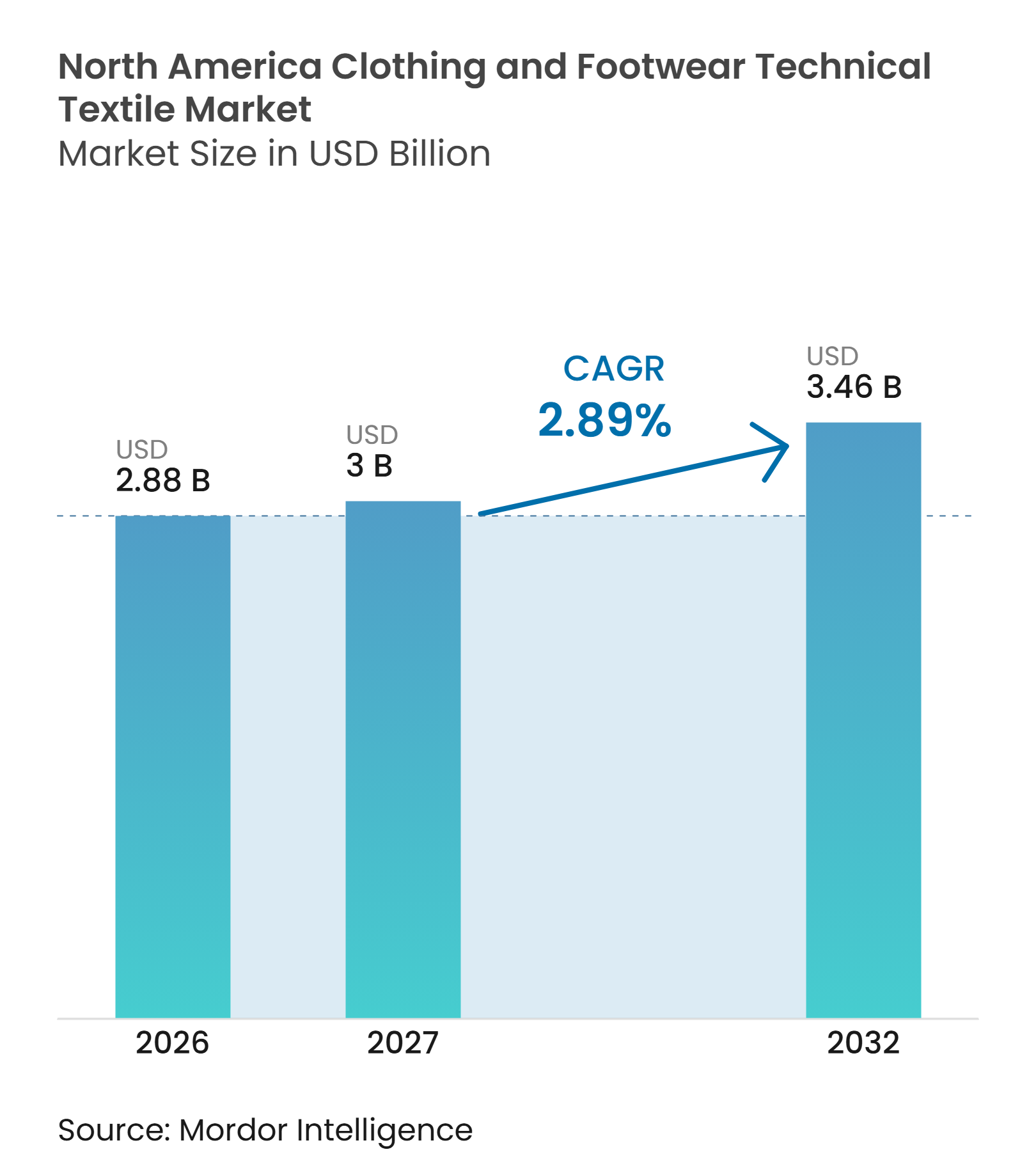
| Base Year Market Size (2026) | USD 2.88 Billion |
| Market Size (2027) | USD 3 Billion |
| Market Size (2032) | USD 3.46 Billion |
| Growth Rate (2027 - 2032) | 2.89 % |
| Market Concentration | Medium |
Major Players *Disclaimer: Major Players sorted in no particular order Image © Mordor Intelligence. Reuse requires attribution under CC BY 4.0. | |
North America Clothing and Footwear Technical Textile Market Analysis by Mordor Intelligence
The North America Clothing And Footwear Technical Textile Market size is projected to be USD 2.88 billion in 2026, USD 3 billion in 2027, and reach USD 3.46 billion by 2032, growing at a CAGR of 2.89% from 2027 to 2032.
The North America clothing and footwear technical textile market is shifting toward materials that deliver more functions within fewer garment and footwear components. Demand is strongest where product performance, worker protection, and domestic procurement rules make substitution difficult. Qualification records and traceable material inputs are becoming important differentiators for suppliers targeting defense, protective-apparel, and performance-brand contracts. PFAS-free membranes, recycled fibers, bio-based elastics, and sensor-ready fabrics are increasing the technical value of supplied materials. Demand is likely to remain concentrated in applications where material performance, procurement rules, and product qualification limit substitution, while the cost and compliance burden for suppliers rises.
Key Report Takeaways
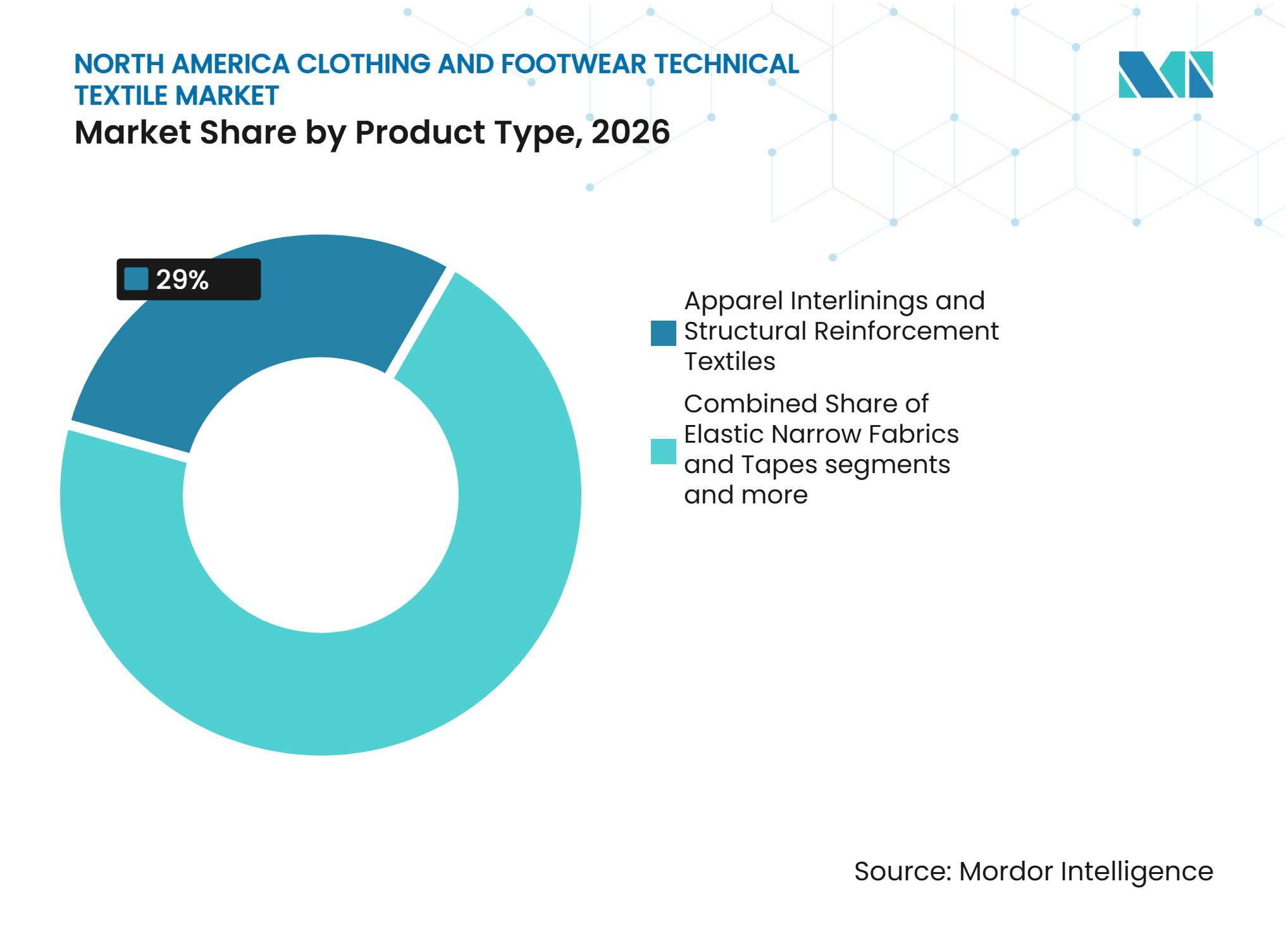
- By product type, apparel interlinings and structural reinforcement textiles accounted for 29.0% of the North America clothing and footwear technical textile market share in 2026, while elastic narrow fabrics and tapes are forecast to grow at a 4.8% CAGR through 2032.
- By material type, polyester accounted for 40.0% of the North America clothing and footwear technical textile market share in 2026, while elastane and other elastomeric fibers are forecast to grow at a 5% CAGR through 2032.
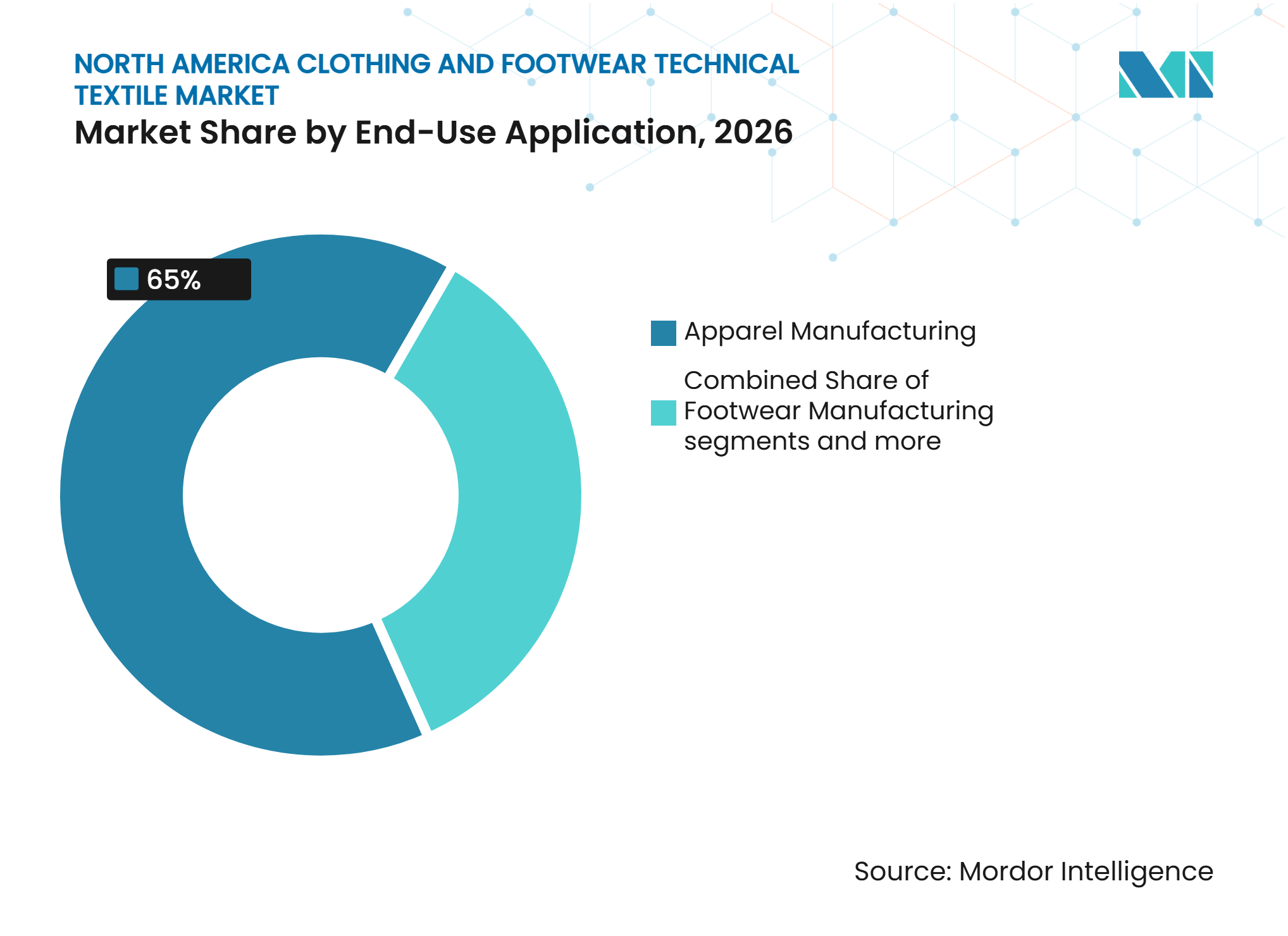
- By end-use application, apparel manufacturing accounted for 65.0% of the North America clothing and footwear technical textile market share in 2026, while athletic and performance footwear is forecast to grow at a 5.1% CAGR through 2032.
- By geography, the United States accounted for 72.0% of the North America clothing and footwear technical textile market share in 2026, while Mexico is forecast to grow at a 4.6% CAGR through 2032.
Note: Market numbers in this report are based on Mordor Intelligence's proprietary estimation framework, which combines nine months of actuals with Q4 projections for base year 2026.
Market Trends and Insights
Drivers Impact Analysis of North America Clothing and Footwear Technical Textile Market*
| Driver | (~) % Impact on CAGR Forecast | Geographic Relevance | Impact Timeline |
|---|---|---|---|
| Rising Adoption of Performance and Protective Apparel | +0.7% | United States, with military and industrial corridors in Texas, North Carolina, California, and the Southeast | Short term (≤ 2 years) |
| Nearshoring and Regional Supply Chain Resilience | +0.5% | Mexico, United States border states, and USMCA supply corridors | Medium term (2-4 years) |
| Demand for Recycled and Bio-Based Technical Fibers | +0.4% | United States and Canada | Medium term (2-4 years) |
| Smart and Sensor-Enabled Clothing and Footwear | +0.3% | United States defense, healthcare, and elite sports applications | Long term (≥ 4 years) |
| Domestic Qualification of Footwear Components | +0.2% | United States manufacturing clusters in New England and the Southeast | Medium term (2-4 years) |
| Traceable Multi-Function Materials for Extreme-Condition Use | +0.2% | United States defense and wildfire programs, and Canadian Armed Forces programs | Long term (≥ 4 years) |
| Source: Mordor Intelligence | |||
Rising Adoption of Performance and Protective Apparel
OSHA’s rule at 29 CFR 1926.95(c), effective January 13, 2025, requires construction employers to ensure that personal protective equipment properly fits each affected employee. The rule makes fit a procurement requirement, linking fabric selection to garment engineering and size availability. The requirement encourages employers and PPE suppliers to review garment sizing and fit across a wider workforce. This can increase the need for differentiated garment constructions, appropriately specified elastic components, and materials that maintain protective performance across size ranges; the demand effect on interlinings and narrow fabrics is therefore indirect. Arc-flash-rated garments are particularly relevant in electrical-hazard workplaces, where NFPA 70E safe-work practices shape PPE specifications and, in turn, material requirements alongside the OSHA fit requirement. The segment also benefits from a wider range of workwear designed for women, a group that standard garment programs have often served poorly.
Nearshoring and Regional Supply Chain Resilience
Mexico is an important textile and apparel supplier to the United States, reflecting its central role in regional apparel sourcing. Under USMCA rules of origin, many textile and apparel goods must meet yarn-forward requirements to claim preferential treatment. However, rules vary by product and tariff classification, and short-supply provisions and other exceptions apply. Regional production integration, USMCA origin rules, and Mexico’s own import duties are separate factors, but together they can increase demand for regionally qualified components where garments claim preference. ECLAC reported that Mexico’s nearshoring model is moving beyond assembly toward full-package production with more integrated upstream sourcing. Demand for regionally sourced components rises where this production model increases the number and complexity of components used in each garment.
Demand for Recycled and Bio-Based Technical Fibers
Recycled and bio-based content requirements are increasingly included in supplier programs for activewear and performance outdoor brands. W.L. Gore & Associates introduced a next-generation GORE-TEX Pro fabric in September 2025 with an ePE membrane that is made without intentionally added PFAS and recycled textile face materials.[1] The company stated that the product reduced carbon impact by up to 39% against the prior generation under its Materials Sustainability Index. This commercial launch shows that PFAS-free membrane technology can meet demanding performance requirements. lululemon also announced a 10-year agreement with Samsara Eco in June 2025 for enzymatically recycled nylon 6,6 and polyester, under which the materials could supply approximately 20% of its total fiber portfolio, an announced ambition rather than current commercial supply. Brand programs are therefore placing more value on traceable recycled materials and bio-based elastics.
Smart and Sensor-Enabled Clothing and Footwear
Conductive yarns, pressure-sensing textiles, and embedded electronics are opening a new application area for technical fabrics. Defense and healthcare programs require substrates that can carry electronic functions while remaining washable, comfortable, and compliant. Where such textiles are procured by the Department of Defense and fall within Berry Amendment coverage, domestic-origin requirements can make United States-sourced knit and woven bases important inputs; coverage depends on the specific procurement category. In footwear, engineered warp-knit uppers can place ventilation, support, and reinforcement zones directly into the textile structure.
Restraints Impact Analysis of North America Clothing and Footwear Technical Textile Market*
| Restraint | (~) % Impact on CAGR Forecast | Geographic Relevance | Impact Timeline |
|---|---|---|---|
| High Cost of Advanced Fibers, Membranes, and Laminates | -0.6% | United States, especially defense, firefighter, and performance outerwear applications | Short term (≤ 2 years) |
| Complex Certification and Qualification Cycles | -0.4% | United States and Canada, especially military and occupational safety channels | Medium term (2-4 years) |
| PFAS and Chemical Compliance Reformulation Burden | -0.3% | California, New York, and national supply chains | Short term (≤ 2 years) |
| Protection, Comfort, Durability, and Recyclability Trade-Offs | -0.2% | North American brands with published sustainability requirements | Long term (≥ 4 years) |
| Source: Mordor Intelligence | |||
High Cost of Advanced Fibers, Membranes, and Laminates
Aramid, ePE membranes, and high-performance elastomeric laminates cost more than conventional polyester-based materials. This limits their use to applications where standards or brand positioning justify the added expense. The market is consequently divided between high-volume basic components and higher-margin specialized products. A revised simplified acquisition threshold of USD 200,000 for Department of Defense contracts took effect on October 1, 2025, and its interaction with Berry Amendment domestic-content requirements and exceptions affects how some smaller contracts are procured.[2] Domestic producers also bear the combined cost of testing, expanded-size inventory, and qualification documentation. For small and medium-sized contractors, the price premium for PFAS-free membranes or aramid-blend flame-resistant fabrics can delay specification upgrades.
Complex Certification and Qualification Cycles
A single garment or component may need to meet OSHA, NFPA, ISO, and military procurement requirements. This creates schedule and cash-flow pressure, particularly for smaller suppliers that are introducing new materials. The Department of Defense Office of Inspector General reviewed 82 contract actions worth USD 2.78 billion in its September 2025 audit and found Berry Amendment clause deficiencies at all 4 contracting sites assessed. A material cleared under one standard may still require separate testing and documentation under another. The market therefore favors companies that already hold well-developed qualification records, even when newer suppliers offer technically capable alternatives.
*Our forecasts treat driver/restraint impacts as directional, not additive. The impact forecasts reflect baseline growth, mix effects, and variable interactions.
North America Clothing and Footwear Technical Textile Market Segment Analysis
By Product Type:
Structural Components Anchor Revenue, Elastic Innovation Leads GrowthApparel interlinings and structural reinforcement textiles accounted for 29.0% of the market in 2026, making them the largest product category. They serve as an enabling layer in tailored clothing, uniforms, structured outerwear, and casual apparel. Suppliers are developing fusible interlinings and nonwoven stiffeners with low-water and bio-based adhesive systems. Specialized sewing and embroidery threads are also an important value-chain component. Coats reported USD 297 million in recycled-thread-related revenue during the first half of 2026. Threads are included where technical criteria such as strength, durability, or heat resistance apply; conventional sewing thread is excluded.
Elastic narrow fabrics and tapes are forecast to grow at 4.8% CAGR through 2032, the strongest rate among product types. Athleisure volumes, shapewear specifications, and seam sealing in performance outerwear support this growth. Non-elastic garment tapes and trims provide technical functions where qualification and traceability can matter more than volume. Fastening and closure components also serve applications with defined performance requirements. Durable, protective, RFID-enabled, and traceability-oriented labels and identification components help support product identification and supply-chain traceability; ordinary labels and decorative trims are excluded. Footwear components are gaining value as warp-knit uppers replace multi-piece cut-and-sew construction. An ACS Applied Engineering Materials study found that interknitted polyester and aramid upper fabrics can improve strength-to-weight performance and thermal dimensional stability.[3] Polartec introduced its next-generation Alpha insulation in 2025 with a construction intended to improve snag and shedding resistance while retaining airflow.



By Material Type:
Polyester Commands the Base, Elastomeric Fibers Command the Growth RatePolyester held 40.0% of the North America clothing and footwear technical textile market share in 2026. Its position reflects its use across interlinings, nonwoven insulation, narrow fabrics, and functional meshes. Polyamide remains important for footwear uppers and linings that need abrasion resistance and dimensional stability. Cotton retains a role in flame-resistant shirting and Berry Amendment-compliant uniform programs. Polypropylene and other polyolefins support lower-cost insulation and water-resistant nonwoven uses, while regenerated cellulosic, acrylic, and modacrylic fibers serve moisture management and inherent flame-resistant applications.
Elastane and other elastomeric fibers are projected to grow at 5.0% CAGR through 2032. Bio-based elastane, including sugarcane-based material certified under USDA programs, is entering activewear and intimate apparel supply programs. The shift supports material traceability and changes sourcing requirements for narrow-fabric and interlining suppliers. PFAS restrictions in California and New York have added reformulation pressure for water-repellent performance fabrics. Materials with inherent stretch and water-management properties can therefore receive more attention from manufacturers seeking alternative component designs.
By End-Use Application:
Apparel Anchors Volume, Footwear Drives Performance InnovationApparel manufacturing held 65.0% of the market in 2026. The application includes formalwear, casualwear, innerwear, outerwear, sportswear, athleisure, occupational clothing, and specialty garments. Outerwear and functional clothing require several technical inputs at once, including PFAS-free membranes, recycled interlinings, certified thread, and bio-based elastics. Formalwear and uniforms continue to rely on woven and nonwoven interlinings for shape and structure. Innerwear, lingerie, and shapewear generate demand for elastic narrow fabrics and elastomeric fibers. Occupational clothing can benefit from the expanded PPE size and fit requirements in the construction sector.
Athletic and performance footwear is forecast to grow at 5.1% CAGR through 2032. Integrated warp-knit upper designs combine multiple functions that were once supplied through separate components. This raises the value of engineered textile inputs per pair while reducing the number of construction steps. Casual and fashion footwear remains a high-volume application for standard mesh and lining fabrics. Demand for recycled-content casual athletic styles is nevertheless increasing the technical requirements in some designs. Occupational and specialty footwear benefits from domestic procurement requirements for toe puffs, heel counters, and mesh linings. USMCA component-origin requirements add support across footwear and apparel applications as nearshoring expands.

Geography Analysis
United States: Procurement Mandates and Performance Innovation Support Demand
The United States held 72.0% of the North America clothing and footwear technical textile market share in 2026. Its position is based on institutional procurement and consumer demand for high-performance products. For industry context, broader United States artificial fiber, textile, and apparel shipments totaled USD 60.9 billion in 2025, with exports of USD 27 billion. The Berry Amendment requires domestic sourcing for Department of Defense clothing and textile procurement, including fabrics, interlinings, threads, zippers, and footwear components. The September 2025 DoD audit also underlined the importance of compliance documentation in Berry Amendment purchasing. Performance outerwear, military clothing, and occupational PPE support demand for qualified materials.
Mexico: USMCA Integration and Full-Package Production Support Growth
Mexico is forecast to grow at a 4.6% CAGR through 2032, the fastest pace in the region. The USMCA yarn-forward rule links tariff preference to regional sourcing of textile materials and trims. ECLAC identified a shift toward full-package production and greater upstream supply integration in Mexico. Full-package production can increase local demand for interlinings, tapes, threads, and functional trims as manufacturers take responsibility for a larger share of sourcing. Higher Mexican import duties on selected textile products introduced in late 2024 are a separate factor from USMCA origin rules and add cost to some imported inputs. Suppliers that can provide documented USMCA origin, competitive delivery times, and stable technical quality are better placed to serve local manufacturers.
Canada and Emerging End Markets: Cold-Weather Performance and Traceable Materials Shape Demand
Canada has demand for cold-weather outerwear, occupational safety clothing for oil and gas, mining, and forestry, and military uniform programs. The country’s requirements favor thermal wadding, waterproof-breathable laminates, and flame-resistant fabrics. Its USMCA participation connects Canadian buyers closely with United States supply chains, although domestic production capacity is more limited. As product technology matures and compliance requirements evolve, PFAS-free membrane adoption is gaining relevance. Gore’s ePE fabric platform combines recycled textiles with an ePE membrane for demanding outdoor conditions. Sensor-integrated workwear, Arctic systems, and traceable supply chains represent a potential opportunity across the United States and Canada rather than evidence of current demand.
Competitive Landscape
Market Concentration
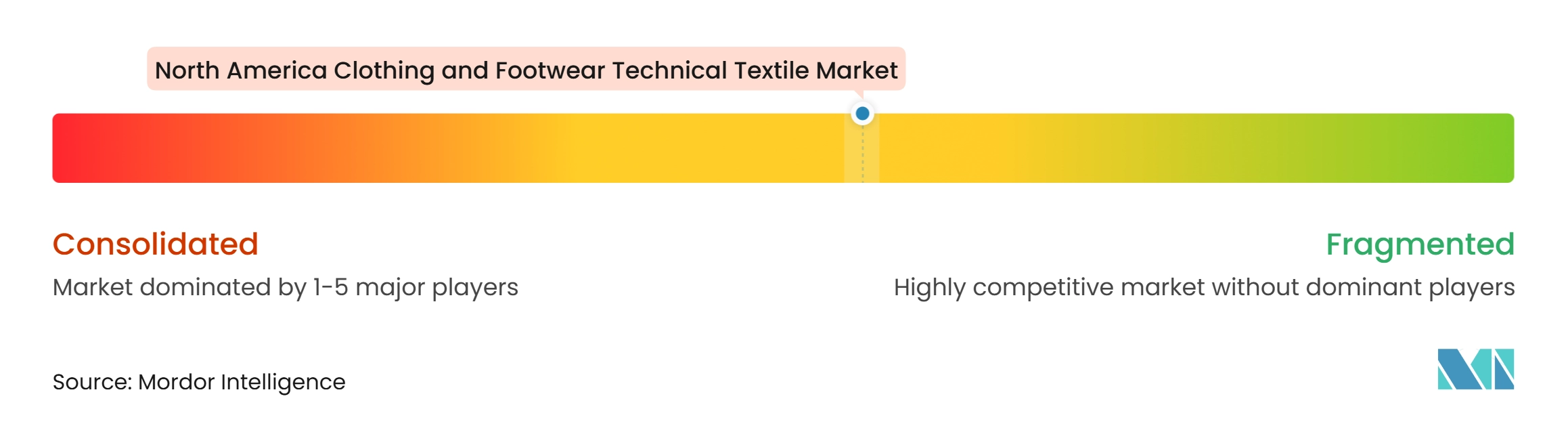
The market exhibits a medium level of concentration, based on a qualitative assessment rather than a measured share or HHI. Large integrated specialty materials companies compete through membrane, interlining, and performance-fiber technologies. Regional converters, narrow-fabric companies, and trim suppliers compete through speed, customization, price, and USMCA compliance. W.L. Gore introduced its ePE-membrane GORE-TEX Pro in September 2025 and expanded its fabric portfolio in 2026 with recycled textile-to-textile face materials. Coats completed its acquisition of OrthoLite in October 2025 at an enterprise value of USD 770 million, extending its footwear component presence beyond sewing thread; only the textile-based share of OrthoLite’s range falls within this market’s scope.
Coats also introduced T2T Epic and T2T Gramax recycled sewing-thread concepts to build a stronger circular materials offering. The USD 297 million of recycled-thread-related revenue reported for the first half of 2026 points to the commercial value of this differentiated supply position. Freudenberg Performance Materials remains a key interlining supplier, and regional converters compete with global suppliers on lead time and local availability alongside product performance. The most accessible openings are in PFAS-free finishes, sensor-ready workwear materials, and traceable nearshore supply systems. Smaller companies can establish positions where they combine a specialized material with the certification evidence needed for safety or military programs.
ISO, NFPA, OSHA, and military requirements create a meaningful barrier in specification-locked applications. Established suppliers can reuse qualification experience across customers and product programs. New companies still need to demonstrate performance, origin, and compliance independently for many uses. This limits rapid entry into firefighter, military, and industrial safety channels. The market also includes suppliers of engineered mesh and narrow fabrics for functional apparel and footwear applications. The LYCRA brand, supplied by Hyosung TNC, remains relevant to stretch applications in swimwear, shapewear, and performance outerwear. Jason Mills is relevant to engineered mesh and knit structures used in functional apparel and footwear.
North America Clothing and Footwear Technical Textile Industry Leaders
-
W. L. Gore and Associates, Inc.
-
Freudenberg Performance Materials
-
Jason Mills
-
Hyosung TNC
-
Coats Group
- *Disclaimer: Major Players sorted in no particular order
North America Clothing and Footwear Technical Textile Market Companies Covered in this Report
- W. L. Gore and Associates, Inc.
- DuPont de Nemours, Inc.
- TORAY INDUSTRIES, INC.
- Milliken and Company
- Freudenberg Performance Materials
- Teijin Aramid B.V.
- Avient Corporation
- Honeywell International Inc.
- Kimberly-Clark Corporation
- Ahlstrom
- Berry Global Inc.
- Schoeller Textil AG
- Polartec LLC
- Elevate Textiles, Inc.
- Unifi, Inc.
- Coats Group plc
- Tietex International, Ltd.
- Precision Fabrics Group, Inc.
- Safety Components Fabric Technologies, Inc.
- Barrday Inc.
- National Safety Apparel, Inc.
- Stedfast, Inc.
- FELLFAB Limited
Recent Industry Developments in North America Clothing and Footwear Technical Textile Market
- January 2026: Freudenberg Performance Materials formalized the rebranding of Filc, a 2023 acquisition, under the Freudenberg Performance Materials brand name effective January 1, 2026, completing the integration and presenting a unified identity in the North American interlinings and technical textiles market.
- October 2025: Coats Group completed the acquisition of OrthoLite at an enterprise value of USD 770 million, originally announced on July 16, 2025, strengthening Coats footwear division by adding a global leader in premium footwear insole materials. The combined entity targets at least USD 20 million in annualized cost synergies by 2028 and USD 40 million in annual incremental revenue synergies by 2030, expanding Coats' Tier 2 clothtech franchise across both thread and performance footwear component supply.
- October 2025: Freudenberg Performance Materials Apparel opened a 20,000-square-foot expansion at its Chennai, India facility, adding specialized production lines for 100% cotton and 100% polyester interlinings. The expansion reduces lead times for regional manufacturers from 6-8 weeks for Chinese imports to 1-2 weeks, supporting nearshore supply-chain strategies relevant to North American OEMs diversifying their interlining sourcing base under tariff pressure.
- September 2025: W.L. Gore & Associates launched the next-generation GORE-TEX Pro Fabric featuring an ePE membrane produced without intentionally added PFAS, incorporating recycled textiles and delivering a carbon impact reduction of up to 39% versus the prior generation as measured by the Materials Sustainability Index.
North America Clothing and Footwear Technical Textile Market Report Scope
The North America Clothing and Footwear Technical Textile Market is Segmented by Product Type (Elastic Narrow Fabrics and Tapes, Footwear Technical Textile Components, and More), by Material Type (Polyester, Polyamide, Cotton, and More), by End-Use (Apparel Manufacturing, Footwear Manufacturing, and More), and by Geography (United States, Canada, and Mexico). The Market Forecasts are Provided in Terms of Value (USD).
Segmentation Overview
| Apparel Interlinings and Structural Reinforcement Textiles |
| Specialized Sewing and Embroidery Threads |
| Elastic Narrow Fabrics and Tapes |
| Non-Elastic Functional Garment Tapes and Trims |
| Textile Fastening and Closure Components |
| Textile Labels, Badges, and Identification Components |
| Footwear Technical Textile Components |
| Garment Insulation and Specialty Functional Textile Components |
| Umbrella and Other Functional Accessory Textiles |
| Polyester |
| Polyamide |
| Cotton |
| Elastane and Other Elastomeric Fibers |
| Polypropylene and Other Polyolefins |
| Regenerated Cellulosic Fibers |
| Acrylic and Modacrylic Fibers |
| Other Specialty Synthetic Fibers |
| Other Materials |
| Apparel Manufacturing | Formalwear and Tailored Apparel |
| Casualwear and Everyday Clothing | |
| Innerwear, Lingerie, and Shapewear | |
| Outerwear and Functional Clothing | |
| Sportswear and Athleisure Apparel Components | |
| Other Apparel Manufacturing | |
| Footwear Manufacturing | Casual and Fashion Footwear |
| Athletic and Performance Footwear | |
| Occupational, Specialty and Other Footwear Components | |
| Clothing Accessories and Umbrellas | Headwear and Wearable Accessories |
| Umbrellas and Rain Accessories | |
| Other Specialized Clothing and Footwear Applications |
| United States |
| Canada |
| Mexico |
| By Product Type | Apparel Interlinings and Structural Reinforcement Textiles | |
| Specialized Sewing and Embroidery Threads | ||
| Elastic Narrow Fabrics and Tapes | ||
| Non-Elastic Functional Garment Tapes and Trims | ||
| Textile Fastening and Closure Components | ||
| Textile Labels, Badges, and Identification Components | ||
| Footwear Technical Textile Components | ||
| Garment Insulation and Specialty Functional Textile Components | ||
| Umbrella and Other Functional Accessory Textiles | ||
| By Material Type | Polyester | |
| Polyamide | ||
| Cotton | ||
| Elastane and Other Elastomeric Fibers | ||
| Polypropylene and Other Polyolefins | ||
| Regenerated Cellulosic Fibers | ||
| Acrylic and Modacrylic Fibers | ||
| Other Specialty Synthetic Fibers | ||
| Other Materials | ||
| By End-Use Application | Apparel Manufacturing | Formalwear and Tailored Apparel |
| Casualwear and Everyday Clothing | ||
| Innerwear, Lingerie, and Shapewear | ||
| Outerwear and Functional Clothing | ||
| Sportswear and Athleisure Apparel Components | ||
| Other Apparel Manufacturing | ||
| Footwear Manufacturing | Casual and Fashion Footwear | |
| Athletic and Performance Footwear | ||
| Occupational, Specialty and Other Footwear Components | ||
| Clothing Accessories and Umbrellas | Headwear and Wearable Accessories | |
| Umbrellas and Rain Accessories | ||
| Other Specialized Clothing and Footwear Applications | ||
| By Geography | United States | |
| Canada | ||
| Mexico | ||
Key Questions Answered in the Report
What is the projected value of the North America clothing and footwear technical textile sector by 2032?
The sector is projected to reach USD 3.46 billion by 2032, expanding at a 2.89% CAGR from 2027 to 2032. The forecast reflects demand for more functional materials across clothing and footwear uses.
Which product category has the largest revenue position?
Apparel interlinings and structural reinforcement textiles led product demand with a 29.0% share in 2026. Their role in uniforms, outerwear, tailored clothing, and casual apparel supports this position.
Which material category is growing fastest?
Elastane and other elastomeric fibers are projected to record the highest material-category CAGR at 5.0% through 2032. Activewear, intimate apparel, and preferred-material programs support this outlook.
What is driving demand for technical fabrics in protective clothing?
OSHA’s 2025 PPE fit rule and safety standards support demand for better-fitting protective garments, interlinings, trims, and elastic components. The need extends to recurring replacement purchases.
Why is Mexico growing faster than other regional countries?
Mexico is expected to grow at 4.6% CAGR as nearshoring and USMCA regional sourcing rules support local apparel and component supply chains. Full-package production also requires more integrated material inputs.