
North America Bottling Line Sterilization Machinery Market Size and Share
Market Overview
| Study Period | 2021 - 2032 |
|---|---|
| Forecast Data Period | 2027 - 2032 |
| Base Year Market Size (2026) | USD 5.61 Million |
| Market Size (2027) | USD 6.09 Million |
| Market Size (2032) | USD 8.61 Million |
| Growth Rate (2027 - 2032) | 7.17 % |
| Market Concentration | Medium |
Major Players *Disclaimer: Major Players sorted in no particular order Image © Mordor Intelligence. Reuse requires attribution under CC BY 4.0. | |
North America Bottling Line Sterilization Machinery Market Analysis by Mordor Intelligence
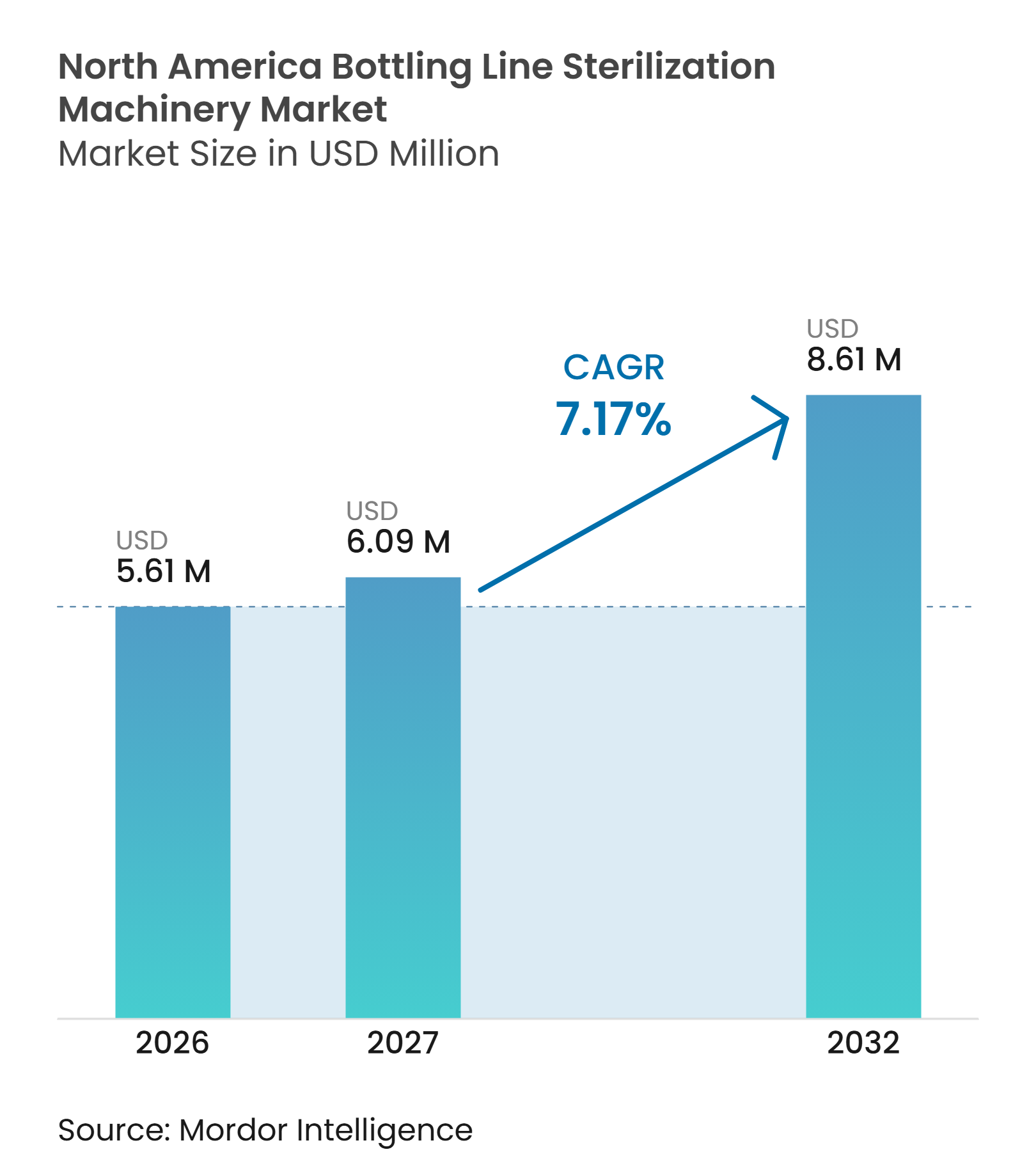
The North America Bottling Line Sterilization Machinery Market size is projected to expand from USD 5.61 million in 2026 and USD 6.09 million in 2027 to USD 8.61 million by 2032, registering a CAGR of 7.17% between 2027 and 2032.
The North America bottling line sterilization machinery market is supported by the shift toward shelf-stable beverages that can be distributed without refrigerated logistics, which is changing the cost and reach of regional beverage supply chains. This change makes validated container sterilization a production requirement for many low-acid and sensitive products, rather than a discretionary line upgrade. Plant-based dairy alternatives also require aseptic processing to support ambient shelf life in mass retail, and their production needs can favor preform treatment and integrated blow-fill-cap designs. Liquid-dosage pharmaceutical and nutraceutical production broadens demand for equipment beyond beverage lines, while more detailed compliance expectations place value on records that link sterilization to filling operations. Suppliers are responding with compact integrated systems, digital validation features, dry sterilization options, and service support that reduce water and chemical use while helping operators manage complex line transitions.
Key Report Takeaways
- By equipment type, integrated sterilization-filling-capping monoblocs held 50.17% of the North America bottling line sterilization machinery market share in 2026 and are expected to expand at an 8.17% CAGR through 2032.
- By sterilization technology, hydrogen peroxide held 40.45% of revenue share in 2026, while electron beam and other emerging technologies are projected to expand at an 8.21% CAGR through 2032.
- By format, PET bottles accounted for 36.97% of revenue share in 2026 of the North America bottling line sterilization machinery market, while preforms are projected to expand at an 8.24% CAGR through 2032.
- By line configuration, rotary systems held 35.31% of revenue share in 2026, while integrated systems are projected to expand at an 8.14% CAGR through 2032.
- By end user, juice, tea, and functional beverage producers accounted for 23.87% of revenue share in 2026, while pharmaceutical and biopharmaceutical manufacturers are projected to expand at an 8.19% CAGR through 2032.
- By geography, the United States held 76.79% of revenue share in 2026, while Mexico is projected to expand at a 7.86% CAGR through 2032.
Note: Market numbers in this report are based on Mordor Intelligence's proprietary estimation framework, which combines nine months of actuals with Q4 projections for base year 2026.
Market Trends and Insights
Drivers Impact Analysis of North America Bottling Line Sterilization Machinery Market*
| Driver | (~) % Impact on CAGR Forecast | Geographic Relevance | Impact Timeline |
|---|---|---|---|
| Expansion of Shelf-Stable and Extended-Shelf-Life Beverages | +2.0% | Global, concentrated in United States and Canada retail corridors | Short term (≤ 2 years) |
| Shift Toward Integrated Blow-Fill-Cap Monoblocs | +1.5% | Global, with early gains in United States dairy and juice production corridors | Medium term (2-4 years) |
| Tightening Food-Safety Validation and Traceability Requirements | +1.0% | United States-driven, with spillover to Canada and Mexico | Medium term (2-4 years) |
| Demand for Water- and Chemical-Efficient Sterilization | +0.8% | Global, amplified in the water-stressed United States Southwest and northern Mexico | Long term (≥ 4 years) |
| Growth in Dairy and Plant-Based Beverage Bottling | +0.7% | United States and Canada dominant, Mexico emerging | Medium term (2-4 years) |
| Retrofit Demand from Aging North American Bottling Lines | +0.5% | United States industrial corridor and Canada | Short term (≤ 2 years) |
| Source: Mordor Intelligence | |||
Expansion of Shelf-Stable and Extended-Shelf-Life Beverages
Shelf-stable functional waters, plant-based milks, and juices are changing the distribution model for beverage producers in the United States and Canada, as regional brands can supply wider markets without maintaining refrigerated logistics across every channel. Ambient distribution can reduce dependence on cold-chain infrastructure, extend the practical reach of a production site, and improve the case for retail listings that require longer shelf life. This model depends on container sterilization that meets the required sterility assurance level, so machinery becomes a core production requirement rather than an optional line upgrade for sensitive beverage formats in the North America bottling line sterilization machinery market. New product launches can therefore influence demand because each product-container combination may require separate process qualification, validation support, documented operating procedures, and a consistent approach to closure handling. The FDA requires a documented, scheduled process for each combination of thermally processed low-acid food and its container under 21 CFR Part 113.[1] Juice, tea, and functional beverage producers are positioned as a major buyer of aseptic line capacity in the North America bottling line sterilization machinery market as brands add ambient-distributed products.
Shift Toward Integrated Blow-Fill-Cap Monoblocs
Integrated lines limit bottle transfer between separate blowing, rinsing, filling, and capping units, which reduces the number of interfaces that need to be controlled within an aseptic validation plan. Removing these transfer points can reduce the risk of a previously treated container being exposed to an uncontrolled environment before filling, a consideration that matters in both greenfield projects and upgrades. Krones launched its compact Contipure AseptBloc in September 2025, featuring integrated preform sterilization, stretch blow molding, and aseptic filling within 100 m² of floor space. The system handles 8,000-27,500 bottles per hour and uses gaseous H₂O₂ as its packaging sterilant, placing integrated capability within the operating range of smaller and mid-sized facilities. In September 2026, Krones introduced a redesigned Contipure D module that raised throughput by 38% and can extend H₂O₂ exposure time by up to 40% for applicable product requirements. GEA also launched a modular beverage filling platform in September 2025 with an EHEDG-compliant isolator, a capacity of 60,000 bottles per hour, and AI-assisted alarm diagnostics, showing that the North America bottling line sterilization machinery market increasingly values operating support alongside mechanical capacity
Tightening Food-Safety Validation and Traceability Requirements
Food safety requirements favor equipment that records and retains sterilization data across the production line, particularly where the manufacturer must demonstrate that the process operated within its validated parameters. The FDA framework under 21 CFR Part 117 requires covered facilities to use preventive controls and maintain applicable records, which adds value to systems that can exchange data with broader production controls. The FDA Food Traceability Rule also creates recordkeeping requirements for key data elements at critical tracking events, although its compliance date was extended to July 20, 2028. These requirements make line-level data integration more relevant when producers assess new machinery, as an isolated sterilization module may not meet the record-keeping expectations of a connected food-production system. Pharmaceutical applications add a separate compliance requirement because 21 CFR 211.113(b) requires procedures designed to prevent the presence of objectionable microorganisms in drug products that are not required to be sterile. FDA warning letter 723059, issued in May 2026, documented deficiencies related to aseptic processing controls and illustrated how compliance concerns can turn documentation gaps into equipment upgrade decisions in the North America bottling-line sterilization machinery market.
Demand for Water- and Chemical-Efficient Sterilization
Dry sterilization systems can reduce the rinsing and wastewater steps associated with wet chemical approaches, a practical benefit for facilities that face process-water constraints or wastewater treatment costs. Gaseous H₂O₂ is suited to preform applications because heating during blow molding can support activation and evaporation within the process, avoiding a separate rinse stage in applicable configurations. Electron beam systems eliminate the need for chemical sterilants on bottles, thereby reducing residue-management work, wastewater requirements, and process steps associated with chemical handling. Peer-reviewed research in 2025 found that electron beam irradiation can effectively sterilize food without thermal stress on the treated container. This operating profile supports dry methods, in which lightweight containers, simplified treatment sequences, and lower process water use are important to the line design. The North America bottling line sterilization machinery market therefore has a clear opening for suppliers that combine dry treatment, integrated handling, documented controls, and workable service arrangements for existing plants.
Restraints Impact Analysis of North America Bottling Line Sterilization Machinery Market*
| Restraint | (~) % Impact on CAGR Forecast | Geographic Relevance | Impact Timeline |
|---|---|---|---|
| High Capital Cost and Long Validation Cycles | -1.5% | Global, most acute in mid-market United States and Canadian facilities | Medium term (2-4 years) |
| Skilled Labor Shortages for Aseptic Operations and Maintenance | -0.8% | United States and Canada, with early signs in Mexico’s industrial corridor | Medium term (2-4 years) |
| Chemical Residual, Wastewater, and Permitting Complexity | -0.5% | United States Southwest and water-stressed Mexican regions | Long term (≥ 4 years) |
| Integration Risk Across Mixed-Vendor Bottling Lines | -0.4% | Global | Short term (≤ 2 years) |
| Source: Mordor Intelligence | |||
High Capital Cost and Long Validation Cycles
Aseptic monobloc systems can require capital commitments that are difficult for mid-scale producers to absorb without co-packing arrangements, especially when the investment also requires changes to plant layout, utilities, and operating procedures. Long qualification cycles delay the time until a new line begins contributing commercial output and can make a project less attractive to facilities operating with limited investment capacity. The cost of a failed media-fill exercise can further delay operations because the manufacturer must identify the cause, document the investigation, and complete corrective actions before resuming the process. FDA rules require written procedures to prevent microbiological contamination and, when appropriate, validation of aseptic processes. This burden is particularly relevant for pharmaceutical and biopharmaceutical manufacturers, where aseptic assurance is central to regulatory compliance, and interruptions can affect planned product output. Compact and modular configurations can lower the initial hurdle, but they do not remove the validation work needed before commercial operation or the return-on-investment pressure faced by smaller producers in the North America bottling line sterilization machinery market.
Skilled Labor Shortages for Aseptic Operations and Maintenance
Aseptic operations need personnel trained in cleanroom practices, media-fill execution, environmental monitoring, and CIP and SIP scheduling, which are capabilities that combine process discipline with equipment knowledge. These skills are limited across sections of the North American food and beverage workforce, leaving some plants dependent on a small group of experienced operators and service technicians. Mexico’s production expansion increases the need for this expertise as manufacturers add new bottling capacity and prepare lines for export-quality production. HEINEKEN México committed USD 2.75 billion for 2025-2028, including a new facility in Kanasín, Yucatán, with an initial capacity of 4 million hectoliters. GEA’s new platform uses AI-assisted alarm diagnostics to help operators identify likely fault causes and may shorten troubleshooting when experienced maintenance staff are not immediately available. Such tools may reduce troubleshooting time, but they do not replace the need for trained operators and maintenance staff who can manage aseptic conditions, conduct planned interventions, and sustain validated performance.
*Our forecasts treat driver/restraint impacts as directional, not additive. The impact forecasts reflect baseline growth, mix effects, and variable interactions.
North America Bottling Line Sterilization Machinery Market Segment Analysis
By Equipment Type:
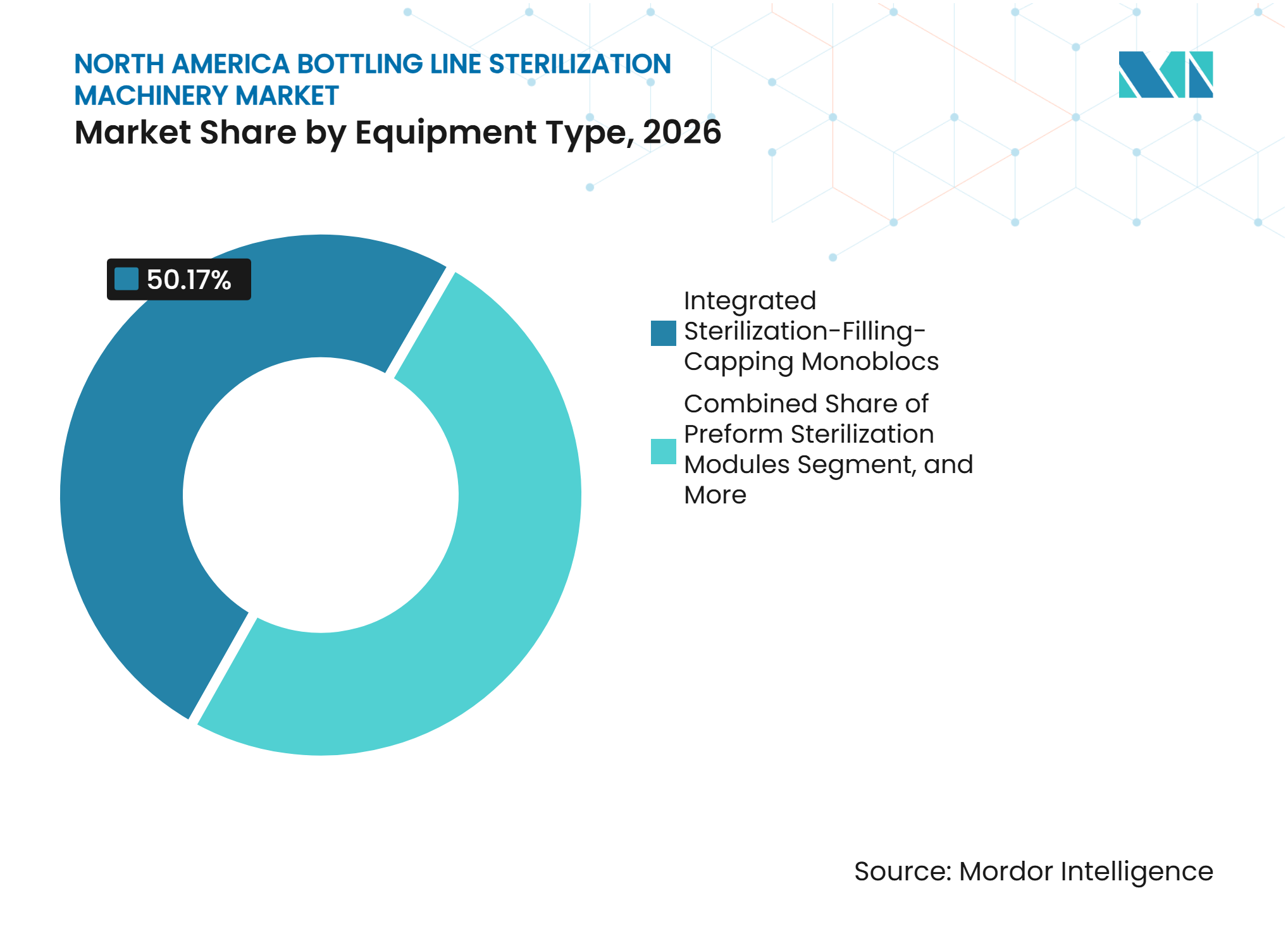
Integrated Systems Lead AdoptionIntegrated sterilization-filling-capping monoblocs accounted for 50.17% of the North America bottling line sterilization machinery market share in 2026 and are projected to expand at an 8.17% CAGR through 2032. The segment combines the leading revenue position with the highest projected rate because a unified architecture reduces the number of transfer points between sterilization, filling, and capping. Each transfer point can introduce a separate contamination-control requirement, while compact designs make the approach more practical for sites that cannot accommodate a conventional full-scale block. Krones’ Contipure AseptBloc integrates preform sterilization, stretch blow molding, and aseptic filling in a 100 m² footprint, with a stated capacity of 8,000-27,500 bottles per hour. This capability supports brownfield upgrades where floor space and line replacement cost have limited previous investment.
Bottle sterilization and rinsing modules remain relevant for producers that add sterilization capability to existing filling lines, particularly where the filler is still serviceable and full replacement is not justified. Preform sterilization modules serve operators with existing stretch blow-molding assets that want in-molder H₂O₂ treatment, allowing aseptic blow-and-fill processing without a full monobloc rebuild. Cap and closure sterilization modules address residual contamination risk after the bottle and filling environment are controlled, a requirement that can be overlooked when producers focus only on the main filling chamber. The North America bottling line sterilization machinery industry is also moving toward connected standalone modules that contribute operating data to validation documentation, enabling the modules to support broader quality-record requirements. This mix keeps retrofit modules relevant even as integrated systems attract the highest new-project interest and gives suppliers several entry points within the North America bottling line sterilization machinery market.



By Sterilization Technology:
Hydrogen Peroxide Leads While Electron Beam AdvancesHydrogen peroxide held 40.45% of revenue share in 2026. Its position reflects established process experience, broad integration across aseptic filling platforms, and its compatibility with PET and preform applications. In these applications, gaseous H₂O₂ works with blow-molding heat to support sterilant activation and evaporation without a separate rinse step. The FDA residual standard and established validation practices give producers a familiar process framework. UV-C and pulsed-light combinations with H₂O₂ are also used in extended shelf-life dairy lines, while hydrogen peroxide remains the established option in integrated aseptic lines.
Electron beam and other emerging technologies are projected to expand at an 8.21% CAGR through 2032, the highest rate in this technology grouping. These approaches eliminate the need for chemical sterilants in bottle treatment and can reduce wastewater management needs. A 2025 peer-reviewed study supports the ability of electron beam irradiation to sterilize food-related applications without thermal stress on the container. Peracetic acid continues to serve HDPE applications, while steam and hot water remain relevant for glass packaging and pharmaceutical settings where thermal treatment is expected. Technology selection depends on container format, operating speed, residue requirements, and the existing validation approach, which keeps hydrogen peroxide in the lead while supporting the faster advance of dry methods.
By Format:
PET Bottles Retain Volume While Preforms AdvancePET bottles held a 36.97% revenue share in 2026, while the North America bottling line sterilization machinery market size for preforms is projected to expand at an 8.24% CAGR through 2032. PET is widely used for bottled water, juice, tea, and functional beverages, and is compatible with both H₂O₂ vapor and electron-beam treatments. This flexibility makes PET a reference container for many aseptic validation processes. Preforms are treated before bottle formation, which reduces the surface area exposed to sterilant and can lower consumption. Integrating treatment into the blow-molding cycle explains the faster projected rate for preforms.
HDPE bottles remain important in dairy and liquid nutrition products, including shelf-stable plant-based beverages that require barrier performance. Glass serves premium juice and functional beverage products where the package format remains part of the product positioning, so steam and hot-water treatment retains a role. Caps and closures form a separate contamination-control point because they can introduce microorganisms after bottle treatment has been optimized. Claranor displayed its pulsed-light decontamination platform for caps, closures, and containers at PACK EXPO International Chicago in 2026. Format choice therefore shapes the sterilization method, machine layout, and validation record required for each line.
By Line Configuration:
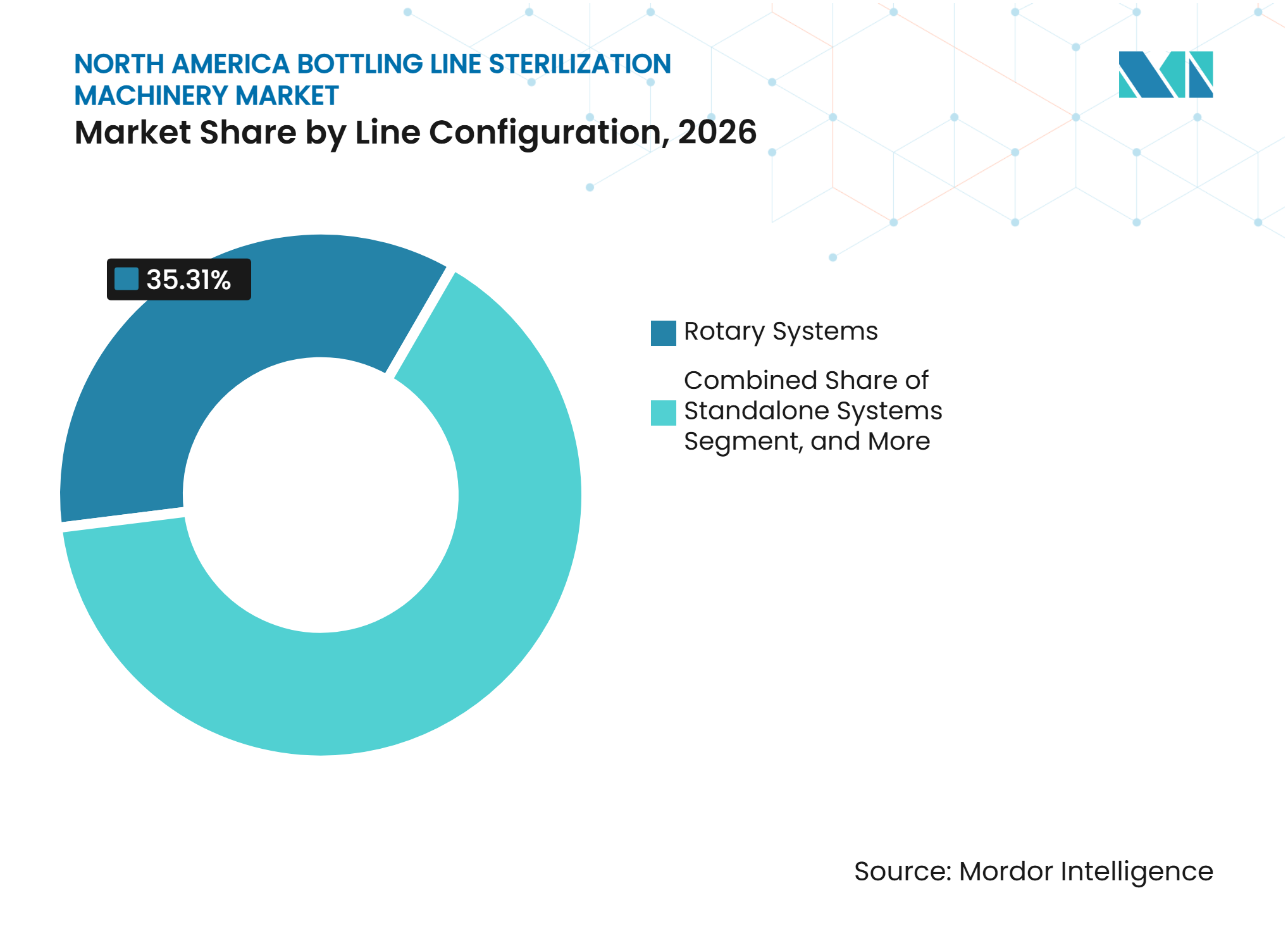
Rotary Systems Hold Installed-Base DemandRotary systems held 35.31% of revenue share in 2026, while integrated systems are projected to expand at an 8.14% CAGR through 2032. Rotary systems are established in high-speed carbonated soft drink and bottled water lines, where their turret-based architecture supports throughput that can justify the capital commitment. The extensive installed base also sustains demand for replacement parts and rotary-compatible sterilization modules when producers need updated contamination controls. Integrated systems attract new projects because they bring sterilization, filling, and capping into a single validated boundary. This approach reduces the number of handoff points that require separate contamination controls and documentation.
Linear and inline systems serve craft and mid-scale producers that need aseptic performance but cannot support a rotary configuration, while compact offerings improve the practical fit in space-constrained facilities. Standalone sterilization systems remain a lower-cost option in which a filler can continue operating after a targeted upgrade, and automatic or semi-automatic systems serve pharmaceutical and nutraceutical users who prioritize documented cycles. GEA’s modular beverage filler supports several aseptic platforms and includes an EHEDG-compliant isolator. Its AI-assisted diagnostic function reflects greater digital support within the filling environment and can help operators focus on likely causes when a line alarm occurs. The configuration decision depends on installed assets, output needs, space, and the extent of validation work that a producer can undertake in the North America bottling-line sterilization machinery market.

By End User:
Functional Beverages Anchor Demand While Pharmaceutical Users AdvanceJuice, tea, and functional beverage producers held 23.87% of revenue share in 2026. This group depends on validated container treatments for ambient-distributed high-acid and low-acid beverages, and functional beverages can introduce new product-and-container combinations. Each combination may require separate qualification and a new or upgraded sterilization module. Dairy and plant-based beverage producers support demand as refrigerated offerings shift to ambient formats, while contract beverage and aseptic packaging organizations invest in infrastructure to serve multiple brand owners. Bottled water, cosmetics, and personal care producers provide steadier replacement-driven demand that is more closely tied to existing production volumes.
Pharmaceutical and biopharmaceutical manufacturers are projected to expand at an 8.19% CAGR through 2032. The segment is adopting bottle-line aseptic filling for liquid oral doses, topical products, and over-the-counter nutraceuticals. FDA requirements under 21 CFR 211.113(b) maintain a focus on procedures that prevent objectionable microbiological contamination, while warning letter 723059 addressed aseptic-control deficiencies in a pharmaceutical setting. This regulatory setting can make infrastructure upgrades more urgent for affected manufacturers. The North America bottling line sterilization machinery industry benefits from demand across beverage and pharmaceutical applications because their compliance needs overlap around controlled filling environments.
Geography Analysis
United States
The United States held 76.79% of regional revenue in 2026, with beverage, pharmaceutical, and nutraceutical capacity concentrated in Texas, California, Ohio, Wisconsin, and New Jersey. FDA requirements under 21 CFR Parts 113 and 117 create an ongoing need to document process and preventive controls, while California juice and plant-based beverage producers are moving selected lines toward ambient distribution. Older equipment that lacks digital records can be less suitable for facilities strengthening audit readiness, especially as the FDA Food Traceability Rule makes line-level records more important across applicable supply chains and sets compliance for July 20, 2028. Equipment vendors can differentiate through service capacity, data connectivity, and compact line designs that fit existing facilities.
Mexico
Mexico is projected to expand at a 7.86% CAGR through 2032, the highest rate among the geographies covered, as nearshoring and domestic beverage investment support new production capacity for domestic and United States-bound demand. HEINEKEN México committed USD 2.75 billion for 2025-2028, including a greenfield brewery in Kanasín, Yucatán, with initial capacity of 4 million hectoliters. New facilities need equipment and documentation that support export-grade food and beverage production, increasing demand for installation, maintenance, validation support, and operator training. Mexico’s expansion also makes local technical service and parts availability more important for suppliers seeking to meet the compliance needs of cross-border production.
Canada and Regional Production Trends
Canada sustains demand through replacement cycles and capacity expansions in the beverages and pharmaceuticals sectors. Ontario and British Columbia are active areas for dairy and plant-based beverage lines that need extended shelf-life processing. The Canadian Food Inspection Agency uses preventive control requirements aligned with HACCP principles, which favor equipment that supports consistent recordkeeping and validation documentation.[2] Across the 3 countries, non-carbonated beverages are a common source of demand because still and pH-sensitive formulations lack carbonation’s microbial-inhibition benefit. The regional opportunity combines the United States installed base, Mexico’s greenfield capacity, and Canada’s targeted replacement demand.
Competitive Landscape
Market Concentration
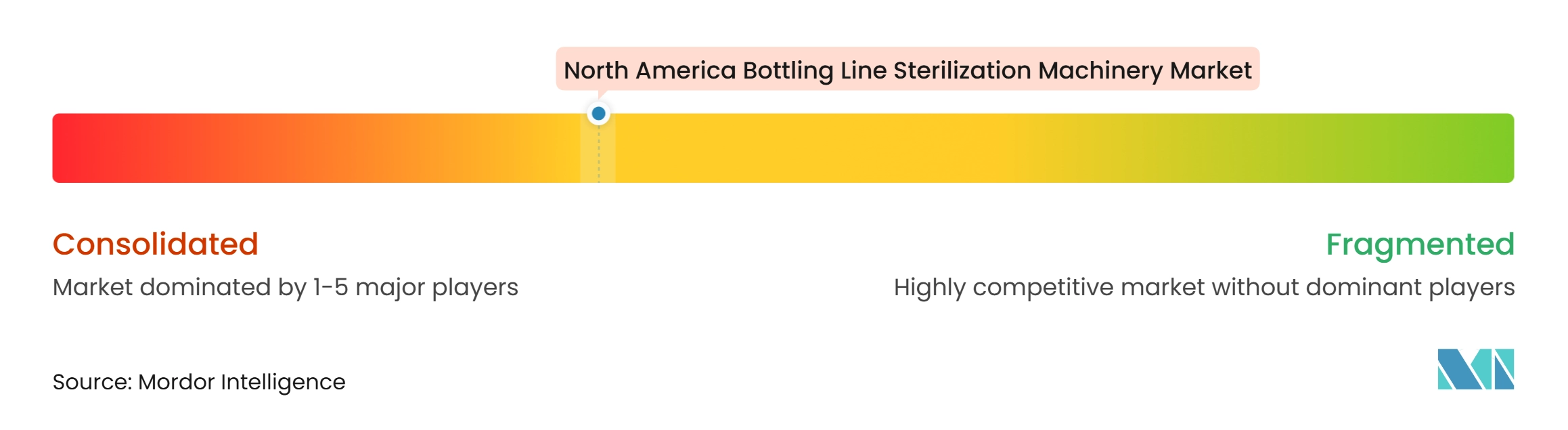
The North America bottling line sterilization machinery market has moderate concentration among established suppliers, including Krones, GEA, Sidel, and KHS, whose installed-base advantages reflect the value producers place on validated performance and continuity of service. Switching an aseptic line can be difficult because new equipment must be integrated and qualified within the existing process, but specialists can compete in pulsed light, retrofit modules, closure treatment, and pharmaceutical configurations. Krones introduced the redesigned Contipure D in September 2026 with a multi-level starwheel design, up to 38% higher speed, and adjustable H₂O₂ exposure time. Krones also offers the compact Contipure AseptBloc for facilities that need an integrated system in a smaller footprint.
GEA is pursuing modularity and digital operating support in beverage filling through its 2025 platform, which works with ABF, EcoSpin, Whitebloc, and Unibloc Flex aseptic solutions and includes AI-assisted alarm diagnostics. This strategy addresses the need for flexible configurations and easier fault identification where specialist labor is limited. Claranor is pursuing chemical-free decontamination for caps, closures, and containers through its pulsed-light platform. That approach can complement H₂O₂ bottle or preform treatment without replacing the entire aseptic architecture. JBT Marel expanded its end-to-end offering through an exclusive partnership with Aurum Process Technology for particulate food processing and aseptic filling in flexible packaging, extending aseptic processing to ready-meal and premium pet-food packaging applications beyond standard PET bottles.[3]
Mid-tier suppliers remain relevant where buyers value rapid technical service, specialized liquid handling, or retrofit compatibility over a single-source line solution. The aging installed base creates opportunities for suppliers to upgrade a specific sterilization stage without requiring a full equipment replacement. Lines installed between 2005 and 2015 increasingly face decisions about whether to extend their operating life or move to an integrated architecture. Compact modular systems can reduce the disruption associated with a complete rebuild, making them relevant in the North America bottling line sterilization machinery market. Validation requirements still favor suppliers with credible process knowledge and documentation support.
North America Bottling Line Sterilization Machinery Industry Leaders
-
Krones AG
-
GEA Group AG
-
Tetra Pak International S.A.
-
Coesia S.p.A.
-
ProMach, Inc.
- *Disclaimer: Major Players sorted in no particular order
North America Bottling Line Sterilization Machinery Market Companies Covered in this Report
- Krones AG
- KHS GmbH
- GEA Group AG
- Tetra Pak International S.A.
- Sidel Group
- ProMach, Inc.
- Serac Group
- Fogg Filler Company
- Shibuya Corporation
- Syntegon Technology GmbH
- Barry-Wehmiller Companies, Inc.
- Coesia S.p.A.
- SACMI Cooperativa Meccanici Imola S.C.
- JBT Marel Corporation
- SPX FLOW, Inc.
- Alfa Laval AB
- M&O Perry Industries, Inc.
- Ecolab Inc.
- Belimed AG
- Steelco S.p.A.
Recent Industry Developments in North America Bottling Line Sterilization Machinery Market
- November 2026: KHS GmbH announced the localization of Innopro Paramix C blending-system production at its Waukesha, USA facility, expanding North American manufacturing capacity for process technology. The move reduces lead times for US and Canadian customers and deepens KHS's operational proximity to a market where service responsiveness is a competitive differentiator in line-upgrade decisions.
- October 2026: Claranor showcased its pulsed-light decontamination platform for chemical-free sterilization of caps, closures, and containers at PACK EXPO International Chicago 2026. The platform complements H₂O₂-based bottle and preform sterilization within an aseptic bottling line.
- September 2026: Krones AG reached commercial series production with its new-generation Contipure D preform sterilization module, featuring a vertically stacked, multi-level starwheel design. The system delivers up to 38% higher speed and extends H₂O₂ exposure time by up to 40% within defined performance ranges, with the first units confirmed to be operating at customer plants globally, positioning Krones to capture mid- to high-volume replacement demand across North American aseptic beverage lines.
- August 2026: AB InBev's Grupo Modelo confirmed construction of a brewery and bottling complex in Apan, Hidalgo, Mexico, representing an investment of MXN 14 billion (USD 760 million) with an initial annual production capacity of 12 million hectoliters. The facility is designed to supply domestic demand and United States export demand for premium Mexican beer brands, directly supporting investment in sterilization and packaging line equipment.
North America Bottling Line Sterilization Machinery Market Report Scope
The North America Bottling Line Sterilization Machinery Market refers to the market for specialized equipment and integrated systems used to sterilize bottles, preforms, caps, closures, and other packaging components before or during the filling and packaging process across the beverage, pharmaceutical, personal care, and other liquid-product manufacturing industries. These machinery systems are designed to eliminate or reduce microorganisms, including bacteria, yeasts, molds, and other contaminants, from packaging surfaces, thereby maintaining product safety, preserving quality, extending shelf life, and meeting stringent hygiene and regulatory requirements.
The North America Bottling Line Sterilization Machinery Market Report is Segmented by Equipment Type (Bottle Sterilization and Rinsing Modules, Preform Sterilization Modules, Cap and Closure Sterilization Modules, Integrated Sterilization-Filling-Capping Monoblocs), Sterilization Technology (Hydrogen Peroxide, Peracetic Acid, Steam and Hot Water, Dry Heat and Hot Air, UV-C and Pulsed Light, Electron Beam and Other Emerging Technologies), Format (PET Bottles, HDPE Bottles, Glass Bottles, Preforms, Caps and Closures, and Other Formats), Line Configuration (Rotary Systems, Linear and Inline Systems, Standalone Systems, Integrated Systems, Automatic and Semi-Automatic Systems), End User (Dairy and Plant-Based Beverage Producers, Juice, Tea, and Functional Beverage Producers, Bottled Water Producers, Pharmaceutical and Biopharmaceutical Manufacturers, Contract Beverage and Aseptic Packaging Organizations, Cosmetics, Personal Care, and Other Liquid Product Producers), and Geography (United States, Canada, and Mexico). The Market Forecasts are Provided in Terms of Value (USD).
Segmentation Overview
| Bottle Sterilization and Rinsing Modules |
| Preform Sterilization Modules |
| Cap and Closure Sterilization Modules |
| Integrated Sterilization-Filling-Capping Monoblocs |
| Hydrogen Peroxide |
| Peracetic Acid |
| Steam and Hot Water |
| Dry Heat and Hot Air |
| UV-C and Pulsed Light |
| Electron Beam and Other Emerging Technologies |
| PET Bottles |
| HDPE Bottles |
| Glass Bottles |
| Preforms |
| Caps and Closures |
| Other Formats |
| Rotary Systems |
| Linear and Inline Systems |
| Standalone Systems |
| Integrated Systems |
| Automatic and Semi-Automatic Systems |
| Dairy and Plant-Based Beverage Producers |
| Juice, Tea, and Functional Beverage Producers |
| Bottled Water Producers |
| Pharmaceutical and Biopharmaceutical Manufacturers |
| Contract Beverage and Aseptic Packaging Organizations |
| Cosmetics, Personal Care, and Other Liquid Product Producers |
| United States |
| Canada |
| Mexico |
| By Equipment Type | Bottle Sterilization and Rinsing Modules |
| Preform Sterilization Modules | |
| Cap and Closure Sterilization Modules | |
| Integrated Sterilization-Filling-Capping Monoblocs | |
| By Sterilization Technology | Hydrogen Peroxide |
| Peracetic Acid | |
| Steam and Hot Water | |
| Dry Heat and Hot Air | |
| UV-C and Pulsed Light | |
| Electron Beam and Other Emerging Technologies | |
| By Format | PET Bottles |
| HDPE Bottles | |
| Glass Bottles | |
| Preforms | |
| Caps and Closures | |
| Other Formats | |
| By Line Configuration | Rotary Systems |
| Linear and Inline Systems | |
| Standalone Systems | |
| Integrated Systems | |
| Automatic and Semi-Automatic Systems | |
| By End User | Dairy and Plant-Based Beverage Producers |
| Juice, Tea, and Functional Beverage Producers | |
| Bottled Water Producers | |
| Pharmaceutical and Biopharmaceutical Manufacturers | |
| Contract Beverage and Aseptic Packaging Organizations | |
| Cosmetics, Personal Care, and Other Liquid Product Producers | |
| By Geography | United States |
| Canada | |
| Mexico |
Key Questions Answered in the Report
What is the North America bottling line sterilization machinery market size?
The market was valued at USD 5.61 million in 2026 and is estimated to reach USD 8.61 million by 2032, with a 7.17% CAGR from 2027 to 2032. The outlook reflects demand for validated sterilization in shelf-stable beverage and liquid-product production, including systems that support documented aseptic control. The forecast also captures the role of integrated machinery, dry treatment options, pharmaceutical applications, and replacement projects at existing bottling facilities.
Which equipment type leads bottling line sterilization machinery demand in North America?
Integrated sterilization-filling-capping monoblocs led with 50.17% share in 2026 and are projected to expand at an 8.17% CAGR through 2032. Their integrated layout reduces the transfer points that require separate aseptic controls and can streamline the validation boundary.
Why are integrated aseptic bottling lines being adopted?
They reduce bottle transfer points between sterilization, filling, and capping, which can simplify contamination control and validation work. Compact integrated systems also suit upgrades at plants with limited floor space and lower tolerance for lengthy production disruption.
Which sterilization technology is expanding fastest in North America?
Electron beam and other emerging technologies are projected to expand at an 8.21% CAGR through 2032 because they offer chemical-free bottle treatment. This can reduce residue-management and wastewater requirements for applicable lines, while maintaining a dry treatment sequence.
Which country is expected to record the fastest expansion through 2032?
Mexico is projected to expand at a 7.86% CAGR, supported by nearshoring and investment in beverage manufacturing capacity. New production sites also increase the need for technical service, validation support, skilled operators, and equipment that can serve cross-border supply chains.
Which end user is expected to expand fastest through 2032?
Pharmaceutical and biopharmaceutical manufacturers are projected to expand at an 8.19% CAGR as aseptic requirements support equipment upgrades. The segment includes liquid oral doses, topical products, and over-the-counter nutraceuticals that need controlled filling conditions and documented procedures. Regulatory inspection expectations reinforce the need for validated contamination-control systems, consistent operating records, well-defined corrective procedures when process deviations are identified, and ongoing staff competency.