
North America Bathroom Vanities Market Size and Share
Market Overview
| Study Period | 2020 - 2031 |
|---|---|
| Forecast Data Period | 2026 - 2031 |
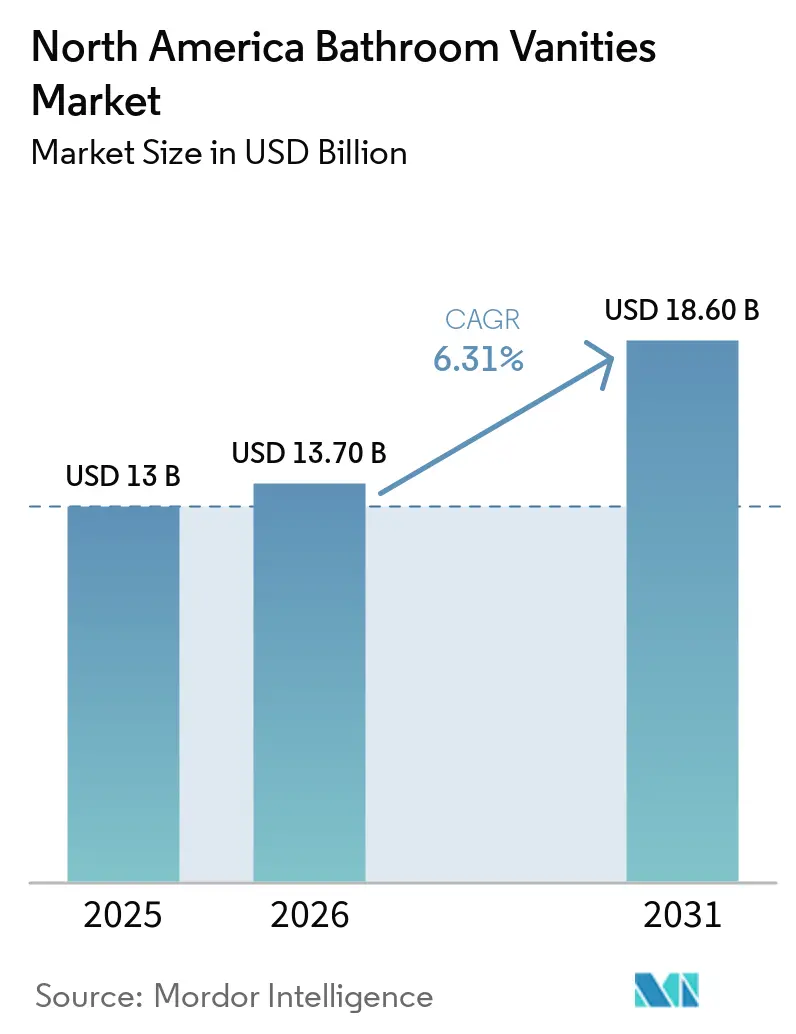
| Base Year Market Size (2025) | USD 13 Billion |
| Market Size (2026) | USD 13.70 Billion |
| Market Size (2031) | USD 18.60 Billion |
| Growth Rate (2026 - 2031) | 6.31 % |
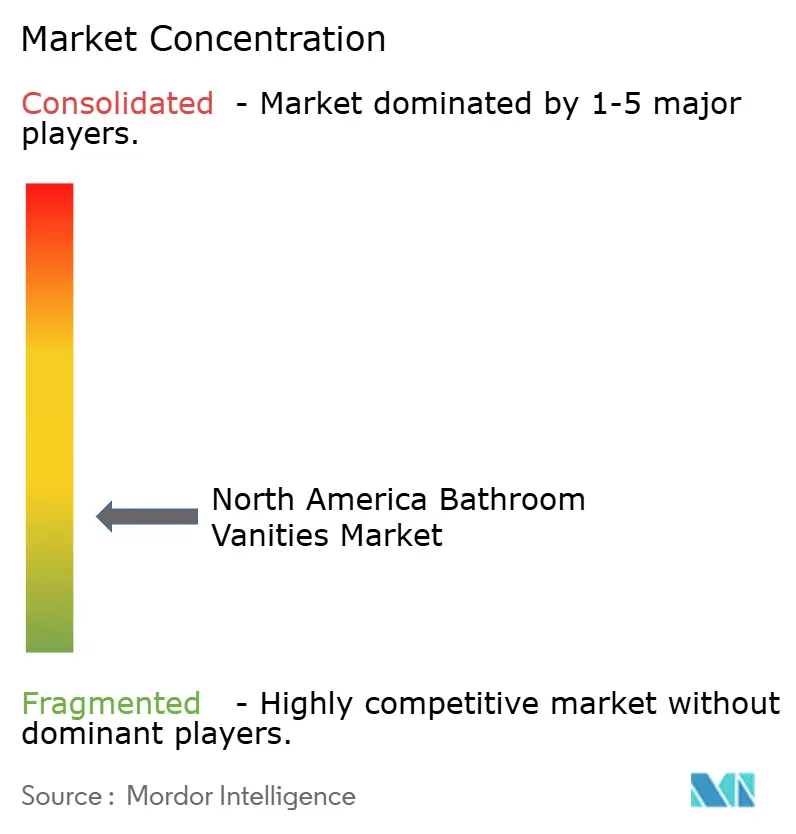
| Market Concentration | Low |
Major Players *Disclaimer: Major Players sorted in no particular order Image © Mordor Intelligence. Reuse requires attribution under CC BY 4.0. | |
North America Bathroom Vanities Market Analysis by Mordor Intelligence
The North America bathroom vanities market was valued at USD 13.00 billion in 2025, is estimated at USD 13.70 billion in 2026, and is forecast to reach USD 18.60 billion by 2031, growing at a 6.31% CAGR during 2026–2031. Replacement demand is expected to remain more important than new housing because many homeowners are improving existing bathrooms rather than moving. United States homeowner improvement and repair spending is projected at USD 519 billion through mid-2027, with year-over-year growth slowing to 0.5% by the second quarter of 2027, according to Harvard's Joint Center for Housing Studies[1]https://www.jchs.harvard.edu/blog/remodeling-growth-set-downshift-late-2026. Bathroom projects absorb a meaningful part of renovation budgets, and vanity replacement remains a central fixture decision within those projects. The North America bathroom vanities market also benefits from housing stock that requires periodic fixture upgrades, premium design preferences, and commercial renovation work. Higher material costs and financing pressure could limit project budgets, while brand differentiation and direct procurement are changing competitive strategies.
Key Report Takeaways
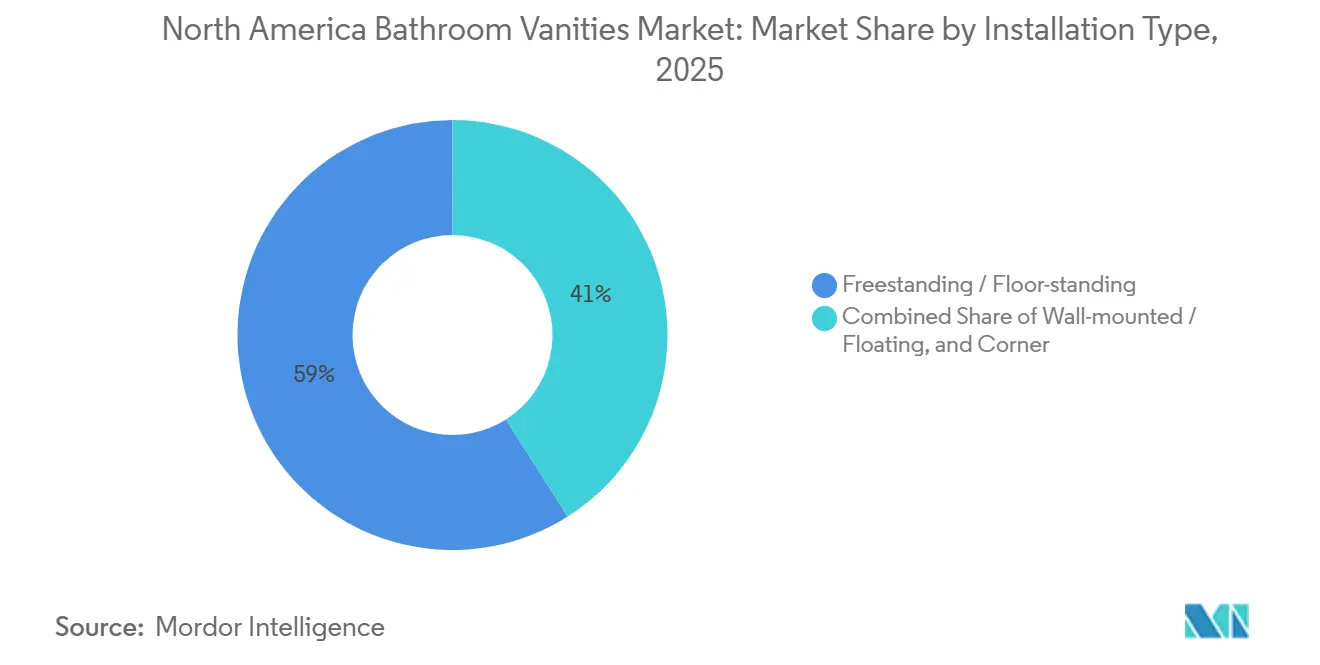
- By installation type, freestanding/floor-standing vanities accounted for the largest value share of the North America bathroom vanities market, at 59.00% in 2025, while wall-mounted/floating vanities are projected to grow at the fastest CAGR of 8.40% during 2026-2031.
- By material, wood accounted for 37.00% of the market in 2025, while stone is projected to grow at the fastest CAGR of 8.00% during 2026-2031.
- By sink configuration, single-sink vanities accounted for 57.00% of the market in 2025, while double-sink vanities are projected to grow at the fastest CAGR of 7.60% during 2026-2031.
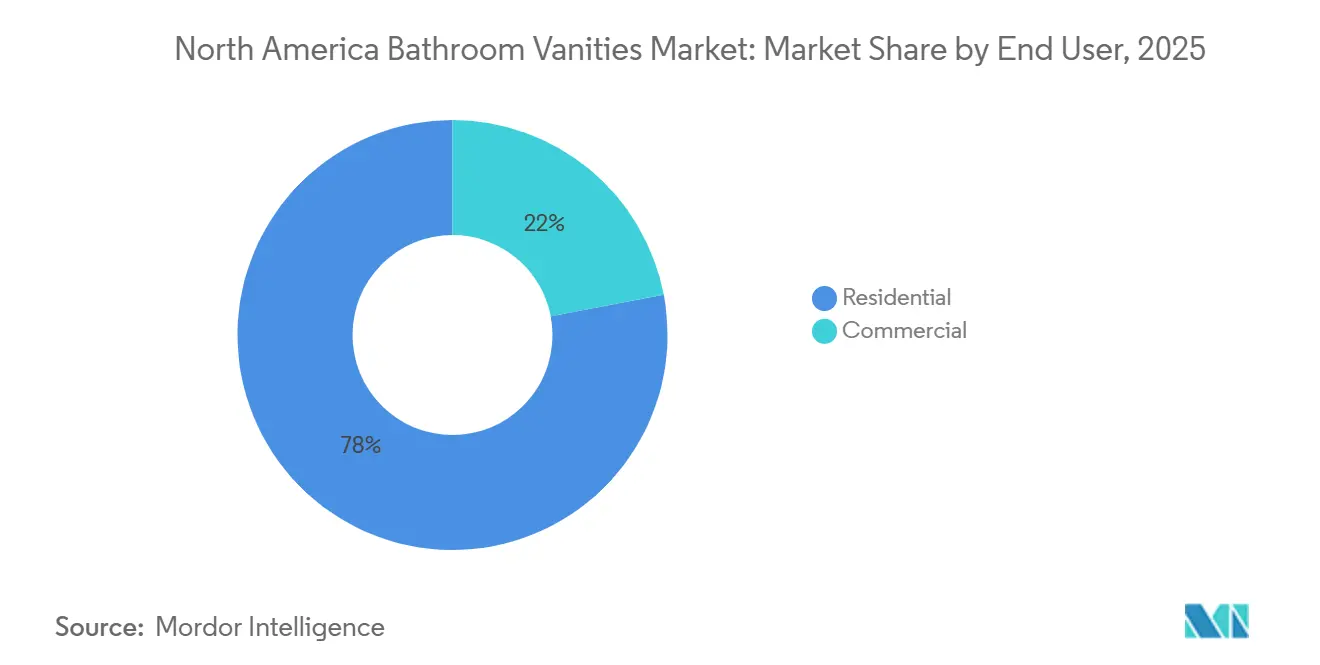
- By end user, residential accounted for 78.00% of the market in 2025, while commercial is projected to grow at the fastest CAGR of 8.70% during 2026-2031.
- By distribution channel, B2C/retail accounted for 63.00% of the market in 2025, while B2B/direct is projected to grow at the fastest CAGR of 8.90% during 2026-2031.
- By geography, the United States accounted for 71.00% of the market in 2025, while Mexico is projected to grow at the fastest CAGR of 7.20% during 2026-2031.
Note: Market size and forecast figures in this report are generated using Mordor Intelligence’s proprietary estimation framework, updated with the latest available data and insights as of January 2026.
North America Bathroom Vanities Market Trends and Insights
Drivers Impact Analysis*
| Driver | (~) % Impact on CAGR Forecast | Geographic Relevance | Impact Timeline |
|---|---|---|---|
| Residential Bathroom Remodeling and Repair Spending | +2.0% | The United States is primary, Canada substantial, and Mexico growing | Medium term (2-4 years) |
| Premium and Customized Bathroom Design Demand | +1.1% | United States primary, Canada secondary | Long term (≥ 4 years) |
| Hospitality and Nonresidential Construction Activity | +0.9% | Mexico fastest growth, United States has a stable volume | Short term (≤ 2 years) |
| E-commerce Expansion and Direct-To-Consumer Assortments | +0.7% | United States, Canada | Medium term (2-4 years) |
| Retrofit-Friendly Vanity Formats for Aging Housing Stock | +0.6% | United States primary | Long term (≥ 4 years) |
| Nearshoring Of Cabinet and Vanity Production in Mexico | +0.5% | USMCA region, northern Mexico industrial corridors | Short term (≤ 2 years) |
| Source: Mordor Intelligence | |||
Residential Bathroom Remodeling and Repair Spending
Residential remodeling supports the North America bathroom vanities market because homeowners are investing in current homes despite difficult moving conditions. The United States faced a housing shortage of 1.2 million units in 2026, which constrained housing choice for many households[2]https://www.nahb.org/news-and-economics/press-releases/2026/08/housing-affordability-worsens-on-higher-mortgage-rates. Higher mortgage rates make relocation less attractive for owners with earlier low mortgages. This helps direct available household equity toward renovation and repair work. Harvard Joint Center for Housing Studies expects annual homeowner improvement outlays to reach USD 518 billion by the end of 2026[3]https://www.jchs.harvard.edu/blog/remodeling-growth-set-downshift-late-2026. The replacement base is less dependent on new-home purchases and can support demand across a range of vanity sizes, materials, and price points.
Premium and Customized Bathroom Design Demand
Premium bathroom design demand supports higher-value vanity specifications in the United States and Canada. Kohler introduced the Claude bathroom collection with Studio McGee in May 2026, including vanities with Carrara quartz tops, hardware options, and integrated electrical features. The launch shows how established suppliers use design collaborations to distinguish products from standard home-center offerings. Integrated vanity, lighting, storage, and countertop choices give homeowners more scope to select coordinated bathroom layouts. Accessibility requirements can also influence the choice of adjustable heights, accessible clearances, and practical hardware. Premium materials and functional features can therefore be specified together in residential and hospitality projects.
Hospitality And Nonresidential Construction Activity
Hotel renovation, multifamily construction, health care facilities, and assisted-living projects create demand for vanities purchased in larger volumes. Commercial projects often require uniform products across many rooms or units. The Hard Rock Hotel West Tower renovation in Las Vegas covers a full re-pipe and bathroom fixture change-out across more than 3,000 guest rooms. Such work requires contractor-grade products with durable finishes and repeatable specifications. The United States commercial installations must also consider accessibility requirements under the Americans with Disabilities Act and the ANSI A117.1 standards. These requirements create a consistent need for compliant formats in renovation programs and new commercial properties.
E-commerce Expansion and Direct-To-Consumer Assortments
Online product information is changing how consumers compare vanity sizes, finishes, storage arrangements, and delivery options. Digital catalogs can provide dimensions and installation guidance before a buyer visits a store or places an order. This is useful for a fixture that must fit existing plumbing and available wall space. Direct-to-consumer assortments can expand the range of styles available beyond a local retail floor. Digital tools can also support product comparison for contractors coordinating smaller renovation projects. Retail showrooms remain important for premium purchases where buyers want to inspect material finishes and design details before ordering.
Restraints Impact Analysis*
| Restraint | (~) % Impact on CAGR Forecast | Geographic Relevance | Impact Timeline |
|---|---|---|---|
| Housing Affordability and Remodeling Financing Pressure | -1.2% | The United States primary, Canada | Short term (≤ 2 years) |
| Volatility In Wood, Engineered Stone, and Hardware Costs | -0.8% | North American exposure to acute | Medium term (2-4 years) |
| Moisture, Installation, And Warranty Risks for Floating Vanities | -0.4% | United States, Canada | Long term (≥ 4 years) |
| Cross-Border Compliance and Product-Liability Complexity | -0.3% | USMCA region, United States-Mexico sourcing | Medium term (2-4 years) |
| Source: Mordor Intelligence | |||
Housing Affordability and Remodeling Financing Pressure
Housing affordability can delay discretionary bathroom projects and reduce the amount households allocate to finishes. The average 30-year fixed mortgage rate reached 6.5% in the second quarter of 2026. The median new-home price was USD 410,700, and a median-income United States household needed to commit 34% of gross income to a new-home mortgage. These conditions leave less flexibility for larger renovation budgets. Remodeling activity still persisted, as the NAHB Remodeling Market Index stood at 61 in the second quarter of 2026. Some buyers may postpone premium upgrades, reduce the scope of a project, or select lower-cost cabinet and countertop formats.
Volatility In Wood, Engineered Stone, And Hardware Costs
Material cost increases place pressure on vanity manufacturers, fabricators, distributors, and contractors. Construction input costs increased 7.1% from July 2025 to July 2026[4]https://www.agc.org/news/2026/08/13/construction-input-costs-climb-71-percent-between-july-2025-and-july-2026-impacts-war-and-tariffs. Over the same period, lumber and plywood prices rose 9.9%, copper and brass mill shapes increased 18.4%, and aluminum mill shapes increased 40.5%. These inputs affect wood cabinets, metal hardware, sink assemblies, and decorative fittings. Smaller suppliers may have less ability to absorb these changes than large companies with established sourcing arrangements. Cost pressure can lead to price adjustments and more cautious specifications in the middle price range.
*Our forecasts treat driver/restraint impacts as directional, not additive. The impact forecasts reflect baseline growth, mix effects, and variable interactions.
Segment Analysis
By Installation Type: Floating Formats Expand Within a Freestanding Base
Freestanding and floor-standing units held 59.00% of the North America bathroom vanities market share in 2025. Their position reflects broad compatibility with existing plumbing in older homes. A floor-standing vanity can often be installed during a partial bathroom renovation without relocating supply lines or drains. This makes it a practical option for owners focused on replacing worn cabinets, sinks, or countertops. It also suits projects where the bathroom layout must remain largely unchanged. The North America bathroom vanities market size for freestanding units is supported by replacement demand in established suburban and urban housing. Builders and remodelers can use these products across entry, mid-range, and premium projects. Their wide assortment of widths, finishes, and storage arrangements supports that flexibility.
Wall-mounted and floating units are forecast to grow at an 8.40% CAGR during 2026-2031. Their appearance can make a smaller bathroom feel more open because the floor remains visible below the cabinet. These products also fit contemporary residential designs that favor clean lines and reduced visual bulk. A wall-mounted design can be installed at accessible heights when the supporting wall and plumbing arrangement allow it. This provides scope for knee clearance in applications designed around mobility requirements. Kohler’s Claude collection includes vanity options that pair with its coordinated bathroom suite. Premium suppliers are using this type of integrated offering to position wall-mounted formats as part of a complete room design. Installation complexity remains a consideration because wall strength, plumbing placement, and moisture management require careful planning.



By Material: Stone Tops Support Premium Specifications
Wood held 37% of the North America bathroom vanities market share in 2025. It remains widely used because it can support a broad range of cabinet styles, stains, painted finishes, and price points. Warm wood tones are being used in bathroom designs that seek more natural-looking surfaces. Wood-based cabinets also fit easily into freestanding vanity formats that dominate many retrofit projects. Manufacturers can produce wood and engineered wood cabinets of standardized sizes for retail programs and contractor orders. Laminate and MDF options continue to provide cost-conscious alternatives with consistent manufacturing properties. These materials are relevant where the buyer prioritizes price, moisture resistance, or repeatable finish selection. Ceramic holds a place in compact residential bathrooms and lower-cost commercial applications. Metal, glass, and solid-surface products remain more specialized choices for design-focused interiors.
Stone, including marble, quartz, and granite, is forecast to grow at an 8% CAGR during 2026–2031. The growth reflects greater use of engineered quartz vanity tops in residential and hospitality projects. Stone tops can be paired with wood, painted, or mineral cabinet finishes, which gives suppliers options for higher-value collections. Integrated countertop and sink designs can also simplify the appearance of the finished installation. The cost of stone surfaces can make this category more sensitive to household budgets and contractor pricing. Higher input costs may widen the gap between standard vanity tops and designer-grade stone products. The North America bathroom vanities market size for stone-led products is closely linked to premium renovation demand and hotel bathroom upgrades.
By Sink Configuration: Double Sinks Gain in Larger Renovations
Single-sink vanities accounted for 57% of the North America bathroom vanities market share in 2025. They are common in compact bathrooms where a single-basin layout matches existing plumbing and available counter space. Many older homes have standard rough-ins designed for one sink. This makes a single-sink replacement less disruptive than a redesign that requires new supply lines and drain connections. The format can also preserve counter space for personal items and accessibility needs. A single basin can be a suitable choice where space is required beside the sink for a mobility aid or assisted use. Manufacturers offer these vanities in broad ranges, making them relevant for small primary bathrooms, secondary bathrooms, and powder rooms. They also support entry and mid-range renovation budgets. Vessels and other specialized sink configurations remain associated with boutique hotels and luxury homes.
Double-sink vanities are forecast to grow at a 7.6% CAGR from 2026 to 2031. They are most relevant to larger primary-bathroom renovations, where simultaneous use and more storage are valued. The configuration is often selected when homeowners rework a primary suite rather than simply replace an existing cabinet. It can also support multigenerational households that place more demand on shared bathrooms. Hospitality properties may use dual-sink layouts in upgraded room categories to improve perceived bathroom quality. These projects generally require wider countertops, more cabinetry, and more complex plumbing work. The higher product content can increase the value of each installation. Double-sink designs may be less practical in smaller bathrooms because they need sufficient wall width and circulation space.
By End User: Commercial Projects Grow Faster Than Residential Demand
Residential applications held 78% of the North America bathroom vanities market share in 2025. Household replacement cycles are the main source of demand because bathroom cabinets, sinks, and tops are renewed as they age or no longer fit the owner’s needs. Owners who remain in their homes can invest in bathroom improvements without undertaking a full property move. This supports steady demand across basic replacement units and more customized products. The residential channel includes homeowner purchases through retail stores, showrooms, designers, and online sellers. It also includes contractor-led projects where the vanity is selected as part of a broader bathroom renovation. Existing housing conditions favor products that can be fitted around current plumbing. Premium residential work contributes to demand for stone tops, double sinks, integrated lighting, and coordinated hardware.
Commercial applications are forecast to expand at an 8.7% CAGR during 2026-2031. Hotel renovations, build-to-rent buildings, health care facilities, and assisted-living properties can create larger and more predictable purchase orders. These buyers often need products that meet durability, accessibility, and installation requirements across many rooms. Standardized specifications can simplify ordering and maintenance for property owners. Hard Rock's redevelopment of the former Mirage in Las Vegas illustrates the scale of bathroom fixture work in a major hospitality project. Commercial orders can have a higher average value because they cover repeated units rather than individual household purchases. This makes direct sales capabilities important for manufacturers serving contractors, developers, and hotel operators. Products must also meet relevant accessibility and material standards.
By Distribution Channel: Direct Buying Changes Procurement Practices
B2C and retail held 63% of the North America bathroom vanities market share in 2025. Home centers remain important for value and mid-range purchases because they offer standardized assortments, local availability, and project-related products in one place. Specialty furniture stores and brand showrooms serve buyers who want greater design support or higher-end options. Retail outlets allow consumers to compare finishes, storage arrangements, countertop materials, and sink configurations before purchase. This can matter for vanities because they are visible fixtures that must fit the room layout. Retail also supports contractors who purchase replacement products for smaller renovation projects. Online retail is becoming more relevant, where consumers can review dimensions, finishes, installation guidance, and delivery options. Digital room-planning tools can reduce uncertainty before a large fixture is ordered. Other retail formats serve lower-price purchases and more immediate replacement needs.
B2B and direct-from-manufacturer procurement are forecast to grow at an 8.90% CAGR during 2026-2031. Developers and hospitality operators use direct purchasing when they need consistent products across many units. This approach can give buyers clearer control over product specifications, order quantities, and delivery timing. It can also reduce the number of intermediaries involved in a large project. Manufacturers benefit when direct relationships create recurring demand from multifamily, build-to-rent, student housing, and hotel customers. Compliance remains important for wood-core cabinets used in commercial work. CARB Phase 2 and TSCA requirements establish a baseline for composite wood products in the North American supply chain. Suppliers that can document compliance may be more credible with professional buyers.
Geography Analysis
The United States held 71% of the North America bathroom vanities market share in 2025. Its position reflects owner-occupied housing scale, mature retail access, and a deep network of remodelers, designers, and contractors. The United States portion of the North America bathroom vanities market size is supported by practical fixture replacement and premium bathroom projects.
Canada has a renovation-led demand profile that shares several features with the United States. Elevated financing and construction costs can make buyers more selective about project timing and scope. The Canadian Home Builders’ Association reported a neutral Renovation Market Index reading of 48.3 for the second half of 2025, while the Future Conditions sub-index averaged 35.2. Canada still contributes a stable replacement base through targeted bathroom upgrades and practical cabinet replacements.
Mexico is forecast to grow at a 7.20% CAGR during 2026-2031, the fastest rate in the region. Its role combines local construction and renovation demand with its value as a manufacturing location for the North American supply. Housing activity in northern industrial corridors can support purchases in expanding cities such as Monterrey, Juárez, and Saltillo. Hospitality projects create further demand for commercial bathroom specifications. The country serves as both a demand geography and a supply base for regional projects under the United States-Mexico-Canada Agreement.
Competitive Landscape
The North America bathroom vanities market is fragmented, with established suppliers at the premium end and many smaller participants in the mid-market. MasterBrand completed its all-stock merger with American Woodmark on May 28, 2026, creating what the companies describe as the most comprehensive portfolio of cabinetry brands in North America. Kohler launched the Claude collection with Studio McGee in May 2026, pairing vanity sizes from 24 inches to 72 inches with Carrara quartz tops and integrated electrical options. This strategy links premium product design with consumer engagement through the Kohler Store by Hajoca at Trolley Square, Salt Lake City.
LIXIL and American Bath Group announced a strategic North American partnership in April 2025. American Bath Group received exclusive rights to produce and distribute bathing products under the American Standard, DXV, and Eljer brands. It also acquired specified LIXIL manufacturing assets in Ohio and Mexico. Masco integrated Liberty Hardware into the Delta Faucet Company effective January 2026. These actions show how larger companies are organizing broader bath-related product portfolios and channel capabilities.
Regional manufacturers and direct-import brands compete where buyers prioritize price, delivery, and standard dimensions. Established suppliers retain advantages in testing, warranty support, compliance documentation, and retail access. Premium companies are adding coordinated lighting, storage, electrical features, and fittings to differentiate their collections. The North America bathroom vanities market remains competitive, with strong premium brands and many smaller participants in the middle and value segments.
North America Bathroom Vanities Industry Leaders
Kohler Co.
Masco Corporation
MasterBrand, Inc.
LIXIL Corporation
Fortune Brands Innovations, Inc.
- *Disclaimer: Major Players sorted in no particular order

Recent Industry Developments
- May 2026: MasterBrand, Inc. completed its all-stock merger with American Woodmark Corporation on May 28, 2026, combining two of North America's largest cabinet and vanity manufacturers. American Woodmark became a wholly owned subsidiary and was delisted from Nasdaq.
- May 2026: Kohler Co. unveiled the Claude bathroom collection in partnership with Studio McGee, encompassing vanities in 24-inch to 72-inch sizes with Carrara quartz tops, Malin hardware, and integrated electrical options in White Oak, Draper Oak, and White finishes. The collection also included a smart toilet, freestanding bath, console sinks, undermount sinks, and mirrors. Kohler opened its first Utah retail store, a 9,584-square-foot space with 10 suites and 23 product vignettes at Trolley Square in Salt Lake City.


North America Bathroom Vanities Market Report Scope
| Freestanding / Floor-standing |
| Wall-mounted / Floating |
| Corner |
| Wood |
| Ceramic |
| Stone (Marble, Quartz, Granite) |
| Laminate / MDF |
| Others (Metal, Glass, Solid Surface) |
| Single Sink |
| Double Sink |
| Others (e.g., Vessel, Integrated Multi-bowl) |
| Residential |
| Commercial |
| B2C/Retail | Home Centers |
| Specialty Furniture Stores (including exclusive brand outlets) | |
| Online | |
| Other Distribution Channels (includes hypermarkets, supermarkets, teleshopping, warehouse clubs, departmental stores, etc.) | |
| B2B/Directly from Manufacturers |
| United States |
| Canada |
| Mexico |
| By Installation Type | Freestanding / Floor-standing | |
| Wall-mounted / Floating | ||
| Corner | ||
| By Material | Wood | |
| Ceramic | ||
| Stone (Marble, Quartz, Granite) | ||
| Laminate / MDF | ||
| Others (Metal, Glass, Solid Surface) | ||
| By Sink Configuration | Single Sink | |
| Double Sink | ||
| Others (e.g., Vessel, Integrated Multi-bowl) | ||
| By End User | Residential | |
| Commercial | ||
| By Distribution Channel | B2C/Retail | Home Centers |
| Specialty Furniture Stores (including exclusive brand outlets) | ||
| Online | ||
| Other Distribution Channels (includes hypermarkets, supermarkets, teleshopping, warehouse clubs, departmental stores, etc.) | ||
| B2B/Directly from Manufacturers | ||
| By Geography | United States | |
| Canada | ||
| Mexico | ||


Key Questions Answered in the Report
What is driving demand for bathroom vanities in North America?
Replacement projects, homeowner renovation spending, and commercial bathroom upgrades support demand. U.S. homeowner improvement spending is projected to reach USD 518 billion by the end of 2026.
How large is the North America bathroom vanities market?
North America bathroom vanities market is estimated at USD 13.70 billion in 2026 and is forecast to reach USD 18.60 billion by 2031.
Which installation type is growing fastest?
Wall-mounted and floating vanities are forecast to grow at an 8.4% CAGR from 2026 to 2031, while freestanding units held the leading 59% share in 2025.
Which material has the highest growth outlook for bathroom vanities?
By material, wood accounted for 37.00% of the market in 2025, while stone is projected to grow at the fastest CAGR of 8.00% during 2026–2031.
Page last updated on:


 Your data is secure and never sold or shared.


