
Nickel Hydroxide Market Size and Share
Market Overview
| Study Period | 2021 - 2031 |
|---|---|
| Market Size (2026) | USD 2.66 Billion |
| Market Size (2031) | USD 3.52 Billion |
| Growth Rate (2026 - 2031) | 5.76 % |
| Fastest Growing Market | North America |
| Largest Market | Asia-Pacific |
| Market Concentration | Medium |
Major Players *Disclaimer: Major Players sorted in no particular order Image © Mordor Intelligence. Reuse requires attribution under CC BY 4.0. | |
Nickel Hydroxide Market Analysis by Mordor Intelligence
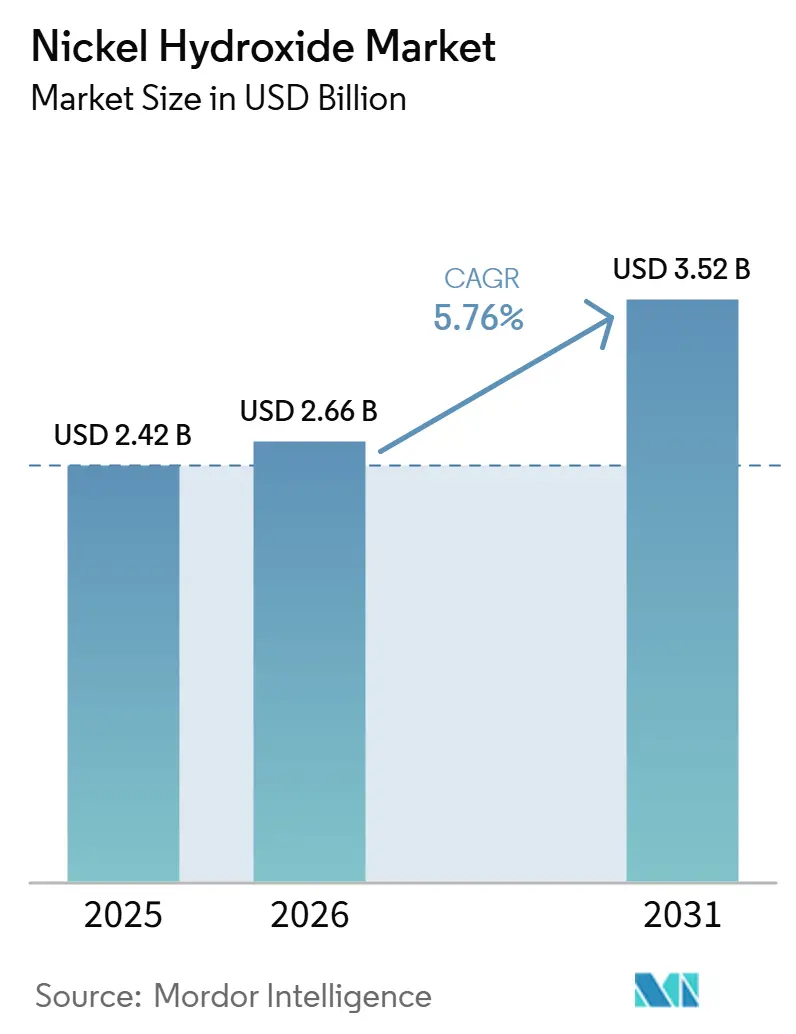
The Nickel Hydroxide Market size was valued at USD 2.42 billion in 2025 and is estimated to grow from USD 2.66 billion in 2026 to reach USD 3.52 billion by 2031, at a CAGR of 5.76% during the forecast period (2026-2031). Competitive positioning in the nickel hydroxide market depends heavily on feedstock access and process control, because producers without secure mixed hydroxide precipitate supply face cost pressure when premium-grade nickel availability tightens, even in a broader primary nickel surplus environment. The nickel hydroxide market is also balancing two opposing forces, with LFP expanding in China while nickel-rich chemistries still dominate many premium and non-China EV applications, and catalyst demand is creating a second source of growth beyond vehicle cycles, as per the International Energy Agency (IEA).
Key Report Takeaways
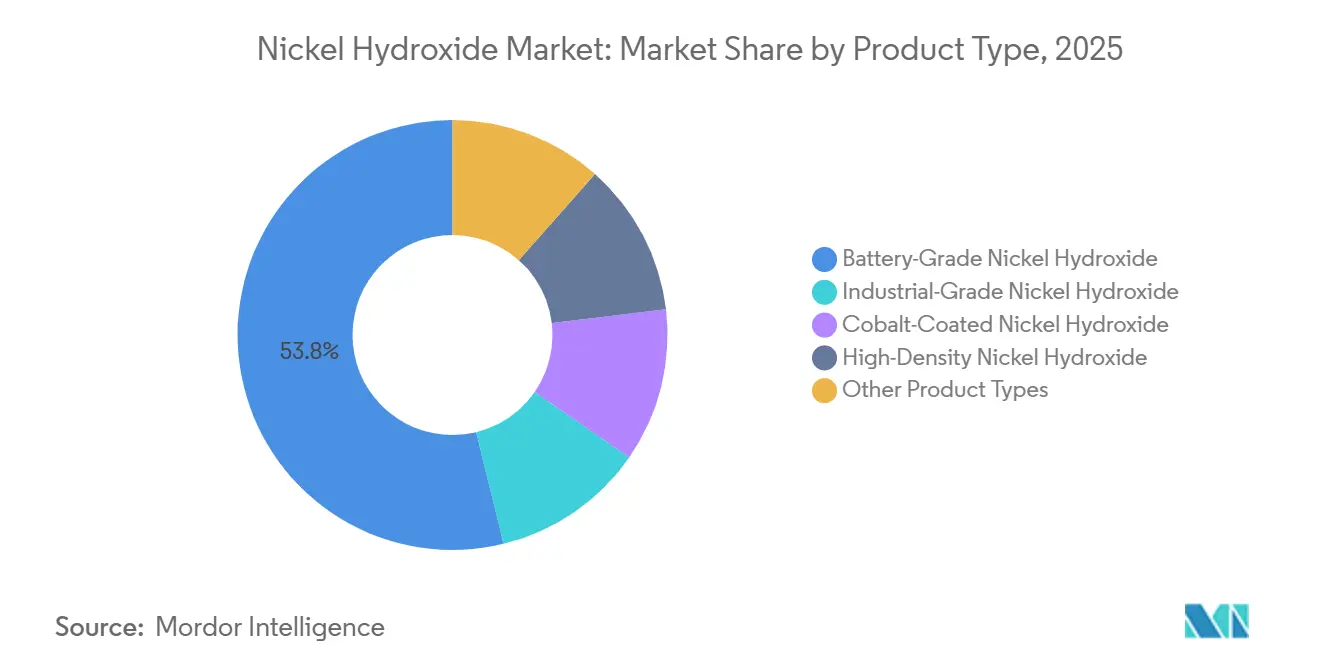
- By product type, Battery-Grade Nickel Hydroxide led with 53.81% revenue share in 2025, while Cobalt-Coated Nickel Hydroxide is forecast to grow at a 6.62% CAGR through 2031.
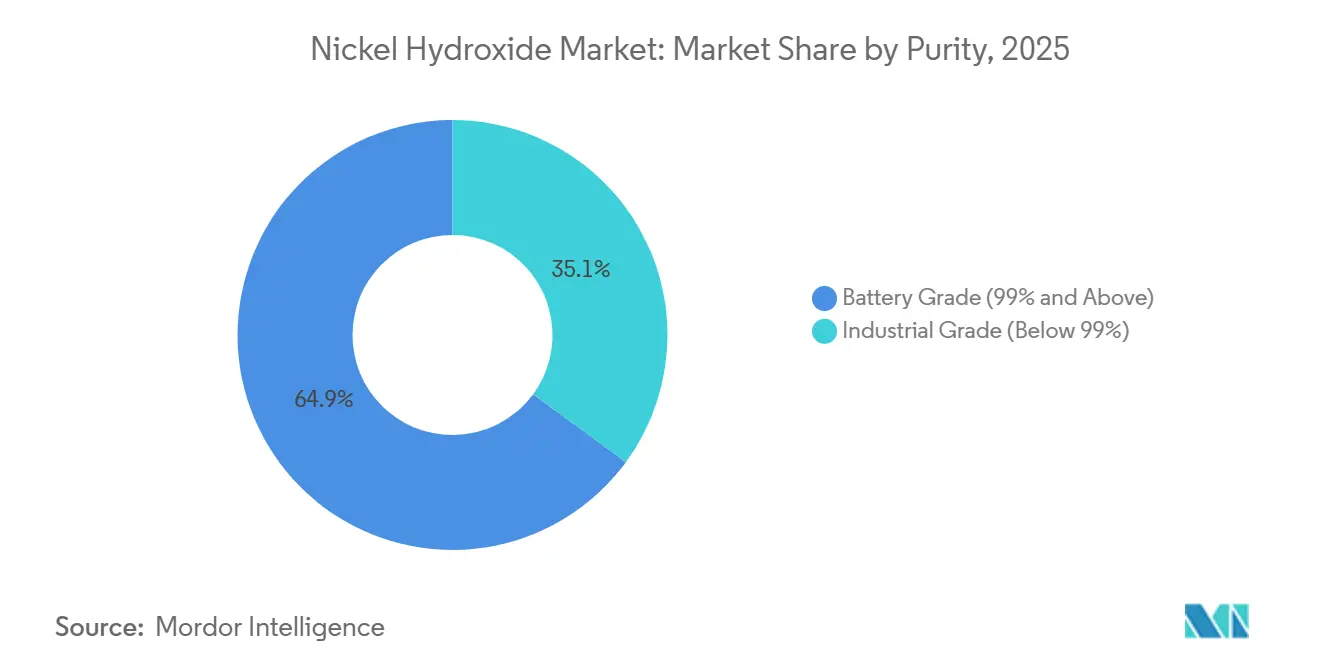
- By purity, Battery Grade (99% and above) held 64.93% revenue share in 2025 and is expected to record the fastest projected CAGR at 6.31% through 2031.
- By form, Powder accounted for 58.12% share in 2025, while Spherical is projected to advance at a 5.82% CAGR through 2031.
- By application, Rechargeable Batteries captured 57.44% revenue share in 2025, while Catalysts is forecast to expand at a 6.24% CAGR through 2031.
- By end-use industry, Battery Manufacturing held 48.61% revenue share in 2025, while Automotive is projected to grow at a 6.48% CAGR through 2031.
- By geography, Asia-Pacific held 59.23% share in 2025, while North America registered the highest projected CAGR at 6.37% through 2031.
Note: Market size and forecast figures in this report are generated using Mordor Intelligence’s proprietary estimation framework, updated with the latest available data and insights as of January 2026.
Global Nickel Hydroxide Market Trends and Insights
Drivers Impact Analysis*
| Driver | (~) % Impact on CAGR Forecast | Geographic Relevance | Impact Timeline |
|---|---|---|---|
| Rapid adoption of EVs and high-performance batteries driving NMC cathode precursor demand | +1.8% | Global, highest concentration in China, Europe, and North America | Long term (≥ 4 years) |
| Structural shift toward high-purity battery-grade nickel hydroxide in NMC 811 and 9-series formulations | +1.2% | APAC core (China, Japan, South Korea), spill-over to North America and Europe | Medium term (2–4 years) |
| Increasing deployment of grid-scale energy storage systems requiring nickel-rich batteries | +0.9% | Global, with early gains in the United States, European Union, and China | Medium term (2–4 years) |
| Growing use of nickel hydroxide as a catalyst in petroleum refining, pharmaceutical hydrogenation, and specialty chemical synthesis | +0.4% | Global, particularly Europe, Japan, and India | Long term (≥ 4 years) |
| Government support for domestic battery manufacturing through tax credits, grants, and localization mandates | +0.8% | North America (IRA §45X), Europe (EU Battery Regulation, Net-Zero Industry Act), Asia (Japan METI, India PLI) | Medium term (2–4 years) |
| Source: Mordor Intelligence | |||
Rapid EV Adoption Intensifying Cathode Precursor Demand
Global EV battery deployment is expected to reach 1.2 TWh in 2025, a 30% increase from 2024, keeping battery materials demand on a strong upward trajectory[1]International Energy Agency, “Electric Vehicle Batteries, Global EV Outlook 2026,” IEA, iea.org . The nickel hydroxide market benefits from this shift, as higher-energy battery platforms continue to rely on nickel-rich cathode chemistries to deliver longer range and stronger performance. The premium EV segment remains especially important, as vehicle programs targeting longer driving ranges continue to favor nickel-bearing chemistries over lower-cost alternatives outside China. This trend sustains demand for materials that can move directly into cathode precursor production while meeting consistent purity and particle control requirements. Therefore, the nickel hydroxide market tracks not only EV unit sales but also the battery chemistry mix selected for those vehicles. As high-nickel cell platforms advance further into commercial use, material demand increases in a more concentrated and specification-driven manner.
Structural Shift Toward High-Purity Battery-Grade Specifications Redefining Supply Standards
The nickel hydroxide market is moving away from industrial-grade material and toward battery-grade supply that can meet stricter cathode manufacturing standards. Battery Grade with 99% and above purity held 64.9% of revenue in 2025, which shows how much the market already depends on advanced battery applications. This change is being reinforced by formal supply chain requirements, including tighter quality and traceability expectations across battery materials procurement . Producers that can maintain tighter impurity controls and more reliable co-precipitation performance are better placed to secure long-term customer approvals. The nickel hydroxide market is also becoming harder for new entrants to access because qualification standards now matter as much as nominal installed capacity. That combination supports pricing discipline for established suppliers, even when broader nickel supply appears more comfortable.
Growing Grid-Scale Energy Storage Deployment Broadening Demand Beyond EVs
The nickel hydroxide market is shifting from industrial-grade material toward battery-grade supply that meets stricter cathode manufacturing standards. Battery Grade with 99% and above purity is projected to account for 64.9% of revenue in 2025, highlighting the market’s growing dependence on advanced battery applications. Formal supply chain requirements, including tighter quality and traceability expectations across battery materials procurement, are reinforcing this shift. Producers that maintain tighter impurity controls and deliver more reliable co-precipitation performance are better positioned to secure long-term customer approvals. The nickel hydroxide market is also becoming more difficult for new entrants to access, as qualification standards now carry as much importance as nominal installed capacity. This combination supports pricing discipline for established suppliers, even when broader nickel supply conditions appear more favorable.
Government Localization Mandates Reshaping Supply Chain Geography
Policy support is reshaping the nickel hydroxide market by moving battery supply chains closer to end-use manufacturing regions. In the United States, the Inflation Reduction Act has encouraged a major battery investment pipeline and elevated upstream materials planning as a strategic priority. In March 2025, Revex Technologies is expected to receive a contracted USD 145 million grant from the U.S. Department of Energy to develop a domestic nickel critical mineral supply, directly addressing an upstream gap in the U.S. battery chain. In Europe, the Battery Regulation will tighten due diligence and carbon reporting requirements from August 2026 onward, increasing the value of traceable and lower-emission material sourcing. As a result, the nickel hydroxide market is shifting from a purely cost-led sourcing model to one that also accounts for policy eligibility, traceability, and regional compliance. This shift creates opportunities for suppliers that can combine specification quality with local or politically aligned supply chains.
Restraints Impact Analysis*
| Restraint | (~) % Impact on CAGR Forecast | Geographic Relevance | Impact Timeline |
|---|---|---|---|
| High capital intensity of battery-grade nickel hydroxide co-precipitation lines, limiting new entrant throughput | -1.0% | Global, most acute in North America and Europe where greenfield costs are highest | Medium term (2–4 years) |
| Growing adoption of LFP and LMFP chemistries reducing per-vehicle nickel hydroxide intensity in mass-market EV segments | -0.9% | China (dominant), with increasing spill-over to cost-sensitive emerging markets | Long term (≥ 4 years) |
| Nickel feedstock price volatility and RKAB mining quota tightening in Indonesia creating procurement cost unpredictability | -0.7% | APAC core, spill-over to all geographies dependent on Indonesian MHP supply | Short term (≤ 2 years) |
| Source: Mordor Intelligence | |||
High Capital Requirements Constraining Battery-Grade Capacity Expansion
The nickel hydroxide market faces a significant barrier due to the high cost of building and qualifying battery-grade co-precipitation lines. New facilities require more than construction capital; they also need process validation, waste treatment systems, and customer approvals, which can take years to complete. This challenge is more pronounced in North America and Europe, where labor and environmental compliance costs are higher than in China. U.S. policy discussions have also highlighted that domestic critical mineral and battery material production still carries a cost disadvantage compared to imports, especially in processing stages that have received less support than lithium and graphite[2]Federation of American Scientists, “Critical Thinking on Critical Minerals,” Federation of American Scientists, fas.org . As a result, the nickel hydroxide market favors larger, more integrated players that can spread costs across mining, intermediate processing, and precursor manufacturing. Smaller producers can still participate, but they often struggle to match price and specification consistency simultaneously.
LFP Chemistry Adoption Moderating But Not Eliminating Demand Growth
The rise of LFP and LMFP chemistries in cost-sensitive EV segments is pressuring the nickel hydroxide market. LFP is projected to surpass 55% of global EV battery deployment in 2025, indicating that lower-cost battery systems are scaling rapidly. However, the battery market remains segmented, and nickel-bearing chemistries continue to hold a strong position in premium and longer-range vehicle classes outside China. As a result, the immediate risk for nickel hydroxide is slower growth in certain vehicle classes rather than a complete loss of relevance. The nickel hydroxide market also continues to benefit from high-nickel cathode development and solid-state battery programs, which still rely on advanced nickel-rich precursor inputs. Therefore, LFP remains an important restraint, but it acts as a moderating force rather than a complete substitute across all battery applications.
*Our forecasts treat driver/restraint impacts as directional, not additive. The impact forecasts reflect baseline growth, mix effects, and variable interactions.
Segment Analysis
By Product Type: Battery-Grade Specifications Set the Commercial Agenda
Battery-grade nickel hydroxide accounted for 53.81% of the nickel hydroxide market share in 2025, reflecting the strong shift in demand toward battery-related applications. This segment leads as cathode active material producers increasingly require precursor inputs that support nickel-rich battery formulations and stricter process tolerances. Industrial-grade nickel hydroxide continues to serve electroplating, pigments, and general chemical synthesis applications, maintaining its role in the broader nickel hydroxide industry. However, it has a slower growth profile as the revenue mix continues to shift toward higher-value battery specifications. As a result, the nickel hydroxide market is becoming more dependent on producers that can supply qualified battery materials rather than generic chemical grades.
Cobalt-coated nickel hydroxide is projected to register a CAGR of 6.62% through 2031, making it the fastest-growing product sub-category in the nickel hydroxide market. Demand is increasing as cathode producers use cobalt surface treatment to improve cycle stability and reduce structural degradation in high-nickel electrodes. High-density nickel hydroxide is also gaining traction in solid-state battery precursor development, where packing density and slurry performance are critical. Product differentiation now depends on both technical performance and procurement confidence, as buyers increasingly assess sustainability and supply chain compliance alongside chemistry. This trend keeps the nickel hydroxide market focused on higher-specification products that are harder to replace and more difficult to qualify.



By Purity: Ultra-High-Purity Grades Capturing Premium Economics
Battery Grade nickel hydroxide with 99% and above purity accounted for 64.93% of revenue in 2025 and is expected to grow at a 6.31% CAGR through 2031. This performance indicates that purity has become a commercial requirement in the nickel hydroxide market rather than an optional premium feature. Buyers in battery supply chains require tighter impurity control, more stable particle characteristics, and more reliable lot-to-lot consistency. Industrial Grade nickel hydroxide with below 99% purity continues to support electroplating, ceramics, pigments, and commodity chemical applications, keeping its demand base intact. However, it has lower pricing power because it does not occupy a central position in advanced battery procurement.
The shift toward tighter standards is also changing which companies can compete effectively in the nickel hydroxide market. Producers that consistently supply higher-purity material are better positioned to secure customer approvals and maintain stronger margins. Regulatory pressure further reinforces this divide, as quality, traceability, and process control are receiving greater formal attention across battery-related supply chains. Small volumes of ultra-high-purity material for emerging battery platforms may remain niche today, but they add an important premium layer to the product mix. As a result, the nickel hydroxide market is becoming more quality-driven, supporting established suppliers with proven processing capabilities.
By Form: Spherical Morphology Driving Next-Generation Cathode Performance
Powder is held a 58.12% share in 2025, maintaining its position as the standard commercial form across much of the nickel hydroxide market. Its position reflects its compatibility with established processing routes in both battery and industrial applications. Powder also benefits from industry familiarity, production scale, and a broad installed base of downstream equipment. Granular and other forms continue to serve narrower industrial applications, including selected catalyst supports and specialty formulation work. As a result, the form mix continues to reflect conventional supply patterns, even as battery requirements become more demanding.
Spherical material is projected to register a 5.82% CAGR through 2031, making it the fastest-growing form in the nickel hydroxide market. Interest in spherical morphology is increasing because it supports higher tap density, more uniform particle distribution, and more consistent electrochemical performance in advanced cells. These attributes are becoming more important as cathode design shifts toward higher nickel loading and tighter production tolerances. Process improvements are also helping reduce the cost gap between spherical and conventional powder grades, which should support wider adoption over time. Consequently, morphology is evolving from a technical detail into a meaningful competitive factor in the nickel hydroxide market.
By Application: Catalysts Outpacing Batteries in Growth Rate
Rechargeable batteries accounted for 57.44% of the nickel hydroxide market size in 2025, confirming that batteries remain the primary outlet for this material. This position is linked to EV growth, battery manufacturing expansion, and the continued use of nickel-rich chemistries in premium and high-energy applications. Electroplating also remains relevant, particularly in automotive decorative coatings and consumer electronics hardware that require reliable surface finishing inputs. Ceramics and pigments contribute a mature but steady demand stream through specialty glass and advanced industrial applications. Chemical intermediates add another stable channel by supplying nickel salts used across several downstream processes.
Catalysts are projected to grow at a CAGR of 6.24% through 2031, making them the fastest-growing application in the nickel hydroxide market. Growth is driven by refinery hydrotreating, pharmaceutical hydrogenation, and selected electrochemical applications that expand the addressable demand base beyond transportation. Recent scientific research has also shown that nickel copper hydroxide electrodes can support ammonia oxidation with hydrogen recovery at high current density, highlighting emerging value in decarbonization-linked processes. This development is significant because it provides the market with a second growth channel that is not fully tied to EV chemistry cycles. The nickel hydroxide market, therefore, benefits as industrial buyers seek catalytic performance, stability, and lower-cost alternatives in specialty chemical and energy applications.
By End-Use Industry: Automotive Sector Pulling Battery Manufacturing Forward
Battery manufacturing accounted for 48.61% of end-use revenue in 2025, making it the largest end-use segment in the nickel hydroxide market. This share reflects the concentration of precursor and cathode production in Asia-Pacific, where large-scale battery materials capacity remains clustered. Electronics continues to serve as an important secondary outlet through nickel-metal hydride batteries used in hybrid vehicles, tools, and industrial systems. The chemical industry also supports steady consumption through catalysts and specialty production routes that do not depend on passenger EV demand. Aerospace and defense represent a smaller but technically demanding niche, with strict traceability and purity standards.
Automotive is projected to register a 6.48% CAGR through 2031, making it the fastest-growing end-use industry in the nickel hydroxide market. This growth reflects a shift in procurement behavior, as automakers move closer to direct materials sourcing rather than relying solely on cell suppliers. Premium EV programs continue to require higher energy density, keeping nickel-rich materials relevant even as lower-cost chemistries expand across mass-market vehicles. As OEMs prioritize supply security, they are exerting greater influence over precursor planning, regional sourcing, and qualification standards. This trend keeps the nickel hydroxide market closely linked to long-range vehicle strategies and the upstream decisions that support them.
Geography Analysis
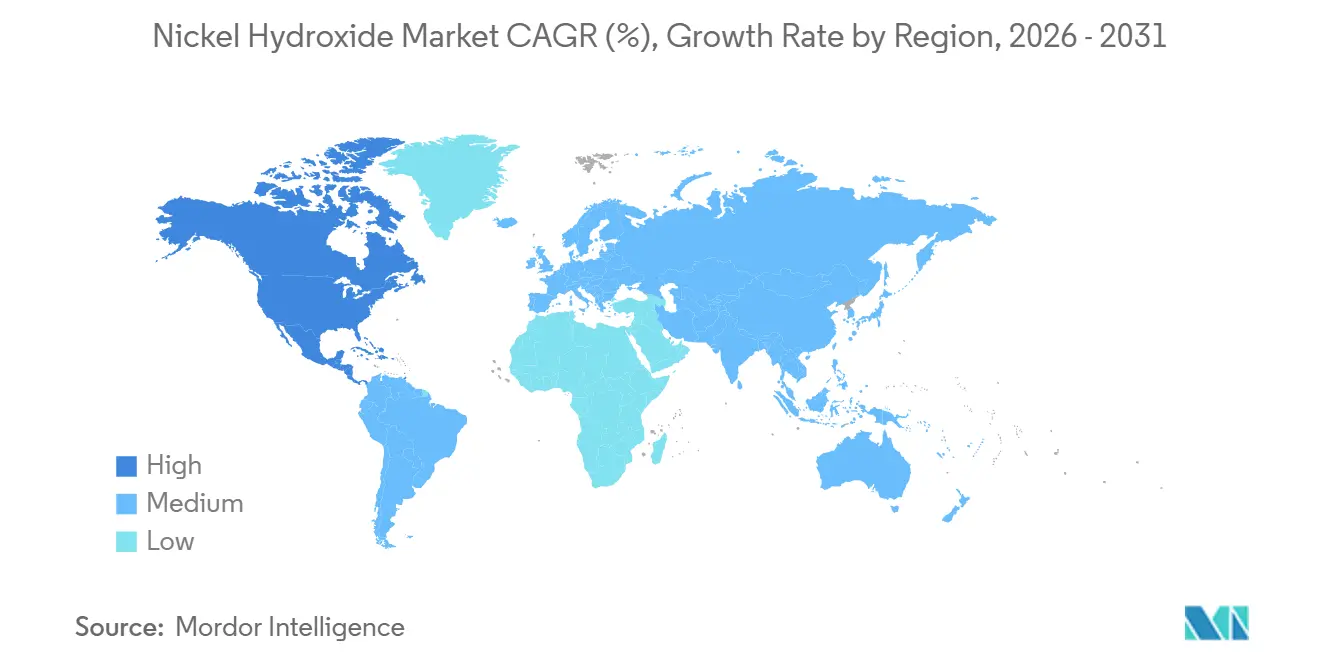
Asia-Pacific held 59.23% of the nickel hydroxide market share in 2025, which kept the region firmly at the center of global production and consumption. China remains the core of this position because it combines cathode precursor processing, battery manufacturing, and large end-market demand within one tightly linked supply chain. Japan adds strength through precision nickel refining and specialty materials capability, which supports higher-specification battery inputs. South Korea also plays a central role through integrated battery materials groups that continue to secure upstream nickel supply and expand downstream cathode capacity. The nickel hydroxide market in Asia-Pacific therefore benefits from scale, process depth, and supply chain coordination that other regions are still building.
North America is projected to grow at a 6.37% CAGR through 2031, which makes it the fastest-growing regional part of the nickel hydroxide market size. This growth is being driven by the Inflation Reduction Act, localization targets, and a broad effort to reduce dependence on imported battery materials. The region is still building its upstream base, which is why support for domestic nickel processing has become strategically important. Canada and Mexico are also becoming more integrated into this regional battery network as OEMs work to meet domestic content and supply chain eligibility rules. For the nickel hydroxide market, this means future demand growth in North America will depend not only on battery assembly, but also on whether qualified precursor and feedstock capacity can be built locally.
Europe remains an important demand center in the nickel hydroxide market because it has an established NMC battery manufacturing base and strict regulatory expectations. Germany, the UK, France, and Italy continue to anchor regional demand through automaker-linked battery investment and industrial chemicals use. The EU Battery Regulation is a major commercial filter because it strengthens carbon footprint disclosure and due diligence requirements for EV battery supply chains . South America and the Middle East and Africa remain smaller in current size, but they are becoming more relevant as EV incentives, refining demand, and new battery materials projects create room for future processing growth.

Competitive Landscape
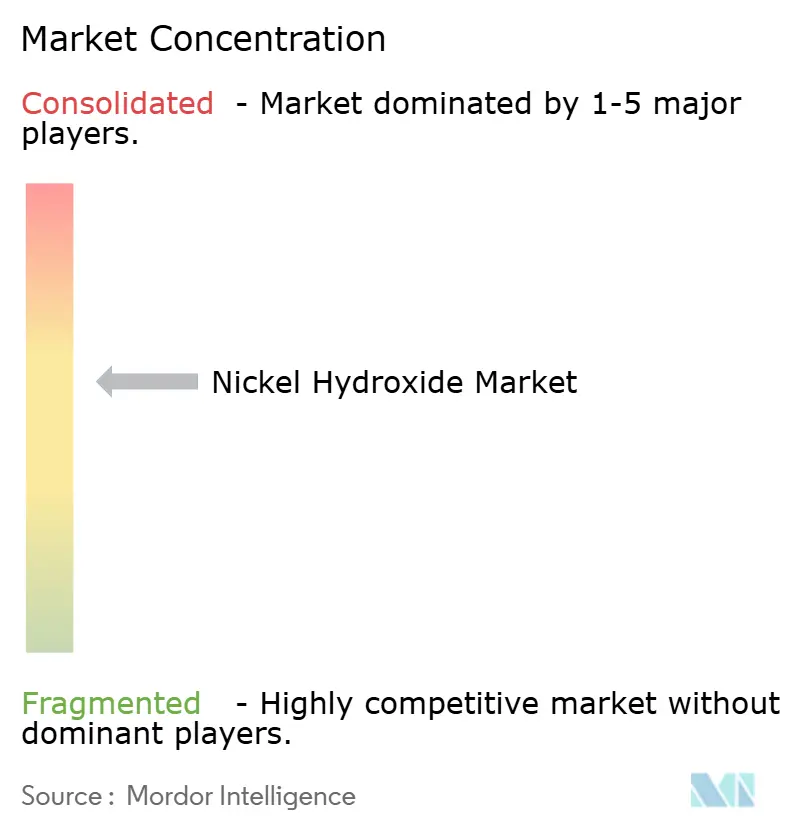
The nickel hydroxide market is moderately concentrated, with leading Chinese integrated producers competing from a position of scale, feedstock access, and co-precipitation expertise. CNGR Advanced Material, GEM Co., and Guangxi Yinyi remain central names because battery-grade supply increasingly depends on upstream nickel control as much as downstream processing quality. The nickel hydroxide market also rewards geographic flexibility, since customers in North America and Europe are looking for supply that can meet both technical and policy requirements. This is why upstream access to mixed hydroxide precipitate from Indonesia has become a major competitive advantage for integrated groups. Producers without direct access to premium-grade feedstock face tighter margins when ore approvals or intermediate supply conditions become less favorable.
Strategy in the nickel hydroxide market is now splitting into two clear tracks. Chinese leaders are still expanding raw material control and overseas manufacturing positions, while some European players are concentrating capital on recycling, partnerships, and higher-margin battery materials niches. Umicore illustrated this shift in 2025 when it announced pCAM EV battery supply agreements with CNGR and Eco&Dream, which showed a partnership-led route to securing material without relying only on internal scale-up. In Indonesia, Danantara Indonesia signed a USD 1.42 billion heads-of-agreement with GEM in August 2025 for a 66,000-tonne HPAL nickel smelter in Sulawesi, which underlined how seriously governments and strategic investors now view battery metal security. In June 2026, EcoPro Group committed KRW 1.5 trillion, which is USD 1 billion, to expand its stake in the BNSI project in Indonesia and secure 65,000 tonnes per year of nickel rights for NCM cathode production, which showed how aggressively non-Chinese players are also moving upstream.
White space in the nickel hydroxide market remains strongest in non-FEOC-compliant battery-grade capacity for North America and Europe. This gap exists because end-market incentives are rising faster than local precursor and nickel processing capacity. New entrants may find room in that space, but only if they can meet both qualification standards and cost expectations. The market, therefore, remains open enough to allow selective expansion but concentrated enough that integrated leaders still set the pace on scale, security, and commercial credibility.
Nickel Hydroxide Industry Leaders
Sumitomo Metal Mining Co., Ltd.
Norilsk Nickel
Umicore
Jinchuan Group International Resources Co. Ltd.
Tanaka Chemical Corporation
- *Disclaimer: Major Players sorted in no particular order

Recent Industry Developments
- July 2026: EcoPro Group committed USD 1 billion to Indonesia BNSI nickel smelter. EcoPro and EcoPro BM secured a combined 39% stake in the Bahodopi Nickel Smelting Indonesia project in Sulawesi, expanding annual nickel supply rights to 65,000 tonnes and establishing a non-FEOC-compliant feedstock base for NCM cathode manufacturing in North America and Europe.
- June 2026: EcoPro BM launched KRW 1.2 trillion capital raise, which is USD 800 million, to fund nickel refinery and Hungarian plant expansion. The fundraising targeted the BNSI second phase and mass-production ramp at EcoPro's Hungarian subsidiary, reinforcing its vertically integrated NMC cathode value chain.
- August 2025: Danantara Indonesia signed USD 1.42 billion Heads of Agreement with GEM for 66,000-tons HPAL nickel smelter in Sulawesi. The facility produces mixed hydroxide precipitate for battery cathode precursor manufacturing, with Indonesian sovereign wealth fund participation.


Global Nickel Hydroxide Market Report Scope
Nickel hydroxide is an inorganic, lime-green crystalline solid. Its electroactive properties make it a vital cathode material in rechargeable batteries, including nickel-cadmium (Ni-Cd) and nickel-metal hydride (Ni-MH) cells.
The Nickel Hydroxide Market is segmented by product type, purity, form, application, end-use industry, and geography. By product type, the market is segmented into battery-grade nickel hydroxide, industrial-grade nickel hydroxide, cobalt-coated nickel hydroxide, high-density nickel hydroxide, and other product types. By purity, the market is segmented into battery grade (99% and above) and industrial grade (below 99%). By form, the market is segmented into powder, granules, spherical, and other forms. By application, the market is segmented into batteries, electroplating, catalysts, ceramics and pigments, chemical intermediates, and other applications. By end-use industry the market is divided into battery manufacturing, automotive, electronics, chemical industry, aerospace and defense, and other end-use industries. By geography, the market is segmented into Asia Pacific, North America, Europe, South America, and the Middle East & Africa. The report also covers market size and forecasts for nickel hydroxide across 20 countries in major regions. The market size and forecasts are provided in terms of value (USD)
| Battery-Grade Nickel Hydroxide |
| Industrial-Grade Nickel Hydroxide |
| Cobalt-Coated Nickel Hydroxide |
| High-Density Nickel Hydroxide |
| Other Product Types |
| Battery Grade (99% and Above) |
| Industrial Grade (Below 99%) |
| Powder |
| Granules |
| Spherical |
| Other Forms |
| Rechargeable Batteries |
| Electroplating |
| Catalysts |
| Ceramics and Pigments |
| Chemical Intermediates |
| Other Applications |
| Battery Manufacturing |
| Automotive |
| Electronics |
| Chemical Industry |
| Aerospace and Defense |
| Other End-Use Industries |
| Asia-Pacific | China |
| India | |
| Japan | |
| South Korea | |
| Rest of Asia Pacific | |
| North America | United States |
| Canada | |
| Mexico | |
| Europe | Germany |
| United Kingdom | |
| France | |
| Italy | |
| Russia | |
| Rest of Europe | |
| South America | Brazil |
| Argentina | |
| Rest of South America | |
| Middle East and Africa | Saudi Arabia |
| South Africa | |
| Rest of Middle East and Africa |
| By Product Type | Battery-Grade Nickel Hydroxide | |
| Industrial-Grade Nickel Hydroxide | ||
| Cobalt-Coated Nickel Hydroxide | ||
| High-Density Nickel Hydroxide | ||
| Other Product Types | ||
| By Purity | Battery Grade (99% and Above) | |
| Industrial Grade (Below 99%) | ||
| By Form | Powder | |
| Granules | ||
| Spherical | ||
| Other Forms | ||
| By Application | Rechargeable Batteries | |
| Electroplating | ||
| Catalysts | ||
| Ceramics and Pigments | ||
| Chemical Intermediates | ||
| Other Applications | ||
| By End-Use Industry | Battery Manufacturing | |
| Automotive | ||
| Electronics | ||
| Chemical Industry | ||
| Aerospace and Defense | ||
| Other End-Use Industries | ||
| By Geography | Asia-Pacific | China |
| India | ||
| Japan | ||
| South Korea | ||
| Rest of Asia Pacific | ||
| North America | United States | |
| Canada | ||
| Mexico | ||
| Europe | Germany | |
| United Kingdom | ||
| France | ||
| Italy | ||
| Russia | ||
| Rest of Europe | ||
| South America | Brazil | |
| Argentina | ||
| Rest of South America | ||
| Middle East and Africa | Saudi Arabia | |
| South Africa | ||
| Rest of Middle East and Africa | ||


Key Questions Answered in the Report
What is the market size of the Nickel Hydroxide Market?
The Nickel Hydroxide Market reached USD 2.66 billion in 2026 and is projected to reach USD 3.52 billion by 2031, growing at a 5.76% CAGR over 2026 to 2031.
Which product type leads the Nickel Hydroxide Market?
Battery-Grade Nickel Hydroxide led the market in 2025 with a 53.81% share, due to critical use as a key precursor material in lithium-ion battery cathodes, driven by rapidly growing electric vehicle and energy storage demand.
Which region leads global demand for nickel hydroxide?
Asia-Pacific led with 59.23% share in 2025 because China, Japan, and South Korea remain deeply integrated across refining, precursor production, and battery manufacturing.
Which purity grade is expanding fastest?
Battery grade purity above 99% leads purity demand and is set to grow at 6.31% CAGR.
Page last updated on:





