
Netherlands Responsible Tourism Market Size and Share
Market Overview
| Study Period | 2021 - 2031 |
|---|---|
| Forecast Data Period | 2026 - 2031 |
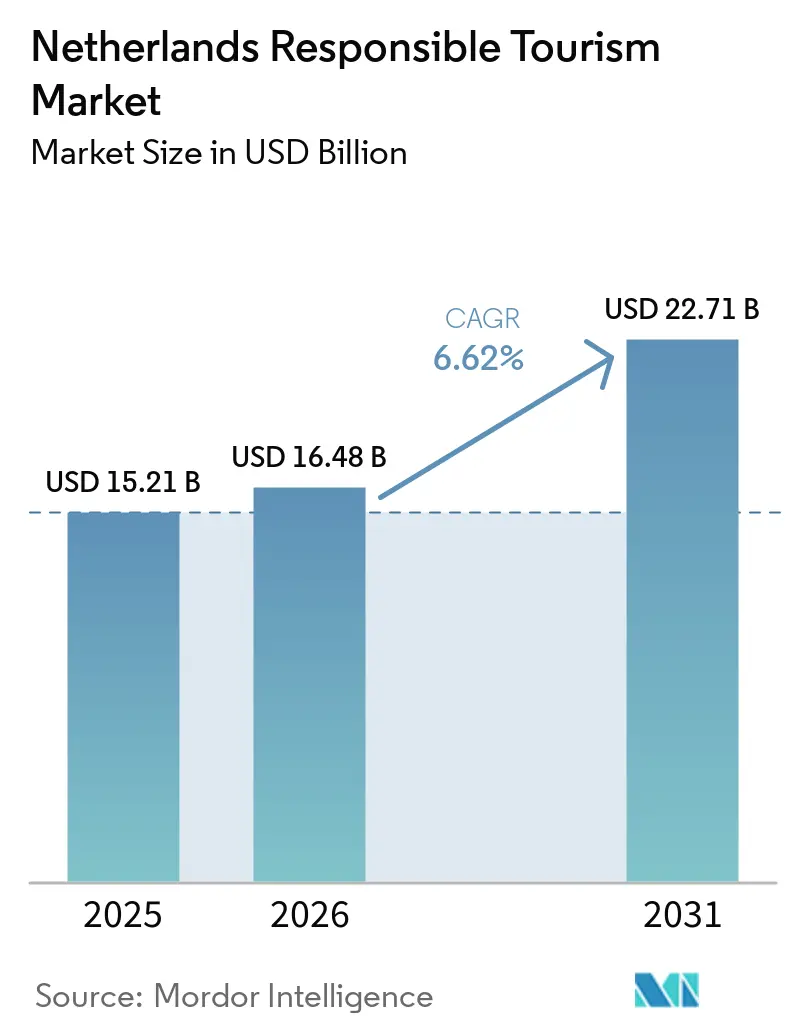
| Base Year Market Size (2025) | USD 15.21 Billion |
| Market Size (2026) | USD 16.48 Billion |
| Market Size (2031) | USD 22.71 Billion |
| Growth Rate (2026 - 2031) | 6.62 % |
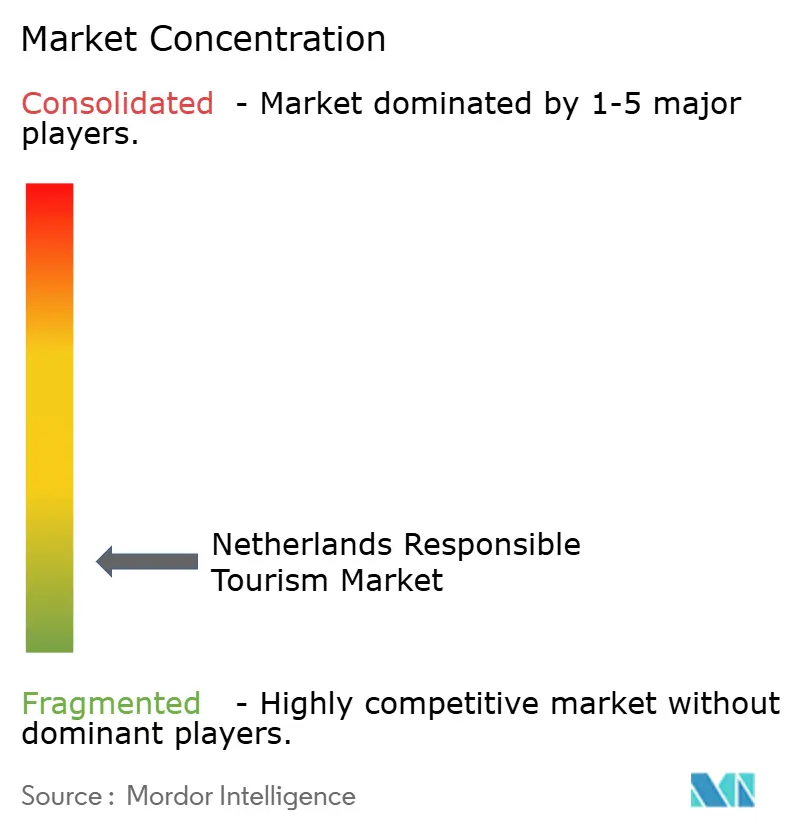
| Market Concentration | Low |
Major Players *Disclaimer: Major Players sorted in no particular order Image © Mordor Intelligence. Reuse requires attribution under CC BY 4.0. | |
Netherlands Responsible Tourism Market Analysis by Mordor Intelligence
The Netherlands Responsible Tourism Market was valued at USD 15.21 billion in 2025 and estimated to grow from USD 16.48 billion in 2026 to reach USD 22.71 billion by 2031, at a CAGR of 6.62% during the forecast period (2026-2031). Growth is driven by the rising adoption of certified, low-impact travel options, despite an expected increase in accommodation taxes in 2026. The country has a well-established sustainable travel ecosystem, including over 830 Green Key-certified businesses and a target to reduce tourism-related CO2 emissions by at least 55% by 2030 compared to 2019[1]. Policies now emphasize quality and spatial balance over visitor volume. On the commercial side, 100 million room nights were booked at sustainability-certified properties on a major platform in 2025, with certified property inventory increasing 22% year over year. Improved rail access from nearby European markets and a rise in international visitors in 2025, despite a slight decline in domestic overnight stays, are supporting demand. Enhanced certification visibility, eco-friendly transport options, and policy-driven dispersal are expanding opportunities beyond the crowded western corridor, enabling secondary regions to attract more bookings.
Key Report Takeaways
- By booking channel, Direct Booking held 47.92% of the Netherlands Responsible Tourism Market in 2025, while Online Platforms recorded the fastest projected CAGR at 7.84% through 2031.
- By tourist type, Domestic travelers accounted for 64.24% of the Netherlands Responsible Tourism Market in 2025, while international travelers are forecast to grow at a 6.98% CAGR through 2031.
- By accommodation format, Holiday Parks & Resorts accounted for 31.53% of the Netherlands Responsible Tourism Market in 2025, while Campsites and Glamping are advancing at a 7.13% CAGR through 2031.
- By tourism type, Cultural & Heritage Tourism led with a 31.12% revenue share of the Netherlands Responsible Tourism Market in 2025, while Rural & Agritourism is forecast to expand at a 7.56% CAGR through 2031.
- By geography, West Netherlands captured 42.31% of the Netherlands Responsible Tourism Market in 2025, while North Netherlands is expected to expand at a 7.61% CAGR through 2031.
Note: Market size and forecast figures in this report are generated using Mordor Intelligence’s proprietary estimation framework, updated with the latest available data and insights as of January 2026.
Netherlands Responsible Tourism Market Trends and Insights
Drivers Impact Analysis*
| Driver | (~) % Impact on CAGR Forecast | Geographic Relevance | Impact Timeline |
|---|---|---|---|
| Demand shift toward rail-first short breaks from nearby source markets | +1.2% | North Sea corridor, Germany, Belgium, United Kingdom, Northern France | Medium term (2-4 years) |
| Expansion of Green Key-certified accommodation supply | +0.9% | National, with density gains in Friesland, Zeeland, and Gelderland | Short term (≤ 2 years) |
| Policy-led visitor dispersion beyond Amsterdam | +0.8% | West to North, East, and South Netherlands | Medium term (2-4 years) |
| Preference for visible third-party sustainability labels | +1.1% | Global, with leading demand from DACH and United Kingdom source markets | Short term (≤ 2 years) |
| Senior traveler demand for quality-led and quieter responsible trips | +0.7% | National, with concentration in Wadden Islands, Veluwe, Limburg | Medium term (2-4 years) |
| AI-assisted trip planning improves discovery of lower-impact itineraries | +0.6% | Global, spill-over to secondary Dutch destinations | Long term (≥ 4 years) |
| Source: Mordor Intelligence | |||
Demand shift toward rail-first short breaks from nearby source markets
Rail travel is driving the Netherlands' responsible tourism market as international rail capacity improves. The Eurostar service resumed its direct London-Amsterdam route in February 2025, while the Amsterdam-Brussels corridor is expanding to 32 daily train departures, enhancing accessibility for nearby leisure travelers[2]. NBTC partnered with Deutsche Bahn and Eurostar in 2025 to promote Dutch city trips as sustainable options for German and United Kingdom visitors. Rail-accessible travelers generate significantly lower transport emissions compared to long-haul visitors, improving the carbon profile of tourism spending. Strengthened rail corridors are boosting repeat, short-break demand, aligning with climate and regional dispersal goals.
Expansion of Green Key-certified accommodation supply
The Netherlands' responsible tourism market expanded in 2025 due to increased certified supply. Green Key Netherlands certified over 830 businesses, including hotels, holiday parks, campsites, restaurants, B&Bs, and conference venues. This variety is essential as travelers often choose lodging based on visible environmental standards. Green Key also expanded globally in 2025, with over 8,300 certified establishments across 90 countries, boosting recognition for Dutch operators among international tourists. Booking Holdings reported stronger traveler interest in certified stays and a 22% rise in certified property inventory. The updated Green Key criteria, set for October 2026, are expected to encourage more operators to adopt sustainability processes, enhancing the quality of the Netherlands' responsible tourism market.
Policy-led visitor dispersion beyond Amsterdam
The Netherlands is shifting its responsible tourism market from volume growth to better visitor pressure distribution. "Perspectief 2030" emphasizes destination development focused on quality, local benefits, and balancing visitors with residents. Research on Amsterdam’s neighborhood carrying capacity identified six neighborhoods under tourism pressure by 2025, supporting the need for dispersing visitors to other regions[3]. The NBTC's destination management framework provides provinces and municipalities with tools to direct tourists to less dense areas, enabling quality-driven growth. This approach is increasing focus on the North, East, and South Netherlands, where certification, nature-based travel, and cultural experiences meet demand with minimal local strain.
Preference for visible third-party sustainability labels
Third-party labels have become mainstream booking cues in the Netherlands' responsible tourism market. Booking.com's 2026 travel and sustainability findings revealed that 85% of travelers considered sustainable travel important in 2025, with 100 million room nights booked at third-party certified properties. The data also showed that booking intent for certified accommodations spans all generations, indicating this preference is no longer limited to a specific age group. In the Dutch lodging market, Landal’s recognition as a sustainable holiday park brand and Center Parcs Netherlands’ full-portfolio BREEAM In-Use certification highlight the role of visible verification in competitive positioning. These developments support the responsible tourism market by making certified options easier to find, compare, and trust at scale.
Restraints Impact Analysis*
| Restraint | (~) % Impact on CAGR Forecast | Geographic Relevance | Impact Timeline |
|---|---|---|---|
| 2026 accommodation VAT increase pressures affordability | -1.2% | National, most acute in Zeeland, Limburg, and border regions | Short term (≤ 2 years) |
| Air-heavy inbound mix keeps tourism carbon intensity elevated | -0.6% | International arrivals via Schiphol, highest burden from long-haul markets | Long term (≥ 4 years) |
| Domestic overnight demand softness limits short-term volume growth | -0.8% | National, most visible in mid-range holiday parks and campsites | Short term (≤ 2 years) |
| Certification cost and compliance burden for smaller operators | -0.5% | National, disproportionate in rural B&B and nature-stay segments | Medium term (2-4 years) |
| Source: Mordor Intelligence | |||
2026 accommodation VAT increase pressures affordability
The recent increase in the VAT rate on overnight accommodations in the Netherlands has significantly impacted the responsible tourism market. The adjustment, which raised the rate from 9% to 21%, has notably increased the cost of hotels, holiday parks, and B&Bs, creating affordability challenges[4]. Research conducted for the hotel sector predicts a decline in hotel overnight stays due to this tax change. The effect varies across accommodation types, as campsites continue to benefit from the lower VAT rate of 9%, redirecting some demand toward outdoor options. This pricing disparity is already influencing traveler preferences, particularly among domestic tourists and visitors from neighboring regions who compare Dutch prices with alternatives in nearby countries. The shift is reshaping accommodation choices and market dynamics within the Netherlands' responsible tourism sector.
Air-heavy inbound mix keeps tourism carbon intensity elevated
The Netherlands' responsible tourism market continues to face emissions challenges, primarily due to aviation's role in visitor growth. Air travel accounted for 28% of inbound trips but generated 71% of transport-related carbon emissions. Transport to the Netherlands contributed 57% of the total emissions footprint of a foreign visitor's stay. Tourism represented 5% of Dutch business greenhouse gas emissions from 2015 to 2022, exceeding its 4% share of value added. Although the Dutch government has set aviation decarbonization targets, progress in reducing emissions from long-haul inbound travel remains slower than policy goals. This sustains a carbon-intensive layer in the responsible tourism sector, even as rail travel from nearby countries gains appeal.
*Our forecasts treat driver/restraint impacts as directional, not additive. The impact forecasts reflect baseline growth, mix effects, and variable interactions.
Segment Analysis
By Booking Channel: Direct Trust Anchors Market, Platforms Accelerating
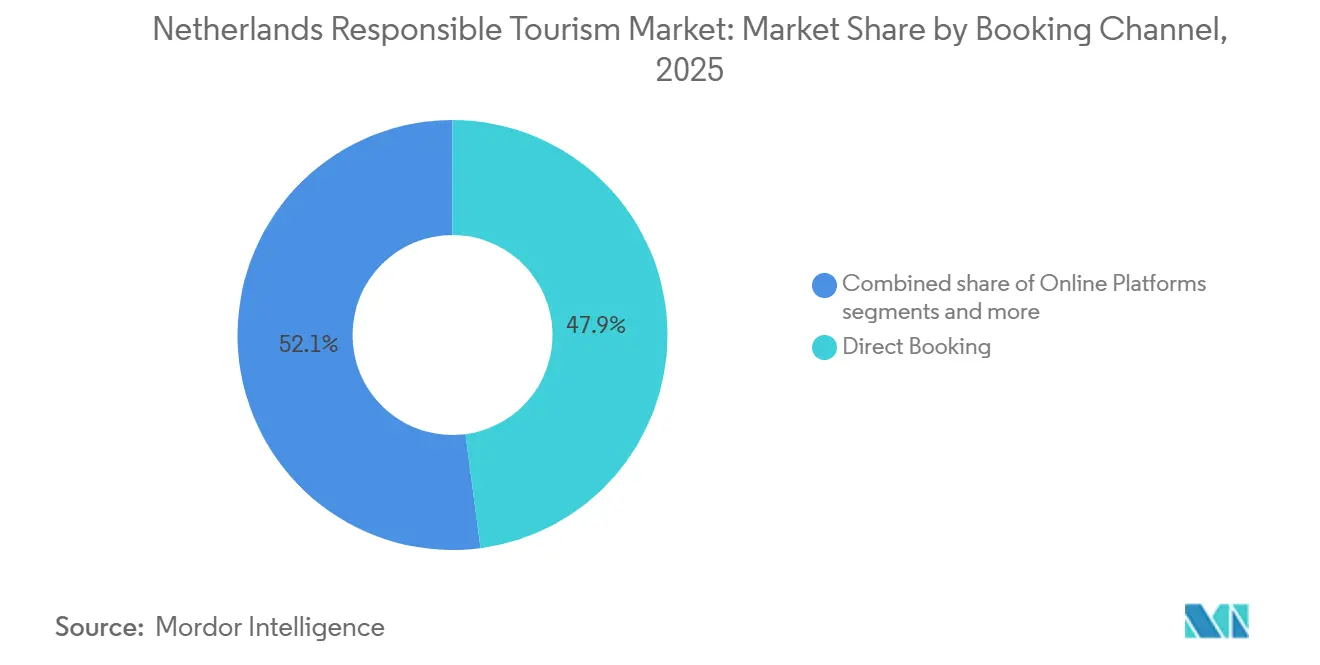
Direct Booking accounted for 47.92% of revenue in 2025, making it the largest channel in the Netherlands' responsible tourism market. Responsible travelers often prefer direct booking as branded operators clearly present certifications, property standards, and sustainability practices on their websites. This is significant in a country with over 830 Green Key-certified businesses across various hospitality sectors. Large holiday park operators, certified hotels, and specialized tour providers benefit as repeat guests and sustainability-focused travelers seek direct confirmation of standards. The channel mix highlights the importance of trust, transparency, and brand familiarity alongside convenience.
Online Platforms are the fastest-growing channel, with a projected 7.84% CAGR through 2031. Growth is driven by improved sustainability search tools, broader third-party certification displays, and the ability to compare multiple options. Booking Holdings reported 100 million room nights at certified properties in 2025 and a 22% increase in certified property inventory, reflecting the rising visibility of certified supply on platforms. Travel agencies and tour operators remain relevant for complex itineraries, offering specialist advice, packaged rail access, or curated rural and cultural routes. TUI Nederland, with its sustainability awards and Travelife certification, demonstrates how major players maintain their position through verified sustainability rather than price competition.

By Tourist Type: Domestic Market Softens as International Demand Diversifies
Domestic travelers represented 64.24% of the Netherlands' responsible tourism market in 2025, making them the largest customer group. This reflects strong local awareness of certified holiday parks, nature stays, and short-break destinations accessible by road or rail. A recent report says that, a slight decline in Dutch overnight stays in 2025, indicating increased price sensitivity as travel costs rose. The 2026 VAT hike further heightened this sensitivity, particularly for families and short-break travelers comparing overnight costs. Camping showed the strongest domestic substitution, with guest numbers rising 9% in 2025, outperforming other accommodation types.
International travelers are the faster-growing segment, with a 6.98% CAGR projected through 2031, driving overnight stays to 22.3 million in 2025. Growth quality outweighs volume, as nearby European rail markets offer a better carbon profile than long-haul arrivals. NBTC’s 2025 campaigns with Deutsche Bahn and Eurostar targeted rail travelers from Germany and the United Kingdom, who are more likely to book certified accommodations and explore beyond Amsterdam. Long-haul visitors, particularly Americans, remain commercially significant but environmentally challenging, contributing disproportionately to tourism-related emissions. Balancing revenue and carbon intensity will shape the Netherlands' inbound strategy through 2031.
By Accommodation Format: Parks Lead Volume, Glamping Leads Growth
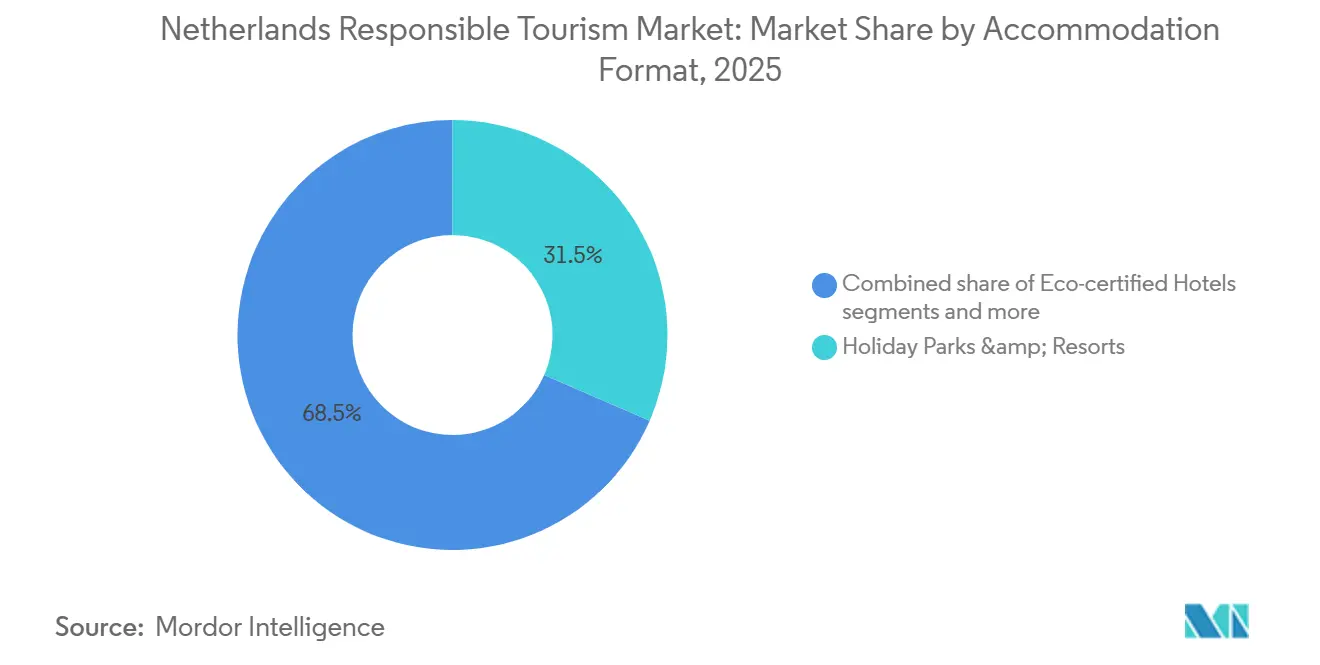
Holiday Parks & Resorts accounted for 31.53% of the Netherlands' responsible tourism market in 2025, maintaining their position as the dominant accommodation format. This segment benefits from the country's extensive bungalow park network and the emphasis on certification by major operators. Landal reported 115 Green Key-certified parks globally in 2025, with a significant presence in the Netherlands. Center Parcs Netherlands completed BREEAM In-Use certification for its entire Dutch portfolio, enhancing scale, visibility, and trust. Eco-certified hotels also play a key role, extending certification to urban areas, heritage sites, and short-stay travel.
Campsites and glamping are the fastest-growing formats, with a projected 7.13% CAGR through 2031. Their pricing advantage improved when campsites retained a 9% VAT rate, while hotels, holiday parks, and B&Bs faced an increase to 21% in January 2026. A recent data showed campsite guest numbers rose 9% in 2025, reflecting strong demand. These formats align with traveler preferences for nature-focused, low-impact, and flexible stays. In contrast, B&Bs and guesthouses face margin pressures due to the higher VAT rate and stricter certification requirements, compounded by their smaller scale compared to larger operators.
By Tourism Type: Heritage Anchors the Market, Rural Agritourism Redefines It
Cultural & Heritage Tourism accounted for 31.12% of revenue in the Netherlands' responsible tourism market in 2025, driven by its extensive network of museums, historic towns, UNESCO sites, and rail-connected cultural destinations. Policies and capacity constraints are redirecting cultural travel to secondary cities and regions, easing pressure on Amsterdam and spreading visitor spending. Ecotourism contributes significantly through attractions like the Wadden Sea, national parks, and eco-certified accommodations. Heritage and nature often complement each other, with many itineraries combining both.
Rural & Agritourism is the fastest-growing segment, with a 7.56% CAGR projected by 2031. This growth reflects travelers’ preference for local, low-density experiences and rural operators’ efforts to generate income tied to land, nature, and community identity. Research shows on-demand destination information effectively guides travelers to alternative locations, supporting rural tourism. Nature & Wildlife Tourism benefits from car-free island travel and biodiversity-focused guest experiences, as seen in Roompot Kustpark Texel’s model. Community-Based Tourism remains smaller in revenue but is gaining traction with B Corp-certified operators like Withlocals, fostering direct host-to-guest value transfer.
Geography Analysis
West Netherlands accounted for 42.31% of the Netherlands' responsible tourism market share in 2025, making it the largest regional cluster. Its strength lies in cities such as Amsterdam, Rotterdam, The Hague, and Utrecht, which offer strong accommodation capacity, public transport, and cultural assets. However, the region faces significant pressure from tourism concentration. A 2025 study on Amsterdam’s neighborhood carrying capacity identified strain in six neighborhoods. This pressure underscores the need for dispersal, shaping future growth opportunities for responsible travel in less crowded areas. While the region remains central to the market, its growth is becoming more selective, focusing on reducing demand in overburdened urban cores.
North Netherlands is the fastest-growing regional cluster, with a projected 7.61% CAGR through 2031. Growth is driven by attractions like the Wadden Sea and Frisian Islands, combined with low visitor density. This region integrates nature, car-light travel, and opportunities for certified supply expansion. East Netherlands benefits from similar trends, with destinations like the Veluwe and rail-accessible nature areas meeting demand for quieter itineraries. Stayokay’s October 2025 announcement of a sustainable hostel in Groningen, set to open in 2027, signals confidence in the northern corridor’s growth potential.
South Netherlands offers cultural and leisure appeal but faces affordability challenges in border areas. The region relies on Belgian and German demand, making it sensitive to tax-driven price changes. The Three-Country-Train service, launched in June 2024, enhances connectivity by linking Liège, Maastricht, Heerlen, and Aachen via a car-free route. This combination of rail access, gastronomy, and reduced crowding positions South Netherlands to attract travelers seeking alternatives to the crowded western corridor.
Competitive Landscape
The responsible tourism market in the Netherlands is highly fragmented, with a small share held by the top operators. Key players include Booking.com, Landal, Roompot (part of the Landal group), TUI Nederland, and Center Parcs Netherlands. The remaining market is distributed among certified operators, specialist agencies, community-based providers, and nature-focused businesses. Domestic travelers often book directly with regional brands, while international visitors prefer platforms emphasizing certifications. Over 830 Green Key-certified businesses operate in the Dutch hospitality sector, limiting market concentration. Reports indicate accredited operators are gaining visibility on digital platforms as demand for certified inventory grows.
Consolidation among holiday park operators has been a significant development in the industry. The merger of Landal and Roompot created a pan-European organization with expanded scale, distribution, and brand reach. Landal increased its Green Key-certified parks and maintained strong sustainability recognition. Center Parcs Netherlands enhanced its position by completing BREEAM In-Use certification for its Dutch portfolio, reflecting the growing importance of verified sustainability.
Opportunities remain in rural agritourism, community-based urban experiences, and rail-first itineraries. TUI Nederland’s Travelife-backed approach highlights a shift toward audited sustainability over price competition. Withlocals offers a direct local host model supported by B Corp certification, catering to travelers seeking community-linked experiences. Smaller operators focus on niche destinations, biodiversity-related stays, and low-density experiences that larger groups cannot standardize. Regulatory changes, driven by NBTC, emphasize substantiated sustainability claims, favoring operators with audited performance over those relying on vague self-reporting.
Netherlands Responsible Tourism Industry Leaders
-
Booking.com
-
Landal
-
Roompot
-
TUI Nederland
-
Center Parcs Netherlands
- *Disclaimer: Major Players sorted in no particular order
Recent Industry Developments
- March 2026: Robbert Weddepohl assumed the role of CEO of Conscious Hotels' parent group in March 2026. His mandate focuses on driving professionalization and scalability following the opening of the Utrecht property. The group has announced plans to expand further across the country, building on the success of its first location outside Amsterdam.
- March 2026: Stayokay Apeldoorn has reopened following a sustainability-focused renovation. The updates include water-saving fixtures, reused and vintage furniture, and a themed family room developed in collaboration with the adjacent Apenheul primate park.
- February 2026: At the national Green Key award ceremony in Apeldoorn, Landal increased its certified park portfolio globally, with plans to achieve 100% certification across its international holdings by 2025.
- January 2026: The Dutch government, as part of its 2026 Tax Plan, increased the VAT on short-stay accommodations to 21%. This adjustment represents the most significant fiscal impact on the country's lodging sector in recent history.
Netherlands Responsible Tourism Market Report Scope
| Direct Booking |
| Online Platforms |
| Travel Agencies & Tour Operators |
| Domestic |
| International |
| Eco-certified Hotels |
| Holiday Parks & Resorts |
| Hostels |
| B&Bs and Guesthouses |
| Holiday Homes and Nature Stays |
| Campsites and Glamping |
| Ecotourism |
| Cultural & Heritage Tourism |
| Rural & Agritourism |
| Community-Based Tourism |
| Nature & Wildlife Tourism |
| North Netherlands |
| East Netherlands |
| West Netherlands |
| South Netherlands |
| By Booking Channel | Direct Booking |
| Online Platforms | |
| Travel Agencies & Tour Operators | |
| By Tourist Type | Domestic |
| International | |
| By Accommodation Format | Eco-certified Hotels |
| Holiday Parks & Resorts | |
| Hostels | |
| B&Bs and Guesthouses | |
| Holiday Homes and Nature Stays | |
| Campsites and Glamping | |
| By Tourism Type | Ecotourism |
| Cultural & Heritage Tourism | |
| Rural & Agritourism | |
| Community-Based Tourism | |
| Nature & Wildlife Tourism | |
| By Geography | North Netherlands |
| East Netherlands | |
| West Netherlands | |
| South Netherlands |
Key Questions Answered in the Report
What is the 2031 outlook for responsible tourism in the Netherlands?
The Netherlands responsible tourism market is forecast to reach USD 22.71 billion by 2031 from USD 16.48 billion in 2026, growing at a 6.62% CAGR.
Which booking channel leads revenue generation in the Netherlands?
Direct Booking remained the largest channel with a 47.92% share in 2025, supported by strong trust in certified operators and clearer sustainability communication.
Which traveler group is expanding faster in the Netherlands?
International travelers are growing faster at a 6.98% CAGR through 2031, while domestic travelers still held the larger 64.24% share in 2025.
Why are campsites and glamping gaining share in the Netherlands?
Campsites and Glamping are projected to grow at a 7.13% CAGR, supported by strong demand for nature stays and the lower 9% VAT rate that still applies to campsites.
Which tourism type is growing fastest in the Netherlands responsible tourism space?
Rural & Agritourism is the fastest-growing tourism type at a 7.56% CAGR, reflecting demand for lower-density and more locally embedded travel experiences.
Which Dutch region offers the strongest growth potential through 2031?
North Netherlands shows the fastest growth at a 7.61% CAGR, supported by the Wadden area, low visitor density, and better fit with dispersed responsible travel demand.