
Natural Surfactants Market Size and Share
Market Overview
| Study Period | 2022 - 2032 |
|---|---|
| Market Size (2027) | USD 23.98 Billion |
| Market Size (2032) | USD 31.90 Billion |
| Growth Rate (2027 - 2032) | 5.87 % |
| Fastest Growing Market | Asia-Pacific |
| Largest Market | Asia-Pacific |
| Market Concentration | Medium |
Major Players *Disclaimer: Major Players sorted in no particular order Image © Mordor Intelligence. Reuse requires attribution under CC BY 4.0. | |
Natural Surfactants Market Analysis by Mordor Intelligence
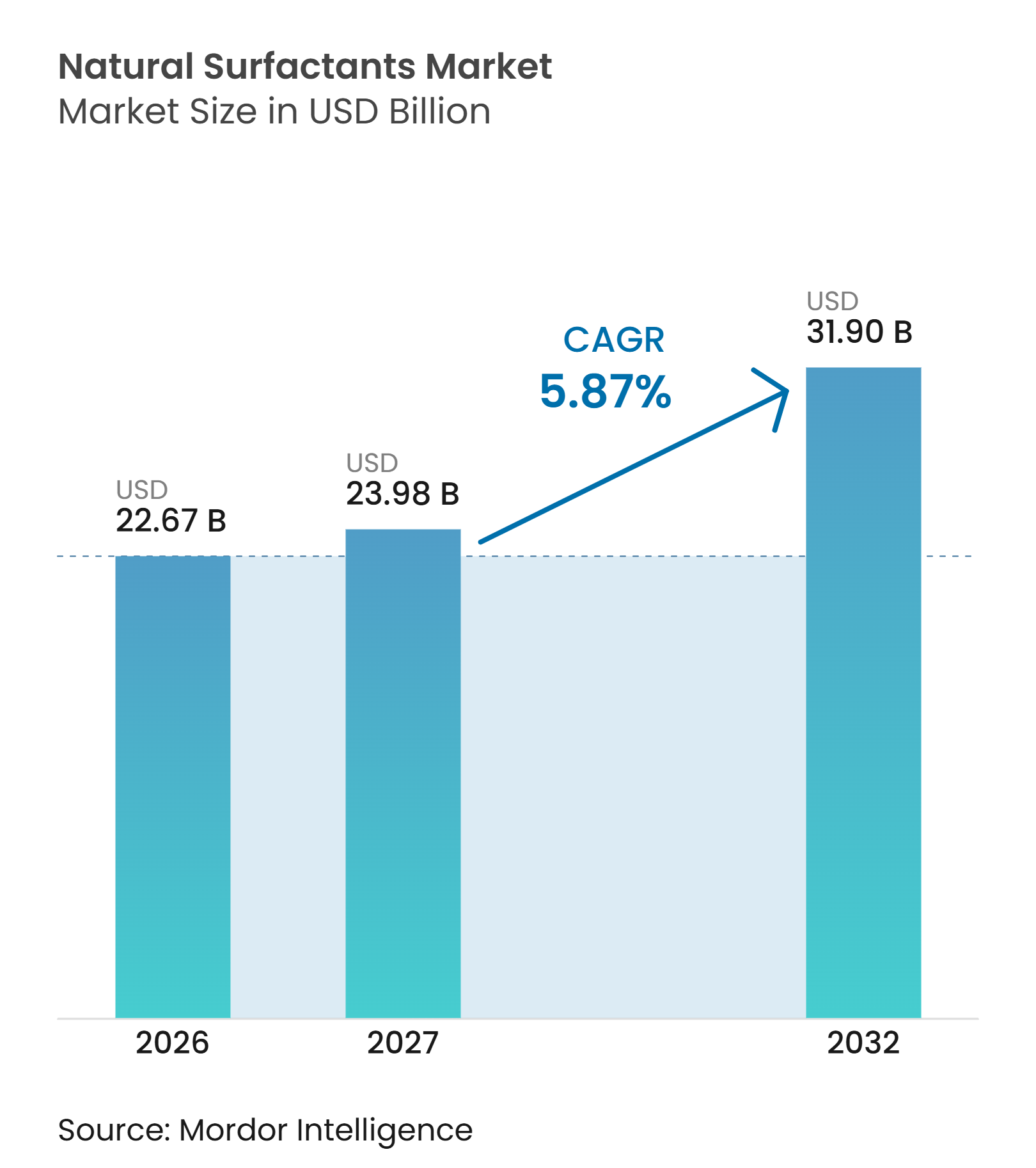
The Natural Surfactants Market size was valued at USD 22.67 billion in 2026 and is estimated to grow from USD 23.98 billion in 2027 to reach USD 31.90 billion by 2032, at a CAGR of 5.87% during the forecast period (2027-2032). Demand is moving beyond niche premium products because personal care and cleaning brands increasingly need ingredients with documented natural origin, lower irritation potential, and biodegradability credentials. Regulation is reinforcing this shift, especially in Europe, where the revised detergent rules are intended to strengthen biodegradability requirements and introduce digital product passports. Feedstock costs remain a material constraint because plant-based production relies heavily on agricultural oils whose availability and pricing can change quickly. Producers are responding through alkyl polyglucoside capacity additions, fermentation platforms, and new feedstocks that can reduce reliance on palm kernel and coconut oil. These changes create opportunities for suppliers that can combine reliable performance, traceable sourcing, and scalable production economics.
Key Report Takeaways
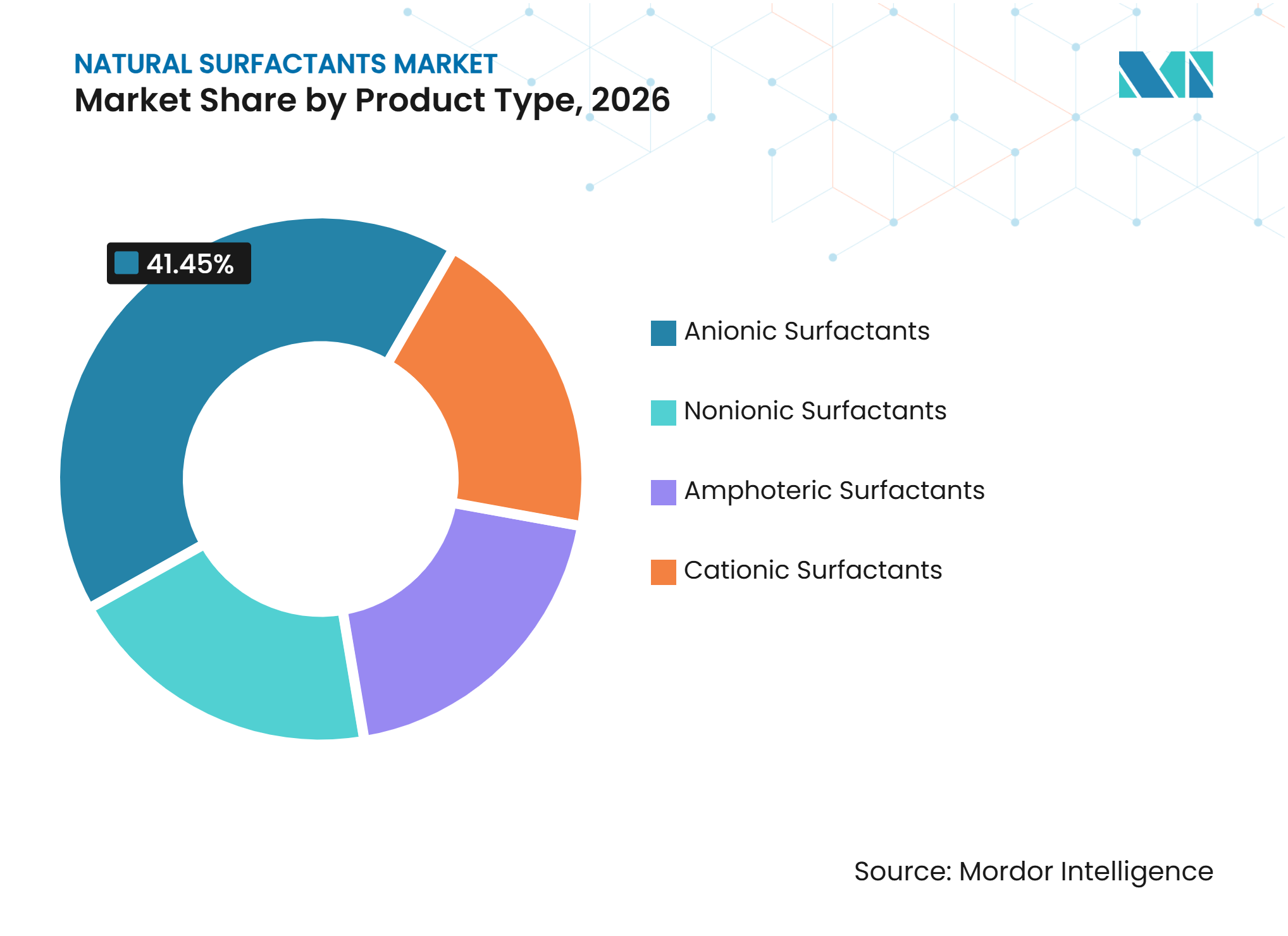
- By product type, anionic surfactants held 41.45% of the natural surfactants market share in 2026, while nonionic surfactants are projected to advance at a 6.45% CAGR through 2032.
- By feedstock and source, plant-derived sources held 67.32% of the natural surfactants market share in 2026, while microbial and fermentation-derived sources are projected to advance at a 6.34% CAGR through 2032.
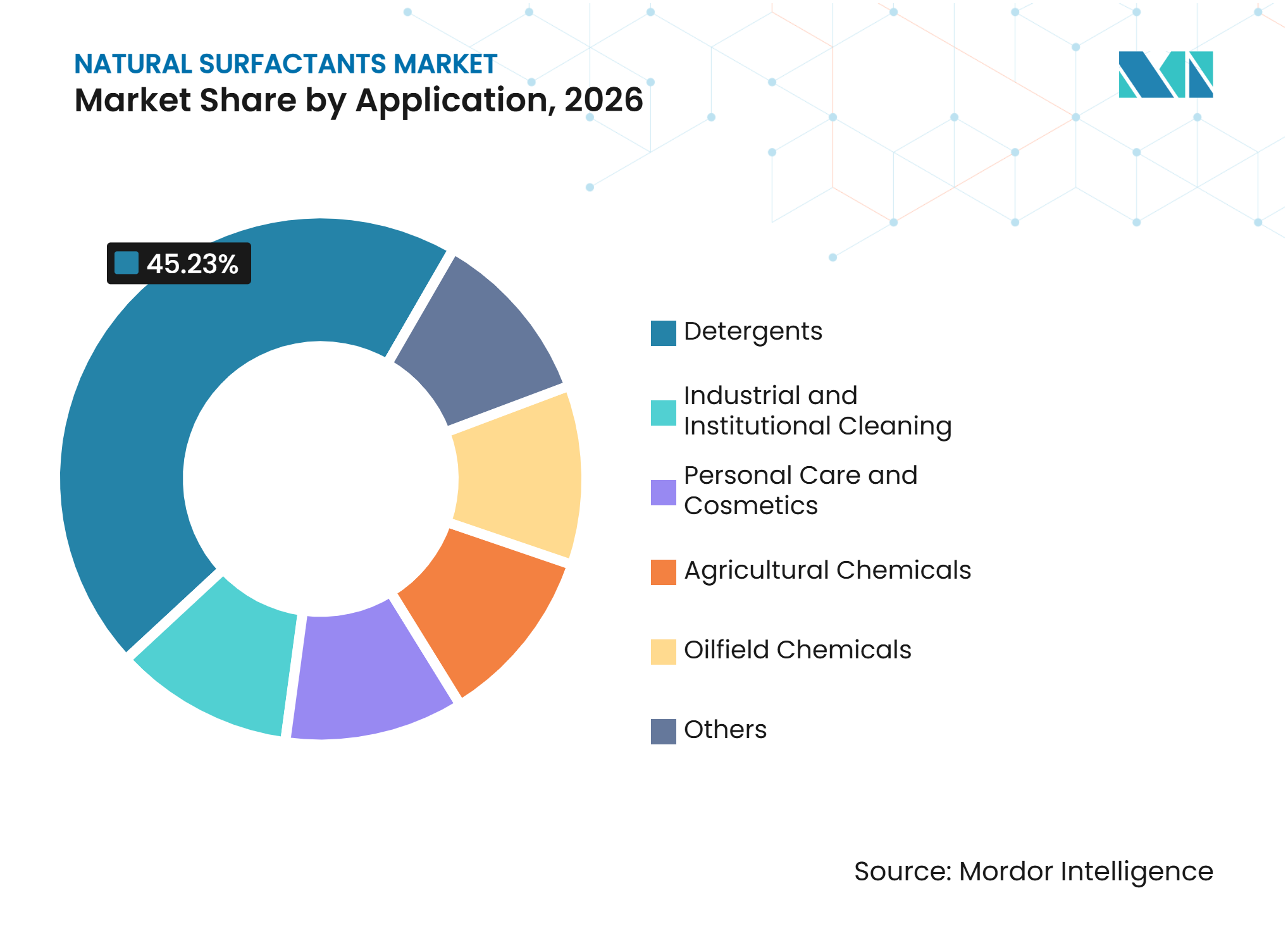
- By application, detergents held 45.23% of the natural surfactants market share in 2026, while personal care and cosmetics are projected to advance at a 6.89% CAGR through 2032.
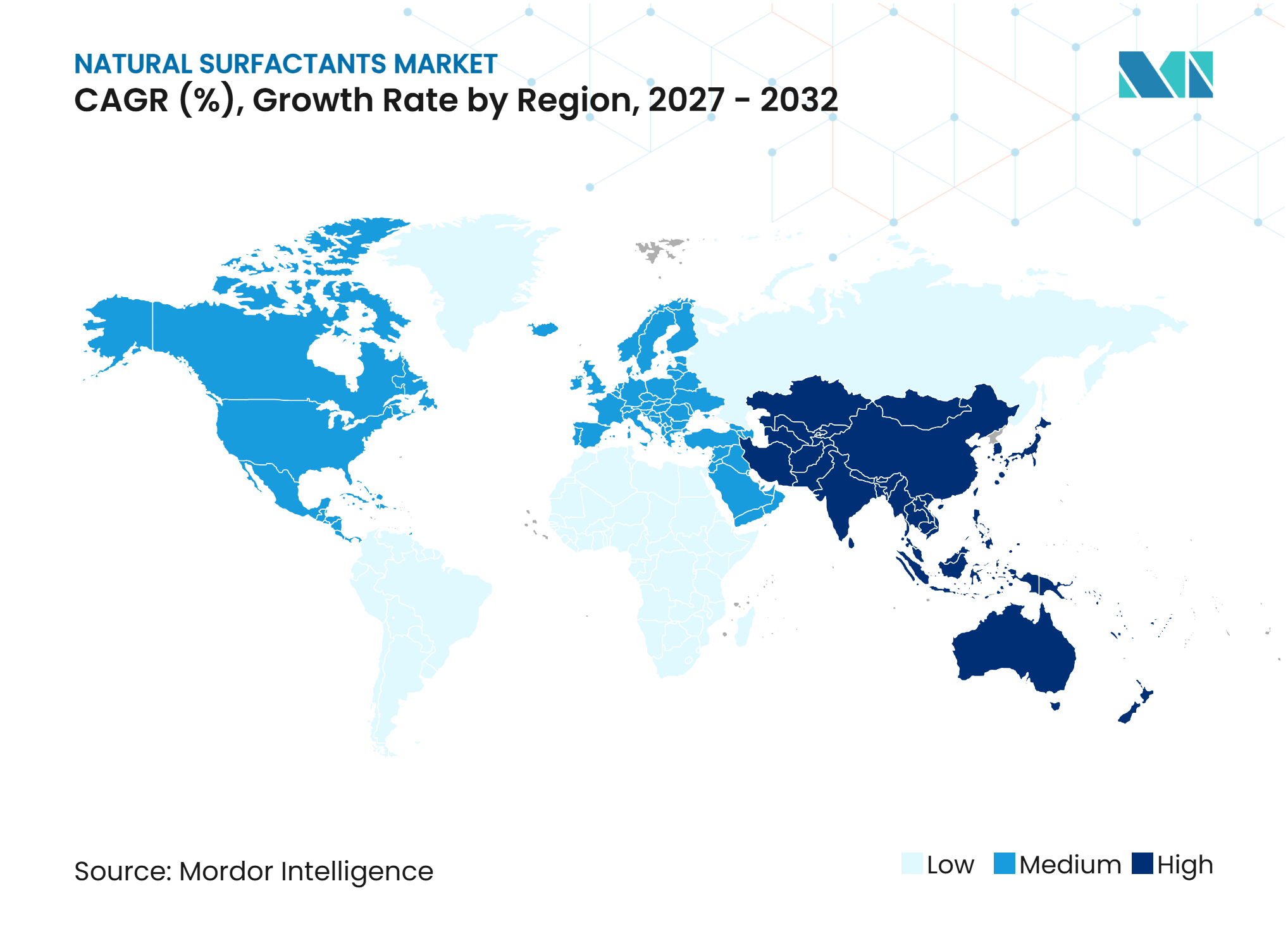
- By geography, Asia-Pacific held 35.66% of the natural surfactants market share in 2026 and is projected to advance at a 6.77% CAGR through 2032.
Note: Market numbers in this report are based on Mordor Intelligence's proprietary estimation framework, which combines nine months of actuals with Q4 projections for base year 2026.
Market Trends and Insights
Drivers Impact Analysis of Natural Surfactants Market*
| Driver | (~) % Impact on CAGR Forecast | Geographic Relevance | Impact Timeline |
|---|---|---|---|
| Clean-Label and Low-Irritation Formulation Demand | +2.0% | Global, with early-mover gains in North America, EU, Japan, and South Korea | Short term (≤ 2 years) |
| Regulatory Preference for Biodegradable and Renewable Ingredients | +1.5% | EU core, spill-over to North America, APAC, and South America | Medium term (2-4 years) |
| Asia-Pacific Personal-Care and Home-Care Scale-Up | +1.3% | APAC core, with spillover demand into MEA and South America | Medium term (2-4 years) |
| Fermentation Yield and Process-Scale Improvements | +0.8% | Global, led by EU and North America R&D centers; manufacturing scaling in APAC | Long term (≥ 4 years) |
| Corporate Renewable-Carbon Procurement Commitments | +0.6% | North America and EU, spillover to APAC through global brand sourcing | Medium term (2-4 years) |
| Source: Mordor Intelligence | |||
Clean-Label and Low-Irritation Formulation Demand
The natural surfactants market is gaining attention as formulators replace conventional sulfate systems in personal care and home care products. A 2025 study reported that adding 2.5% sodium cocoyl glutamate to a sodium laureth sulfate formulation reduced surfactant adsorption on skin by 55%. This evidence supports the use of amino acid and sugar-derived surfactants where mild cleansing and barrier protection matter. The example shows that high natural-origin content can be pursued in concentrated formats without abandoning functional performance. The natural surfactants market therefore benefits as clean-label requirements move from brand positioning into formulation specifications.
Regulatory Preference for Biodegradable and Renewable Ingredients
Regulatory requirements are creating a more durable demand base for biodegradable surfactants. The European Commission announced a provisional political agreement on the revised Detergents Regulation in June 2025, covering strengthened biodegradability requirements, digital product passports, and a ban on animal testing[1]. The rules are planned to apply from summer 2029, giving suppliers and formulators a defined preparation period. A separate Commission study released in May 2025 showed that the biodegradation of commercial chemicals can vary substantially across European rivers, increasing the importance of context-specific environmental evidence. The U.S. Environmental Protection Agency added 18 chemicals to its Safer Chemical Ingredients List in July 2025, bringing the list to 983 chemicals. In China, provisions issued in January 2025 support cosmetic ingredient innovation, while revised national standards further shape product qualification.
Asia-Pacific Personal-Care and Home-Care Scale-Up
Asia-Pacific is expanding both its consumption base and production capabilities for the natural surfactants market. BASF began operating an alkyl polyglucoside plant in Bangpakong, Thailand, in 2025 to serve personal care and home care customers in the region. Alkyl polyglucosides are bio-based nonionic surfactants that fit sulfate-free and biodegradable formulation needs. China’s cosmetic ingredient rules are evolving to support innovation, which can broaden the route for qualifying new natural-origin ingredients[2]. Indonesia, Malaysia, India, and China also have established oleochemical processing networks that support competitively priced fatty alcohols and related intermediates. This combination of supply infrastructure and consumer demand supports further natural surfactants market development across the region.
Fermentation Yield and Process-Scale Improvements
The natural surfactants market is becoming more receptive to fermentation as it becomes commercially relevant, as producers work to narrow the cost gap with petrochemical surfactants. A 2025 review identified production costs of USD 3.8 per kilogram using optimized simultaneous saccharification and fermentation with agricultural-residue feedstocks. The same review identified costs below USD 2.50 per kilogram as an important threshold for stronger competitiveness against conventional surfactants. Holiferm completed a commercial-scale sophorolipid facility in the United Kingdom in March 2025, using continuous gravity separation to lower processing costs at scale. Evonik Industries AG and the China Detergent Industry Association released a rhamnolipid industry standard in November 2025, addressing production, testing, and application specifications. Consistent specifications can reduce qualification friction for formulators and support the natural surfactants market as supply moves toward larger commercial volumes.
Restraints Impact Analysis of Natural Surfactants Market*
| Restraint | (~) % Impact on CAGR Forecast | Geographic Relevance | Impact Timeline |
|---|---|---|---|
| Production-Cost Premium Versus Petrochemical Surfactants | -0.7% | Global, most acute in cost-sensitive Asian and South American commodity detergent markets | Long term (≥ 4 years) |
| Renewable Feedstock Price and Availability Volatility | -0.4% | APAC and global commodity surfactant markets dependent on tropical oil supply chains | Short term (≤ 2 years) |
| Purification, Safety, and Application-Qualification Burden | -0.2% | EU and North America, where REACH and TSCA compliance review timelines are longest | Medium term (2-4 years) |
| Source: Mordor Intelligence | |||
Production-Cost Premium Versus Petrochemical Surfactants
The production-cost premium remains a constraint for the natural surfactants market for fermentation-derived materials. A 2025 review placed conventional microbial biosurfactant production costs at USD 5-20 per kilogram, compared with USD 2 per kilogram for commodity synthetic surfactants. The difference limits adoption in high-volume laundry and cleaning products where ingredient cost strongly influences the cost per use. Downstream purification and batch-to-batch quality control add further expenses for many biosurfactant producers. Premium personal care, agricultural, and specialty cleaning products can absorb a higher input cost more easily than commodity detergents. The natural surfactants market may therefore see faster adoption where total formulation value and product differentiation matter more than the price of the individual surfactant.
Renewable Feedstock Price and Availability Volatility
The natural surfactants market remains exposed to agricultural commodity cycles through plant-derived surfactants and regional supply disruptions. These changes affect producers that depend on lauric C12-C14 feedstocks for anionic and nonionic products. Weather-related production disruption can add pressure in concentrated producing regions. Suppliers are exploring insect oils, fermentation-derived fatty acids, and glucose-based routes to diversify supply. Sasol launched LIVINEX IO 7 in October 2025 as an insect-oil-based nonionic surfactant for care chemicals, demonstrating one such alternative.
*Our forecasts treat driver/restraint impacts as directional, not additive. The impact forecasts reflect baseline growth, mix effects, and variable interactions.
Natural Surfactants Market Segment Analysis
By Product Type:
Anionic Surfactants Lead, While Nonionic Surfactants ExpandAnionic surfactants held 41.45% of the natural surfactants market share in 2026, supported by their use in laundry, dishwashing, and industrial cleaning. Their detergency and foaming performance maintain their role in high-volume cleansing formulations. Natural anionic options include coconut-oil-based alternatives and amino acid surfactants such as sodium cocoyl glutamate and sodium lauroyl sarcosinate. These materials help brands respond to sulfate-free and mildness-focused product claims. BASF introduced natural-based personal care ingredients in 2025, including a betaine derived from Rainforest Alliance-certified coconut oil. The category retains an important place where cleaning performance and foam profile remain central to product design.
Nonionic surfactants are projected to advance at a 6.45% CAGR through 2032. Alkyl polyglucosides and sorbitan esters are central to this growth because they support sulfate-free and biodegradable formulations. BASF’s Bangpakong plant expands regional alkyl polyglucoside supply, while a Cincinnati plant was under construction for a 2026 startup. Amphoteric surfactants, including cocamidopropyl betaine, continue to support mild personal care systems. Cationic surfactants are also relevant for fabric softening and hair conditioning. The product mix is becoming broader as formulators use multiple surfactant classes to balance cleansing, foam, conditioning, and sensory performance.



By Feedstock and Source:
Plant-Derived Sources Lead, While Microbial and Fermentation-Derived Sources AcceleratePlant-derived sources held a 67.32% share in 2026, based on established processing routes for palm kernel oil, coconut oil, and corn-derived glucose. Existing oleochemical capacity supports large-scale supply and broad regulatory familiarity. Plant-based routes remain important for fatty alcohols, glycosides, and related surfactant intermediates. Their established position also creates exposure to the availability and cost of tropical oils. Feedstock traceability is also becoming more important as buyers seek documented sourcing practices.
Microbial and fermentation-derived sources are projected to advance at a 6.34% CAGR through 2032. Sophorolipids, rhamnolipids, and mannosylerythritol lipids are moving from specialty applications toward broader commercial qualification. Evonik Industries AG’s RHEANCE and SOPHANCE platforms show how established producers are bringing fermentation-derived offerings into personal care portfolios. Sasol also introduced an insect-oil-based product that broadens the range of nontraditional renewable inputs.
By Application:
Detergents Lead, While Personal Care and Cosmetics AdvanceDetergents held a 45.23% share in 2026, reflecting the scale of household laundry, automatic dishwashing, and hand dishwashing formulations. This application has large requirements and a broad global customer base. Its economics are demanding because bulk detergent formulations remain sensitive to raw-material prices. The natural surfactants market can gain where brands need improved biodegradability, renewable sourcing, or a more differentiated consumer proposition. The planned European detergent rules add an important compliance consideration for companies selling cleaning products in the region. Industrial and institutional cleaning also offers a route for products that need documented environmental performance.
Personal care and cosmetics are projected to advance at a 6.89% CAGR through 2032. Sulfate-free hair care, clean beauty claims, and demand for biodegradable cleansing systems support this application. A 2025 scientific review described renewable content, lower carbon footprint, and biodegradability as important considerations in modern cleanser development. The natural surfactants market can support mild cleansers, facial products, body washes, and other personal care formats. Agricultural chemicals are another targeted application, supported by a Federal Register tolerance exemption published in August 2026 for a plant-based sucrose ester surfactant used in pesticide formulations. Oilfield applications remain smaller but can require alternatives with stronger environmental profiles.

Geography Analysis
Asia-Pacific
Asia-Pacific held 35.66% of the natural surfactants market share in 2026 and is projected to advance at a 6.77% CAGR through 2032. The region combines growing personal care and home care demand with deep oleochemical processing capacity. China, India, and Association of Southeast Asian Nations (ASEAN) markets are important because brands are extending product access beyond major urban centers. China issued provisions in January 2025 to support cosmetic ingredient innovation, creating a clearer pathway for new materials. The National Standardization Commission approved revisions to 12 surfactant and detergent standards in July 2025. These standards support more consistent analytical methods and quality expectations. BASF’s 2025 alkyl polyglucoside start-up in Thailand reflects the region’s importance for local supply. The Roundtable on Sustainable Palm Oil (RSPO) certification is becoming more relevant to supply-chain decisions in the region.
North America
North America has a premium-oriented demand profile that supports bio-based personal care and specialty cleaning ingredients. The U.S. Environmental Protection Agency’s Safer Choice program added 18 chemicals to its approved ingredients list in July 2025, bringing the total to 983. This provides a recognized pathway for formulators choosing safer chemical inputs. Stepan Company reported USD 1.67 billion in surfactant net sales for 2025, while industrial cleaning, agricultural, and oilfield applications outperformed commodity laundry volumes. Kao Corporation and Pilot Chemical Company announced an exclusive January 2025 partnership to introduce Bio IOS bio-based internal olefin sulfonates in North America from 2026. Kensing, LLC also partnered with AmphiStar in May 2025 to commercialize upcycled microbial biosurfactants for North American personal care applications. These actions add more commercial routes for renewable surfactant technologies in the region.
Europe, South America, and Middle East and Africa
Europe's regulatory influence continues to shape the natural surfactants market and global formulation and documentation practices. The European Commission’s 2025 agreement on revised detergents rules will introduce stronger biodegradability requirements and digital product passports from summer 2029. Evonik Industries AG has commercial rhamnolipid production in Slovakia, supporting Europe’s position in fermentation-derived biosurfactants. SEPPIC continues to develop natural-origin emulsifier systems for personal care, with its products aligned to COSMOS and NATRUE requirements. In South America, Indovinya launched OXISMOOTH DS, a 100% plant-based multifunctional emollient, in Brazil during December 2025. Indovinya also reported that 20.5% of its 2025 revenue came from sustainable solutions. In the Middle East and Africa, Sasol’s biosurfactant portfolio and its work with Holiferm represent a route to use the region’s chemical and energy infrastructure for lower-carbon specialty products.
Competitive Landscape
Market Concentration
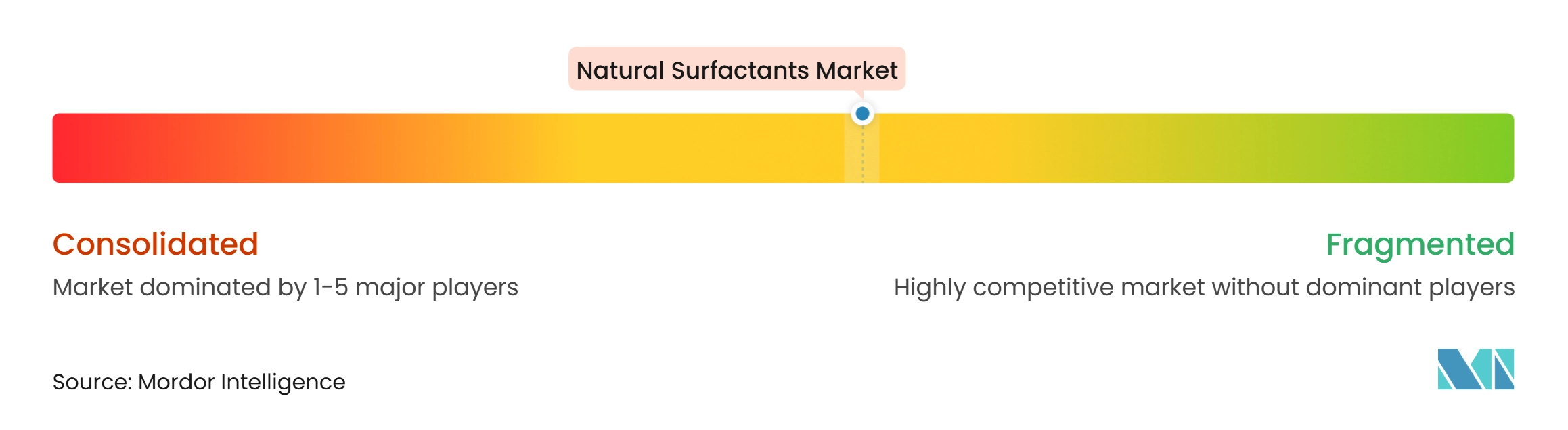
The natural surfactants market is moderately concentrated, with top players including BASF, Croda International Plc, CLARIANT, Evonik Industries AG, and Arkema. These companies compete through portfolio breadth, technical support, and access to established customer relationships. Their scale also helps them qualify materials across multiple regulatory environments. BASF combines alkyl polyglucoside platforms with capacity expansion in Thailand and planned production in the United States. Evonik Industries AG has expanded its biosurfactant position through rhamnolipid and sophorolipid platforms.
Traceability and performance data are becoming competitive tools in addition to molecule design. BASF tracks palm volumes to oil-mill level through its responsible sourcing approach. These moves address feedstock security, performance differentiation, and sustainability documentation at the same time. Smaller participants have opportunities where conventional plant-derived surfactants have limitations. Sasol’s LIVINEX IO 7 uses insect oil, which can reduce dependence on palm-kernel-based C12-C14 chemistry. Kensing, LLC and AmphiStar are pursuing upcycled microbial biosurfactants for personal care, drawing on vegetable-oil by-products and regional production plans. Stepan Company signed an exclusive distribution agreement for AmphiStar’s upcycled biosurfactants in Europe, the Middle East, and Africa in November 2025. International Sustainability and Carbon Certification PLUS, Roundtable on Sustainable Palm Oil, and Registration, Evaluation, Authorisation and Restriction of Chemicals requirements can favor companies with stronger documentation capabilities. Product differentiation is therefore likely to depend on scale, qualification support, and credible feedstock choices rather than on natural origin claims alone.
Natural Surfactants Industry Leaders
-
BASF
-
CLARIANT
-
Croda International Plc
-
Evonik Industries AG
-
Arkema
- *Disclaimer: Major Players sorted in no particular order
Natural Surfactants Market Companies Covered in this Report
- Arkema
- BASF
- CLARIANT
- Croda International Plc
- Dow
- Evonik Industries AG
- Galaxy Surfactants
- India Glycols Limited
- Indorama Ventures Public Company Limited
- Kao Corporation
- Kensing, LLC
- Sasol
- SEPPIC
- Solvay
- Stepan Company
Recent Industry Developments in Natural Surfactants Market
- October 2026: BASF commissioned expanded Alkyl Polyglucosides (APG) production capacity at its Cincinnati, Ohio facility, strengthening regional supply of bio-based and readily biodegradable nonionic surfactants. The expansion supported the natural surfactants market by increasing manufacturing capacity for renewable-feedstock surfactants used in personal care, household cleaning, and industrial applications.
- July 2026: Godrej Chemicals launched SLNOVA, a sophorolipid-based biosurfactant platform developed using renewable feedstocks and fermentation technology for personal care, home care, and industrial cleaning applications. The launch expanded the commercial availability of fermentation-derived surfactants and strengthened the biosurfactant segment of the natural surfactants market.
Global Natural Surfactants Market Report Scope
Natural surfactants are surface-active agents derived from renewable biological sources such as plants, microorganisms, and fermentation-based feedstocks. They reduce surface and interfacial tension, enabling effective cleaning, emulsification, foaming, and wetting properties. Their biodegradability and potential for lower environmental impact support their use in household cleaning, personal care, agriculture, and industrial applications.
The Natural Surfactants Market is segmented by product type, feedstock and source, application, and geography. By product type, the market is segmented into anionic surfactants, nonionic surfactants, cationic surfactants, and amphoteric surfactants. By feedstock and source, the market is segmented into plant-derived sources, microbial and fermentation-derived sources, and others. By application, the market is segmented into detergents, industrial and institutional cleaning, personal care and cosmetics, agricultural chemicals, oilfield chemicals, and others. The report also covers the market size and forecasts for natural surfactants in 15 countries across major regions. For each segment, the market sizing and forecasts have been done on the basis of value (USD).Global
Segmentation Overview
| Anionic Surfactants |
| Nonionic Surfactants |
| Cationic Surfactants |
| Amphoteric Surfactants |
| Plant-Derived Sources |
| Microbial and Fermentation-Derived Sources |
| Others |
| Detergents |
| Industrial and Institutional Cleaning |
| Personal Care and Cosmetics |
| Agricultural Chemicals |
| Oilfield Chemicals |
| Others |
| Asia-Pacific | China |
| India | |
| Japan | |
| South Korea | |
| ASEAN Countries | |
| Rest of Asia-Pacific | |
| North America | United States |
| Canada | |
| Mexico | |
| Europe | Germany |
| United Kingdom | |
| France | |
| Italy | |
| NORDIC Countries | |
| Rest of Europe | |
| South America | Brazil |
| Argentina | |
| Rest of South America | |
| Middle East and Africa | Saudi Arabia |
| South Africa | |
| Rest of Middle East and Africa |
| By Product Type | Anionic Surfactants | |
| Nonionic Surfactants | ||
| Cationic Surfactants | ||
| Amphoteric Surfactants | ||
| By Feedstock and Source | Plant-Derived Sources | |
| Microbial and Fermentation-Derived Sources | ||
| Others | ||
| By Application | Detergents | |
| Industrial and Institutional Cleaning | ||
| Personal Care and Cosmetics | ||
| Agricultural Chemicals | ||
| Oilfield Chemicals | ||
| Others | ||
| By Geography | Asia-Pacific | China |
| India | ||
| Japan | ||
| South Korea | ||
| ASEAN Countries | ||
| Rest of Asia-Pacific | ||
| North America | United States | |
| Canada | ||
| Mexico | ||
| Europe | Germany | |
| United Kingdom | ||
| France | ||
| Italy | ||
| NORDIC Countries | ||
| Rest of Europe | ||
| South America | Brazil | |
| Argentina | ||
| Rest of South America | ||
| Middle East and Africa | Saudi Arabia | |
| South Africa | ||
| Rest of Middle East and Africa | ||
Key Questions Answered in the Report
What is the size of the natural surfactants market?
The natural surfactants market size was valued at USD 22.67 billion in 2026 and is estimated to grow from USD 23.98 billion in 2027 to reach USD 31.90 billion by 2032, at a CAGR of 5.87% during the forecast period (2027-2032).
What is driving demand for natural surfactants?
Demand is supported by clean-label personal care, biodegradable cleaning products, regulatory requirements, and corporate sourcing programs for renewable-carbon materials.
Which product type held the largest share in 2026?
Anionic surfactants held a 41.45% share in 2026, supported by their use in laundry, dishwashing, and industrial cleaning.
Which feedstock and source is projected to advance fastest?
Microbial and fermentation-derived sources are projected to advance at a 6.34% CAGR through 2032 as sophorolipids and rhamnolipids gain commercial qualification.