
Multimodal Remote Inspection Systems Market Size and Share
Market Overview
| Study Period | 2020 - 2031 |
|---|---|
| Market Size (2026) | USD 1.21 Billion |
| Market Size (2031) | USD 2.11 Billion |
| Growth Rate (2026 - 2031) | 11.76 % |
| Fastest Growing Market | Middle East and Africa |
| Largest Market | Asia-Pacific |
| Market Concentration | Medium |
Major Players *Disclaimer: Major Players sorted in no particular order Image © Mordor Intelligence. Reuse requires attribution under CC BY 4.0. | |
Multimodal Remote Inspection Systems Market Analysis by Mordor Intelligence
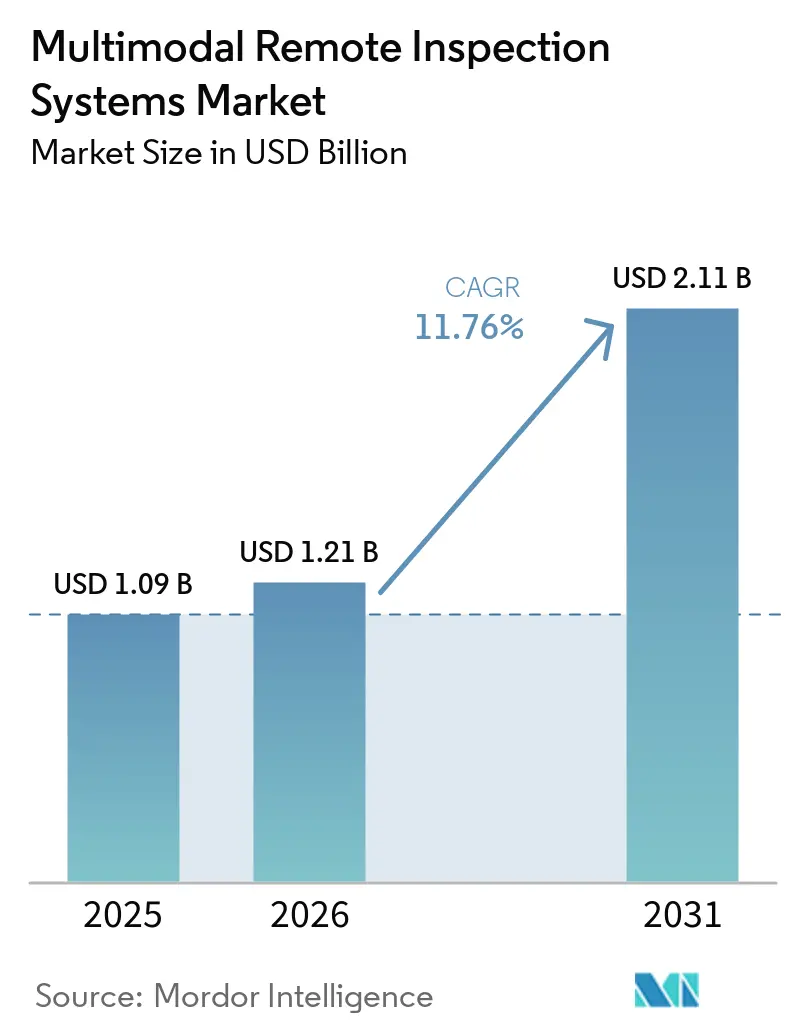
The multimodal remote inspection systems market size was USD 1.09 billion in 2025 and is projected to reach USD 2.11 billion by 2031, at a CAGR of 11.76% from 2026 to 2031. The multimodal remote inspection systems market is benefiting as physical AI, edge computing, and smaller sensors enable more frequent inspection at dispersed and difficult sites. Energy-transition investment, digital infrastructure construction, and spending on aging assets are widening demand beyond traditional nondestructive testing work. Buyers are moving from periodic manual rounds toward continuous data collection, which increases the importance of reliable sensor data and repeatable workflows. Established suppliers are combining measurement hardware with analytics, while robotics providers are building positions through managed inspection programs. Unclear responsibility for AI-generated findings still slows procurement in aviation, nuclear, and offshore applications where compliance requirements are strict.
Key Report Takeaways
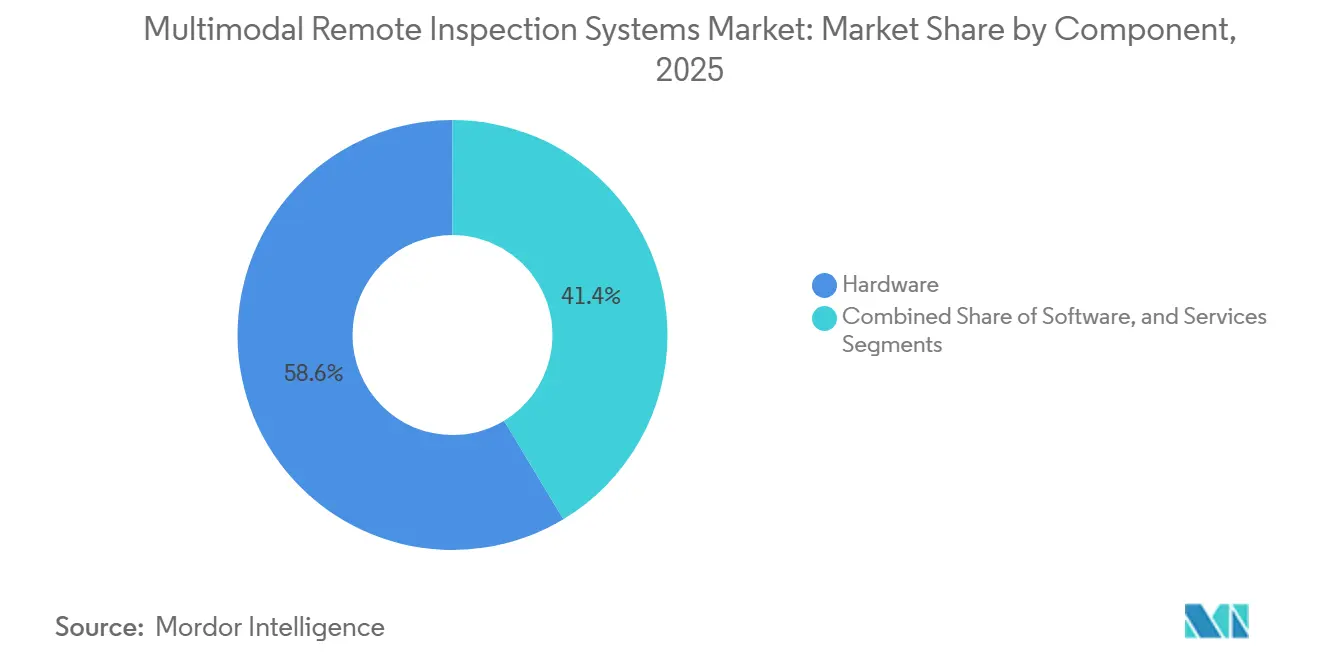
- By component, hardware held 58.63% of the multimodal remote inspection systems market share in 2025, while software is projected to expand at an 11.93% CAGR through 2031.
- By inspection platform, aerial systems accounted for 34.72% of revenue in 2025, while underwater and subsea systems are projected to expand at a 12.22% CAGR through 2031.
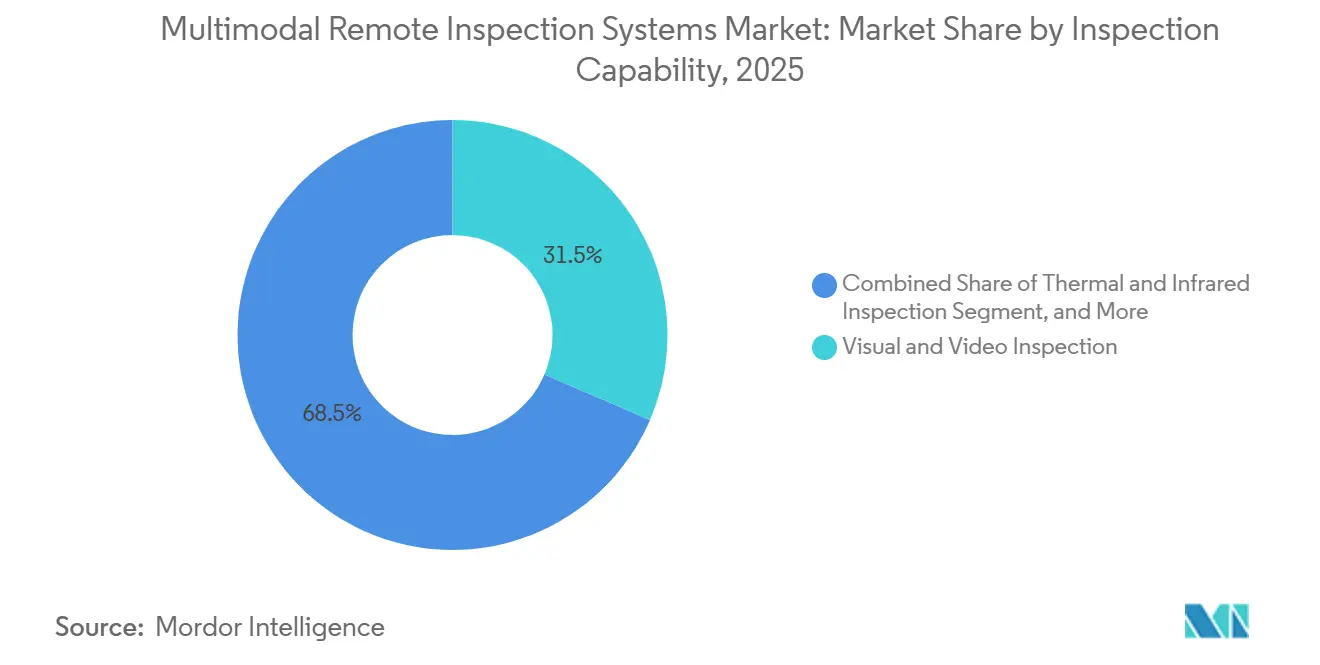
- By inspection capability, visual and video inspection held 31.46% of revenue of the multimodal remote inspection systems market in 2025, while multimodal fusion inspection is projected to expand at a 12.18% CAGR through 2031.
- By end-user industry, industrial manufacturing held 21.83% of revenue in 2025, while energy and utilities are projected to expand at a 12.53% CAGR through 2031.
- By geography, Asia-Pacific held 35.27% of the multimodal remote inspection systems market share in 2025, while the Middle East and Africa are projected to expand at a 12.64% CAGR through 2031.
Note: Market size and forecast figures in this report are generated using Mordor Intelligence’s proprietary estimation framework, updated with the latest available data and insights as of January 2026.
Global Multimodal Remote Inspection Systems Market Trends and Insights
Drivers Impact Analysis*
| Driver | (~) % Impact on CAGR Forecast | Geographic Relevance | Impact Timeline |
|---|---|---|---|
| Rising Adoption of AI, Robotics, and Digital Twin Workflows | +2.5% | Global, strongest in North America, East Asia, and Western Europe | Short term (≤ 2 years) |
| Increasing Safety Demand for Hazardous and Inaccessible Inspections | +2.0% | Global, strongest in oil and gas, mining, and nuclear areas across North America, the Middle East, and Asia-Pacific | Short term (≤ 2 years) |
| Expansion of Predictive Maintenance and Asset Integrity Programs | +1.8% | Global, with faster adoption in energy and utilities across Europe, North America, and Asia-Pacific | Medium term (2-4 years) |
| Aging Infrastructure and Stricter Quality and Compliance Requirements | +1.4% | North America, Europe, Japan, and Australia | Medium term (2-4 years) |
| Sensor-Fusion Advantage in Detecting Surface, Subsurface, and Geometric Defects | +1.0% | Global, with early commercial scale in aerospace, power generation, and advanced manufacturing centers | Medium term (2-4 years) |
| Inspection Data Scarcity for Multimodal Model Training | +0.6% | Global, most acute in emerging deployments with limited legacy data archives | Long term (≥ 4 years) |
| Source: Mordor Intelligence | |||
Rising Adoption of AI, Robotics, and Digital Twin Workflows
The multimodal remote inspection systems market is moving inspection from a periodic compliance task toward a continuous operating practice. Boston Dynamics integrated Google Gemini Robotics-ER 1.6 into its Orbit AIVI-Learning platform in April 2026. The update raised analog gauge reading accuracy on the Spot robot from 23% to 98%. This result supports more autonomous routine rounds and reduces reliance on experienced technicians for basic readings. A February 2026 trial by NTT Group, 1Finity, and Mitsubishi Chemical also confirmed that IOWN APN and 60 GHz wireless LAN could support real-time data collection and analysis by autonomous robots and digital twins at the Mizushima Coastal Industrial Zone.[1]“First Verification in Japan of Advanced Industrial Complex Inspections Using Physical AI, IOWN APN, and 60 GHz Wireless LAN,” NTT Communications, nttcom.co.jp A 2026 peer-reviewed study found that digital twin frameworks support mission planning and real-time adjustments for inspection robots in difficult settings.
Increasing Safety Demand for Hazardous and Inaccessible Inspections
The multimodal remote inspection systems market is supported by safety requirements in confined, elevated, and hazardous locations. OSHA recorded 30,273 federal inspections in fiscal year 2025. Construction and manufacturing accounted for more than 62% of that activity.[2]“Current Enforcement Summary, FY 2025,” Occupational Safety and Health Administration, osha.gov This enforcement activity increases the cost of noncompliance for asset owners. Copel used Flyability's Elios 3 drone inside hydroelectric plant conduits in September 2025. The deployment removed fall-from-height exposure, reduced downtime by at least 1 day per generating unit, and lowered operating cost by 30% against conventional methods.[3]“Copel Uses a Drone for Internal Conduit Inspection and Eliminates High-Risk Work at a Hydroelectric Plant,” Copel, copel.com
Expansion of Predictive Maintenance and Asset Integrity Programs
The multimodal remote inspection systems market is using inspection data as a direct input for predictive maintenance decisions. Percepto launched an inspection intelligence platform for energy infrastructure. Its platform combined autonomous drone hardware, contextual AI, and AIM asset intelligence software for maintenance prioritization and capital planning. This model supports subscription contracts that combine flight operations, analytics, and asset health monitoring. TDK demonstrated edgeRX, using LYNQ sensors to identify anomalies on-device and issue real-time alerts in sites with limited connectivity. Gecko Robotics added Ouster Rev8 native-color LiDAR to its Cantilever platform, allowing wall-climbing robots to create structured 3D data for corrosion and coating analysis.
Aging Infrastructure and Stricter Quality and Compliance Requirements
The multimodal remote inspection systems market is benefiting from aging infrastructure that shortens inspection intervals and increases survey complexity. The American Society of Civil Engineers identified a USD 2.6 trillion US infrastructure funding gap through 2029. Bridges, tunnels, and utility systems built decades ago require more frequent assessment as they approach or exceed their design life. Manual inspection can require traffic restrictions, operating outages, and significant worker access planning. Multimodal systems can combine LiDAR, thermal, and acoustic monitoring to identify changes before failures require emergency intervention. These requirements create an opening for providers that can deliver reliable records and integrate findings into maintenance planning.
Restraints Impact Analysis*
| Restraint | (~) % Impact on CAGR Forecast | Geographic Relevance | Impact Timeline |
|---|---|---|---|
| High Initial System and Brownfield Retrofit Costs | -2.0% | Global, most acute in cost-sensitive areas across South America, Africa, and Southeast Asia | Short term (≤ 2 years) |
| Integration, Interoperability, and Data-Governance Complexity | -1.5% | Global, with greater friction in aviation, nuclear, and offshore oil and gas | Medium term (2-4 years) |
| Limited Bandwidth, Battery Endurance, and Payload Capacity in Remote Sites | -1.0% | The Middle East, Africa, and remote Asia-Pacific sites with limited connectivity | Medium term (2-4 years) |
| Unclear Liability for AI-Generated Inspection Decisions | -0.7% | Global, especially aviation and nuclear inspection | Long term (≥ 4 years) |
| Source: Mordor Intelligence | |||
High Initial System and Brownfield Retrofit Costs
Entry into the multimodal remote inspection systems market can require substantial spending on platforms, sensors, edge computing, docking stations, and software. Brownfield projects also require facility mapping, safety validation, workforce training, and integration with existing asset systems. These requirements can create a barrier for mid-sized industrial users and facilities not designed for robotic access. ANYbotics' ATEX Zone 1-certified ANYmal robot illustrates the challenge because a refinery deployment may also need docking infrastructure, wireless upgrades, and digital twin architecture. A short payback assessment can overlook savings from fewer unplanned shutdowns in later years. ISO 17020 inspection-body requirements can also add validation work and extend approval timelines.
Integration, Interoperability, and Data-Governance Complexity
The multimodal remote inspection systems market generates point clouds, thermal images, acoustic signatures, video feeds, and ultrasonic waveforms. These formats often do not fit a common schema or existing enterprise asset-management systems. Aviation and offshore operators must retain inspection records that meet formal evidentiary requirements. FAA maintenance rules and BSEE requirements, therefore, add reporting and traceability obligations for autonomous findings. A 2025 peer-reviewed study described NDE 4.0 as technically mature but identified standardized reporting from sensor-fusion outputs as a major implementation barrier. Without a shared governance layer, operators can collect large volumes of information that still require manual interpretation before it becomes a maintenance decision.
*Our forecasts treat driver/restraint impacts as directional, not additive. The impact forecasts reflect baseline growth, mix effects, and variable interactions.
Segment Analysis
By Component: Hardware Retains Revenue Leadership as Software Advances
Hardware accounted for 58.63% of revenue in 2025 within the multimodal remote inspection systems market. The category includes aerial drones, ground robots, subsea vehicles, fixed camera systems, sensor payloads, docking equipment, and rugged edge computing modules. These assets support site-level data capture and sensor fusion across inspection missions. Services in the multimodal remote inspection systems market were the second-largest component because buyers increasingly require deployment support, maintenance contracts, and managed programs with predictable outcomes.
Software is projected to expand at an 11.93% CAGR from 2026 to 2031. Operators are adding analytics, digital twin synchronization, and AI defect detection over their installed hardware. DroneDeploy reported in 2026 that its visual dataset exceeded 20 trillion square feet and that autonomous ground robot missions increased by 160% year over year. Panasonic Connect began sales of the Bead Eye M edition in June 2026, combining 3D sensing and proprietary AI for weld inspection. Panasonic stated that the system reduced setup labor by 90%, showing how hardware and software value are becoming less distinct.



By Inspection Platform: Aerial Systems Lead as Subsea Systems Accelerate
Aerial systems held 34.72% of revenue in 2025 within the multimodal remote inspection systems market. Their position reflects mature drone hardware, clearer visual line-of-sight rules, and their use across power lines, tanks, and bridge decks. Ground robots serve confined spaces and high-radiation settings, while fixed systems provide continuous monitoring on manufacturing lines and critical infrastructure. This platform mix lets operators select equipment based on site access and inspection frequency.
Underwater and subsea systems are projected to expand at a 12.22% CAGR from 2026 to 2031. In the multimodal remote inspection systems market, aging offshore assets, deepwater development, and required pipeline and riser surveys support demand. Elsa Energy secured a July 2026 contract to deploy autonomous underwater vehicle systems for offshore structure inspections in East and West Malaysia. Work was scheduled to begin in the third quarter of 2026. FAA proposed Part 108 rules in January 2026 that could establish a framework for scalable beyond-visual-line-of-sight operations and widen aerial inspections across long corridors.
By Inspection Capability: Visual Inspection Leads as Multimodal Fusion Gains Use
Visual and video inspection held 31.46% of revenue in the multimodal remote inspection systems market in 2025. Its broad use and acceptance in compliance workflows are supported by better cameras, lighting, and AI-assisted defect tagging. Thermal and infrared methods support electrical, insulation, and bearing-temperature assessment, while 3D LiDAR is used for geometric tracking in civil surveys. Nondestructive, subsurface, acoustic, and vibration methods remain important where surface observation cannot show deterioration.
Multimodal fusion inspection is projected to expand at a 12.18% CAGR from 2026 to 2031. Buyers are replacing sequential single-sensor passes with synchronized capture from several channels. A 2024 study found that combining phased-array ultrasound and pulsed thermography improved subsurface-defect detection in composites. Hitachi developed an edge AI semiconductor in April 2026 that processes image, acoustic, and vibration data onboard equipment with 10 times the power efficiency of prior server-dependent designs. Lower energy and connectivity requirements can improve the use of fusion systems at remote sites.
By End-User Industry: Manufacturing Leads as Energy and Utilities Expand
Industrial manufacturing held 21.83% of revenue in the multimodal remote inspection systems market in 2025. Recurring quality-control work across electronics, automotive, aerospace components, and process facilities supports this position. Oil and gas were the second-largest user group because pipeline surveys, refinery vessel inspections, and offshore assessments are required. Aerospace and defense also have high inspection intensity, and Waygate Technologies, with GE Aerospace, introduced automated GEnx engine borescope templates in April 2026.
Energy and utilities is projected to expand at a 12.53% CAGR from 2026 to 2031. Wind farms, solar arrays, and transmission corridors require recurring inspections at dispersed, hard-to-access sites. ISA ENERGIA BRASIL deployed automated drone inspections at high-voltage substations in September 2025. The program cut inspection time by more than 70% against manually piloted surveys. Transportation, marine, mining, public safety, and inspection service providers retain distinct roles driven by asset aging, confined-space safety, and emergency response.
Geography Analysis
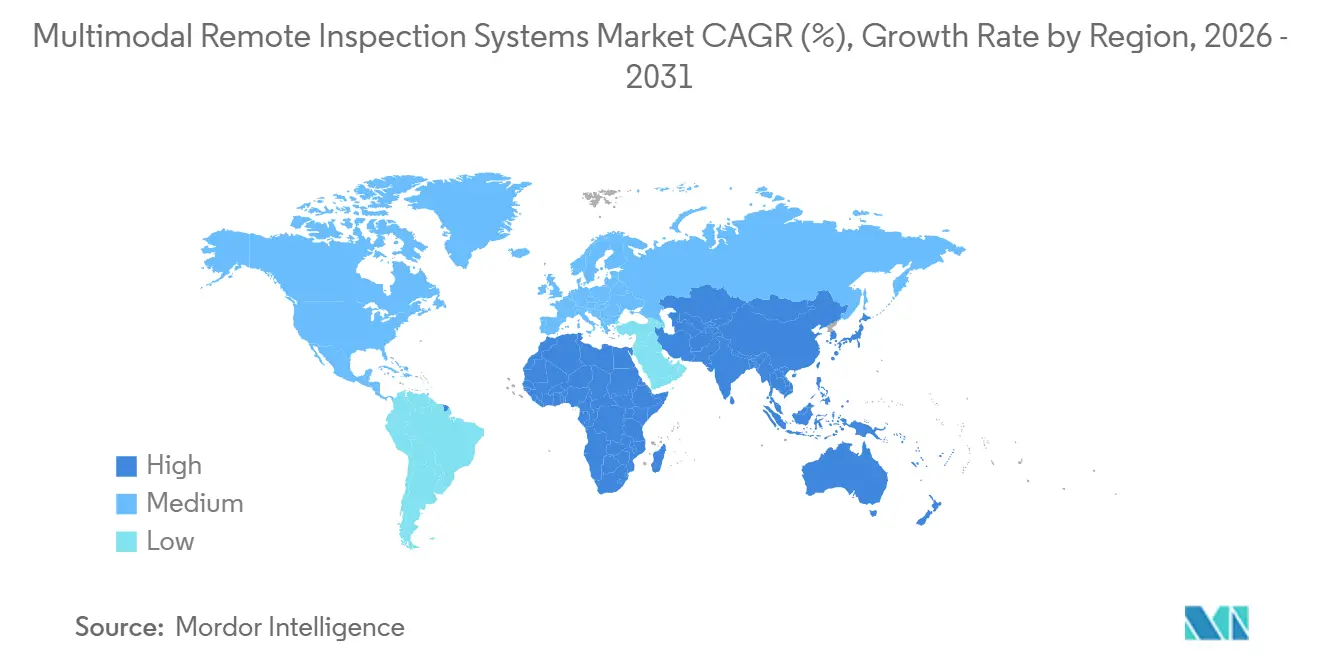
Asia-Pacific held 35.27% of revenue in 2025 within the multimodal remote inspection systems market. The region combines major electronics, semiconductor, automotive, refinery, and petrochemical assets across China, India, South Korea, Japan, and the ASEAN countries. Hitachi announced edge AI semiconductor work in April 2026 for simultaneous processing of image, acoustic, and vibration data, supporting device-level sensor integration. India’s production-linked incentive programs and wider production-line certification in Vietnam, Malaysia, and Thailand are increasing demand for traceable automated inspection. China’s refinery and pipeline network supports ground and aerial robotics, while supply-chain separation favors more domestic platform vendors.
North America and Europe were the second- and third-largest revenue pools in the multimodal remote inspection systems market. The United States held the largest country-level position in North America, supported by a USD 2.6 trillion infrastructure funding gap through 2029 that sustains inspection demand. FAA authorization for simultaneous Skydio X10 operations and the July 2026 Blue UAS certification widened access to US inspection-drone procurement. European demand is supported by aging rail bridges, industrial safety requirements, and wind-energy construction. Endesa deployed 17 long-range drones in Spain in April 2026 to create power-line digital twins using LiDAR, thermal, and visual data.
The Middle East and Africa segment of the multimodal remote inspection systems market is projected to expand at a 12.64% CAGR from 2026 to 2031. Saudi Arabia’s Public Investment Fund approved its 2026-2030 strategy for six domestic ecosystems, including advanced manufacturing and clean energy infrastructure. These projects will create inspection requirements across petrochemical, power, and construction assets. Africa is at an earlier stage, with additional demand linked to infrastructure projects funded by Gulf investors.

Competitive Landscape
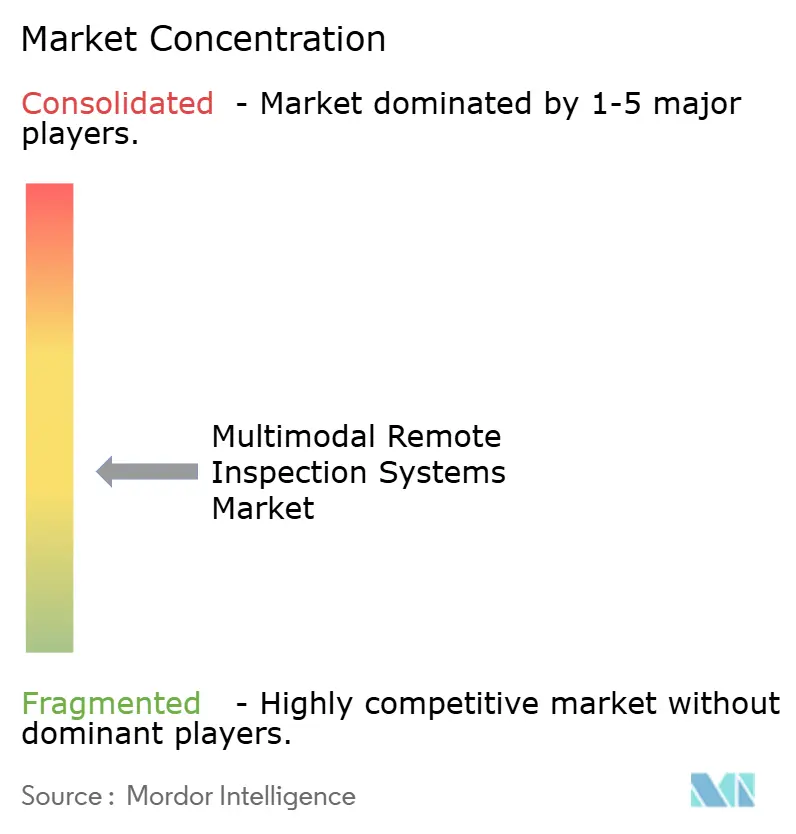
The multimodal remote inspection systems market is moderately fragmented across platforms, capabilities, and end-user applications. Baker Hughes, Hexagon, and Teledyne Technologies have established positions in precision instrumentation and nondestructive testing. Boston Dynamics, ANYbotics, Gecko Robotics, Flyability, and Percepto have developed specialized robotics and autonomy offerings. Competition rests on system reliability, operating access, data quality, and workflow integration. No supplier leads every application because customer requirements vary widely.
Baker Hughes agreed to sell Waygate Technologies to Hexagon for USD 1.45 billion in April 2026, with closing expected in the second half of 2026. The deal combines Waygate’s remote visual inspection, ultrasound, radiography, and imaging portfolio with Hexagon’s measurement and software capabilities. The multimodal remote inspection systems market is seeing suppliers offer integrated sensing and analytics rather than individual instruments. Boston Dynamics integrated Google Gemini Robotics-ER 1.6 into its Orbit platform in April 2026, raising autonomous analog gauge reading accuracy from 23% to 98%. Percepto introduced its next-generation energy-infrastructure inspection platform in June 2026, combining autonomous drone hardware, contextual AI, and asset intelligence software.
ANYbotics targets hazardous locations with ATEX-certified robots, Flyability focuses on GPS-denied confined spaces, and Percepto serves remote energy infrastructure operations. These focused positions help smaller suppliers in the multimodal remote inspection systems market avoid direct competition across every inspection setting. A shared inspection-data format remains an open opportunity because it could connect systems with major maintenance and digital twin platforms. No vendor holds a commanding position across the full platform, capability, and end-user scope.
Multimodal Remote Inspection Systems Industry Leaders
Waygate Technologies (Baker Hughes Company)
MISTRAS Group, Inc.
Intertek Group plc
Eddyfi Technologies Inc.
Evident Corporation
- *Disclaimer: Major Players sorted in no particular order

Recent Industry Developments
- July 2026: Skydio's X10, Dock for X10, and R10 drone solutions were added to the US federal government's Blue UAS Cleared List, marking the first time Skydio's full commercial portfolio secured cleared-list status. The certification opens the entire US federal procurement channel, including military branches, civilian agencies, and critical-infrastructure operators, for Skydio's autonomous inspection platform.
- June 2026: Percepto launched its next-generation inspection intelligence platform for energy infrastructure, integrating updated Percepto Air drone hardware, inspection-grade onboard autonomy, contextual AI, and its AIM asset intelligence software. The platform is designed to scale human-expert inspection logic across multiple sites and asset classes simultaneously, targeting oil and gas operators and electric utilities facing inspection demand growth without proportional workforce expansion.
- June 2026: Panasonic Connect began sales of "Bead Eye M edition," an AI-powered weld inspection solution combining 3D sensors and proprietary AI, reducing setup man-hours for weld inspection by 90%. The product reflects the integration of visual and geometric sensing in manufacturing quality programs.
- May 2026: Waygate Technologies launched the Everest Mentor Flex+ video borescope globally, introducing QuickChange interchangeable probe technology, Real3D sub-millimeter 3D measurement, and Push2IW cloud data transfer to InspectionWorks. The system targets mid-sized aerospace and energy inspection operators requiring 3D measurement and structured digital workflows without full-scale enterprise platform investment.


Global Multimodal Remote Inspection Systems Market Report Scope
The Multimodal Remote Inspection Systems Market Report is Segmented by Component (Hardware, Software, and Services), Inspection Platform (Aerial Inspection Systems, Ground Inspection Robots, Underwater and Subsea Inspection Systems, and Fixed/Stationary Remote Inspection Systems), Inspection Capability (Visual and Video Inspection, Thermal and Infrared Inspection, 3D/LiDAR and Spatial Inspection, NDT and Subsurface Inspection, Acoustic and Vibration Inspection, and Multimodal Fusion Inspection), End-User Industry (Manufacturing, Oil and Gas, Energy, Infrastructure, Transport, Aerospace, Mining, Government, Inspection, Testing and Certification Service Providers, and Other End-User Industries), and Geography (North America, South America, Europe, Asia-Pacific, Middle East and Africa). The Market Forecasts are Provided in Terms of Value (USD).
| Hardware |
| Software |
| Services |
| Aerial Inspection Systems |
| Ground Inspection Robots |
| Underwater and Subsea Inspection Systems |
| Fixed/Stationary Remote Inspection Systems |
| Visual and Video Inspection |
| Thermal and Infrared Inspection |
| 3D/LiDAR and Spatial Inspection |
| NDT and Subsurface Inspection |
| Acoustic and Vibration Inspection |
| Multimodal Fusion Inspection |
| Industrial Manufacturing |
| Oil and Gas |
| Energy and Utilities |
| Infrastructure and Construction |
| Transportation and Marine |
| Aerospace and Defense |
| Mining and Metals |
| Government and Public Safety |
| Inspection, Testing and Certification Service Providers |
| Other End-User Industries |
| North America | United States | |
| Canada | ||
| Mexico | ||
| South America | Brazil | |
| Argentina | ||
| Rest of South America | ||
| Europe | Germany | |
| United Kingdom | ||
| France | ||
| Italy | ||
| Spain | ||
| Rest of Europe | ||
| Asia-Pacific | China | |
| Japan | ||
| India | ||
| South Korea | ||
| ASEAN | ||
| Rest of Asia-Pacific | ||
| Middle East and Africa | Middle East | Saudi Arabia |
| United Arab Emirates | ||
| Turkey | ||
| Rest of the Middle East | ||
| Africa | South Africa | |
| Nigeria | ||
| Rest of Africa | ||
| By Component | Hardware | ||
| Software | |||
| Services | |||
| By Inspection Platform | Aerial Inspection Systems | ||
| Ground Inspection Robots | |||
| Underwater and Subsea Inspection Systems | |||
| Fixed/Stationary Remote Inspection Systems | |||
| By Inspection Capability | Visual and Video Inspection | ||
| Thermal and Infrared Inspection | |||
| 3D/LiDAR and Spatial Inspection | |||
| NDT and Subsurface Inspection | |||
| Acoustic and Vibration Inspection | |||
| Multimodal Fusion Inspection | |||
| By End-User Industry | Industrial Manufacturing | ||
| Oil and Gas | |||
| Energy and Utilities | |||
| Infrastructure and Construction | |||
| Transportation and Marine | |||
| Aerospace and Defense | |||
| Mining and Metals | |||
| Government and Public Safety | |||
| Inspection, Testing and Certification Service Providers | |||
| Other End-User Industries | |||
| By Geography | North America | United States | |
| Canada | |||
| Mexico | |||
| South America | Brazil | ||
| Argentina | |||
| Rest of South America | |||
| Europe | Germany | ||
| United Kingdom | |||
| France | |||
| Italy | |||
| Spain | |||
| Rest of Europe | |||
| Asia-Pacific | China | ||
| Japan | |||
| India | |||
| South Korea | |||
| ASEAN | |||
| Rest of Asia-Pacific | |||
| Middle East and Africa | Middle East | Saudi Arabia | |
| United Arab Emirates | |||
| Turkey | |||
| Rest of the Middle East | |||
| Africa | South Africa | ||
| Nigeria | |||
| Rest of Africa | |||


Key Questions Answered in the Report
What is the multimodal remote inspection systems market size?
It was USD 1.09 billion in 2025 and is projected to reach USD 2.11 billion by 2031, at an 11.76% CAGR from 2026 to 2031.
Which component leads multimodal remote inspection systems revenue?
Hardware led with 58.63% of revenue in 2025, supported by spending on platforms, sensors, docking systems, and edge processing.
Which inspection platform is expanding the fastest?
Underwater and subsea systems are projected to expand at a 12.22% CAGR through 2031, supported by offshore asset inspection needs.
Why is multimodal fusion inspection gaining adoption?
It is projected to expand at a 12.18% CAGR because it combines visual, thermal, LiDAR, acoustic, and subsurface information within one inspection workflow.
Which end-user sector is projected to expand the fastest?
Energy and utilities is projected to expand at a 12.53% CAGR through 2031 as wind, solar, and transmission assets require recurring inspections.
Which region leads remote inspection systems adoption?
Asia-Pacific led with 35.27% of revenue in 2025, while the Middle East and Africa is projected to expand at a 12.64% CAGR through 2031.
Page last updated on:





