
Multi-Agent Systems Market Size and Share
Market Overview
| Study Period | 2020 - 2031 |
|---|---|
| Market Size (2026) | USD 5.84 Billion |
| Market Size (2031) | USD 20.98 Billion |
| Growth Rate (2026 - 2031) | 29.15 % |
| Fastest Growing Market | Asia-Pacific |
| Largest Market | North America |
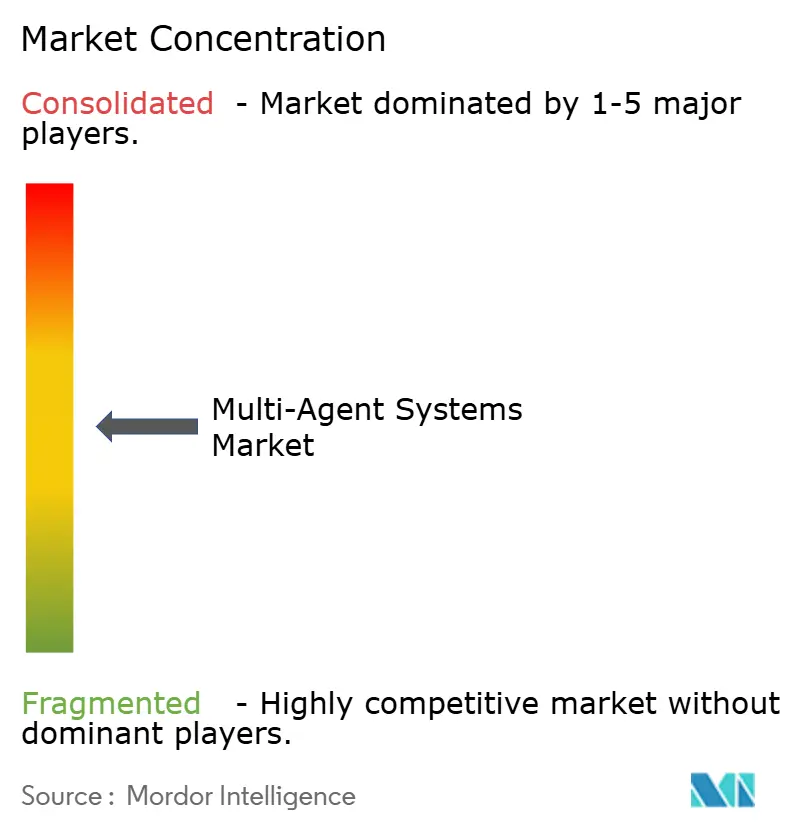
| Market Concentration | Medium |
Major Players *Disclaimer: Major Players sorted in no particular order Image © Mordor Intelligence. Reuse requires attribution under CC BY 4.0. | |
Multi-Agent Systems Market Analysis by Mordor Intelligence
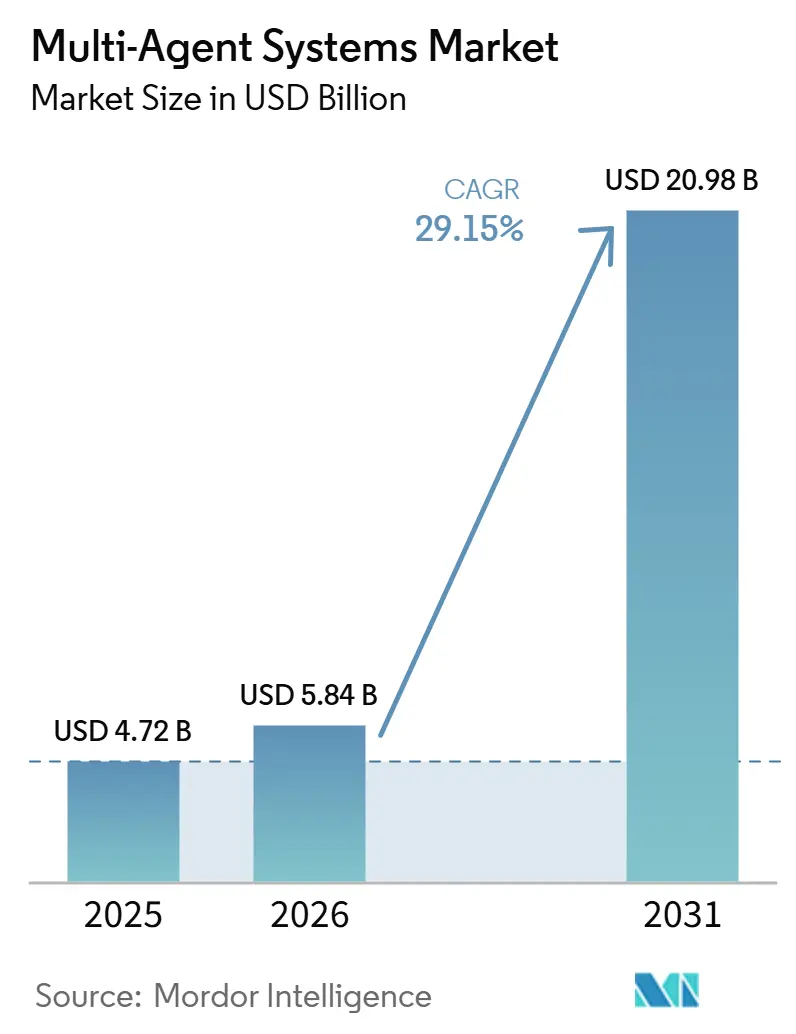
The Multi-Agent Systems Market size is expected to grow from USD 4.72 billion in 2025 to USD 5.84 billion in 2026 and is forecast to reach USD 20.98 billion by 2031 at 29.15% CAGR over 2026-2031. Growth in the multi-agent systems market is being shaped by the shift from isolated automation tools toward coordinated agent ecosystems that can manage linked workflows across operations, finance, and software development. The combination of large language model reasoning with structured orchestration layers is expanding the role of these systems from task support to enterprise process execution, raising demand for platforms that can coordinate multiple specialized agents with shared context and tool access. The multi-agent systems market is also benefiting from stronger interest in governance-aware orchestration, as enterprises want deployment models that can support auditability, policy control, and broader workflow coverage without rebuilding each automation layer from scratch. At the same time, sovereign AI priorities in Europe and Asia-Pacific are widening the opening for on-premises and hybrid architectures, which is creating a higher-value niche that differs from the economics of cloud-first adoption. Competitive positioning in the multi-agent systems market is therefore being shaped by platform depth, interoperability, and compute efficiency, while fragmented standards, high inference costs, and limited engineering talent continue to slow broader production rollout.
Key Report Takeaways
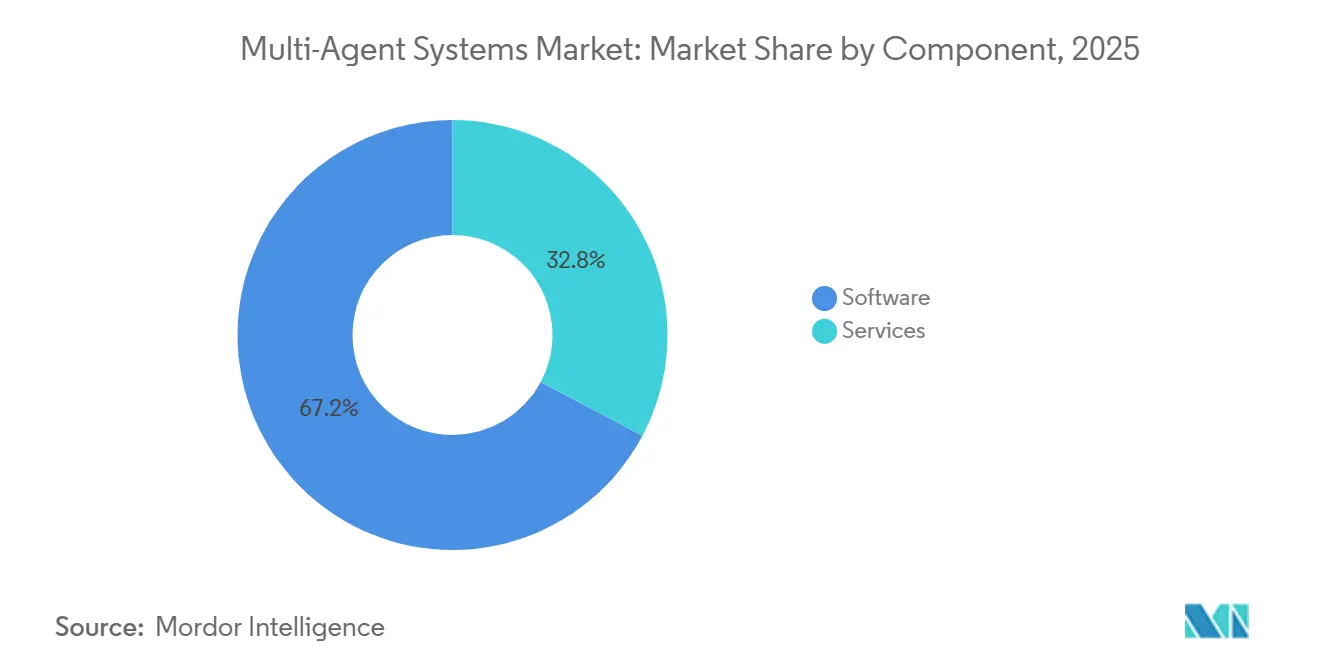
- By component, software accounted for 67.23% of revenue share in the multi-agent systems market in 2025, while services are projected to expand at a 29.01% CAGR through 2031.
- By deployment mode, cloud accounted for 73.56% of revenue share in the multi-agent systems market in 2025 and is expected to expand at a 28.32% CAGR through 2031.
- By enterprise size, large enterprises held 76.87% of revenue share in the multi-agent systems market in 2025, while small and medium enterprises are projected to advance at a 28.76% CAGR through 2031.
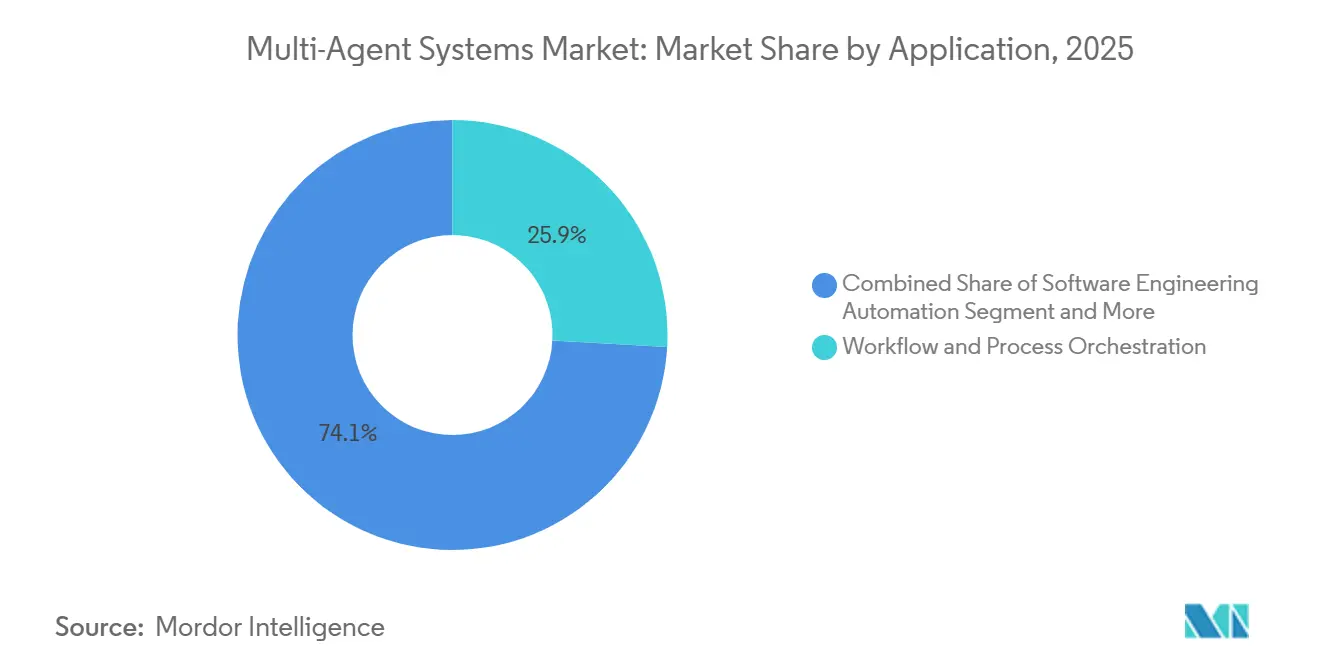
- By application, workflow and process orchestration led with 25.88% of revenue share in the multi-agent systems market in 2025, while software engineering automation is expected to expand at a 28.18% CAGR through 2031.
- By end-user industry, IT and telecommunications accounted for 23.40% of revenue share in the multi-agent systems market in 2025, while healthcare and life sciences are projected to grow at a 29.34% CAGR through 2031.
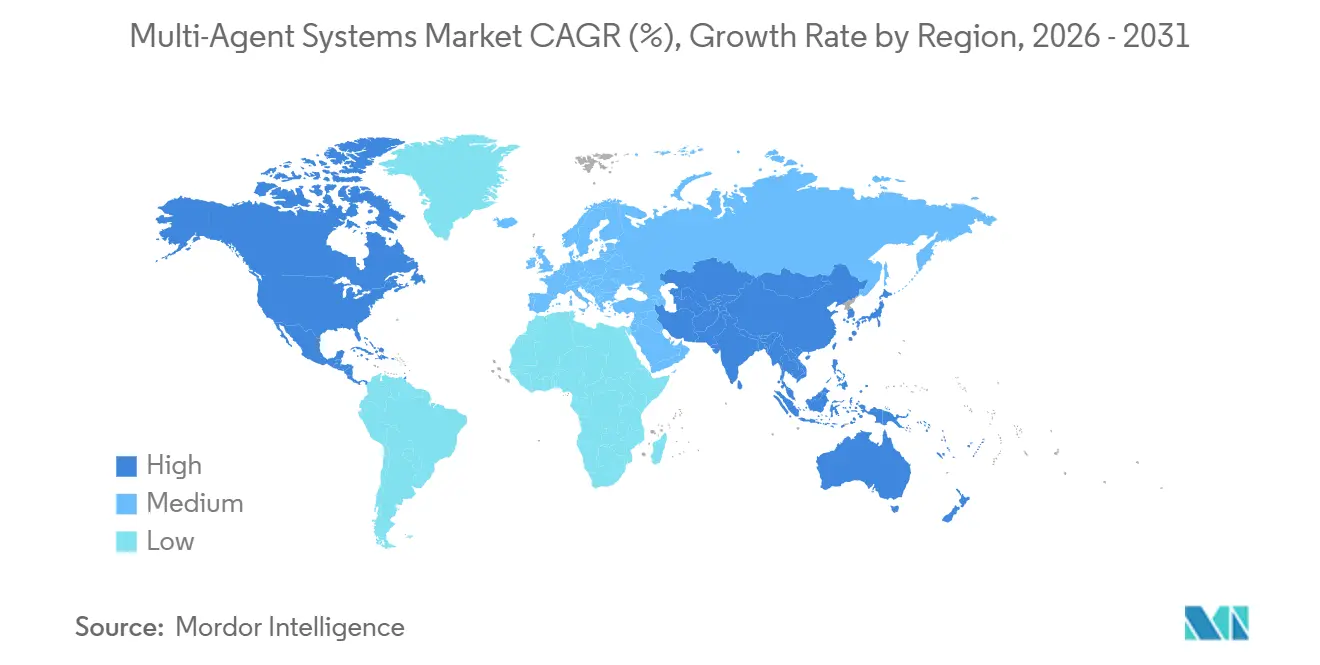
- By geography, North America accounted for 41.89% of revenue share in the multi-agent systems market in 2025, while Asia-Pacific is projected to record the fastest regional CAGR of 29.81% through 2031.
Note: Market size and forecast figures in this report are generated using Mordor Intelligence’s proprietary estimation framework, updated with the latest available data and insights as of January 2026.
Market Trends and Insights
Drivers Impact Analysis of Multi-Agent Systems Market*
| Driver | (~) % Impact on CAGR Forecast | Geographic Relevance | Impact Timeline |
|---|---|---|---|
| Enterprise Demand for Autonomous Workflow Orchestration | +8.5% | Global, strongest in North America and Western Europe | Short term (≤ 2 years) |
| Convergence of Large Language Models and Multi-Agent Frameworks | +7.2% | Global technology hubs across North America, Europe, and Asia-Pacific | Medium term (2-4 years) |
| Rising Need for Real-Time Distributed Decision Making | +5.8% | North America, Asia-Pacific, China, Japan, Singapore | Medium term (2-4 years) |
| Expansion of Robotics and Industrial Automation Coordination | +4.1% | Asia-Pacific, China, South Korea, Japan, Germany | Long term (≥ 4 years) |
| Growth of Cloud-Native Agent Development Stacks | +3.6% | Global, with early gains in North America and urban Asia-Pacific | Short term (≤ 2 years) |
| Increasing Reuse of Open-Source Agent Frameworks and Tooling | +2.9% | Developer communities worldwide, notably India, Germany, and Singapore | Medium term (2-4 years) |
| Source: Mordor Intelligence | |||
Enterprise Demand for Autonomous Workflow Orchestration
Autonomous workflow orchestration has moved beyond pilot testing and is becoming a formal enterprise priority in the multi-agent systems market. Buyers are no longer looking for isolated agent functions, because higher-value workflows usually require several specialized agents to share state, tools, and escalation rules across the same process. This is especially relevant in procurement approvals, regulatory reporting, finance operations, and IT change management, where a single workflow often crosses several internal teams before completion. As a result, the multi-agent systems market is seeing stronger demand for orchestration platforms that bundle workflow control, governance, routing, and integration into a single operating environment. That shift is also lifting contract scope, because enterprises increasingly want orchestration software, middleware, and policy management together rather than as separate purchases. Vendors that secure this orchestration layer early are in a stronger position to retain customers as deployments widen across enterprise functions.
Convergence of Large Language Models and Multi-Agent Frameworks
The convergence of large language models and structured orchestration frameworks is widening the range of problems that the multi-agent systems market can address. Microsoft made multi-agent orchestration generally available in Copilot Studio in April 2026, allowing agents built across Microsoft Fabric, the Microsoft 365 Agents SDK, and the open A2A protocol to work toward shared enterprise goals.[1]Microsoft, “New and Improved Multi-Agent Orchestration, Connected Experiences, and Faster Prompt Iteration,” Microsoft Copilot Blog, microsoft.com This is separating the vendor field into platforms built for tightly governed execution and systems aimed at more exploratory or research-led tasks. NVIDIA also introduced its Agent Toolkit in March 2026, combining open models, runtime components, and enterprise integrations to reduce the operational barrier to agent deployment.[2]NVIDIA, “NVIDIA Ignites the Next Industrial Revolution in Knowledge Work With Open Agent Development Platform,” NVIDIA Investor Relations, nvidia.com Lower deployment friction matters because the multi-agent systems market still faces cost sensitivity in small and medium business environments. As LLM reasoning becomes easier to integrate with orchestration logic, the multi-agent systems market is likely to see broader adoption for functions that were previously too complex for rule-based automation alone.
Rising Need for Real-Time Distributed Decision Making
The need for real-time distributed decision making is pushing the multi-agent systems market into time-sensitive operating environments. In trading, logistics, and industrial control, enterprises are using specialized agents to split complex decisions into parallel subtasks that can be processed more quickly than a single sequential chain. This matters most when re-routing, escalation, or exception handling must occur across several systems simultaneously. The A2A protocol reached version 1.0.1 in May 2026, giving vendors and enterprises a more unified way to support cross-vendor delegation and agent-to-agent coordination.[3]A2A Protocol, “Agent2Agent Protocol Specification,” A2A Protocol, a2a-protocol.org That development supports the multi-agent systems market by making real-time collaboration more practical across different tools and frameworks. In supply chain and logistics settings, this kind of coordination enables the same network to rework inventory, transportation, and procurement actions within a single disruption window.
Expansion of Robotics and Industrial Automation Coordination
The expansion of robotics and industrial automation coordination is broadening the multi-agent systems market beyond software-centered enterprise workflows. Industrial use cases require several agents to supervise physical processes, maintenance schedules, and yield optimization within tightly managed operating environments. That raises the addressable market for multi-agent systems because manufacturing and industrial buyers often have longer deployment cycles and higher contract values than pure software buyers. Automation Anywhere introduced EnterpriseClaw in collaboration with Cisco, NVIDIA, Okta, and OpenAI, focusing on autonomous AI agents across cloud platforms, desktops, on-premises systems, and secure enterprise networks. The message for vendors is clear, because platforms that cannot operate across edge, cloud, and enterprise security layers may struggle to win industrial deployments. The multi-agent systems market is therefore moving toward hybrid architectures that can support both probabilistic execution and deterministic control requirements.
Restraints Impact Analysis of Multi-Agent Systems Market*
| Restraint | (~) % Impact on CAGR Forecast | Geographic Relevance | Impact Timeline |
|---|---|---|---|
| Lack of Interoperability Standards Across Agent Frameworks | -3.8% | Global, most acute in enterprise deployments spanning multiple frameworks | Medium term (2-4 years) |
| Governance, Auditability, and Compliance Complexity | -3.1% | North America and Europe, spill-over to Asia-Pacific regulated sectors | Medium term (2-4 years) |
| Escalating Compute, Inference, and API Orchestration Costs | -2.4% | Global, heaviest burden on SMEs and cost-sensitive enterprise segments | Short term (≤ 2 years) |
| Scarcity of Multi-Agent System-Ready Engineering Talent | -1.9% | Global, with acute shortages in Europe and Southeast Asia | Long term (≥ 4 years) |
| Source: Mordor Intelligence | |||
Lack of Interoperability Standards Across Agent Frameworks
Interoperability remains one of the clearest limits on wider adoption in the multi-agent systems market. Agents built on different frameworks still do not exchange task state, memory, or governance metadata in a native, consistent way, forcing enterprises to build custom integration layers around them. That increases delivery time, raises implementation cost, and makes system behavior harder to monitor when several frameworks are used in the same deployment. Even though the A2A protocol has improved cross-vendor delegation, enterprises still need additional controls to manage governance and workflow consistency across broader production environments. This problem is especially visible in large organizations where agent sprawl is increasing faster than standardization. In the multi-agent systems market, the result is a slower platform-buying cycle and greater reliance on systems integration effort before scale can be achieved.
Governance, Auditability, and Compliance Complexity
Governance and auditability are also slowing the rollout of production in the multi-agent systems market, especially in regulated sectors. Multi-agent workflows generate a high volume of linked decision events, and compliance teams need a clear way to trace how those events were created, delegated, and completed across the full chain. That requirement is particularly important in healthcare, financial services, and public-sector settings, where transparency expectations are higher, and workflow errors carry broader consequences. Microsoft introduced the Agent Governance Toolkit in April 2026 to address runtime security and policy enforcement across several leading frameworks, showing how governance tooling is becoming a core product layer rather than an optional add-on. Cloud Security Alliance commentary around NIST CAISI also reflects how compliance expectations are shaping enterprise procurement behavior for agent systems. Until governance controls become more consistent across the vendor field, the multi-agent systems market is likely to keep seeing slower rollout in high-risk workflows.
*Our forecasts treat driver/restraint impacts as directional, not additive. The impact forecasts reflect baseline growth, mix effects, and variable interactions.
Multi-Agent Systems Market Segment Analysis
By Component:
Software Platforms Anchor Revenue and Services Scale Through Integration DemandSoftware held 67.23% share in 2025 and remained the largest revenue base across the multi-agent systems market. This segment includes orchestration platforms, agent development frameworks, and coordination middleware, which explains why enterprise spending is concentrated in platform licensing and subscription-led delivery models. Buyers typically begin with software because that is where routing logic, governance controls, and tool integration are defined before any broader services layer is added. In the multi-agent systems market, software revenue also benefits from renewal economics because once an enterprise standardizes its orchestration logic, switching becomes more disruptive. IBM expanded watsonx Orchestrate at Think 2026 into a broader agentic control plane, which shows how software vendors are deepening the platform layer to keep strategic control of enterprise deployments.
Services are projected to grow at a 29.01% CAGR through 2031, making them the faster-growing subsegment in the multi-agent systems market. The main reason is that many deployments still require consulting, integration, testing, customization, and managed support before they can move from the pilot stage to broad production use. Integration work is especially important when agent systems must connect with ERP, CRM, HRMS, data governance, and security tools that were not built for shared agent orchestration. This has created a situation in which service growth is strong even as enterprises aim to reduce long-term dependence on manual deployment support. The multi-agent systems industry is therefore seeing software vendors invest in visual builders, reusable templates, and low-code development layers to reduce the intensity of professional services over time. As a result, the multi-agent systems market keeps software as its revenue anchor, while services expand alongside increasing implementation complexity.


By Deployment Mode:
Cloud Dominates and On-Premises Builds a Premium PositionCloud accounted for 73.56% of the multi-agent systems market size in 2025 and advanced at a 28.32% CAGR through 2031. Cloud led because hyperscaler-managed endpoints reduce the burden of infrastructure scaling, runtime patching, and orchestration maintenance for enterprises that want faster deployment. This gives buyers a shorter path to production, especially in early-adopter phases when internal agent engineering capacity is limited. The multi-agent systems market also favors cloud for horizontal enterprise use cases because managed environments can provide baseline governance interfaces without requiring custom infrastructure work upfront. That early advantage has helped Cloud become the default deployment mode for broad workflow orchestration across several business functions.
On-premises has still gained a stronger footing in regulated and sovereignty-sensitive environments within the multi-agent systems market. Defense, healthcare, public sector, and financial services buyers often need tighter control over data residency, security boundaries, and operational accountability than standard public cloud models can easily support. UiPath addressed this requirement in May 2026 by extending agentic AI capabilities on Automation Suite for the public sector, enabling government organizations to run and govern these deployments within their own environments. That kind of move matters because on-premises deployments often carry higher contract values due to bundled infrastructure, support, and governance layers. The multi-agent systems market is therefore not treating on-premises as a declining model, but as a premium architecture for buyers with stricter control needs.
By Enterprise Size:
Large Enterprises Lead and SMEs Open the Next Adoption LayerLarge enterprises held a 76.87% share in 2025, keeping them at the center of the multi-agent systems market. These organizations have larger AI budgets, more complex internal workflows, and a stronger ability to absorb the costs of governance, integration, and compute. They also tend to have earlier automation investments in place, which gives them a practical base for adding multi-agent coordination without rebuilding entire systems from the ground up. In many cases, a single workflow may require procurement, finance, legal, and compliance teams to work together, which pushes platform usage and orchestration depth higher than they would be in smaller deployments. That operating reality helps explain why large enterprises still account for most current spending in the multi-agent systems market.
Small and medium enterprises are projected to expand at a 28.76% CAGR through 2031, making them the fastest-growing segment of the multi-agent systems market. Their momentum is tied to pre-integrated agent suites, reusable workflow templates, and managed delivery models that reduce the need for deep internal engineering teams. Instead of building custom orchestration stacks, these buyers can adopt narrower workflow packages that focus on customer support, coding assistance, business operations, or document handling. This makes the opportunity less about broad horizontal platforms and more about targeted deployment models that solve defined process bottlenecks. The multi-agent systems industry is likely to reward vendors that package these capabilities in a simpler format, because SME buyers respond more quickly to lower setup effort and faster time to value.
By Application:
Workflow Orchestration Anchors Adoption and Software Engineering Automation Rises FastWorkflow and process orchestration accounted for 25.88% of the market in 2025, making it the leading application area in the multi-agent systems market. It led because functions such as finance approvals, HR onboarding, legal review, and supply chain exception handling are bounded enough to measure clearly, yet complex enough to benefit from coordinated agent roles. Enterprises can see value quickly when several agents reduce cycle time across a process that previously depended on handoffs, queues, and manual review. This makes workflow orchestration the natural entry point for the multi-agent systems market, since it aligns well with both automation budgets and governance needs. Other use cases, such as customer service, decision support, cybersecurity automation, and simulation, continue to build from that same orchestration base.
Software engineering automation is projected to expand at a 28.18% CAGR through 2031, which makes it the fastest-growing application area in the multi-agent systems market. The appeal lies in coordinating code generation, testing, vulnerability scanning, and deployment verification within a single, linked workflow rather than treating them as isolated tasks. That shift changes software development from simple code assistance to orchestration across the full delivery pipeline. UiPath reinforced this direction in May 2026 when it launched UiPath for Coding Agents with native support for coding-agent integration in enterprise orchestration workflows. The multi-agent systems market is likely to see continued acceleration here because development teams can measure gains directly in release speed, workflow consistency, and issue handling across the same environment.

By End-User Industry:
IT and Telecom Commands Share While Healthcare and Life Sciences Expand FastestIT and telecommunications held 23.40% share in 2025 and remained the largest end-user base in the multi-agent systems market. The segment sits at the intersection of demand and infrastructure, because these organizations both deploy agent systems internally and provide network, cloud, and software capacity that supports wider adoption. Use cases such as service desk automation, network operations, field service scheduling, and escalation routing match well with multi-agent coordination because they involve several steps, tools, and response triggers. That makes IT and telecom a strong early adopter group in the multi-agent systems market, especially where operational speed and service consistency matter. The segment also benefits from greater internal familiarity with orchestration, APIs, and enterprise software operations than many other verticals.
Healthcare and life sciences are projected to grow at a 29.34% CAGR through 2031, making them the fastest-growing end-user area in the multi-agent systems market. Growth is being supported by the emergence of specialized clinical agent frameworks that coordinate diagnostic reasoning, patient record retrieval, drug interaction checks, and related workflow tasks across the same care pathway. A 2026 Nature study showed that autonomous medical AI agent systems could approach the performance of experienced physicians on key sandboxed electronic health record tasks. In the multi-agent systems market, that combination of workflow coordination and clinical viability is widening the role of healthcare from a future target to a more active deployment segment.
Geography Analysis
North America Multi-Agent Systems Market
North America accounted for 41.89% share in 2025 and remained the largest regional base in the multi-agent systems market. The region benefits from the concentration of hyperscaler investment, platform incumbents, and large enterprise AI budgets that can support orchestration, governance, and compute spending together. The United States remains the core adoption center because it combines software platform leadership with strong enterprise demand across financial services, healthcare, defense, and digital business functions. Canada is developing as a secondary node through financial services modernization and public-sector digitization. Cloud Security Alliance commentary tied to NIST CAISI also highlights how compliance-aware standards and governance expectations are shaping procurement behavior across North American enterprise environments.
APAC Multi-Agent Systems Market
Asia-Pacific is projected to record the fastest regional CAGR at 29.81% through 2031, making it the most dynamic growth zone in the multi-agent systems market. China is directing capital toward manufacturing supervision and logistics coordination through sovereign AI programs. India provides a scalable demand engine because IT services firms are re-skilling engineers for agent engineering and embedding orchestration capabilities into delivery contracts. Japan is pushing adoption through labor-substitution needs in manufacturing, while Singapore supports localized deployment through data-sovereignty compliant cloud nodes. South Korea, Australia, and New Zealand add further demand through electronics, semiconductors, and enterprise automation priorities, giving the multi-agent systems market a broad regional growth base rather than a single-country story.
EMEA Multi-Agent Systems Market
Europe is seeing demand centered in Germany, the United Kingdom, and France, where industrial automation, enterprise software use, and financial services support deployment in the multi-agent systems market. The region is distinctive because the same compliance pressure that slows some production rollouts is also increasing interest in governance-native orchestration tools. That creates a more selective buying pattern in which transparency, accountability, and the choice of deployment model carry more weight than speed alone. In the Middle East and Africa, adoption is still early, but Saudi Arabia and the UAE are investing through national digital transformation and AI infrastructure priorities, while Turkey and South Africa represent stronger enterprise clusters in banking automation and telecom operations. Taken together, these patterns show that the multi-agent systems market is regionalizing around governance requirements, industrial structure, and national digital capacity.

Competitive Landscape
The multi-agent systems market shows moderate-to-high concentration at the platform layer, even though the wider vendor landscape remains fragmented. A small group of large vendors is competing to control the governance and orchestration layer, while smaller specialists are building tools for vertical use cases, knowledge retrieval, and employee-facing automation. This has turned the competitive contest toward policy enforcement, agent identity, audit telemetry, and workflow visibility rather than simple model access alone. In practical terms, the most valuable position is the one that can coordinate many agents across an enterprise while remaining auditable and adaptable. That is why the multi-agent systems market is rewarding vendors that can package orchestration depth with enterprise controls.
Microsoft and IBM both made important moves in 2026 that reflect this race for control of the orchestration layer in the multi-agent systems market. Microsoft shipped the Agent Framework Version 1.0 in April 2026, with production-stable APIs, multi-provider support, and cross-runtime interoperability, thereby strengthening its position in enterprise multi-agent deployments. IBM then expanded watsonx Orchestrate in May 2026 into a broader control plane for managing agents from different sources, reinforcing a vendor-agnostic governance approach. These moves matter because they are not limited to agent creation; they aim to own how agents are supervised, connected, and governed across the full enterprise. The multi-agent systems market is therefore becoming a competition over operating architecture as much as product features.
Another source of disruption in the multi-agent systems market is coming from adjacent platform vendors and hardware-software integrators. NVIDIA extended beyond GPU infrastructure in March 2026 with its Agent Toolkit and a partner ecosystem that included Salesforce, SAP, ServiceNow, Adobe, Atlassian, and Cisco, giving it a clearer role in orchestration middleware. Salesforce expanded its partnership with OpenAI in October 2025 to deepen Agentforce 360 with reasoning, voice, and multimodal capabilities for enterprise deployment. ServiceNow also strengthened its OpenAI collaboration in January 2026 to support direct customer access to frontier model capabilities in enterprise automation workflows. These moves show that the multi-agent systems market is being shaped by vendors seeking to integrate domain workflows, model access, and governance into a single commercial stack. Open-source frameworks still matter because they reduce entry barriers, but enterprise buying is increasingly shifting toward platforms that enable those deployments to be observable, compliant, and scalable.
Multi-Agent Systems Industry Leaders
Microsoft Corporation
Google LLC
Amazon Web Services, Inc.
OpenAI, LLC
IBM Corporation
- *Disclaimer: Major Players sorted in no particular order
Multi-Agent Systems Market Companies Covered in this Report
- Microsoft Corporation
- Google LLC
- Amazon Web Services, Inc.
- OpenAI, LLC
- IBM Corporation
- Salesforce, Inc.
- ServiceNow, Inc.
- UiPath, Inc.
- Anthropic PBC
- LangChain, Inc.
- CrewAI Inc.
- LlamaIndex, Inc.
- Automation Anywhere, Inc.
- SAP SE
- Oracle Corporation
- NVIDIA Corporation
- Writer, Inc.
- Cohere Inc.
- Glean Technologies, Inc.
- Moveworks, Inc.

Recent Industry Developments in Multi-Agent Systems Market
- June 2026: UiPath announced Maestro Case, an AI-native, agentic case management capability that extends governed orchestration to complex, long-running enterprise case workflows, with enhanced visibility, control, and execution speed. The launch addressed a historically underserved gap in dynamic case management, where exception-heavy processes had resisted rule-based automation.
- June 2026: Microsoft announced the general availability of Copilot Cowork worldwide, integrating Anthropic models (Opus 4.8 and Sonnet 4.6) with 9 partner plugins spanning financial data, ERP, and productivity platforms. The release extended Microsoft's multi-agent SaaS surface into enterprise horizontal workflows, with Dynamics 365 Sales, Customer Service, and ERP apps included at general availability.
- May 2026: Microsoft released Conductor, an open-source deterministic orchestration tool (MIT license) for multi-agent AI workflows, using YAML-defined routing with zero token overhead for the orchestration layer. The tool supports GitHub Copilot and Anthropic Claude as providers and targets, and supports regulated-industry use cases that require auditability and deterministic workflow execution.


Global Multi-Agent Systems Market Report Scope
The Multi-Agent Systems Market comprises software platforms and services that enable the development, orchestration, coordination, and management of multiple autonomous AI agents that collaborate to execute complex tasks, automate workflows, and support enterprise decision-making across cloud and on-premises environments. Market revenue is generated through the licensing and subscription of agent orchestration platforms, agent development frameworks, communication middleware, monitoring and governance software, as well as consulting, system integration, deployment, managed services, training, and support for enterprise applications spanning workflow automation, software engineering, autonomous research, cybersecurity, supply chain optimization, and other AI-driven use cases.
The Multi-Agent Systems Market Report is Segmented by Component (Software and Services), Deployment Mode (Cloud and On-Premises), Enterprise Size (Large Enterprises, and Small and Medium Enterprises), Application (Workflow and Process Orchestration, Software Engineering Automation, Autonomous Research and Analysis, Cybersecurity Automation, Supply Chain and Logistics Optimization, and Other Applications (Customer Service Automation, Decision Support and Planning, Simulation and Digital Twin Modeling, etc.)), End-User Industry (BFSI, IT and Telecommunications, Manufacturing, Healthcare and Life Sciences, Retail and E-Commerce, Transportation and Logistics, and Other End-User Industries (Government and Defense, Energy and Utilities, Media and Entertainment, etc.)), and Geography (North America, South America, Europe, Asia-Pacific, and Middle East and Africa). The Market Forecasts are Provided in Terms of Value (USD).
| Software (Including Agent Orchestration Platforms, Agent Development Frameworks, Agent Communication Middleware, Agent Monitoring and Observability Solutions, and Agent Governance and Policy Engines) |
| Services (Including Consulting Services, System Integration Services, Deployment and Managed Services, and Training and Support Services) |
| Cloud |
| On-Premises |
| Large Enterprises |
| Small and Medium Enterprises |
| Workflow and Process Orchestration |
| Software Engineering Automation |
| Autonomous Research and Analysis |
| Cybersecurity Automation |
| Supply Chain and Logistics Optimization |
| Other Applications (Customer Service Automation, Decision Support and Planning, Simulation and Digital Twin Modeling, etc.) |
| BFSI |
| IT and Telecommunications |
| Manufacturing |
| Healthcare and Life Sciences |
| Retail and E-Commerce |
| Transportation and Logistics |
| Other End-User Industries (Government and Defense, Energy and Utilities, Media and Entertainment, etc.) |
| North America | United States |
| Canada | |
| South America | Brazil |
| Argentina | |
| Rest of South America | |
| Europe | Germany |
| United Kingdom | |
| France | |
| Italy | |
| Spain | |
| Rest of Europe | |
| Asia-Pacific | China |
| India | |
| Japan | |
| South Korea | |
| Australia and New Zealand | |
| Singapore | |
| Rest of Asia-Pacific | |
| Middle East and Africa | GCC Countries |
| Turkey | |
| South Africa | |
| Rest of Middle East and Africa |
| By Component | Software (Including Agent Orchestration Platforms, Agent Development Frameworks, Agent Communication Middleware, Agent Monitoring and Observability Solutions, and Agent Governance and Policy Engines) | |
| Services (Including Consulting Services, System Integration Services, Deployment and Managed Services, and Training and Support Services) | ||
| By Deployment Mode | Cloud | |
| On-Premises | ||
| By Enterprise Size | Large Enterprises | |
| Small and Medium Enterprises | ||
| By Application | Workflow and Process Orchestration | |
| Software Engineering Automation | ||
| Autonomous Research and Analysis | ||
| Cybersecurity Automation | ||
| Supply Chain and Logistics Optimization | ||
| Other Applications (Customer Service Automation, Decision Support and Planning, Simulation and Digital Twin Modeling, etc.) | ||
| By End-User Industry | BFSI | |
| IT and Telecommunications | ||
| Manufacturing | ||
| Healthcare and Life Sciences | ||
| Retail and E-Commerce | ||
| Transportation and Logistics | ||
| Other End-User Industries (Government and Defense, Energy and Utilities, Media and Entertainment, etc.) | ||
| By Geography | North America | United States |
| Canada | ||
| South America | Brazil | |
| Argentina | ||
| Rest of South America | ||
| Europe | Germany | |
| United Kingdom | ||
| France | ||
| Italy | ||
| Spain | ||
| Rest of Europe | ||
| Asia-Pacific | China | |
| India | ||
| Japan | ||
| South Korea | ||
| Australia and New Zealand | ||
| Singapore | ||
| Rest of Asia-Pacific | ||
| Middle East and Africa | GCC Countries | |
| Turkey | ||
| South Africa | ||
| Rest of Middle East and Africa | ||


Key Questions Answered in the Report
What is the current and forecast value of the multi-agent systems market?
The multi-agent systems market was valued at USD 4.72 billion in 2025, reached USD 5.84 billion in 2026, and is forecast to reach USD 20.98 billion by 2031 at a 29.15% CAGR.
Which region leads global demand for multi-agent systems?
North America led with 41.89% share in 2025, supported by hyperscaler presence, large enterprise AI budgets, and strong demand for governed orchestration.
Which region is growing the fastest through 2031?
Asia-Pacific is projected to record the fastest CAGR at 29.81% through 2031, supported by sovereign AI programs, IT services capacity, and industrial automation demand.
Which deployment model is most widely used?
Cloud remained dominant with 73.56% share in 2025 and continued to scale because managed environments reduce infrastructure and orchestration complexity.
What is the main application area for these systems today?
Workflow and process orchestration led with 25.88% share in 2025 because enterprises can measure cycle-time improvements quickly across finance, HR, legal, and supply chain workflows.
Which end-user group offers the strongest growth outlook?
Healthcare and life sciences are projected to grow at a 29.34% CAGR through 2031 as agent frameworks move deeper into diagnostic, record retrieval, and care-pathway coordination tasks.
Page last updated on:





