
Molecular Sieve Desiccants Market Size and Share
Market Overview
| Study Period | 2021 - 2031 |
|---|---|
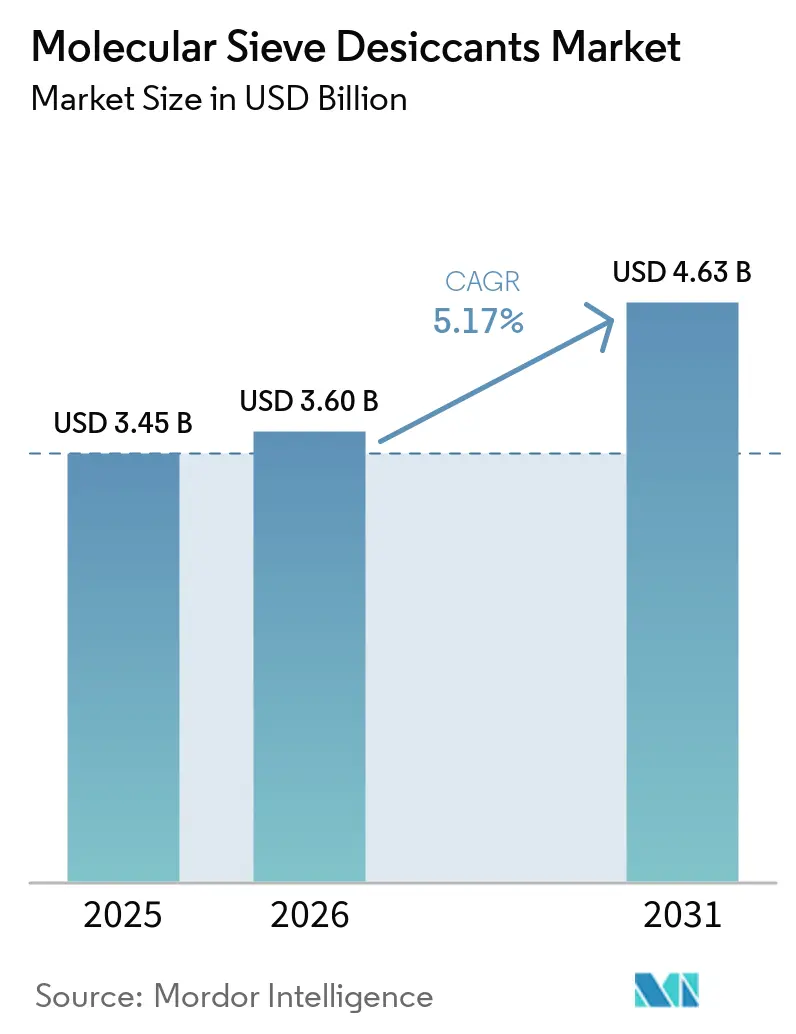
| Market Size (2026) | USD 3.60 Billion |
| Market Size (2031) | USD 4.63 Billion |
| Growth Rate (2026 - 2031) | 5.17 % |
| Fastest Growing Market | Asia-Pacific |
| Largest Market | Asia-Pacific |
| Market Concentration | Low |
Major Players *Disclaimer: Major Players sorted in no particular order Image © Mordor Intelligence. Reuse requires attribution under CC BY 4.0. | |
Molecular Sieve Desiccants Market Analysis by Mordor Intelligence
The molecular sieve desiccants market size was valued at USD 3.45 billion in 2025 and is estimated to grow from USD 3.60 billion in 2026 to USD 4.63 billion by 2031, at a CAGR of 5.17% during the forecast period (2026-2031). The molecular sieve desiccants market serves applications requiring low moisture levels, including systems with dew points below -100°C or relative humidity below 10%. Molecular sieves provide moisture control where silica gel and activated alumina do not meet operating specifications. LNG liquefaction capacity additions support demand, as dehydration is required before cryogenic processing. Molecular sieve beds reduce water content to below 0.1 parts per million (ppm), preventing ice formation in heat exchangers. Expanding manufacturing capacity in Asia-Pacific pressures commodity-grade prices while supporting demand for specialized formulations. Suppliers offer pore engineering, process support, and integrated adsorption solutions for the refrigerant, gas processing, and electronics sectors.
Key Report Takeaways
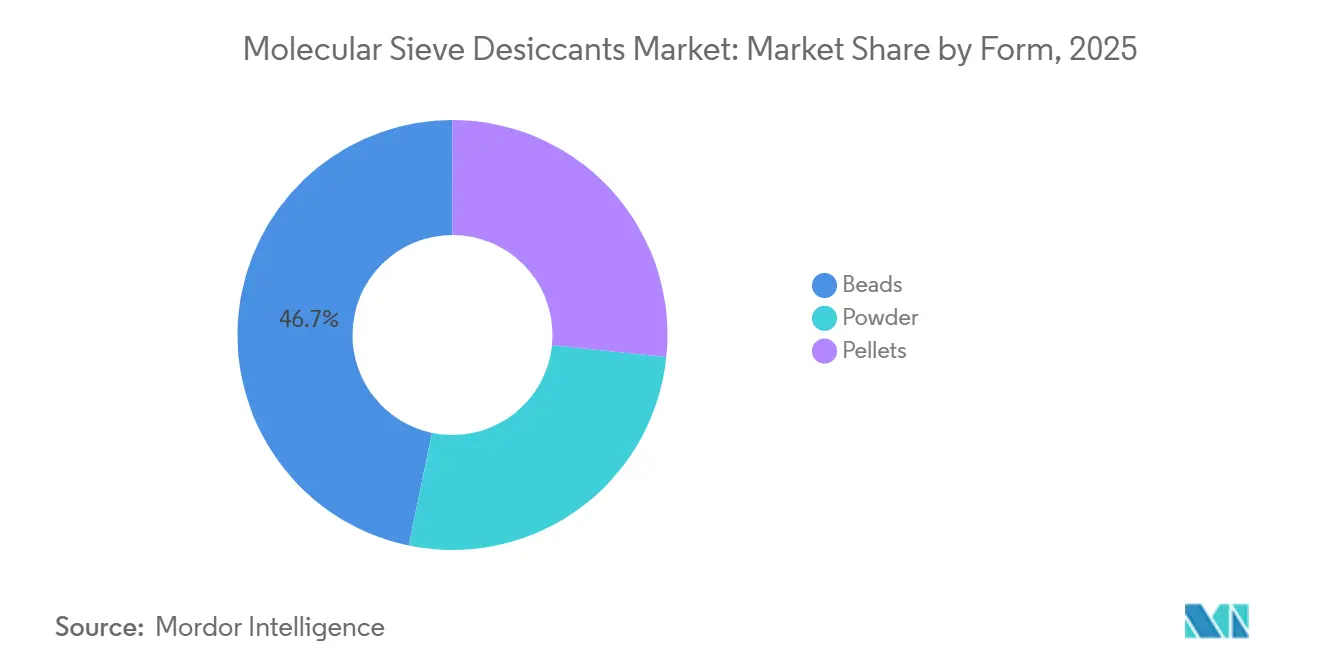
- By form, beads held 46.73% of revenue in 2025, while pellets are forecast to grow at a 5.56% CAGR through 2031.
- By type, 4A held 28.12% of revenue in 2025, while 13X is forecast to grow at a 5.71% CAGR through 2031.
- By application, industrial drying held 32.06% of revenue in 2025, while refrigerants are forecast to grow at a 5.93% CAGR through 2031.
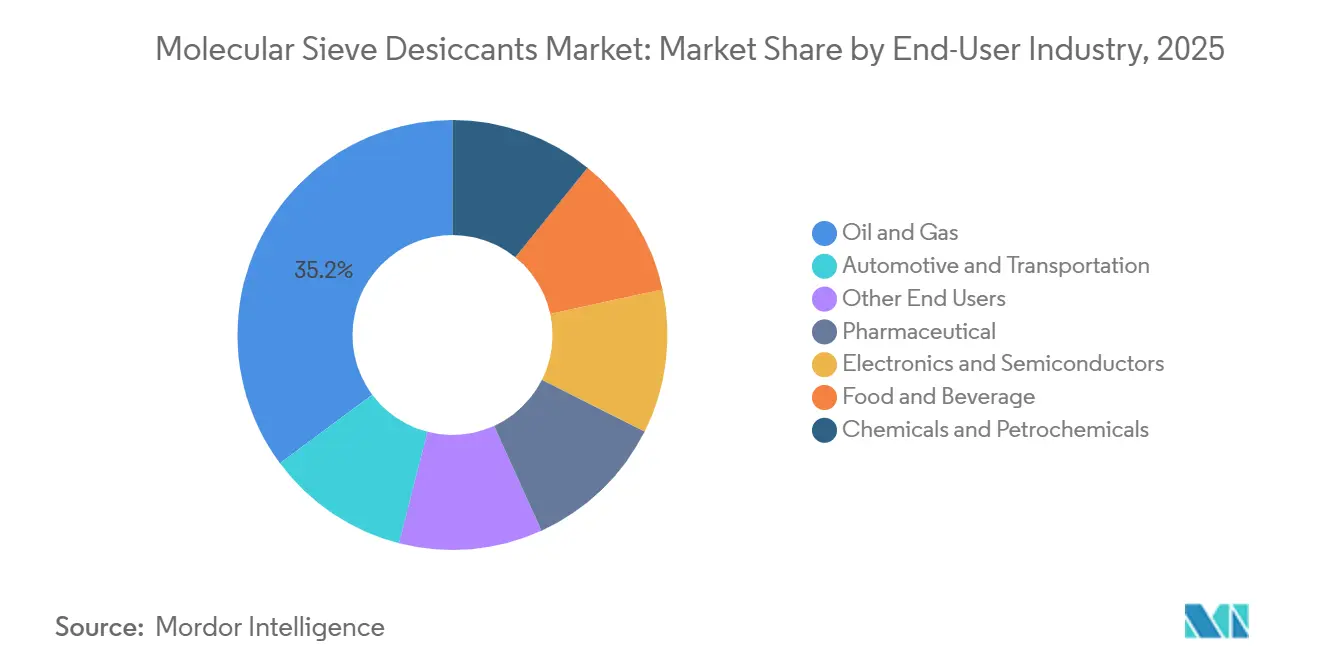
- By end-user industry, oil and gas held 35.18% of revenue in 2025, while electronics and semiconductors are forecast to grow at a 6.23% CAGR through 2031.
- By geography, Asia-Pacific held 39.41% of revenue in 2025 and is forecast to grow at a 6.11% CAGR through 2031.
Note: Market size and forecast figures in this report are generated using Mordor Intelligence’s proprietary estimation framework, updated with the latest available data and insights as of January 2026.
Market Trends and Insights
Drivers Impact Analysis of Molecular Sieve Desiccants Market*
| Drivers | (~) % Impact on CAGR Forecast | Geographic Relevance | Impact Timeline |
|---|---|---|---|
| Natural Gas Processing and LNG Dehydration Expansion | +1.8% | Global, the highest in North America, the Middle East, and the Asia-Pacific LNG exporters | Short term (≤ 2 years) |
| Moisture Control in Pharmaceuticals and Electronics | +1.2% | Global, concentrated in India, China, Southeast Asia, and North America | Medium term (2-4 years) |
| High-Purity Industrial Gas and Air Separation Growth | +0.9% | Asia-Pacific core, with spillover to the Middle East, Africa, and Europe | Medium term (2-4 years) |
| Industrialization and Manufacturing Expansion in the Asia-Pacific | +0.6% | Asia-Pacific, with the highest impact in China, India, and ASEAN | Long term (≥ 4 years) |
| Application-Specific Pore Engineering for Low-Emission Processing | +0.4% | Global, with early gains in North America and the European Union industrial corridors | Long term (≥ 4 years) |
| Source: Mordor Intelligence | |||
Expansion of Natural Gas Processing and LNG Dehydration
Global LNG liquefaction projects through 2030 are increasing demand for 3A and 4A molecular sieves in the molecular sieve desiccants market. Projects on the U.S. Gulf Coast, Qatar’s North Field expansion, and emerging African export projects require dehydration equipment before liquefaction. LNG production requires water removal to below 0.1 ppmv, a level that molecular sieve beds can achieve. In September 2026, BASF announced that Cheniere Energy commissioned Durasorb LNG MAX across multiple trains at Corpus Christi, with the remaining trains targeted for completion by the end of 2027. The technology removes heavy hydrocarbons, benzene, toluene, ethylbenzene, xylene (BTEX), and water in a single adsorption unit. Variable cycling adjusts the adsorption cycle length based on bed age, supporting service life, and fuel efficiency. Each new LNG train also generates replacement demand, as adsorbent contracts recur every 3 to 7 years.
Rising Moisture-Control Requirements in Pharmaceuticals and Electronics
Pharmaceutical packaging requires validated desiccant performance within the container-closure system under U.S. Food and Drug Administration (FDA) and United States Pharmacopeia (USP) requirements. International Council for Harmonization (ICH) stability testing and EU good manufacturing practice requirements also require manufacturers to assess material interactions, extractables, and leachables. These compliance requirements support the recurring purchase of precision-grade molecular sieves following product-system validation. Under its Production Linked Incentive scheme, India commissioned 38 greenfield bulk drug projects, establishing 56,800 tons of annual domestic active pharmaceutical ingredient (API) capacity[1]. This capacity creates demand for 3A and 4A zeolite desiccants for pharmaceutical moisture management. Electronics applications require low relative humidity during the cleanroom transport and storage of advanced semiconductors, organic light-emitting diode (OLED) components, and AI accelerator packages. The expansion of pharmaceutical and electronics activities in the Asia-Pacific supports demand for molecular sieve desiccants.
Growth of High-Purity Industrial Gas and Air-Separation Systems
Zeolite 13X is used in pre-purification units for cryogenic air-separation plants, where it removes water vapor and carbon dioxide before cryogenic distillation. A 2026 study found that 13X achieved oxygen purity of up to 95.9% in pressure swing adsorption systems under the tested conditions. The study reported higher performance for 13X than 3A, 4A, and 5A materials under identical column conditions. On-site nitrogen and oxygen generation is expanding across semiconductor fabrication, medical oxygen supply, and steel production. Biogas upgrading also uses 13X to remove carbon dioxide from raw biogas, thereby producing renewable natural gas. Suppliers are developing air-purification-grade 13X products with lower dust formation and improved dynamic carbon dioxide adsorption performance. These requirements support demand for higher-performance products in the molecular sieve desiccants market.
Industrialization and Manufacturing Expansion in the Asia-Pacific
China’s 2060 carbon-neutrality target creates an energy challenge and an incentive to lower emissions in molecular sieve production. In November 2025, Guangde Yuanhao Molecular Sieve began a CNY 50 million expansion and technical renovation project. The project targets intelligent and lower-carbon production of carbon molecular sieves. India’s pharmaceutical manufacturing expansion creates demand for solvent drying, gas separation, and cleanroom moisture management. Vietnam and Thailand are attracting petrochemical and electronics investments that include adsorption dehydration requirements. These countries have historically imported finished desiccants from China; however, growing local demand is changing regional purchasing patterns. This multi-country manufacturing expansion supports Asia-Pacific’s role in the molecular sieve desiccants market.
Restraints Impact Analysis of Molecular Sieve Desiccants Market*
| Restraints | (~) % Impact on CAGR Forecast | Geographic Relevance | Impact Timeline |
|---|---|---|---|
| Energy-Intensive Activation and Regeneration | -1.1% | Global, most acute in energy-cost-sensitive markets in Europe and Japan | Short term (≤ 2 years) |
| Competition From Membranes, Silica Gel, and Activated Alumina | -0.8% | Global, highest in cost-sensitive emerging-market applications | Medium term (2-4 years) |
| Feedstock and Specialty Raw-Material Price Volatility | -0.5% | Global, most acute for specialty-grade producers reliant on sodium aluminate | Medium term (2-4 years) |
| Source: Mordor Intelligence | |||
Energy-Intensive Activation and Regeneration
Thermal swing adsorption regeneration requires operators to heat zeolite beds to 200-350 °C using steam- or gas-fired heaters. A study of single-layer 3A zeolite beds reported energy consumption of 15-20 MJ per kg of water removed. This energy requirement can limit adoption in cost-sensitive applications and affect the lifecycle cost comparison with competing technologies. A 2025 Scientific Reports study found that microwave-assisted regeneration of 13X reduced energy consumption from 0.62 kWh to 0.06 kWh at equivalent regeneration temperatures[2]. In the referenced study, layered beds combining silica gel and 3A zeolite reduced energy consumption from 19.57 MJ/kg to 4.51 MJ/kg. However, the same configuration increased the adsorption cycle time from 760 minutes to 1,530 minutes. Heat integration and variable cycling can reduce this constraint; however, energy costs remain a commercial consideration in the molecular sieve desiccants market.
Competition From Membranes, Silica Gel, and Activated Alumina
Membrane separation technologies compete in compressed-air drying and selected natural gas applications, where capital efficiency is a priority. These applications generally do not require dew points below -40 °C. Silica gel is used in food, consumer electronics, and secondary pharmaceutical packaging applications, where price sensitivity is high. Activated alumina is used in compressed-air drying, fluoride removal, and selected gas purification circuits because of its lower cost and simpler regeneration profile. Competitive risks are highest in commodity industrial drying applications, where operators prioritize total cost of ownership over peak performance. Lower-priced silica gel and activated alumina products increase pressure on entry-level pricing. Suppliers respond through application support, performance warranties, and lifecycle cost models that focus on operational reliability.
*Our forecasts treat driver/restraint impacts as directional, not additive. The impact forecasts reflect baseline growth, mix effects, and variable interactions.
Molecular Sieve Desiccants Market Segment Analysis
By Form:
Beads Lead Process Applications While Pellets Gain GroundBeads accounted for 46.73% of the molecular sieve desiccants market in 2025. Their spherical geometry reduces bed pressure drop compared with extruded pellets in adsorption systems. Lower pressure drop can reduce the energy requirements of the blower and compressor during the adsorption cycle. Beads also help control dust in gas-phase dryer columns, making them suitable for continuous twin-tower and multi-bed dryer configurations. Established industrial drying systems continue to use bead-based molecular sieve desiccants.
Pellets are forecast to grow at a 5.56% CAGR through 2031 in the molecular sieve desiccants market. Their crush strength and controlled geometry support their use in fixed-bed reactors, pharmaceutical blister lines, and compact automotive air-brake dryers. Powder remains important in applications that require uniform dispersion in coatings, adhesives, sealants, elastomers, and polyurethane formulations. In these liquid applications, physical dispersion is more important than bed hydraulics. A 2024 study found that regenerated molecular sieves retained 80-90% of their original adsorption capacity after thermal treatment, thereby reducing replacement frequency in mature installations. Therefore, adoption in new applications will support demand growth across the molecular sieve desiccants market.

By Type:
4A Retains Broad Use While 13X Expands in Gas SeparationType 4A accounted for 28.12% of the molecular sieve desiccants market in 2025. It is used in static packaging, industrial gas drying, refrigerant moisture removal, and solvent dehydration. This range of applications supports its position as a general-purpose desiccant. Type 3A remains important for natural gas and liquefied natural gas (LNG) dehydration, as well as polar liquid drying. Its pore structure excludes hydrocarbon molecules in certain applications, thereby preserving adsorption capacity. Type 5A is used for normal- and isoparaffin separation and for nitrogen and oxygen adsorption.
Type 13X is forecast to grow at a CAGR of 5.71% through 2031. Demand will stem from air separation units, carbon dioxide removal in biogas upgrading, and drying circuits for hydrofluoroolefin (HFO) refrigerants. The material can remove both moisture and carbon dioxide in suitable air-purification applications. A 2026 pressure swing adsorption study reported that 13X achieved oxygen purity of up to 95.9%. Other molecular sieve types include LiX and high-silica formulations, which are used in carbon capture and specialty gas purification. These specialized products face fewer commodity competitors in applications that require proprietary crystal engineering. This mix of performance requirements supports a broader product base for the molecular sieve desiccants market.
By Application:
Industrial Drying Remains the Largest Use While Refrigerants Grow FasterIndustrial drying accounted for 32.06% of the molecular sieve desiccants market in 2025. Compressed-air systems, solvent drying, and natural gas pretreatment have created a large installed base for this application. Operator familiarity and long replacement cycles support predictable demand. Refinery applications include gas sweetening, naphtha isomerization feed preparation, and paraxylene separation. Air-brake systems use 3A and 4A molecular sieves to prevent moisture-related valve freezing in commercial vehicles. Packaging and insulating glass remain demand-driven applications linked to construction and consumer goods production.
Refrigerant applications are forecast to grow at a CAGR of 5.93% through 2031. The hydrofluorocarbon (HFC) phase-down is encouraging equipment manufacturers to adopt HFO alternatives, which are more moisture-sensitive than legacy refrigerants. Some A2L systems, classified as lower-flammability refrigerants, require aluminum-binder-free desiccant grades to limit acid formation from HFO hydrolysis. Air-Conditioning, Heating, and Refrigeration Institute (AHRI) Standard 710 addresses moisture absorption and retention performance in relevant refrigerant applications. Arkema’s Siliporite products are used for polyurethane moisture control in coatings, adhesives, sealants, and elastomers (CASE) formulations. In this application, the desiccant is incorporated into the formulation rather than packaged alongside it. These applications support specialized demand within the molecular sieve desiccants market.
By End-User Industry:
Oil and Gas Provides Scale While Electronics AcceleratesOil and gas accounted for a 35.18% share of the molecular sieve desiccants market in 2025. Gas-processing plants and LNG trains require dehydration beds, resulting in recurring replacement purchases every three to seven years. These replacement requirements are tied to the operating asset once the bed has been specified. The chemicals and petrochemicals industry also uses molecular sieves for ethylene cracker feed drying, paraxylene separation, and specialty solvent dehydration. Pharmaceutical demand increased through 2025 as capacity investments drove the validation of desiccant procurement. Regulatory requirements restrict the use of lower-cost substitutes in certain pharmaceutical applications.
Electronics and semiconductors are forecast to grow at a CAGR of 6.23% through 2031. Advanced chipsets, AI processors, OLED panels, and power electronics require controlled moisture conditions. Molecular sieves perform at relative humidity levels below 10%, where trace moisture can contribute to micro-corrosion and reflow-soldering defects. The planned rollout of 2-nm and sub-2-nm fabrication nodes through 2027 will require stricter cleanroom transport and logistics controls. This requirement will support demand for desiccant sachets and integrated packaging formats. Automotive and transportation demand follow commercial vehicle production and fleet aging. Food and beverage applications provide steady demand for 3A and 4A sachets, particularly where traceability and food-contact documentation are required.
Geography Analysis
APAC Molecular Sieve Desiccants Market
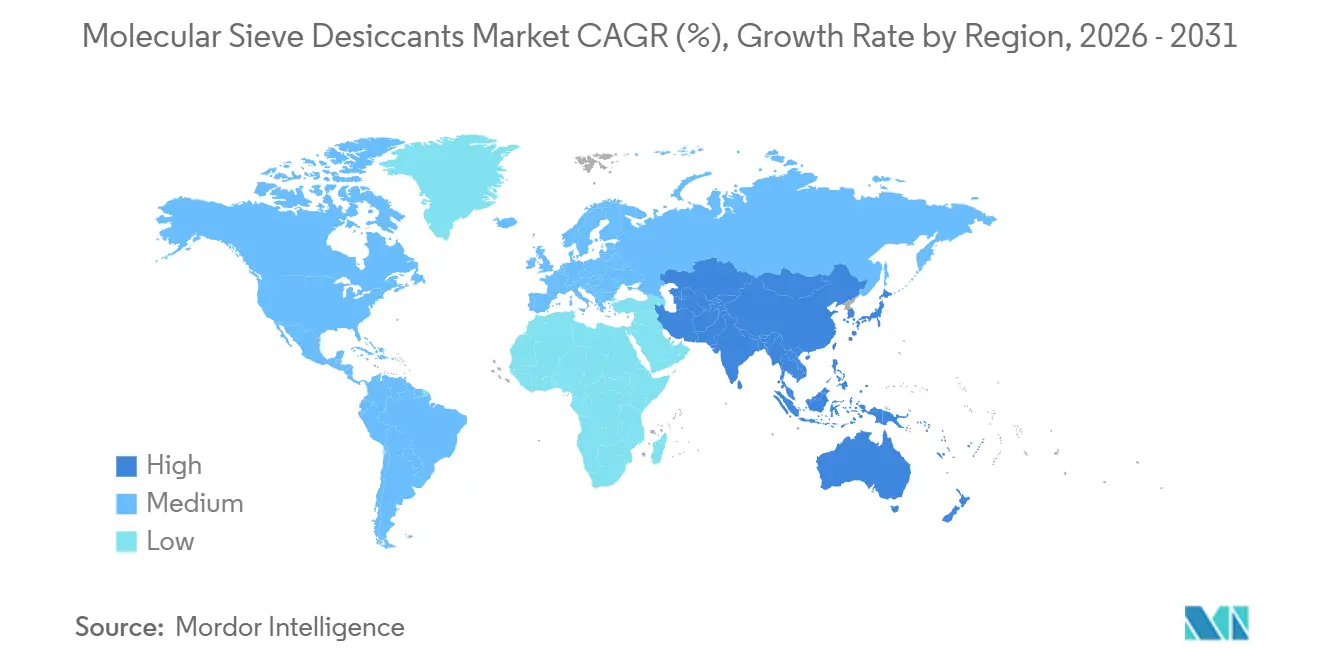
Asia-Pacific held 39.41% of the molecular sieve desiccants market share in 2025 and is forecast to grow at a CAGR of 6.11% through 2031. China has manufacturing bases in Pingxiang, Ningbo, and Dalian and serves as a demand center for refining, liquefied natural gas (LNG) terminals, and semiconductor fabrication. India’s Production Linked Incentive program supported 38 greenfield bulk-drug projects, with a combined annual active pharmaceutical ingredient (API) capacity of 56,800 tons. This capacity supports demand for 3A and 4A desiccants in processing and packaging applications. Japan and South Korea generate demand from electronics and precision chemical manufacturing.
North America and Europe Molecular Sieve Desiccants Market
North America accounted for a share of revenue in 2025, supported by LNG export terminals and ethylene cracker complexes along the U.S. Gulf Coast. Plaquemines LNG, Golden Pass LNG, and related projects support procurement of dehydration equipment through 2028. Canada contributes to demand through oil sands gas processing, while Mexico supports demand through petrochemical manufacturing. Europe generates unit-value demand from insulation glass and pharmaceutical applications. The Energy Performance of Buildings Directive supports energy-efficiency requirements across the European building stock. BASF’s Ludwigshafen site supports the regional production of specialty zeolite products.
South America and MEA Molecular Sieve Desiccants Market
South America’s molecular sieve desiccants market is supported by Brazil’s pre-salt gas processing activities and Argentina’s LNG ambitions in Vaca Muerta. As gas infrastructure becomes operational, these investments can create recurring demand for adsorbents. The Middle East and Africa consume less molecular sieve material per unit of gas reserves. Saudi Arabia’s downstream diversification program and South Africa’s industrial gas sector support existing demand. East African LNG projects anticipated through 2030 may increase demand for dehydration systems. The Middle East combines wellhead gas production, LNG export targets, and petrochemical integration, supporting long-term supply contracts for premium grades and technical services in the molecular sieve desiccants market.
Competitive Landscape
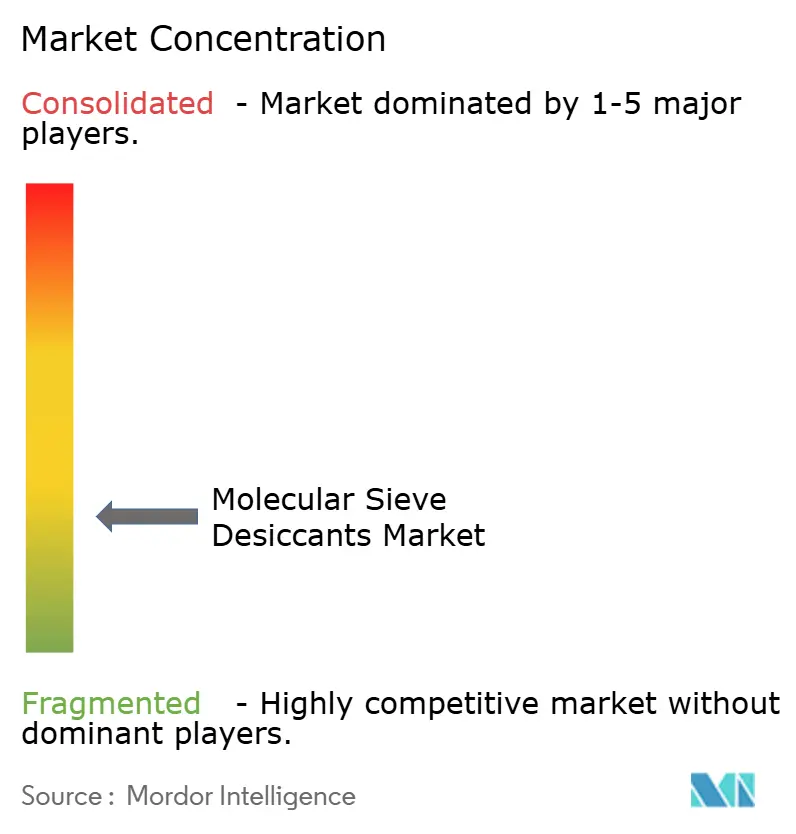
The molecular sieve desiccants market is fragmented. Honeywell UOP, BASF, Arkema, Clariant, and W.R. BASF supply Durasorb products for LNG dehydration. Arkema also supplies Siliporite molecular sieves for Coatings, Adhesives, Sealants, and Elastomers (CASE) and LNG applications. Zeochem, Tosoh Corporation, and CWK Chemiewerk Bad Köstritz serve pharmaceutical-grade beads, 13X products for air separation, and analytical applications. Chinese suppliers, including HengYe and JALON, compete primarily on price in standard-grade 4A and 13X products. Competition is concentrated in segments where purchasing decisions primarily depend on standard product pricing.
In September 2026, BASF commissioned Durasorb LNG MAX at Cheniere’s Corpus Christi facility, reflecting an integrated process strategy. The adsorption system combines the removal of heavy hydrocarbons, Benzene, Toluene, Ethylbenzene, and xylene (BTEX), and water with proprietary modeling support. This strategy differentiates suppliers through integrated process capabilities. In March 2026, Clariant entered into a strategic collaboration with Vertimass to develop advanced zeolite catalysts for the CADO biofuels process. The collaboration targets sustainable aviation fuel and advanced biofuel production. These initiatives indicate that suppliers are expanding into adjacent process applications alongside established desiccant product lines.
Specialized Hydrofluoroolefin (HFO)-compatible refrigerant grades offer an opportunity where standard 4A products do not meet system requirements. Pharmaceutical-grade supply chains in South Asia also require validated materials and application support. Microwave- and electric-swing-regeneration-compatible formulations can address energy-use concerns associated with conventional thermal regeneration. Process engineering capabilities, including variable cycling and layered-bed configurations, remain important to competitive performance. Material science and process integration influence supplier differentiation. Therefore, the molecular sieve desiccants market includes both scale-based standard-product competition and technical application-based competition.
Molecular Sieve Desiccants Industry Leaders
-
BASF
-
Honeywell International Inc
-
W. R. Grace & Co.
-
Arkema
-
CLARIANT
- *Disclaimer: Major Players sorted in no particular order
Molecular Sieve Desiccants Market Companies Covered in this Report
- Arkema
- Axens
- BASF
- Bear River Zeolite Co.
- CLARIANT
- CWK Chemiewerk Bad Köstritz GmbH
- HengYe Inc.
- Honeywell International Inc
- JALON
- KNT Group
- Sorbchem India
- Tosoh Corporation
- W. R. Grace & Co.
- Zeochem
- Zeolyst
Recent Industry Developments in Molecular Sieve Desiccants Market
- August 2026: Shanghai Jiuzhou Chemicals Co. (JOOZEO) showcased its molecular sieve portfolio for industrial gas applications at IG China 2026 in Hangzhou. The portfolio included grades for oxygen, nitrogen, hydrogen, refrigerant, and natural gas treatment, supporting its shift from a bulk supplier to a specification-aligned partner for gas processing.
- March 2026: Clariant Zeolites entered into a collaboration with Vertimass LLC to develop and commercialize zeolite catalysts for the Consolidated Alcohols Deoxygenation and Oligomerization (CADO) biofuels process. The partnership aims to scale Vertimass’ technology by leveraging Clariant’s six decades of zeolite catalyst expertise, with a focus on sustainable aviation fuel and biofuel production.
Global Molecular Sieve Desiccants Market Report Scope
A molecular sieve desiccant is a synthetic, highly porous crystalline material that selectively adsorbs moisture and specific impurities to extremely low levels based on molecular size and shape.
The molecular sieve desiccants market is segmented by form, type, application, end-user industry, and geography. By form, the market is segmented into beads, pellets, and powder. By type, the market is segmented into 3A, 4A, 5A, 13X, and other molecular sieve types. By application, the market is segmented into refinery, industrial drying, air brakes, packaging, coatings, adhesives, sealants, elastomers, refrigerants, insulation glass, and other applications. By end-user industry, the market is segmented into oil and gas, pharmaceutical, electronics and semiconductors, food and beverage, chemicals and petrochemicals, automotive and transportation, and other end users. The report also covers market size and forecasts for molecular sieve desiccants across 15 countries in major regions. The market sizes and forecasts are provided in terms of value (USD).
Segmentation Overview
| Beads |
| Pellets |
| Powder |
| 3A |
| 4A |
| 5A |
| 13X |
| Other Molecular Sieve Types |
| Refinery |
| Industrial Drying |
| Air Brakes |
| Packaging |
| Coatings, Adhesives, Sealants and Elastomers |
| Refrigerant |
| Insulation Glass |
| Other Applications |
| Oil and Gas |
| Pharmaceutical |
| Electronics and Semiconductors |
| Food and Beverage |
| Chemicals and Petrochemicals |
| Automotive and Transportation |
| Other End Users |
| Asia-Pacific | China |
| India | |
| Japan | |
| South Korea | |
| ASEAN Countries | |
| Rest of Asia-Pacific | |
| North America | United States |
| Canada | |
| Mexico | |
| Europe | Germany |
| United Kingdom | |
| France | |
| Italy | |
| NORDIC Countries | |
| Rest of Europe | |
| South America | Brazil |
| Argentina | |
| Rest of South America | |
| Middle East and Africa | Saudi Arabia |
| South Africa | |
| Rest of Middle East and Africa |
| By Form | Beads | |
| Pellets | ||
| Powder | ||
| By Type | 3A | |
| 4A | ||
| 5A | ||
| 13X | ||
| Other Molecular Sieve Types | ||
| By Application | Refinery | |
| Industrial Drying | ||
| Air Brakes | ||
| Packaging | ||
| Coatings, Adhesives, Sealants and Elastomers | ||
| Refrigerant | ||
| Insulation Glass | ||
| Other Applications | ||
| By End-User Industry | Oil and Gas | |
| Pharmaceutical | ||
| Electronics and Semiconductors | ||
| Food and Beverage | ||
| Chemicals and Petrochemicals | ||
| Automotive and Transportation | ||
| Other End Users | ||
| By Geography | Asia-Pacific | China |
| India | ||
| Japan | ||
| South Korea | ||
| ASEAN Countries | ||
| Rest of Asia-Pacific | ||
| North America | United States | |
| Canada | ||
| Mexico | ||
| Europe | Germany | |
| United Kingdom | ||
| France | ||
| Italy | ||
| NORDIC Countries | ||
| Rest of Europe | ||
| South America | Brazil | |
| Argentina | ||
| Rest of South America | ||
| Middle East and Africa | Saudi Arabia | |
| South Africa | ||
| Rest of Middle East and Africa | ||
Key Questions Answered in the Report
What is current market size of Molecular Sieve Desiccants Market?
The molecular sieve desiccants market size was valued at USD 3.45 billion in 2025 and is estimated to grow from USD 3.60 billion in 2026 to USD 4.63 billion by 2031, at a CAGR of 5.17% during the forecast period (2026-2031).
Which molecular sieve type is growing the fastest?
13X is forecast to grow at a 5.71% CAGR through 2031, supported by air separation, biogas upgrading, and refrigerant drying.
Which application is expanding most quickly?
Refrigerants are forecast to grow at a 5.93% CAGR through 2031 as equipment transitions toward hydrofluoroolefin (HFO) refrigerants.
Which end-user sector has the strongest growth outlook?
Electronics and semiconductors are forecast to grow at a 6.23% CAGR through 2031 because advanced components require tighter moisture control.