
Market Overview
| Study Period | 2021 - 2031 |
|---|---|
| Forecast Data Period | 2026 - 2031 |
| Base Year Market Size (2025) | USD 0.95 Billion |
| Market Size (2026) | USD 0.98 Billion |
| Market Size (2031) | USD 1.16 Billion |
| Growth Rate (2026 - 2031) | 3.42 % |
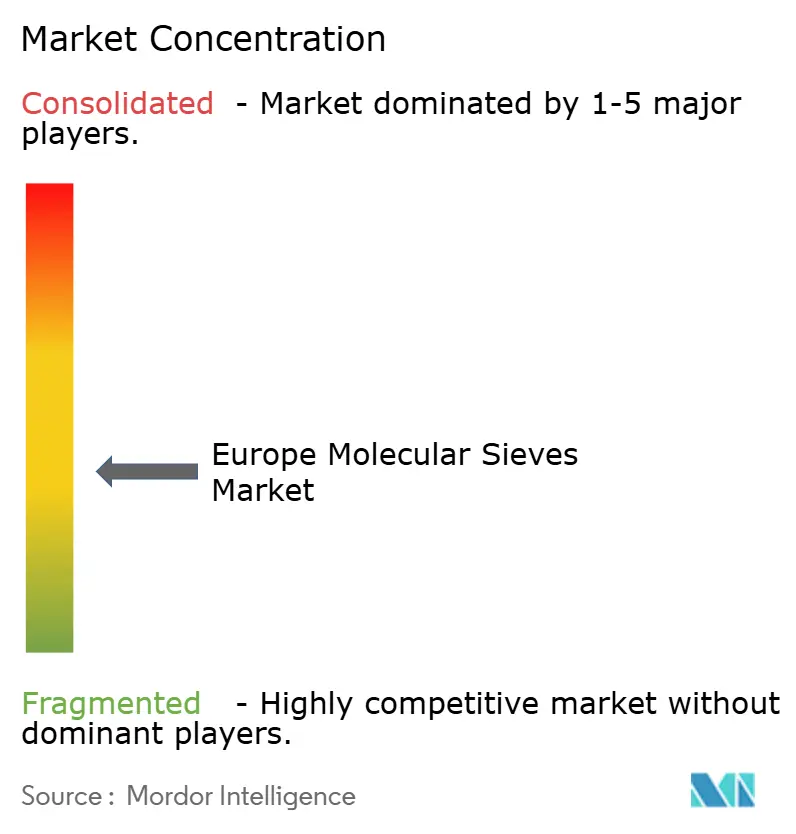
| Market Concentration | Medium |
Major Players *Disclaimer: Major Players sorted in no particular order Image © Mordor Intelligence. Reuse requires attribution under CC BY 4.0. | |
Europe Molecular Sieves Market Analysis by Mordor Intelligence
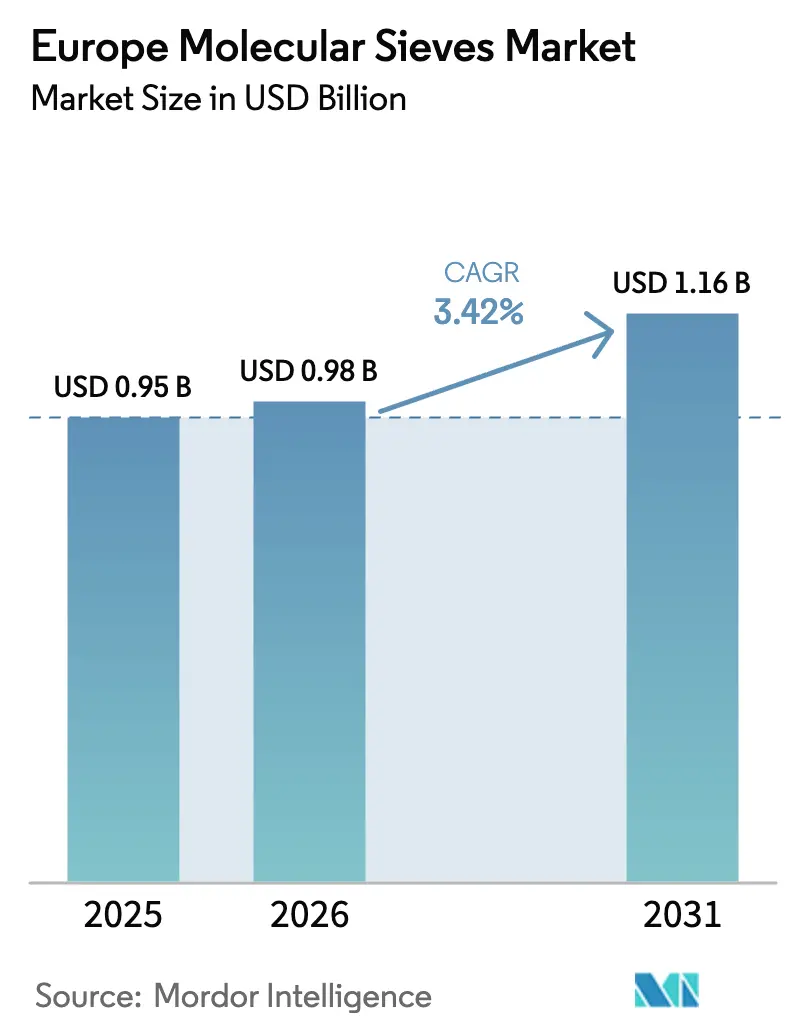
The Europe Molecular Sieves Market size is expected to grow from USD 0.95 billion in 2025 to USD 0.98 billion in 2026 and is forecast to reach USD 1.16 billion by 2031 at a 3.42% CAGR over 2026-2031. Surging demand for ultra-dry hydrogen in expanding electrolyzer parks, accelerated post-COVID investments in hospital oxygen plants, and Carbon Border Adjustment Mechanism (CBAM)-driven upgrades across industrial gas networks are widening the application base for adsorbents. Carbon molecular sieves are edging ahead of traditional zeolites as biogas upgrading and direct air-capture projects prefer their lower-temperature regeneration profiles. Format preferences are also shifting: powdered grades are gaining ground in phosphate-free detergents while pellets retain primacy in large air-separation units. Competitive strategy now pivots on binder-free zeolite technologies, energy-efficient regeneration, and hybrid membrane-adsorber offerings that blunt operating-cost headwinds.
Key Report Takeaways
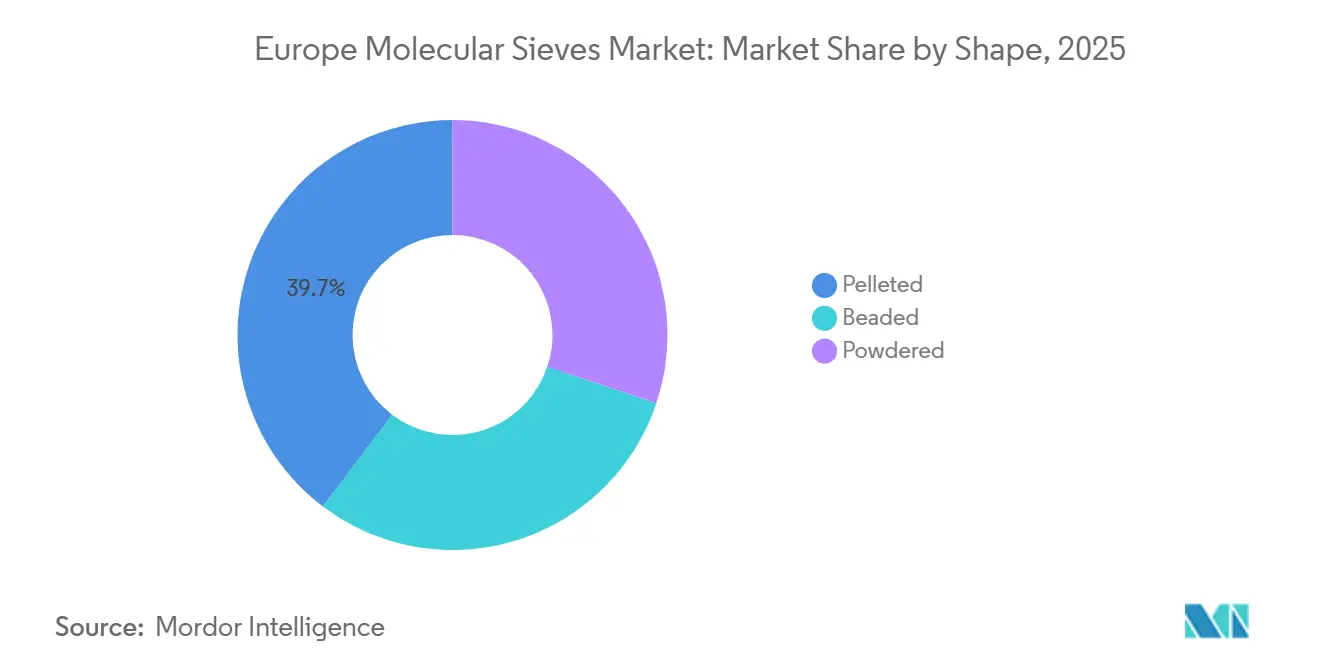
- By shape, pelleted formats led with 39.71% of the Europe Molecular Sieves market share in 2025, whereas powdered grades are forecast to post the fastest 3.90% CAGR during the forecast period (2026-2031).
- By pore size, microporous variants accounted for 64.57% share of the Europe Molecular Sieves market size in 2025 and are advancing at a 3.99% CAGR during the forecast period (2026-2031).
- By product type, carbon molecular sieves commanded 38.48% share in 2025 and are growing at a 4.65% CAGR during the forecast period (2026-2031).
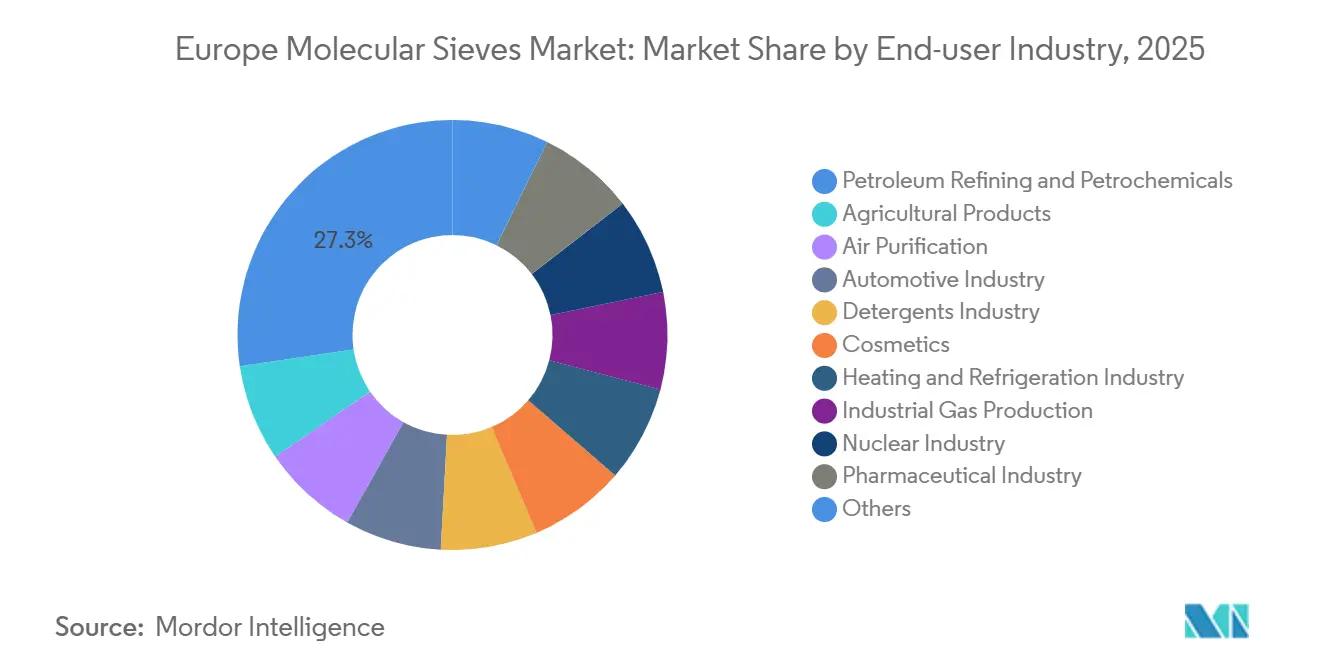
- By end-user industry, petroleum refining and petrochemicals held 27.32% of the Europe Molecular Sieves market share in 2025, and petroleum refining and petrochemicals are also expected to register the highest 3.89% CAGR during the forecast period (2026-2031).
- By geography, Germany commanded a 24.42% share in 2025, whereas the Rest of Europe is forecast to post the fastest 3.86% CAGR during the forecast period (2026-2031).
Note: Market size and forecast figures in this report are generated using Mordor Intelligence’s proprietary estimation framework, updated with the latest available data and insights as of January 2026.
Market Trends and Insights
Drivers Impact Analysis of Europe Molecular Sieves Market*
| Driver | (~) % Impact on CAGR Forecast | Geographic Relevance | Impact Timeline |
|---|---|---|---|
| Regulatory tail-winds from REACH and CBAM tightening moisture/VOC specs | +0.8% | Germany, France, Netherlands, Belgium | Medium term (2-4 years) |
| Explosive PSA oxygen demand from ageing EU hospitals and mini-plants | +0.6% | Germany, France, United Kingdom, Italy, Spain | Short term (≤2 years) |
| Surge in green-hydrogen electrolyzer build-outs requiring ultra-dry H₂ streams | +1.2% | Germany, Spain, Netherlands, France | Long term (≥4 years) |
| Petro-refinery revamps to meet Euro 7 fuel standards | +0.5% | Germany, France, Italy, Spain, Netherlands | Medium term (2-4 years) |
| Detergent phosphate bans boosting 4A zeolite uptake | +0.4% | Pan-European | Short term (≤2 years) |
| Source: Mordor Intelligence | |||
Regulatory Tail-Winds From REACH and CBAM Tightening Moisture/VOC Specs
REACH (Registration, Evaluation, Authorisation and Restriction of Chemicals) updates and the phased CBAM roll-out from 2026 are lowering allowable moisture and VOC (Volatile Organic Compound) thresholds across industrial gas, petrochemical, and pharmaceutical plants, pushing operators toward high-performance zeolite beds with documented kinetics. The European Industrial Gases Association put 2025 industry revenue at EUR 21.2 billion and flagged energy-cost exposure under CBAM, heightening the value of efficient adsorption trains. Air Liquide earmarked over EUR 250 million for new air-separation capacity in Dresden, Germany, and partnered with Aurubis on a EUR 100 million Bulgarian unit, both specifying CBAM-compliant molecular sieve packages. Suppliers able to certify ISO 9001 processes and deliver moisture breakthroughs below 2 ppm (parts per million) are winning early replacement contracts.
Explosive PSA Oxygen Demand From Ageing EU Hospitals and Mini-Plants
Post-pandemic hospital retrofits and an aging population have lifted PSA oxygen installations, sending regional zeolite demand higher at 5.8-7.8% CAGR in Germany, France, and the United Kingdom. Honeywell UOP’s OXYSIV range supplied emergency volumes to Italian hospitals during the 2021 surges, underscoring strategic proximity benefits[1]. Rural clinics and nursing homes favor compact beaded beds that stretch service intervals beyond 18 months, further widening the Europe Molecular Sieves market.
Surge in Green-Hydrogen Electrolyzer Build-Outs Requiring Ultra-Dry H₂ Streams
Electrolyzer clusters across Germany’s hydrogen valleys, Spain’s renewables corridor, and the Netherlands’ port complexes require dew points below –70°C to protect membranes. In 2024, OMEGA AIR released purification skids using 13X zeolite, and Donaldson followed in April 2025 with the HRC-T dryer optimized for electrolyzer feeds[2]. VITO’s 2025 study further validated 13X for combined hydrogen drying and CO₂ capture. Collectively, hydrogen infrastructure is set to eclipse refining as the fastest-growing outlet before 2029.
Petro-Refinery Revamps to Meet Euro 7 Fuel Standards
Euro 7 legislation tightens evaporative-emission ceilings, forcing EU refineries to retrofit isomerization and aromatics-reduction units with shape-selective zeolite catalysts. BASF’s 2024 binder-free 4ABF/5ABF/13XBF grades boast thermal stability above 600 °C, positioning them for low-pressure isomerization loops. INEOS has earmarked EUR 550 million to decarbonize its Lavera refinery and integrate zeolite-based trains for CBAM alignment.
Restraints Impact Analysis of Europe Molecular Sieves Market*
| Restraint | (~) % Impact on CAGR Forecast | Geographic Relevance | Impact Timeline |
|---|---|---|---|
| Energy-intensive regeneration costs amid EU carbon price escalation | -0.7% | Germany, France, Netherlands, Belgium | Medium term (2-4 years) |
| Competition from hybrid membrane-adsorber skids in biogas upgrading | -0.5% | France, Switzerland, Italy, United Kingdom, Germany | Short term (≤2 years) |
| Raw-material (soda-ash, sodium-silicate) price volatility | -0.3% | Pan-European | Short term (≤2 years) |
| Source: Mordor Intelligence | |||
Energy-Intensive Regeneration Costs Amid EU Carbon Price Escalation
Vacuum-temperature swing or thermal swing cycles consume up to 90 kWh of electricity and 2.9 GJ of heat per tonne of CO₂ desorbed, inflating operating costs as EU-ETS (European Union Emissions Trading System) allowances rise. Smaller biogas and PSA oxygen operators with limited capital find the economics challenging and may defer bed replacements, dampening short-term volumes.
Competition From Hybrid Membrane-Adsorber Skids in Biogas Upgrading
Evonik’s SEPURAN Green membranes now serve more than 500 plants and exceed 60% market share in France, Switzerland, Italy, and the United Kingdom, eliminating thermal regeneration and shrinking footprint by 40%. Molecular sieve suppliers are responding with hybrid PSA-membrane packages and predictive-maintenance tools, but near-term share erosion is expected.
*Our forecasts treat driver/restraint impacts as directional, not additive. The impact forecasts reflect baseline growth, mix effects, and variable interactions.
Europe Molecular Sieves Market Segment Analysis
By Shape:
Pelleted Formats Anchor Legacy InstallationsPelleted grades represented 39.71% of the Europe Molecular Sieves market size in 2025, benefiting from mechanical strength that withstands pressure cycles in air-separation and refinery PSA (Pressure Swing Adsorption) towers. Although format changeovers are capital-heavy, the Europe Molecular Sieves market is witnessing incremental retrofits in which pellets are swapped for low-pressure-drop extrudates to trim blower energy.
Powdered molecular sieves, forecast to grow at a 3.90% CAGR during the forecast period (2026-2031), are penetrating detergent and rapid-cycle adsorption niches, where high surface area overrides handling convenience. The trend aligns with phosphate-free mandates that solidify Zeolite A dominance. Beaded variants occupy a smaller share, mainly in compact medical oxygen concentrators, where dust control extends filter life.

By Pore Size:
Microporous Dominance Reflects Air Separation PrioritiesMicroporous materials held 64.57% of the Europe Molecular Sieves market share in 2025 and will rise at a 3.99% CAGR during the forecast period (2026-2031), reflecting sustained air-separation demand. Investments such as Air Liquide’s EUR 250 million Dresden ASU lean on 13X beds to meet CBAM efficiency thresholds.
Mesoporous and macroporous grades serve catalyst and specialty chromatographic uses. Zeopore’s May 2025 mesoporized launch demonstrates momentum in hydrocracking and biofuel routes, but volumes remain modest against microporous workhorses that dominate drying, purification, and CO₂ capture.
By Product Type:
Carbon Molecular Sieves Outpace Zeolites in Emerging StreamsCarbon molecular sieves captured 38.48% share of the Europe Molecular Sieves market size in 2025 and are expanding at 4.65% CAGR during the forecast period (2026-2031) as biogas and DAC operators prefer sub-100°C regeneration, as in Honeywell UOP’s DACSIV line.
Zeolite molecular sieves still underpin detergents, ASUs, and refinery catalysts, but face raw-material volatility. Silica gel, clay, and hybrid adsorbents fill niche roles, often bundled with molecular sieves for multi-contaminant polishing.
By End-User Industry:
Refining Holds Scale, Health-Care and Hydrogen AcceleratePetroleum refining and petrochemicals accounted for 27.32% of the Europe Molecular Sieves market in 2025, fueled by Euro 7 revamps and CBAM-aligned decarbonization. Meanwhile, medical oxygen plants show the steepest 7.8% CAGR during the forecast period (2026-2031), riding demographic trends and decentralized care models. Green-hydrogen build-outs add a long-tail upside, with dew-point specifications positioning 13X and carbon grades as critical process safeguards.
Geography Analysis
Germany and Broader European Markets
Germany commanded a 24.42% share in 2025, whereas the Rest of Europe is forecast to post the fastest 3.86% CAGR during the forecast period (2026-2031). Germany anchors demand through more than 300 PSA biogas units and large CBAM-compliant ASUs, including the EUR 250 million Dresden project slated for 2027 commissioning. The country’s hydrogen valleys in North Rhine-Westphalia and Lower Saxony also raise consumption of 13X and carbon molecular sieves for electrolyzer feed drying.
France Molecular Sieves Market
France remains pivotal: Arkema’s Honfleur plant doubled specialty capacity, securing global reach for Siliporite SPX 5003, and Evonik’s SEPURAN membranes have displaced PSA beds in a sizeable share of French biogas installations. INEOS is injecting EUR 550 million into its Lavera refinery to embed zeolite-based separation in circular-feedstock strategies.
United Kingdom and Continental Europe Molecular Sieves Market
The United Kingdom, Italy, and Spain contribute incremental growth via medical oxygen roll-outs and hydrogen corridor investments. Belgium, home to Zeopore’s mesoporized debut and Honeywell UOP’s planned methanol-to-olefins complex, is fast becoming an innovation hub. Eastern Europe, led by the Aurubis–Air Liquide ASU in Bulgaria, is absorbing capacity migrations as firms seek lower-cost carbon footprints, while Nordic districts incorporate molecular sieves into low-GWP refrigerant drying under strengthened F-Gas rules.
Competitive Landscape
The Europe Molecular Sieves market is moderately fragmented. Product strategy converges on binder-free and mesoporized zeolites that stretch cycle times, as reflected in BASF’s 2024 4ABF/5ABF/13XBF launch and Zeopore’s semi-industrial line targeting FCC and biofuel catalysts. Incumbents are pairing software analytics with absorbent sales to guarantee uptime in ASU and PSA fleets.
Europe Molecular Sieves Industry Leaders
-
Zeochem
-
BASF
-
Arkema
-
Clariant
-
Honeywell International Inc.
- *Disclaimer: Major Players sorted in no particular order
Europe Molecular Sieves Market Companies Covered in this Report
- Arkema Group
- Axens
- BASF SE
- Bear River Zeolite Co.
- Bete Ceramics Co. Ltd.
- Cabot Corporation
- CARBOTECH AC GMBH
- Clariant
- Dalian absorbent Co., Ltd
- Desicca Chemicals Pvt. Ltd.
- Graver Technologies
- Honeywell International Inc.
- KNT Group
- Merck KGaA
- Shanghai Hengye Molecular Sieve Co. Ltd
- SHOWA DENKO K.K.
- Solvay
- Tosoh Corporation
- W. R. Grace & Co.-Conn.
- Zeolyst International
- Zeochem
Recent Industry Developments in Europe Molecular Sieves Market
- January 2026: Solvay unveiled its latest bio-circular silica facility at its Livorno plant in Italy. This strategic move not only underscores Solvay's commitment to the European Green Deal and the forthcoming Ecodesign for Sustainable Products Regulation (ESPR) but also bolsters Italy's stature as a center for green innovation.
- May 2025: Scientists at the Institute of Catalysis SB RAS Federal Research Center in Russia unveiled an enhanced technique for synthesizing zeolite crystals. By refining the vapor-phase crystallization method, these researchers have harnessed water vapor to facilitate the formation of zeolite crystals.
Europe Molecular Sieves Market Report Scope
Molecular sieves, often synthetic zeolites or aluminosilicates, are engineered to separate molecules by size and polarity. With their precise, uniform pores, they adeptly trap smaller molecules while keeping larger ones at bay. These materials excel in purifying gases and liquids, efficiently eliminating moisture, CO₂, and sulfur from gaseous mixtures.
The Europe Molecular Sieves market is segmented by shape, size, product type, end-user industry, and geography. By shape, the market is segmented into pelleted, beaded, and powdered. By size, the market is segmented into microporous (less than 2 nm), mesoporous (2–50 nm), and macroporous (over 50 nm). By product type, the market is segmented into carbon, clay, porous glass, silica gel, zeolite, and others. By end-user industry, the market is segmented into agricultural products, air purification, automotive industry, detergents industry, cosmetics, heating and refrigeration industry, industrial gas production, nuclear industry, petroleum refining and petrochemicals, pharmaceutical industry, plastics and polymers industry, waste and water treatment, and others. The report also covers the market size and forecasts for carbon composites in 6 countries across the region. For each segment, the market sizing and forecasts have been done on the basis of value (USD).
By Shape
| Pelleted |
| Beaded |
| Powdered |
By Size
| Microporous (< 2 nm) |
| Mesoporous (2–50 nm) |
| Macroporous (> 50 nm) |
By Product Type
| Carbon |
| Clay |
| Porous Glass |
| Silica Gel |
| Zeolite |
| Others |
By End-user Industry
| Agricultural Products |
| Air Purification |
| Automotive Industry |
| Detergents Industry |
| Cosmetics |
| Heating and Refrigeration Industry |
| Industrial Gas Production |
| Nuclear Industry |
| Petroleum Refining and Petrochemicals |
| Pharmaceutical Industry |
| Plastics and Polymers Industry |
| Waste and Water Treatment |
| Others |
By Geography
| Germany |
| United Kingdom |
| France |
| Italy |
| Spain |
| Russia |
| Rest of Europe |
| By Shape | Pelleted |
| Beaded | |
| Powdered | |
| By Size | Microporous (< 2 nm) |
| Mesoporous (2–50 nm) | |
| Macroporous (> 50 nm) | |
| By Product Type | Carbon |
| Clay | |
| Porous Glass | |
| Silica Gel | |
| Zeolite | |
| Others | |
| By End-user Industry | Agricultural Products |
| Air Purification | |
| Automotive Industry | |
| Detergents Industry | |
| Cosmetics | |
| Heating and Refrigeration Industry | |
| Industrial Gas Production | |
| Nuclear Industry | |
| Petroleum Refining and Petrochemicals | |
| Pharmaceutical Industry | |
| Plastics and Polymers Industry | |
| Waste and Water Treatment | |
| Others | |
| By Geography | Germany |
| United Kingdom | |
| France | |
| Italy | |
| Spain | |
| Russia | |
| Rest of Europe |
Key Questions Answered in the Report
What is the forecast value of the Europe molecular sieves market by 2031?
The Europe Molecular Sieves market is expected to reach USD 1.16 billion by 2031.
Which product type will grow fastest through 2031?
Carbon molecular sieves are projected to post the highest 4.65% CAGR on the back of biogas and direct air-capture demand.
Why are powdered molecular sieves gaining traction in Europe?
Phosphate bans in detergents have boosted Zeolite A usage, propelling powdered grades at a 3.90% CAGR. during the forecast period (2026-2031).
How will Euro 7 regulations influence adsorbent consumption?
Stricter fuel standards are driving refinery revamps that incorporate shape-selective zeolite catalysts, supporting sustained market growth.
Which European country shows the highest installed base of PSA biogas units?
Germany hosts more than 300 of the region’s 620 PSA biogas installations, making it the largest single national market.