
Modular Flooring Market Size and Share
Market Overview
| Study Period | 2022 - 2032 |
|---|---|
| Market Size (2027) | USD 15.58 Billion |
| Market Size (2032) | USD 19.21 Billion |
| Growth Rate (2027 - 2032) | 4.27 % |
| Fastest Growing Market | Asia-Pacific |
| Largest Market | North America |
| Market Concentration | Medium |
Major Players *Disclaimer: Major Players sorted in no particular order Image © Mordor Intelligence. Reuse requires attribution under CC BY 4.0. | |
Modular Flooring Market Analysis by Mordor Intelligence
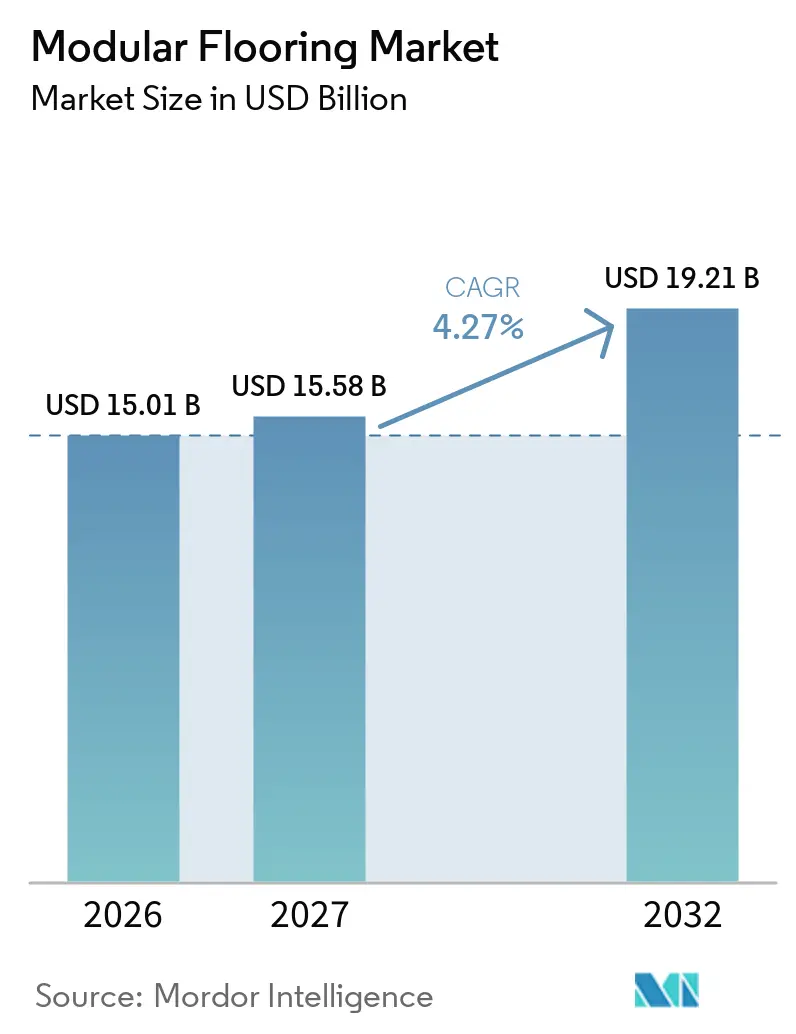
The Modular Flooring Market size was valued at USD 15.01 billion in 2026 and is estimated to grow from USD 15.58 billion in 2027 to reach USD 19.21 billion by 2032, at a CAGR of 4.27% during the forecast period (2027-2032). Commercial renovation, residential upgrades, and institutional purchasing support demand because buyers value shorter closures, targeted replacement, and the ability to schedule work around normal building operations. In mature economies, replacement work provides a steadier base for the modular flooring market than new construction because floors in offices, schools, healthcare sites, and retail properties require recurring updates. Suppliers are responding with products that combine resilient surfaces, acoustic control, simpler installation, and design choices suitable for several interior zones. Environmental documentation, take-back programs, recycled inputs, and transparent material information are becoming more important in institutional procurement, especially when projects pursue green-building requirements. The competitive response increasingly depends on offering several compatible floor formats rather than a single material category, which can reduce coordination work for architects, contractors, and facility managers.
Key Report Takeaways
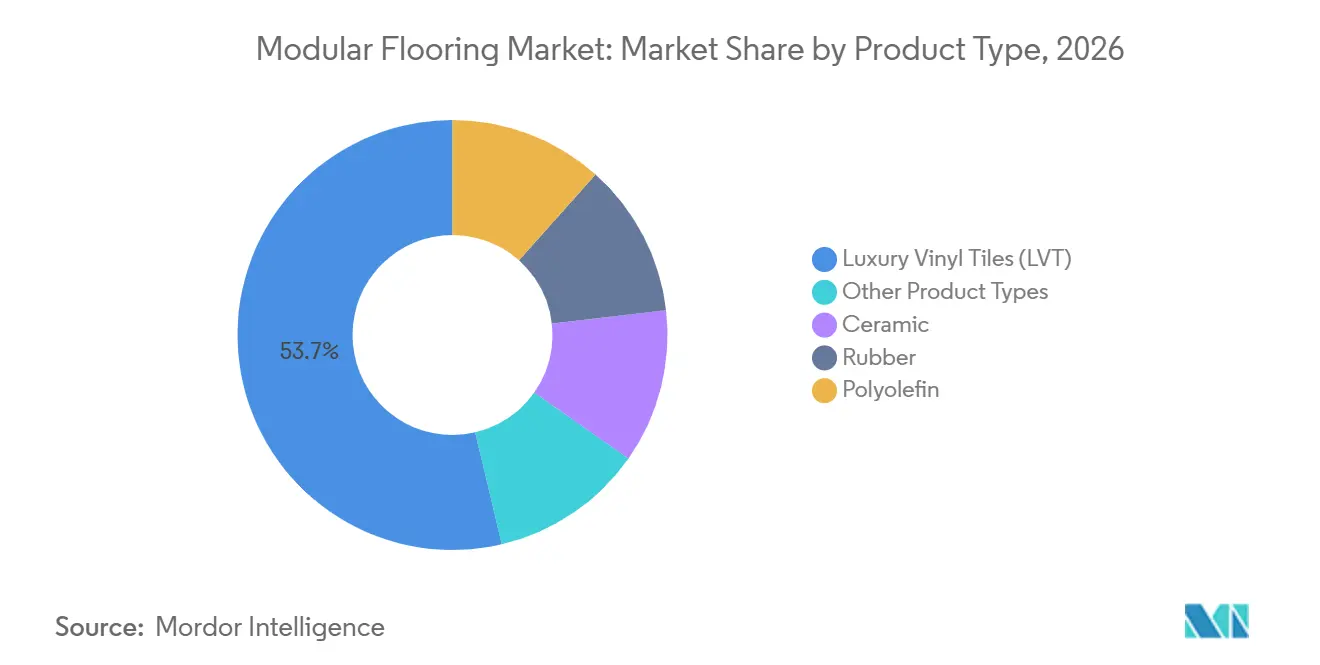
- By product type, luxury vinyl tiles (LVT) held 53.67% of the modular flooring market share in 2026 and are forecast to advance at a 4.89% CAGR through 2032.
- By installation technique, interlocking held 34.19% of the modular flooring market share in 2026, while loose lay is forecast to advance at a 5.12% CAGR through 2032.
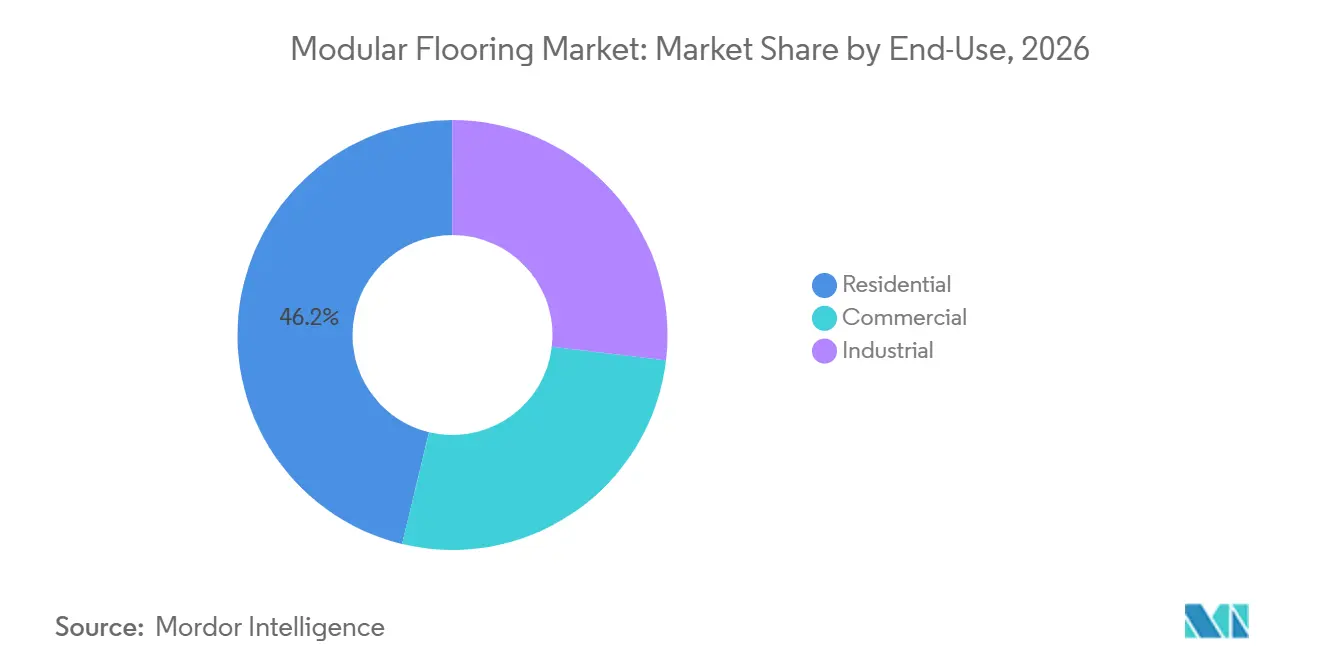
- By end-use, residential held 46.23% of the modular flooring market share in 2026 and is forecast to advance at a 5.45% CAGR through 2032.
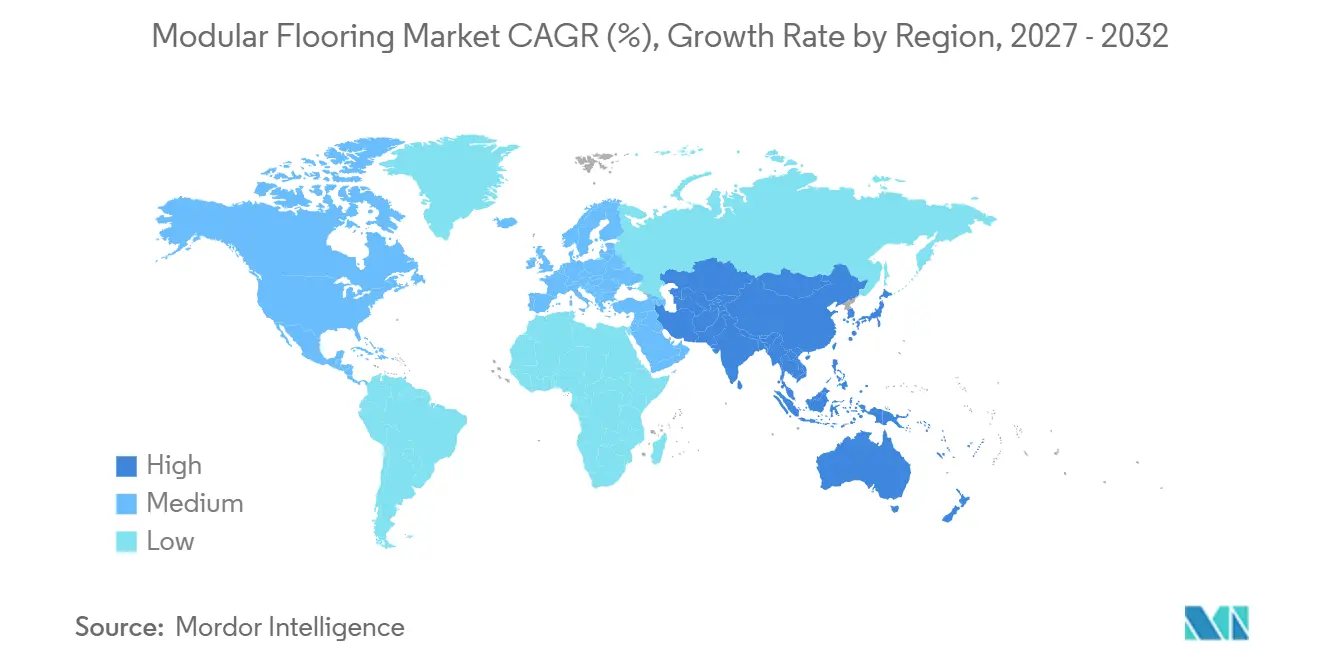
- By geography, North America held 48.14% of the modular flooring market share in 2026, while Asia-Pacific is forecast to advance at a 5.38% CAGR through 2032.
Note: Market numbers in this report are based on Mordor Intelligence's proprietary estimation framework, which combines nine months of actuals with Q4 projections for base year 2026.
Market Trends and Insights
Drivers Impact Analysis of Modular Flooring Market*
| Driver | (~) % Impact on CAGR Forecast | Geographic Relevance | Impact Timeline |
|---|---|---|---|
| Commercial Renovation and Retrofit Cycles | +1.2% | North America & Europe; spillover to APAC core | Medium term (2–4 years) |
| Low-Disruption Installation and Selective Replacement | +0.9% | Global, with early gains in North America and Western Europe | Short term (≤ 2 years) |
| Acoustic and Well-being Requirements in Modern Interiors | +0.7% | Europe and North America core; emerging in APAC commercial hubs | Medium term (2–4 years) |
| Circular Procurement and Green-Building Certification | +0.6% | North America & EU; spillover to APAC | Long term (≥ 4 years) |
| Interoperable Carpet Tile, LVT and Rubber Flooring Systems | +0.4% | Global | Medium term (2–4 years) |
| Source: Mordor Intelligence | |||
Commercial Renovation and Retrofit Cycles
Renovation work is a central source of demand for the modular flooring market in North America and Europe because most occupied facilities cannot pause services for a full floor replacement. Facility managers can replace a defined area without closing an entire building or removing a complete floor, which makes the approach useful where occupants, patients, students, guests, or customers remain on site. Healthcare, education, senior living, retail, and office properties need phased work that keeps services available and allows each work area to return to use quickly. This requirement favors formats that can be installed in stages, replaced later without broad disruption, and specified for a mixture of high-use and lower-use spaces. The renovation focus also makes demand less dependent on new building permits and financing activity, since existing assets still require maintenance and interior upgrades. Owners can direct available capital toward refurbishment when they delay larger construction projects, which maintains a source of work for flooring suppliers and installers.
Low-Disruption Installation and Selective Replacement
Selective replacement changes how building owners compare flooring costs over a product’s service life because they can assess disruption, labor, and future repair needs alongside the material price. A damaged tile can be removed and replaced without taking out adjacent flooring, which helps occupied hospitals, airports, retail stores, offices, and other locations where access must be carefully managed. Click-lock products remove adhesive curing time and allow faster use of the finished area, while loose lay products provide similar flexibility where contractors need to complete work during a short closure window. The modular flooring market benefits when reduced downtime carries a higher cost than the initial material price, particularly for facilities with fixed operating hours or high foot traffic. Large suppliers can strengthen customer retention when replacement tiles, warranties, design support, and installation guidance are available through the same channel. This can turn a single installation into a longer relationship based on maintenance, replacement, and future refurbishment work.
Acoustic and Well-Being Requirements in Modern Interiors
Open offices, education facilities, healthcare buildings, and shared residential settings increasingly need products that manage impact noise. Forbo Holding AG offers Allura Decibel products with 19 dB impact sound reduction, while Gerflor offers Creation LVT formats with integrated acoustic performance. Integrated acoustic layers can remove the need for a separate underlay and simplify material selection. This makes specification easier for projects that have noise targets and restricted installation time. Milliken reported that commercial designers are giving more attention to sensory needs in workplace and healthcare settings. Products that combine acoustic, ergonomic, and material-health features can therefore carry greater value for architects and facility teams.
Circular Procurement and Green-Building Certification
Green-building requirements are raising the importance of recycled content, environmental product declarations, take-back programs, and material disclosures. LEED v5 includes product selection and procurement criteria that address climate, human health, ecosystem health, and circular economy factors[1]. Interface, Inc.’s ReEntry and Shaw Industries Group, Inc.’s ReTurn programs are examples of extended producer responsibility pathways recognized in the LEED material framework. These programs can help project teams manage end-of-life materials and document procurement choices. The modular flooring market is well placed where buyers seek flooring that can be removed, recovered, and directed to recycling rather than disposal. The approach also favors companies that can provide audited sustainability information across their portfolios.
Restraints Impact Analysis of Modular Flooring Market*
| Restraint | (~) % Impact on CAGR Forecast | Geographic Relevance | Impact Timeline |
|---|---|---|---|
| Petrochemical Input Exposure and Raw-Material Volatility | -1.5% | Global; intensified in APAC and Europe | Short term (≤ 2 years) |
| Subfloor Moisture, Flatness and Preparation Sensitivity | -1.0% | Global | Long term (≥ 4 years) |
| Higher Upfront Cost Versus Conventional Flooring | -0.8% | APAC, South America, MEA (cost-sensitive markets) | Medium term (2–4 years) |
| Source: Mordor Intelligence | |||
Subfloor Moisture, Flatness and Preparation Sensitivity
Subfloor preparation remains a lasting constraint for the modular flooring market. Moisture is identified as a leading reason for flooring failure, which makes testing and remediation important before installation[2]. Existing buildings can require grinding, moisture barriers, and repeat testing before installers can begin. These steps add cost and can lengthen a retrofit project in facilities that have limited downtime. Magnetic systems can reduce some flatness concerns in specialist settings, although the system cost restricts broader use. Buyers that focus mainly on the first installation price may select conventional options when remediation expenses are not known at tender stage.
Petrochemical Input Exposure and Raw-Material Volatility
Luxury vinyl tiles and polyolefin products depend on inputs linked to petrochemical supply chains. Changes in availability or pricing for these inputs can affect manufacturer costs and contract pricing. Companies with short procurement cycles are more exposed when materials become harder to source. This exposure can pressure margins when demand from renovation programs remains strong. Recycling systems provide one route to reduce reliance on virgin material inputs while supporting circular procurement goals. The modular flooring market therefore gives added value to suppliers that combine recycled material capability with reliable quality control.
*Our forecasts treat driver/restraint impacts as directional, not additive. The impact forecasts reflect baseline growth, mix effects, and variable interactions.
Modular Flooring Market Segment Analysis
By Product Type:
Luxury Vinyl Tiles Combine Scale with Product DevelopmentLuxury vinyl tiles accounted for 53.67% of the modular flooring market size in 2026 and are projected to advance at a 4.89% CAGR through 2032. The segment benefits from click-lock rigid-core formats that reduce adhesive use, shorten installation work, and support occupied-building renovation where work needs to be completed in defined stages. Stone plastic composite products improve stability, dent resistance, and performance under changing indoor conditions, which broadens their use in homes, retail settings, offices, and public interiors. Digital printing gives suppliers more options for wood, stone, and other surface designs while allowing product ranges to serve several aesthetic preferences. These features support demand in residential renovation as well as commercial replacement projects, where users want a balance of durability, visual choice, and simple upkeep.
Manufacturers are directing product development toward lower-impact materials, improved acoustic performance, easier recovery at end of life, and improved surface performance for heavily used spaces. Shaw Industries Group, Inc. introduced EcoWorx Resilient as a closed-loop recyclable commercial resilient flooring platform in 2025. Ceramic modular tiles remain relevant in wet areas and institutional settings that need durability, chemical resistance, and a surface suited to regular cleaning. Rubber formats have roles in healthcare and education where slip resistance, comfort underfoot, acoustic performance, and long service life are important. Polyolefin products support specialized industrial and clean room needs, which ties their performance requirements to controlled environments, equipment traffic, and hygiene requirements rather than general refurbishment.

By Installation Technique:
Interlocking Leads While Loose Lay Supports Fast RenovationInterlocking held 34.19% of the modular flooring market size in 2026 because click-lock systems form durable connections without adhesive. The method suits airports, logistics centers, retail locations, and other areas with heavy traffic because the flooring can maintain a stable fit under frequent use and wheeled loads. It also helps installers replace individual units during phased renovation work without disturbing the full floor area. Contractors value the predictable fit, clear installation sequence, and ability to return areas to use quickly when project schedules are restricted. The format can carry a higher material cost, but it helps reduce dependence on specialized adhesive work and supports future repair without broad material removal.
Loose lay is projected to advance at a 5.12% CAGR through 2032. It allows installers to remove and reposition tiles with limited impact on the subfloor, a practical benefit when the building owner expects later changes. This supports renovation in healthcare wards, hotel rooms, and occupied office space where a multi-day closure is difficult. Forbo Holding AG’s Allura Decibel range adds a 19 dB acoustic backing within the tile format, reducing the need for a separate underlay. Magnetic systems continue to serve specialist projects with access floors, while peel-and-stick products are used in lower-traffic and restricted-installation settings.
By End-Use:
Residential Demand Reflects Do-It-Yourself Renovation ActivityResidential held 46.23% of the modular flooring market share in 2026 and is projected to advance at a 5.45% CAGR through 2032. Homeowners use luxury vinyl tiles and interlocking products in kitchens, bathrooms, basements, and other rooms that benefit from practical installation. Click-lock systems can reduce the need for adhesives and professional installation equipment. Retail and online channels make a wider range of products available to household buyers. Digital visualization tools also help homeowners compare surface designs before purchase.
Tarkett provides a Tailored by Tarkett visualizer that supports flooring selection for residential projects. Residential renovation demand also reflects improvement projects that households postponed during periods of higher borrowing costs. Commercial end-use remains important across offices, retail, hospitality, healthcare, and education because these locations require durable surfaces and targeted replacement. Industrial buyers choose rubber and polyolefin formats where load capacity, chemical resistance, and spot repair matter. Data centers, pharmaceutical sites, and logistics facilities add specialized demand for materials that perform in controlled or high-use conditions.
Geography Analysis
North America Modular Flooring Market
North America held 48.14% of the modular flooring market share in 2026, supported by a large installed base of commercial properties entering regular renovation cycles. Corporate offices, healthcare facilities, schools, warehouses, and data centers support demand for durable products that can be installed with limited disruption to daily operations. The United States represents the largest part of regional demand because project teams often use specification-led purchasing and consider service continuity when planning interior upgrades. Mexico is developing as an important growth location as manufacturing investment adds industrial and commercial floor space that requires rapidly installed, durable flooring products.
APAC Modular Flooring Market
Asia-Pacific is projected to advance at a 5.38% CAGR through 2032. Urbanization, household formation, and rising interior standards support demand in China, India, and Southeast Asian economies. Education, healthcare, retail, hospitality, and mixed-use projects are expanding the use of products selected through formal design and procurement processes. India is seeing greater adoption of luxury vinyl tiles in organized retail, hospitality, and mid-range housing, where buyers are moving toward rigid-core designs with wood and stone visuals. China remains important for regional demand, while Vietnam, Indonesia, and Thailand are both production locations and consumer markets as household incomes support higher expectations for interior finishes.
South America and MEA Modular Flooring Market
South America and the Middle East and Africa are earlier-stage markets where use of modular formats is expanding from a lower base. Brazil supports South American demand through multifamily housing renovation, corporate real estate, and growing retail networks in São Paulo and Rio de Janeiro. Saudi Arabia creates opportunities through hospitality, education, and commercial development connected with Vision 2030, while South Africa provides a secondary source of commercial renovation demand. Higher initial costs can limit broader adoption in both regions, especially where conventional vinyl sheet and ceramic tile remain less expensive and total-cost-of-ownership analysis is not routinely used.
Competitive Landscape
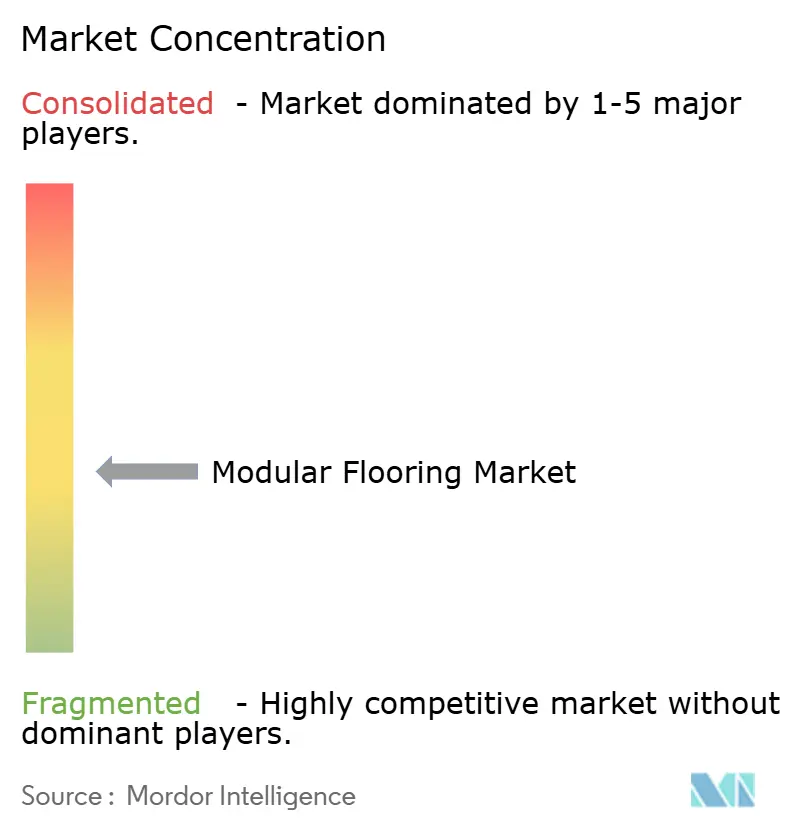
The modular flooring market is moderately concentrated, with the top five players including MOHAWK INDUSTRIES, INC., Shaw Industries Group, Inc., Interface, Inc., Tarkett, and Forbo Holding AG. Larger suppliers compete through product development, distribution reach, sustainability programs, and breadth of product formats. Regional companies often compete through pricing, local design preferences, and service responsiveness. This mix makes it important for global producers to balance standardized platforms with local project needs.
Circular design is a major area of competitive activity in the modular flooring market. Interface, Inc. launched noravant in February 2026 as a polyvinyl chloride-free rubber flooring platform with a product take-back program and Cradle to Cradle Certified Silver status. Shaw Industries Group, Inc. uses its ReTurn program to support material recovery, while its EcoWorx Resilient platform extends the company’s work in recyclable commercial flooring. These programs can help project teams make product selections that account for recovery, reuse, recycling, documented material information, and end-of-life planning.
Product coordination is another competitive priority in the modular flooring market. Interface, Inc. introduced coordinated carpet tile and Luxury Vinyl Tile collections in 2025 so architects could specify connected designs from one supplier. Interface, Inc. also expanded its resilient offering with In The Mix and Raw Materials Luxury Vinyl Tiles in 2025, widening the available design options for commercial interiors. Forbo Holding AG, Gerflor, Tarkett, and Shaw Industries Group, Inc. also compete by bringing acoustic performance, product recovery, and complementary designs into their broader portfolios. This approach is useful for commercial projects that need different floor materials to work together across adjacent spaces.
Modular Flooring Industry Leaders
-
MOHAWK INDUSTRIES, INC.
-
Shaw Industries Group, Inc.
-
Interface, Inc.
-
Tarkett
-
Forbo Holding AG
- *Disclaimer: Major Players sorted in no particular order
Modular Flooring Market Companies Covered in this Report
- AHF, LLC
- Beaulieu International Group
- CFL Holding Limited
- DH Floors
- Forbo Holding AG
- Gerflor
- Interface, Inc.
- James Halstead PLC
- LX Hausys
- Mannington
- Milliken
- MOHAWK INDUSTRIES, INC.
- Shaw Industries Group, Inc.
- Tarkett
- Toli Floor
Recent Industry Developments in Modular Flooring Market
- August 2026: Interface, Inc. launched its Between the Notes carpet tile collection, featuring three coordinated designs for workplaces, educational facilities, senior living and other commercial spaces. The launch supports the modular flooring market by expanding design flexibility and enabling customized flooring layouts through modular carpet tiles.
- June 2026: Tarkett introduced its Transcribe collection, combining carpet tiles and luxury vinyl tiles with textured patterns designed primarily for workplace interiors. The launch supports the modular flooring market by broadening modular flooring options for commercial spaces seeking coordinated aesthetics and functional flexibility.
Global Modular Flooring Market Report Scope
Modular flooring consists of individual flooring units designed for convenient installation, replacement, and maintenance without requiring the entire floor to be removed. These systems offer flexibility in design and installation while supporting durability and efficient upkeep across different building environments.
The Modular Flooring Market is segmented by product type, installation technique, end-use, and geography. By product type, the market is segmented into luxury vinyl tiles (LVT), ceramic, rubber, polyolefin, and other product types. By installation technique, the market is segmented into interlocking, loose lay, magnetic systems, and other installation techniques. By end-use, the market is segmented into residential, commercial, and industrial. The report also covers the market size and forecasts for modular flooring across 16 countries. For each segment, the market sizing and forecasts have been done on the basis of value (USD).
Segmentation Overview
| Luxury Vinyl Tiles (LVT) |
| Ceramic |
| Rubber |
| Polyolefin |
| Other Product Types |
| Interlocking |
| Loose Lay |
| Magnetic Systems |
| Other Installation Techniques |
| Residential |
| Commercial |
| Industrial |
| Asia-Pacific | China |
| India | |
| Japan | |
| South Korea | |
| ASEAN Countries | |
| Rest of Asia-Pacific | |
| North America | United States |
| Canada | |
| Mexico | |
| Europe | Germany |
| United Kingdom | |
| France | |
| Italy | |
| NORDIC Countries | |
| Russia | |
| Rest of Europe | |
| South America | Brazil |
| Argentina | |
| Rest of South America | |
| Middle East and Africa | Saudi Arabia |
| South Africa | |
| Rest of Middle East and Africa |
| By Product Type | Luxury Vinyl Tiles (LVT) | |
| Ceramic | ||
| Rubber | ||
| Polyolefin | ||
| Other Product Types | ||
| By Installation Technique | Interlocking | |
| Loose Lay | ||
| Magnetic Systems | ||
| Other Installation Techniques | ||
| By End-Use | Residential | |
| Commercial | ||
| Industrial | ||
| By Geography | Asia-Pacific | China |
| India | ||
| Japan | ||
| South Korea | ||
| ASEAN Countries | ||
| Rest of Asia-Pacific | ||
| North America | United States | |
| Canada | ||
| Mexico | ||
| Europe | Germany | |
| United Kingdom | ||
| France | ||
| Italy | ||
| NORDIC Countries | ||
| Russia | ||
| Rest of Europe | ||
| South America | Brazil | |
| Argentina | ||
| Rest of South America | ||
| Middle East and Africa | Saudi Arabia | |
| South Africa | ||
| Rest of Middle East and Africa | ||
Key Questions Answered in the Report
What is the size of the modular flooring market?
The modular flooring market size was valued at USD 15.01 billion in 2026 and is estimated to grow from USD 15.58 billion in 2027 to reach USD 19.21 billion by 2032, at a CAGR of 4.27% during the forecast period (2027-2032).
Which product type leads global demand?
Luxury vinyl tiles (LVT) held a 53.67% share in 2026 and are projected to advance at a 4.89% CAGR through 2032.
Which installation is projected to advance fastest through 2032?
Loose lay is projected to advance at a 5.12% CAGR through 2032 because it supports rapid renovation with limited disruption.
Which end-use is projected to advance fastest through 2032?
The residential segment is projected to advance at a 5.45% CAGR through 2032, supported by renovation and do-it-yourself installation needs.