
Military Load Carriage System Market Size and Share
Market Overview
| Study Period | 2020 - 2032 |
|---|---|
| Market Size (2027) | USD 6.19 Billion |
| Market Size (2032) | USD 7.75 Billion |
| Growth Rate (2027 - 2032) | 4.60 % |
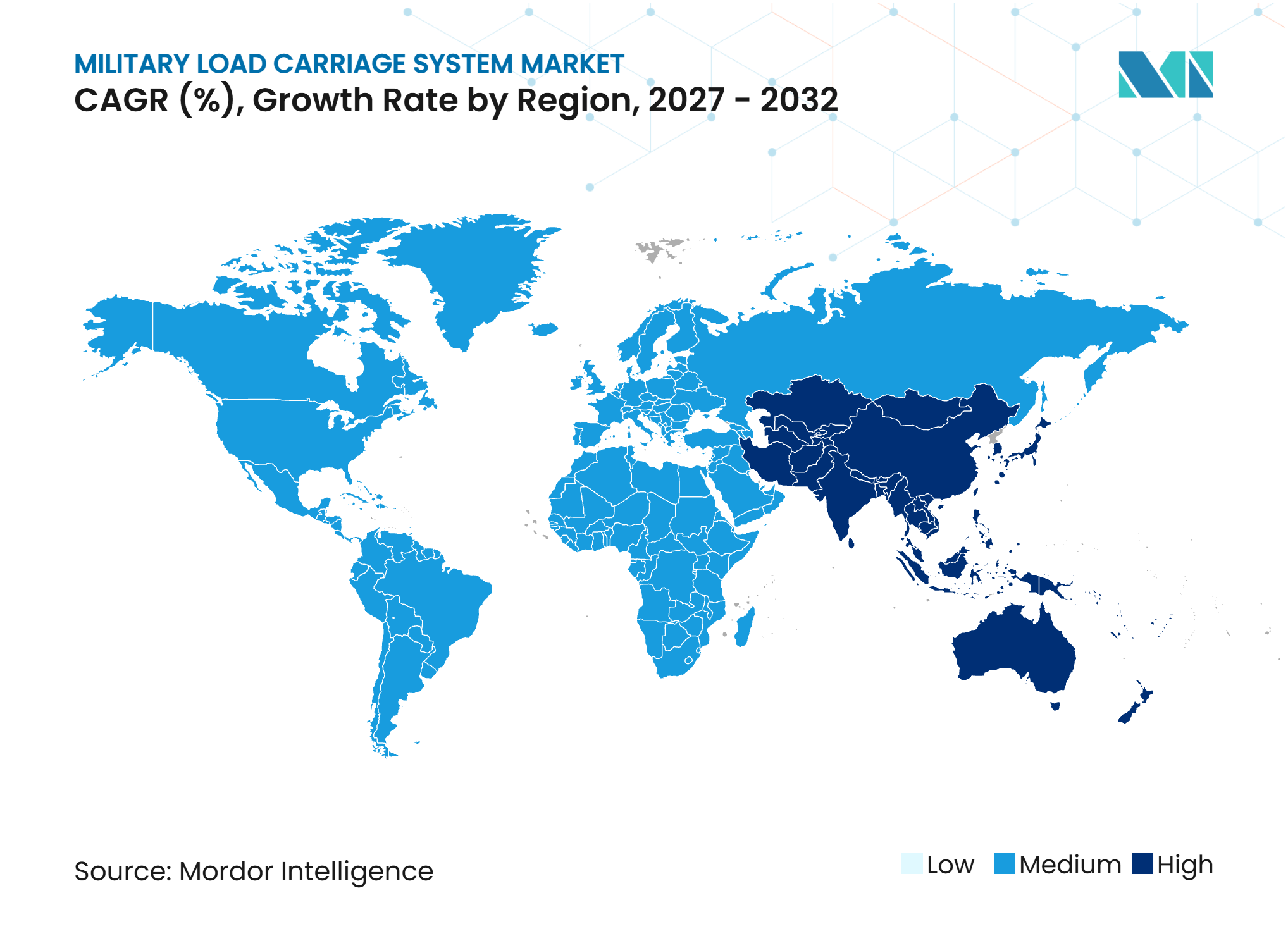
| Fastest Growing Market | Asia-Pacific |
| Largest Market | North America |
| Market Concentration | Medium |
Major Players *Disclaimer: Major Players sorted in no particular order Image © Mordor Intelligence. Reuse requires attribution under CC BY 4.0. | |
Military Load Carriage System Market Analysis by Mordor Intelligence
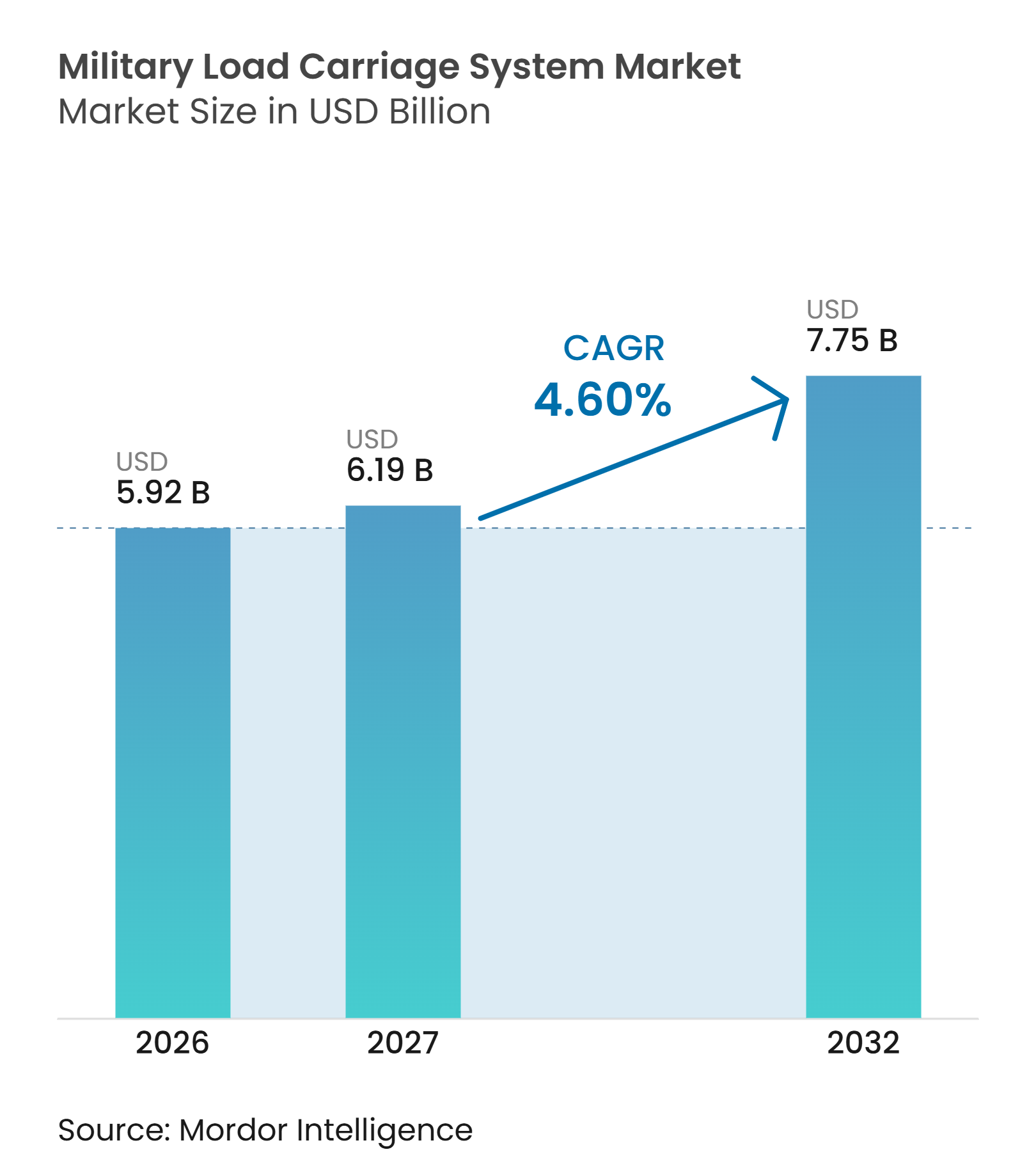
The military load carriage system market size was valued at USD 5.92 billion in 2026 and is forecast to grow from USD 6.19 billion in 2027 to reach USD 7.75 billion by 2032, at a 4.60% CAGR during the forecast period (2027-2032). Higher defense outlays are supporting spending on individual soldier equipment as armed forces replace aging packs, vests, and frames. Global military spending reached USD 2,887 billion in 2025, according to SIPRI. The US Army’s Squad as a System concept is shifting procurement toward equipment that works with protection, communications, and power systems. This favors suppliers that can meet common interface and domestic sourcing requirements. The military load carriage systems market also benefits from demand for equipment that reduces strain without limiting mobility.
Key Report Takeaways
- By product type, tactical backpacks and rucksacks held 32.67% of the military load carriage system market share in 2026, while military load-carriage exoskeletons are forecast to grow at an 8.76% CAGR through 2032.
- By load capacity, medium accounted for 45.01% of the military load carriage system market size in 2026, while heavy are projected to expand at a 5.72% CAGR through 2032.
- By end user, the army captured 57.87% of the military load carriage system market share in 2026, while Special Operations Forces are expected to grow at a 6.21% CAGR through 2032.
- By application, combat and tactical operations accounted for 65.45% of the military load carriage system market size in 2026, while medical and casualty support operations are projected to grow at a 5.76% CAGR through 2032.
- By geography, North America held a 36.81% revenue share in 2026, while Asia-Pacific is forecast to expand at a 5.95% CAGR through 2032.
Note: Market numbers in this report are based on Mordor Intelligence's proprietary estimation framework, which combines nine months of actuals with Q4 projections for base year 2026.
Market Trends and Insights
Drivers Impact Analysis of Military Load Carriage System Market*
| Driver | (~) % Impact on CAGR Forecast | Geographic Relevance | Impact Timeline |
|---|---|---|---|
| Soldier modernization and force readiness programs | +1.60% | Global, concentrated in North America, Europe, and Northeast Asia | Short term (≤ 2 years) |
| Lessons from high-intensity and hybrid conflicts | +1.00% | Eastern Europe, with spillover to Asia-Pacific and the Middle East | Short term (≤ 2 years) |
| Modular interoperability across protection, communications, and sustainment gear | +0.60% | NATO member states and Five Eyes partners | Medium term (2-4 years) |
| Demand for lightweight and ergonomic load distribution | +0.70% | Global, with early gains in the US, the UK, Canada, and Australia | Medium term (2-4 years) |
| Anthropometric fit requirements for more diverse soldier populations | +0.40% | North America, Western Europe, and Australia | Medium term (2-4 years) |
| Integration of smart textiles, sensors, and soldier-worn electronics | +0.50% | European Union, South Korea, and the US research corridors | Long term (≥ 4 years) |
| Source: Mordor Intelligence | |||
Soldier Modernization and Force Readiness Programs
Government modernization programs are creating coordinated demand for packs, carriers, harnesses, and protective equipment in the military load carriage system market. In February 2025, Rheinmetall received a framework agreement for up to 368 IdZ-ES platoon systems, with load-bearing equipment included in each system, followed by a further EUR 1.04 billion (USD 1.16 billion) call-off in April 2026 covering 237 systems for 8,600 soldiers. These contracts consolidate several equipment categories into a single purchase cycle. Canada also awarded Logistik Unicorp a USD 19.7 million contract in 2025 for 3,000 modular load-carriage units under the Dismounted Infantry Capability Enhancement (DICE).[1] These programs favor qualified manufacturers with interoperable kits.
Lessons From High-Intensity and Hybrid Conflicts
Recent conflicts have increased attention to casualty evacuation, modularity, and load relief in the military load carriage system market. Ukraine tested the battery-free Gyurza-1 passive exoskeleton in 2026, designed to support loads of up to 70 kg while reducing strain. The Bundeswehr’s 2025 special forces rucksack framework covered heavy-load, sniper, communications, and prolonged field-care variants. These requirements reflect a move away from one general-purpose pack for all missions. The French Army also began testing passive exoskeletons for logistics roles in 2026, with target loads of up to 100 kg. More specialized equipment broadens opportunities, although each variant needs its own qualification path.
Modular Interoperability Across Protection, Communications, and Sustainment Gear
The military load carriage system market is increasingly shaped by requirements for equipment that connects with protective, communications, and power components. The US Army introduced its Squad as a System concept to industry in 2025, placing compatibility across the soldier system at the center of equipment planning. Rheinmetall’s IdZ-ES system includes load-bearing equipment prepared for the D-LBO digital battlefield network. NATO STANAG 4660 and MOLLE interface requirements remain important compliance factors for allied equipment. Suppliers with proven systems integration can gain an advantage in integrated procurements. New entrants may face longer testing and documentation requirements before gaining access to those programs.
Lightweight and Ergonomic Load Distribution
Load-related injuries and fatigue are driving procurement toward more ergonomic designs in the military load-carriage systems market. The US Marine Corps began a limited user evaluation of the military light frame in July 2025. Participants reported that a 35-lb load felt like 15-20 lb compared with a standard infantry configuration. The program is assessing better transfer of weight from shoulders to hips. Suppliers that can demonstrate comfort, stability, and movement under realistic loads are more likely to meet future evaluation criteria.
Restraints Impact Analysis of Military Load Carriage System Market*
| Restraint | (~) % Impact on CAGR Forecast | Geographic Relevance | Impact Timeline |
|---|---|---|---|
| Long qualification and government procurement cycles | -0.50% | Global; most acute in the US and EU military specification procurement | Medium term (2-4 years) |
| Defense-budget trade-offs and delayed replacement programs | -0.30% | Asia-Pacific emerging markets, parts of the Middle East and Africa, and Latin America | Medium term (2-4 years) |
| Integration constraints with legacy armor and communications systems | -0.20% | NATO allies with mixed-generation inventories | Medium term (2-4 years) |
| Protection-to-weight and thermal-burden trade-offs | -0.20% | Global, particularly arid and tropical operating areas | Long term (≥ 4 years) |
| Source: Mordor Intelligence | |||
Long Qualification and Government Procurement Cycles
Long qualification and procurement schedules limit how quickly suppliers can convert demand into revenue. The Defense Logistics Agency’s 2025 MOLLE rucksack acquisition specified a 240-day lead time for first delivery after award and 150 days for subsequent orders.[2] Canada’s DICE initiative moved from trials in late 2024 to a March 2025 contract award, with delivery expected in fall 2026. Testing, domestic sourcing rules, and military specifications all add time to the fielding process. Smaller specialists must carry qualification costs before an award is assured. This gives suppliers with established manufacturing and compliance records an advantage.
Defense-Budget Trade-Offs and Delayed Replacement Programs
Personnel equipment competes with platforms, munitions, and communications systems for constrained defense budgets. US DoD reporting stated that demand for SOCOM capabilities increased by more than 35% over the 2 years to 2025 while budgets remained flat. The military load carriage systems market can therefore face delayed replacement decisions even where older equipment needs renewal. Cost pressure also affects high-tenacity nylon, UHMWPE fiber, and carbon composite inputs used in lighter products. Militaries with more limited budgets may extend the service life of existing packs and carriers. Manufacturers need flexible production plans that can absorb irregular contract releases and changing annual procurement priorities.
*Our forecasts treat driver/restraint impacts as directional, not additive. The impact forecasts reflect baseline growth, mix effects, and variable interactions.
Military Load Carriage System Market Segment Analysis
By Product Type:
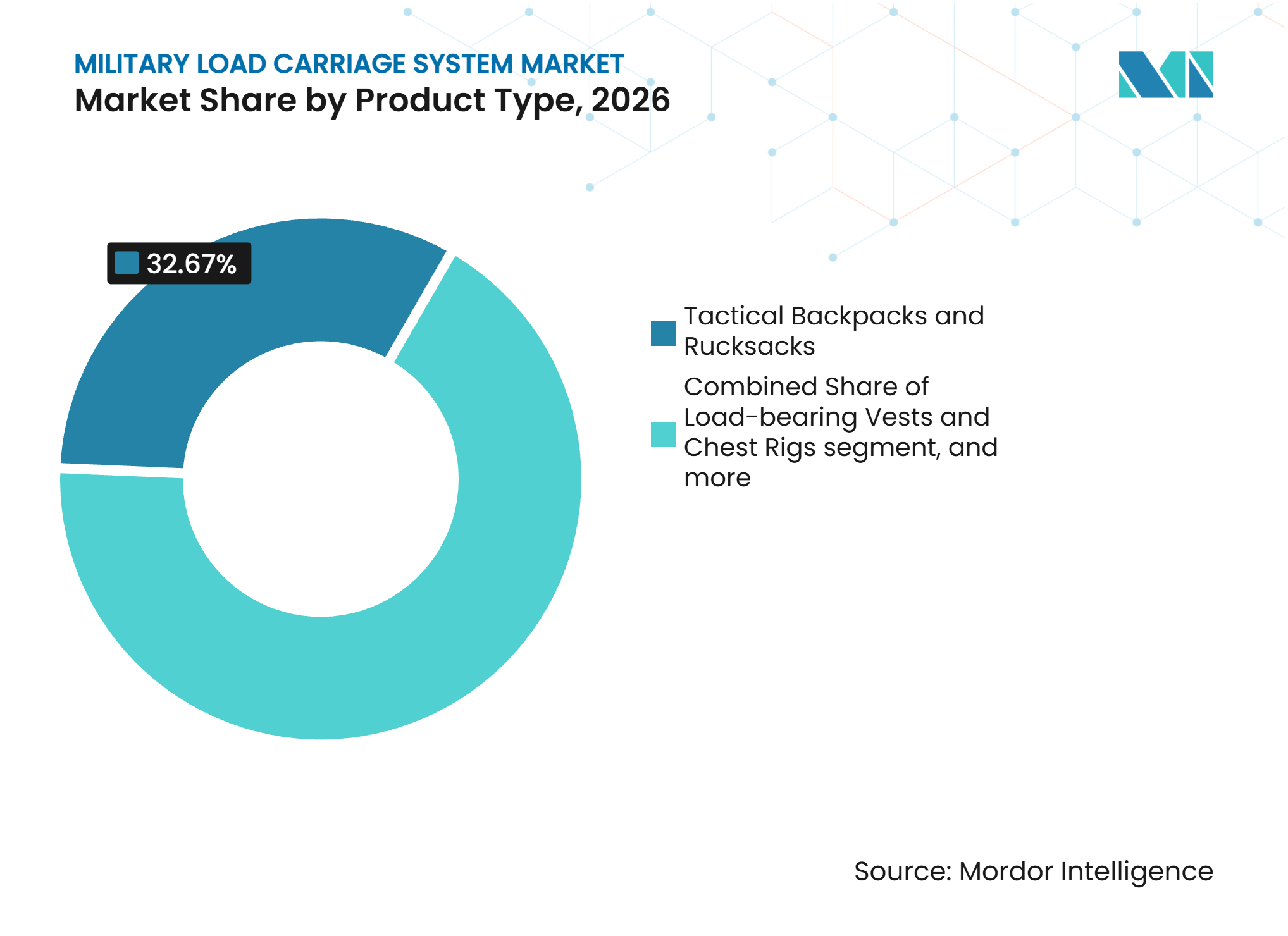
Exoskeletons Emerge While Rucksacks Anchor RevenueTactical backpacks and rucksacks accounted for 32.67% of the military load carriage system market share in 2026, making them the largest product category. Their position reflects routine demand for MOLLE-compatible packs across standing armies and partner forces. The Defense Logistics Agency maintained a MOLLE procurement stream for large field packs and medium rucksack sets in 2025, with monthly quantities. Load-bearing vests and chest rigs also remain important because they must connect with plates, pouches, and radios. Tactical belts, harnesses, hydration systems, and modular pouches support unit refreshes and mission-specific issue. Their demand is stable because these products are established elements of dismounted equipment sets. These categories also support replacement demand across long equipment life cycles.
Military load-carriage exoskeletons are projected to grow at an 8.76% CAGR through 2032, the highest among all product segments. China’s PLA deployed a powered frame that was reported to reduce the carried weight by more than 50% in Himalayan operations. The US Air Force also evaluated Roam Robotics’ Forge exoskeleton for logistics activities.[3] These projects show active interest across combat and support roles. Full procurement remains limited because many programs have not reached formal program-of-record status. The segment’s progress will depend on proving reliability, user acceptance, value, straightforward maintenance, and practical use during extended field trials.



By Load Capacity:
Heavy Systems Gain Share as Mission Weights RiseMedium-capacity systems accounted for 45.01% of the military load carriage system market in 2026. They serve the three-day assault pack requirement common to dismounted infantry formations. The MOLLE medium rucksack remains a standard field configuration in US procurement. Heavy-capacity systems are projected to grow at a 5.72% CAGR through 2032. The US Army NCO Journal documented squad approach loads exceeding 1,061 lb for a 9-soldier squad. This burden supports demand for frames, better suspension systems, and mechanical assistance under difficult operational conditions during extended dismounted missions.
Heavy-load demand is also evident in specialized procurement. The Bundeswehr framework included Rucksack Basis variants in 60-liter and 110-liter configurations. The US Marine Corps Military Light Frame evaluation is examining how improved frame mechanics manage weight transfer. Light-capacity equipment remains relevant for reconnaissance and rapid-response roles. However, electronics, batteries, and sensors can move a nominally light configuration toward a higher actual load. The Army has set a fighting-load goal of no more than 30% of body weight, or 55 pounds for an average infantry soldier.
By End User:
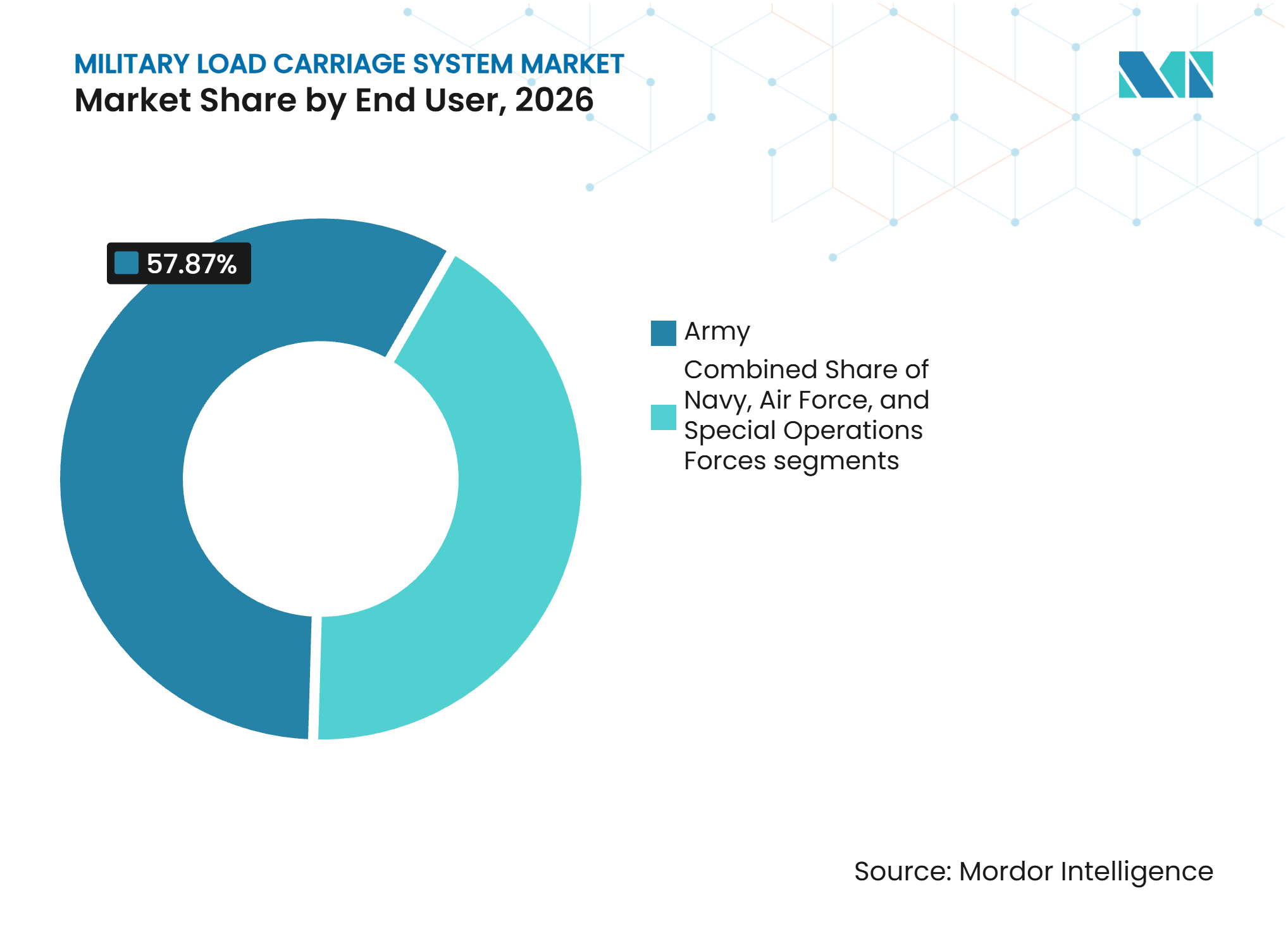
Army Volumes Dominate While SOF Drives InnovationArmy users held 57.87% of 2026 demand in the military load carriage system market. The large installed base of land forces makes army modernization central to the procurement of pack, carrier, and harness systems. SIPRI reported that global military expenditure reached USD 2,887 billion in 2025. Germany’s IdZ-ES contract and Canada’s DICE program show how soldier equipment is being renewed as part of broader land-force programs. Navy and air force users form smaller, technically distinct groups. Maritime requirements can require flotation compatibility, while air force programs are examining load support for logistics crews. Their operating environments also require product-specific materials and attachment configurations.
Special Operations Forces are forecast to expand at a 6.21% CAGR through 2032. US reporting identified a future SOCOM equipment refresh cycle for rucksacks and hard armor. The same plan included integration of blast monitoring and full fielding of a casualty evacuation kit system. These requirements support the use of technically tailored equipment rather than a standard infantry configuration. Products must work across service elements and international partners. Suppliers with relevant qualification histories can compete on capability differentiation. This gives the SOF customer group an important role in trialing advanced materials, medical carriers, and modular interfaces across demanding operational roles.

By Application:
Combat Dominance Persists as Medical Carriage ExpandsCombat and tactical operations accounted for 65.45% of demand in the military load carriage system market in 2026. Every combat-designated soldier needs a fighting-load configuration that can carry protection, ammunition, and essential equipment. Procurement at this scale emphasizes durability, common interfaces, and compliance with domestic sourcing requirements. MOLLE-compatible designs remain central to many tender requirements. Logistics and sustainment operations form another material application area. Training requirements also create recurring demand, although buyers in this segment give close attention to durability across repeated use. These applications collectively keep conventional equipment volumes high across standing and reserve formations.
Medical and casualty support operations are projected to grow at a 5.76% CAGR through 2032. The Bundeswehr’s special forces agreement included a dedicated prolonged field-care rucksack category. It was designed for medical equipment rather than ammunition or communications loads. SOCOM also planned full fielding of a casualty evacuation kit system by FY2026. These developments support purpose-built medical carriers. They reflect longer casualty management needs in contested environments. Suppliers must balance access to clinical supplies with weight distribution, protection, and rapid user access requirements.
Geography Analysis
North America: US Procurement Supports Sustained Demand
North America held 36.81% of the military load carriage system market share in 2026. US demand is supported by the Defense Logistics Agency’s continuing procurement of MOLLE medium rucksacks and large field pack sets. The US Marine Corps began its Military Light Frame evaluation in 2025, paving the way for field feedback on ergonomic load transfer. Canada’s DICE contract covered 3,000 modular systems and is intended to inform the wider SOCEM initiative. Berry Amendment requirements remain a major compliance factor in the US. They favor qualified domestic supply chains but can extend approval. Integrated soldier systems keep the region focused on interoperability and fit.
Asia-Pacific: Defense Expansion Creates Faster Growth
Asia-Pacific is projected to grow at a 5.95% CAGR through 2032 in the military load carriage system market. SIPRI reported regional military spending of USD 681 billion in 2025, its largest annual increase since 2009. India approved a USD 22 billion defense modernization package in October 2026. India also tested a passive exoskeleton developed by Tata Advanced Systems and DRDO for mountainous operations. These programs show interest in both local development and procurement. The region’s demand spans conventional systems and emerging load-assistance equipment. National procurement rules and domestic production priorities will shape supplier access.
Europe and Other Regions: Rearmament Broadens Supplier Opportunities
European defense equipment procurement reached EUR 115 billion (USD 128.68 billion) in 2025, a 26% real-terms increase from 2024: Germany’s IdZ-ES framework and Sweden’s 7-year agreement for load-carrying systems point to sustained procurement in Europe. Sweden’s agreement covered combat packs, medical rucksacks, and associated equipment. PESCO is providing a collaboration route for European soldier-system projects. South America has incremental demand tied to army modernization and counterinsurgency needs. Middle Eastern spending supports purchases of advanced equipment, while several African buyers favor lower-specification tactical systems. This requires suppliers to match design, price, and compliance with local needs.
Competitive Landscape
Market Concentration
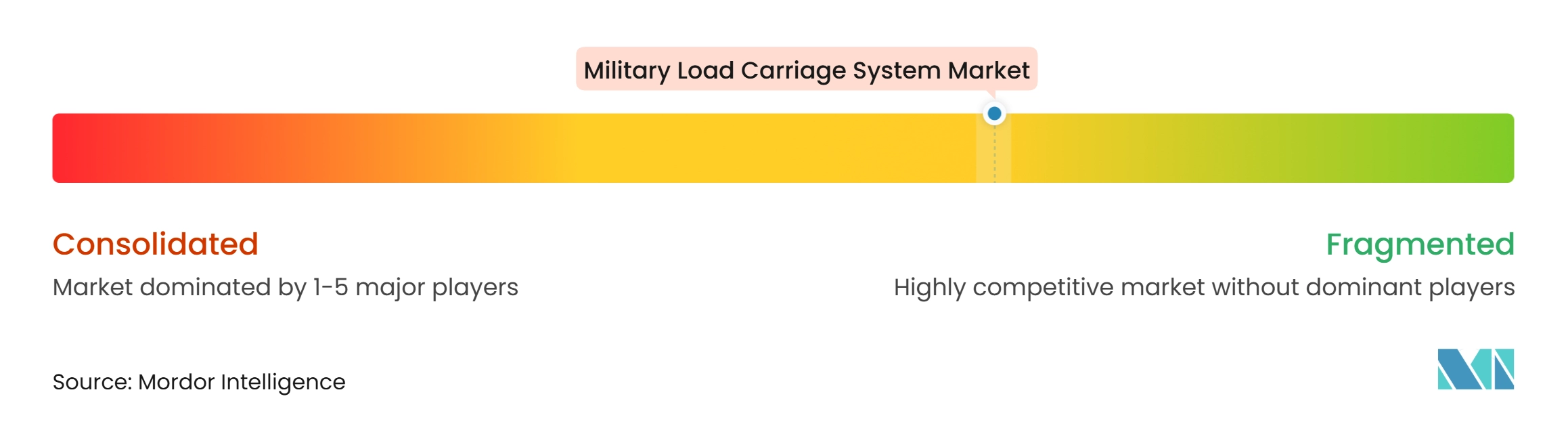
The military load carriage system market is moderately fragmented. Established US suppliers compete through qualified domestic production, MOLLE compatibility, and access to Defense Logistics Agency and special operations programs. European and Israeli specialists compete through product design and export relationships. Rheinmetall’s IdZ-ES program draws on more than 30 subcontractors, showing that prime contractors increasingly assemble broader soldier systems rather than make every component themselves. This structure gives specialized carriers and protection suppliers a route into larger contracts. It also means that system-level compatibility can be as important as individual product compatibility. Qualification status remains difficult for new suppliers to replicate quickly. Procurement rules also favor firms that have established test records.
Competition is expanding in anthropometric fit and exoskeleton-assisted carriage. Canada’s DICE program offers a practical test environment for modular equipment across users. The French Army’s 2026 tests of RB3D and German Bionic passive exoskeletons demonstrate interest in logistics support. Rheinmetall’s April 2026 IdZ-ES call-off shows an integrator extending a soldier-system program into more field units. These moves pressure suppliers to pair lighter equipment with dependable integration.
Regional procurement rules limit a single supplier's ability to serve every program. The Berry Amendment influences US supply choices, while European collaborative programs may offer preferred pathways to regional companies. The European Defence Agency’s 2025 PESCO report identified soldier systems as a collaborative focus area. Suppliers therefore need local manufacturing arrangements, evidence of testing, and documented interoperability. Procurement buyers are also assessing thermal burden, user mobility, and compatibility with armor and radios. The competitive field includes established equipment specialists as well as defense primes.
Military Load Carriage System Industry Leaders
-
FINN-SAVOTTA OY
-
NFM Group AS
-
Crye Precision LLC
-
Snigel
-
Mystery Ranch Ltd.
- *Disclaimer: Major Players sorted in no particular order
Military Load Carriage System Market Companies Covered in this Report
- Snigel
- TYR Tactical
- Mystery Ranch Ltd.
- Tactical Assault Gear
- London Bridge Trading Inc
- 5.11, Inc.
- Eagle Industries
- Point Blank Enterprises, Inc.
- Safariland LLC
- Source Tactical Gear LTD
- Crye Precision LLC
- FirstSpear, LLC
- Blackhawk (Revelyst, Inc.)
- Eberlestock USA LLC
- NFM Group AS
- FINN-SAVOTTA OY
- MKU Limited
- Warrior Assault Systems
- Marom Dolphin LTD
- Tactical Tailor, Inc.
- Direct Action Gear (Entire M sp. z o.o.)
Recent Industry Developments in Military Load Carriage System Market
- April 2026: The Bundeswehr placed a call-off under the existing IdZ-ES framework, ordering 237 additional platoon systems, including load-carrying equipment, protection, and IT components, to equip a further 8,600 soldiers. Deliveries are scheduled between November 2027 and December 2029.
- March 2026: Sweden’s Defence Materiel Administration signed a 7-year framework agreement with 7 Nordic suppliers for load-carrying systems, including combat packs, medical rucksacks, and associated equipment.
- March 2025: Canada awarded a contract with an initial value of USD 19.70 million to Logistik Unicorp to supply the Canadian Army's (CA) light forces with 3,000 units of protective and load-carrying equipment. The contract includes ballistic armor layers, tactical vests, pack systems, and associated pouches, with options for additional systems and services.
Global Military Load Carriage System Market Report Scope
The military load carriage system market comprises specialized equipment and integrated solutions designed to enable military personnel to carry, distribute, and manage operational loads across combat, tactical, logistical, and support missions. The scope includes load carriage systems supplied for new military procurement, soldier modernization programs, equipment replacement, and upgrades across conventional military forces and special operations units. The market focuses on military-grade load-carriage equipment, excluding standalone ballistic-protection equipment, weapons, and other soldier systems not primarily designed for load carriage.
The military load carriage system market is segmented by product type, load capacity, end user, application, and geography. By product type, the market is segmented into tactical backpacks and rucksacks, load-bearing vests and chest rigs, tactical belts and harness systems, modular pouches and equipment carriers, integrated load carriage systems, and military load-carriage exoskeletons. By load capacity, the market is segmented into light, medium, and heavy. By end user, the market is segmented into army, navy, air force, and Special Operations Forces. By application, the market is segmented into combat and tactical operations, logistics and sustainment operations, medical and casualty support operations, and training and other military operations. The report also covers the market sizes and forecasts for the military load carriage system market in major countries across different regions. For each segment, the market size is provided in terms of value (USD).
Segmentation Overview
| Tactical Backpacks and Rucksacks |
| Load-bearing Vests and Chest Rigs |
| Tactical Belts and Harness Systems |
| Modular Pouches and Equipment Carriers |
| Integrated Load Carriage Systems |
| Military Load Carriage Exoskeletons |
| Light |
| Medium |
| Heavy |
| Army |
| Navy |
| Air Force |
| Special Operations Forces |
| Combat and Tactical Operations |
| Logistics and Sustainment Operations |
| Medical and Casualty Support Operations |
| Training and Other Military Operations |
| North America | United States | |
| Canada | ||
| Mexico | ||
| Europe | United Kingdom | |
| France | ||
| Germany | ||
| Italy | ||
| Russia | ||
| Rest of Europe | ||
| Asia-Pacific | China | |
| India | ||
| Japan | ||
| South Korea | ||
| Australia | ||
| Rest of Asia-Pacific | ||
| South America | Brazil | |
| Rest of South America | ||
| Middle East and Africa | Middle East | Saudi Arabia |
| United Arab Emirates | ||
| Rest of Middle East | ||
| Africa | South Africa | |
| Rest of Africa | ||
| By Product Type | Tactical Backpacks and Rucksacks | ||
| Load-bearing Vests and Chest Rigs | |||
| Tactical Belts and Harness Systems | |||
| Modular Pouches and Equipment Carriers | |||
| Integrated Load Carriage Systems | |||
| Military Load Carriage Exoskeletons | |||
| By Load Capacity | Light | ||
| Medium | |||
| Heavy | |||
| By End User | Army | ||
| Navy | |||
| Air Force | |||
| Special Operations Forces | |||
| By Application | Combat and Tactical Operations | ||
| Logistics and Sustainment Operations | |||
| Medical and Casualty Support Operations | |||
| Training and Other Military Operations | |||
| By Geography | North America | United States | |
| Canada | |||
| Mexico | |||
| Europe | United Kingdom | ||
| France | |||
| Germany | |||
| Italy | |||
| Russia | |||
| Rest of Europe | |||
| Asia-Pacific | China | ||
| India | |||
| Japan | |||
| South Korea | |||
| Australia | |||
| Rest of Asia-Pacific | |||
| South America | Brazil | ||
| Rest of South America | |||
| Middle East and Africa | Middle East | Saudi Arabia | |
| United Arab Emirates | |||
| Rest of Middle East | |||
| Africa | South Africa | ||
| Rest of Africa | |||
Key Questions Answered in the Report
What is the value of the military load carriage system market?
The military load carriage system market is projected to increase from USD 5.92 billion in 2026 to USD 7.75 billion by 2032, at a 4.60% CAGR.
Which product category has the largest demand?
Tactical backpacks and rucksacks led product demand with a 32.67% share in 2026.
Which product category is growing fastest?
Military load-carriage exoskeletons are forecast to record an 8.76% CAGR through 2032.
Which end user accounts for the largest demand?
Army users held 57.87% of demand in 2026 because land forces require high volumes of individual equipment.
Which region is growing fastest?
Asia-Pacific is expected to grow at a 5.95% CAGR through 2032, supported by expanding defense modernization programs.
Why is medical load carriage system expanding?
Medical and casualty support systems are expected to grow at a 5.76% CAGR as forces procure purpose-built equipment for prolonged field care and evacuation.