
Market Overview
| Study Period | 2020 - 2031 |
|---|---|
| Forecast Data Period | 2026 - 2031 |
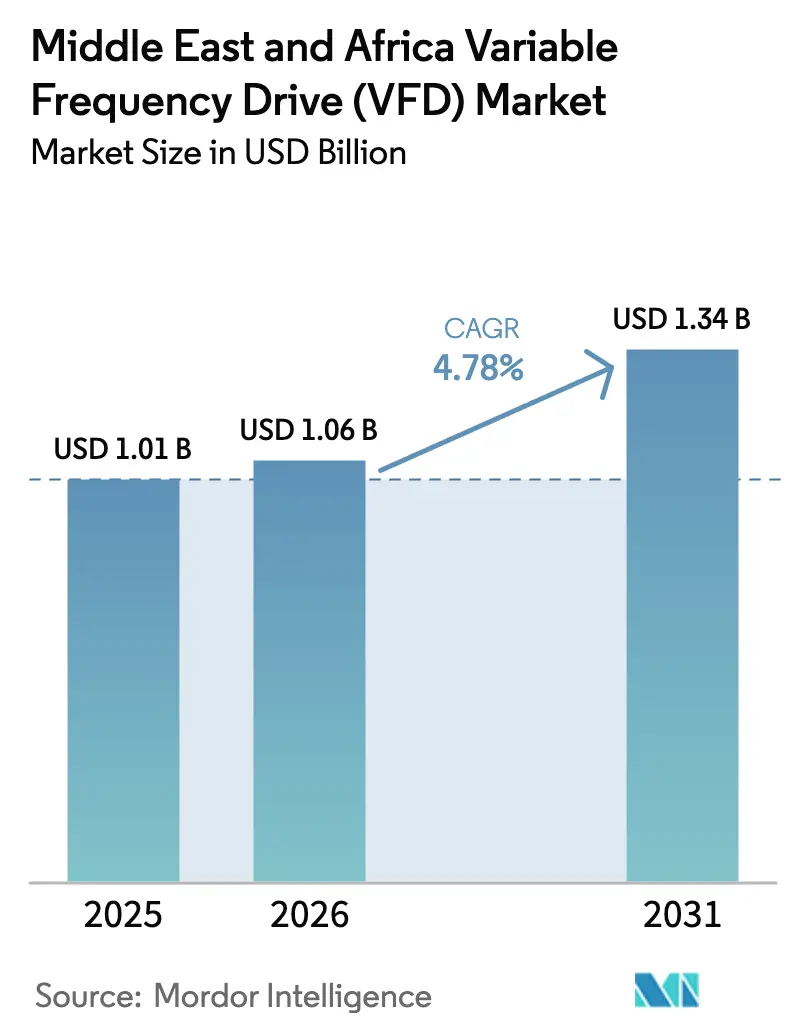
| Base Year Market Size (2025) | USD 1.01 Billion |
| Market Size (2026) | USD 1.06 Billion |
| Market Size (2031) | USD 1.34 Billion |
| Growth Rate (2026 - 2031) | 4.78 % |
| Market Concentration | Medium |
Major Players *Disclaimer: Major Players sorted in no particular order Image © Mordor Intelligence. Reuse requires attribution under CC BY 4.0. | |
Middle East And Africa Variable Frequency Drive (VFD) Market Analysis by Mordor Intelligence
The variable frequency drive market size in the Middle East and Africa is expected to grow from USD 1.01 billion in 2025 to USD 1.06 billion in 2026 and is forecast to reach USD 1.34 billion by 2031 at 4.78% CAGR over 2026-2031. Rising efficiency mandates, widening desalination capacity, and rapid solar-PV rollout form the backbone of demand, while precision-centric applications such as servo-based solar trackers add incremental gains. Medium-voltage specifications tied to green-hydrogen and LNG mega-projects lift the value mix, even as low-voltage installations dominate in commercial HVAC retrofits. Competitive intensity sits at a moderate level, with European and Asian multinationals cementing share through technology depth, regional assembly, and lifecycle services, while local assemblers leverage public-sector localization incentives for entry points. Volatile oil-price-linked capex cycles and fragmented post-warranty service outside the GCC temper the variable frequency drive market growth outlook.
Key Report Takeaways
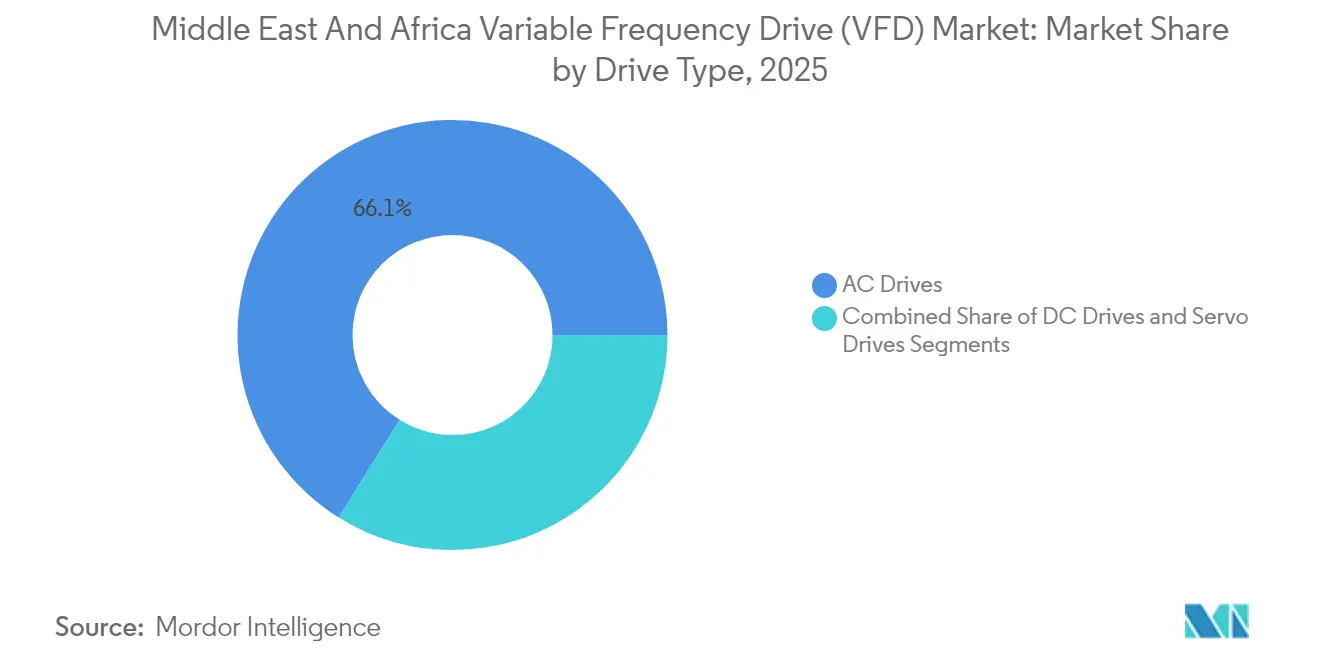
- By drive type, AC drives led with 66.12% revenue share of the Middle East and Africa variable frequency drive market in 2025, while servo drives are projected to grow at a 5.63% CAGR through 2031.
- By power rating, the 5-30 kW class held 38.35% of the 2025 value of the Middle East and Africa variable frequency drive market, whereas 31-75 kW systems are forecast to advance at a 5.78% CAGR to 2031.
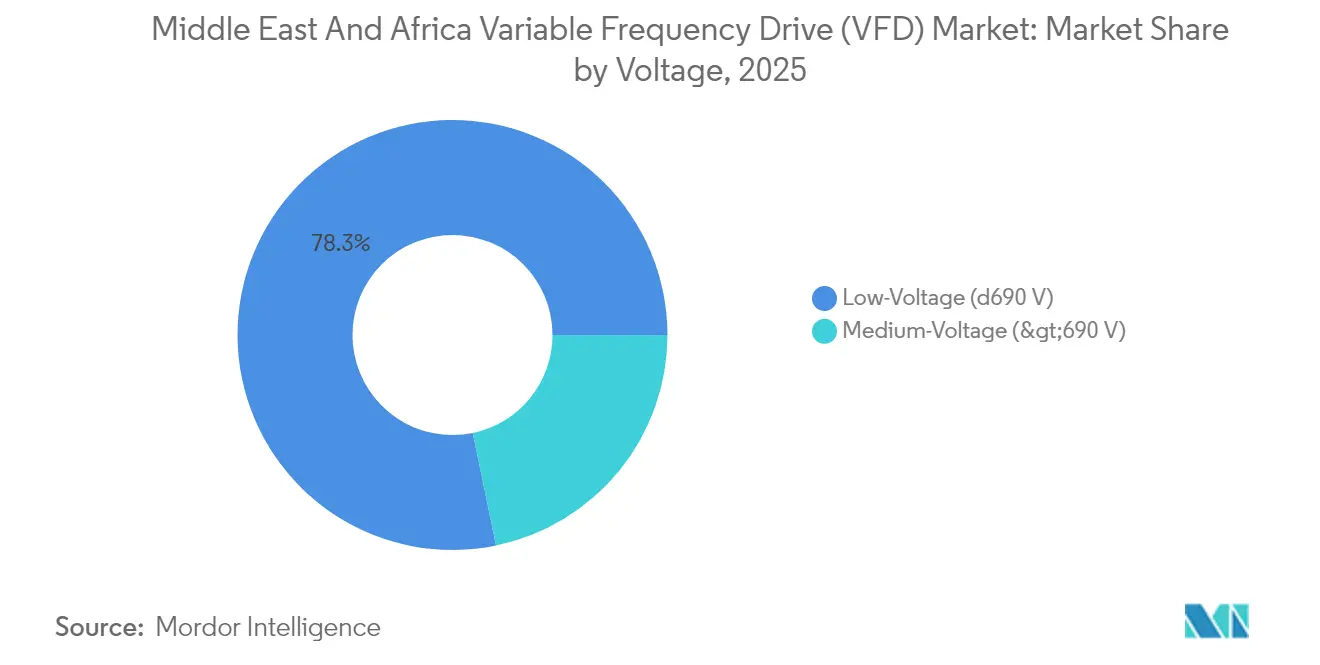
- By voltage, low-voltage units captured 78.25% of the 2025 revenue of the Middle East and Africa variable frequency drive market, while medium-voltage installations are set to post a 5.29% CAGR through 2031.
- By end-user, oil and gas accounted for 32.74% of the 2025 spending of the Middle East and Africa variable frequency drive market, yet water and wastewater treatment is expanding at a 6.24% CAGR to 2031.
- By application, pumps commanded a 39.55% share of the Middle East and Africa variable frequency drive market in 2025, while compressors are registering the fastest uptake at a 5.88% CAGR.
- By geography, the Middle East dominated with 69.62% market share of the Middle East and Africa variable frequency drive market in 2025, whereas Africa is anticipated to record a 5.68% CAGR through 2031.
Note: Market size and forecast figures in this report are generated using Mordor Intelligence’s proprietary estimation framework, updated with the latest available data and insights as of 2026.
Market Trends and Insights
Drivers Impact Analysis of Middle East And Africa Variable Frequency Drive (VFD) Market*
| Driver | (~) % Impact on CAGR Forecast | Geographic Relevance | Impact Timeline |
|---|---|---|---|
| Intensifying energy-efficiency mandates across Middle East and Africa | +1.2% | Global MEA, strongest in GCC states | Medium term (2-4 years) |
| Massive build-out of desalination and district-cooling infrastructure | +1.4% | Middle East core, UAE and Saudi Arabia | Long term (≥ 4 years) |
| Rapid solar-PV integration driving need for variable-speed motors | +0.9% | Middle East and North Africa | Medium term (2-4 years) |
| Shift toward electric submersible pumps in mature oilfields | +0.8% | GCC states, Algeria, Nigeria | Short term (≤ 2 years) |
| Government-funded localization of industrial automation manufacturing | +0.6% | Saudi Arabia, UAE, Egypt | Long term (≥ 4 years) |
| Upcoming green-hydrogen mega-projects requiring medium-voltage VFDs | +0.7% | Saudi Arabia, UAE, Oman | Long term (≥ 4 years) |
| Source: Mordor Intelligence | |||
Intensifying Energy-Efficiency Mandates Across Middle East and Africa
Governments across GCC states now specify IE3 and IE4 motor efficiency classes for new installations, prompting widespread adoption of inverter-driven systems to match the higher in-rush requirements of premium motors.[1]International Electrotechnical Commission, “IEC 61800-9-2,” IEC.ch Utility rebate programs in Saudi Arabia and the UAE cut payback periods for HVAC retrofits to under three years, accelerating replacement of fixed-speed starters with modern drives. Grid operators in Oman have begun applying power-factor penalties above 0.90, nudging industrial users toward drives equipped with active front-end rectifiers. Multilateral development banks have embedded efficiency targets into desalination and wastewater funding criteria, making variable speed control a prerequisite for loan approval. Together, these policies create a predictable baseline for the variable frequency drive market while fostering a services ecosystem around inspection and tuning of installed bases.
Massive Build-Out of Desalination and District-Cooling Infrastructure
Saudi Arabia’s National Water Strategy calls for 8.5 million m³/day of incremental desalination by 2030, translating into thousands of 5-75 kW pump drives for reverse-osmosis feed and brine recirculation circuits.[2]International Electrotechnical Commission, “Electric motors,” IEC.ch District-cooling operators in Dubai, Doha, and Abu Dhabi report 20-30% energy savings after migrating from throttling valves to speed control, bolstering payback narratives for financiers. Integration of rooftop solar and waste-heat recovery complicates load profiles, heightening the need for digital drives that track variable head pressures without cavitation. Specifications now routinely cite IEC 61800-9-2 efficiency classes, steering procurement toward higher-grade converter topologies. As chilled-water networks extend to mixed-use megaprojects like NEOM and Lusail, the variable frequency drive market gains high-volume orders linked to long-dated concession agreements that secure O&M revenues.
Rapid Solar-PV Integration Driving Need for Variable-Speed Motors
Utility-scale solar parks across Saudi Arabia, Egypt, and Morocco exceeded 24 GW of cumulative capacity in 2025, creating variable power conditions that favor inverters with ride-through and low-voltage support. Servo drives enable single-axis and dual-axis trackers to improve yield up to 17% versus fixed-tilt arrays, underpinning the 5.83% CAGR in the servo segment. In NEOM’s hydrogen complex, 2.2 GW of electrolyzers rely on medium-voltage drives to modulate compressor loads in sync with fluctuating solar output, demonstrating high-value niches for digitally networked units. Regional grid codes increasingly mandate active-harmonic mitigation, pushing suppliers to embed twelve-pulse or active-filter stages. As solar LCOE falls below USD 20 /MWh in Dubai tenders, operators focus on balancing OPEX, where efficient motor control is the fastest lever.
Government-Funded Localization of Industrial Automation Manufacturing
Saudi Arabia’s Vision 2030 sets 50% local-content thresholds for public-sector industrial projects, prompting OEMs to assemble drives in the kingdom and transfer test-bench know-how to domestic partners. The UAE’s In-Country Value program offers bid preference scoring, guiding global vendors to establish wiring-harness and PCB sub-assemblies in free zones. Egypt’s industrial zones provide ten-year tax holidays for automation firms, positioning Cairo as a re-export hub to North and West Africa. Local assembly slashes lead times from 14 weeks to 6 weeks for standard 30-kW units and improves spare-parts availability, directly addressing aftermarket constraints outside the GCC. Over time, localization also cultivates an indigenous technician base, raising service density and reinforcing pull-through for the variable frequency drive market.
Restraints Impact Analysis of Middle East And Africa Variable Frequency Drive (VFD) Market*
| Restraint | (~) % Impact on CAGR Forecast | Geographic Relevance | Impact Timeline |
|---|---|---|---|
| Volatile capex cycles tied to Brent-crude price swings | -1.1% | Oil-dependent economies: GCC, Algeria, Nigeria | Short term (≤ 2 years) |
| Fragmented aftermarket service networks outside GCC | -0.8% | Sub-Saharan Africa, North Africa excluding Egypt | Medium term (2-4 years) |
| Limited grid-power quality hindering high-frequency inverter adoption | -0.6% | Rural Africa, secondary cities | Long term (≥ 4 years) |
| Persistent import tariffs on power-electronic components in Africa | -0.5% | Sub-Saharan Africa excluding South Africa | Medium term (2-4 years) |
| Source: Mordor Intelligence | |||
Volatile Capex Cycles Tied to Brent-Crude Price Swings
EIA projections place Brent at USD 74 /bbl in 2025 before sliding to USD 66 /bbl in 2026, narrowing fiscal buffers for oil-weighted economies and leading to deferred automation budgets.[3]U.S. Energy Information Administration, “Short-Term Energy Outlook,” Eia.gov Project cancellations ripple fastest through mid-stream debottlenecking and petrochemical expansions, directly denting medium-voltage drive orders. Suppliers prioritize frame-size consolidation to hedge inventory risk, yet long planning horizons for LNG trains make timing mismatches inevitable. Loan syndicates become cautious on dollar-denominated debt for utilities, further trimming near-term tender volumes. Consequently, the variable frequency drive market endures uneven quarterly demand despite compelling lifecycle savings.
Fragmented Aftermarket Service Networks Outside GCC
Mining hubs in Zambia and Mali often face six-week lead times for power-module replacements, compelling operators to stock spares worth 12-18 months of consumption, inflating carrying costs. The scarcity of certified technicians results in extended downtime for water utilities in Kenya and Tanzania, where a failed 15-kW inverter can halt municipal supply for days. OEMs attempt to bridge gaps via remote diagnostics, yet patchy connectivity limits real-world effectiveness. International financiers now weigh service coverage maps when appraising infrastructure loans, inadvertently penalizing projects in thinly served geographies. Until local distributor capability expands, the variable frequency drive market will see adoption throttled by perceived reliability risks.
*Our forecasts treat driver/restraint impacts as directional, not additive. The impact forecasts reflect baseline growth, mix effects, and variable interactions.
Middle East And Africa Variable Frequency Drive (VFD) Market Segment Analysis
By Drive Type:
AC Dominance, Servo UpswingAC drives retained 66.12% share of the 2025 variable frequency drive market size thanks to proven durability in desert heat and refinery duty cycles. Servo drives posted a 5.63% CAGR as solar trackers, robotic welders, and pick-and-place units demanded sub-1° positioning accuracy. DC drives linger in niche mining hoists where torque control is paramount. The drive-type mix also reflects evolving motor standards; IEC-certified IE3 and IE4 motors prompt design tweaks in AC inverters to manage higher magnetizing currents, keeping established suppliers in pole position.
Projected upgrades across district-cooling plants and potable-water boosters sustain AC volume through 2031, yet incremental revenue skews toward servo units embedded with edge analytics. Vendors unlock cross-sell potential via integrated packages. ABB’s IE3-ready line couples synchronous reluctance motors with tailored drive firmware, while WEG’s axial-flux motor plus CFW900 inverter packs tighten the footprint for rooftop solar trackers. Such packaging deepens ecosystem stickiness and elevates service attachment in the variable frequency drive market.



By Power Rating:
Mid-Range Drives Propel GrowthProducts spanning 5-30 kW met 38.35% of 2025 demand, mirroring pump sizes in district-cooling loops and municipal well fields. The 31-75 kW class lifts fastest at 5.78% CAGR, riding medium-scale industrial automation across food processing and textiles in Egypt and Morocco. Sub-5 kW units flourish in building management, while >75 kW frames anchor desalination high-pressure pumps and refinery blowers.
Hydrogen hubs like NEOM create outsized pull for multi-megawatt ratings, but complex EPC cycles temper volume swings. Conversely, SME factories chasing ISO 50001 energy targets adopt mid-range drives as quick wins, reinforcing steady expansion. Capacity investments by regional assemblers shorten delivery to four weeks for 37-kW skids, strengthening the variable frequency drive market’s mid-band momentum.
By Voltage:
Low-Voltage Retains Majority, Medium-Voltage Builds MomentumLow-voltage products ≤690 V captured 78.25% of the 2025 value on the back of HVAC retrofits and packaged booster sets. Medium-voltage units >690 V grow at 5.29% CAGR as seawater RO, LNG, and green-hydrogen plants specify 6-11 kV motors. Digital twins embedded in ABB’s ACS8080 platform monitor insulation stress, bolstering reliability credentials needed for critical desalination duty. IEC 61800-5-1 revisions extend safety mandates to 35 kV, nudging end-users toward certified suppliers for high-voltage skids.
Elevated copper prices encourage OEMs to shift to silicon-carbide switchgear, shaving cable cross-section and offsetting CAPEX premiums. The broader shift favors firms with power-electronics competencies, gradually tightening barriers to entry in the variable frequency drive market.
By End-User:
Oil and Gas Leads, Water Sector AcceleratesOil and gas facilities absorbed 32.74% of 2025 spending, spanning ESP lift pumps, flare compressors, and crude pipeline boosters. Water and wastewater projects edge forward with 6.24% CAGR, propelled by 8.5 million m³/day desalination targets in Saudi Arabia and the UAE’s slant toward district-cooling. Chemicals and petrochemicals enjoy diversification tailwinds as GCC economies move downstream, whereas metals and mining depend on commodity cycles but still demand ruggedized inverters for conveyors and crushers in South Africa’s iron-ore belt.
Municipal utilities now carve out O&M funding for predictive maintenance modules embedded in drive firmware, a shift that tightens vendor-customer linkages. Hybrid renewables plus battery farms in Egypt’s Benban complex add auxiliary load profiles, broadening the variable frequency drive market use-cases beyond legacy segments.
By Application:
Pumps Hold Sway, Compressors ClimbPumps commanded a 39.55% share in 2025 variable frequency drive market share calculations and remain volume workhorses from agriculture pivots to RO membranes. Compressors gain at a 5.88% CAGR as hydrogen, nitrogen, and CO₂ value chains scale. Fans keep steady traction in high-rise HVAC yet face saturation in core GCC cities; however, new African telecom data centers resurrect fan demand for precision cooling.
Power factor penalties push end-users toward VFD-driven air compressors that modulate draw, enhancing grid stability. Meanwhile, conveyor applications pivot to regenerative drives that recuperate downhill energy in South African platinum mines, subtly widening the variable frequency drive industry footprint.
Geography Analysis
GCC Variable Frequency Drive (VFD) Market
The Middle East captured 69.62% of 2025 revenue, underpinned by Vision 2030 megaprojects and steady LNG investments. Saudi Arabia tops the leaderboard, funneling USD 8.4 billion into the NEOM hydrogen complex that alone requires thousands of medium-voltage drives. The UAE sustains growth through smart-city builds and solar roof mandates, while Qatar’s LNG expansion adds compressor duty-cycles that pull in high-power inverters.
Africa Variable Frequency Drive (VFD) Market
Africa, though smaller, posts a 5.68% CAGR to 2031 as industrialization gains steam. South Africa remains the anchor with mining automation, such as Kumba Iron Ore’s USD 428 million digitization plan, dependent on regenerative conveyor drives. Egypt leverages canal toll receipts to bankroll textile and food-processing clusters, demanding 7.5-37 kW drives with quick-ship lead times. Nigeria, despite forex constraints, continues ESP drive upgrades to arrest production decline, keeping oil-linked demand afloat.
GCC and Africa Variable Frequency Drive (VFD) Market
Infrastructure gaps shape divergent adoption curves. GCC grids deliver 99.9% reliability, enabling sophisticated active-front-end topologies, whereas Kenya and Ghana place higher emphasis on voltage-tolerant scalar drives. Localization moves ABB’s Dammam plant, Innomotics’ Midrand assembly hub with solar-backed power, and an Egyptian PCB cluster shorten chain lengths, gradually smoothing disparity across sub-regions and broadening the addressable variable frequency drive market.
Regulatory Landscape
Regulation in the Middle East and Africa VFD market is anchored in electrical safety, EMC, and energy-efficiency compliance, which is often evaluated at the motor-system level. Across GCC markets, the Gulf Standardization Organization (GSO) technical regulation for low-voltage electrical equipment (BD-142004-01) provides the conformity baseline, while the UAE Ministry of Industry and Advanced Technology (MoIAT) runs conformity assessment routes for regulated electrical products through its digital registration and certification processes.
In 2026, import-facing compliance requirements tightened in key markets. South Africa moved to mandatory in-country EMC testing for imported variable frequency drives under SANS IEC 61800-3:2018 (April 2026), increasing the value of local lab access for suppliers serving mining, water, and industrial users. Saudi Arabia also published updated energy-efficiency standards for low-voltage equipment (SASO-2663:2025 and SASO-2874:2025), with enforcement starting December 1, 2026, which elevates the role of documented compliance and certificates of conformity at customs and in public procurement, particularly for VFD-motor packages aligned to MEPS and labeling rules.
Value Chain Analysis
The MEA VFD value chain starts with power-electronics and control-component sourcing (semiconductors, capacitors, magnetics, enclosures, PCBs), then moves through OEM design, assembly, testing and certification, distribution, and system integration into pumps, compressors, fans, conveyors, and HVAC assets. Global OEMs such as ABB, Siemens, Schneider Electric, WEG, Danfoss, and Eaton typically supply the drive platforms and application libraries, while regional panel builders and automation integrators handle enclosure engineering, PLC/SCADA integration, commissioning, and harmonics or power-quality mitigation. Channel partners and industrial distributors influence downtime and perceived reliability through stocking, spares, and field support, which becomes more consequential outside the GCC.
Localization and lead-time control are key parts of value creation. Egypt and Saudi Arabia act as assembly and export footholds under local-content programs, including ABB's 10th of Ramadan City plant, positioned as a regional manufacturing hub with reported local content reaching up to 78% for specific products (July 2026). On the demand side, EPCs and end-users in oil and gas, desalination, and district cooling increasingly procure drives together with lifecycle services such as remote monitoring, parameter tuning, and predictive maintenance. In the UAE and Saudi Arabia, integrators also bundle VFDs into packaged skids for pump stations, pipeline boosters, and utility infrastructure.
Competitive Landscape
European and Asian incumbents hold a mid-70% combined share, reflecting decades of installed base and lifecycle contracts. ABB channels USD 100 million into regional manufacturing, pairing synchronous reluctance motors with drives for IE4 compliance. Siemens fortifies with cloud analytics layered on the SINAMICS series for desalination predictive maintenance. Schneider Electric rides EcoStruxure’s open-protocol stack, winning building-automation retrofits in Dubai.
Localization mandates spawn new alliances: WEG closed on Regal Rexnord’s motor line in February 2025, expanding horsepower coverage and enabling motor-drive bundles tailored to solar trackers. Bonfiglioli’s INR 3.2 billion Tamil Nadu site extends gearmotor capacity that feeds Middle Eastern OEMs seeking compact powertrains. Eaton refreshes its PowerXL line with IE4 motor support, capturing retrofit projects spurred by energy audits.
White-space entrants pitch integrated powertrain kits or SaaS-wrapped asset health dashboards, nibbling at service revenues. Fragmented post-warranty markets in sub-Saharan Africa attract regional distributors offering multi-brand repair under one roof. Compliance with IEC 61800 norms remains the non-negotiable barrier, channeling high-voltage volumes toward full-line multinationals and reinforcing moderate concentration in the variable frequency drive market.
Middle East And Africa Variable Frequency Drive (VFD) Industry Leaders
ABB Ltd.
Siemens AG
Schneider Electric SE
Rockwell Automation, Inc.
Danfoss A/S
- *Disclaimer: Major Players sorted in no particular order

Middle East And Africa Variable Frequency Drive (VFD) Market Companies Covered in this Report
- ABB Ltd.
- Siemens AG
- Schneider Electric SE
- Rockwell Automation, Inc.
- Danfoss A/S
- Yaskawa Electric Corporation
- Toshiba Mitsubishi Electric Industrial Systems Corporation
- Mitsubishi Electric Corporation
- Fuji Electric Co., Ltd.
- Hitachi Energy Ltd.
- Nidec Corporation
- CG Power and Industrial Solutions Ltd.
- WEG S.A.
- Eaton Corporation plc
- Invertek Drives Ltd.
- Delta Electronics, Inc.
- LS Electric Co., Ltd.
- Bonfiglioli Riduttori S.p.A.
- SEW-Eurodrive GmbH and Co KG
- Leroy-Somer (Emerson Electric Co., Ltd.)
Read Analysis of Middle East And Africa Variable Frequency Drive (VFD) Companies

Market Opportunities and Future Outlook
Compliance-driven replacement and retrofit work is a major opportunity area, since tighter EMC and energy-efficiency requirements encourage end-users to choose certified, documented VFD installations rather than ad-hoc starter replacements. South Africa's April 2026 decision to mandate local EMC testing for imported VFDs under SANS IEC 61800-3:2018 creates room for suppliers and local partners to shorten test cycles, assemble compliant documentation packs, and support commissioning for mining and municipal water applications. In the GCC, programs linked to Saudi Vision 2030, the UAEs In-Country Value framework, and unified GSO low-voltage requirements reward vendors that localize assembly, maintain in-country spares, and can provide conformity artifacts through MoIAT or SASO-linked routes.
Digitization of motor systems is another whitespace the region is actively funding. Rockwell Automations 2026 State of Smart Manufacturing findings for the Middle East point to broad prioritization of digital transformation and significant allocation of operating budgets to industrial technology, which favors drives with diagnostics, connectivity, and integration into SCADA/IIoT stacks. That demand supports energy-management layers, remote asset health monitoring, and standardized parameterization for pump and compressor trains across desalination, district cooling, and industrial utilities, where operators increasingly separate hardware procurement from maintenance contracting, expanding vendor choice and reducing lock-in.
Recent Industry Developments in Middle East And Africa Variable Frequency Drive (VFD) Market
- May 2026: Schneider Electric announced a commitment to nearly triple its Saudi manufacturing capacity, targeting 32 production lines by 2030 to support Vision 2030 industrialization. The move strengthens local supply options for electrification and automation equipment used in motor control systems, improving lead times and alignment with in-country value requirements. Greater in-Kingdom manufacturing depth also supports lifecycle services and spares availability for large installed bases in utilities and industrial plants.
- April 2026: South African authorities initiated mandatory local EMC testing for imported variable frequency drives under SANS IEC 61800-3:2018, tightening market-entry conditions for suppliers shipping into the country. Imported units can no longer rely solely on overseas ISO/IEC 17025 test reports, raising the importance of domestic lab access and compliance documentation. The requirement increases the role of local distributors and service partners who can manage testing logistics and commissioning schedules.
- October 2024: Bonfiglioli committed INR 3.2 billion to expand manufacturing capacity and a technology hub in Tamil Nadu, India, which supports export supply into markets including the Middle East. Expanded gearmotor and related production capability helps OEMs and system integrators sourcing compact powertrain elements used in pump, conveyor, and industrial automation builds. The investment also improves supplier resilience for projects exposed to long lead times on imported electromechanical components.


Middle East And Africa Variable Frequency Drive (VFD) Market Report Scope and Research Methodology
Market Definition and Coverage
This market covers revenue generated from variable frequency drives sold across the Middle East and Africa, where the drive is used to control the speed and torque of electric motors by varying voltage and frequency.
Scope exclusions: We exclude motors, gearboxes, sensors, PLC/SCADA systems, field installation labor, and broader motor control centers unless they are sold as part of the VFD product itself.
Segments Covered in This Report
- By Drive Type
- AC Drives
- DC Drives
- Servo Drives
- By Power Rating
- Below 5 kW
- 5 – 30 kW
- 31 – 75 kW
- Above 75 kW
- By Voltage
- Low-Voltage (≤690 V)
- Medium-Voltage (>690 V)
- By End-User
- Oil and Gas
- Chemicals and Petrochemicals
- Metals and Mining
- Power Generation
- Water and Wastewater
- HVAC
- Pulp and Paper
- Other End-User Industries
- By Application
- Pumps
- Fans
- Compressors
- Conveyors
- HVAC Systems
- Other Applications
- By Region
- Middle East
- Saudi Arabia
- United Arab Emirates
- Qatar
- Kuwait
- Rest of Middle East
- Africa
- South Africa
- Egypt
- Nigeria
- Algeria
- Rest of Africa
- Middle East
Data Sources, Market Sizing, and Validation
Desk Research
Desk research starts with building the demand context for VFD usage in the region, mainly around industrial motor loads in pumps, fans, compressors, and HVAC systems. We referenced public and official sources such as IEA energy statistics, World Bank macro and infrastructure indicators, UN Comtrade trade flows for electrical equipment categories, OPEC and national energy ministry releases for upstream and downstream project direction, and desalination and water utilities publications where available.
To translate that context into sizing inputs, we also reviewed manufacturer product catalogs and technical notes on voltage classes (low-voltage versus medium-voltage), public tender portals for water and power projects, and investor presentations and annual filings that indicate regional exposure and order mix. For cross-checking company-level scale and shipment signals, we used paid subscriptions focused on company financials and news intelligence, and we supplemented this with import-export shipment-level data where it was relevant for direction checks. The desk sources listed here are illustrative only, since many other public documents were used for data collection, validation, and research clarification.
Primary Interviews and Surveys
Primary work was used to stress-test desk assumptions on typical VFD attach rates by application, channel markups, and how pricing changes across low-voltage and medium-voltage installations. We spoke with a mix of regional distributors, system integrators, EPC-linked decision makers, and end users in water, power, oil and gas, mining, and large building HVAC, so gaps in public data could be closed and then triangulated back into the model.
Distribution of primary research fieldwork respondents
| Company type | Respondent position |
|---|---|
| Top tier: 32% | CXOs: 17% |
| Mid tier: 51% | Functional/Unit leaders: 36% |
| Smaller Players: 17% | Managers: 47% |
Market-Sizing & Forecasting
For market sizing, we used a top-down and bottom-up approach, starting from region and country level industrial activity signals and then reconstructing how much drive demand is created by motor-driven applications. The top-down build leaned on demand pools tied to water and wastewater capex cycles, power generation and grid reliability programs, oil and gas expansion and maintenance patterns, and commercial building HVAC retrofit activity, which are all strong users of VFD-controlled pumps and fans.
Those demand pools were then translated into value using a small set of practical variables, such as the split of low-voltage versus medium-voltage drives, typical power rating mix (below 5 kW, 5-30 kW, and above 30 kW), the application mix across pumps, fans, compressors, and conveyors, and the share of projects that use variable speed control versus fixed speed alternatives. We also tracked indicators that tend to move VFD orders in MEA, including energy efficiency initiatives, desalination and water treatment project pipelines, mining electrification activity, and the cadence of large industrial and infrastructure tenders.
To keep the totals realistic, we corroborated outputs with selective bottom-up approximations, including sampled average selling prices by voltage class and power band, channel checks on distributor throughput, and a supplier-side revenue sanity check using publicly visible regional exposure statements. Where bottom-up inputs were thin in specific countries, we filled gaps by using neighboring-country ratios tied to industrial output and infrastructure spend, and then the implied totals were reviewed again with regional interview feedback.
Forecasting was done using scenario analysis, where the base case follows confirmed project pipelines and expected retrofit cycles, while upper and lower paths reflect timing shifts in large water, power, and oil and gas projects. Each scenario was anchored to the same input levers, and the final forecast path was selected after checking it against what primary respondents described as the most probable order pattern over the next few years.
Data Validation & Update Cycle
Validation was handled through a layered set of checks so that obvious overcounts or undercounts are caught early. We compared the modeled market totals against independent signals like import and trade movement direction, major project award cycles, and the expected split between low-voltage building demand and medium-voltage industrial demand, and then any large variance was reworked before sign-off.
Before the numbers are finalized, a second analyst review is done to test assumptions, confirm unit economics logic, and verify that country and end-use splits behave consistently with known sector activity. If new tenders, policy actions, or macro events materially change project timing, we re-contact sources to refresh the key levers. Reports are refreshed annually, and a final pre-delivery review is completed so clients receive the latest updated view.
Mordor Intelligence's Middle East and Africa Variable Frequency Drive Vfd Market Size Versus Other Published Estimates
Published market sizes for VFDs in the Middle East and Africa can look far apart, even when everyone is talking about the same general equipment category. The gaps usually come from what is counted as a VFD sale, which countries are included in MEA, and whether the estimate focuses on products only or also adds adjacent electrical systems and services.
The table shows that the spread is mainly driven by scope and pricing mechanics, and in Mordor Intelligence's model the value is restricted to VFD product revenue across drive type, voltage, power rating, end-user industries, and core applications like pumps and fans, which reduces inflation from installation or broader motor control packages. Differences also show up when some publishers use aggressive price uplift assumptions, apply a single regional ASP across low-voltage and medium-voltage systems, or keep older currency conversion timing that does not match recent inflation and exchange rate movement in parts of Africa.
Benchmark comparison
| Source | Market Size | Gaps in Research Methodology |
|---|---|---|
| Mordor Intelligence | USD 1.01 B (2025) | |
| Regional Consultancy A | USD 1.18 B (2025) | Includes installation, commissioning, and parts of motor control centers within the value, which lifts totals beyond VFD product revenue, especially in large water and power projects. |
| Industry Association B | USD 0.93 B (2025) | Uses a narrower country coverage and a conservative pricing deck that applies limited ASP escalation across voltage classes, which tends to understate medium-voltage drive value in heavy industry. |
Taken together, the comparison points to two practical levers that most change the number, which are what is included around the drive hardware and how pricing is carried across voltage and power bands. Our approach stays traceable because each step is tied to observable demand pools (projects and motor-driven applications) and then checked against channel and supplier signals before the totals are finalized for the region.


Key Questions Answered in the Report
What is the current value of the Middle East and Africa variable frequency drive market?
The variable frequency drive market size reached USD 1.06 billion in 2026 and is forecast to hit USD 1.34 billion by 2031.
Which segment is expanding fastest within regional demand?
Servo drives, used in precision applications such as solar trackers, are advancing at a 5.63% CAGR through 2031.
How dominant are low-voltage drives compared with medium-voltage models?
Low-voltage units accounted for 78.25% of 2025 revenue, while medium-voltage units are growing at 5.29% CAGR thanks to desalination and hydrogen projects.
Why are variable frequency drives critical in desalination plants?
VFD-controlled pumps optimize flow and pressure, cutting energy use by 20-30% and aligning with IEC 61800-9-2 efficiency requirements.
What hampers drive adoption in sub-Saharan Africa?
A fragmented service network causes long downtime for repairs, prompting end-users to defer purchases despite energy-savings potential.
Which policy trends most support market growth?
Mandatory IE3/IE4 motor standards and localization incentives in Saudi Arabia, UAE, and Egypt underpin stable, long-term demand for advanced drives.
Page last updated on:





