
Middle East and Africa Soil Monitoring Market Size and Share
Market Overview
| Study Period | 2021 - 2031 |
|---|---|
| Base Year Market Size (2025) | USD 36.75 Million |
| Market Size (2026) | USD 42.13 Million |
| Market Size (2031) | USD 83.43 Million |
| Growth Rate (2026 - 2031) | 14.64 % |
| Fastest Growing Market | Africa |
| Largest Market | Middle East |
Major Players *Disclaimer: Major Players sorted in no particular order Image © Mordor Intelligence. Reuse requires attribution under CC BY 4.0. | |
Middle East and Africa Soil Monitoring Market Analysis by Mordor Intelligence
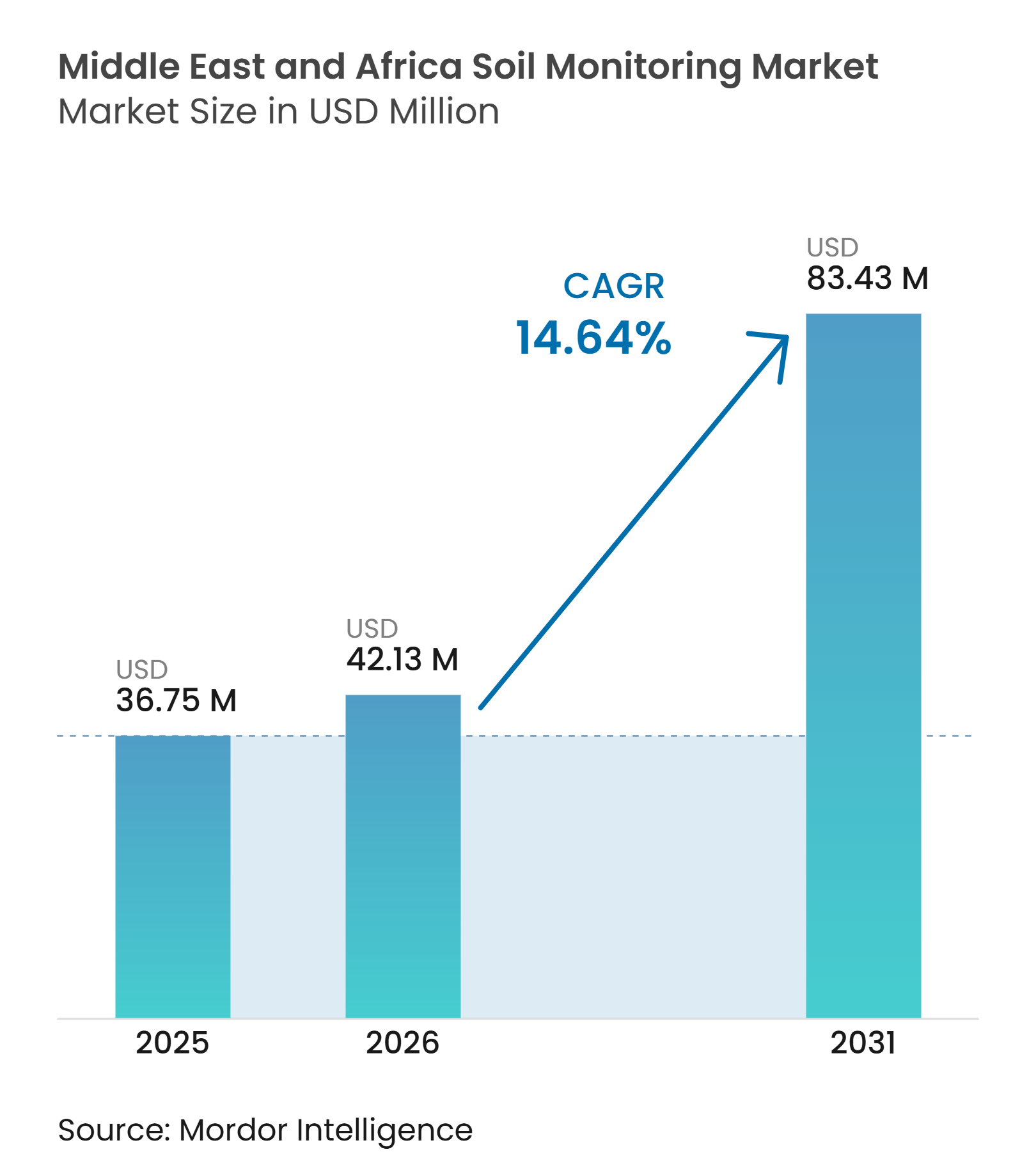
The Middle East and Africa soil monitoring market size in 2026 is estimated at USD 42.13 million, up from the 2025 value of USD 36.75 million, with 2031 projections of USD 83.43 million, growing at a 14.64% CAGR over 2026-2031. Water scarcity is making field-level soil data more important for irrigation planning across the region, particularly where farm operators need to manage limited water supplies across several crop areas. Demand is supported by irrigated agriculture in the Gulf Cooperation Council countries and by the expansion of digital agriculture programs in East and North Africa. The Middle East and Africa soil monitoring market also benefits when software platforms combine field readings with irrigation schedules, nutrient plans, and farm records. Suppliers that can calibrate products for saline soils, provide reliable connectivity, and support local users are better positioned to win projects. Import costs, limited rural networks, uneven agricultural data rules, and the cost of technical support may still slow adoption in parts of Africa.
Key Report Takeaways
- By component, hardware accounted for the largest share of the Middle East and Africa soil monitoring market size at 56.0% in 2025, while services were the fastest-growing segment, projected to register a CAGR of 13.2% through 2026-2031.
- By product type, in-situ sensors accounted for the largest share at 47.1% in 2025, while remote sensing platforms were the fastest-growing segment, projected to register a 13.8% CAGR through 2026-2031.
- By connectivity technology, wireless accounted for the largest share of the Middle East and Africa soil monitoring market share at 72.3% in 2025 and was also the fastest-growing segment, projected to register a CAGR of 14.0% through 2026-2031.
- By application, open field cultivation accounted for the largest share at 58.4% in 2025, while protected cultivation was the fastest-growing segment, projected to register a CAGR of 12.8% through 2026-2031.
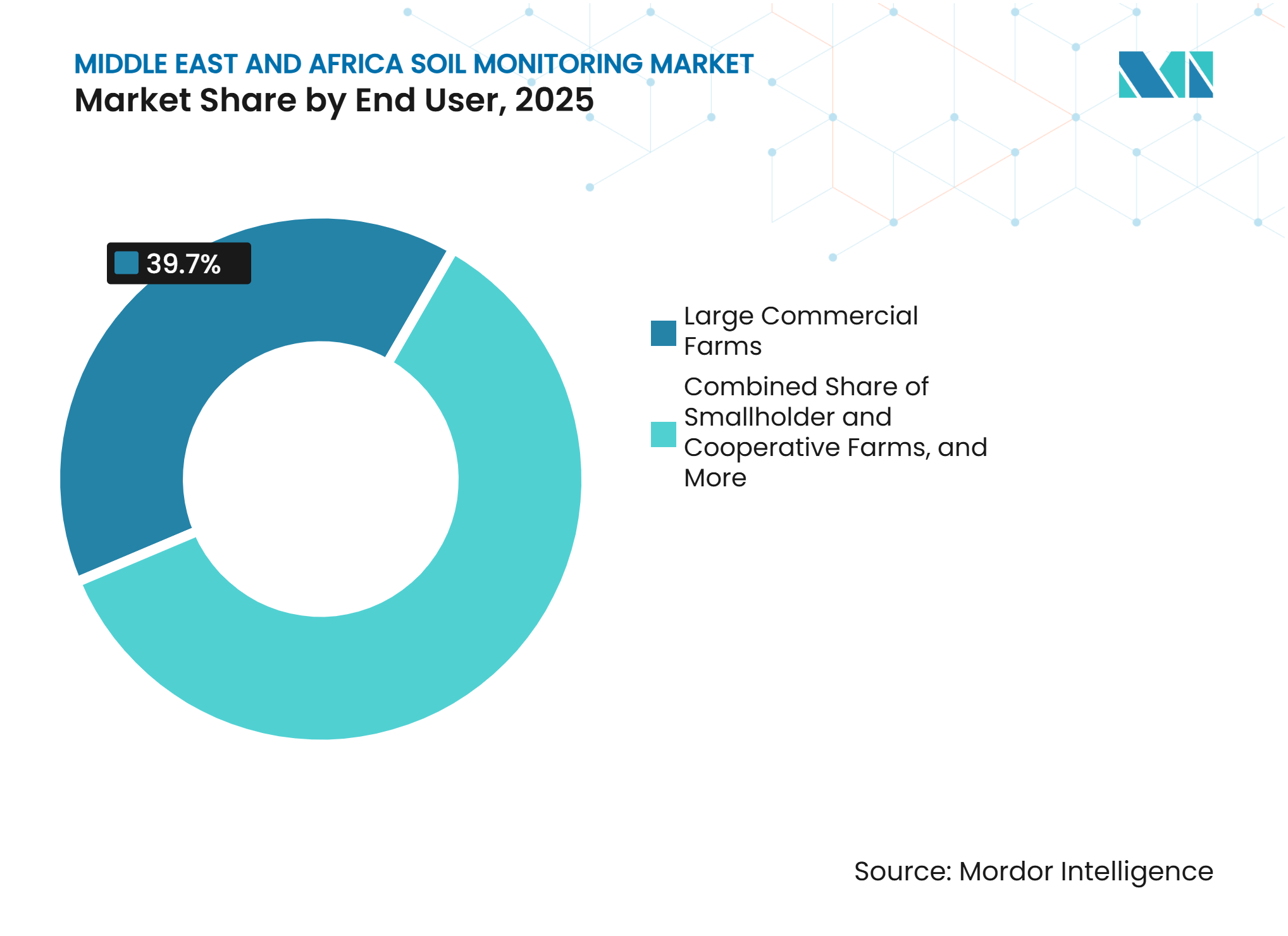
- By end user, large commercial farms held largest 39.7% revenue share in 2025, while research institutes and universities recorded the fastest projected CAGR at 13.2% through 2026-2031.
- By geography, Middle East accounted for largest 64.5% reveneue share in 2025, while Africa projected to grow fastest at a CAGR of 14.9% CAGR over 2026-2031.
Note: Market size and forecast figures in this report are generated using Mordor Intelligence’s proprietary estimation framework, updated with the latest available data and insights as of January 2026.
Market Trends and Insights
Drivers Impact Analysis of Middle East and Africa Soil Monitoring Market*
| Driver | (~) % Impact on CAGR Forecast | Geographic Relevance | Impact Timeline |
|---|---|---|---|
| Precision Agriculture and Irrigation Optimization | +3.2% | Global, with core impact in Saudi Arabia, the UAE, Israel, and South Africa | Short term (≤ 2 years) |
| Climate-Smart Agriculture and Soil-Health Programs | +2.5% | Global, with strong relevance in Kenya, Ethiopia, Egypt, and Morocco | Medium term (2-4 years) |
| Farm Management Software Integration | +2.0% | The UAE, Saudi Arabia, South Africa, and North Africa | Short term (≤ 2 years) |
| Water-Efficiency Subsidies and Food-Security Programs | +2.8% | Saudi Arabia, the UAE, Qatar, Morocco, and Egypt | Short term (≤ 2 years) |
| Salinity-Aware Sensor Calibration for Arid Soils | +1.5% | Saudi Arabia, the UAE, Qatar, Egypt, Kuwait, and the rest of the Middle East | Medium term (2-4 years) |
| Sensor Rental and Soil-as-a-Service Models for Smallholders | +2.0% | Kenya, Nigeria, Morocco, South Africa, Egypt, and Turkey | Medium term (2-4 years) |
| Source: Mordor Intelligence | |||
Precision Agriculture and Irrigation Optimization
Soil moisture, salinity, and other field-condition data support irrigation decisions at the field level in water-constrained farming areas, where managers need a clearer view of conditions across separate fields and irrigation zones. LTS reported deploying a Smart Agriculture System for the National Agricultural Development Company (NADEC), using battery-powered soil sensors designed for 5-10 years of operation and Internet of Things (IoT) gateways capable of connecting sensors located 8-12 km away. The system delivered real-time dashboards for monitoring soil moisture, temperature, humidity, and electrical conductivity to support irrigation and crop-management decisions. Saudi Arabia continues to promote smart agriculture technologies to improve water-use efficiency and agricultural productivity. These benefits can encourage wider adoption of soil-monitoring systems and create follow-on sales opportunities as growers expand monitored acreage and seek to apply the same operating approach across additional production areas.
Climate-Smart Agriculture and Soil-Health Programs
Climate-resilience programs are creating structured demand for soil monitoring across African agriculture. The World Bank launched the Data for Soil Health and Innovation Challenges program in Kenya in 2025. Eligible solutions must use AI, machine learning, or big data to improve soil health and remain accessible to smallholder farmers[1]. Such programs fund early deployments, train agronomists, and build local soil reference data that can be used as later projects move from pilot work to routine agricultural services. This can reduce the need for recalibration in later commercial installations. The World Bank’s Repurposing of Agricultural Support for Soil Health Impact Program was launched in early 2026 and includes digital soil mapping and public-private partnerships across sub-Saharan Africa[2].
Farm Management Software Integration
Farm management software is changing how soil monitoring equipment is introduced to growers. Connected platforms turn sensor readings into irrigation schedules, nutrient plans, and compliance reports that users can apply in daily farm management. This makes sensors part of a broader operating system rather than a separate capital purchase, particularly for growers that first subscribe to an irrigation advisory service. The approach is visible in the UAE and Saudi Arabia and is extending to commercial farms in South Africa and Kenya. The Middle East and Africa soil monitoring market gains recurring revenue when subscriptions, calibration, and data services are included with equipment. Vendors that combine hardware and advisory functions can retain customers through replacement cycles and reduce the operational burden of using information from several separate suppliers.
Water-Efficiency Subsidies and Food-Security Programs
Food-security and water-efficiency programs can reduce the first-year cost of soil monitoring for growers. Public procurement also gives suppliers reference sites under local farming conditions, where water constraints and soil conditions differ from those in other farming regions. This helps buyers evaluate irrigation and soil-monitoring systems before wider deployment and gives project teams a clearer basis for selecting equipment and service partners. The resulting projects can shorten supplier qualification processes in markets where technology performance must be demonstrated locally. The Middle East and Africa soil monitoring market has particular potential in greenhouse and irrigated farm projects supported by public institutions. These programs also make water and fertilizer records more relevant to procurement decisions because the information can be used to assess management practices over the course of a project.
Restraints Impact Analysis of Middle East and Africa Soil Monitoring Market*
| Restraint | (~) % Impact on CAGR Forecast | Geographic Relevance | Impact Timeline |
|---|---|---|---|
| High Upfront Cost of Sensor Networks | -1.8% | Global, with greatest impact in Nigeria, Kenya, and smallholder-dominated sub-Saharan Africa | Short term (≤ 2 years) |
| Fragmented Smallholder Farm Ownership | -1.2% | Sub-Saharan Africa, Morocco, Turkey, and Egypt | Medium term (2-4 years) |
| Calibration Drift and Sensor Fouling in Saline and Sodic Soils | -1.0% | Saudi Arabia, the UAE, Qatar, Egypt, and Kuwait | Medium term (2-4 years) |
| Limited Rural Connectivity and Technical Support Capacity | -1.5% | Nigeria, Kenya, the rest of Africa, rural Turkey, and Egypt | Long term (≥ 4 years) |
| Source: Mordor Intelligence | |||
High Upfront Cost of Sensor Networks
Hardware, gateway installation, LPWAN subscriptions, and recalibration services can lead to high first-year costs for farms with variable margins. A 2025 study in Algeria and Morocco tested an autonomous LoRaWAN sensor framework for smallholder communities. The framework operated without internet access and delivered edge-computed soil analysis[3]. NexusLabs deployed a lower-cost system in Morocco’s Tensift River Basin in February 2026, providing multi-depth readings of soil moisture, temperature, and electrical conductivity at 30-second intervals[4]. The work shows that lower-cost technical designs are possible, although delivery models still need to fit farm budgets. Sensor rental and service models can reduce the need for a single large capital purchase.
Fragmented Smallholder Farm Ownership
Fragmented farm ownership makes it difficult to sell a complete monitoring network to each individual grower. Small plots can limit the financial return from fixed gateways and repeated field visits. Farms may also differ in crops, irrigation practices, and technical skills within the same service area. Cooperative purchasing and shared service models can address some of these limits. However, these models require local coordination and clear responsibilities for maintaining equipment. The restraint remains significant across smallholder areas in sub-Saharan Africa, Morocco, Turkey, and Egypt.
*Our forecasts treat driver/restraint impacts as directional, not additive. The impact forecasts reflect baseline growth, mix effects, and variable interactions.
Middle East and Africa Soil Monitoring Market Segment Analysis
By Component:
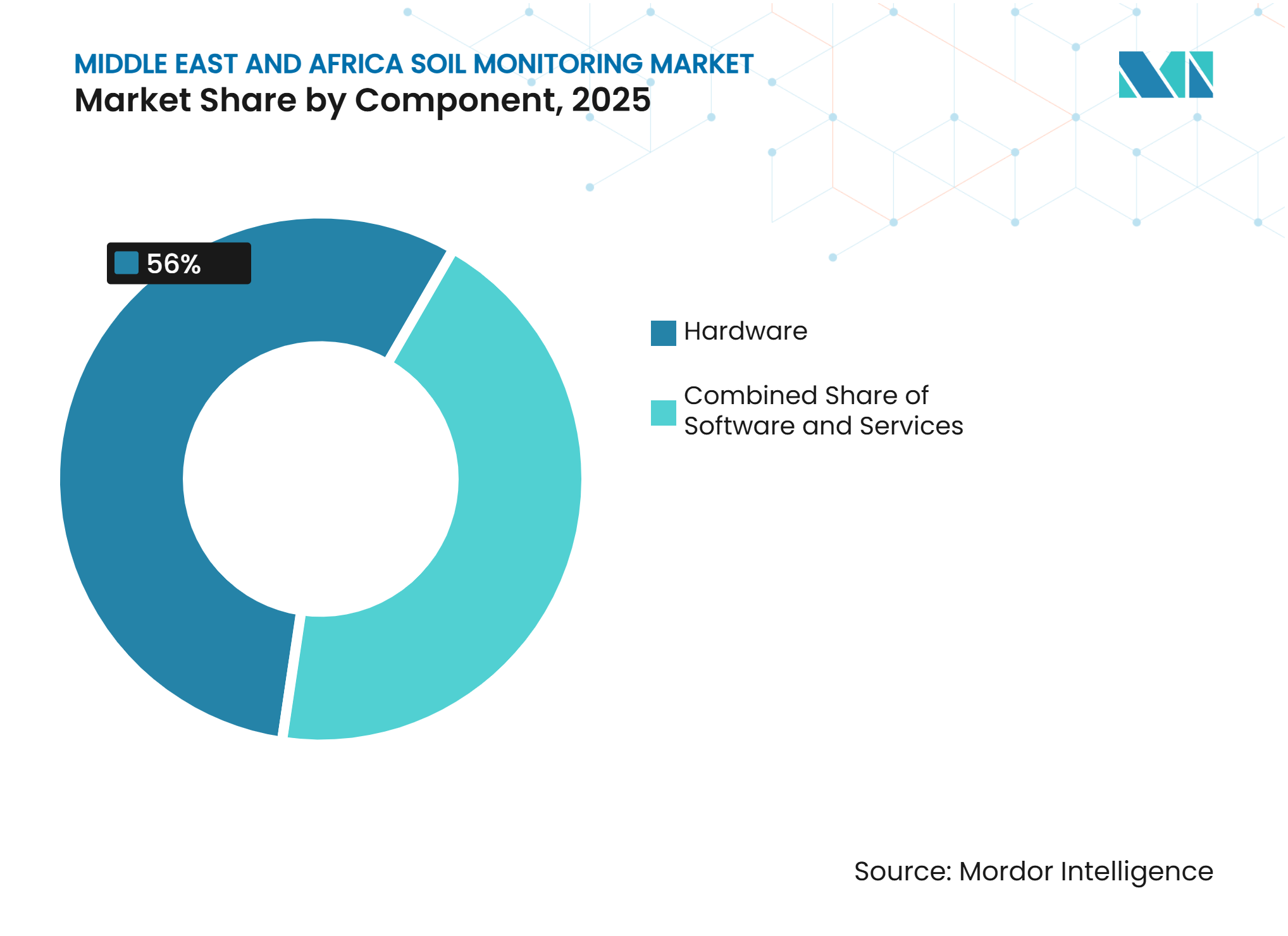
Hardware Anchors Spending and Services Build Recurring ValueHardware held 56.0% of the Middle East and Africa soil monitoring market share in 2025. Sensors, data loggers, IoT gateways, and mounting equipment account for a large initial share of project spending because each monitored area needs reliable field devices before readings can be captured or transmitted. Field hardware is needed before a grower can use software or service offerings. Farm networks can range from a few hectares to several thousand hectares, which affects equipment needs, installation design, and the number of measurement points. Hardware spending is therefore concentrated in early deployment stages. The category remains central to supplier revenue even as digital services become more important.
Services were the fastest-growing component, and the Middle East and Africa soil monitoring market size for services is projected to grow at a 13.2% CAGR through 2031. Growers increasingly require calibration, testing, analytics, and interpretation rather than raw readings alone, particularly when soil variability, salinity, and changing irrigation conditions affect measurement outcomes. A 2025 study in Nigeria found strong links between cassava yield and soil electrical conductivity using multi-source sensing across agro-ecological zones. Auditable soil health information can also support compliance with subsidy requirements and reporting requirements. These needs give services value between hardware replacement cycles.



By Product Type:
Remote Sensing Extends Access Beyond In-Situ SystemsIn-situ sensors held 47.1% of product revenue in 2025. Their installed base reflects use on drip-irrigated commercial farms that require continuous, root-zone readings to manage water delivery near the crop. These systems are important for salinity management and precision deficit irrigation in Saudi Arabia, the UAE, and Egypt. Portable probes and test kits serve smaller farms and research trials. They provide single-sample information without the fixed infrastructure required by networked arrays. In-situ systems remain important where growers need frequent measurements at depth.
Remote sensing platforms are forecast to grow at a 13.8% CAGR through 2031. The Middle East and Africa soil monitoring market size for remote sensing is expanding because satellite-based estimates can be accessed without installing a field sensor network, reducing the operational and initial equipment burden. This can lower the barrier to entry for smallholders with smartphones. A 2025 study of the AgriLink system in Morocco found that connected field sensors and satellite tools performed complementary roles. Remote sensing supported field-scale variability assessment, while in-situ sensors addressed root-zone precision. Suppliers that combine both approaches can address different farm sizes and production systems.
By Connectivity Technology:
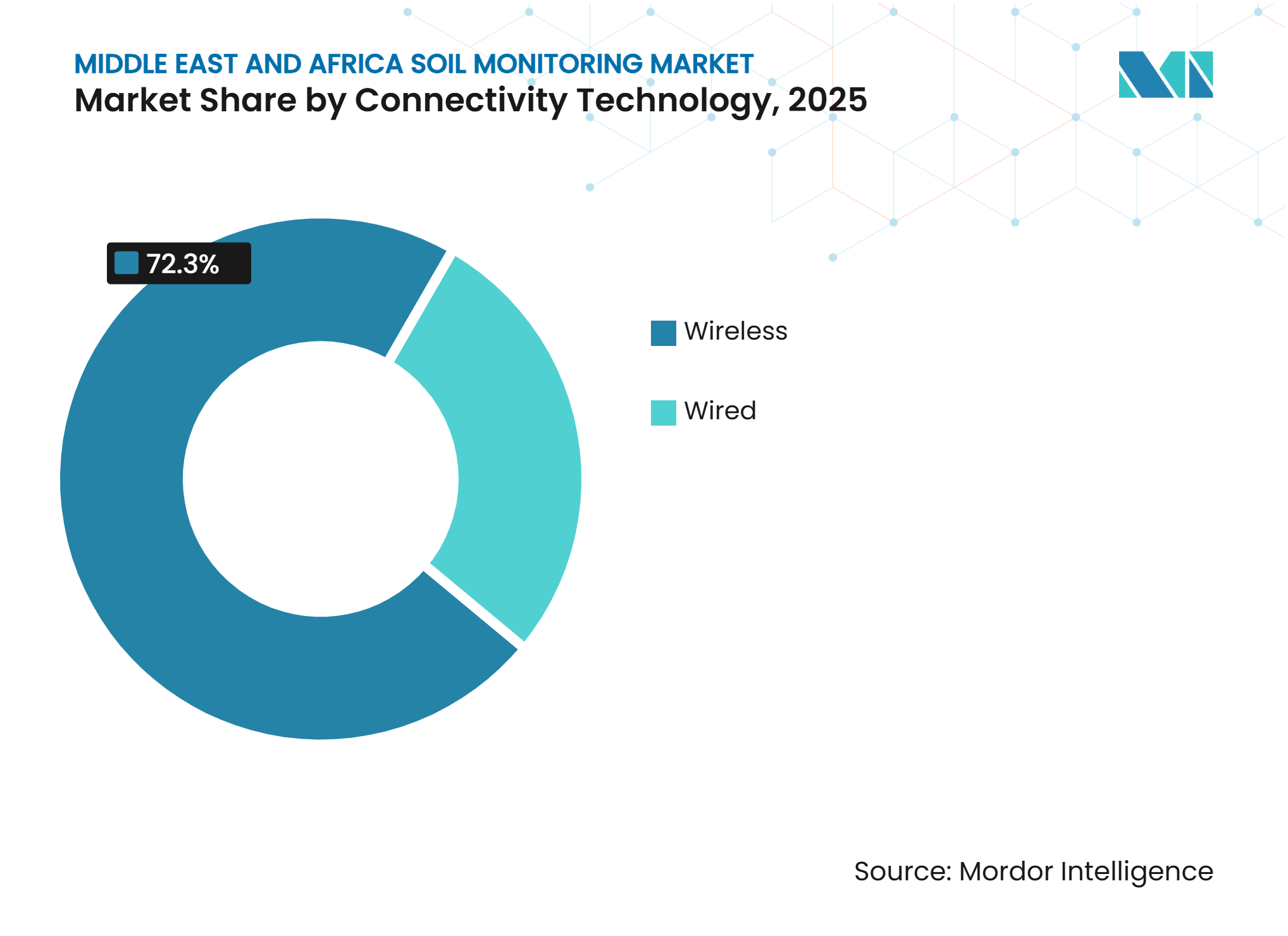
Wireless Systems Support Wider Field CoverageWireless connectivity accounted for 72.3% of revenue in 2025 and was projected to be the fastest-growing segment, with a CAGR of 14.0% over 2026-2031. The Middle East and Africa soil monitoring market share for wireless reflects the difficulty of installing cables across open fields, fragmented plots, and remote rangelands. Long Range Wide Area Network (LoRaWAN) and other Low-Power Wide-Area Network (LPWAN) protocols provide long-range connectivity, multi-year battery life, and lower data transmission costs. These features suit dispersed monitoring points and large farming areas. Wireless systems also reduce the disruption involved in adding new sensors. The segment is particularly relevant where a farm must cover wide distances with limited fixed infrastructure.
Wired connectivity remains relevant in greenhouses and other protected cultivation settings. Permanent cabling can support higher-frequency data transmission in locations where installation is practical. The Global System for Mobile Communications Association (GSMA) projected that licensed cellular Internet of Things (IoT) connections in the Middle East and North Africa exceeded 70 million by 2025. Smart agriculture was identified as a priority application for this expansion. LPWAN is well-suited for sensor data uplinks, while irrigation control may require cellular links for actuator commands. Hybrid systems can therefore combine telemetry with more responsive control functions

By Application:
Open Fields Lead While Protected Cultivation Grows FasterOpen-field cultivation accounted for 58.4% of revenue in 2025. Irrigated cereal, vegetable, and tree-crop farms in Saudi Arabia, Egypt, Turkey, and South Africa drive demand in this application. Larger acreage can make sensor networks financially viable when irrigation gains are measurable. Forestry accounts for a smaller share of demand. It is mainly supported by public soil health monitoring and land restoration programs in countries such as Ethiopia and Morocco. Open fields remain the primary source of deployment volume in the Middle East and African soil-monitoring market.
Protected cultivation is forecast to grow at a 12.8% CAGR through 2031. The Middle East and Africa soil monitoring market for protected cultivation benefits from investment in greenhouses and vertical farming in the Gulf. These facilities reduce dependence on ambient arid conditions and require close control of water and nutrients. Higher sensor density per hectare supports greater revenue per hectare than in open fields. Frequent calibration can further raise service demand in controlled settings. This makes protected cultivation an important opportunity for suppliers serving high-value crops.
By End User:
Commercial Farms Lead Revenue While Research Institutions Grow FasterLarge commercial farms held 39.7% of revenue in 2025. Their scale, access to capital, and multi-year contracts make them important buyers for suppliers that bundle hardware, software, and services. These farms can adopt systems across multiple fields and integrate readings into routine irrigation decisions. Smallholder and cooperative farms are increasingly reached through group delivery and subsidized programs. Their current revenue contribution does not fully show their longer-term addressable demand. Government agencies and NGOs procure systems for land restoration and food-security monitoring.
Research institutes and universities are projected to grow at a 13.2% CAGR through 2031. The World Bank’s 2026 soil-health program places digital soil mapping within agricultural support reform across Africa. Instrumented research projects can generate validated soil health datasets needed for local programs. They can also help establish calibration practices for different soil conditions. This demand is tied more closely to public and multilateral program cycles than to farm commodity cycles. Consequently, the Middle East and Africa soil monitoring industry has a growing institutional customer base alongside commercial farms.
Geography Analysis
The Middle East accounted for 64.5% of the Middle East and Africa soil monitoring market share in 2025. Saudi Arabia and the United Arab Emirates (UAE) account for much of this position through capital-intensive horticulture, irrigated production, and controlled-environment farming that relies on water, fertilizer, and soil-condition records in daily operations. The region continues to shift from periodic field inspections toward continuous monitoring and data-driven farm management. The growing adoption of digital agricultural technologies and water-efficiency initiatives is driving demand for soil-monitoring solutions across large commercial farming operations.
Israel contributes through its role in agricultural technology exports, while Qatar and Turkey add demand for protected cultivation and irrigated production. Software platforms can be particularly effective in this sub-region when they link soil data to irrigation scheduling and compliance records. Salinity conditions increase the need for equipment that is properly calibrated for local soils. Public water-efficiency programs support projects that document operating results, sustaining demand for integrated offerings rather than standalone equipment.
Africa is projected to grow at a CAGR of 14.9% through 2026-2031, the fastest geographic rate in the Middle East and Africa soil monitoring market. The expansion of irrigated agriculture supports growth, the increasing adoption of digital farming technologies, and greater interest in soil health management. Mobile-first delivery models, donor-supported agricultural programs, and a relatively low installed base create a different adoption pattern from the Middle East, favoring solutions that can be deployed without extensive fixed infrastructure.
Competitive Landscape
Market Concentration
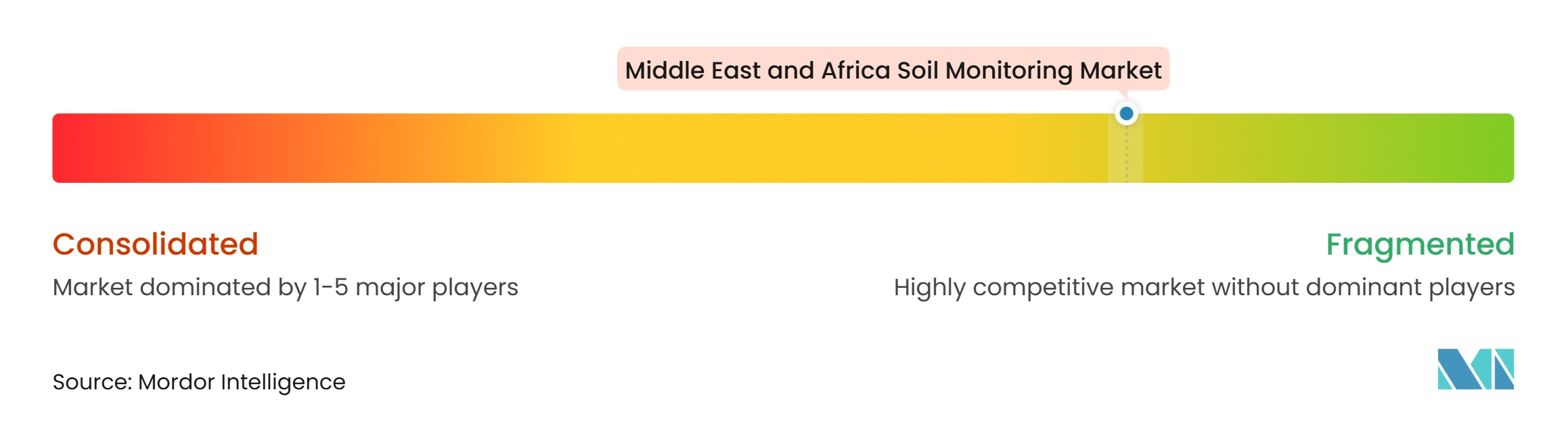
The Middle East and Africa soil monitoring market is fragmented, with no single supplier holding a dominant position across the region. Customers procure different combinations of irrigation equipment, sensors, advisory services, laboratory analysis, and software depending on crop type, farm size, and local operating conditions. Revenue is distributed across irrigation technology providers, sensor manufacturers, testing laboratories, software platforms, and agricultural service providers. This diversity of end-user requirements and farming environments limits any one company's ability to establish a leading position across multiple national markets.
Companies such as Netafim Ltd., SGS SA, and CropX Inc. compete on distinct value propositions spanning irrigation integration, laboratory testing, analytics, and agronomic decision support. Their market strategies highlight the importance of combining hardware, software, and advisory capabilities to address increasingly complex soil and water management requirements. Competitive differentiation is increasingly driven by data interpretation, service quality, and integration with broader farm-management systems.
The Middle East and Africa soil monitoring market offers opportunities for offline-capable platforms in low-connectivity environments. Lower-cost solutions are gaining relevance among smaller farms, while integrated soil, weather, and irrigation management tools appeal to growers seeking a unified operational view. Regional agritech providers are also introducing mobile-centric and community-based delivery models tailored to local farming conditions. As a result, competition is projected to remain diverse across technologies, customer segments, and geographic markets.
Middle East and Africa Soil Monitoring Industry Leaders
-
Netafim Ltd.
-
The Toro Company
-
SGS SA
-
METER Group
-
Sentek Technologies
- *Disclaimer: Major Players sorted in no particular order
Middle East and Africa Soil Monitoring Market Companies Covered in this Report
- Netafim Ltd.
- The Toro Company
- SGS SA
- METER Group
- Sentek Technologies
- AquaCheck
- CropX Inc.
- Spectrum Technologies, Inc.
- Stevens Water Monitoring Systems, Inc.
- Pessl Instruments GmbH
- Lindsay Corporation
- Irrometer Company, Inc.
- Campbell Scientific, Inc.
- Soil Scout Oy
- Arable Labs, Inc.
Recent Industry Developments in Middle East and Africa Soil Monitoring Market
- June 2026: MyBitSecure introduced its SmartFarm platform in South Africa, enabling farmers to remotely monitor soil conditions and water flow via retrofit sensors, thereby supporting the wider adoption of cost-effective digital soil-monitoring solutions.
- March 2026: Otto Wireless Solutions launched a LoRaWAN-enabled smart farming platform for South Africa and broader African markets, integrating soil-monitoring sensors with remote dashboards to improve irrigation management and agricultural decision-making in low-connectivity environments.
- February 2026: NexusLabs deployed a low-cost integrated soil-monitoring system in Morocco’s Tensift River Basin Living Lab, supporting irrigation optimization through real-time monitoring of soil moisture, temperature, and electrical conductivity under water-constrained agricultural conditions.
Middle East and Africa Soil Monitoring Market Report Scope
The Middle East and Africa Soil Monitoring Market comprises technologies and services for measuring, analyzing, and monitoring soil conditions, including moisture, temperature, nutrients, pH, and salinity. These solutions support precision agriculture, soil health management, irrigation optimization, and environmental monitoring through data-driven decision-making.
The Middle East and Africa Soil Monitoring Market is segmented by Component (Hardware, Software, and Services), by Product Type (In-Situ Sensors, Remote Sensing Platforms, and Portable Probes and Test Kits), by Connectivity (Wired and Wireless), by Application (Open Field, Protected Cultivation, and Forestry), by End User (Large Commercial Farms, Smallholder and Cooperative Farms, Research Institutes and Universities, and Government and Non-Governmental Organizations (NGOs)), by Geography (Middle East and Africa). The market forecasts are provided in terms of value (USD).
Segmentation Overview
| Software |
| Services |
| In-Situ Sensors |
| Remote Sensing Platforms |
| Portable Probes and Test Kits |
| Wired |
| Wireless |
| Open Field |
| Protected Cultivation |
| Forestry |
| Large Commercial Farms |
| Smallholder and Cooperative Farms |
| Research Institutes and Universities |
| Government and NGOs |
| Middle East | United Arab Emirates |
| Saudi Arabia | |
| Turkey | |
| Israel | |
| Qatar | |
| Rest of Middle East | |
| Africa | South Africa |
| Kenya | |
| Nigeria | |
| Morocco | |
| Egypt | |
| Rest of Africa |
| Hardware | Software | |
| Services | ||
| By Product Type | In-Situ Sensors | |
| Remote Sensing Platforms | ||
| Portable Probes and Test Kits | ||
| By Connectivity Technology | Wired | |
| Wireless | ||
| By Application | Open Field | |
| Protected Cultivation | ||
| Forestry | ||
| By End User | Large Commercial Farms | |
| Smallholder and Cooperative Farms | ||
| Research Institutes and Universities | ||
| Government and NGOs | ||
| By Geography | Middle East | United Arab Emirates |
| Saudi Arabia | ||
| Turkey | ||
| Israel | ||
| Qatar | ||
| Rest of Middle East | ||
| Africa | South Africa | |
| Kenya | ||
| Nigeria | ||
| Morocco | ||
| Egypt | ||
| Rest of Africa | ||
Key Questions Answered in the Report
What is the projected value of the Middle East and Africa soil monitoring market by 2031?
The Middle East and Africa soil monitoring market is forecast to reach USD 83.43 million by 2031, growing at a 14.64% CAGR between 2026-2031.
Which component generated the most revenue in 2025?
Hardware led with 56.0% revenue share in 2025 because sensors, gateways, and field equipment are needed at the start of a deployment.
Why do saline soils matter for soil monitoring systems?
Salinity can affect sensor accuracy, increasing the need for local calibration, ongoing maintenance, and services that interpret readings.
Which geography is expanding the fastest?
Africa is forecast to grow at a 14.9% CAGR through 2031, led by mobile-first delivery, public programs, and low installed sensor penetration.