
Middle East and Africa Scaffolding Rental Market Size and Share
Market Overview
| Study Period | 2021 - 2032 |
|---|---|
| Forecast Data Period | 2027 - 2032 |
| Base Year Market Size (2026) | USD 0.79 Billion |
| Market Size (2027) | USD 0.85 Billion |
| Market Size (2032) | USD 1.25 Billion |
| Growth Rate (2027 - 2032) | 8.10 % |
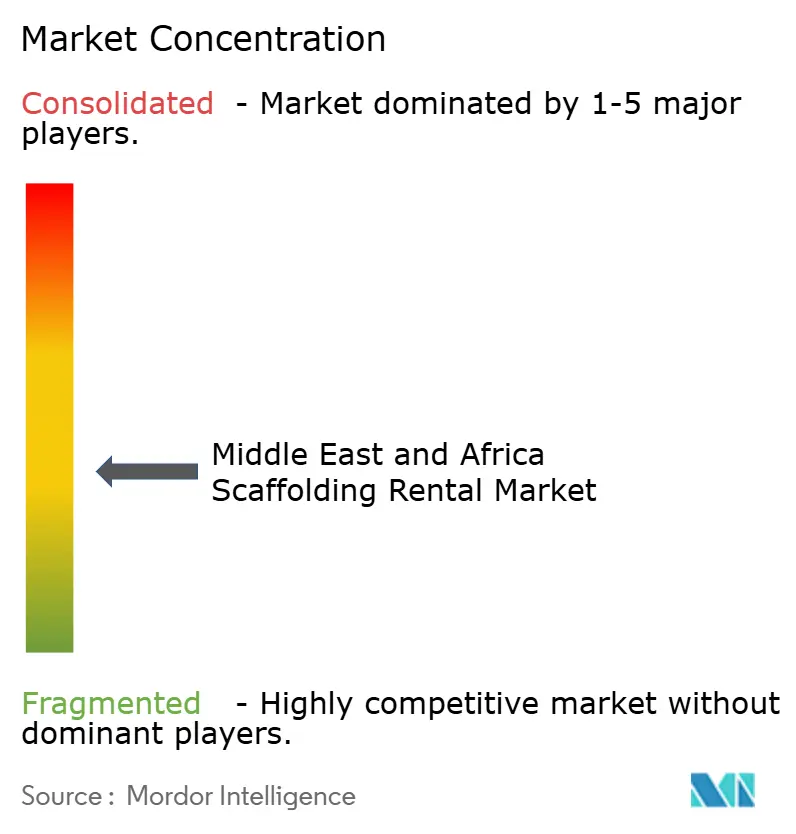
| Market Concentration | Medium |
Major Players *Disclaimer: Major Players sorted in no particular order Image © Mordor Intelligence. Reuse requires attribution under CC BY 4.0. | |
Middle East and Africa Scaffolding Rental Market Analysis by Mordor Intelligence
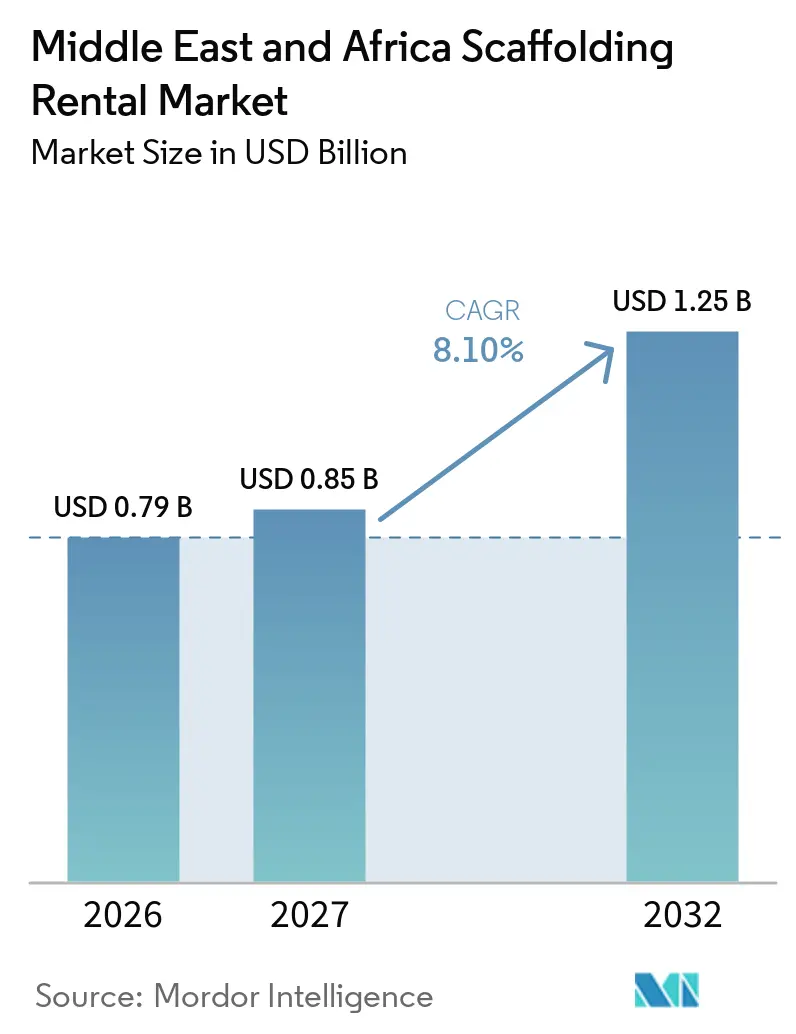
The Middle East And Africa Scaffolding Rental Market size is projected to be USD 0.79 billion in 2026, USD 0.85 billion in 2027, and reach USD 1.25 billion by 2032, growing at a CAGR of 8.10% from 2027 to 2032.
Construction activity across the Gulf Cooperation Council, often abbreviated as GCC, continues to support rental demand because contractors need access equipment across several project phases. Maintenance work at refineries, petrochemical sites, and power assets adds recurring demand that is less dependent on new building starts. Contractors are also using rentals more often when project schedules move between structural work, fit-out, and maintenance. This favors providers with certified fleets, installation capability, and a broad geographic presence. Local production of modular systems could gradually reduce the cost advantage held by import-dependent operators.
Key Report Takeaways
- By type, supported scaffold held 62.00% of the Middle East and Africa scaffolding rental market share in 2026, while mobile scaffold is forecast to record the highest CAGR of 8.70% through 2032.
- By system, modular and Ringlock systems accounted for 40.00% of the Middle East and Africa scaffolding rental market size in 2026 and are projected to grow at a 9.10% CAGR through 2032.
- By material type, steel captured 70.00% of the Middle East and Africa scaffolding rental market share in 2026, while aluminum is forecast to expand at a 9.10% CAGR through 2032.
- By sector, infrastructure represented 38.00% of the Middle East and Africa scaffolding rental market size in 2026, while industrial and logistics is forecast to grow at a 9.00% CAGR through 2032.
- By country, the Rest of Middle East & Africa segment held 34.00% of the Middle East and Africa scaffolding rental market share in 2026, while Saudi Arabia is forecast to grow at a 10.00% CAGR through 2032.
Note: Market numbers in this report are based on Mordor Intelligence's proprietary estimation framework, which combines nine months of actuals with Q4 projections for base year 2026.
Market Trends and Insights
Drivers Impact Analysis of Middle East and Africa Scaffolding Rental Market*
| Drivers | (~) % Impact on CAGR Forecast | Geographic Relevance | Impact Timeline |
|---|---|---|---|
| GCC Giga-Projects and National Development Programs | +2% | Saudi Arabia, United Arab Emirates, Qatar, Bahrain | Long term (≥ 4 years) |
| Oil, Gas, and Petrochemical Shutdown Maintenance | +1.8% | Saudi Arabia, United Arab Emirates, Bahrain, Oman | Medium term (2-4 years) |
| Transport, Utilities, and Energy Infrastructure Investment | +1.5% | Saudi Arabia, United Arab Emirates, South Africa, Nigeria | Long term (≥ 4 years) |
| Event-Driven Construction | +1.2% | Saudi Arabia | Medium term (2-4 years) |
| Shift to Modular and Ringlock Rental Systems | +0.8% | Gulf Cooperation Council, South Africa | Medium term (2-4 years) |
| Urbanization and Housing Programs in Africa | +0.7% | Sub-Saharan Africa, Egypt | Long term (≥ 4 years) |
| Source: Mordor Intelligence | |||
GCC Giga-Projects and National Development Programs
Large national construction programs support sustained equipment demand across Saudi Arabia and neighboring GCC markets. The work includes transport, urban development, hospitality, and industrial projects that need access equipment during structural, façade, and interior phases. This project mix creates more varied requirements than a single civil construction cycle. Providers that can serve industrial clients and commercial contractors from the same fleet can spread equipment across project types. Contractors also need reliable installation and removal services when several packages overlap at one site. The Middle East and Africa scaffolding rental market therefore benefits when contractors prefer flexible rentals over committing capital to owned equipment.
Oil, Gas, and Petrochemical Shutdown Maintenance
Shutdown and turnaround work provides regular scaffolding demand at major industrial facilities. KAEFER Saudi Arabia is delivering 161,000 square meters of scaffolding for Package 4 of Saudi Aramco’s Amiral petrochemical complex in Al Jubail, alongside insulation and surface-protection work[1]. Such contracts favor suppliers that can combine access, insulation, and related site services. Planned shutdown windows also create short periods of high fleet demand. Framework agreements can help operators secure utilization during these periods and reduce reliance on individual project tenders. This makes established industrial customer relationships important for suppliers in the Middle East and Africa scaffolding rental market.
Transport, Utilities, and Energy Infrastructure Investment
Transport corridors, water facilities, ports, and power assets extend rental demand beyond landmark construction projects. South Africa announced 250 fully funded infrastructure projects for 2025 and 2026, with water, energy, and ports among the stated priorities[2]. These projects require equipment for bridges, water structures, station upgrades, and maintenance work. The work often lasts longer than a conventional building contract. This gives rental companies an opportunity to build longer customer relationships and plan fleet availability more effectively. It also creates demand for technical support in projects with complex structures and changing work areas.
Event-Driven Construction
Saudi Arabia’s event-related development supports demand for mobile and suspended access systems. Expo 2030 Riyadh and the 2034 FIFA Fédération Internationale de Football Association) World Cup have fixed completion schedules that place pressure on contractors to complete façade, fit-out, and finishing work on time. This favors systems that can be repositioned quickly inside large venues and hospitality facilities. It also increases the value of providers that can mobilize trained crews across several sites. Suppliers must plan fleet availability well before the busiest finishing periods. The Middle East and Africa scaffolding rental market can gain from this work as projects move from early construction to finishing stages[3].
Restraints Impact Analysis of Middle East and Africa Scaffolding Rental Market*
| Restraints | (~) % Impact on CAGR Forecast | Geographic Relevance | Impact Timeline |
|---|---|---|---|
| Project Re-Phasing, Payment Delays, and Oil Price Dependence | -0.9% | Saudi Arabia, Bahrain, Oman, Nigeria | Medium term (2-4 years) |
| Intense Price Competition from Local Fabricators | -0.7% | Nigeria, Egypt, South Africa, GCC secondary cities | Medium term (2-4 years) |
| Dependence on Imported Steel and System Components | -0.6% | Gulf Cooperation Council, South Africa | Medium term (2-4 years) |
| Political, Currency, and Security Risks in Parts of Africa | -0.5% | Nigeria, parts of sub-Saharan Africa | Long term (≥ 4 years) |
| Source: Mordor Intelligence | |||
Project Re-Phasing, Payment Delays, and Oil Price Dependence
Rental activity can weaken when public projects are delayed, resequenced, or paid later than expected. This risk is relevant where construction spending depends heavily on public budgets and energy revenue. Equipment, labor, inspection, and maintenance costs continue even when a customer postpones site activity. Smaller operators are more exposed because they may have limited cash reserves and fewer long-term contracts. Providers may need to shift fleets between sectors or locations to maintain use. The Middle East and Africa scaffolding rental market remains sensitive to these timing changes, especially in project-led economies.
Intense Price Competition from Local Fabricators
Local suppliers can compete strongly on price in residential, small commercial, and lower-specification civil work. These providers may operate with lower overheads and concentrate on standard configurations. Certified systems retain an advantage on major industrial sites where clients require documented safety and engineering controls. This divides the customer base between a compliance-led tier and a price-led tier. International providers must therefore decide whether volume growth justifies lower margins outside industrial contracts. The resulting pressure encourages larger firms to focus on reliability, inspection records, and service breadth.
*Our forecasts treat driver/restraint impacts as directional, not additive. The impact forecasts reflect baseline growth, mix effects, and variable interactions.
Middle East and Africa Scaffolding Rental Market Segment Analysis
By Type:
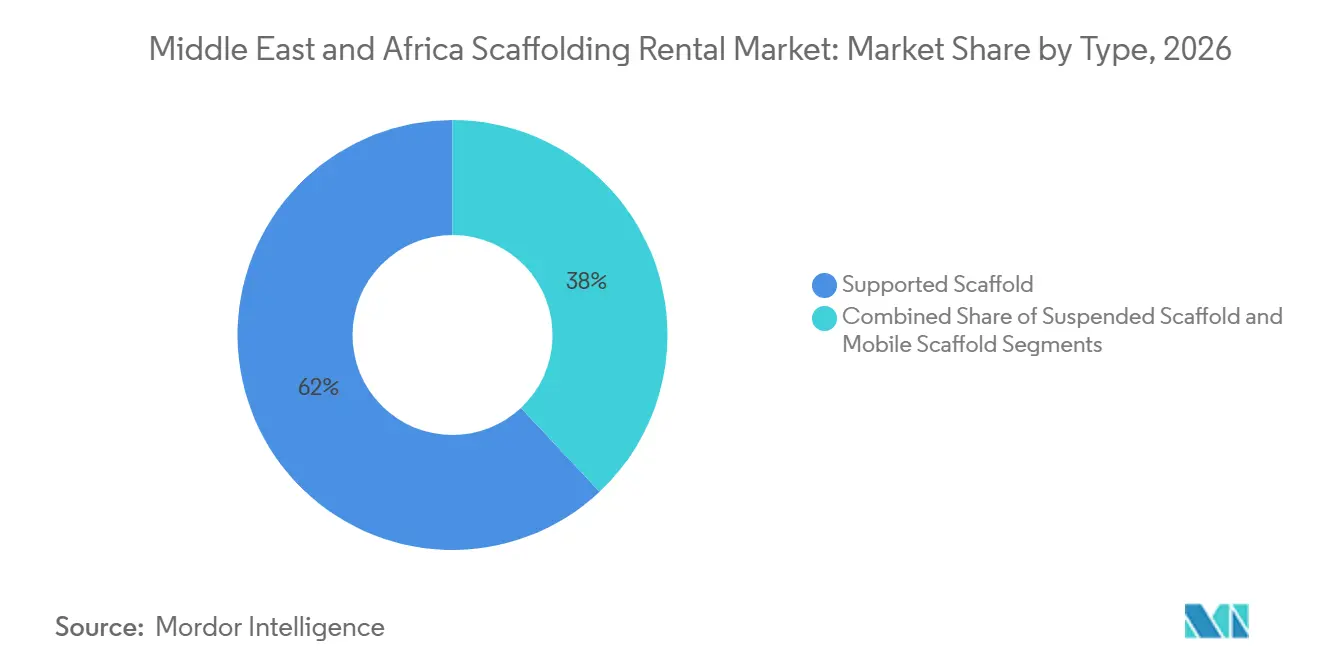
Ground-Based Systems Retain the Broadest UseSupported scaffold held 62.00% of the Middle East and Africa scaffolding rental market share in 2026. Its leading position reflects the requirements of petrochemical plants, transport works, multi-story civic structures, and other projects where a stable platform is essential. The system can support heavy loads and accommodate large work areas. This makes it suitable for activities such as concrete work, exterior finishing, piping access, and maintenance. Supported scaffold also remains familiar to local site teams, which can reduce training needs during mobilization.
The segment benefits from the continued focus on certified, load-rated equipment at industrial facilities. Saudi Aramco General Instruction 8.001 and Abu Dhabi National Oil Company, or ADNOC, site standards raise the importance of controlled access systems for energy work. Suspended scaffold remains necessary for high-rise façades, bridge inspection, and offshore maintenance where ground support is impractical. Mobile scaffold is forecast to grow at 8.70% through 2032, supported by airport interiors, exhibition areas, hotel projects, and mixed-use developments. The Middle East and Africa scaffolding rental market needs a mix of supported, suspended, and mobile fleets because project requirements change as construction progresses.
Type selection depends on the height, geometry, load requirements, and pace of work at each site. Supported equipment remains a dependable choice for projects with extensive ground access. Suspended systems serve locations where a base cannot be placed below the working area. Mobile units are useful when trades need to move between short-duration tasks inside completed structures. A provider with all 3 types can respond as a project moves from structural work to finishing and maintenance. This fleet breadth can improve customer retention because the same supplier can meet several changing needs. It can also improve equipment utilization across different construction cycles. Site managers also value suppliers that can recommend the right configuration before work starts. This reduces the risk that equipment will be unsuitable for the next phase of work. Training and inspection routines need to match each system type. Rental firms can support customers by providing clear installation guidance and qualified site teams. The ability to combine equipment with technical support can matter as much as the hardware itself. These services are particularly useful where schedules are tight, and several trades are working at once. The broad use of ground-based systems will keep them central to fleet planning. At the same time, growing finishing work will increase the need for mobile and suspended alternatives.

By System:
Modular and Ringlock Fleets Gain GroundModular and Ringlock systems accounted for 40.00% of the Middle East and Africa scaffolding rental market size in 2026. Their position reflects a move away from tube-and-coupler equipment on projects that require faster assembly and consistent engineering performance. The systems are used across industrial work, major transport projects, and complex commercial developments. Their components can be configured for varied elevations and working layouts. This makes them useful where work fronts change frequently or where access must fit around irregular structures.
Modular and Ringlock systems are also forecast to grow at 9.10% through 2032. The rosette-node design can accommodate several connections and can support difficult geometries such as curved stadium façades and exhibition structures. Plant-Tech Arabia stated that its Ringlock partnership with PERI improved assembly efficiency, lowered costs, and increased load capacity for Saudi energy infrastructure work. Cuplock still has an installed base among contractors with existing equipment, while tube-and-coupler remains relevant where upfront system costs are a limiting factor. The change requires fleet investment because an operator cannot convert a legacy inventory through a small add-on purchase.
System selection increasingly affects how operators compete for complex work. Customers often value predictable assembly methods because they support consistent planning and site supervision. Modular systems can also simplify the use of standard components across projects with different layouts. This helps providers manage stock and reduce the time needed to prepare a fleet for deployment. Older systems will remain in use where they meet project specifications and contractors already have trained crews. However, the rental fleet mix is likely to continue shifting toward engineered systems. That shift gives early investors more options on higher-specification projects. The transition also changes how operators plan maintenance and replacement purchases. Standardized components can make it easier to control equipment condition across a large fleet. Contractors may prefer systems that provide repeatable installation steps for complex work areas. This can improve coordination between access crews and other site teams. The preference is strongest where project owners require documented safety procedures. It does not eliminate demand for legacy systems in cost-sensitive applications. Instead, it widens the gap between basic equipment supply and higher-service rental offerings. This division will remain important in regional fleet strategies.
By Material Type:
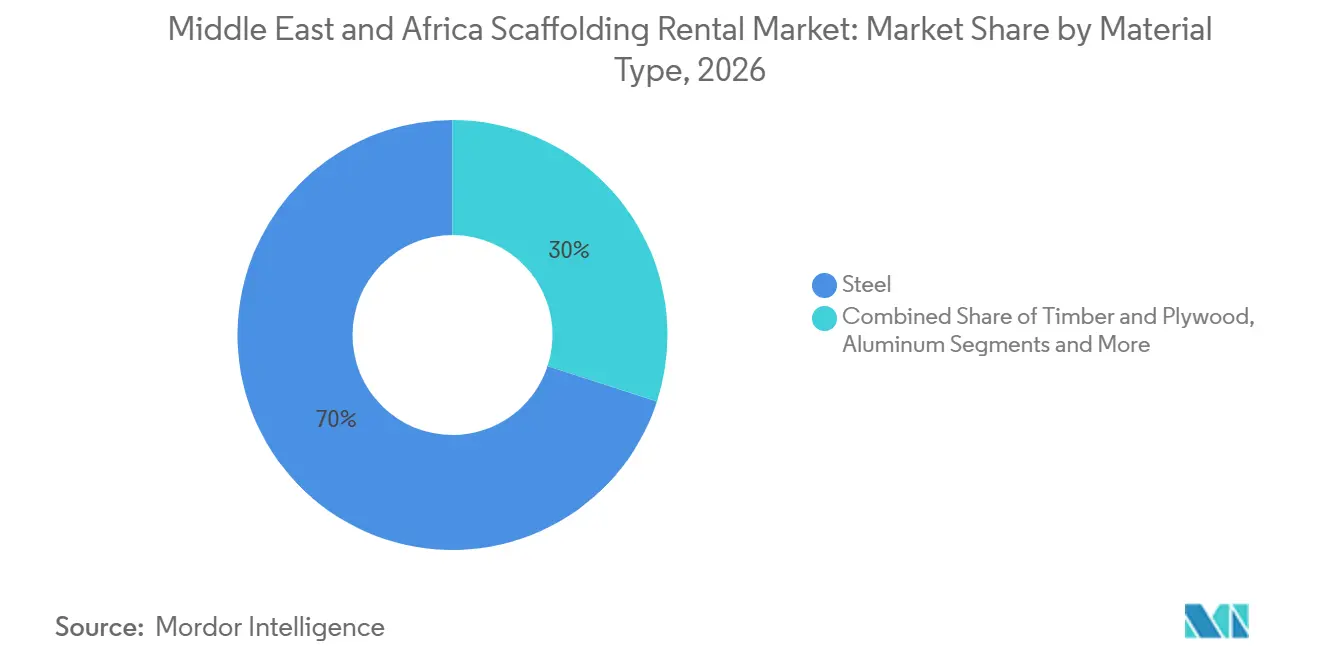
Steel Remains the Core Rental MaterialSteel held 70.00% of the Middle East and Africa scaffolding rental market share in 2026. It is the primary material for petrochemical platforms, overpasses, towers, and other applications where load capacity and durability are central. Steel systems can be used repeatedly across large industrial and infrastructure programs. Their established supply base also supports maintenance and replacement needs. These factors keep steel important for high-volume rental fleets across the region.
Aluminum is forecast to grow at 9.10% through 2032, making it the fastest-growing material category. Its lower weight can reduce handling effort and support faster assembly in commercial, hospitality, airport, and fit-out work. It also has practical value in coastal locations where corrosion management affects fleet upkeep. Timber and plywood continue to have a limited role in areas where metal systems are less accessible. The Middle East and Africa scaffolding rental market will continue to use steel for heavy-duty work while aluminum expands where speed and handling are more important.
Material choice changes with the work environment and the expected duration of a contract. Steel fleets are well suited to repeated industrial use and to projects where components must carry higher loads. Aluminum gives contractors a practical option where work moves quickly between rooms, levels, or work zones. Rental operators may retain both materials to meet these different requirements. The decision is not only about purchase cost because assembly time, transportation, maintenance, and site conditions also matter. A balanced fleet can therefore serve a broader range of customers. This reinforces the continued role of material specialization in equipment planning. Steel remains appropriate when structural stability is the first consideration. Aluminum becomes more attractive where crews must handle equipment often and move it through completed interiors. Coastal operating conditions can further affect the maintenance choices made by rental firms. A material mix allows a provider to assign equipment based on the needs of the job rather than a fixed fleet preference. This can improve the practical value of a rental proposal. It can also limit delays caused by using overly heavy equipment for light commercial work. The balance between strength, mobility, and upkeep will continue to guide material decisions. This supports different fleet roles for steel and aluminum rather than direct substitution.
By Sector:
Infrastructure Holds the Largest Demand BaseInfrastructure represented 38.00% of the Middle East and Africa scaffolding rental market size in 2026. The segment includes transport systems, water networks, power projects, and port facilities that need access equipment across several construction and maintenance stages. These projects usually involve longer delivery schedules than individual commercial buildings. Equipment can be required for structural works, mechanical installation, inspections, and repairs. This supports repeat rental demand for providers that can work across large project areas.
Industrial and logistics is forecast to grow at 9.00% through 2032. New warehouses, logistics parks, manufacturing sites, mining projects, and energy facilities support this expansion. Maintenance at refineries and desalination plants can also generate higher-value work because safety and scheduling requirements are demanding. KAEFER’s Amiral project work demonstrates the scale of bundled access services used at major industrial sites. Commercial demand remains relevant through hotel fit-outs, retail refurbishment, office towers, and façade work in cities such as Riyadh, Dubai, and Abu Dhabi.
Infrastructure rental contracts can involve work at several locations and over several years. Providers need enough equipment to handle peak demand without leaving assets idle between work packages. Planning is especially important when water, rail, and power projects require different access configurations. Industrial and logistics work strengthens the value of providers that can offer inspections, installation, and dismantling with the equipment. Long-term maintenance programs can make fleet utilization more predictable than one-off building projects. This mix supports investment in newer systems that meet the needs of both construction and maintenance customers. It also makes infrastructure a stable part of regional demand. A transport project may require different equipment at stations, bridges, and supporting utility areas. Water and power assets can create recurring demand after construction is complete. This helps rental companies maintain customer relationships over a longer period. Clear scheduling becomes important when several contractors share the same project site. Providers that can coordinate delivery and removal can reduce disruptions for customers. The sector also rewards fleet durability because equipment may face difficult outdoor conditions. These features support the role of infrastructure as a major source of rental demand. They also create opportunities for companies with strong project management capability.
Geography Analysis
Saudi Arabia
Saudi Arabia is forecast to grow at a 10.00% CAGR through 2032, making it the fastest-growing country segment. Industrial construction, transport projects, hospitality sites, and event-related development create demand for several access-system types. Brogan Group has announced work on Riyadh Metro, King Khalid International Airport, and Sports Boulevard. Saudi Aramco General Instruction 8.001 supports the use of certified systems at energy assets. The overlap of these programs favors providers with flexible fleets, trained teams, and dependable local support.
United Arab Emirates, South Africa, and Nigeria
The United Arab Emirates maintains demand through commercial fit-outs, airport work, tourism facilities, and industrial maintenance. Abu Dhabi National Oil Company, or ADNOC, standards support certified access systems at industrial sites. South Africa’s demand centers on power-station maintenance, water projects, and port development, while Nigeria’s formal rental activity is concentrated around Lagos, Port Harcourt, larger commercial projects, and oil and gas maintenance. Together, these markets give the Middle East and Africa scaffolding rental market opportunities across premium industrial services, public infrastructure, and developing urban construction.
Rest of Middle East & Africa
The Rest of Middle East & Africa segment held 34.00% of the Middle East and Africa scaffolding rental market share in 2026. The segment includes Qatar, Kuwait, Oman, Egypt, and sub-Saharan markets with different demand profiles. Refinery turnarounds and liquefied natural gas, or LNG, maintenance support industrial rentals in the smaller Gulf states. Egypt’s construction base supports use of rented steel systems in commercial and residential work. Water, energy, and infrastructure projects also create opportunities for formal rental providers across sub-Saharan Africa.
Competitive Landscape
The Middle East and Africa scaffolding rental market has a clear split between large integrated service providers and regional specialists. BrandSafway, Altrad Group, and KAEFER Group compete for high-specification industrial work by combining scaffolding with insulation, coating, fireproofing, and related services. This approach can simplify procurement for refinery, petrochemical, and power customers. It also gives larger providers an advantage when customers want a single contractor for several access and maintenance activities. Local specialists compete more heavily on daily rates and rapid availability in smaller commercial and residential projects.
Altrad’s December 2025 acquisition of a fabrication and painting facility in Qatar strengthened its ability to provide integrated work for oil, gas, LNG, and petrochemical customers. KAEFER’s continuing work at the Amiral complex shows the value of combining scaffolding with insulation and surface protection on a large industrial contract. Hünnebeck by BrandSafway expanded its supply agreement with alkus AG in August 2025 to cover additional formwork systems across the Middle East and other regions. These moves show that service breadth and adjacent equipment offerings are important competitive tools. Certified equipment and trained teams remain important where customers operate under formal industrial safety requirements.
Competitive pressure is strongest where customers prioritize price over certification or bundled services. This can limit margins for international operators in lower-specification construction work. The Middle East and Africa scaffolding rental market also faces a possible change in the supply chain as local production capacity develops. Domestic manufacturers can combine equipment supply with rental operations and may be able to respond faster to local project needs. Large providers are likely to focus on long-term agreements, industrial compliance, and fleet reliability, while regional firms continue to compete on availability and cost.
Middle East and Africa Scaffolding Rental Industry Leaders
-
BrandSafway
-
Altrad Group
-
PERI SE
-
Layher Holding GmbH & Co. KG
-
Doka GmbH
- *Disclaimer: Major Players sorted in no particular order
Middle East and Africa Scaffolding Rental Market Companies Covered in this Report
- BrandSafway
- Altrad Group
- PERI SE
- Layher Holding GmbH & Co. KG
- Doka GmbH
- ULMA Construction
- Waco International
- KAEFER Group
- Saudi Scaffolding Factory (SSF)
- Al Najm Al Thaqib Scaffolding Company (NTC)
- SGB Al-Dabal Co. Ltd.
- Resa Gulf Scaffolding (RGS)
- ASCEND Access Global Scaffolding Company
- Arabian Scaffolding Factory
- Emirates Scaffolding Factory LLC
- Al Shola Al Modea Scaffolding (Gulf)
- Formwork & Scaffolding Contracting Co. (FSC) – Qatar
- Form-Scaff (South Africa)
- SGB-Cape (South Africa)
- MJ Scaffolding & Formwork Nigeria
Recent Industry Developments in Middle East and Africa Scaffolding Rental Market
- October 2026: Brogan Group secured the scaffolding access package for the King Abdullah Financial District, or KAFD, Monorail Station in Riyadh. The project is a 3.6 km elevated circular loop with 6 stations that directly links to the Riyadh Metro network at KAFD Station and is due for completion in 2027. The contract extends Brogan Group’s access portfolio across Riyadh’s transit infrastructure after 5 prior Riyadh Metro phases.
- September 2026: Brogan Group secured a scaffolding package for a major metro station in Riyadh under the 85-station, 6-line Riyadh Metro program. The contract extends the group’s sequential access coverage across a major transport infrastructure investment in Saudi Arabia.
- March 2026: SPAR Steel Industries in Ras Al Khaimah, United Arab Emirates, integrated into Altrad Group as Altrad SPAR. The company combines local scaffolding manufacturing, hire, and sales capabilities with Altrad’s industrial-services network. Altrad SPAR supplies Ringlock, Cuplock, and frame systems certified to Conformité Européenne, or CE, and International Organization for Standardization, or ISO, 9001, 14001, and 45001 requirements for petrochemical, oil and gas, and infrastructure customers across the Gulf Cooperation Council.
Middle East and Africa Scaffolding Rental Market Report Scope
Segmentation Overview
| Supported Scaffold |
| Suspended Scaffold |
| Mobile Scaffold |
| Tube and Coupler |
| Cuplock |
| Modular and Ringlock |
| Frame and H-Frame |
| Timber and Plywood |
| Steel |
| Aluminum |
| Plastic and Fiberglass |
| Others |
| Residential |
| Commercial |
| Industrial and Logistics |
| Infrastructure |
| United Arab Emirates |
| Saudi Arabia |
| South Africa |
| Nigeria |
| Rest of Middle East & Africa |
| By Type | Supported Scaffold |
| Suspended Scaffold | |
| Mobile Scaffold | |
| By System | Tube and Coupler |
| Cuplock | |
| Modular and Ringlock | |
| Frame and H-Frame | |
| By Material Type | Timber and Plywood |
| Steel | |
| Aluminum | |
| Plastic and Fiberglass | |
| Others | |
| By Sector | Residential |
| Commercial | |
| Industrial and Logistics | |
| Infrastructure | |
| By Country | United Arab Emirates |
| Saudi Arabia | |
| South Africa | |
| Nigeria | |
| Rest of Middle East & Africa |
Key Questions Answered in the Report
What is the projected value of the Middle East and Africa scaffolding rental market by 2032?
The market is forecast to reach USD 1.25 billion by 2032, growing at an 8.10% CAGR from 2027 to 2032. This outlook reflects construction, maintenance, and infrastructure demand across the region, with industrial and project-led work creating a broader base for rentals. The forecast also reflects a wider need for equipment that can move between new-build, finishing, and maintenance work, which gives rental providers several ways to use the same fleet.
Which scaffolding type holds the largest share in 2026?
Supported scaffold leads with a 62.00% share in 2026 because it is widely used in industrial, infrastructure, and large civic projects. Its stable platform supports work that requires high load capacity, wide working areas, and extended use on structural and maintenance tasks. It remains practical when access must be maintained around substantial industrial structures and civil assets, where stability and working space take priority over easy repositioning.
Which system is growing fastest through 2032?
Modular and Ringlock systems are forecast to grow at a 9.10% CAGR through 2032, supported by faster assembly and flexible configurations. They are increasingly used on projects with complex layouts, where standardized components support more consistent site planning and equipment deployment. Their adaptable configuration also helps providers serve projects with irregular façades, interiors, and plant structures, while reducing the need to rely on several incompatible system designs.
Why is Saudi Arabia the fastest-growing country segment?
Saudi Arabia is forecast to grow at a 10.00% CAGR through 2032 due to industrial, transport, hospitality, and event-related construction activity. Its project mix requires several types of access equipment and favors providers that can supply flexible fleets with reliable site support. Large public programs also create concurrent requirements across transportation, hospitality, industrial, and civic locations, which increases the importance of planning fleet availability and skilled labor.
What material is most widely used in rental fleets?
Steel holds a 70.00% share in 2026 because heavy industrial and infrastructure work requires high load capacity and durability. It remains the core material for large, repeat-use rental fleets, particularly when operators need sturdy systems for demanding outdoor and industrial environments. This makes steel suitable for many long-duration infrastructure and energy maintenance applications, where equipment must remain reliable under repeated use and challenging operating conditions.
Which sector creates the greatest demand for rented scaffolding?
Infrastructure holds a 38.00% share in 2026, supported by transport, water, power, and port projects. These projects often require equipment across construction, installation, and maintenance work, which can extend rental requirements across multiple work packages and locations. The long delivery cycle can also support repeat equipment use during construction, inspection, repair, and operating phases, giving rental providers more consistent work than short building contracts.