
Middle East and Africa Low Smoke Zero Halogen (LSZH) Cables Market Size and Share
Market Overview
| Study Period | 2020 - 2031 |
|---|---|
| Forecast Data Period | 2026 - 2031 |
| Base Year Market Size (2025) | USD 0.84 Billion |
| Market Size (2026) | USD 0.89 Billion |
| Market Size (2031) | USD 1.24 Billion |
| Growth Rate (2026 - 2031) | 6.86 % |
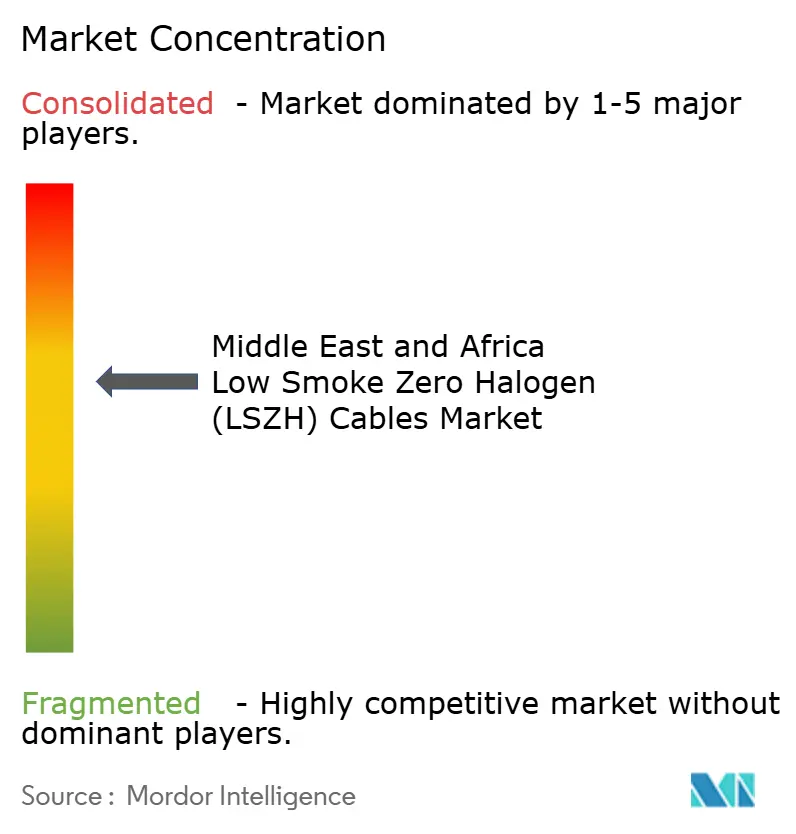
| Market Concentration | Medium |
Major Players *Disclaimer: Major Players sorted in no particular order Image © Mordor Intelligence. Reuse requires attribution under CC BY 4.0. | |
Middle East and Africa Low Smoke Zero Halogen (LSZH) Cables Market Analysis by Mordor Intelligence
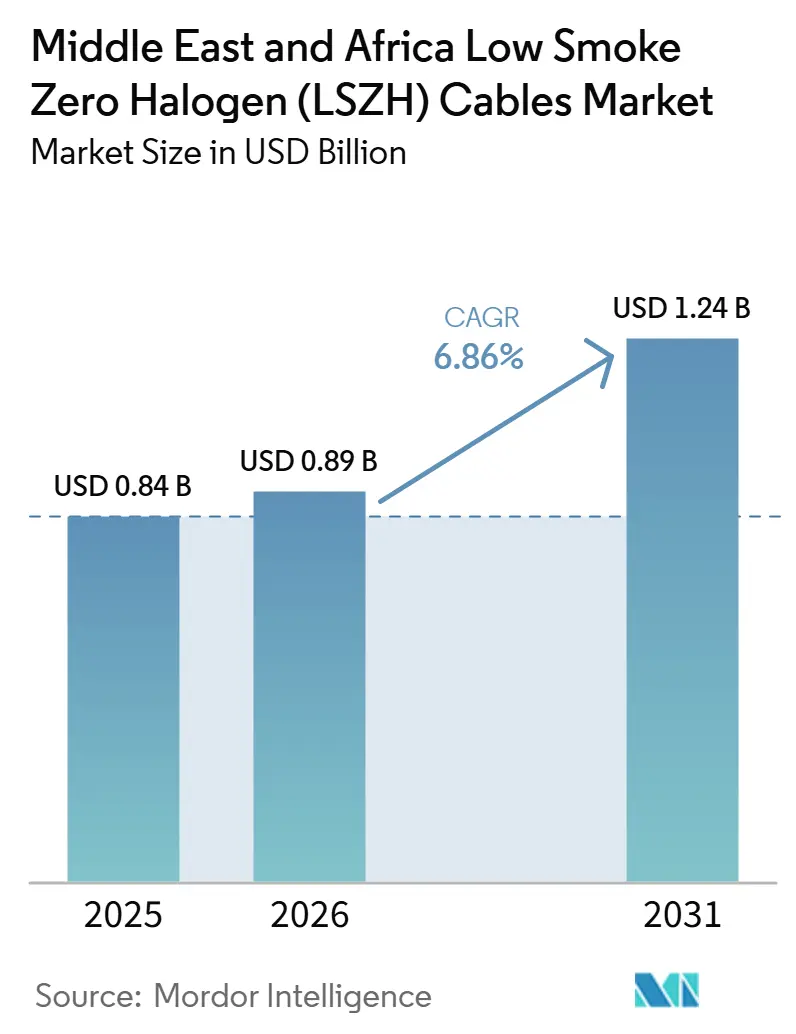
The Middle East and Africa low smoke zero halogen (LSZH) cables market size is expected to increase from USD 0.84 billion in 2025 to USD 0.89 billion in 2026 and reach USD 1.24 billion by 2031, growing at a CAGR of 6.86% over 2026-2031. Stricter life-safety requirements in commercial buildings, public infrastructure, and enclosed facilities support the LSZH cables market in the Middle East and Africa. Procurement rules increasingly require cables that limit corrosive gas emissions and smoke during a fire, which makes compliance a design requirement rather than an optional upgrade. Insurance conditions for major commercial projects also favor low-smoke, zero-halogen products, extending demand beyond formal code enforcement. Digital infrastructure, transport projects, offshore modernization, and utility investment create additional opportunities for suppliers with approved products and regional manufacturing capacity. Competition centers on certification, approved-vendor status, product performance, and the ability to supply specialized cable systems for demanding applications.
Key Report Takeaways
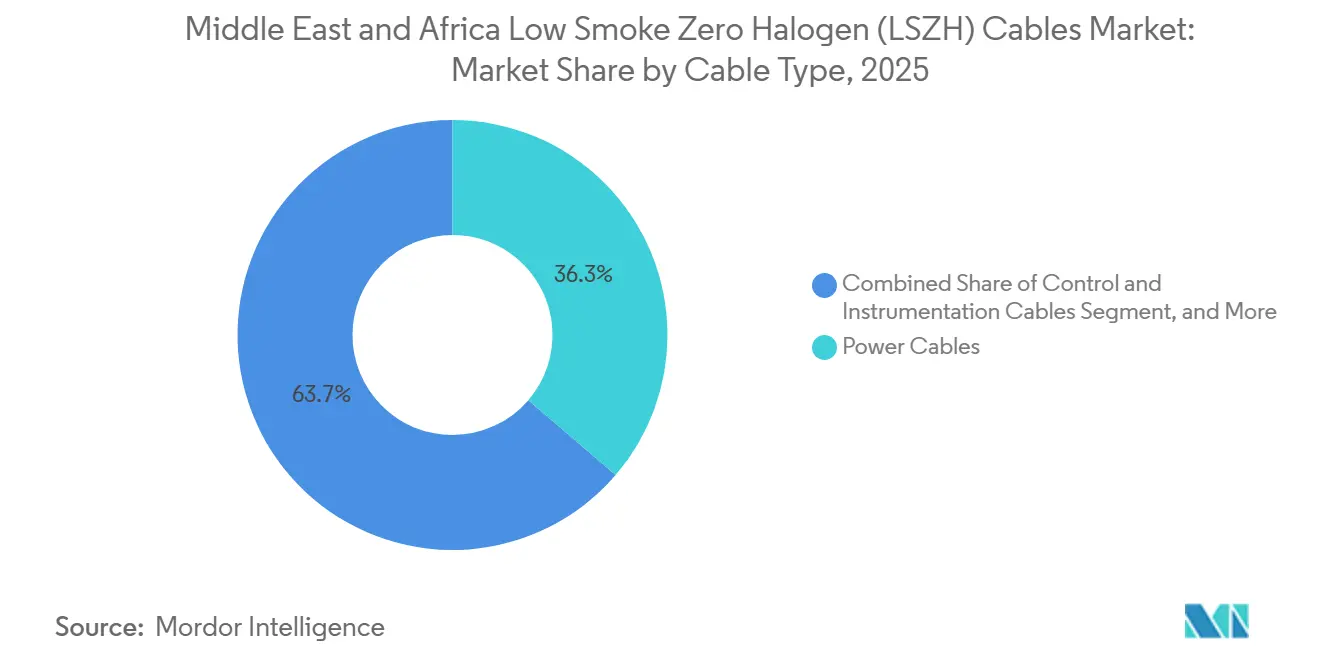
- By cable type, power cables held a 36.29% share of the Middle East and Africa low smoke zero halogen (LSZH) cables market in 2025, while fiber-optic cables are projected to expand at an 8.11% CAGR through 2031.
- By voltage rating, the less than 1 kV segment accounted for 61.11% share of the Middle East and Africa low smoke zero halogen (LSZH) cables market in 2025, while the 1-35 kV segment is expected to expand at a 7.41% CAGR through 2031.
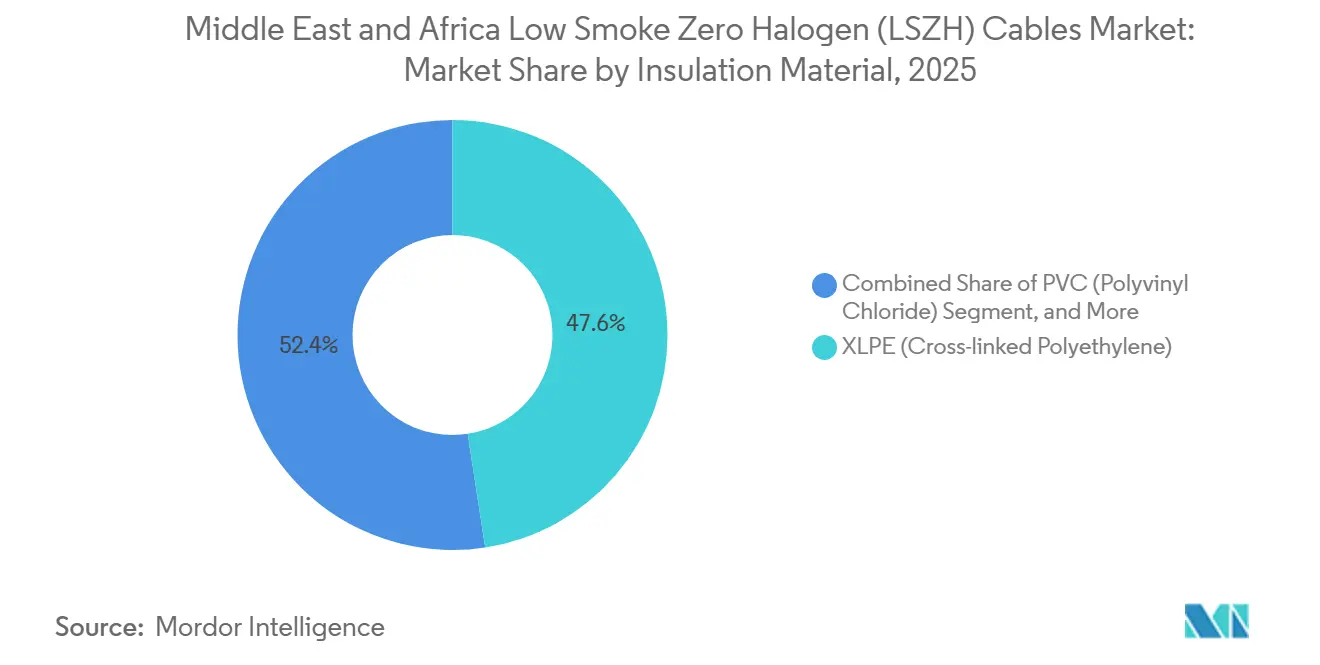
- By insulation material, XLPE held 47.57% share of the Middle East and Africa low smoke zero halogen cables market in 2025, while other specialty insulation materials are projected to advance at a 7.95% CAGR through 2031.
- By end-user industry, commercial buildings accounted for 22.78% share of the Middle East and Africa LSZH cables market in 2025, while data centers are expected to expand at an 8.55% CAGR through 2031.
- By geography, the Middle East accounted for 66.21% of the Middle East and Africa low smoke zero halogen (LSZH) cables market in 2025, while Africa is projected to expand at a 7.35% CAGR through 2031.
Note: Market size and forecast figures in this report are generated using Mordor Intelligence’s proprietary estimation framework, updated with the latest available data and insights as of January 2026.
Middle East and Africa Low Smoke Zero Halogen (LSZH) Cables Market Trends and Insights
Drivers Impact Analysis*
| Driver | (~) % Impact on CAGR Forecast | Geographic Relevance | Impact Timeline |
|---|---|---|---|
| Life-Safety Requirements in High-Occupancy and Enclosed Infrastructure | +2.1% | Global, with concentrated enforcement in United Arab Emirates, Saudi Arabia, Qatar | Short term (≤ 2 years) |
| GCC Data Center and Digital Infrastructure Expansion | +1.8% | GCC core, United Arab Emirates and Saudi Arabia, with spillover to Egypt and South Africa | Short term (≤ 2 years) |
| Railway, Metro, Airport, and Tunnel Development | +1.3% | Saudi Arabia, United Arab Emirates, Egypt, Rest of Middle East | Medium term (2-4 years) |
| Oil and Gas Electrification and Offshore Modernization | +0.9% | United Arab Emirates, Saudi Arabia, Qatar, Nigeria | Medium term (2-4 years) |
| Project-Specification Localization and Regional Manufacturing Qualification | +0.5% | Saudi Arabia, United Arab Emirates, Egypt | Medium term (2-4 years) |
| Multilateral-Institution Procurement Favoring International Fire-Safety Standards | +0.3% | Sub-Saharan Africa, Egypt, Nigeria, South Africa | Long term (≥ 4 years) |
| Source: Mordor Intelligence | |||
Life-Safety Requirements in High-Occupancy and Enclosed Infrastructure
Mandatory LSZH specifications in enclosed spaces are embedded in building requirements across the GCC, and their use continues to widen through code revision cycles. The UAE Fire and Life Safety Code of Practice, including its 2025 amendments, requires LSZH cables in enclosed spaces within high-rise buildings and links compliance to Dubai Civil Defense certification. The code sets requirements for circuit integrity and references tests measuring halogen-acid gas emissions and smoke density.[1]Emirates Authority for Standardization and Metrology, “UAE Fire and Life Safety Code of Practice,” esma.gov.ae Saudi procurement requirements also refer to IEC 60332 fire-testing criteria for buildings above defined occupancy thresholds.[2]International Electrotechnical Commission, “IEC 60332 Series, Tests on Electric and Optical Fibre Cables Under Fire Conditions,” iec.ch Insurance underwriters increasingly make the use of LSZH a condition of fire-risk coverage for large commercial developments, thereby strengthening demand where enforcement is less consistent. This commercial requirement reinforces the regulatory case for compliant products in the Middle East and Africa low smoke zero halogen (LSZH) cables market.
GCC Data Center and Digital Infrastructure Expansion
Data center construction supports demand for LSZH fiber optic cables because enclosed server halls, risers, and associated electrical spaces require certified fire-performance products. High-density computing equipment creates more demanding thermal conditions than conventional IT installations, increasing the value of cable systems per MW of installed capacity. NEOM and DataVolt began work on a USD 5 billion AI data center complex in Saudi Arabia in 2026, with a first phase targeting 200 MW by Q4 2027 and full capacity targeting 1.5 GW by 2030. Prysmian announced a EUR 5.5 billion (USD 6.16 billion) long-term optical cable supply agreement with Molex in July 2026, alongside a EUR 1.25 billion (USD 1.40 billion) increase in fiber and optical cable capacity. The agreement shows how global suppliers are securing capacity for hyperscale deployments as regional projects move forward. The Middle East and Africa low smoke zero halogen (LSZH) cables market, therefore, gains from digital projects that require both connectivity and stringent fire performance.
Railway, Metro, Airport, and Tunnel Development
Railway, metro, airport, and tunnel projects require LSZH cables for power, communication, and control circuits because smoke and corrosive gases can restrict evacuation in enclosed spaces. EN 45545-2 is commonly referenced in rail specifications and supports the use of halogen-free, low-smoke, self-extinguishing cable designs in higher-hazard rail environments. Etihad Rail is prepared to introduce passenger service in 2026 across a network connecting 11 cities, with safety requirements considered in the design of the tunnel and station infrastructure.[3]Etihad Rail, “Etihad Rail Prepares the Public for the Launch of Passenger Trains,” railwaypro.com Dubai's Roads and Transport Authority completed ventilation-system work at underground Red and Green Line stations in July 2026. Such rehabilitation projects can create repeat demand for compliant ventilation and fire-safety circuit cables beyond greenfield construction. This replacement activity provides the Middle East and Africa low smoke zero halogen (LSZH) cables market with a recurring source of demand through the forecast period.
Oil and Gas Electrification and Offshore Modernization
Offshore platforms use LSZH cables that meet marine standards because living quarters, enclosed process areas, and electrical distribution systems may share fire compartments. The applicable designs support low-smoke performance in crew-safety applications and often cover instrumentation, control, and power circuits. ADNOC's Lightning project connected the Al Mirfa terminal to the Al Ghallan offshore cluster through 134 km of HVDC submarine cable and was commissioned in 2025. In June 2026, Middle East Specialized Cables Company received a SAR 175 million (USD 46.6 million) letter of award for ADNOC's Lower Zakum Long-Term Development Plan Phase I cable supply. Electrification broadens cable requirements because converted facilities need modern fire-compliant instrument, control, and power systems. This broadens the scope of the Middle East and Africa low smoke zero halogen (LSZH) cables market beyond conventional platform wiring.
Restraints Impact Analysis*
| Restraint | (~) % Impact on CAGR Forecast | Geographic Relevance | Impact Timeline |
|---|---|---|---|
| LSZH Price Premium Versus PVC Cable Alternatives | -2.1% | Africa broadly, cost-sensitive segments across Middle East and Africa | Short term (≤ 2 years) |
| Limited Enforcement Consistency Across African Markets | -1.5% | Sub-Saharan Africa, particularly Nigeria, Kenya, Rest of Africa | Medium term (2-4 years) |
| Specialized Polymer and Flame-Retardant Compound Supply Exposure | -0.8% | Global supply chain, with impact concentrated in import-dependent Middle East and Africa markets | Medium term (2-4 years) |
| Limited Installer and Consultant Familiarity With LSZH Performance Classes | -0.5% | Africa, secondary GCC markets | Long term (≥ 4 years) |
| Source: Mordor Intelligence | |||
LSZH Price Premium Versus PVC Cable Alternatives
The price premium for halogen-free cable materials remains the most persistent barrier to adoption in cost-sensitive projects. The premium is particularly important for control and instrumentation cables, where the compound represents a larger share of the total material cost than for large-conductor power cables. Developers without financing conditions that require international fire-safety standards can face material budget pressure across the entire cable bill of materials. This is most evident in commercial and light-industrial construction categories in Africa, where procurement decisions remain highly cost-led. The restraint is less pronounced where building codes are consistently enforced because projects must absorb the cost of compliant products. It remains significant for the Middle East and Africa low smoke zero halogen (LSZH) cables market in non-prestige categories, where compliance checks are less consistent.
Limited Enforcement Consistency Across African Markets
Several African countries have fire standards, but inspection and verification capacity may not consistently confirm the cable type installed during construction. South Africa's National Regulator for Compulsory Specifications enforces VC 8075 for certain low-voltage cables and requires compliance with SANS 1507. Enforcement is strongest in utility and state-funded procurement, while private commercial projects can face greater specification dilution. In Nigeria and Kenya, this gap can sustain PVC substitution in budget commercial construction outside multilaterally funded projects. Regulatory responses to fire incidents may strengthen enforcement over time, but they are not a near-term demand catalyst. Project specifications in the Middle East and Africa low smoke zero halogen (LSZH) cables market can therefore differ between funded infrastructure and ordinary commercial construction.
*Our forecasts treat driver/restraint impacts as directional, not additive. The impact forecasts reflect baseline growth, mix effects, and variable interactions.
Segment Analysis
By Cable Type: Fiber Optics Lead Growth While Power Cables Anchor Demand
Power cables accounted for 36.29% of the Middle East and Africa low smoke zero halogen (LSZH) cables market share in 2025, reflecting their central role in commercial construction, grid infrastructure, and industrial facilities. IEC 60502-2:2014/AMD1:2024 introduced ST8 and ST12 halogen-free sheath options and expanded fire-performance requirements for medium-voltage power cables. Fiber optic cables are projected to grow at an 8.11% CAGR from 2026 to 2031, driven by data centers requiring LSZH-jacketed optical products for enclosed server halls. The Middle East and Africa LSZH cables market size for fiber systems is supported by stricter fire classifications around high-density computing facilities.
Data and communication cables, as well as building wires, serve commercial, hospitality, and residential projects where code compliance is a requirement. Specialty products include mica-tape fire-resistant variants, radiation cross-linked offshore products, and rail-compliant constructions. These categories are used in applications where IEC 60331 circuit-integrity requirements are accompanied by halogen-free and low-smoke attributes. Ducab launched the GCC's first high-voltage fiber-optic cable at Middle East Energy 2025, underscoring regional investment in higher-specification products.



By Voltage Rating: Low-Voltage Volumes Support Market Stability
The less-than-1-kV segment accounted for 61.11% of the regional value in 2025, supported by building wires and low-voltage distribution systems. Commercial construction, hospitality projects, health-care facilities, and data centers account for much of this demand. The 1-35 kV tier is expected to expand at a 7.41% CAGR through 2031 as utilities and municipalities develop underground cabling, renewable-energy connections, and denser grids. The Middle East and Africa low smoke zero halogen (LSZH) cables market size for this tier is driven by procurement standards that increasingly include halogen-free medium-voltage cable specifications.
The 36-65 kV and above 65 kV tiers serve transmission, offshore interconnection, and selected utility applications. Their volumes are lower, but their value per kilometer and specification intensity are higher. LSZH use in these tiers is concentrated in substations, tunneled corridors, and offshore platforms. Ducab completed the Middle East's first extended pre-qualification test for a 400 kV extra-high-voltage cable system in February 2026, aligned with IEEE, IEC, and AEIC standards.
By Insulation Material: XLPE Leads While Specialty Compounds Add Value
XLPE accounted for 47.57% of regional value in 2025 because it is compatible with a broad range of low- and medium-voltage project specifications. Its 90°C continuous operating capability and IEC 60502-series compatibility support its use across regional installations. Regional and global suppliers offer XLPE-based LSZH systems for common construction and infrastructure applications in the Middle East and Africa's low smoke zero halogen (LSZH) cables market. PVC remains present in legacy and cost-constrained applications, while PE has a narrower role in direct-burial outdoor installations.
Other specialty insulation materials are projected to expand at a 7.95% CAGR from 2026 to 2031. The category includes halogen-free thermoplastic elastomers, radiation cross-linked compounds, and EPR-based LSZH formulations. Data centers need flexible, high-density cabling, while offshore platforms require extended fire-survival performance. ST8 and ST12 halogen-free sheath grades support LSZH-sheathed XLPE systems in the 1-35 kV tier.
By End-User Industry: Data Centers Set the Fastest Pace
Commercial buildings held 22.78% of regional value in 2025, supported by high-rise offices, hospitality facilities, and health-care complexes. Dubai, Riyadh, Doha, and Johannesburg have building activity where LSZH cables are specified for escape routes, service shafts, and enclosed spaces. Industrial manufacturing, energy, and utilities support demand from process facilities and grid-extension projects. Elsewedy Electric announced USD 500 million in manufacturing expansion in Saudi Arabia and Qatar in December 2025, strengthening the regional supply of specialized cable products.
Data centers are projected to expand at an 8.55% CAGR from 2026 to 2031, making them the fastest-growing end-user category. Hyperscale facilities need substantial quantities of data cables, and LSZH-jacketed products command a premium where fire-risk coverage requires halogen-free specifications. Transportation infrastructure requires circuit-integrity-rated cables for metro, rail, and airport projects. Renewable-energy installations create another demand channel, with enclosed inverter rooms and monitoring stations requiring compliant cable systems.
Geography Analysis
The Middle East held 66.21% of the Middle East and Africa LSZH cables market share in 2025, led by Saudi Arabia, the UAE, and Qatar. The UAE requires LSZH cables in enclosed commercial spaces under its Fire and Life Safety Code and enforces this requirement through Dubai Civil Defense certification. Halogen-content specifications also affect cable products used in commercial towers in Dubai and Sharjah. Saudi Arabia's SASO framework, localization requirements, and utility supplier qualifications increasingly embed LSZH requirements in construction.
Saudi Arabia is the fastest-growing individual national market, supported by Vision 2030 projects, metro corridors, and renewable-energy developments. Qatar and Kuwait contribute through LNG-linked industrial construction, infrastructure maintenance, hospital, airport, and desalination projects. International fire-safety conditions are often used when multilateral financing is involved. The Middle East and Africa LSZH cables market benefits when manufacturers obtain utility and civil-defense approvals that reduce delivery and qualification barriers.
Africa is projected to expand at a 7.35% CAGR through 2031, making it the fastest-growing geography. South Africa has the region's most mature LSZH cable environment because the National Regulator for Compulsory Specifications applies VC 8075, and procurement can reference SANS 1507. Egypt is the fastest-growing African national market, supported by the New Administrative Capital, Cairo Metro expansion, and grid densification. Nigeria remains an emerging data center location, although PVC substitution continues in commercial projects without multilateral financing. Ducab supplied 220 kV high-voltage cables to Senegal in 2025, expanding its African coverage to 23 countries. This supply presence can support the adoption of future specifications in West and Central Africa.
Competitive Landscape
The Middle East and Africa LSZH cables market is moderately concentrated, with regional and international suppliers competing across different performance categories. Ducab Group, Riyadh Cables Group, Elsewedy Electric S.A.E., alfanar Group, and Middle East Specialized Cables Company hold strong positions through national utility and civil-defense approved-supplier lists. Prysmian S.p.A. and Nexans S.A. retain advantages in offshore, optical, and fire-survival categories. Vendor qualification can determine access to large project procurement channels, encouraging regional manufacturers to invest in certification and advanced production.
Elsewedy Electric announced USD 500 million in manufacturing expansion across Saudi Arabia and Qatar in December 2025. The expansion included 9 Saudi factories for specialized cables, copper rods, and accessories. The Yanbu facility targeted an annual copper rod capacity exceeding 130,000 tonnes in partnership with Alfanar Group. Ducab completed the Middle East's first 400 kV extra-high-voltage extended pre-qualification test in February 2026 and acquired Oman's National Cable Factory. These moves pair technical qualification with broader regional manufacturing integration.
Prysmian's EUR 5.5 billion (USD 6.16 billion) agreement with Molex and EUR 1.25 billion (USD 1.40 billion) capacity expansion demonstrate the global push to secure data center fiber supply. Opportunities remain in offshore fire-survival cables, halogen-free medium-voltage products above 33 kV, and radiation cross-linked LSZH cables for rolling stock. HELUKABEL GmbH, Belden Inc., TE Connectivity Ltd., and Leoni AG serve several specialized categories through imported products, while Saudi and UAE localization policies increase pressure for in-country manufacturing. Riyadh Cables Group signed an agreement in October 2025 to acquire a majority stake in Artikul Aziya Kabel in Uzbekistan. The transaction broadened its manufacturing geography and created a Cable Center of Excellence in Central Asia.
Middle East and Africa Low Smoke Zero Halogen (LSZH) Cables Industry Leaders
Ducab Group
Riyadh Cables Group
Elsewedy Electric S.A.E.
Gulf Cable and Electrical Industries Co. K.S.C.P.
Alfanar Group
- *Disclaimer: Major Players sorted in no particular order

Recent Industry Developments
- July 2026: Dubai's RTA, in collaboration with Keolis MHI, completed a comprehensive overhaul of tunnel ventilation systems across all underground stations and facilities on the Red and Green Lines of the Dubai Metro, conducted during off-peak and overnight shifts, an infrastructure rehabilitation exercise that typically triggers LSZH cable replacement in ventilation and fire-safety circuits.
- June 2026: Middle East Specialized Cables Company (MESC) received a letter of award from Cunado Middle East worth USD 46.6 million (SAR 175 million) for the supply of low-voltage power and communication cables for ADNOC's Lower Zakum Long-Term Development Plan Phase I (LTDP-1), Amirah Island Surface Facilities Package II, covering power distribution, control, instrumentation, and telecommunications cables for a major UAE offshore oil development.
- February 2026: Ducab Group completed the Middle East's first Extended Pre-qualification (EPQ) test for a 400 kV Extra-High Voltage cable system at an emergency temperature of 105 °C, in collaboration with Brugg Cables, in alignment with IEEE, IEC, and AEIC standards. The milestone positioned Ducab as the only supplier on TAQA's approved vendor list with 2 certified accessory suppliers.


Middle East and Africa Low Smoke Zero Halogen (LSZH) Cables Market Report Scope
The Middle East and Africa low smoke zero halogen (LSZH) cable market revenue is generated through the sale of LSZH power, control and instrumentation, data and communication, fiber optic, building wire, and specialty cables across multiple voltage ratings and insulation materials, as well as associated value-added cable solutions supplied to end-user industries including commercial buildings, industrial manufacturing, data centers, energy and utilities, transportation infrastructure, and telecommunications throughout the region.
The Middle East and Africa low smoke zero halogen (LSZH) cables market report is segmented by cable type (LSZH power cables, LSZH control and instrumentation cables, LSZH data and communication cables, LSZH fiber optic cables, LSZH building wires, and specialty LSZH cables), voltage rating (less than 1 kV, 1-35 kV, 36-65 kV, and above 65 kV), insulation material (PVC (polyvinyl chloride), XLPE (cross-linked polyethylene), PE (polyethylene), and other specialty insulation materials), end-user industry (commercial buildings, industrial manufacturing, data centers, energy and utilities, transportation infrastructure, telecommunications, renewable energy, and other end-user industries), and geography (Middle East (Saudi Arabia, United Arab Emirates, Qatar, and rest of Middle East) and Africa (South Africa, Egypt, Nigeria, and rest of Africa)). The market forecasts are provided in terms of value (USD).
| LSZH Power Cables |
| LSZH Control and Instrumentation Cables |
| LSZH Data and Communication Cables |
| LSZH Fiber Optic Cables |
| LSZH Building Wires |
| Specialty LSZH Cables |
| Less Than 1 kV |
| 1-35 kV |
| 36-65 kV |
| Above 65 kV |
| PVC (Polyvinyl Chloride) |
| XLPE (Cross-linked Polyethylene) |
| PE (Polyethylene) |
| Other Specialty Insulation Materials |
| Commercial Buildings |
| Industrial Manufacturing |
| Data Centers |
| Energy and Utilities |
| Transportation Infrastructure |
| Telecommunications |
| Renewable Energy |
| Other End-User Industries |
| Middle East | Saudi Arabia |
| United Arab Emirates | |
| Qatar | |
| Rest of Middle East | |
| Africa | South Africa |
| Egypt | |
| Nigeria | |
| Rest of Africa |
| By Cable Type | LSZH Power Cables | |
| LSZH Control and Instrumentation Cables | ||
| LSZH Data and Communication Cables | ||
| LSZH Fiber Optic Cables | ||
| LSZH Building Wires | ||
| Specialty LSZH Cables | ||
| By Voltage Rating | Less Than 1 kV | |
| 1-35 kV | ||
| 36-65 kV | ||
| Above 65 kV | ||
| By Insulation Material | PVC (Polyvinyl Chloride) | |
| XLPE (Cross-linked Polyethylene) | ||
| PE (Polyethylene) | ||
| Other Specialty Insulation Materials | ||
| By End-User Industry | Commercial Buildings | |
| Industrial Manufacturing | ||
| Data Centers | ||
| Energy and Utilities | ||
| Transportation Infrastructure | ||
| Telecommunications | ||
| Renewable Energy | ||
| Other End-User Industries | ||
| By Geography | Middle East | Saudi Arabia |
| United Arab Emirates | ||
| Qatar | ||
| Rest of Middle East | ||
| Africa | South Africa | |
| Egypt | ||
| Nigeria | ||
| Rest of Africa | ||


Key Questions Answered in the Report
What is the size of the Middle East and Africa Low Smoke Zero Halogen (LSZH) cables market?
The Middle East and Africa LSZH cables market was USD 0.89 billion in 2026 and is projected to reach USD 1.24 billion by 2031, at a CAGR of 6.86%. Its outlook reflects compliance-led demand across construction, public infrastructure, data centers, and specialized facilities.
What is driving demand for LSZH cables in the Middle East and Africa?
Fire-safety rules for enclosed buildings, data center construction, transport infrastructure, and offshore electrification support demand. In the Middle East and Africa LSZH cables market, approved-supplier requirements and insurance conditions also reinforce compliant cable use.
Which cable type is expanding the fastest in the region?
Fiber optic cables are projected to expand at an 8.11% CAGR through 2031, supported by hyperscale data center requirements. Enclosed server halls and risers require products with suitable smoke, flame, and circuit-performance characteristics.
Which voltage category has the largest share of regional demand?
The less than 1 kV segment held 61.11% of regional value in 2025, driven by building wires and low-voltage distribution. Commercial buildings, hospitality facilities, health-care sites, public spaces, and data centers are important applications.
Which end-user application has the highest projected CAGR?
Data centers are expected to expand at an 8.55% CAGR through 2031 because enclosed facilities require higher fire-performance cable systems. High-density equipment also raises the importance of reliable optical, power, control, and communication connections.
Which geography is expanding the fastest?
Africa is projected to expand at a 7.35% CAGR through 2031, supported by power, metro, and public-building projects that use IEC-compliant specifications. Growth is strongest where project financing, procurement practices, and compliance checks enforce these requirements.
Page last updated on:





