
Middle East And Africa High Voltage Switchgear Market Size and Share
Market Overview
| Study Period | 2021 - 2031 |
|---|---|
| Forecast Data Period | 2026 - 2031 |
| Base Year Market Size (2025) | USD 2.40 Billion |
| Market Size (2026) | USD 2.55 Billion |
| Market Size (2031) | USD 3.34 Billion |
| Growth Rate (2026 - 2031) | 5.57 % |
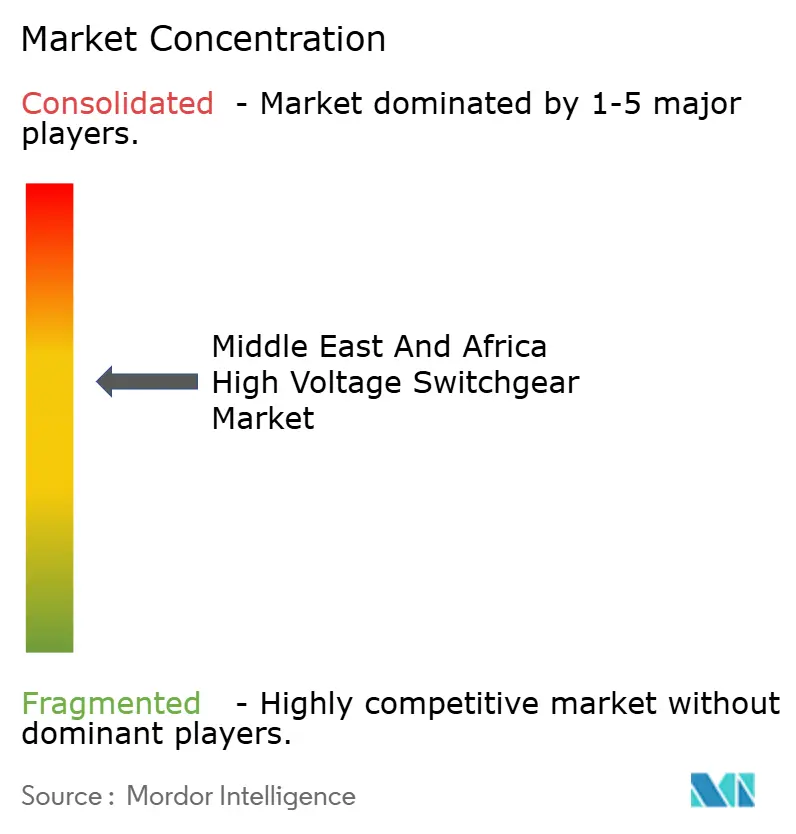
| Market Concentration | Medium |
Major Players *Disclaimer: Major Players sorted in no particular order Image © Mordor Intelligence. Reuse requires attribution under CC BY 4.0. | |
Middle East And Africa High Voltage Switchgear Market Analysis by Mordor Intelligence
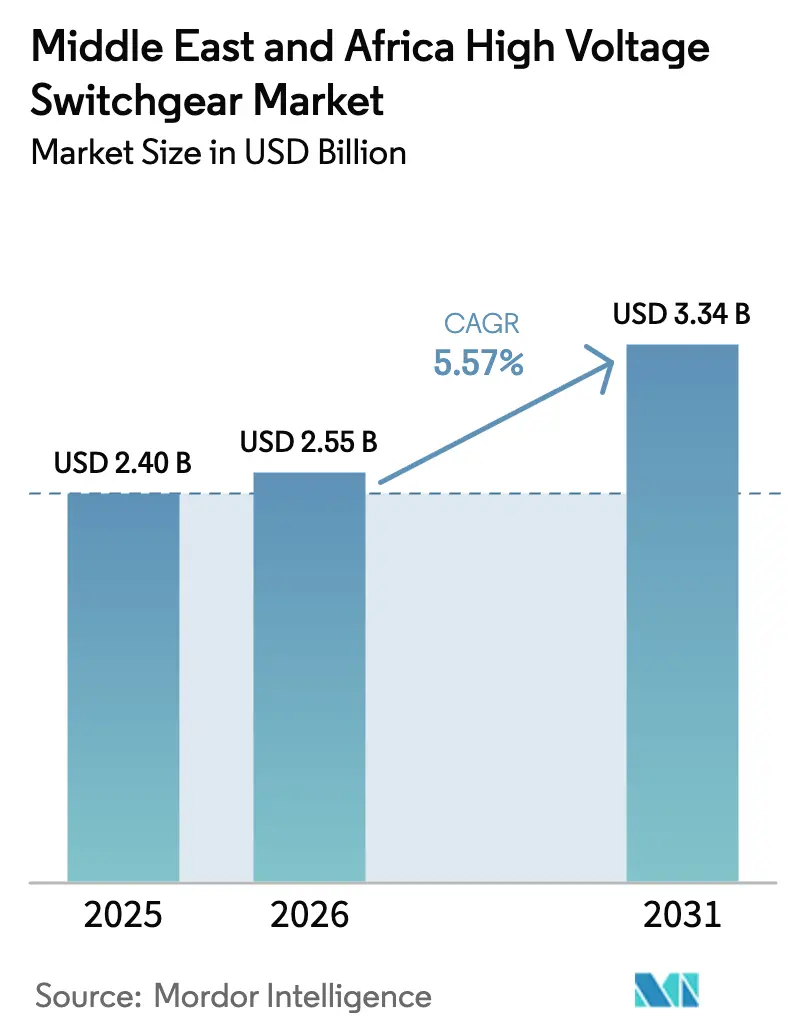
The Middle East And Africa High Voltage Switchgear Market size was valued at USD 2.40 billion in 2025 and is estimated to grow from USD 2.55 billion in 2026 to reach USD 3.34 billion by 2031, at a CAGR of 5.57% during the forecast period (2026-2031).
A structural pivot toward HVDC-enabled green-hydrogen export corridors, sovereign transmission backbones that bypass aging AC grids, and multi-gigawatt utility procurement programs anchor this upturn. Saudi Arabia retained 25.89% of 2025 revenue as Vision 2030 accelerated substation rollout, while Egypt delivered the region’s fastest switchgear growth on the back of its 3 GW Egypt-Saudi interconnector and a 14 GW renewables pipeline. Utilities drove 72.68% of 2025 demand and will outpace overall growth, supported by GCC mandates to harden grids against renewable intermittency and cross-border wheeling needs. Gas-insulated switchgear (GIS) is gaining ground in space-constrained industrial megaprojects even though air-insulated switchgear (AIS) remains dominant, and DC switchgear is scaling rapidly as HVDC Light corridors displace conventional AC. Competitive intensity is moderate, with four global vendors capturing more than half of high-end tenders and niche suppliers using local-content rules to penetrate sub-132 kV niches.
Key Report Takeaways
- By insulation, gas insulated switchgear posted a 7.23% growth rate through 2031, while air insulated switchgear retained 45.45% of the Middle East and Africa high voltage switchgear market share in 2025.
- By current type, DC switchgear expanded at 8.85% CAGR, whereas AC switchgear accounted for 90.11% share of the Middle East and Africa high voltage switchgear market size in 2025.
- By installation, outdoor systems advanced at 8.49% CAGR, and indoor units captured 61.36% of the Middle East and Africa high voltage switchgear market share in 2025.
- By end-user, utilities held 72.68% of the Middle East and Africa high voltage switchgear market size in 2025 and are forecast to expand at a 7.71% CAGR to 2031.
- By geography, Saudi Arabia led with 25.89% revenue share in 2025, while Egypt recorded the highest CAGR at 9.06% through 2031.
Note: Market size and forecast figures in this report are generated using Mordor Intelligence’s proprietary estimation framework, updated with the latest available data and insights as of January 2026.
Worldwide, activity is shaped by contributions from multiple regions, with Middle east and africa representing one of the more structurally developed among them. The global report on high voltage switchgear market by Mordor Intelligence reflects how these regional layers combine into a single system.
Middle East And Africa High Voltage Switchgear Market Trends and Insights
Drivers Impact Analysis*
| Driver | (~) % Impact on CAGR Forecast | Geographic Relevance | Impact Timeline |
|---|---|---|---|
| Expansion of HV transmission projects | +1.2% | Saudi Arabia, Egypt, UAE, Qatar, Bahrain | Medium term (2-4 years) |
| Increasing renewable-energy grid integration | +1.0% | Morocco, Egypt, South Africa, Kenya | Long term (≥ 4 years) |
| Industrial megaprojects | +0.9% | Saudi Arabia, UAE, Oman | Medium term (2-4 years) |
| Growing data-center build-out | +0.5% | Kenya, South Africa, UAE, Egypt | Short term (≤ 2 years) |
| Refugee-camp electrification | +0.3% | Jordan, Kenya, Uganda, Ethiopia | Long term (≥ 4 years) |
| Green-hydrogen export corridors | +0.8% | Saudi Arabia, UAE, Egypt, Morocco | Long term (≥ 4 years) |
| Source: Mordor Intelligence | |||
Expansion Of HV Transmission Projects
The 3 GW, ±500 kV Egypt-Saudi HVDC interconnector reached 95% completion in 2025, creating the first asynchronous link between North Africa and the Arabian Peninsula.[1]Hitachi Energy, “Egypt-Saudi HVDC Interconnector,” hitachienergy.com Saudi Arabia’s NEOM-Yanbu 525 kV corridor and the Riyadh-Kudmi 500 kV line illustrate a broader pivot to long-haul HVDC, which lowers line losses and bypasses congested AC corridors. GCCIA’s Al-Fadhili upgrade added 1,800 MW of transfer capacity in 2025, boosting resilience for the six-nation grid.[2]GCC Interconnection Authority, “Grid Statistics,” gccia.com.sa These flagship projects accelerate orders for 525 kV DC breakers, converter-station GIS, and protection relay systems.
Increasing Renewable Energy Grid Integration Needs
Morocco’s 1,000 km Boujdour-Tanxift ultra-high-voltage line will evacuate 2 GW of solar and wind by 2028 and requires switchgear tolerant of rapid voltage transients.[3]Masen, “Boujdour-Tanxift Transmission Line,” masen.ma Kenya’s grid now exceeds 90% renewables, prompting KETRACO to deploy 400 kV substations with relays that isolate faults within 20 milliseconds. South Africa’s REIPPPP sped up GIS retrofits at 132 kV and 275 kV sites along coastal corridors. ABB’s 420 kV GIS at the Green Duba solar park in Saudi Arabia shows how compact switchgear cuts civil works by 30% and shortens build time.[4]ABB, “Green Duba 420 kV GIS,” abb.com Harmonized IEC 62271-200:2023 adoption across the Gulf standardizes performance requirements, encouraging cross-border equipment sourcing.
Industrial Megaprojects
NEOM’s green-hydrogen plant needs 92 GIS bays at 380 kV to synchronize electrolyzers, desalination units, and ammonia synthesis loops, a package supplied by GE Vernova. ADNOC’s USD 5.5 billion Ruwais LNG complex and Oman’s Duqm refinery expansion both specify outdoor hybrid switchgear that withstands corrosive marine atmospheres. DEWA’s AED 7.6 billion transmission plan includes 49 new 132 kV and two 400 kV substations, reinforcing the UAE backbone.
Surge In Green-Hydrogen Export Corridors Requiring HVDC Hubs
The NEOM-Yanbu 3 GW HVDC Light link integrates electrolyzer clusters with export terminals and provides black-start capability, functions that AC networks struggle to support. Morocco’s feasibility study for a 24 GW North Africa-Europe interconnector foresees ±525 kV subsea cables paired with GIS converter stations, advancing the kingdom’s vision of becoming an EU power bridge. Egypt and the UAE pursue similar hydrogen corridors aligned with the India-Middle East-Europe Economic Corridor. As electrolyzer supply chains mature and European carbon-border rules favor green hydrogen after 2028, HVDC nodes will scale.
Restraints Impact Analysis*
| Restraint | (~) % Impact on CAGR Forecast | Geographic Relevance | Impact Timeline |
|---|---|---|---|
| Volatile public-sector capex | -0.6% | Saudi Arabia, UAE, Qatar, Kuwait, Bahrain, Oman | Short term (≤ 2 years) |
| Persistent counterfeits & grey imports | -0.4% | Egypt, Nigeria, Kenya, Morocco, wider MEA | Medium term (2-4 years) |
| Delays in wheeling code harmonization | -0.3% | GCC states, Egypt-Saudi corridor, North Africa coastal interconnects | Long term (≥ 4 years) |
| Scarcity of SF₆-free maintenance expertise | -0.2% | South Africa, Kenya, Morocco, broader MEA | Medium term (2-4 years) |
| Source: Mordor Intelligence | |||
Volatile Public-Sector Capex Due To Oil-Price Swings
Brent crude fluctuated between USD 70 and USD 90 per barrel in 2024 and trimmed Saudi discretionary infrastructure funding by about 10%. Egypt’s currency crunch similarly delayed USD 400 million of 220 kV upgrades. The UAE maintained outlays using sovereign-wealth reserves, but ADNOC still cut upstream budgets by 5% in 2024.
Persistent Counterfeits And Grey Imports Eroding Margins
SASO issued 11,589 IECEE certificates in 2023, yet counterfeit breakers still cause substation failures in Nigeria and Egypt. Grey imports undercut OEM prices by 15-20% in the sub-132 kV bracket and complicate warranty enforcement. Harmonized GSO IEC 60947-1:2024 is expected to tighten customs checks after 2027.
*Our forecasts treat driver/restraint impacts as directional, not additive. The impact forecasts reflect baseline growth, mix effects, and variable interactions.
Segment Analysis
By Insulation: GIS Scales In Constrained Industrial Sites
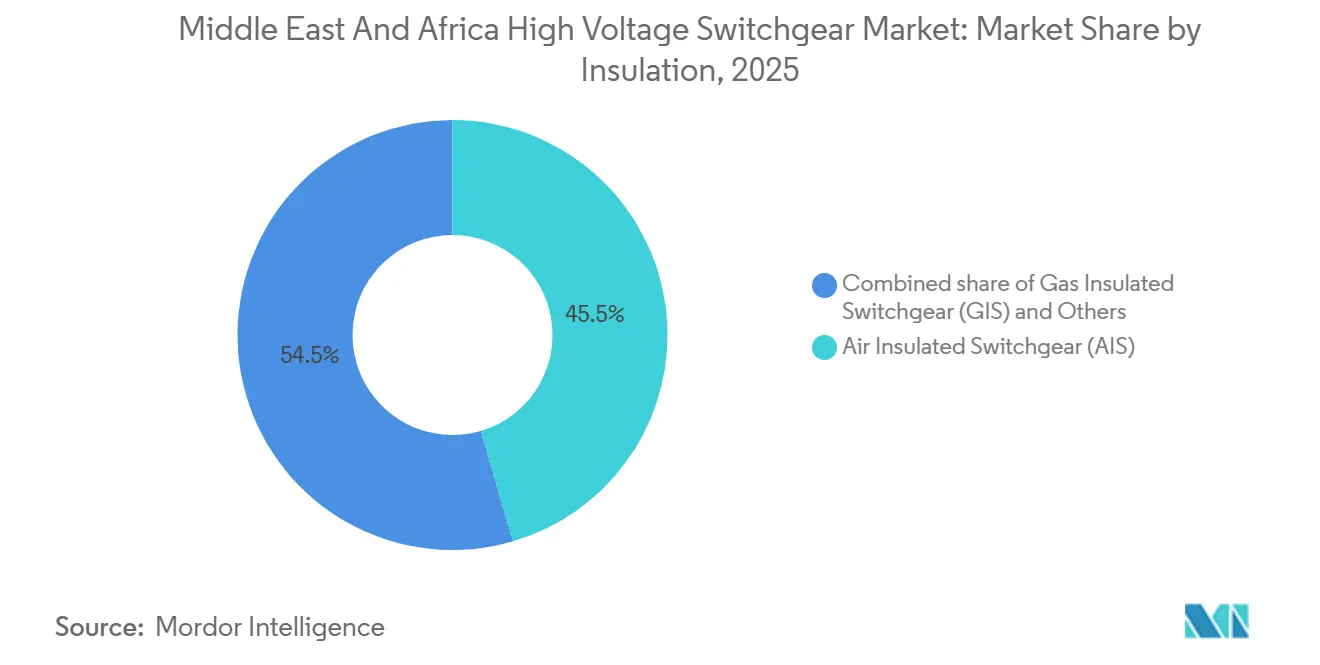
Air-insulated switchgear retained 45.45% of 2025 revenue within the Middle East and Africa high voltage switchgear market share, underpinned by its cost advantage in land-abundant utility substations. Gas-insulated switchgear is growing at a 7.23% CAGR, supported by megaprojects such as NEOM’s coastal hydrogen complex, which ordered 92 bays at 380 kV. Compact GIS reduces footprint roughly tenfold versus AIS, slashing civil works spend and enabling faster commissioning.
The Middle East and Africa high voltage switchgear market size tied to GIS will widen further as urban densification prompts indoor upgrades and as SF₆-free variants comply with tightening environmental rules. Hybrid solutions using clean-air insulation satisfy offshore and mobile needs, while GSO-aligned IEC standards harmonize short-circuit testing, improving cross-border procurement efficiency. Utilities still favor AIS for greenfield transmission yards where land is cheap, but industrial and commercial operators increasingly specify GIS to unlock real-estate value.



By Current Type: HVDC Corridors Propel DC Adoption
AC switchgear captured 90.11% of 2025 revenue, reflecting legacy 50/60 Hz networks. DC switchgear, though only 9.89% of volume, is projected to expand at an 8.85% CAGR as HVDC Light links such as the 3 GW NEOM-Yanbu and 3 GW Egypt-Saudi corridors progress. Hybrid mechanical-semiconductor DC breakers handle fault current interruption without natural zero crossings, unlocking new point-to-point corridors.
The Middle East and Africa high voltage switchgear market size associated with DC projects will rise as green-hydrogen exporters link electrolyzer clusters directly to converters, bypassing repetitive AC-DC-AC stages. AC technology remains the backbone for meshed grids, distribution feeders, and most industrial plants, but DC is emerging as the favored architecture for cross-border power trade and long-distance, high-capacity evacuation.
By Installation: Outdoor Innovations Tackle Harsh Climates
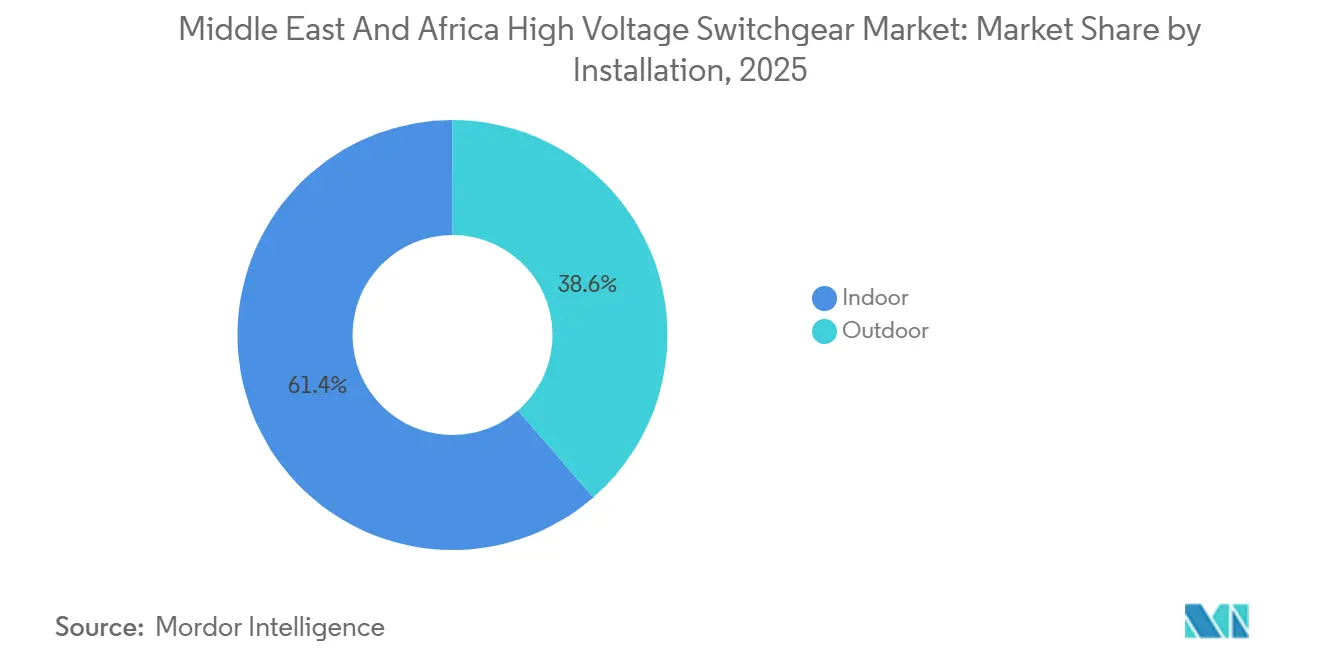
Indoor equipment held 61.36% of 2025 spending, thanks to controlled environments that protect against dust and 50 °C heat. Hyperscale data centers in Nairobi and Dubai deploy indoor GIS with remote monitoring to meet 99.995% uptime. Outdoor switchgear, however, is outpacing at 8.49% CAGR, led by pre-assembled modules that shrink on-site labor by up to 35%.
Outdoor units in DEWA’s 400 kV network withstand sandstorms and extreme temperatures, aided by IP65 enclosures, corrosion-resistant coatings, and natural convection cooling. As project owners compress schedules to integrate renewables, factory-tested outdoor skids become attractive, broadening the Middle East and Africa high voltage switchgear market.
By End-User: Utilities Still Dominate As Industrial Demand Diversifies
Utilities absorbed 72.68% of 2025 demand and are forecast to grow at a 7.71% CAGR as Saudi Arabia’s Vision 2030, Egypt’s 14 GW renewables program, and Morocco’s UHV line drive bulk procurement. The Middle East and Africa high voltage switchgear market share linked to utilities will stay above two-thirds, but industrial complexes, LNG terminals, and mining operations are diversifying revenue streams.
Industrial megaprojects such as Ruwais LNG, Duqm refinery, and South African platinum mines require ruggedized switchgear with arc-flash mitigation. Commercial real estate and EV-ready smart communities in Riyadh and Cairo are specifying compact ring-main units. Refugee-camp mini-grids, though small, present double-digit growth and premium margins for standardized microgrid switchgear.
Geography Analysis
Saudi Arabia accounted for 25.89% of 2025 revenue, anchored by Vision 2030’s USD 500 billion infrastructure program and the Al-Fadhili grid upgrade that lifted transfer capacity by 1,800 MW. The NEOM-Yanbu and Riyadh-Kudmi HVDC projects alone represent more than USD 2 billion in switchgear opportunity through 2028. Egypt, benefiting from the 3 GW Egypt-Saudi interconnector and Europe-oriented hydrogen plans, is projected to expand switchgear spending at a 9.06% CAGR to 2031.
The United Arab Emirates continues to invest via DEWA’s AED 7.6 billion program, integrating 5 GW of solar by 2030 and backing ADNOC’s Ruwais LNG complex. Morocco’s Boujdour-Tanxift UHV corridor and Noor Midelt hybrid solar plant strengthen its role as an exporter to Europe. South Africa’s USD 8.5 billion Just Energy Transition Partnership obliges Eskom to deploy GIS at 132 kV to 400 kV. Qatar, Oman, and Kenya contribute mid-single-digit growth through industrial zones and geothermal-linked substations.
Nigeria’s Siemens Electrification Project targets 25 GW by 2034 and, despite currency and regulatory hurdles, positions the country as sub-Saharan Africa’s second-largest market after South Africa. Smaller nations such as Jordan, Ethiopia, and Uganda add incremental demand via refugee-camp electrification and dam-linked transmission corridors, broadening geographic diversification within the Middle East and Africa high voltage switchgear market.
Mordor Intelligence provides coverage of the high voltage switchgear market across other key regional markets, including Asia, South America, and Europe, each with their regulatory frameworks and demand patterns.

Regulatory Landscape
High-voltage switchgear procurement across the Middle East and Africa increasingly ties to IEC-aligned technical compliance, with utilities using grid-code and standards references to screen suppliers and limit grey imports. In Africa, Kenya issued the National Distribution Grid Code (March 2024) and Tanzania updated its Electricity (Generation, Transmission and Distribution Activities) Rules (2024), both strengthening structured technical requirements that feed into substation equipment specifications and acceptance testing. Nigeria continues to reference NERCs NESIS Regulations (2015) as a baseline for installation and safety conformity across the electricity infrastructure value chain.
Regional harmonization initiatives also affect equipment qualification and cross-border sourcing. The African Union Action Plan for a Harmonised Regulatory Framework for the Electricity Market in Africa (2021) supports more consistent market rules and interoperability goals for interconnected power systems, which increases the weight of standardized switchgear performance and documentation. In the Gulf, ongoing adoption of IEC 62271 series requirements in utility specifications is supported by utility-led prequalification practices, including Saudi Electricity Company (SEC) procurement directives linked to NEOM-related GIS requirements that treat compliance and delivery discipline as gating criteria for large programs.
Competitive Landscape
Four global players, Hitachi Energy, Siemens, Schneider Electric, and ABB, collectively commanded roughly 55-60% of extra-high-voltage and HVDC tenders in 2025. Hitachi Energy leads HVDC thanks to its converter-station portfolio used on the Egypt-Saudi, NEOM-Yanbu, and Al-Fadhili projects. Siemens and Schneider differentiate through digital twins and predictive-maintenance suites that cut unplanned outages by up to 20%. ABB’s GIS footprint benefits from compact designs that lower civil costs.
Second-tier suppliers such as CG Power, Hyosung Heavy Industries, and Larsen & Toubro capture distribution automation work aided by local-content rules. NOJA Power and Ormazabal win niche business in rural reclosers and commercial ring-main units. Chinese firms, including Chint, are pushing turnkey EPC packages at steep discounts under Belt and Road financing, though IEC certification gaps hinder entry into top-tier utility bids.
White-space opportunities revolve around SF₆-free maintenance services, DC switchgear for hydrogen corridors, and standardized microgrid panels for relief agencies. Vendors that secure technician upskilling and digital-service contracts lock in aftermarket revenue and counter growing price competition in primary equipment. Compliance with GSO IEC 62271-200:2023 and IEC 62271-1 rules will remain a key gatekeeper, filtering out grey-market imports and shaping long-term market share in the Middle East and Africa high voltage switchgear market.
Middle East And Africa High Voltage Switchgear Industry Leaders
Hitachi Energy
Siemens AG
Schneider Electric
General Electric
Mitsubishi Electric
- *Disclaimer: Major Players sorted in no particular order

Market Opportunities and Future Outlook
The clearest opportunity set is forming around utility procurement rules that tighten technical compliance, compress delivery timelines, and raise the share of low-GWP insulation options in space-constrained substations. SEC-linked NEOM procurement requirements that reference IEC 62271 series compliance create a more defined pathway for suppliers with qualified GIS portfolios, complete testing documentation, and short-cycle delivery capability, while Siemens Energys SF6-free GIS deployment in Saudi Arabia (Jawharat Al Aros substation, July 2025) offers a regional proof point that SF6-free designs are moving into grid applications.
As GIS adoption continues in industrial megaprojects and urban substations, aftermarket demand broadens across field services, condition monitoring, and training for alternative-insulation maintenance where local expertise is thinner. Localization and capacity build-outs also open additional whitespace across manufacturing, assembly, and component supply. Voltamp Energys May 2026 Localize it with Voltamp program in Oman, framed around a USD 130 million investment and a network of local factories for energy equipment manufacturing, points to sustained regional pressure for local content and faster spares availability. In Saudi Arabia, vendor actions to build domestic capability for GIS and HVDC-related equipment, including Hitachi Energys Dammam-focused HVDC valve manufacturing initiative with PCC Arabia (July 2026) and GE Vernovas Dammam facility expansion to support GIS, strengthen the set of partners for large interconnector and hydrogen-linked transmission programs, including qualified local panel builders, testing labs, and service contractors.
Recent Industry Developments
- July 2026: Schneider Electric announced a strategic collaboration with T964 to provide power infrastructure for Iraq’s first commercial Tier III data center. The deal targets rising data center power infrastructure demand in the Middle East and Africa and expands Schneider Electric's footprint in mission critical markets. The collaboration supports integrated power and cooling solutions for mission critical workloads in new data center markets.
- June 2026: Schneider Electric accelerated the rollout of its SM AirSeT pure-air (SF6-free) switchgear across East Africa, covering multiple countries. This supports SF6-free switchgear adoption in East Africa and reinforces ESG aligned, low-GWP equipment uptake among regional utilities. It also reinforces competitive differentiation for regional utilities and large projects by demonstrating sustainable technology.
- May 2026: Siemens announced localisation of 8DA gas-insulated medium voltage switchgear manufacturing in South Africa in partnership with Private National Grid PNG. This reduces supply-chain lead times and strengthens local content in regional utility tenders. The expansion positions Siemens to leverage local manufacturing to win regional utility tenders and support energy transition.


Research Methodology Framework and Report Scope
Market Definition and Coverage
This market covers revenue generated from high voltage switchgear sold and installed across Middle East and Africa for power flow control, protection, and isolation in grid and large end-user electrical networks.
Scope exclusions: Low and medium voltage switchgear, along with routine electrical components that do not perform switchgear functions, are excluded from this sizing.
Segmentation Overview
- By Insulation
- Gas Insulated Switchgear (GIS)
- Air Insulated Switchgear (AIS)
- Others
- By Current Type
- AC Switchgear
- DC Switchgear
- By Installation
- Indoor
- Outdoor
- By End-User
- Utilities
- Residential
- Commercial
- Industrial
- By Geography
- Saudi Arabia
- United Arab Emirates
- Qatar
- South Africa
- Egypt
- Morocco
- Rest of Middle East and Africa
Data Sources, Market Sizing, and Validation
Desk Research
Desk research built the base layer for electricity context at the country level and for project signals, which are needed before we model demand. We used public materials, including national energy ministries and regulators, national statistics offices, and utility planning documents, to map grid expansion and refurbishment priorities.
We also referenced sources such as IEA power and grid releases, World Bank development indicators, and trade and customs statistics for electrical equipment flows where available. These inputs helped us cross-check directionally against local market conditions. To tighten the company and project context, we reviewed annual reports, investor presentations, reputable press coverage, and tender disclosures, then applied selective use of paid subscriptions for company financials and intelligence, import and export shipment-level checks, and patents. The sources listed above are illustrative, and additional public and paid references were used for data collection, validation, and clarification.
Primary Interviews and Surveys
Primary work was used to verify adoption patterns for GIS versus AIS, typical replacement cycles, and how purchase decisions differ between utilities and large industrial buyers. Interviews and surveys were conducted with a mix of manufacturers, EPC channel participants, utility stakeholders, and independent experts across key MEA sub-regions, so that assumptions from desk research could be stress-tested and adjusted.
Distribution of primary research fieldwork respondents
| Company type | Respondent position |
|---|---|
| Top tier: 38% | CXOs: 20% |
| Mid tier: 42% | Functional/Unit leaders: 38% |
| Smaller Players: 20% | Managers: 42% |
Market-Sizing & Forecasting
Our sizing starts with a top-down build where power network expansion and refurbishment needs are reconstructed from utility investment plans, grid connection additions, and new substation and transmission build activity across the covered countries, and then translated into switchgear demand pools. Once this is in place, we use selective bottom-up approximations to corroborate totals, such as sampling country-level project awards, checking typical equipment packages for substations, and applying reasonable ASP ranges to estimated unit needs.
Key inputs that shape the model include the pace of transmission and distribution capacity additions, the share of GIS versus AIS selected for space, environment, and safety needs, the split of indoor versus outdoor installations, and the utilities versus industrial demand mix. Replacement demand is also reflected through the aging installed base and outage and reliability programs, which become more visible when new build activity slows. For forecasting, scenario analysis is applied around project execution timing, procurement cycles, and public spending sensitivity, and then the path is aligned to expert consensus on near-term order flow. Where bottom-up signals are missing for smaller countries, gaps are handled by using proxy ratios tied to grid build indicators and then rechecked with interview feedback.
Data Validation & Update Cycle
Validation is done by comparing model outputs against independent checks such as stated utility capex, visible tender pipelines, and trade patterns for relevant electrical equipment categories, and then reviewing any variances that look out of line. When a mismatch persists, we revisit assumptions and may re-contact respondents so the driver causing the difference is properly explained.
Before sign-off, the model and written assumptions go through multi-step internal reviews. Unusual country results are challenged with cross-country benchmarks. Reports are refreshed annually, with interim updates when material events occur, and a final pre-delivery pass is completed so clients receive the most current view possible.
Mordor Intelligence's Middle East and Africa High Voltage Switchgear Market Sizing Compared With Other Published Estimates
Published market values for MEA high voltage switchgear can vary because the scope line is not drawn the same way, and because different teams use different project timing assumptions and price paths. Differences also show up when some studies rely heavily on announced projects that later get delayed, which can lift a single year estimate.
Medium voltage switchgear and hybrid distribution panels are the most common add-ons that change totals, and those items sit outside Mordor Intelligence's scope for this report. This keeps the value tied to the high voltage equipment set described in the study. The spread can also come from how GIS versus AIS pricing is trended over time, how local currency conversion timing is handled, and whether estimates are refreshed after tender awards move from announcement to execution.
Benchmark comparison
| Source | Market Size | Gaps in Research Methodology |
|---|---|---|
| Mordor Intelligence | USD 2.40 B (2025) | |
| Regional Consultancy A | USD 2.95 B (2025) | Often expands the equipment basket to include adjacent medium voltage packages for substations and large facilities, and may book announced projects earlier in the cycle without filtering for execution timing. |
| Industry Association B | USD 2.10 B (2025) | Typically relies on member-reported sales coverage that can miss non-member imports and project-driven spot demand, and may apply conservative ASP progression that understates GIS-heavy orders. |
The table shows that the main differences are linked to what is counted as switchgear in the first place and how project timing is treated in the model. By keeping inclusions and exclusions explicit, and then checking totals against practical demand signals like tenders and grid build activity, the estimate remains traceable to clear steps that can be repeated year to year.


Key Questions Answered in the Report
How large is the Middle East and Africa high voltage switchgear market in 2026?
It is projected at about USD 2.55 billion, following the 5.57% CAGR trajectory quantified in this report.
Which country is growing fastest for high voltage switchgear demand?
Egypt leads with a 9.06% CAGR to 2031, propelled by the Egypt-Saudi HVDC link and a 14 GW renewables pipeline.
What technology segment is expanding more quickly, GIS or AIS?
Gas insulated switchgear is advancing at 7.23% CAGR, outpacing air insulated alternatives due to footprint advantages in industrial megaprojects.
Why is DC switchgear gaining traction in the region?
HVDC corridors such as NEOM-Yanbu and Egypt-Saudi favor DC breakers that eliminate AC-DC-AC conversions and cut transmission losses.
How are oil-price swings affecting switchgear procurement?
Volatile crude prices reduce Gulf fiscal buffers and delay some utility tenders, trimming near-term market growth by about 0.6 percentage point.
Which vendors dominate HVDC projects in the region?
Hitachi Energy, Siemens, Schneider Electric and ABB collectively control roughly 55-60% of extra-high-voltage and HVDC switchgear awards.
Page last updated on:


 Your data is secure and never sold or shared.


