
Middle East and Africa Grapes Harvesters Market Size and Share
Market Overview
| Study Period | 2021 - 2031 |
|---|---|
| Forecast Data Period | 2026 - 2031 |
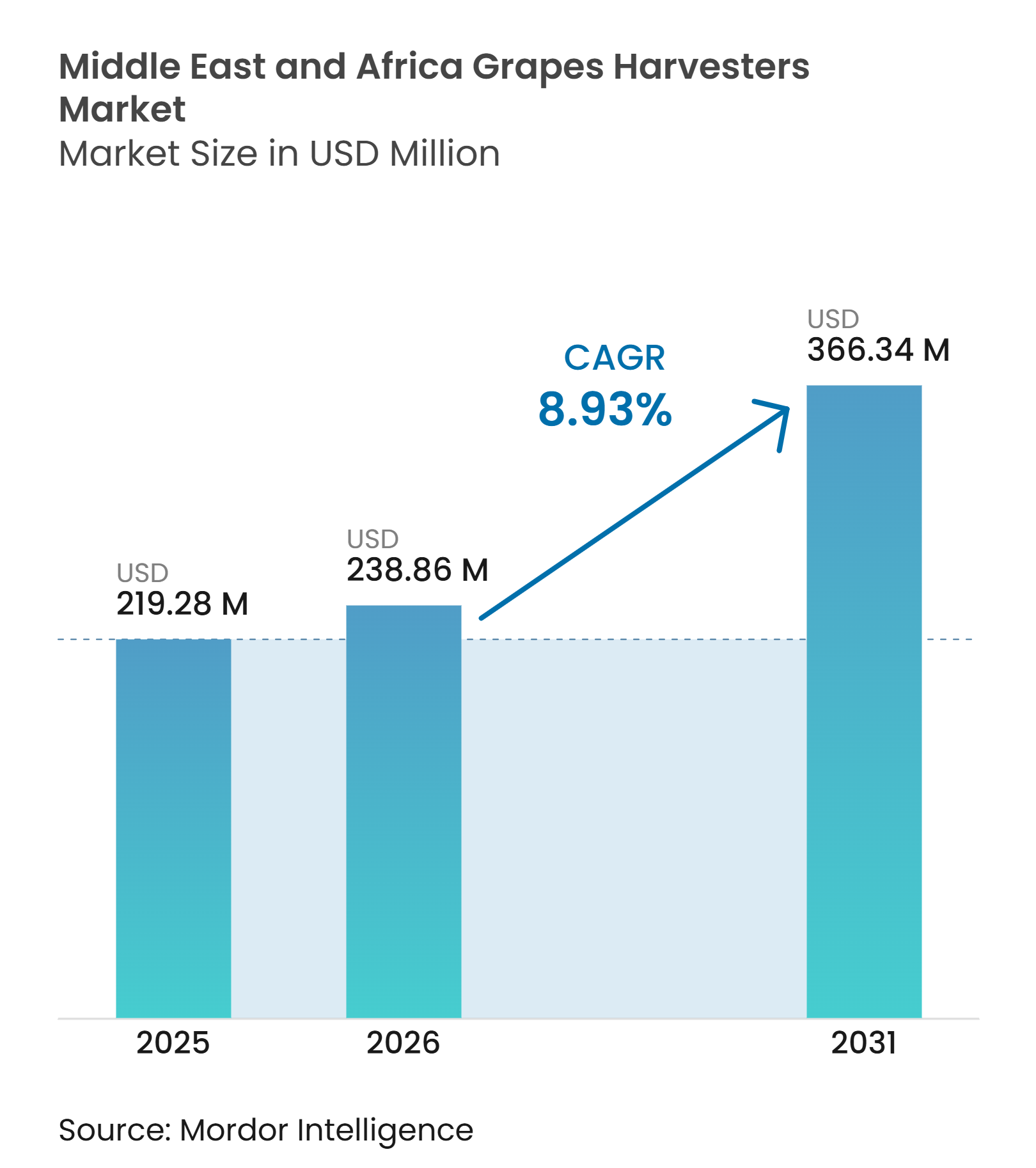
| Base Year Market Size (2025) | USD 219.28 Million |
| Market Size (2026) | USD 238.86 Million |
| Market Size (2031) | USD 366.34 Million |
| Growth Rate (2026 - 2031) | 8.93 % |
| Market Concentration | Medium |
Major Players *Disclaimer: Major Players sorted in no particular order Image © Mordor Intelligence. Reuse requires attribution under CC BY 4.0. | |
Middle East and Africa Grapes Harvesters Market Analysis by Mordor Intelligence
The Middle East and Africa grapes harvesters market size was valued at USD 219.28 million in 2025 and estimated to grow from USD 238.86 million in 2026 to reach USD 366.34 million by 2031, at a CAGR of 8.93% during the forecast period (2026-2031). Growth rests on commercial vineyards adopting machinery, given that labor costs, labor availability, and short harvest windows make manual picking less dependable. Turkey, South Africa, and Morocco provide the largest near-term base for demand because each has established commercial grape production. Heat in desert-growing areas can speed sugar accumulation and narrow the optimal picking period, which increases the value of equipment that can work quickly and consistently. Manufacturers are responding through local service coverage, precision features, and equipment options that work with existing tractors. Contract harvesting and rental services can expand access for growers who cannot afford to own a machine.
Key Report Takeaways
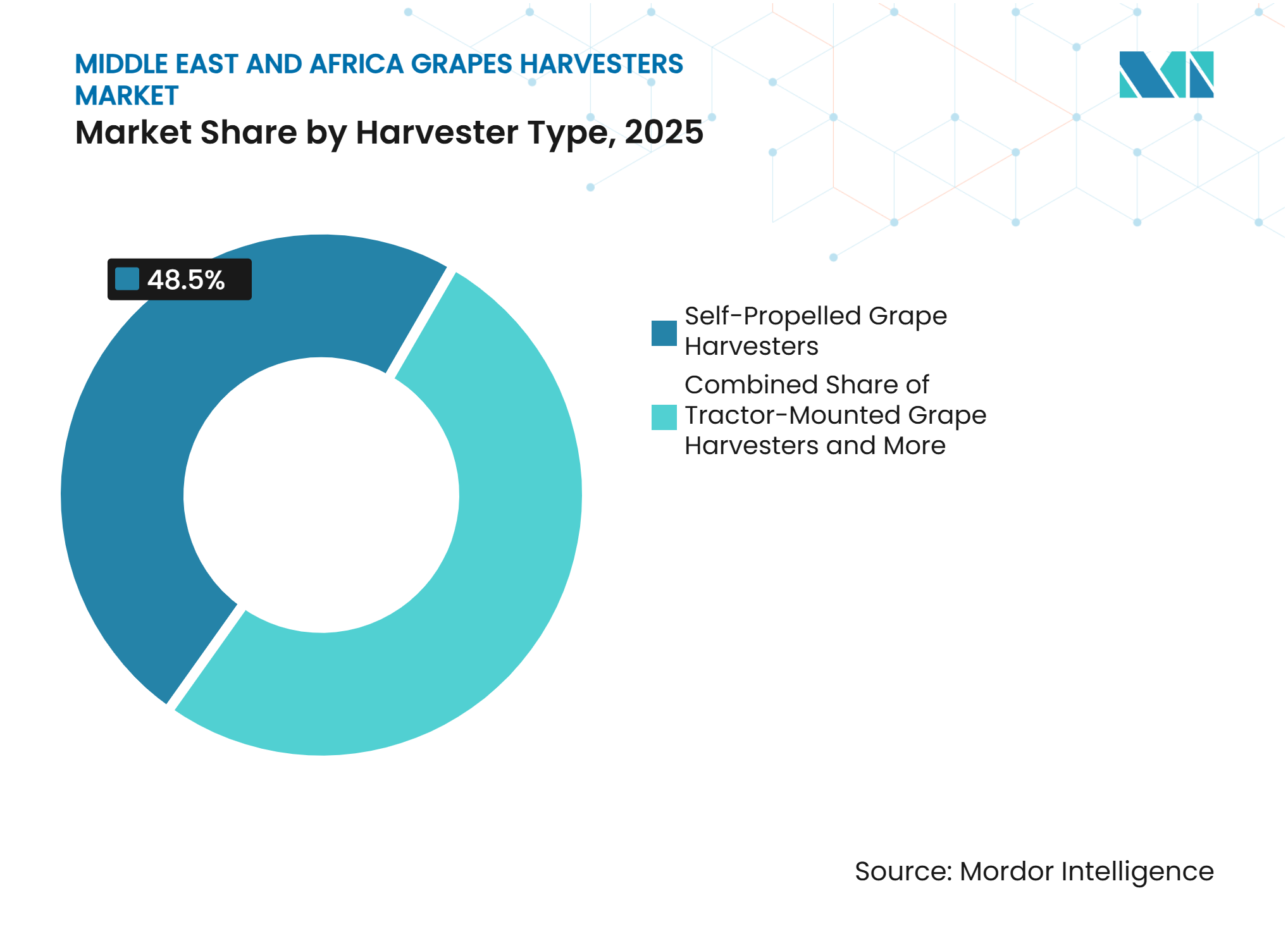
- By harvester type, self-propelled grape harvesters were the largest segment with 48.5% of Middle East and Africa grapes harvesters market share in 2025, while tractor-mounted grape harvesters are the fastest segment at a 7.8% CAGR over 2026 to 2031.
- By mode of operation, assisted or precision-guided grape harvesters were the largest segment with 47.2% of Middle East and Africa grapes harvesters market size in 2025, while autonomous grape harvesters are the fastest segment at an 8.6% CAGR over 2026 to 2031.
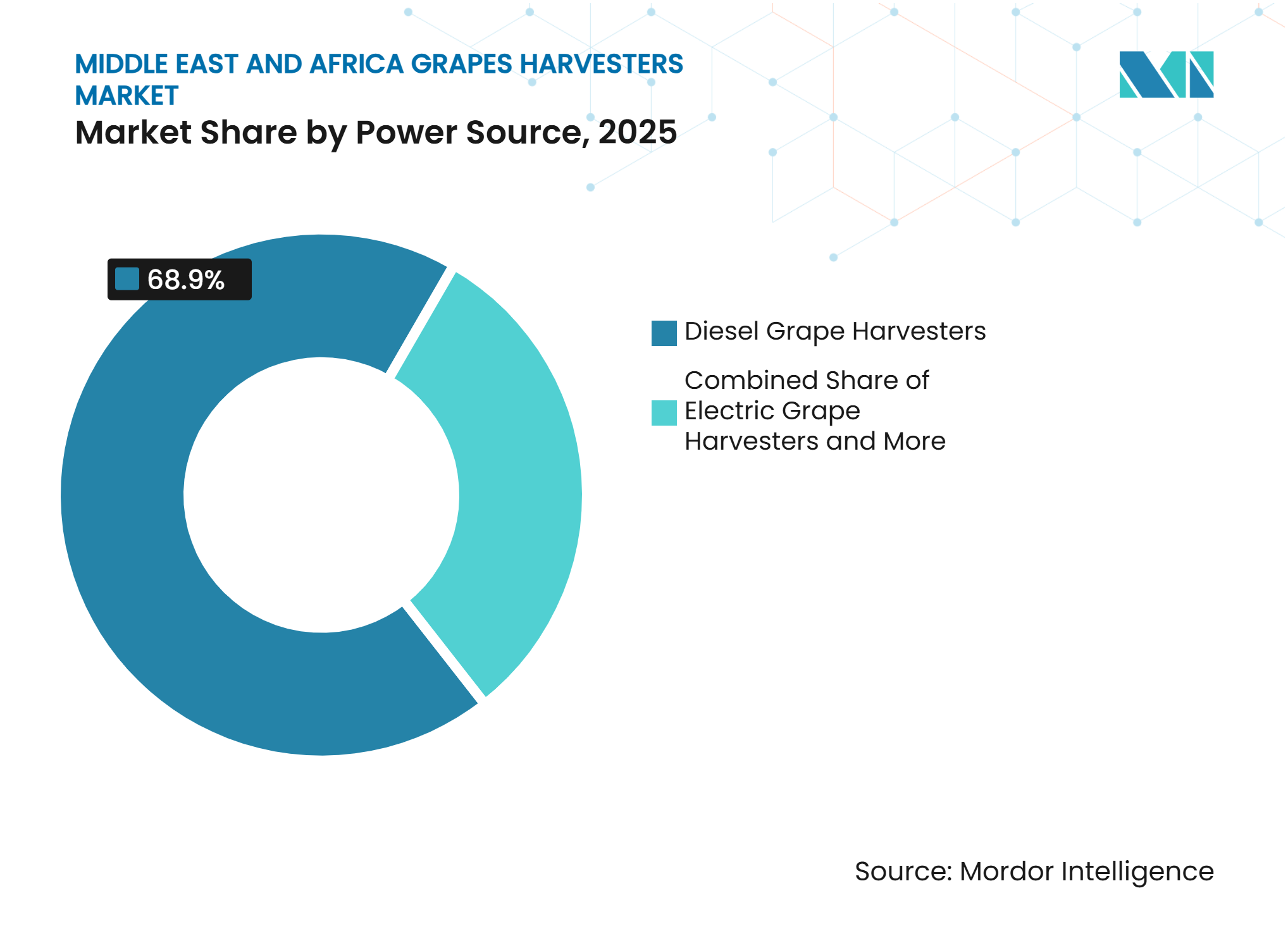
- By power source, diesel grape harvesters were the largest segment with 68.9% share in 2025, while electric grape harvesters are the fastest-growing segment at a 9.2% CAGR over 2026 to 2031.
- By vineyard size, medium vineyards (51 to 200 hectares) were the largest segment with 45.7% share in 2025, while small vineyards (below 50 hectares) are the fastest segment at a 7.2% CAGR over 2026 to 2031.
- By geography, the Middle East was the largest segment with 37.4% share in 2025, while Africa is the fastest segment at an 8.7% CAGR over 2026 to 2031.
Note: Market size and forecast figures in this report are generated using Mordor Intelligence’s proprietary estimation framework, updated with the latest available data and insights as of January 2026.
Market Trends and Insights
Drivers Impact Analysis of Middle East and Africa Grapes Harvesters Market*
| Driver | (~) % Impact on CAGR Forecast | Geographic Relevance | Impact Timeline |
|---|---|---|---|
| Rising mechanization in commercial vineyards | +2.5% | South Africa, Turkey, Morocco | Medium term (2-4 years) |
| Chronic vineyard labor shortages and rising seasonal wage bills | +2.0% | South Africa, Turkey | Short term (≤ 2 years) |
| Expansion of export-oriented wine and table grape production | +1.3% | South Africa, Morocco, Turkey | Medium term (2-4 years) |
| Adoption of precision harvesting and yield-data integration | +1.0% | South Africa, Turkey | Long term (≥ 4 years) |
| Growth of contract harvesting and equipment rental models | +0.8% | South Africa, Morocco, Rest of Africa | Short term (≤ 2 years) |
| Climate-driven harvest window compression in hot, arid zones | +0.7% | Saudi Arabia, Rest of Middle East, Morocco | Medium term (2-4 years) |
| Source: Mordor Intelligence | |||
Rising Mechanization in Commercial Vineyards
Labor remained a major cost category in South African wine grape cultivation in 2024, increasing the importance of dependable harvesting capacity for commercial operators. The Olifants River region reached 97% mechanical harvesting penetration in 2024 and 2025, while Orange River reached 28%[1]. This difference reflects farm scale, trellis suitability, and exposure to labor costs, rather than a simple lack of awareness in the Middle East and Africa grapes harvesters market. Commercial vineyards in Turkey are adapting trellis layouts to permit machine access, which makes field design an important condition for adoption. The Middle East and Africa grapes harvesters market benefits when growers plan vineyard renewal and machinery investment together. Public support for vineyard equipment in Turkey also shows that mechanization is reaching areas that previously relied on hand harvesting, bringing field preparation, equipment access, and seasonal labor planning into the same investment decision for commercial growers.
Chronic Vineyard Labor Shortages and Rising Seasonal Wage Bills
Rising permanent labor expenses in South Africa added further pressure on vineyard operating budgets in 2024. Rising wages improve the economics of mechanical harvesting for vineyards that once depended entirely on seasonal crews. Research found that the viable area for machinery depends on the equipment type and can range from 42 to 100 hectares for self-propelled equipment. An aging rural workforce in Turkey and shortages of trained vineyard workers in Morocco add to the pressure on commercial growers. The Middle East and Africa grapes harvesters industry, therefore, serves a need for reliable harvest capacity, not only a need to lower labor expenses, particularly when available crews must cover several blocks during the same short picking period.
Expansion of Export-Oriented Wine and Table Grape Production
Türkiye remains one of the world's largest table grape producers, with approximately 1.8 million metric tons produced in 2024, while total vineyard area exceeds 400,000 hectares[2]. Commercial vineyards and export-oriented producers continue to invest in mechanization and precision viticulture technologies to improve labor efficiency and productivity. South Africa recorded a strong table grape harvest in the 2025 and 2026 marketing season, which increased pressure on logistics and packing operations. Export businesses need dependable harvest timing and consistent fruit handling when shipments must meet buyer requirements. Mechanical systems can support traceability and operating consistency across large vineyard blocks. GlobalGAP certification and related export requirements also strengthen the case for better harvest records and equipment monitoring. These conditions give the Middle East and Africa grapes harvesters market a role in export-oriented production systems, especially where commercial volumes continue to grow and harvest teams must meet exact packing, transport, and delivery schedules.
Adoption of Precision Harvesting and Yield-Data Integration
Precision harvesting is becoming a practical source of vineyard data and a way to remove fruit from vines. Gregoire S.A.S. integrated ISOBUS connectivity into its 2025 harvester models, enabling data exchange with farm management systems. Pellenc S.A.S. introduced the EASY ADJUST smartphone interface in 2025 for shaker-setting calibration and performance logging. The South African Grape and Wine Research Institute at Stellenbosch University is studying machine vision for bunch characterization, including berry size, color, bunch shape, and crop-load estimation. This work can help growers use harvest information to manage quality and timing across vineyard blocks. It also supports the longer-term move toward equipment that provides operational records alongside harvesting capacity, giving vineyard managers a clearer basis for reviewing settings, field performance, and harvest timing after the season.
Restraints Impact Analysis of Middle East and Africa Grapes Harvesters Market*
| Restraint | (~) % Impact on CAGR Forecast | Geographic Relevance | Impact Timeline |
|---|---|---|---|
| High upfront capital cost of grape harvesters | -1.8% | Morocco, Rest of Africa, Saudi Arabia | Short term (≤ 2 years) |
| Grower preference for hand harvesting in premium wine segments | -0.8% | South Africa, Morocco | Medium term (2-4 years) |
| Row-spacing and trellis-system compatibility constraints | -0.6% | Turkey, Morocco, Rest of Middle East | Medium term (2-4 years) |
| Limited access to dealer service and spare parts in rural areas | -0.5% | Rest of Africa, Rest of Middle East | Long term (≥ 4 years) |
| Source: Mordor Intelligence | |||
High Upfront Capital Cost of Grape Harvesters
Self-propelled grape harvesters require substantial upfront capital investment, limiting adoption among many small and medium-sized vineyard operators in South Africa. Given the fragmented structure of the Western Cape wine industry, many producers rely on custom-harvesting contractors or shared machinery services rather than individual equipment ownership, thereby reducing the economic viability of purchasing self-propelled harvesters for smaller vineyard operations. Establishing a vineyard also requires significant capital before a grower considers equipment purchases. The ownership challenge is most acute where farm area is fragmented and annual machine use is limited. Contract harvesting, leasing, and rental arrangements can separate access to equipment from full ownership. Agricultural loans in Gulf Cooperation Council countries and Turkish machinery grants can reduce the immediate barrier to qualifying growers, though the value of the support depends on vineyard scale, loan access, and the availability of suitable machinery.
Grower Preference for Hand Harvesting in Premium Wine Segments
Premium wine producers in Stellenbosch, Franschhoek, Meknes, and Benslimane continue to prefer hand-harvesting in some vineyards. Their decision reflects quality expectations and the limits of dense, small-lot vine layouts. Uneven ripening within a bunch can also require the judgment of experienced pickers. Machine vision research at Stellenbosch University may help automated systems improve selection over time. Current equipment does not fully match every premium producer’s preference for selective harvesting. This reduces the immediate addressable base for high-end autonomous machines in prestige-oriented wine areas, where growers place greater value on visual fruit selection, handling practices, and control over individual vineyard blocks.
*Our forecasts treat driver/restraint impacts as directional, not additive. The impact forecasts reflect baseline growth, mix effects, and variable interactions.
Middle East and Africa Grapes Harvesters Market Segment Analysis
By Harvester Type:
Self-Propelled Machines Lead and Tractor-Mounted Units ExpandSelf-propelled grape harvesters were the largest harvester type, holding 48.5% of the Middle East and Africa grapes harvesters market size in 2025. They suit medium and large-sized vineyards that can spread ownership costs across a substantial seasonal workload. Independent operation reduces reliance on a separate tractor fleet during peak harvesting. Estates along the Olifants River and in the Western Cape, as well as larger vineyards in Turkey’s Thrace region, have operating conditions that suit this equipment. Trailed and towed machines offer growers with compatible tractors a lower-cost route into mechanical harvesting.
Tractor-mounted grape harvesters were the fastest harvester type, with a forecast CAGR of 7.8% over 2026 to 2031. Growers can use their existing tractor fleet, which limits the required investment to the harvesting attachment. Research found that towed harvesters can reach break-even at 7 to 8 hectares, compared with 12 to 14 hectares for self-propelled equipment. This difference broadens the potential customer base in Morocco and African countries where farm size is constrained. The Middle East and Africa grapes harvesters market can therefore reach more operators through mounted configurations than through self-propelled equipment alone, especially where farm managers need machinery that fits an existing tractor, budget, and field layout.



By Mode of Operation:
Precision Guidance Holds the Lead and Autonomy AdvancesAssisted or precision-guided grape harvesters were the largest mode-of-operation segment, with 47.2% share in 2025. These systems combine operator oversight with automated shaker control, Global Positioning System row following, and yield monitoring. They appeal to growers seeking greater consistency while retaining direct supervision in variable vineyard conditions. The equipment helps operators maintain settings and travel accurately through long vineyard rows, which supports repeatable work across the Middle East and Africa grapes harvesters market. Manual harvesting remains relevant for small operations and premium estates requiring selective fruit picking, particularly where plant spacing, variable ripening, and wine style make a standardized machine pass less suitable.
Autonomous grape harvesters were the fastest mode-of-operation segment, advancing at an 8.6% CAGR over 2026 to 2031. The online platforms are designed to reduce labor required for repetitive vineyard tasks by up to 80%. It represents early commercial development rather than broad regional adoption. The Middle East and Africa grapes harvesters market may see precision-guided equipment increasingly positioned between entry-level mounted machines and fully autonomous platforms, offering a practical step for growers that want automation without removing the operator from the process.
By Power Source:
Diesel Leads and Electric Equipment Gains MomentumDiesel grape harvesters were the largest power-source segment, accounting for 68.9% share in 2025. They support long operating days and the range requirements of larger commercial estates. Fuel availability and established service knowledge also sustain their position across agricultural areas in the region. Diesel machines avoid the charging constraints that growers in rural areas can face. Hybrid grape harvesters provide an intermediate option for operators seeking to lower fuel use without moving immediately to full electrification, which can suit vineyards that need familiar daily operating patterns while assessing newer power systems.
Electric grape harvesters were the fastest power-source segment, with a forecast CAGR of 9.2% over 2026 to 2031. The New Holland R4 Electric, launched in November 2025, includes a 40-kilowatt-hour battery pack and is designed for 8 working hours per charge. CNH Industrial N.V. stated that the vehicle could reduce emissions by up to 90% compared with diesel equipment[3]. Access to charging remains uneven in rural areas of Africa and in inland Middle Eastern regions. The Middle East and Africa grapes harvesters market will need dependable charging and local technical support before electric models move beyond early commercial use, since operators cannot accept extended downtime when fruit must be picked within a narrow window.

By Vineyard Size:
Medium Vineyards Lead and Small Vineyards Build AccessMedium vineyards of 51 to 200 hectares were the largest vineyard-size segment, with 45.7% of Middle East and Africa grapes harvesters market share in 2025. Their scale offers meaningful annual machine use while keeping the capital commitment more manageable than a large fleet. Research places the viable ownership range for self-propelled harvesters at 42 to 100 hectares, depending on machine configuration. Medium vineyards are therefore a central customer group for self-propelled and precision-guided equipment. Large vineyards above 200 hectares are more likely to focus on fleet replacement, upgrades, and service support, because their established equipment base shifts decisions toward reliability, operating continuity, and the value of improved machine functions.
Small vineyards below 50 hectares were the fastest vineyard-size segment, advancing at a 7.2% CAGR over 2026 to 2031. Their growth relies on contract harvesting, cooperative ownership, rentals, and leasing arrangements. Saudi Arabia’s Tabuk Agricultural Development Company signed a 10-year grape orchard management agreement with Ruwad Alsinaa Waltatweer Company in 2025, showing one approach to professional management and fixed-rental income. These structures can give small operators access to machinery without having to purchase it outright. The Middle East and Africa grapes harvesters market gains a broader customer base when access to services is separated from machine ownership, allowing growers to pay for a defined harvesting activity rather than carry the full cost of a rarely used asset.
Geography Analysis
The Middle East was the largest geographic segment, accounting for 37.4% of the Middle East and Africa grapes harvesters market in 2025. Turkey is the principal demand center because it had 190,000 hectares of table grapes and produced 1.49 million metric tons in 2025 and 2026. Commercial vineyards in Thrace and the Aegean region have favored machinery that suits wide-row trellis systems, supporting the Middle East and Africa grapes harvesters market in its largest geography. Saudi Arabia is building organized viticulture through government-supported production areas. Temperatures above 35 degrees Celsius can accelerate ripening and shorten the harvest period in desert vineyards.
Africa was the fastest geographic segment, with a forecast CAGR of 8.7% from 2026 to 2031. The 97% harvesting penetration in the Olifants River, compared with 28% in the Orange River, indicates a clear opportunity for further adoption of VINPRO equipment. Morocco can add demand as export-oriented growers seek better harvest timing and operational consistency, though water constraints and fragmented farms remain constraints. The rest of Africa remains earlier in the transition, where contract and cooperative models are more common than individual ownership, requiring suppliers to offer flexible equipment access and maintenance arrangements rather than relying solely on direct equipment sales.
Oman added 100 acres of grape cultivation through its Model Farms project in 2025, taking organized production to 127 acres. The project projected a yield of 635 metric tons and returns above OMR 1 million (USD 2.6 million). Smaller Middle Eastern producers are building more organized production systems, even where vineyard area remains limited. Such projects can create future demand for equipment and associated operating services. Government support for modern vineyard machinery in Turkey also reinforces this shift toward organized production, in which field layouts, water management, crop handling, and harvest planning can be more closely aligned with machinery use.
Competitive Landscape
Market Concentration
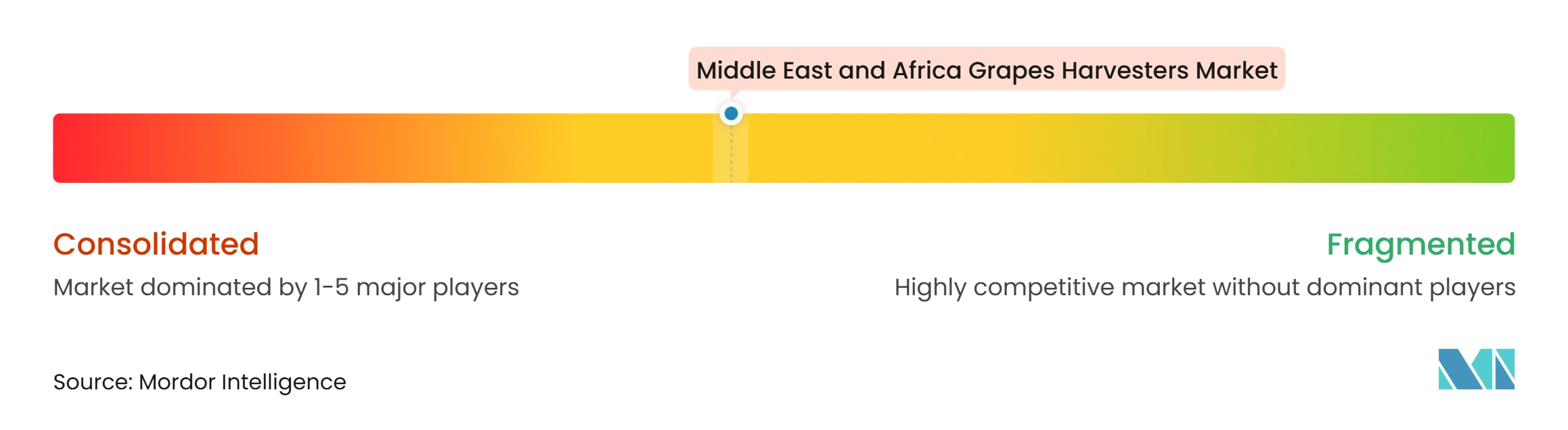
The Middle East and Africa grapes harvesters market is moderately concentrated in the premium tier and more fragmented at entry price points. Pellenc S.A.S. and Gregoire S.A.S. hold established regional positions through specialist equipment and local support, while Pellenc S.A.S. has operated in Morocco through Pellenc Maroc SARL since 2004 and has served South Africa since 2014. Gregoire S.A.S. gained further regional support through SDF S.p.A.’s branch in Paarl, Western Cape, opened in June 2026. Local parts supply and technical support are central to competition because downtime can be costly during a short harvest window, and because growers often have limited scope to postpone picking while waiting for a technician or replacement component.
CNH Industrial N.V. is developing New Holland equipment for electric and autonomous specialty-crop operations. The R4 series uses Global Positioning System, light detection and ranging sensors, and camera-based navigation for vineyard and orchard tasks, while Pellenc S.A.S. added its EASY ADJUST smartphone interface for remote shaker-setting calibration and performance records. Gregoire S.A.S. integrated ISOBUS connectivity into 2025 models to link harvesters with farm-management platforms. These moves show that the Middle East and Africa grapes harvesters market is competing through service, data collection, and machine performance, not through harvesting capacity alone, as growers seek equipment that can support daily work and provide usable records.
Oxbo International Corporation and Nairn Harvesters Limited support the competitive base through distribution, parts availability, and servicing. Their role can be important where established dealer networks are limited. Rental and cooperative models provide a route to customers below 100 hectares in Morocco, inland Middle Eastern areas, and other African markets. Providers that support these models can serve growers who would otherwise delay a purchase. No combined share for leading companies is available in the supplied material, so a concentration score cannot be assigned without unsupported data, even though the presence of established specialists indicates a distinct premium equipment tier within the regional competitive landscape.
Middle East and Africa Grapes Harvesters Industry Leaders
-
Pellenc S.A.S. (Pellenc Group)
-
Gregoire S.A.S. (SDF S.p.A.)
-
ERO GmbH (ERO Group)
-
Oxbo International Corporation (Ploeger Oxbo Group B.V.)
-
CNH Industrial N.V.
- *Disclaimer: Major Players sorted in no particular order
Middle East and Africa Grapes Harvesters Market Companies Covered in this Report
- Pellenc S.A.S. (Pellenc Group)
- Gregoire S.A.S. (SDF S.p.A.)
- ERO GmbH (ERO Group)
- Oxbo International Corporation (Ploeger Oxbo Group B.V.)
- CNH Industrial N.V.
- Kubota Corporation
- Yanmar Holdings Co., Ltd.
- Alma S.R.L.
- CRF Costruzioni S.R.L.
- Blueline Manufacturing Company
- American Grape Harvesters, Inc.
- Bobard S.A.S.
- Nairn Harvesters Limited
- Reese Group Ltd.
- Weremczuk FMR Sp. z o.o.
Recent Industry Developments in Middle East and Africa Grapes Harvesters Market
- June 2026: SDF S.p.A. (parent of Gregoire S.A.S.) opened a commercial branch in Paarl, Western Cape, South Africa, managing SAME, DEUTZ-FAHR, and GREGOIRE brands through local distribution partnerships with Kempston Agri and Smith Power Equipment. The expansion consolidates SDF's Africa strategy following its first Sub-Saharan subsidiary launch in Tanzania in 2025, targeting South Africa's position as the continent's tractor market.
- April 2026: CNH Industrial N.V.'s New Holland continued advancing its autonomous specialty-crop machinery program with the R4 Electric Power and Hybrid Power robotic platforms for vineyard and orchard harvesters. Equipped with GPS, LiDAR, and vision camera systems, the autonomous robots remained in advanced prototype testing, with limited production planned for the first half of 2027.
- January 2026: Pellenc South Africa delivered a new OPTIMUM XL40 grape harvester to a commercial client in Rawsonville, Western Cape, ahead of the local grape harvest season. The delivery further strengthened Pellenc's presence in the Breedekloof wine-producing region, where Rawsonville is located.
Middle East and Africa Grapes Harvesters Market Report Scope
The Middle East and Africa Grapes Harvesters Market Report is Segmented by Harvester Type (Self-Propelled, Trailed or Towed, and More), by Mode of Operation (Manual, Assisted or Precision-Guided, and More), by Power Source (Diesel, Hybrid, and Electric), by Vineyard Size (Small Vineyards (Below 50 Hectares), and More), and by Geography (Middle East and Africa). The Market Forecasts are Provided in Terms of Value in USD.
Segmentation Overview
| Self-Propelled Grape Harvesters |
| Trailed or Towed Grape Harvesters |
| Tractor-Mounted Grape Harvesters |
| Manual Grape Harvesters |
| Assisted or Precision-Guided Grape Harvesters |
| Autonomous Grape Harvesters |
| Diesel Grape Harvesters |
| Hybrid Grape Harvesters |
| Electric Grape Harvesters |
| Small Vineyards (Below 50 hectares) |
| Medium Vineyards (51-200 hectares) |
| Large Vineyards (Above 200 hectares) |
| Middle East | Turkey |
| Saudi Arabia | |
| Rest of Middle East | |
| Africa | South Africa |
| Morocco | |
| Rest of Africa |
| By Harvester Type | Self-Propelled Grape Harvesters | |
| Trailed or Towed Grape Harvesters | ||
| Tractor-Mounted Grape Harvesters | ||
| By Mode of Operation | Manual Grape Harvesters | |
| Assisted or Precision-Guided Grape Harvesters | ||
| Autonomous Grape Harvesters | ||
| By Power Source | Diesel Grape Harvesters | |
| Hybrid Grape Harvesters | ||
| Electric Grape Harvesters | ||
| By Vineyard Size | Small Vineyards (Below 50 hectares) | |
| Medium Vineyards (51-200 hectares) | ||
| Large Vineyards (Above 200 hectares) | ||
| By Geography | Middle East | Turkey |
| Saudi Arabia | ||
| Rest of Middle East | ||
| Africa | South Africa | |
| Morocco | ||
| Rest of Africa | ||
Key Questions Answered in the Report
What is driving demand for grapes harvesters in the Middle East and Africa?
Labor costs, limited seasonal labor, export production, and shorter harvest windows are increasing the value of mechanical harvesting. These pressures are strongest in commercial vineyards that need dependable completion of picking within a limited period.
How large is the Middle East and Africa grapes harvesters market?
The sector is estimated at USD 238.86 million in 2026 and is forecast to reach USD 366.34 million by 2031 at an 8.93% CAGR. The forecast reflects rising adoption across commercial vineyards and wider access through service-based models. Demand is concentrated in locations where the cost and availability of harvest labor make timely mechanical work more valuable.
Which harvester type has the largest share in the region?
Self-propelled grape harvesters were the largest type, holding 48.5% share in 2025. They are most suitable for operations that can keep equipment productively employed during the harvest season. Their independent operation also helps larger vineyards manage busy picking schedules without assigning tractors to every harvesting task.
Which power source is growing fastest for grape harvesters?
Electric grape harvesters are forecast to be the fastest power-source segment, with a 9.2% CAGR through 2031. Progress will depend on practical charging access, machine range, and technical support in vineyard areas. These operating requirements will remain important for commercial users that work long days during a time-sensitive harvest.