
Middle East and Africa Frozen Bread Market Size and Share
Market Overview
| Study Period | 2021 - 2031 |
|---|---|
| Forecast Data Period | 2026 - 2031 |
| Base Year Market Size (2025) | USD 758.41 Million |
| Market Size (2026) | USD 783.56 Million |
| Market Size (2031) | USD 998.72 Million |
| Growth Rate (2026 - 2031) | 4.97 % |
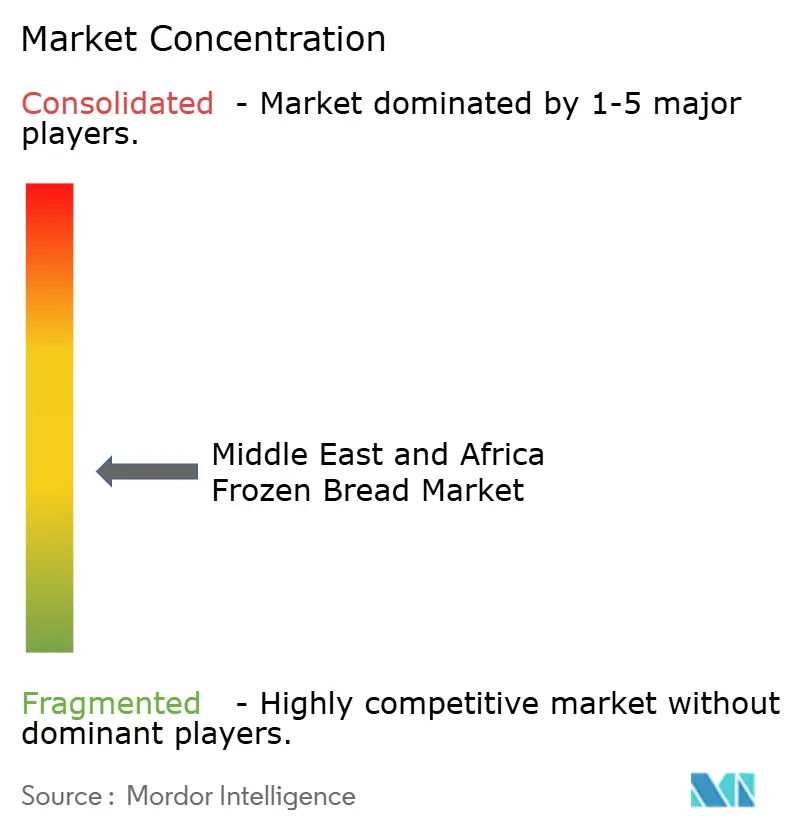
| Market Concentration | Medium |
Major Players *Disclaimer: Major Players sorted in no particular order Image © Mordor Intelligence. Reuse requires attribution under CC BY 4.0. | |
Middle East and Africa Frozen Bread Market Analysis by Mordor Intelligence
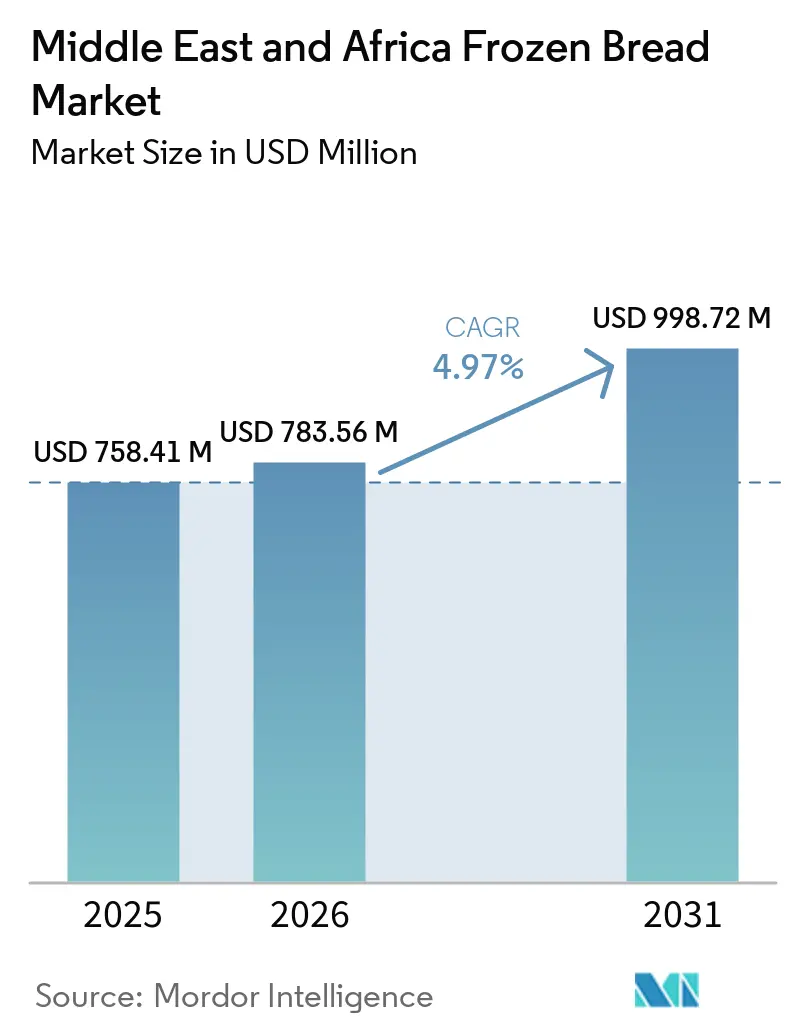
The Middle East and Africa frozen bread market size is expected to grow from USD 758.41 million in 2025 to USD 783.56 million in 2026 and is forecast to reach USD 998.72 million by 2031 at 4.97% CAGR over 2026-2031. The market is moving toward formats that help retailers and foodservice operators manage availability, labor requirements, and waste. Foodservice demand is especially important because hotel, restaurant, institutional, and delivery operators need consistent buns, loaves, and flatbreads across outlets. The Middle East and Africa frozen bread market also benefits when modern retail adds dependable freezer capacity in large urban centers. Cold-chain investment may strengthen access in the Gulf and selected African cities, while gaps in electricity reliability and refrigerated transport remain material barriers elsewhere. Competitive strategies therefore center on local distribution, certified handling, and products suited to both regional eating habits and standardized foodservice menus.
Key Report Takeaways
- By product type, leavened bread held 62.56% of the Middle East and Africa frozen bread market share in 2025, while unleavened bread is forecast to grow at a 5.98% CAGR through 2031.
- By ingredient type, wheat bread held 74.18% in 2025, while multigrain bread is forecast to grow at a 6.04% CAGR through 2031.
- By nature, conventional products held 90.37% in 2025, while free-from products are forecast to grow at a 6.17% CAGR through 2031.
- By distribution channel, off-trade held 58.9% in 2025, while on-trade is forecast to grow at a 6.39% CAGR through 2031.
- By geography, Saudi Arabia held 29.45% of the Middle East and Africa frozen bread market share in 2025, while the United Arab Emirates is forecast to grow at a 5.9% CAGR through 2031.
Note: Market size and forecast figures in this report are generated using Mordor Intelligence’s proprietary estimation framework, updated with the latest available data and insights as of January 2026.
Middle East and Africa Frozen Bread Market Trends and Insights
Drivers Impact Analysis*
| Driver | (~) % Impact on CAGR Forecast | Geographic Relevance | Impact Timeline |
|---|---|---|---|
| Growing demand for convenient and ready-to-bake bakery products | +1.2% | Regional, concentrated in GCC and urban South Africa | Short term (≤ 2 years) |
| Rising adoption of frozen bakery products in foodservice | +1.0% | Saudi Arabia, United Arab Emirates, Egypt | Medium term (2–4 years) |
| Expansion of cold chain and frozen food distribution infrastructure | +0.7% | GCC core, spill-over to East Africa | Medium term (2–4 years) |
| Growing tourism and hospitality industry | +0.6% | Saudi Arabia, United Arab Emirates | Medium term (2–4 years) |
| Increasing demand for consistent bakery quality and reduced food waste | +0.4% | Global, with early gains in United Arab Emirates and Saudi Arabia | Short term (≤ 2 years) |
| Product innovation in artisanal, specialty, and par-baked breads | +0.3% | United Arab Emirates, Saudi Arabia, South Africa | Long term (≥ 4 years) |
| Source: Mordor Intelligence | |||
Growing Demand for Convenient and Ready-to-bake Bakery Products
The busy lifestyles of urban consumers and the need for efficient food preparation are supporting demand for frozen bread across the Middle East and Africa. Frozen loaves, rolls, buns, and flatbreads offer convenient storage, consistent quality, and reduced preparation time for households and foodservice operators. In the UAE, retail sales of frozen baked goods reached USD 74.1 million in 2025, according to Agriculture and Agri-Food Canada[1]. This growth reflects increasing consumer acceptance of frozen bakery products and the expansion of convenient food options. Hotels, restaurants, cafés, and quick-service restaurants also use frozen bread to streamline kitchen operations and maintain consistent product quality. These factors are expected to support market growth as modern retail and foodservice distribution networks expand across the region.
Rising Adoption of Frozen Bakery Products in Foodservice
The growing number of hotels, restaurants, cafés, and quick-service restaurants across the Middle East and Africa is supporting the adoption of frozen bakery products in foodservice operations. Frozen bread enables operators to maintain consistent product quality, reduce preparation time, manage inventory efficiently, and minimize wastage. In Saudi Arabia, the number of licensed tourism hospitality facilities reached 5,622 in the third quarter of 2025, increasing by 40.6% year-on-year, according to the General Authority for Statistics[2]. This expansion creates opportunities for frozen bread suppliers serving hotels, catering companies, and restaurant chains. Frozen burger buns, sandwich rolls, baguettes, and flatbreads are particularly suitable for high-volume foodservice operations. The continued development of hospitality infrastructure and organized food distribution networks is expected to strengthen demand for frozen bread across the region.
Expansion of Cold Chain and Frozen Food Distribution Infrastructure
Expansion of cold-chain logistics and frozen food distribution infrastructure is improving the availability of frozen bread across the Middle East and Africa. Temperature-controlled warehouses, refrigerated transportation, and modern distribution facilities help preserve product quality, reduce spoilage, and extend the geographic reach of frozen bakery suppliers. In Saudi Arabia, the Saudi Food and Drug Authority reported an 18% increase in licensed factories and warehouses in 2025, reaching 9,155 facilities compared with 7,750 in 2024, including 5,344 licensed food-sector warehouses[3]. These infrastructure developments support the storage and movement of temperature-sensitive food products across retail and foodservice channels. In the UAE, investments in food logistics and temperature-controlled warehousing are also strengthening regional distribution capabilities. Improved cold-chain coverage is expected to facilitate wider frozen bread penetration across urban centres and emerging markets in the region.
Growing Tourism and Hospitality Industry
The expansion of tourism and hospitality infrastructure across the Middle East and Africa is creating opportunities for frozen bread suppliers serving hotels, restaurants, cafés, and catering establishments. Rising tourist arrivals and hotel occupancy increase demand for convenient bakery products, including burger buns, sandwich rolls, baguettes, and flatbreads, which help foodservice operators maintain consistent quality and reduce preparation time. According to the UAE Ministry of Economy and Tourism, hotels across the country welcomed 32.34 million guests in 2025, representing a 5.2% increase from 30.75 million in 2024. The growth of hospitality services also encourages foodservice businesses to adopt frozen bakery products that simplify inventory management and support high-volume meal preparation. Continued investment in tourism destinations, hotel facilities, and restaurant infrastructure is expected to strengthen demand for frozen bread across the region.
Restraints Impact Analysis*
| Restraint | (~) % Impact on CAGR Forecast | Geographic Relevance | Impact Timeline |
|---|---|---|---|
| High costs associated with frozen storage and transportation | -0.6% | Regional, highest impact in sub-Saharan Africa | Medium term (2–4 years) |
| Limited cold chain infrastructure in developing African markets | -0.4% | Nigeria, Rest of Africa | Long term (≥ 4 years) |
| Fluctuations in electricity prices and power supply reliability | -0.3% | Nigeria, South Africa | Medium term (2–4 years) |
| High import dependence on frozen bakery products and ingredients | -0.3% | Saudi Arabia, United Arab Emirates | Medium term (2–4 years) |
| Source: Mordor Intelligence | |||
High Costs Associated with Frozen Storage and Transportation
High costs associated with frozen storage and transportation pose a significant restraint on the Middle East and Africa frozen bread market. Frozen bread requires uninterrupted temperature-controlled storage and distribution to maintain product quality, texture, and shelf life. Investments in refrigerated warehouses, freezer equipment, insulated vehicles, and electricity increase operating expenses for manufacturers, distributors, and retailers. The World Bank's Logistics Performance Index highlights the importance of reliable logistics infrastructure and temperature-sensitive supply-chain capabilities in facilitating efficient food distribution, particularly in markets where infrastructure development remains uneven. These costs can increase the final selling price of frozen bread, limiting its affordability among price-sensitive consumers and small foodservice operators.
Limited Cold Chain Infrastructure in Developing African Markets
Limited cold-chain infrastructure in developing African markets constrains the storage, transportation, and distribution of frozen bread products. Frozen bread requires consistent low-temperature conditions throughout the supply chain to preserve quality and prevent deterioration during transit and storage. Inadequate refrigerated warehouses, limited freezer-equipped vehicles, and unreliable electricity supplies can disrupt distribution, particularly outside major urban centres. These challenges increase operating costs for manufacturers and distributors, making it difficult to serve geographically dispersed markets efficiently. Smaller retailers and foodservice operators may also lack the freezer capacity required to store frozen bread products.
*Our forecasts treat driver/restraint impacts as directional, not additive. The impact forecasts reflect baseline growth, mix effects, and variable interactions.
Segment Analysis
By Product Type: Leavened Formats Lead Volume While Unleavened Bread Expands
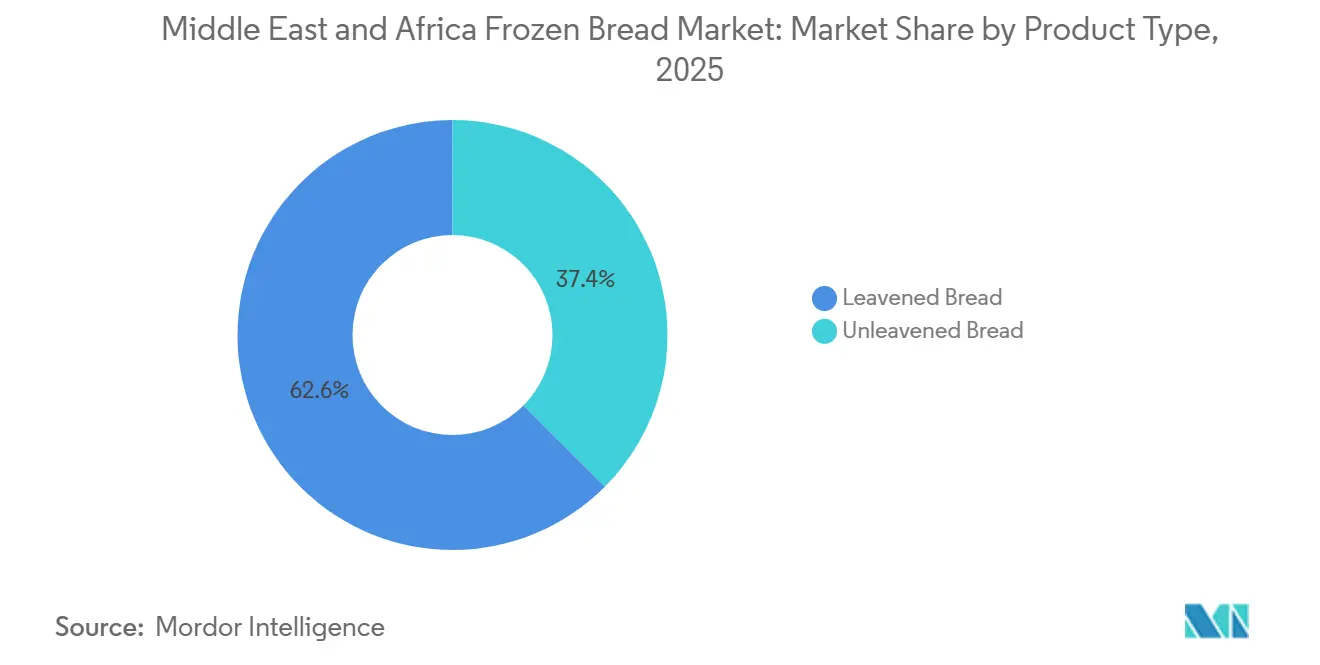
Leavened bread accounted for 62.56% of the Middle East and Africa frozen bread market size in 2025. Burger buns, hotdog buns, dinner rolls, and sandwich loaves support recurring requirements from quick-service restaurants, hotels, airlines, and supermarkets. These formats are suited to standardized weights and specifications. Their established use in foodservice makes them the largest product group. Producers can offer them through bake-off, par-baked, or finished frozen formats. The segment’s scale also supports efficient production and distribution across established cold-chain routes.
Unleavened bread is projected to grow at a 5.98% CAGR through 2031. Pita, flatbread, lavash, and naan match familiar regional meals and diverse expatriate preferences. Their flat shape can simplify freezing, packing, and pallet utilization. This can improve transport and storage efficiency compared with some loaf formats. The Middle East and Africa frozen bread market can use these products to enter foodservice menus outside major urban centers. Wider restaurant formats and delivery menus should support continued demand for this category.
By Ingredient Type: Wheat Bread Retains Scale While Multigrain Builds Demand
Wheat bread accounted for 74.18% of the Middle East and Africa frozen bread market size in 2025. It remains familiar to consumers and practical for large-scale bread production. Wheat-based products also cover widely used buns, loaves, rolls, and flatbreads. Existing recipes and sourcing systems support its leading position. Major producers can manufacture wheat products in formats that fit retail and foodservice demand. This broad relevance makes wheat the central ingredient base for the category.
Multigrain bread is expected to grow at a 6.04% CAGR through 2031. Health-focused consumers and expatriate communities are increasing interest in seeded and wholegrain products. Retailers can use these products to offer a premium choice beside standard wheat formats. Rye and other specialty ingredients remain smaller categories, with demand concentrated in select urban markets. The Middle East and Africa frozen bread market benefits when specialty products are offered in familiar freezer locations. This placement can make trial easier for shoppers who are new to premium frozen bread.
By Nature: Conventional Products Hold Scale While Free-From Products Gain
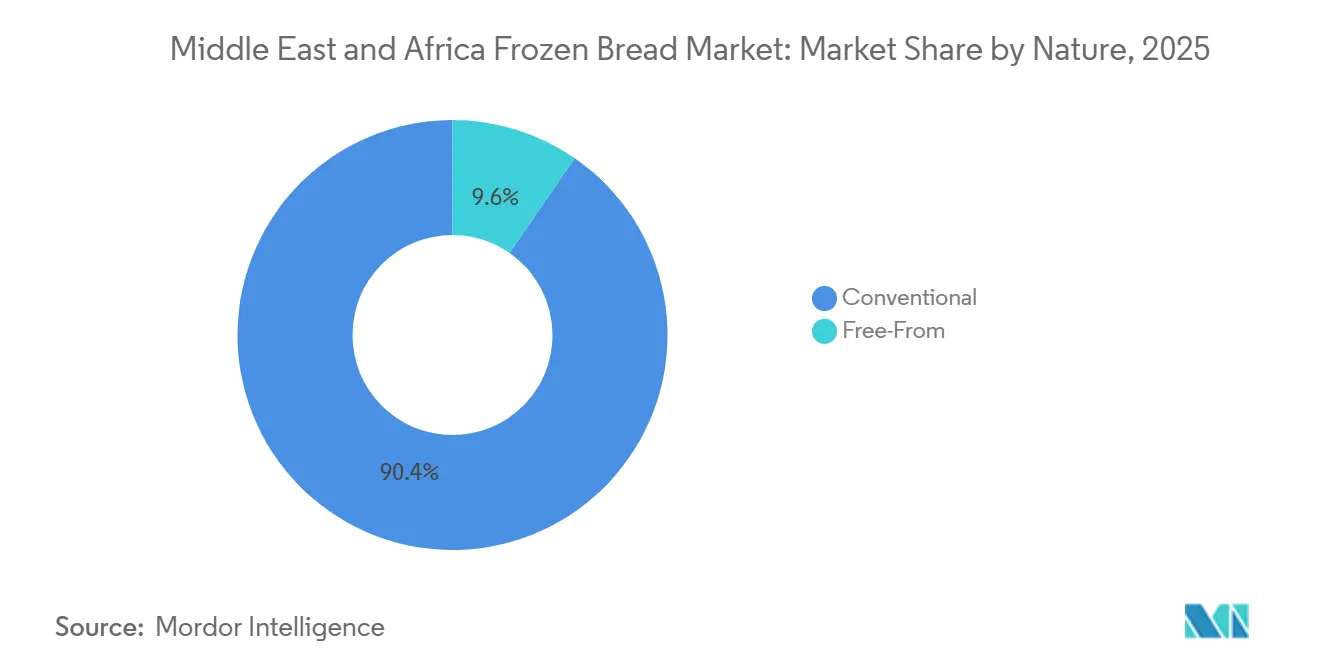
Conventional products accounted for 90.37% of the Middle East and Africa frozen bread market size in 2025. Standard wheat-based products remain more accessible for most households, restaurants, and institutional buyers. Their scale reflects established production processes and a broad price range. Conventional formats also match the main volume needs of supermarket and foodservice customers. Local and international suppliers can offer them across several bread types. This keeps conventional frozen bread as the primary commercial base of the category.
Free-from products are forecast to grow at a 6.17% CAGR through 2031. Gluten-free formats are gaining attention among higher-income consumers in GCC urban areas. The segment remains smaller because free-from products carry a higher price than conventional bread. Its growth nevertheless gives manufacturers a premium product option. Retailers are placing free-from products beside mainstream frozen bread to encourage trial. The Middle East and Africa frozen bread market may gain from this approach where allergen information and product labeling are clearly managed.
By Distribution Channel: Off-Trade Leads Sales While On-Trade Grows Faster
Off-trade channels held 58.39% of the Middle East and Africa frozen bread market size in 2025. Supermarkets and hypermarkets provide the main access point for frozen bread in the GCC and urban South Africa. Their freezer aisles enable consumers to buy loaves, rolls, flatbreads, and specialty items during routine grocery shopping. Organized retailers also have better capacity to maintain product temperature and assortment. Shelf placement in leading stores can determine whether products reach mass consumers. This makes retail partnerships central to brand visibility and volume growth.
On-trade channels are forecast to grow at a 6.39% CAGR through 2031. Hotels, restaurants, catering providers, airlines, and quick-service restaurants use frozen products to improve consistency and planning. Saudi Arabia’s food-delivery channel and growing institutional catering activity increase the need for reliable bakery inputs. Cloud kitchens can use frozen bread, buns, and wraps to support repeatable menu preparation. The Middle East and Africa frozen bread industry has a clear channel opportunity where foodservice groups expand across multiple outlets. Suppliers that meet delivery, quality, and certification requirements are better placed to serve this demand.
Geography Analysis
Saudi Arabia held the leading position in the Middle East and Africa frozen bread market, accounting for 29.45% of the market share in 2025. Demand is supported by the country's established bakery consumption patterns, expanding modern retail infrastructure, and growing foodservice sector. Frozen bread products offer retailers, hotels, restaurants, and catering operators greater convenience, consistent product quality, and reduced preparation time. The development of cold-chain logistics and the availability of frozen bakery products through supermarkets and hypermarkets further support market penetration.
The United Arab Emirates frozen bread market is forecast to register a CAGR of 5.89% through 2031, driven by the expansion of foodservice establishments, tourism, and hospitality infrastructure. The country's diverse expatriate population and established consumption of international cuisines support demand for different bread varieties, including flatbreads, rolls, baguettes, and specialty bread products. Frozen bread also provides operational advantages to hotels, restaurants, cafés, and catering businesses by supporting standardized quality, efficient inventory management, and reduced preparation requirements.
South Africa's frozen bread market benefits from its relatively developed retail infrastructure, established bakery industry, and growing availability of frozen food products through supermarkets and foodservice channels. In Nigeria, urbanization, changing consumption patterns, and demand for convenient food options create opportunities for frozen bread, although affordability, electricity costs, and cold-chain limitations may constrain adoption. Across the rest of the Middle East and Africa, market growth is influenced by urban population expansion, tourism, the development of hospitality establishments, and improvements in food distribution infrastructure.
Competitive Landscape
The market is characterized by a fragmented structure in which regional incumbents, specialty importers, and international frozen bakery suppliers hold distinct channel positions. The Middle East and Africa frozen bread market has no single supplier with the reach to serve every product format and geography. International groups including Aryzta, Lantmännen Unibake, Vandemoortele, and Europastry focus on bake-off and par-baked products for foodservice customers. Their value rests on dependable specifications, centralized supply, and the ability to serve multi-site operators. Regional suppliers including Sunbulah Group, Almarai, and Saudia Bakery have local brand familiarity and domestic distribution networks. Their proximity to customers can reduce last-mile complexity in key GCC markets.
Lantmännen Unibake signed an agreement in December 2025 to acquire Panificio San Francesco, an Italian producer of frozen bread for retail customers. The move adds retail-focused frozen bread capability to its European network. In September 2025, the company also acquired Boboli Benelux, strengthening its savory bakery portfolio and bake-off capabilities. These actions can broaden the products available to foodservice and retail customers in export markets. In June 2025, Lantmännen announced an SEK 700 million investment in a new Swedish production facility focused on specialty buns and rolls. Such capacity investment shows how suppliers are preparing for demand from standardized foodservice and specialty retail segments.
Smaller players such as Modern Bakery, DoFreeze, and Goosebumps can compete through local responsiveness and close relationships with hospitality accounts. These companies may be better positioned to address small, customized orders. The Middle East and Africa frozen bread market also has room for artisanal and specialty products between standard packaged bread and in-store bakery offerings. Compliance remains important because halal certification, allergen declarations, and frozen-food labeling influence customer approval. Suppliers with established food safety systems can be more credible to large retailers and hotel groups. This requirement can limit entry by suppliers without recognized audit and documentation capability. Competition is therefore shaped as much by channel service and compliance as by product price.
Middle East and Africa Frozen Bread Industry Leaders
-
Aryzta AG
-
Sunbulah Group
-
Almarai Company
-
Agthia Group
-
Lantmännen Unibake
- *Disclaimer: Major Players sorted in no particular order
Recent Industry Developments
- August 2026: BinDawood Holding completed the acquisition of a 51% stake in Wonder Bakery, following the December 2025 agreement and completion of the relevant regulatory procedures. The transaction strengthens the link between a major Saudi grocery retailer and a UAE industrial bakery manufacturer supplying regional foodservice and retail customers.
- December 2025: Tiger Brands committed ZAR 1 billion, converted in the supplied source to USD 58.5 million, to construct a new bakery facility in Klerksdorp under its Albany bread brand. The facility is expected to be operational in 2026. The project consolidates production from older locations and is expected to improve efficiency across the South African baking network. It also creates 120 permanent jobs.
- October 2025: DP World announced a USD 29 million cold-storage investment in Egypt’s Elsewedy Industrial Development Park. The facility adds 25,000 pallet positions across 8 independently controlled chambers for chilled and frozen categories. It is designed to provide access to Greater Cairo and major export corridors. Multi-chamber storage can help food suppliers manage products with different temperature requirements.
Middle East and Africa Frozen Bread Market Report Scope
Frozen bread refers to bread products that are baked or partially baked and then frozen to preserve freshness, texture, and quality until they are ready for distribution, retail sale, or final preparation. The Middle East and Africa frozen bread market is segmented by product type, ingredient type, nature, distribution channel and geography. Based on product type, the market is segmented into leavened bread and unleavened bread. Based on ingredient type, the market is segmented into wheat bread, rye bread, multigrain bread and other ingredients. Based oin nature, the market is segmented into conventional and free-from. Based on distribution channel, the market is segmented into off-trade and on-trade. Based on geography, the market is segmented into Saudi Arabia, United Arab Emirates, Nigeria and Rest of Middle East and Africa. For each segment, the market sizing and forecasting have been done in value terms (USD million).
| Leavened Bread |
| Unleavened Bread |
| Wheat Bread |
| Rye Bread |
| Multigrain Bread |
| Other Ingredients |
| Conventional |
| Free-From |
| On-Trade | |
| Off-Trade | Supermarkets/Hypermarkets |
| Convenience Stores | |
| Online Retail Stores | |
| Other Distribution Channels |
| United Arab Emirates |
| Saudi Arabia |
| South Africa |
| Nigeria |
| Rest of Middle East and Africa |
| By Product Type | Leavened Bread | |
| Unleavened Bread | ||
| By Ingredient Type | Wheat Bread | |
| Rye Bread | ||
| Multigrain Bread | ||
| Other Ingredients | ||
| By Nature | Conventional | |
| Free-From | ||
| By Distribution Channel | On-Trade | |
| Off-Trade | Supermarkets/Hypermarkets | |
| Convenience Stores | ||
| Online Retail Stores | ||
| Other Distribution Channels | ||
| By Geography | United Arab Emirates | |
| Saudi Arabia | ||
| South Africa | ||
| Nigeria | ||
| Rest of Middle East and Africa | ||
Key Questions Answered in the Report
What is driving demand for frozen bread in the Middle East and Africa?
Foodservice expansion, modern retail freezer capacity, tourism, and demand for consistent products are supporting growth. The category is projected to grow at a 4.97% CAGR through 2031.
Which product type leads sales in the Middle East and Africa frozen bread category?
Leavened bread leads with 62.56% share in 2025, supported by demand for buns, rolls, and sandwich loaves.
Which frozen bread segment is growing the fastest in the region?
On-trade distribution is the fastest-growing channel, with a projected 6.39% CAGR through 2031.
Why is Saudi Arabia important for frozen bread suppliers?
Saudi Arabia holds 29.45% share in 2025 and has a growing foodservice base. The USDA identifies frozen sandwich bread as a best-prospect product in the country’s foodservice channel.
What is the largest challenge for frozen bread distribution in Africa?
Cold storage, refrigerated transport, and reliable power remain limited in many developing African markets. These constraints restrict product availability beyond major urban centers.