
Middle East and Africa Data Center Video Surveillance Market Size and Share
Market Overview
| Study Period | 2021 - 2032 |
|---|---|
| Forecast Data Period | 2027 - 2032 |
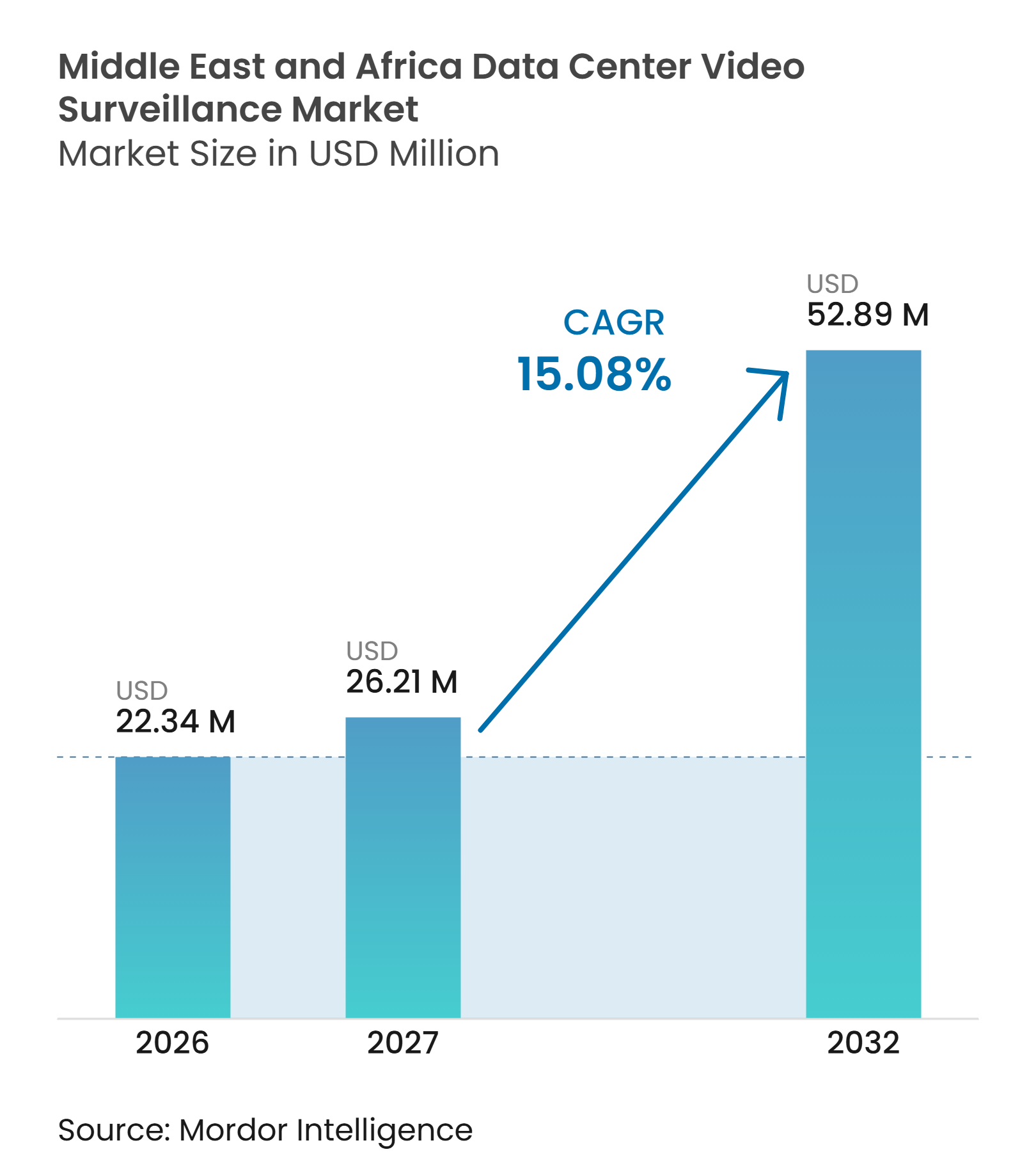
| Base Year Market Size (2026) | USD 22.34 Million |
| Market Size (2027) | USD 26.21 Million |
| Market Size (2032) | USD 52.89 Million |
| Growth Rate (2027 - 2032) | 15.08 % |
| Market Concentration | Medium |
Major Players *Disclaimer: Major Players sorted in no particular order Image © Mordor Intelligence. Reuse requires attribution under CC BY 4.0. | |
Middle East and Africa Data Center Video Surveillance Market Analysis by Mordor Intelligence
The Middle East and Africa data center video surveillance market size is valued at USD 22.34 million in 2026 and is forecast to reach USD 52.89 million by 2032, expanding at a CAGR of 15.08% over 2027-2032. The Middle East and Africa data center video surveillance market is being shaped by new campuses in the Gulf, where surveillance is increasingly specified during design rather than added after commissioning. New compute capacity requires coverage at perimeters, access points, and internal areas, which links security spending to physical expansion and makes security design part of early project planning. Cloud and colocation operators are also raising baseline requirements because tenant obligations demand controlled access to footage, auditable security processes, and clear separation between customer areas. The Middle East and Africa data center video surveillance market is moving beyond cameras alone as operators place more value on centralized management, analytics, and monitoring of technical areas. Data residency rules in Saudi Arabia and the UAE can favor local storage, on-premise systems, or hybrid arrangements for sites that handle sensitive footage.
Key Report Takeaways
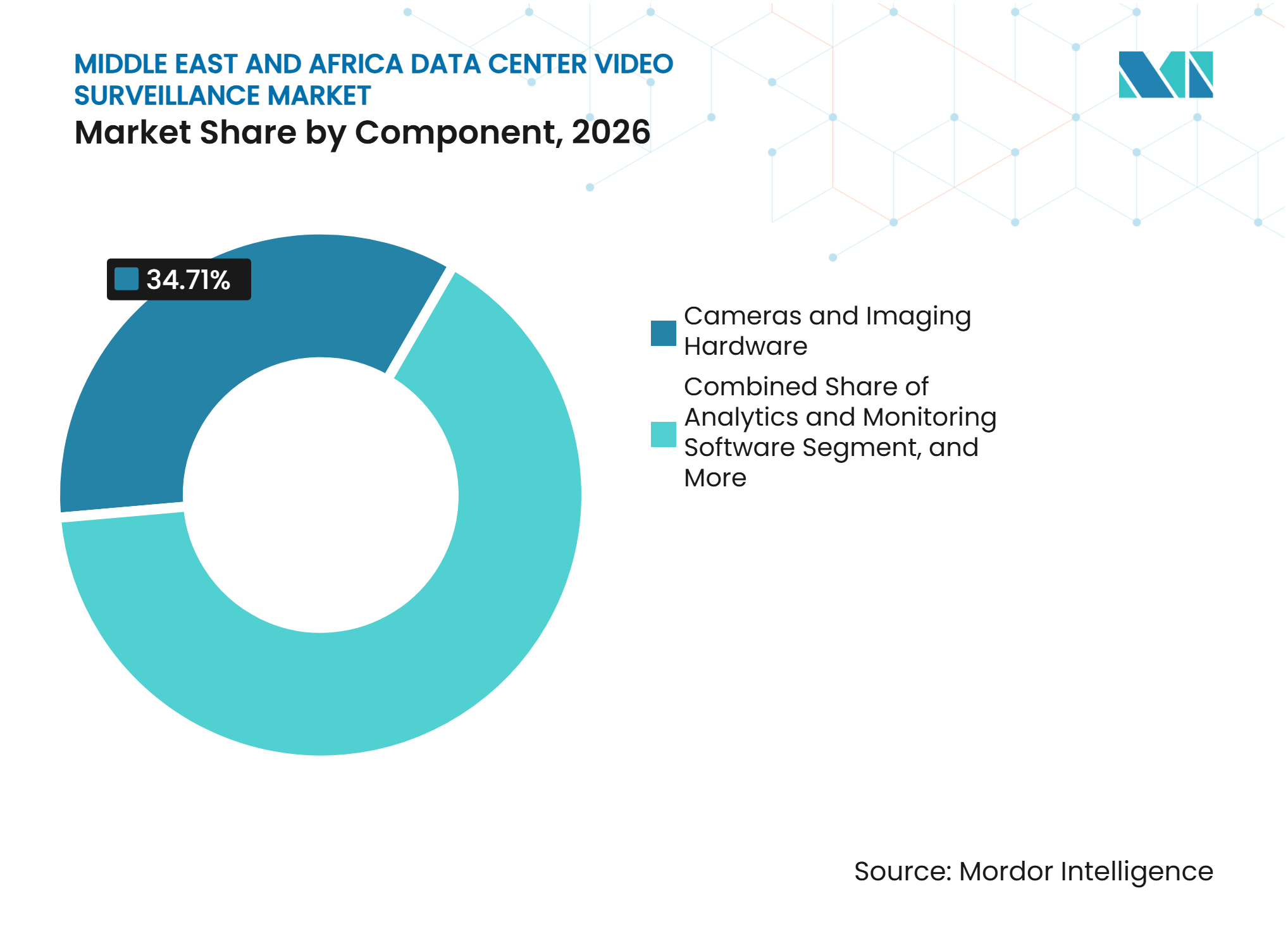
- By component, Cameras and Imaging Hardware held 34.71% of the Middle East and Africa data center video surveillance market share in 2026, while Analytics and Monitoring Software is projected to expand at a 17.26% CAGR through 2032.
- By camera type, Fixed Cameras accounted for 63.28% share in 2026, while PTZ Cameras are projected to expand at an 18.92% CAGR through 2032.
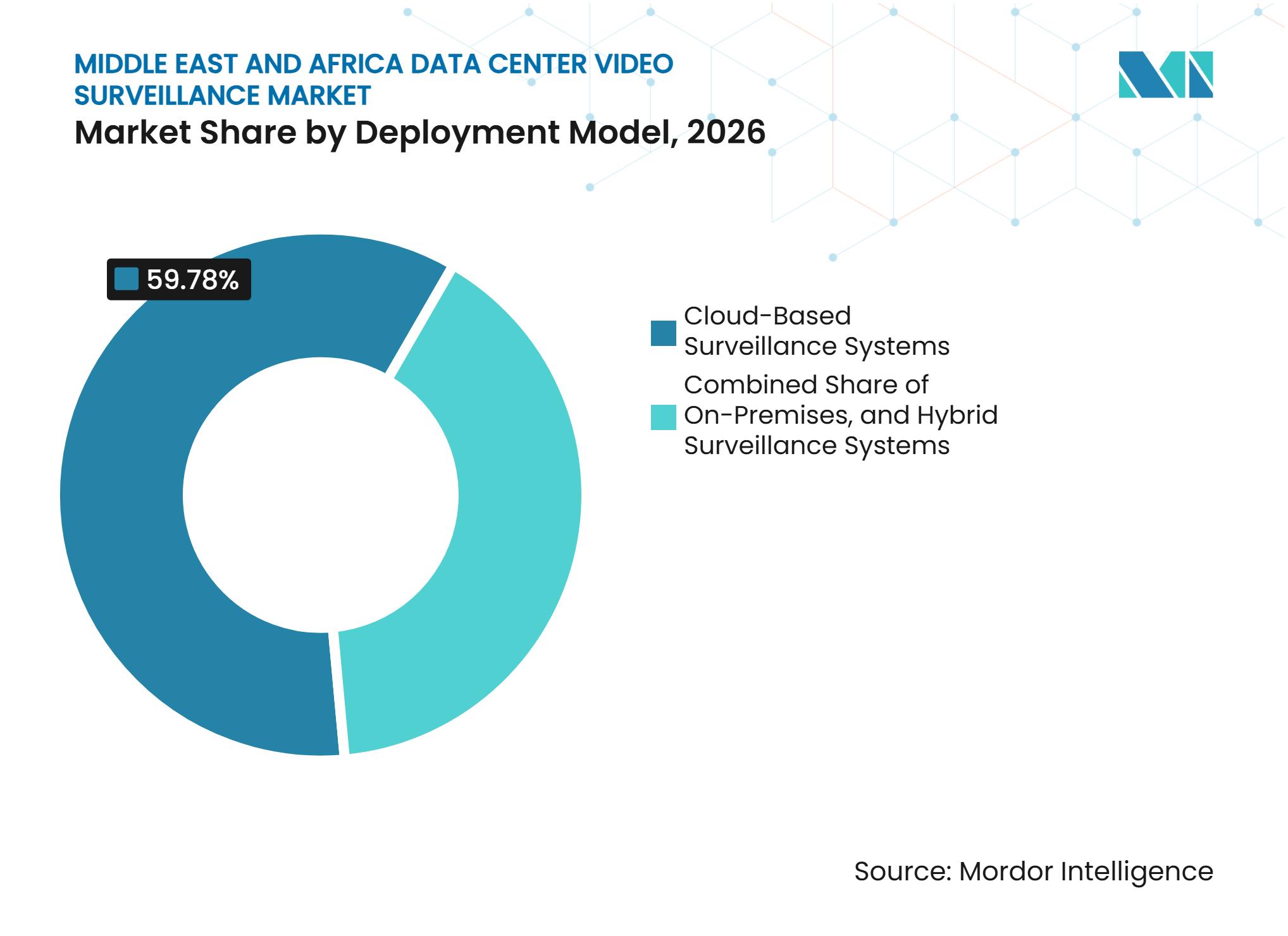
- By deployment model, Cloud-Based Surveillance Systems held 59.78% share in 2026 and are projected to expand at a 17.39% CAGR through 2032.
- By application, Perimeter and External Area Monitoring held 28.74% share in 2026, while Electrical and Mechanical Room Monitoring is projected to expand at a 16.59% CAGR through 2032.
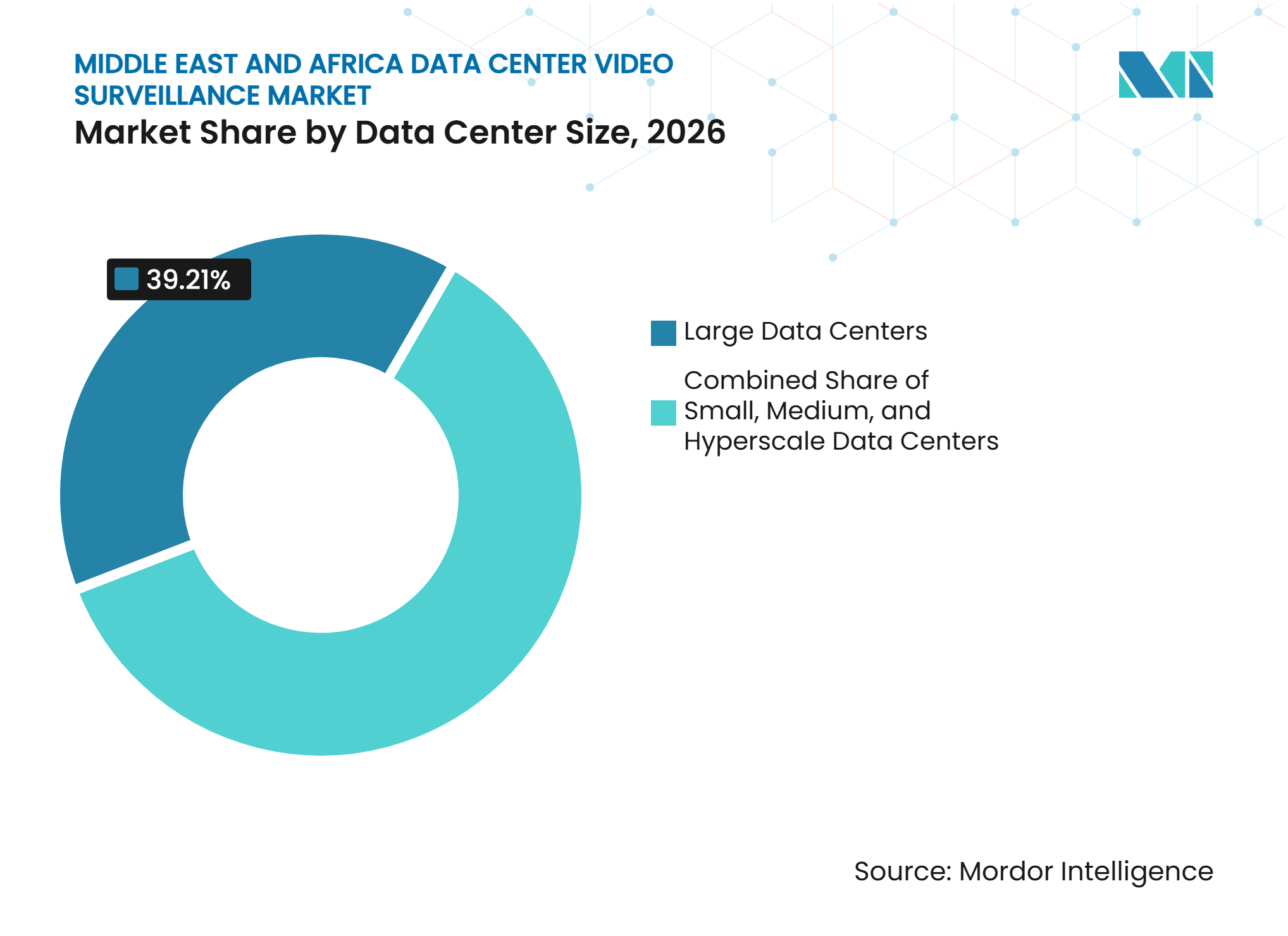
- By data center size, Large Data Centers accounted for 39.21% share in 2026, while Hyperscale Data Centers are projected to expand at a 16.27% CAGR through 2032.
- By data center type, Colocation Data Centers held 36.64% share in 2026, while Edge Data Centers are projected to expand at a 17.38% CAGR through 2032.
- By geography, the UAE accounted for 37.64% share in 2026, while Saudi Arabia is projected to expand at a 16.91% CAGR through 2032.
Note: Market numbers in this report are based on Mordor Intelligence's proprietary estimation framework, which combines nine months of actuals with Q4 projections for base year 2026.
Market Trends and Insights
Drivers Impact Analysis of Middle East and Africa Data Center Video Surveillance Market*
| Driver | (~) % Impact on CAGR Forecast | Geographic Relevance | Impact Timeline |
|---|---|---|---|
| Data Center Capacity Expansion in Saudi Arabia and the UAE | +4.8% | Saudi Arabia, UAE | Short term (≤ 2 years) |
| Cloud Region and Colocation Investment in the Gulf | +3.2% | UAE, Saudi Arabia, Qatar | Medium term (2-4 years) |
| Migration From Analog to IP and Hybrid Surveillance | +2.5% | UAE and Saudi Arabia primary, Africa secondary | Short term (≤ 2 years) |
| AI Video Analytics for Real-Time Threat Detection | +2.0% | UAE, Saudi Arabia, South Africa | Medium term (2-4 years) |
| Data Residency and Critical Infrastructure Protection Requirements | +1.3% | Saudi Arabia, UAE, Nigeria | Medium term (2-4 years) |
| Integrated Surveillance, Access Control, and VMS Procurement | +0.8% | UAE, Saudi Arabia, South Africa | Long term (≥ 4 years) |
| Source: Mordor Intelligence | |||
Data Center Capacity Expansion Across Saudi Arabia and the UAE
Saudi Arabia and the UAE are adding data center capacity that requires surveillance coverage before sites begin operations. HUMAIN plans up to 6.6 GW of national capacity by 2034 through partnerships with NVIDIA, AMD, and Amazon Web Services. Each campus requires layered coverage across outside boundaries, entry points, data halls, plant areas, loading zones, and other places where staff or contractors move through the site. Khazna Data Centers has a USD 1.3 billion expansion program, while G42 is developing its 200 MW Stargate UAE campus. These projects extend the procurement cycle beyond initial camera installation because facilities must maintain and scale their security systems as new halls, technical equipment, and tenant areas enter service. The Middle East and Africa data center video surveillance market therefore benefits when capacity expansion moves from planning to construction and operation.
Cloud Region and Colocation Investment in the Gulf
Cloud region entry into Gulf colocation campuses brings physical security requirements from global operators into local facilities. Host operators must meet those requirements when security controls form part of tenant conditions. Multi-tenant sites need separate rights for viewing footage, storing recordings, and accessing analytics dashboards. This creates demand for video management systems that can separate users and areas without reducing site-wide oversight, while retaining a documented record for investigation and audit purposes. Eagle Eye Networks established a Riyadh data center to support local cloud video storage requirements under Saudi Vision 2030.[1] The Middle East and Africa data center video surveillance market gains from this shift because cloud connectivity must be paired with control over where video is held.
Migration From Analog to IP and Hybrid Surveillance
New Gulf facilities generally use IP-connected video systems, while upgrade activity continues in African colocation sites. Tier III requirements strengthen the case for replacing analog equipment with networked cameras and managed recording systems. At Moro Hub in Dubai, Axis Communications deployed visual and thermal cameras across 5 security layers, from the outside perimeter to individual server racks.[2] The deployment shows how networked video can support coverage, lower false alarms, and reduce reliance on patrols. Hybrid configurations can retain legacy cameras through IP encoders while adding cloud-managed video management capabilities, allowing operators to modernize recording, search, alerts, and remote review in stages. This approach protects earlier equipment investment and gives the Middle East and Africa data center video surveillance market a longer upgrade path.
AI Video Analytics for Real-Time Threat Detection
AI analytics can help operators distinguish authorized technicians from unauthorized people in restricted areas. This reduces the volume of alarms that staff must review and can speed the response to a genuine incident, especially where manual review across a large campus would otherwise take substantial time. Motorola Solutions introduced Avigilon Visual Alerts at Intersec Dubai in January 2026, using on-premise generative AI for site-specific detection without cloud connectivity.[3] Presight and Khazna Data Centers signed an October 2025 MOU for an AI command-and-control platform across 30 UAE sites that combines energy, cooling, equipment, and physical security monitoring. InfraX and Hikvision also signed an October 2025 MOU to develop AI and machine learning camera and video management solutions for UAE critical infrastructure. These developments support the Middle East and Africa data center video surveillance market by placing analytics within both centralized platforms and camera hardware.
Restraints Impact Analysis of Middle East and Africa Data Center Video Surveillance Market*
| Restraint | (~) % Impact on CAGR Forecast | Geographic Relevance | Impact Timeline |
|---|---|---|---|
| High Upfront Cost for Advanced Data Center Security | -2.1% | Africa, South Africa, Nigeria, Emerging MEA | Short term (≤ 2 years) |
| Privacy, Footage Governance, and Cross-Border Data Transfer Risk | -1.4% | Saudi Arabia, UAE, cross-border colocation contexts | Medium term (2-4 years) |
| Fragmented Integration Across Legacy and New Security Systems | -1.0% | Global, particularly Turkey and Africa | Medium term (2-4 years) |
| Shortage of Specialized Security Operations Personnel in Emerging African Markets | -0.7% | Sub-Saharan Africa, Nigeria, Kenya, Ethiopia | Long term (≥ 4 years) |
| Source: Mordor Intelligence | |||
High Upfront Cost for Advanced Data Center Security
Tier III and Tier IV security designs can require perimeter cameras, thermal imaging, access-point biometrics, video management licenses, installation, and regular maintenance. These costs compete with spending on power, cooling, connectivity, and wider site certification, particularly for early-stage African colocation operators that are still building basic infrastructure. The International Finance Corporation noted that Microsoft committed USD 300 million to South African hyperscale cloud and AI infrastructure for 2025-2027. Smaller operators do not necessarily have the same ability to fund certified security upgrades. Skilled integrator fees, firmware maintenance, and managed-service contracts add to the financial burden in locations with limited specialist talent. The Middle East and Africa data center video surveillance market may therefore see delayed upgrades where core infrastructure needs remain urgent.
Privacy, Footage Governance, and Cross-Border Data Transfer Risk
Video footage recorded inside a data center may capture individuals and can be subject to different data protection rules across the region. Saudi Arabia's Personal Data Protection Law governs the handling of image and biometric data. The UAE Cyber Security Council issued National Cloud Security Policy v2.0 in September 2025 with 3 sovereignty tiers linked to data classification for critical infrastructure. Operators that use international cloud storage for video must assess whether recording, retention, remote access, and administrative arrangements meet local obligations for sensitive facilities. Contractual safeguards, local storage decisions, and cross-border controls can add work for smaller providers that have limited specialist compliance resources. These rules can slow deployment in the Middle East and Africa data center video surveillance market while also encouraging local cloud, on-premise, and hybrid solutions.
*Our forecasts treat driver/restraint impacts as directional, not additive. The impact forecasts reflect baseline growth, mix effects, and variable interactions.
Middle East and Africa Data Center Video Surveillance Market Segment Analysis
By Component:
Hardware Holds Share, Software Intelligence Drives GrowthCameras and Imaging Hardware held 34.71% of Middle East and Africa data center video surveillance market share in 2026 because certified sites require coverage across multiple security zones. Camera installation remains necessary regardless of a facility's size, deployment model, or tenant mix. The hardware category includes the visible field devices needed at perimeters, access points, corridors, and data halls. Its position reflects the basic coverage requirements that operators must meet before they can add more advanced functions. Multi-tenant facilities can require more camera coverage because they must document access across areas used by different customers.
Analytics and Monitoring Software is projected to expand at a 17.26% CAGR through 2032. Operators are shifting more procurement attention toward behavioral detection and faster review of recorded video. Per-camera analytics licenses create recurring revenue that differs from hardware replacement cycles. Duxbury Networking introduced the Ironlink AI NVR with CVEDIA Analytics and Milestone XProtect in South Africa in November 2025, supporting edge-based behavioral detection on existing camera estates. Milestone Systems announced AI Search and Video Summarization for XProtect in March 2026, with general availability targeted by the end of 2026. The Middle East and Africa data center video surveillance market is consequently giving software a larger role in system value and vendor differentiation.



By Camera Type:
Fixed Cameras Dominate as PTZ Deployments Scale in New FacilitiesFixed Cameras held 63.28% of the camera type segment in 2026 because static coverage is required at perimeters, access points, and data hall corridors. These units provide the baseline visual record for locations with predictable routes and fixed fields of view. Thermal cameras and specialized low-light and infrared cameras serve outer areas and locations with difficult nighttime conditions. Their installation volumes are lower because their use is more targeted and their unit cost is higher. Fixed coverage remains central to the Middle East and Africa data center video surveillance market because every certified facility needs consistent monitoring of core zones.
PTZ Cameras are projected to expand at an 18.92% CAGR through 2032. Hyperscale campuses use PTZ systems to track movement across wide outdoor areas without matching every requirement with a fixed-camera unit. AI analytics can trigger a PTZ camera to reposition when it detects an anomaly. This pairing can extend the area covered by each unit and reduce response time for security teams. High ambient temperatures at Saudi Arabian and UAE campuses also support the use of thermal technology in demanding perimeter settings. As campus footprints expand, the Middle East and Africa data center video surveillance market has a stronger case for dynamic coverage alongside fixed installations.
By Deployment Model:
Cloud Platform Consolidates as Multi-Site Surveillance BackboneCloud-Based Surveillance Systems held 59.78% share of the deployment model segment in 2026. The same deployment model is projected to expand at a 17.39% CAGR through 2032. Multi-site colocation operators use centralized video management to apply consistent security policies across facilities. A cloud platform can reduce the hardware needed at each individual site while making remote oversight easier. These operational benefits explain why the Middle East and Africa data center video surveillance market has placed cloud systems at the center of multi-site deployments.
Eagle Eye Networks completed its merger with Brivo in December 2025, combining cloud video, AI analytics, access control, visitor management, and intrusion detection in one managed suite. On-Premise Surveillance Systems remain important where classified government data cannot pass through cloud infrastructure. Hybrid Surveillance Systems combine local recording with cloud-managed analytics and remote access. This model helps operators modernize older facilities without discarding working equipment. The need to match architecture to data sovereignty conditions keeps more than one deployment model relevant. That flexibility supports continued demand across the Middle East and Africa data center video surveillance market.

By Application:
Perimeter Defense Commands the Largest Share, Internal Monitoring AcceleratesPerimeter and External Area Monitoring held 28.74% share of the application segment in 2026. Operators prioritize the outer boundary because they need to detect and deter unauthorized entry before an intruder reaches an internal security layer. Entrance and Access Point Monitoring, Data Hall and Internal Corridor Monitoring, and Loading Bay and Delivery Area Monitoring cover places with regular staff, contractor, and delivery activity. These applications require close links between visual monitoring and identity verification. Perimeter coverage therefore remains a basic requirement in the Middle East and Africa data center video surveillance market.
Electrical and Mechanical Room Monitoring is projected to expand at a 16.59% CAGR through 2032. Operators increasingly treat equipment anomalies and unauthorized internal access as risks that can lead to downtime. Cameras in technical areas can relate unusual access patterns to environmental sensor information and create alerts before an event becomes an outage. Moro Hub used modular cameras to monitor individual server racks, showing how surveillance can extend deeper into high-density computing environments. ISO/IEC 27001 requires documented and monitored access controls across critical areas, widening the scope of surveillance beyond facility boundaries. Distributed estates also increase the need for remote site and campus monitoring across the Middle East and Africa data center video surveillance market.
By Data Center Size:
Large Facilities Anchor Revenue, Hyperscale Expands ScopeLarge Data Centers held 39.21% share of the size segment in 2026. These facilities have high surveillance spending per site and represent the largest installed base among regional operators. Medium and small facilities make up more locations but have lower expenditure per site. Their systems generally involve fewer areas, less integration work, and lighter specifications. The Middle East and Africa data center video surveillance market size for large facilities reflects the greater number of zones that large sites must secure.
Hyperscale Data Centers are projected to expand at a 16.27% CAGR through 2032. New campuses in the UAE and Saudi Arabia can require surveillance over extensive data halls, mechanical plant, and outdoor boundaries. At this scale, surveillance needs its own redundancy measures and managed-service arrangements. HUMAIN has a 1.9 GW capacity target for 2030, while the Stargate UAE campus adds to the region's near-term hyperscale pipeline. These projects can create further security spending after initial commissioning as sites mature and coverage requirements expand. The Middle East and Africa data center video surveillance market is therefore exposed to a growing concentration of high-value projects even as smaller sites remain numerous.
By Data Center Type:
Colocation Sets Security Standards as Edge Facilities MultiplyColocation Data Centers held 36.64% share of the data center type segment in 2026. Their tenant contracts require surveillance controls and audit trails that make physical security a commercial requirement. Cloud Service Providers that operate within third-party sites must often meet the same standards as the host facility. This extends the effect of colocation requirements across both facility operators and tenants. The Middle East and Africa data center video surveillance market share held by colocation sites reflects the importance of multi-tenant obligations.
Edge Data Centers are projected to expand at a 17.38% CAGR through 2032. Distributed AI inferencing infrastructure is extending toward telecommunications towers, smart-city nodes, and industrial sites. These smaller sites need enterprise-grade security within limited power and physical space. Vendors are responding with compact systems that maintain AI analytics in smaller equipment formats. Presight and Khazna's planned AI command center for 30 UAE data centers illustrates a centralized model for governing distributed physical security. This approach avoids the need for separate manual monitoring teams at every edge location in the Middle East and Africa data center video surveillance market.
Geography Analysis
United Arab Emirates
The UAE accounted for 37.64% of Middle East and Africa data center video surveillance market share in 2026. The country has 35 operational data centers operating at 98.7% utilization and a USD 46.1 billion investment pipeline. G42's Stargate UAE campus has a 200 MW target for mid-2026, while Khazna Data Centers has a USD 1.3 billion expansion across 5 facilities. These projects increase the need for security systems that can operate across campus boundaries, technical areas, and tenant zones. Turkey has 76 data centers, the highest count in the broader MENA region, and its colocation operators bring European-standard IP surveillance into regional deployments.
Saudi Arabia
Saudi Arabia is projected to expand at a 16.91% CAGR through 2032, the highest geographic rate in the Middle East and Africa data center video surveillance market. HUMAIN's 1.9 GW target for 2030 and its USD 3 billion Blackstone partnership point to substantial future capacity development. The National Cybersecurity Authority's CCC-2:2024 framework and data residency governance administered by the Saudi Data and AI Authority require regulated facilities to demonstrate local handling of cloud-connected surveillance footage. These requirements can favor local cloud regions or on-premise storage. They also make regulatory alignment a central part of supplier selection.
Africa (South Africa and Nigeria)
Africa provides a longer-term opportunity led by South Africa and Nigeria, where investment is starting from a lower base. Equinix announced a USD 22 million LG3 Lagos project in November 2025 as the first phase of a USD 100 million Africa expansion. The project includes enterprise IP video surveillance and biometric access at zone boundaries under Equinix IBX security standards. Nigeria's data center capacity is set to surpass 320 MW in the medium term, while the Nigeria Data Protection Commission enforces the Nigeria Data Protection Act 2023 for facilities processing Nigerian personal data. Duxbury Networking's November 2025 AI NVR launch in South Africa adds to the local integrator base for the next set of colocation projects. The Middle East and Africa data center video surveillance market must also address capital constraints and specialist staffing gaps as these locations expand.
Competitive Landscape
Market Concentration
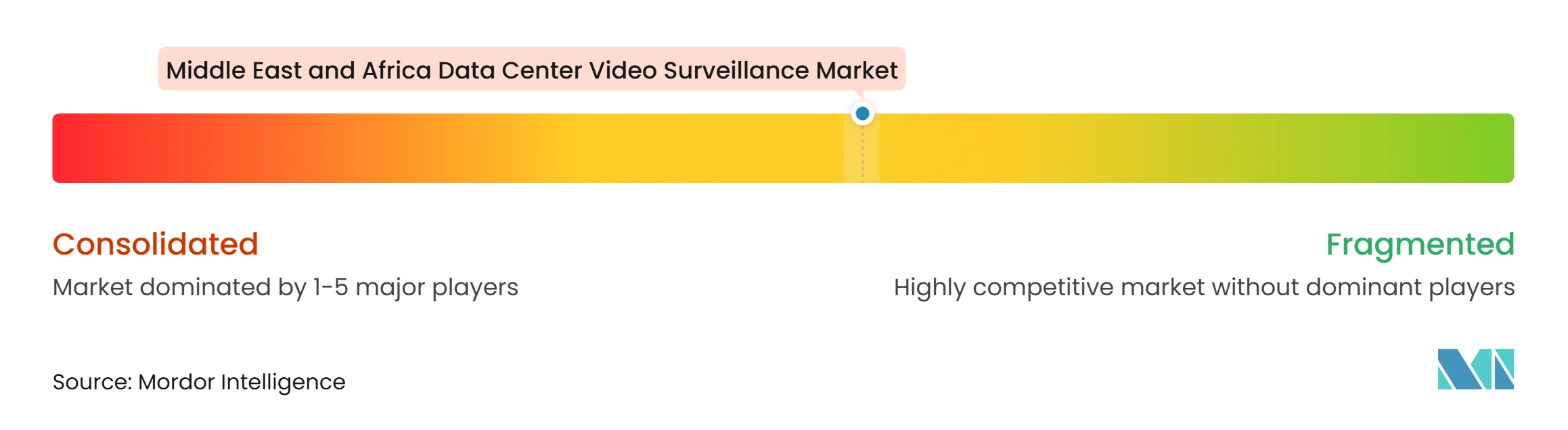
The Middle East and Africa data center video surveillance market is moderately fragmented. Axis Communications AB, Hangzhou Hikvision Digital Technology Co., Ltd., and Hanwha Vision Co., Ltd. compete through cameras, embedded AI functions, and hardware development. Genetec Inc. and Milestone Systems A/S compete through open-platform video management and cloud-focused delivery. Honeywell International Inc., Johnson Controls International plc, and Motorola Solutions Inc. offer combinations of cameras, video management, access control, and managed services. This range of suppliers gives colocation operators a choice between specialist components and integrated security packages.
Johnson Controls' American Dynamics video surveillance range received SIRA accreditation in the UAE. The accreditation shows that formal compliance credentials can be a procurement condition in mission-critical environments. Hikvision is pursuing hardware-level differentiation through its Guanlan large-language-model technology and the InfraX partnership. The approach could make camera software more important in purchasing decisions at large facilities. In Africa, Securex Agencies (K) Ltd. and GardaWorld Security Africa address local managed-security needs that remote global vendors may not serve as efficiently. This leaves the Middle East and Africa data center video surveillance market open to both global technology providers and regional service firms.
Eagle Eye Networks and Brivo combined their cloud video and access-control capabilities in December 2025. The transaction reduces fragmentation among cloud video management providers and broadens the scope of a single managed platform. Milestone Systems announced native AI functions for XProtect in March 2026, which strengthens open-platform competition with proprietary AI camera systems. Motorola Solutions introduced an on-premise generative AI offering in January 2026 for operators that cannot use cloud connectivity. These moves raise the requirements for suppliers that offer only a single feature. The Middle East and Africa data center video surveillance market remains competitive because no supplier share data establishes a dominant group of leading vendors.
Middle East and Africa Data Center Video Surveillance Industry Leaders
-
Axis Communications AB
-
Robert Bosch GmbH
-
Honeywell International Inc.
-
Johnson Controls International plc
-
Motorola Solutions, Inc.
- *Disclaimer: Major Players sorted in no particular order
Middle East and Africa Data Center Video Surveillance Market Companies Covered in this Report
- Axis Communications AB
- Robert Bosch GmbH
- Honeywell International Inc.
- Johnson Controls International plc
- Motorola Solutions, Inc.
- Hangzhou Hikvision Digital Technology Co., Ltd.
- Dahua Technology Co., Ltd.
- Hanwha Vision Co., Ltd.
- Schneider Electric SE
- Genetec Inc.
- Milestone Systems A/S
- Eagle Eye Networks, Inc.
- Avigilon Corporation
- FLIR Systems, Inc.
- Securitas Technology AB
- G4S Limited
- Convergint Technologies LLC
- NTT DATA Corporation
- Equinix, Inc.
- Digital Realty Trust, Inc.
- N+ONE Data Centers
- IXAfrica Data Centre
- Securex Agencies (K) Ltd
Recent Industry Developments in Middle East and Africa Data Center Video Surveillance Market
- May 2026: Honeywell International Inc. and the UAE Cyber Security Council announced a collaboration to develop AI-powered OT cybersecurity programs for the UAE's National Security Operations Centre, targeting critical digital infrastructure sectors including data centers.
- March 2026: Milestone Systems A/S announced native AI features, AI Search and Video Summarization via fine-tuned vision-language models, for XProtect, targeting general availability by end of 2026 in a major capability upgrade for the open-platform VMS category.
- January 2026: Motorola Solutions Inc. unveiled Avigilon Visual Alerts at Intersec Dubai, delivering on-premise generative AI for site-specific surveillance scenario detection without cloud connectivity, addressing the data sovereignty requirements of Gulf data center operators.
- December 2025: Eagle Eye Networks Inc. completed its merger with access-control company Brivo, forming the Brivo Security Suite integrating cloud video surveillance, AI analytics, access control, visitor management, and intrusion detection under a single managed platform.
Middle East and Africa Data Center Video Surveillance Market Report Scope
The Middle East and Africa Data Center Video Surveillance Market encompasses technologies and services that enable visual security, monitoring, and surveillance of data center facilities. It includes solutions designed to enhance physical security, detect unauthorized activities, support incident response, and provide real-time operational visibility across critical infrastructure environments. The market is driven by increasing concerns over facility protection, asset security, business continuity, and the growing adoption of intelligent surveillance systems with advanced monitoring and analytics capabilities.
The Middle East and Africa Data Center Video Surveillance Market is Segmented by Component (Cameras and Imaging Hardware, Video Management Software, Storage and Recording Hardware, Analytics and Monitoring Software, and Installation, Integration, and Support Services), Camera Type (Fixed Cameras, Pan-Tilt-Zoom Cameras, Thermal Cameras, and Specialized Low-Light and Infrared Cameras), Deployment (On-Premise Surveillance Systems, Cloud-Based Surveillance Systems, and Hybrid Surveillance Systems), Application (Perimeter and External Area Monitoring, Entrance and Access Point Monitoring, Data Hall and Internal Corridor Monitoring, Electrical and Mechanical Room Monitoring, Loading Bay and Delivery Area Monitoring, and Remote Site and Campus Monitoring), Size (Small, Medium, Large, Hyperscale), Data Center Type (Colocation, Cloud Service Provider(CSPs), Enterprise / Edge, and Edge Data Centers), and Country (Middle East (United Arab Emirates, Saudi Arabia, Turkey, and Rest of Middle East), Africa (South Africa, Nigeria, and Rest of Africa)). The Market Forecasts are Provided in Terms of Value (USD).
Segmentation Overview
| Cameras and Imaging Hardware |
| Video Management Software |
| Storage and Recording Hardware |
| Analytics and Monitoring Software |
| Installation, Integration, and Support Services |
| Fixed Cameras |
| Pan-Tilt-Zoom Cameras |
| Thermal Cameras |
| Specialized Low-Light and Infrared Cameras |
| On-Premise Surveillance Systems |
| Cloud-Based Surveillance Systems |
| Hybrid Surveillance Systems |
| Perimeter and External Area Monitoring |
| Entrance and Access Point Monitoring |
| Data Hall and Internal Corridor Monitoring |
| Electrical and Mechanical Room Monitoring |
| Loading Bay and Delivery Area Monitoring |
| Remote Site and Campus Monitoring |
| Small |
| Medium |
| Large |
| Hyperscale |
| Colocation |
| Cloud Service Provider(CSPs) |
| Enterprise / Edge |
| Edge Data Centers |
| Middle East | United Arab Emirates |
| Saudi Arabia | |
| Turkey | |
| Rest of Middle East | |
| Africa | South Africa |
| Nigeria | |
| Rest of Africa |
| By Component | Cameras and Imaging Hardware | |
| Video Management Software | ||
| Storage and Recording Hardware | ||
| Analytics and Monitoring Software | ||
| Installation, Integration, and Support Services | ||
| By Camera Type | Fixed Cameras | |
| Pan-Tilt-Zoom Cameras | ||
| Thermal Cameras | ||
| Specialized Low-Light and Infrared Cameras | ||
| By Deployment Model | On-Premise Surveillance Systems | |
| Cloud-Based Surveillance Systems | ||
| Hybrid Surveillance Systems | ||
| By Application | Perimeter and External Area Monitoring | |
| Entrance and Access Point Monitoring | ||
| Data Hall and Internal Corridor Monitoring | ||
| Electrical and Mechanical Room Monitoring | ||
| Loading Bay and Delivery Area Monitoring | ||
| Remote Site and Campus Monitoring | ||
| By Data Center Size | Small | |
| Medium | ||
| Large | ||
| Hyperscale | ||
| By Data Center Type | Colocation | |
| Cloud Service Provider(CSPs) | ||
| Enterprise / Edge | ||
| Edge Data Centers | ||
| By Geography | Middle East | United Arab Emirates |
| Saudi Arabia | ||
| Turkey | ||
| Rest of Middle East | ||
| Africa | South Africa | |
| Nigeria | ||
| Rest of Africa | ||
Key Questions Answered in the Report
What is the size of the Middle East and Africa data center video surveillance market?
The Middle East and Africa data center video surveillance market size is USD 22.34 million in 2026 and is forecast to reach USD 52.89 million by 2032. The forecast reflects an expected 15.08% CAGR over 2027-2032, with surveillance demand tied to both new campuses and the modernization of existing sites, including upgrades that connect legacy cameras to IP networks, centralized management platforms, analytics software, remote review tools, and more secure recording arrangements for regulated and critical infrastructure settings across the region. The expansion is linked to capacity additions that require coverage at perimeters, entry points, data halls, technical areas, loading areas, and remote facilities that are managed as part of a wider estate.
What is driving demand for video surveillance at regional data centers?
New capacity in Saudi Arabia and the UAE is increasing demand for coverage at perimeters, access points, data halls, and technical areas. Colocation requirements also increase the need for separated access to footage, documented security controls, and reliable audit trails for multiple tenants. AI analytics adds value by helping teams prioritize incidents that need immediate attention and by reducing reliance on staff who would otherwise review substantial amounts of routine video.
Which deployment model leads regional data center surveillance?
Cloud-Based Surveillance Systems held 59.78% share in 2026 and are projected to expand at a 17.39% CAGR through 2032. Multi-site operators use centralized video management to apply comparable policies, access rights, and video review processes across several facilities. On-premise systems remain relevant for sites where classified information cannot pass through cloud infrastructure or where the operator needs direct control of recordings held inside the facility.
Which camera type is expected to expand fastest?
PTZ Cameras are projected to expand at an 18.92% CAGR through 2032 as large campuses use dynamic tracking across wider perimeters. When connected with analytics, PTZ systems can reposition after an anomaly is detected and help security teams review activity across broad outdoor areas. Fixed Cameras nonetheless remain the baseline camera type for predictable access routes, corridors, entrance points, and core security zones where a stable field of view is required.
Why are hybrid surveillance systems relevant for data centers?
Hybrid systems retain local recording while adding cloud-managed analytics and remote access. This can help operators modernize existing camera estates while retaining control of footage that is subject to data residency conditions and internal storage requirements. The model also avoids replacing working hardware at once, which can ease the cost of an upgrade and allow a site to update its security capabilities during normal operations.
Which country has the highest projected growth rate?
Saudi Arabia is projected to expand at a 16.91% CAGR through 2032, supported by data center capacity development, local data handling requirements, and large planned hyperscale projects. Regulated facilities can require cloud-connected surveillance footage to be handled within the country. This can favor suppliers that support local cloud regions, on-premise storage, or hybrid deployment options, together with controls that limit footage access to approved users.