
Middle East and Africa Data Center Risk Engineering and Management Market Size and Share
Market Overview
| Study Period | 2021 - 2032 |
|---|---|
| Forecast Data Period | 2027 - 2032 |
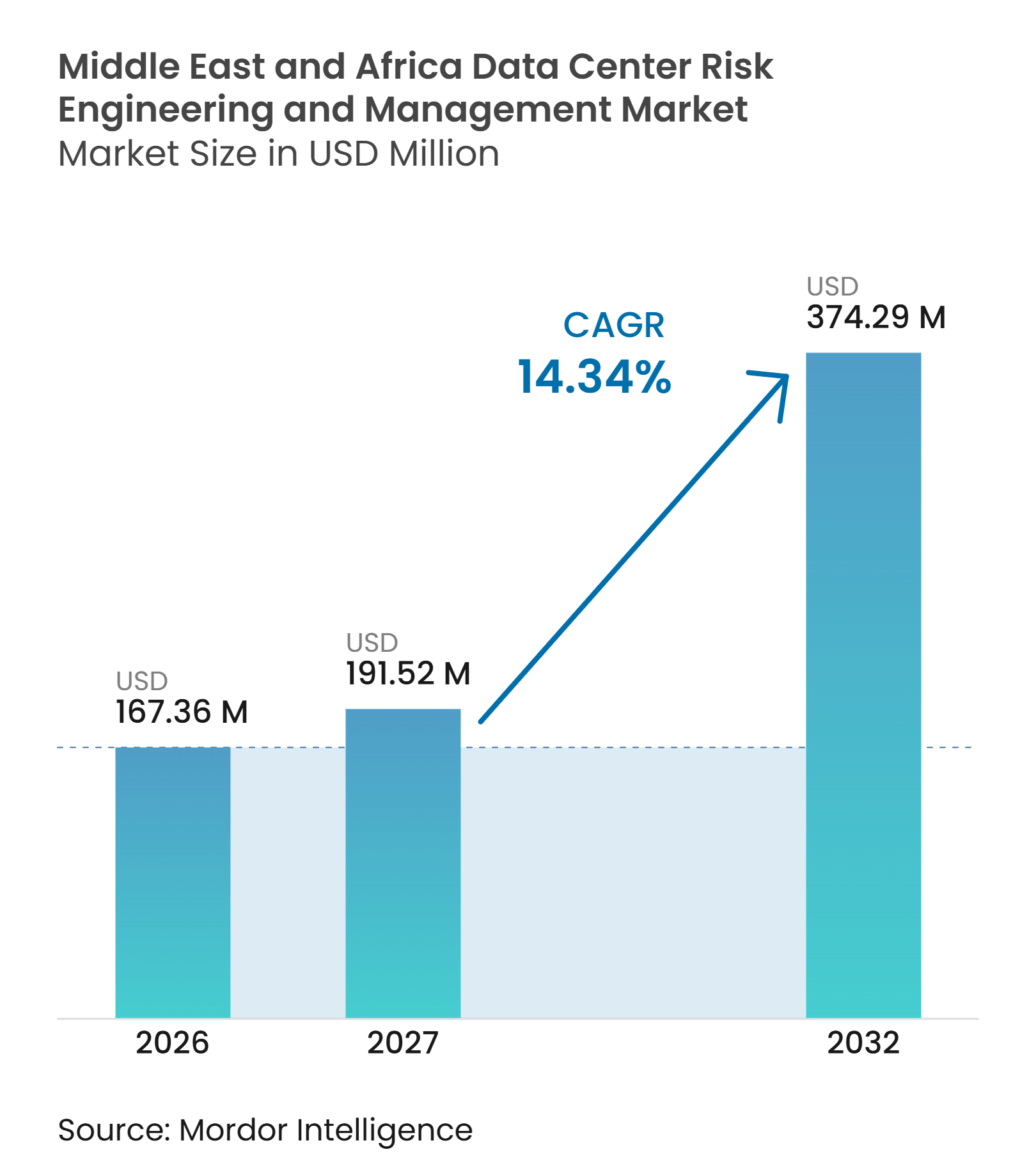
| Base Year Market Size (2026) | USD 167.36 Million |
| Market Size (2027) | USD 191.52 Million |
| Market Size (2032) | USD 374.29 Million |
| Growth Rate (2027 - 2032) | 14.34 % |
| Market Concentration | Medium |
Major Players *Disclaimer: Major Players sorted in no particular order Image © Mordor Intelligence. Reuse requires attribution under CC BY 4.0. | |
Middle East and Africa Data Center Risk Engineering and Management Market Analysis by Mordor Intelligence
The Middle East and Africa data center risk engineering and management market size is projected to expand from USD 167.36 million in 2026 to USD 374.29 million by 2032, registering a CAGR of 14.34% between 2027 and 2032. The Middle East and Africa data center risk engineering and management market is supported by a large pipeline of facilities that must manage demanding power, cooling, resilience, and compliance requirements. AI infrastructure increases the consequences of equipment failure because higher rack density brings greater heat loads and more complex electrical systems into each facility. National data rules and tier-based licensing also make formal risk reviews part of the operating framework rather than an optional service. Insurers and lenders are bringing engineering assessments earlier into project planning, which links risk work with financing and construction decisions. This gives providers an opening to build longer client relationships that extend from design review through operational monitoring across the region and its major facility clusters.
Key Report Takeaways
- By service type, Risk Assessment and Auditing held 31.48% of the Middle East and Africa data center risk engineering and management market share in 2026, while Reliability and Availability Engineering is projected to expand at a 15.13% CAGR through 2032.
- By risk category, Electrical and Power Infrastructure Risk accounted for 28.62% of the market in 2026, while Cooling and Thermal Management Risk is projected to expand at a 14.96% CAGR through 2032.
- By assessment method, Qualitative Risk Assessment held a 34.19% share in 2026, while Continuous Risk Assessment and Monitoring is projected to expand at a 14.89% CAGR through 2032.
- By engagement model, One-Time Assessment and Audit accounted for 35.76% of the market in 2026, while Continuous Risk Management Services is projected to expand at a 14.93% CAGR through 2032.
- By project lifecycle stage, Operational Risk Management held 36.57% share in 2026, while Expansion, Retrofit, and Modernization is projected to expand at a 14.87% CAGR through 2032.
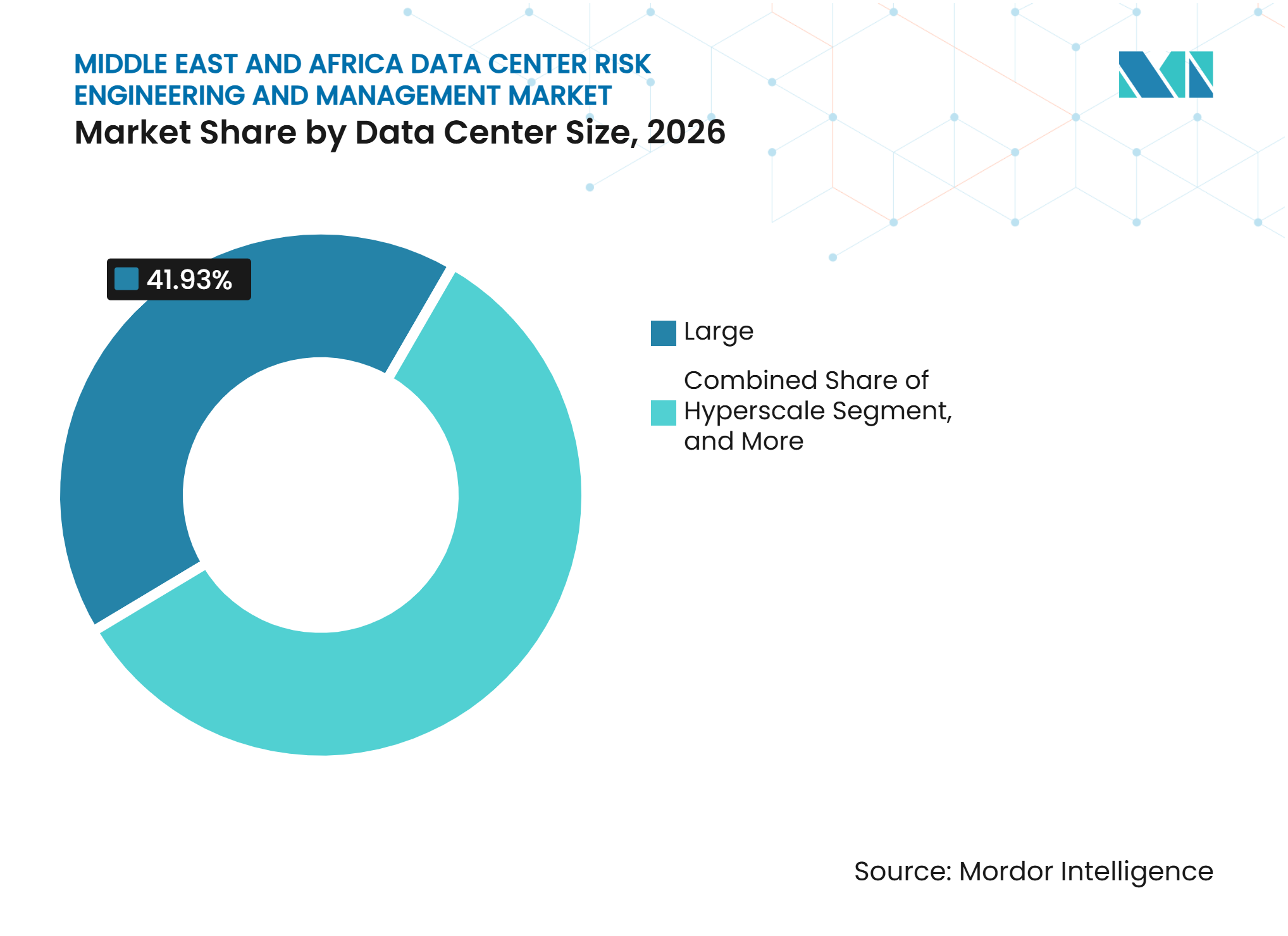
- By data center size, Large data centers accounted for 41.93% share in 2026, while Hyperscale data centers are projected to expand at a 14.98% CAGR through 2032.
- By data center type, Colocation facilities held 38.24% share in 2026, while Cloud Service Providers are projected to expand at a 14.91% CAGR through 2032.
- By geography, the United Arab Emirates held 32.85% share in 2026, while Saudi Arabia is projected to expand at a 15.17% CAGR through 2032.
Note: Market numbers in this report are based on Mordor Intelligence's proprietary estimation framework, which combines nine months of actuals with Q4 projections for base year 2026.
Market Trends and Insights
Drivers Impact Analysis of Middle East and Africa Data Center Risk Engineering and Management Market*
| Driver | (~) % Impact on CAGR Forecast | Geographic Relevance | Impact Timeline |
|---|---|---|---|
| AI and High-Density Workload Expansion | +3.8% | UAE, Saudi Arabia core, GCC-wide spillover | Short term (≤ 2 years) |
| Data Sovereignty and National-Critical Digital Infrastructure | +3.2% | GCC-wide, Saudi Arabia and UAE in focus | Short term (≤ 2 years) |
| Insurer and Lender Demand for Demonstrable Risk Controls | +2.5% | Global, MEA and GCC priority markets | Medium term (2-4 years) |
| Rising Complexity of Power, Cooling, Networking, and Facility Infrastructure | +2.1% | MEA-wide | Medium term (2-4 years) |
| Water Scarcity and Extreme-Climate Design Requirements | +1.4% | GCC primarily, with early gains in North Africa and Egypt | Medium term (2-4 years) |
| Concurrent Construction and Live-Operations Risk | +0.8% | Saudi Arabia, UAE, and construction-dense corridors | Short term (≤ 2 years) |
| Source: Mordor Intelligence | |||
AI and High-Density Workload Expansion
AI-focused facilities are changing the technical scope of the Middle East and Africa data center risk engineering and management market. Higher-density server layouts require reviews of electrical design, cooling performance, fire protection, and fault isolation before equipment enters service. The UAE’s active data center program includes an AED 2 billion (USD 544.6 million) hyperscale facility announced by du in April 2025, with Microsoft named as its primary offtaker. Such projects can require specialist engagement during design, commissioning, and later operating stages. Providers that understand liquid cooling and high-density electrical systems can move beyond a single certification review. This also makes the Middle East and Africa data center risk engineering and management market more dependent on multidisciplinary engineering capacity.
Data Sovereignty and National-Critical Digital Infrastructure
Data localization requirements make risk management part of the governance model for facilities that host government, financial, and other sensitive workloads. Saudi Arabia’s Data Center Services Regulation uses a tiered framework that includes Qualifying, Limited, Standard, and Advanced classifications. Operators must demonstrate service continuity, recovery planning, and operating controls that align with their classification requirements. Nournet announced ANSI/TIA-942-C Rated-3 certification for its Dammam data center in April 2025, showing how an operator can translate compliance needs into a formal technical program. The Middle East and Africa data center risk engineering and management market therefore benefits when regulation requires documentation that can be independently reviewed. Firms that can work across technical, security, and operational evidence will be well placed as these rules mature.
Insurer and Lender Demand for Demonstrable Risk Controls
Insurance and project finance decisions increasingly require evidence that a facility can withstand construction and operating failures. Aon expanded its Data Center Lifecycle Insurance Program to USD 2.5 billion in January 2026 and included risk engineering and cyber impact modeling within the offer. FM launched its Intellium program in May 2025 to provide specialist support for data center and power infrastructure risks.[1] These approaches place engineering review alongside insurance capacity instead of treating it as a separate cost. In the Middle East and Africa data center risk engineering and management market, this can bring specialists into site selection, design review, and commissioning earlier than before. It also favors suppliers that can explain technical controls in terms useful to insurers, lenders, owners, and contractors.
Rising Complexity of Power, Cooling, Networking, and Facility Infrastructure
The Middle East and Africa data center risk engineering and management market must address systems that interact more closely than in earlier facilities. Electrical distribution, backup power, cooling loops, controls, fiber routes, and fire systems can each create a wider outage if their interfaces are not tested. TÜV NORD stated that TSI.EN50600 V3.0 replaced V2.1 in September 2025, creating updated requirements for certified facilities. EN 50600, ISO/IEC 22237, and ANSI/TIA-942 provide recognized structures for evaluating reliability and facility performance. A review that covers only a single discipline may miss linked failures across equipment and operational processes. This supports demand for teams that can combine power, thermal, networking, and resilience expertise in a single engagement.
Restraints Impact Analysis of Middle East and Africa Data Center Risk Engineering and Management Market*
| Restraint | (~) % Impact on CAGR Forecast | Geographic Relevance | Impact Timeline |
|---|---|---|---|
| High Cost of Specialist Risk Engineering and Assessment Services | -2.3% | Global, most acute in Africa | Short term (≤ 2 years) |
| Limited Availability of Engineers with Data Center-Specific Expertise | -1.9% | MEA-wide | Medium term (2-4 years) |
| Scarcity of Loss History for Hyperscale AI Facilities | -0.8% | Global, with GCC in focus | Medium term (2-4 years) |
| Fragmented Responsibility Across Owner, Contractor, Utility, and Technology Stakeholders | -0.6% | MEA-wide | Long term (≥ 4 years) |
| Source: Mordor Intelligence | |||
High Cost of Specialist Risk Engineering and Assessment Services
Comprehensive risk work can cover site selection, design review, commissioning, and operating monitoring, making it difficult for smaller operators to buy the full service. This challenge is more pronounced in African markets, where many facilities are smaller and local technical budgets are limited. The Africa Data Centre Association identifies the need for stronger skills capacity as data center development expands across the continent. Large facilities can spread specialist costs across more capacity and more demanding customer contracts. Smaller operators may instead rely on internal teams or general engineering advisers, which limits the reach of the Middle East and Africa data center risk engineering and management market. Providers that develop modular reviews and local delivery capacity could reduce this access gap without lowering technical standards.
Limited Availability of Engineers With Data Center-Specific Expertise
The region needs engineers who can assess power systems, thermal controls, fire protection, failure analysis, and facility operations together. Those combined capabilities are scarce, especially while construction programs compete for the same specialists across several global regions. The Africa Data Centre Association has identified workforce development as a key issue for the continent’s digital infrastructure plans. This shortage can delay assessments and concentrate work among larger providers with broader technical teams. Certification pathways aligned with ANSI/TIA-942, EN 50600, and ISO/IEC 22237 can help develop more consistent local capability. In the Middle East and Africa data center risk engineering and management market, training programs and locally sustainable staffing models can become a practical source of differentiation.
*Our forecasts treat driver/restraint impacts as directional, not additive. The impact forecasts reflect baseline growth, mix effects, and variable interactions.
Middle East and Africa Data Center Risk Engineering and Management Market Segment Analysis
By Service Type:
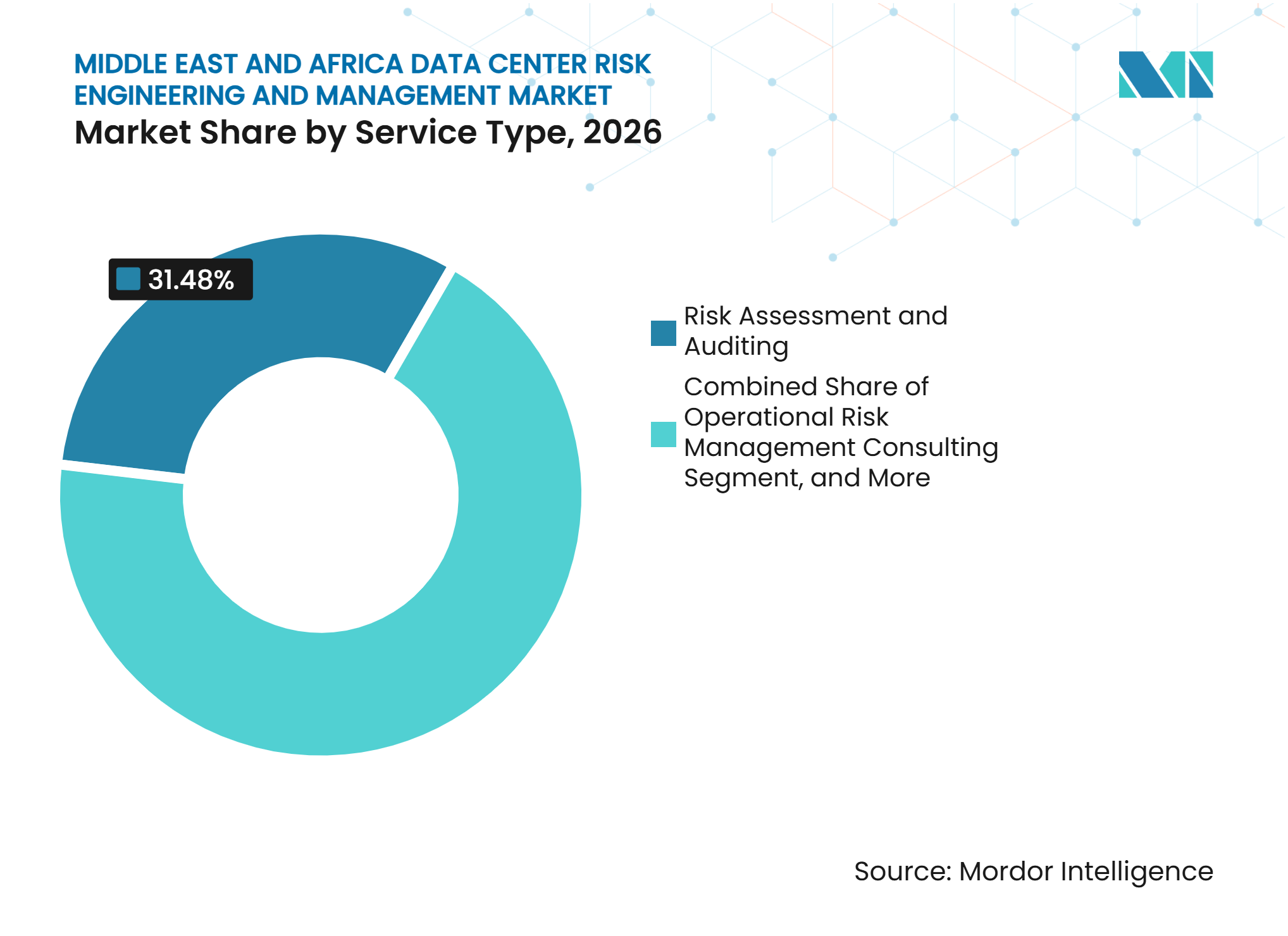
Auditing Supports Entry Requirements as Reliability Work ExpandsRisk Assessment and Auditing held a 31.48% share of the regional market in 2026. It often provides the documented evidence needed for licensing, insurance placement, and initial facility approval. Operators use audit work to identify weaknesses in power, cooling, fire safety, security, and procedures before a facility moves into service. The service also establishes a baseline to support subsequent reviews following capacity changes or major equipment upgrades. Regulatory and insurance expectations make audit trails particularly important in Gulf projects. This keeps auditing central even as customers seek more continuous services.
Reliability and Availability Engineering is projected to grow at a 15.13% CAGR through 2032. It focuses on whether systems and operating practices can deliver the availability commitment made to customers. Failure mode and effects analysis, fault-tree review, and root cause analysis are useful where a single failure may disrupt critical services. Saudi tiered requirements strengthen the need to retain records of failures, recovery actions, and corrective work. Updated technical criteria under TSI.EN50600 V3.0 also encourages certified facilities to review their evidence and controls.



By Risk Category:
Power Risk Leads as Thermal Risk Becomes More ComplexElectrical and Power Infrastructure Risk accounted for 28.62% of the Middle East and Africa data center risk engineering and management market size in 2026. Power availability underpins every facility service, which makes electrical design, backup generation, switching procedures, and equipment maintenance core review areas. Grid connection timing and transformer procurement can also shape project schedules. A power assessment must consider redundancy as well as the sequence of events that occurs when a component fails. High-value equipment and customer commitments raise the cost of a poorly managed electrical incident. This explains why power risk remains the leading category across operating and construction-stage facilities.
Cooling and Thermal Management Risk is projected to grow at a 14.96% CAGR through 2032. AI workloads increase heat density and encourage the use of direct-to-chip and immersion cooling methods. These systems introduce distinct failure paths compared with conventional computer room air conditioning systems. Engineering teams need to evaluate coolant loops, water quality, leak detection, controls, electrical interfaces, and emergency response. The UAE government has formed a national team to review the impact of data centers on the energy sector, reflecting the broader significance of fast-growing capacity for infrastructure. This creates a sustained role for thermal and environmental risk evaluation in the Middle East and Africa data center risk engineering and management market.
By Assessment Method:
Qualitative Reviews Lead While Continuous Monitoring RisesQualitative Risk Assessment held a 34.19% market share in 2026. New facilities often need structured workshops, risk matrices, and expert review before there is enough operating history for detailed statistical modeling. These methods help owners identify priority concerns during early design, construction, and certification stages. They also bring together the views of operators, contractors, technology suppliers, and compliance teams. The approach is useful when a project must make decisions quickly under incomplete technical information. Its leading position reflects the high share of facilities still moving through early lifecycle stages.
Continuous Risk Assessment and Monitoring is projected to expand at a 14.89% CAGR through 2032. Sensor networks and facility management systems can provide current information on temperature, power quality, equipment alarms, and operating performance. This lets teams compare live performance with commissioning baselines and identify exceptions sooner. Digital models can also test the effect of an equipment loss before it occurs in service. Continuous approaches are especially relevant for sites hosting critical workloads that cannot tolerate lengthy maintenance outages. The Middle East and Africa data center risk engineering and management market can use these tools to shift work from periodic checks toward more regular operational support.
By Engagement Model:
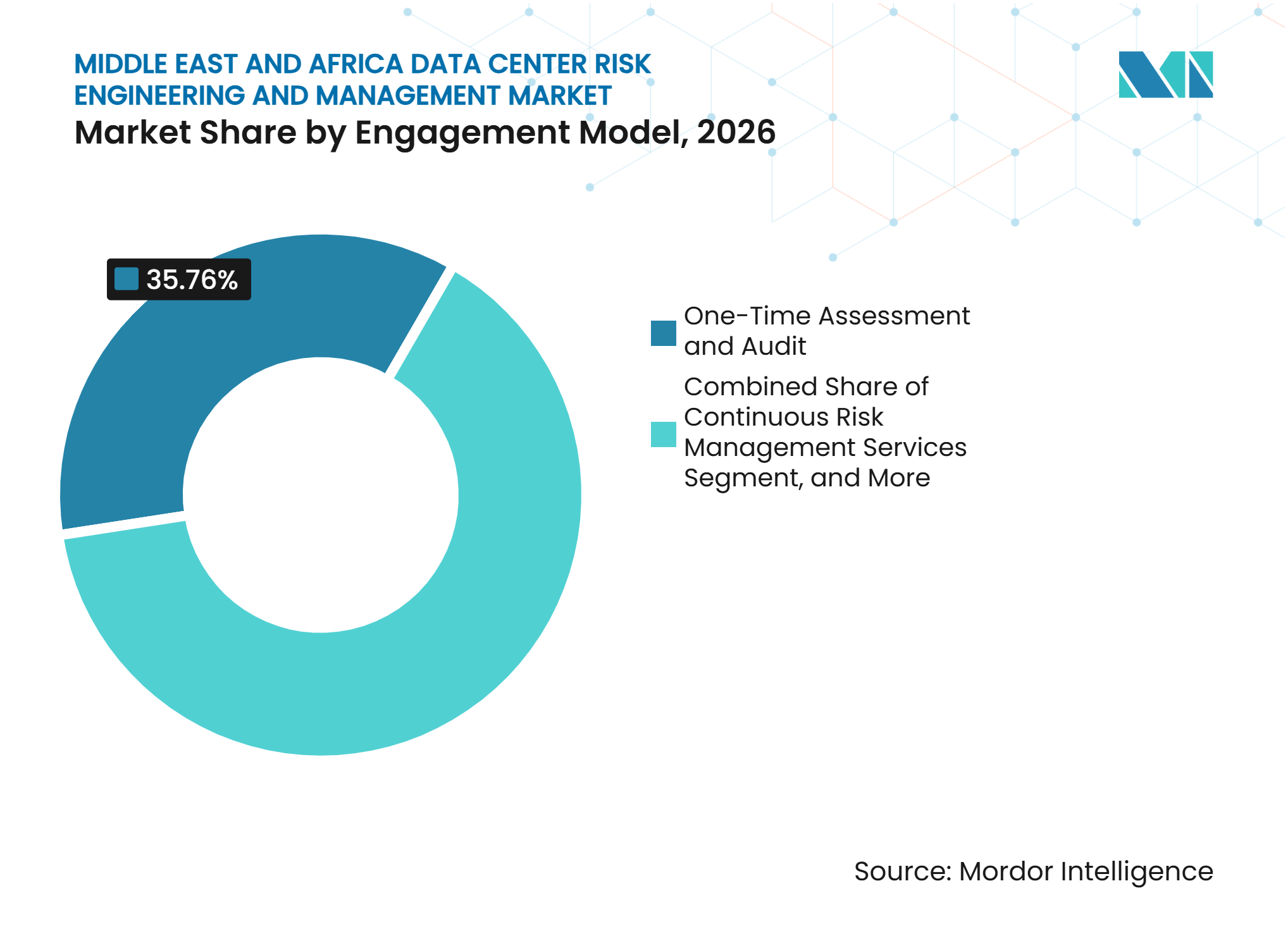
One-Time Audits Remain Foundational as Retained Services GrowOne-Time Assessment and Audit accounted for 35.76% of market share in 2026. New buildings need initial technical validation before operators begin service and before customers place sensitive workloads. A defined audit engagement offers a clear scope, specific findings, and an evidence trail for a regulator, insurer, lender, or customer. It is also a practical entry point for operators that do not yet have funding for an extended advisory program. The model remains important across both Gulf construction programs and emerging African facilities. It will continue to support demand while the installed base grows.
Continuous Risk Management Services is projected to expand at a 14.93% CAGR through 2032. These arrangements can cover operational review, compliance monitoring, expansion planning, and periodic resilience testing. They are suited to facilities that support sovereign, financial, or cloud workloads and must show ongoing control rather than a single approval. Aon’s lifecycle insurance program combines insurance elements with risk engineering and cyber modeling, illustrating a more integrated service structure. The retained model can provide providers with better visibility into a client’s evolving risk profile. It can also create a more stable revenue base for the Middle East and Africa data center risk engineering and management market.

By Project Lifecycle Stage:
Operational Services Lead as Retrofit Work AcceleratesOperational Risk Management held a 36.57% share in 2026. Existing data centers require recurring reviews of maintenance practices, emergency procedures, incidents, vendor performance, and control effectiveness. The installed base in the UAE, Saudi Arabia, Turkey, and South Africa supports this demand even while new construction expands. Operational work matters because design intent can weaken if procedures are not maintained after handover. It also gives owners a record of how risks were identified and addressed over time. This makes operational support the largest lifecycle stage in the Middle East and Africa data center risk engineering and management market.
Expansion, Retrofit, and Modernization is projected to expand at a 14.87% CAGR through 2032. Many operating facilities were designed before the current demand for AI-ready racks and more intensive cooling. Owners may need to add liquid cooling, stronger power feeds, and upgraded fire protection without taking critical services offline. This places a premium on phasing plans, change control, and commissioning tests. The work is more complex when a facility must continue serving live customers during the upgrade. Risk specialists can help owners manage those interfaces and maintain evidence for customers and insurers.
By Data Center Size:
Large Sites Lead While Hyperscale Projects AccelerateLarge data centers accounted for 41.93% in 2026. This reflects an established base of enterprise and carrier-neutral facilities in the UAE, Saudi Arabia, and South Africa. Large sites have enough installed equipment and customer exposure to justify more formal risk assessments. Their owners often manage multiple power paths, cooling systems, network connections, and tenant requirements. A single operational interruption can affect many clients at once. This keeps large facilities a consistent source of work for the Middle East and Africa data center risk engineering and management market.
Hyperscale data centers are projected to expand at a 14.98% CAGR through 2032. These campuses concentrate large amounts of computing capacity, energy demand, and project capital in a small number of sites. Their scale requires careful consideration of grid access, equipment delivery, construction sequencing, and resilience design. The UAE government’s announcement of du’s AED 2 billion (USD 544.6 million) hyperscale project shows the level of investment entering this category.[2] A failure at a major campus could affect services beyond a single local customer group. Specialist support is therefore likely to extend through the full project lifecycle.
By Data Center Type:
Colocation Leads as Cloud Providers Add CapacityColocation facilities held 38.24% of the regional market in 2026. Carrier-neutral campuses must accommodate multiple tenants, network providers, insurers, and operating commitments within the same building. This produces overlapping expectations for security, access control, power continuity, and change management. Colocation owners also need to show that shared infrastructure can meet each customer’s service requirements. Their broad tenant base makes documented procedures and consistent testing particularly important. The segment continues to form a major base of demand across regional hubs.
Cloud Service Providers are projected to grow at a 14.91% CAGR through 2032. Sovereign cloud regions and AI capacity require dedicated engineering attention from construction to live operations. Their service commitments make resilience, cyber controls, and recovery planning important to both operators and customers. Enterprise and edge sites remain relevant in African markets where banking, government, and telecommunications users need localized processing. Bureau Veritas launched a Mission Critical Data Centers advisory offering for the Middle East in October 2026, covering compliance, quality assurance, commissioning, sustainability, cybersecurity, and resilience. This indicates how suppliers are organizing services for different data center types in the Middle East and Africa data center risk engineering and management market.
Geography Analysis
United Arab Emirates
The United Arab Emirates held 32.85% of the Middle East and Africa data center risk engineering and management market share in 2026. The country combines a dense operational base with new capacity programs that require formal engineering review. Its Telecommunications and Digital Government Regulatory Authority sets requirements for data sovereignty, cybersecurity, and operational resilience for licensed operators. These compliance factors sustain demand after a facility receives initial approval because controls must remain effective through operations. The UAE Ministry of Energy and Infrastructure formed a national team in February 2025 to examine the effects of data centers on the energy sector and support federal policy development. This work points to the need for closer coordination between digital infrastructure planning and energy system management. The Middle East and Africa data center risk engineering and management market can benefit, as developers require evidence on energy, cooling, continuity, and licensing controls.
Saudi Arabia
Saudi Arabia is projected to expand at a 15.17% CAGR through 2032, the highest rate among the geographic segments. The National Communications Commission’s Data Center Services Regulation requires a structured approach to classification and operating controls. Advanced-tier operators must be prepared to demonstrate continuity, recovery, and risk-management arrangements to customers and regulators. This turns compliance into a continuing engineering requirement rather than a one-time filing. Nournet’s April 2025 ANSI/TIA-942-C Rated-3 certification in Dammam shows the role of formal technical standards in Saudi projects.[3] The country’s rapid AI and cloud buildout also increases the need for commissioning, power, cooling, and operational reviews. These conditions position Saudi Arabia as a central growth area for the Middle East and Africa data center risk engineering and management market.
Africa and Gulf Periphery
Turkey serves as a connectivity route between European, Middle Eastern, and Central Asian networks, while its data center projects increasingly use European facility standards. South Africa remains Africa’s most developed data center location, with a concentration of cloud platforms and colocation capacity in Johannesburg and Cape Town. Africa Data Centers announced financing for additional Cape Town capacity, while the region's development needs stronger technical skills and operating capabilities. Nigeria and Egypt are adding facilities and connectivity assets that support local processing and regional traffic flows. Operators in these markets need practical methods for managing power quality, availability, security, and equipment supply risk. Cost pressure and limited specialist availability remain more significant in several African locations than in the Gulf. This makes standardized certification and training pathways valuable for extending the Middle East and Africa data center risk engineering and management market beyond the largest sites.
Competitive Landscape
Market Concentration
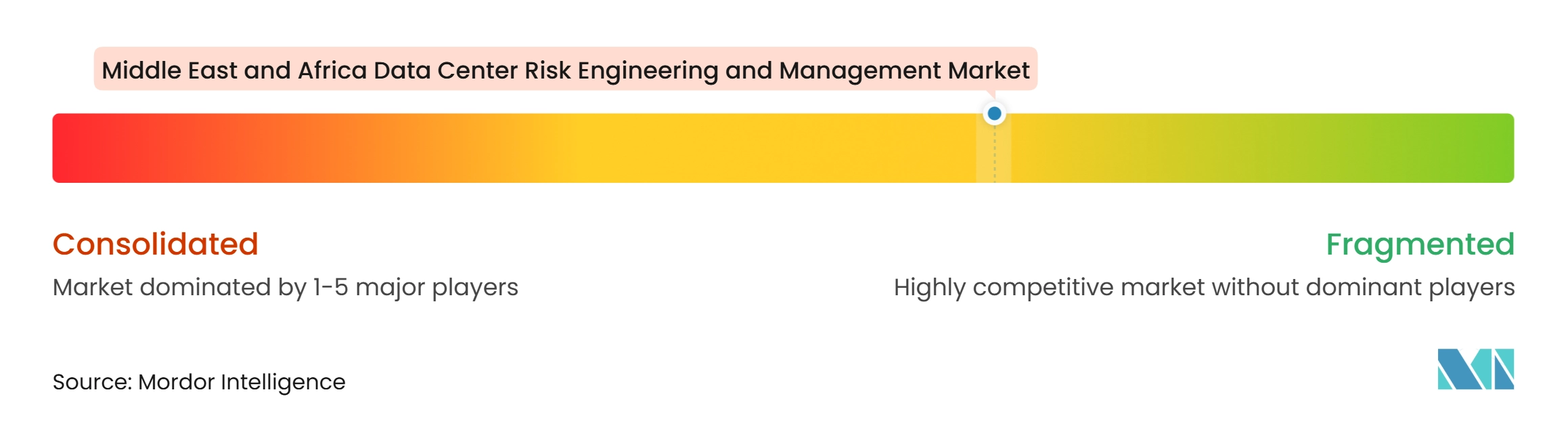
The Middle East and Africa data center risk engineering and management market is moderately fragmented. Global inspection, testing, and certification providers compete with insurance-linked risk engineering specialists and regional engineering advisers. Bureau Veritas, TÜV SÜD, TÜV Rheinland, SGS, DNV, UL Solutions, and DEKRA compete on the breadth and portability of their certifications. Aon, Marsh, FM, and Kroll bring insurance, financing, and risk advisory capabilities into the same customer discussion. Jensen Hughes and Arup offer engineering depth, while regional firms can differentiate through local knowledge and engagement with Arabic-language regulatory bodies. The field is shaped by both technical accreditation and the ability to work with owners, contractors, insurers, and regulators.
Technical standards are an important basis for competition in the Middle East and Africa data center risk engineering and management market. EN 50600, ISO/IEC 22237, and ANSI/TIA-942 help customers compare facility controls and give providers a shared framework for assessment. TÜV NORD’s September 2025 update on TSI.EN50600 V3.0 highlighted the need for certified facilities to address revised criteria. Bureau Veritas launched its Mission Critical Data Centers advisory brochure for the Middle East in October 2026.[4] The company presented a lifecycle offer spanning compliance, quality assurance, commissioning, sustainability, cybersecurity, and resilience. This move shows a strategy of linking several service lines around one facility lifecycle.
Insurance-linked providers are also changing the competitive offer. Aon expanded its Data Center Lifecycle Insurance Program to USD 2.5 billion in January 2026, combining several insurance covers with embedded risk engineering and cyber impact modeling. FM launched Intellium in May 2025 to provide specialist support for data center and power risk questions. Marsh also launched global Data Centre Insurance and Risk Management Services in May 2025, covering assessment, vulnerability identification, and risk strategy alongside insurance placement. AI-specific failure assessment remains an open area because high-density cooling and GPU configurations are advancing faster than established technical practices. Providers that develop credible methods for those systems could gain an advantage before standards become more prescriptive.
Middle East and Africa Data Center Risk Engineering and Management Industry Leaders
-
Aon plc
-
Factory Mutual Insurance Company
-
Howden Group Holdings Limited
-
Marsh & McLennan Companies, Inc.
-
Lockton Companies, LLC
- *Disclaimer: Major Players sorted in no particular order
Middle East and Africa Data Center Risk Engineering and Management Market Companies Covered in this Report
- Aon plc
- Factory Mutual Insurance Company
- Marsh & McLennan Companies, Inc.
- Lockton Companies, LLC
- Howden Group Holdings Limited
- Zurich Insurance Group AG
- JENOA
- ITMAD Engineering Consultancy
- DNV AS
- TÜV SÜD AG
- TÜV Rheinland AG
- UL Solutions Inc.
- Bureau Veritas SA
- SGS Société Générale de Surveillance SA
- DEKRA SE
- Kroll, LLC
- Willis Towers Watson Public Limited Company
- Munich Reinsurance Company
- Swiss Re AG
- AXA XL
- Allianz SE
- HDI Global SE
- Jensen Hughes, Inc.
- Arup Group Limited
Recent Industry Developments in Middle East and Africa Data Center Risk Engineering and Management Market
- October 2026: Bureau Veritas launched its Mission Critical Data Centers advisory brochure for the Middle East, presenting a full lifecycle assurance offering covering compliance, quality assurance, commissioning, sustainability, cybersecurity, and operational resilience. The launch, citing over 2,000 data center project references across more than 35 countries and 1,000-plus specialist engineers worldwide, marks the firm’s intent to deepen regional market share as the Gulf pipeline accelerates.
- August 2026: BSI Group certified Safaricom’s Limuru Data Centre in Kenya under its Data Centre Facilities Mark of Trust, following assessment across design, construction, operation, and continual improvement criteria. The certification provides independent verification of the facility’s governance, operational resilience, and compliance with international best practices, marking a significant expansion of institutional certification activity into East Africa.
- June 2026: TÜV NORD expanded its data center certification and professional training offering through updated services covering TSI.STANDARD, EN 50600, and ISO/IEC 22237, surpassing 1,000 completed data center certification projects globally. The expansion updates its criteria catalogue following the September 2025 release of TSI.EN50600 V3.0, which replaced V2.1 and introduced revised requirements that existing certified facilities must re-validate.
- May 2026: Bureau Veritas expanded its data center assurance activity through active participation in Datacloud Global Congress 2026, presenting testing, inspection, and certification capabilities for data center infrastructure across the full facility lifecycle, including sustainability verification services addressing energy efficiency and emerging EU Taxonomy regulatory requirements.
Middle East and Africa Data Center Risk Engineering and Management Market Report Scope
The Middle East and Africa data center risk engineering and management market comprises services and solutions that help data center operators identify, assess, mitigate, and manage operational, infrastructure, cybersecurity, and environmental risks. These services support business continuity, regulatory compliance, asset protection, and the reliable operation of data center facilities across the region.
The Middle East and Africa Data Center Risk Engineering and Management Market Report is Segmented by Service Type (Risk Assessment and Auditing, Reliability and Availability Engineering, FMEA, Fault Tree and Root Cause Analysis, Hazard Identification and Risk Evaluation, Risk Mitigation Planning, Operational Risk Management Consulting, and Compliance and Engineering Certification Support), Risk Category (Electrical and Power Infrastructure Risk, Cooling and Thermal Management Risk, Fire and Life Safety Risk, Structural and Building Infrastructure Risk, Environmental and Climate Risk, Operational and Human Error Risk, Supply Chain and Equipment Availability Risk, and Physical Security and Access Risk), Assessment Method (Qualitative Risk Assessment, Quantitative Risk Assessment, Reliability-Centered Assessment, Scenario-Based Risk Analysis, Simulation and Digital Modeling, and Continuous Risk Assessment and Monitoring), Engagement Model (One-Time Assessment and Audit, Periodic Risk Review, Continuous Risk Management Services, Managed Risk Engineering, and Integrated Engineering and Advisory Services), Project Lifecycle Stage (Site Selection and Feasibility, Design and Engineering, Construction and Commissioning, Operational Risk Management, and Expansion, Retrofit, and Modernization), Data Center Size (Small, Medium, Large, and Hyperscale), Data Center Type (Colocation, Cloud Service Providers (CSPs), and Enterprise and Edge), and Geography (Middle East (Saudi Arabia, UAE, Turkey, and Rest of Middle East) and Africa (South Africa, Egypt, Nigeria, and Rest of Africa)). The Market Forecasts are Provided in Terms of Value (USD).
Segmentation Overview
| Risk Assessment and Auditing |
| Reliability and Availability Engineering |
| Failure Mode and Effects Analysis (FMEA) |
| Fault Tree and Root Cause Analysis |
| Hazard Identification and Risk Evaluation |
| Risk Mitigation Planning |
| Operational Risk Management Consulting |
| Compliance and Engineering Certification Support |
| Electrical and Power Infrastructure Risk |
| Cooling and Thermal Management Risk |
| Fire and Life Safety Risk |
| Structural and Building Infrastructure Risk |
| Environmental and Climate Risk |
| Operational and Human Error Risk |
| Supply Chain and Equipment Availability Risk |
| Physical Security and Access Risk |
| Qualitative Risk Assessment |
| Quantitative Risk Assessment |
| Reliability-Centered Assessment |
| Scenario-Based Risk Analysis |
| Simulation and Digital Modeling |
| Continuous Risk Assessment and Monitoring |
| One-Time Assessment and Audit |
| Periodic Risk Review |
| Continuous Risk Management Services |
| Managed Risk Engineering |
| Integrated Engineering and Advisory Services |
| Site Selection and Feasibility |
| Design and Engineering |
| Construction and Commissioning |
| Operational Risk Management |
| Expansion, Retrofit, and Modernization |
| Small |
| Medium |
| Large |
| Hyperscale |
| Colocation |
| Cloud Service Providers (CSPs) |
| Enterprise and Edge |
| Middle East | Saudi Arabia |
| United Arab Emirates | |
| Turkey | |
| Rest of Middle East | |
| Africa | South Africa |
| Egypt | |
| Nigeria | |
| Rest of Africa |
| By Service Type | Risk Assessment and Auditing | |
| Reliability and Availability Engineering | ||
| Failure Mode and Effects Analysis (FMEA) | ||
| Fault Tree and Root Cause Analysis | ||
| Hazard Identification and Risk Evaluation | ||
| Risk Mitigation Planning | ||
| Operational Risk Management Consulting | ||
| Compliance and Engineering Certification Support | ||
| By Risk Category | Electrical and Power Infrastructure Risk | |
| Cooling and Thermal Management Risk | ||
| Fire and Life Safety Risk | ||
| Structural and Building Infrastructure Risk | ||
| Environmental and Climate Risk | ||
| Operational and Human Error Risk | ||
| Supply Chain and Equipment Availability Risk | ||
| Physical Security and Access Risk | ||
| By Assessment Method | Qualitative Risk Assessment | |
| Quantitative Risk Assessment | ||
| Reliability-Centered Assessment | ||
| Scenario-Based Risk Analysis | ||
| Simulation and Digital Modeling | ||
| Continuous Risk Assessment and Monitoring | ||
| By Engagement Model | One-Time Assessment and Audit | |
| Periodic Risk Review | ||
| Continuous Risk Management Services | ||
| Managed Risk Engineering | ||
| Integrated Engineering and Advisory Services | ||
| By Project Lifecycle Stage | Site Selection and Feasibility | |
| Design and Engineering | ||
| Construction and Commissioning | ||
| Operational Risk Management | ||
| Expansion, Retrofit, and Modernization | ||
| By Data Center Size | Small | |
| Medium | ||
| Large | ||
| Hyperscale | ||
| By Data Center Type | Colocation | |
| Cloud Service Providers (CSPs) | ||
| Enterprise and Edge | ||
| By Geography | Middle East | Saudi Arabia |
| United Arab Emirates | ||
| Turkey | ||
| Rest of Middle East | ||
| Africa | South Africa | |
| Egypt | ||
| Nigeria | ||
| Rest of Africa | ||
Key Questions Answered in the Report
What is the Middle East and Africa data center risk engineering and management market size?
The market is valued at USD 167.36 million in 2026 and is projected to reach USD 374.29 million by 2032, at a 14.34% CAGR from 2027 to 2032.
What is driving demand for data center risk engineering in the Middle East and Africa?
AI-ready facilities, data sovereignty rules, insurance requirements, and more complex power and cooling systems are increasing demand for specialist risk work.
Which service type holds the largest share in the Middle East and Africa data center risk engineering and management market?
Risk Assessment and Auditing lead with a 31.48% share in 2026 because it supports licensing, insurance placement, and facility approval.
Which risk category is growing fastest across regional data centers?
Cooling and Thermal Management Risk is projected to expand at a 14.96% CAGR through 2032 as AI workloads require more intensive cooling systems.
Which country is expected to grow fastest for data center risk engineering services?
Saudi Arabia is projected to expand at a 15.17% CAGR through 2032, supported by AI infrastructure investment and tier-based regulatory requirements.
Why do insurers matter in data center engineering decisions?
Insurers increasingly seek evidence that facilities have strong resilience, power, cooling, and cyber controls before they provide capacity or price risk.