
Middle East and Africa Data Center Physical Disaster Protection Market Size and Share
Market Overview
| Study Period | 2021 - 2032 |
|---|---|
| Forecast Data Period | 2027 - 2032 |
| Base Year Market Size (2026) | USD 342.51 Million |
| Market Size (2027) | USD 384.81 Million |
| Market Size (2032) | USD 646.19 Million |
| Growth Rate (2027 - 2032) | 10.92 % |
| Market Concentration | Medium |
Major Players *Disclaimer: Major Players sorted in no particular order Image © Mordor Intelligence. Reuse requires attribution under CC BY 4.0. | |
Middle East and Africa Data Center Physical Disaster Protection Market Analysis by Mordor Intelligence
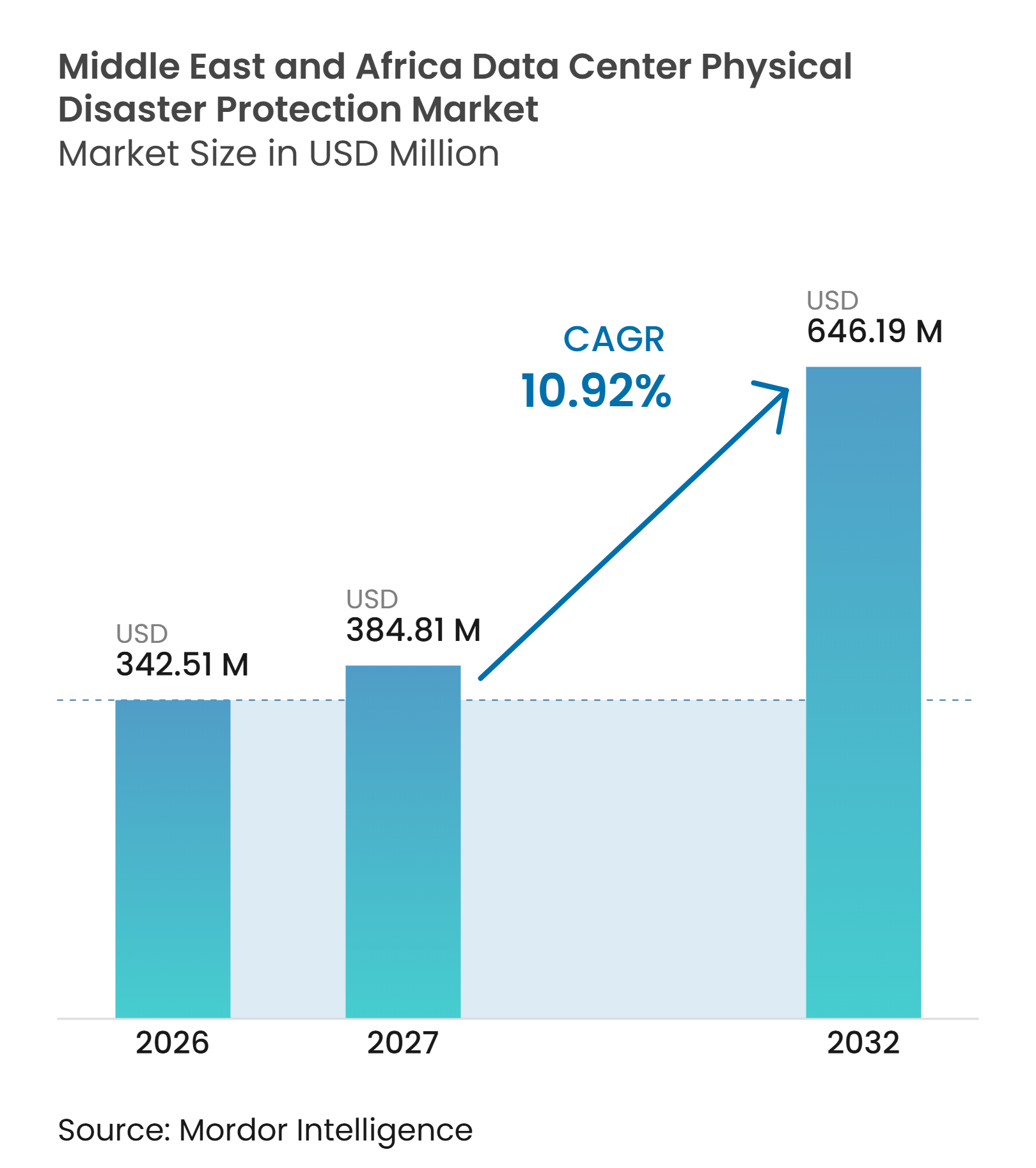
The Middle East And Africa Data Center Physical Disaster Protection Market size is projected to expand from USD 342.51 million in 2026 and USD 384.81 million in 2027 to USD 646.19 million by 2032, registering a CAGR of 10.92% between 2027 and 2032.
New hyperscale campuses are increasing demand for fire suppression, water protection, structural safeguards, and monitoring systems across the region. Saudi Arabia and the United Arab Emirates are raising protection specifications as sovereign AI programs treat digital infrastructure as critical national infrastructure. The April 2024 UAE rainfall event also moved water ingress protection from a late design consideration to an early project requirement. Vendors can benefit when they pair equipment with installation, testing, and long-term maintenance services. The Middle East and Africa data center physical disaster protection market is also shifting toward integrated designs that address linked fire, flood, power, and cooling risks.
Key Report Takeaways
-
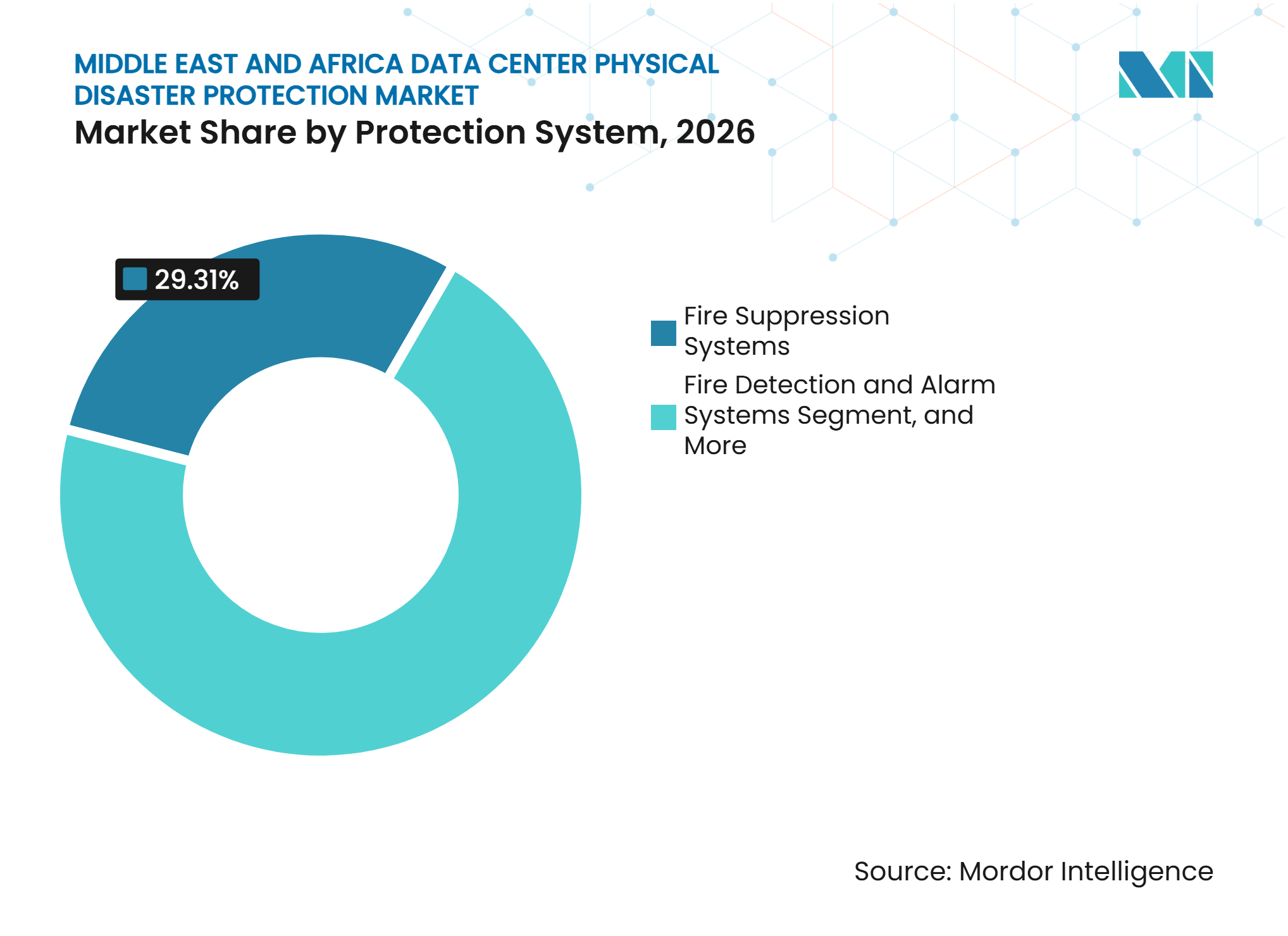
By protection system type, fire suppression systems held 29.31% of the Middle East and Africa data center physical disaster protection market share in 2026, while integrated multi-hazard protection systems are projected to expand at a 12.52% CAGR through 2032.
-
In fire protection technology, clean agent suppression accounted for 21.84% of the market in 2026, while water mist systems are projected to expand at a 12.31% CAGR through 2032.
-
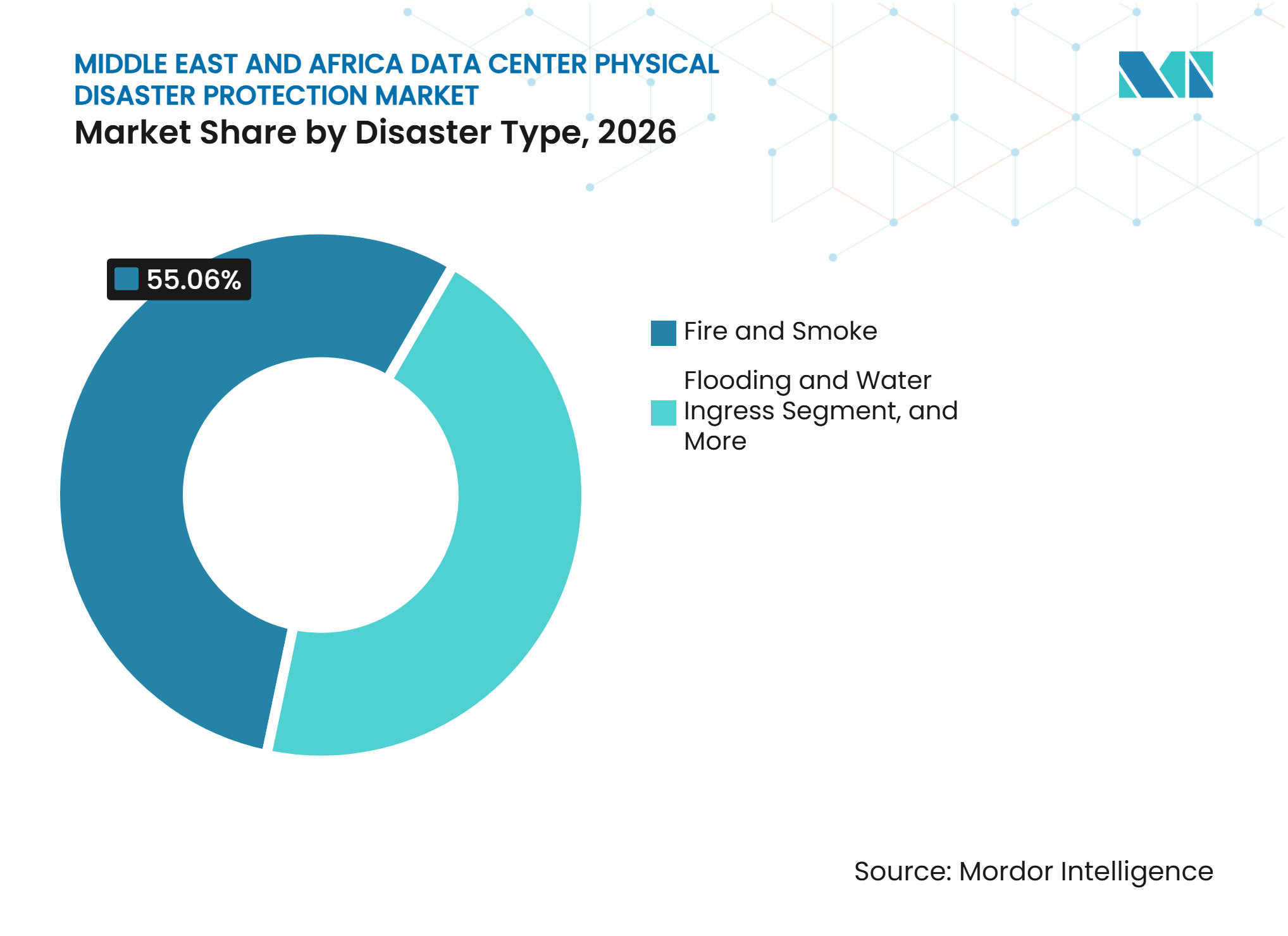
By disaster type, fire and smoke accounted for 55.06% in 2026, while flooding and water ingress are projected to expand at a 12.48% CAGR through 2032.
-
By protection layer, data hall and white space protection held a 34.27% share in the Middle East and Africa data center physical disaster protection market in 2026, while integrated facility-wide protection is projected to expand at a 12.11% CAGR through 2032.
-
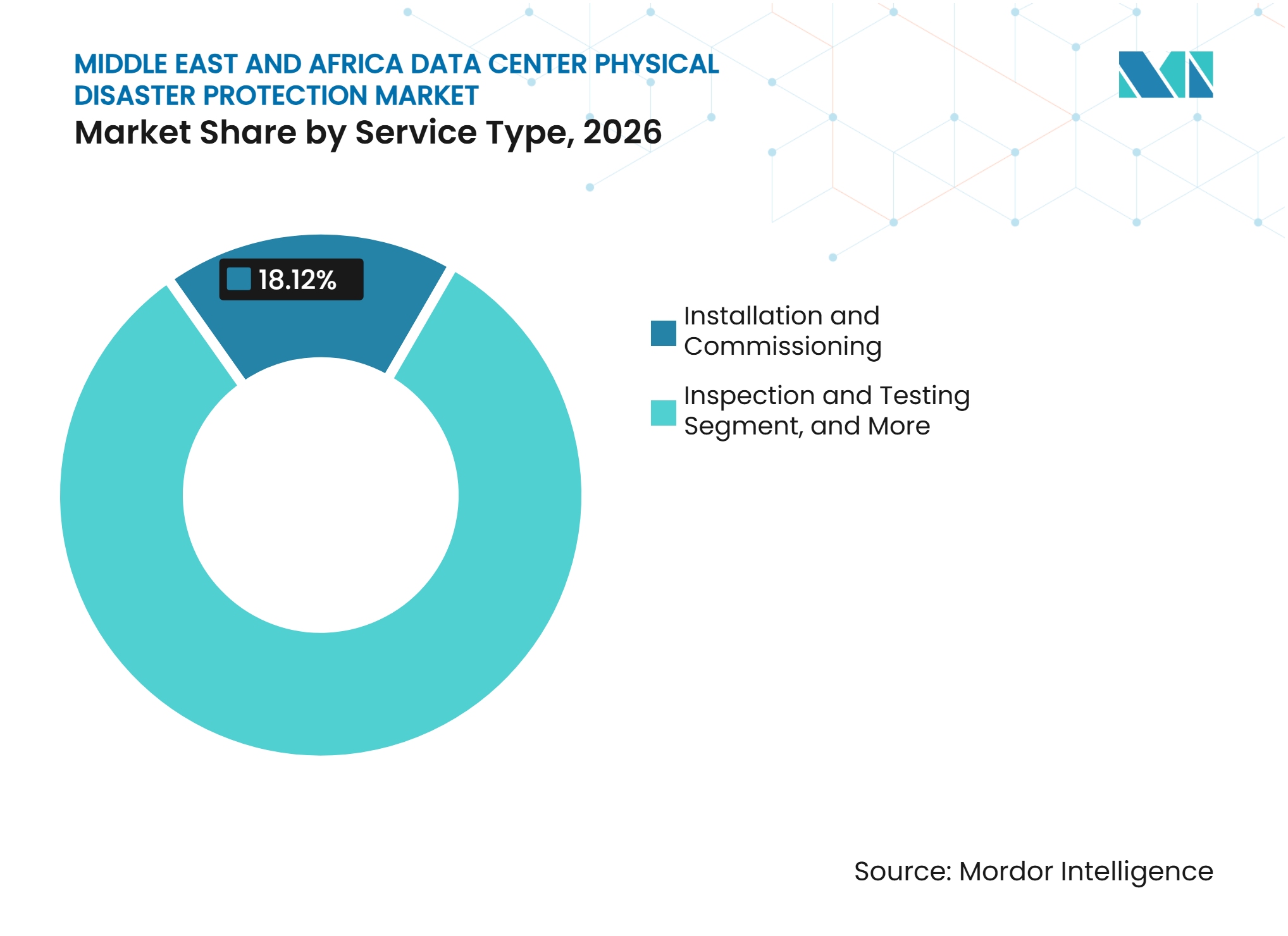
By service type, installation and commissioning services held an 18.12% share in the Middle East and Africa data center physical disaster protection market in 2026, while maintenance and system upgrade services are projected to expand at an 11.87% CAGR through 2032.
-
By data center size, large data centers held a 34.67% share in 2026, while hyperscale data centers are projected to expand at an 11.71% CAGR through 2032.
-
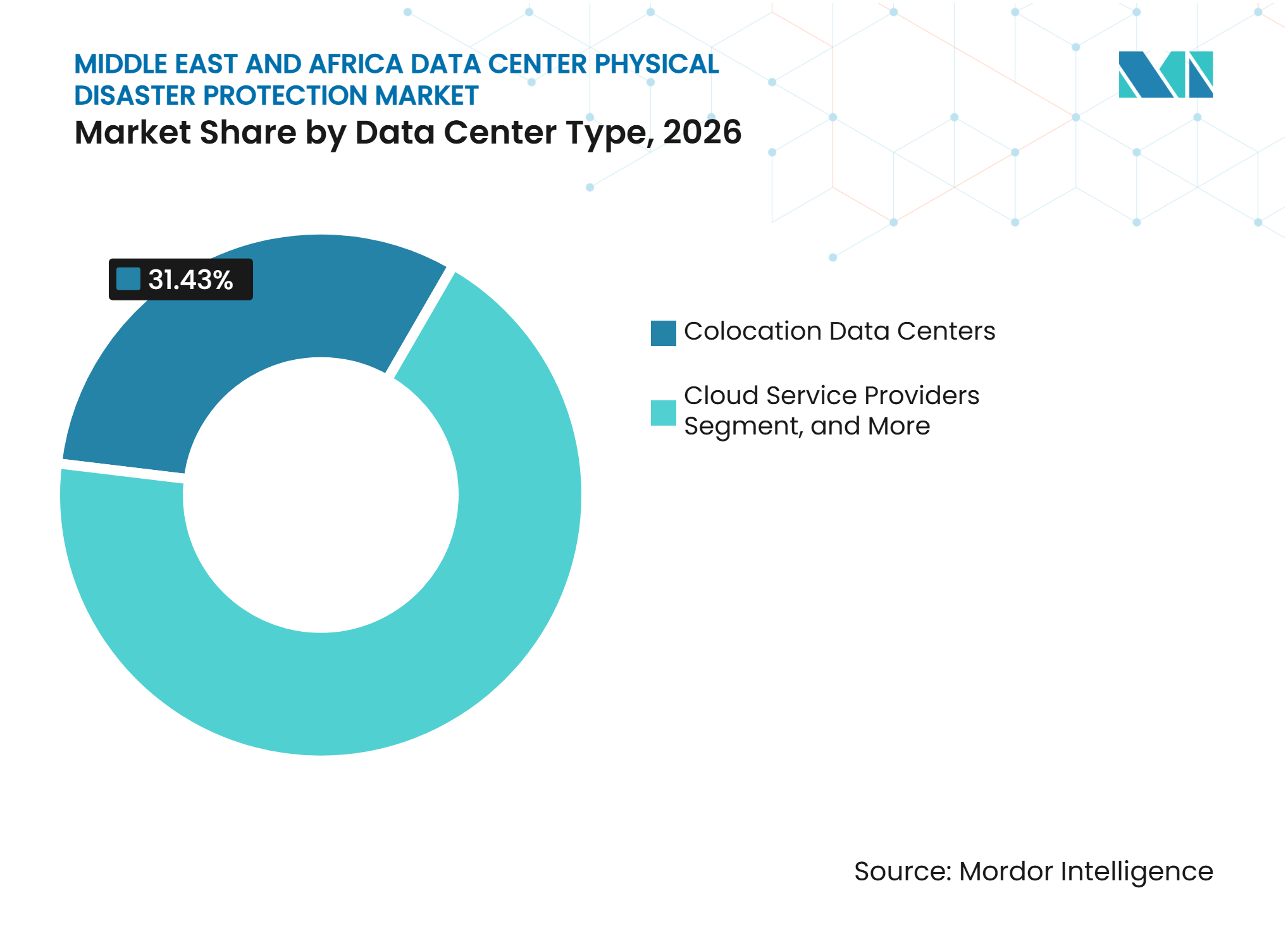
By data center type, colocation data centers held a 31.43% share in 2026, while edge data centers are projected to expand at a 12.04% CAGR through 2032.
-
By geography, Saudi Arabia held a 34.58% share in 2026 and is projected to expand at an 11.69% CAGR through 2032.
Note: Market numbers in this report are based on Mordor Intelligence's proprietary estimation framework, which combines nine months of actuals with Q4 projections for base year 2026.
Market Trends and Insights
Drivers Impact Analysis of Middle East and Africa Data Center Physical Disaster Protection Market*
| Driver | (~) % Impact on CAGR Forecast | Geographic Relevance | Impact Timeline |
|---|---|---|---|
| Expansion of Hyperscale and Colocation Data Centers | +2.8% | Saudi Arabia, UAE, South Africa | Short term (≤ 2 years) |
| Sovereign AI and Digital Infrastructure Investment | +2.4% | Saudi Arabia, UAE, with spillover to Rest of MEA | Medium term (2-4 years) |
| Stricter Data Sovereignty and Critical Infrastructure Requirements | +1.6% | Saudi Arabia, UAE, South Africa | Medium term (2-4 years) |
| Higher Thermal Density in AI-Ready Data Halls | +1.5% | Saudi Arabia, UAE, with early gains in GCC core | Medium term (2-4 years) |
| Flash-Flood Exposure in Low-Drainage Urban Areas | +1.2% | UAE, Saudi Arabia, Rest of MEA | Short term (≤ 2 years) |
| Heatwave-Day Cooling and Water-Stress Adaptation | +0.9% | Saudi Arabia, UAE, South Africa | Long term (≥ 4 years) |
| Source: Mordor Intelligence | |||
Expansion of Hyperscale and Colocation Data Centers
The region is moving from incremental colocation projects toward multi-gigawatt, AI-ready campuses. Saudi Arabia secured more than USD 2.5 billion in data center and technology investments at LEAP 2026. Al Moammar Information Systems committed USD 1.2 billion to reach 192 MW of operational capacity. NHC Innovation announced a USD 880 million Khuzam Digital Valley project targeting 65 MW of capacity by 2033. Facilities of 100 MW or more require broader power infrastructure coverage, denser server arrays, and larger floor areas. Protection procurement and commissioning schedules are being compressed to 12-18 months. This pipeline can exceed the available regional installation workforce. It can also create tender pricing pressure for qualified protection specialists.
Sovereign AI and Digital Infrastructure Investment
Sovereign AI strategies are making data centers central to national policy in Saudi Arabia and the UAE. Humain plans to add 1.9 GW of computing capacity by 2030, with an investment envelope of USD 77 billion. G42’s Stargate project represents a USD 20 billion data center investment with OpenAI, Nvidia, Oracle, and SoftBank. These programs require continuity during incidents across each construction phase. Their standards can exceed those applied to conventional commercial facilities. Saudi Arabia’s National Data Center Strategy was launched in June 2025 and targets up to 1.5 GW of capacity by 2030. The new build pipeline supports sustained demand for suppression, structural protection, and monitoring equipment. A critical-infrastructure designation raises the minimum threshold for resilience systems. The Middle East and Africa data center physical disaster protection market can benefit as specifications become more demanding across retrofit and greenfield projects.
Stricter Data Sovereignty and Critical Infrastructure Requirements
Data sovereignty rules are encouraging local processing capacity in Saudi Arabia, the UAE, and South Africa. Local facilities must protect service continuity for government, enterprise, and regulated workloads. The UAE Fire and Life Safety Code of Practice treats IT and telecom rooms as special hazards. It requires total-flooding clean agent systems and very early smoke detection in applicable facilities. TIA-942 and Uptime Institute assessments also require evidence that relevant systems can perform as designed. ISO 27001 and ISO 9001 documentation can drive demand for compliance assessments and periodic testing. These requirements favor suppliers that can deliver equipment, integration records, and maintenance evidence. They also narrow vendor qualification for operators seeking annual recertification. The Middle East and Africa data center physical disaster protection market, therefore, plays a stronger role in compliance-led capital programs.
Higher Thermal Density in AI-Ready Data Halls
AI workloads are moving rack power density from 5-10 kW toward 50-100 kW or more. Higher density raises the consequences of electrical faults and thermal events. Strong airflow in AI cooling designs can challenge the operating conditions of standard suppression systems. Johnson Controls stated that its data center fire detection systems are designed to provide early warning before risk becomes critical. A 2025 journal study tested a power-independent cooling and suppression architecture for GPU-dense servers. The study reported fire-agent discharge in under 0.45 seconds without external power. This approach is relevant where edge sites have limited local infrastructure. Facilities converting to AI-grade computing need to reassess detector sensitivity, agent capacity, and cooling-related water risks. The Middle East and Africa data center physical disaster protection industry is consequently moving toward systems designed for high-density server halls.[1]
Restraints Impact Analysis of Middle East and Africa Data Center Physical Disaster Protection Market*
| Restraint | (~) % Impact on CAGR Forecast | Geographic Relevance | Impact Timeline |
|---|---|---|---|
| High Upfront Cost of Multilayer Protection Systems | -1.9% | Global, with acute impact in Rest of MEA and secondary African markets | Short term (≤ 2 years) |
| Retrofit Disruption in Live Data Centers | -1.5% | Saudi Arabia, UAE, South Africa | Medium term (2-4 years) |
| Shortage of Certified Fire and Resilience Specialists | -1.2% | MEA-wide | Medium term (2-4 years) |
| Uneven Drainage, Grid, and Emergency-Response Infrastructure | -1.0% | Rest of MEA, secondary African markets | Long term (≥ 4 years) |
| Source: Mordor Intelligence | |||
High Upfront Cost of Multilayer Protection Systems
Integrated fire, flood, structural, and monitoring systems cost more than single-hazard installations. This difference can constrain adoption among smaller operators and markets with weaker insurance requirements. In secondary African markets, many projects fall within the 2-20 MW range. Fully engineered multilayer protection systems can represent 15-25% of total facility construction costs in these projects. This can narrow project margins and delay protection upgrades. GCC campuses with sovereign backing can purchase comprehensive systems aligned with NFPA 2001 and FM Approvals guidance. Smaller edge deployments may instead pursue minimum-code compliance. Suppliers need modular offerings that suit smaller facilities without simply scaling down a hyperscale design. Better sizing can widen adoption across the Rest of MEA.
Retrofit Disruption in Live Data Centers
Retrofitting a live data center is more difficult than designing protection systems for a new facility. Pipework, sensors, and drain systems must be installed without disrupting customer services. Any outage can create service-level agreement liabilities for colocation operators. Earlier projects may have deferred protective measures or installed only minimum-specification equipment. Howden identified incomplete protection during early construction stages as a relevant data center insurance issue. Large operators must schedule work across maintenance windows that can span 24-36 months. Live retrofit projects can also carry higher insurance costs than standard facility work. These indirect costs can discourage early upgrades before regulatory deadlines. The restraint remains important in Saudi Arabia, the UAE, and South Africa.
*Our forecasts treat driver/restraint impacts as directional, not additive. The impact forecasts reflect baseline growth, mix effects, and variable interactions.
Middle East and Africa Data Center Physical Disaster Protection Market Segment Analysis
By Protection System Type:
Fire Suppression Leads While Multi-Hazard Integration AcceleratesFire suppression systems held 29.31% of the Middle East and Africa data center physical disaster protection market share in 2026. They remain a mandatory first-line deployment across Saudi Arabia, the UAE, and South Africa. Fire systems protect high-voltage distribution, cabling, batteries, and concentrated thermal loads. The UAE Fire and Life Safety Code of Practice classifies IT and telecom rooms as special hazards. Applicable facilities require total-flooding clean agent systems and early smoke detection. Flood detection is gaining relevance as extreme precipitation becomes an observed operating risk. Physical barriers, compartmentalization, drainage, and wind protection cover other parts of the system mix. Each layer reduces exposure to a different failure path. Suppliers are increasingly asked to show how the layers work together during an incident.
Integrated multi-hazard protection systems are projected to expand at a 12.52% CAGR through 2032. Operators are replacing isolated deployments with connected systems covering fire, flood, and structural hazards. A flood can interrupt substation operations and reduce pump pressure for fire systems. This link makes coordinated monitoring more useful than separate control platforms. Emergency drainage and water removal are becoming defined procurement categories in Dammam and industrial locations outside Riyadh. A 2025 study showed that a self-actuating hybrid system could release an agent in under 0.45 seconds without external power. This type of design can suit GPU-dense racks and remote installations. Structural protection is also gaining attention in North and East African locations where seismic standards are being updated. The Middle East and Africa data center physical disaster protection market is rewarding designs that reduce dependencies between protection layers.



By Fire Protection Technology:
Clean Agent Maintains Dominance, Water Mist ScalesClean agent suppression accounted for 21.84% of the physical disaster protection market share in the Middle East and Africa data center market in 2026. It is compatible with live IT environments because it does not conduct electricity or leave corrosive residue. FM-200 and Novec 1230 systems are widely used for data hall protection across the Gulf. Inert gas systems are more common in power and mechanical rooms. Pre-action sprinklers provide a further layer in building-level designs. Aspirating smoke detection provides early indication before suppression activation. VESDA-class air-sampling systems are being calibrated for high airflow in aisle-contained halls. Conventional and addressable detection systems remain important in broader facility coverage. These technologies form the detection base used by most suppression designs.
Water mist systems are projected to expand at a 12.31% CAGR through 2032. The technology can suppress fires using up to 90% less water than conventional sprinklers. This reduces equipment damage risk and supports projects facing water scarcity. VID FIREKILL received the first FM Approval under FM Approvals Standard 5560 for a low-pressure water mist system covering Hazard Categories 2 and 3. The approval gives operators a clearer route to specify water mist where FM-certified solutions are required. Marioff’s HI-FOG system was selected for 2 NorthC data center facilities in March 2025. Aerosol systems remain relevant for compact edge rooms and remote sites. Their smaller footprint can suit locations where gas system infrastructure is impractical. Water mist suppliers can therefore address both large colocation facilities and specific edge applications.
By Disaster Type:
Fire and Smoke Still Dominant, Flooding Risk AcceleratesFire and smoke held 55.06% of the Middle East and Africa data center physical disaster protection market share in 2026. Large data centers contain dense cable loads, continuous power distribution, and concentrated heat. These conditions make fire prevention and response a core design requirement. Swiss Re recommends combining pre-action sprinklers, air-sampling detection, and clean-agent or water-mist systems for data centers. This combination provides redundancy when a single control method is insufficient. Extreme heat is another emerging facility hazard in Gulf locations. Ambient temperatures can exceed 45°C, placing pressure on cooling systems. Cooling failures can create a secondary fire risk when equipment operates at high density. Fire protection remains the most established line item in physical resilience budgets.
Flooding and water ingress are projected to expand at a 12.48% CAGR through 2032. The April 2024 UAE floods changed the way many developers consider drainage and water barriers. New Saudi sites are using flood risk assessments during feasibility work. MitKat Advisory applies ISO 31000 and TIA-942 frameworks to inundation zone mapping for such sites. This makes water protection a construction prerequisite rather than a post-commissioning addition. Earthquakes and ground movement remain relevant for parts of sub-Saharan Africa. Coastal South Africa and East Africa are also exposed to severe windstorms and cyclones. Dust ingress and electromagnetic interference pose additional risks at exposed edge locations. The Middle East and Africa data center physical disaster protection market has more demand for designs that protect against multiple environmental conditions.

By Protection Layer:
Data Hall Protection Leads, Facility-Wide Integration GrowsData hall and white space protection held 34.27% of the Middle East and Africa data center physical disaster protection market share in 2026. This layer protects IT assets that directly support customer workloads and revenue. Fire, humidity, and cooling failures can quickly lead to outages in these rooms. Site and perimeter systems provide an outer line of defense. Building envelope and structural protection limit weather-related and physical exposure. Critical equipment protection focuses on UPS units, batteries, and generator rooms. A local event in these areas can affect wider power distribution. Electrical and mechanical room protection is therefore distinct from white space coverage. Operators need every layer to protect a different route to a service interruption.
Integrated facility-wide protection is projected to expand at a 12.11% CAGR through 2032. Facility managers increasingly want a single view of alarm, drainage, cooling, and suppression conditions. Siemens has used fire safety digital twins to simulate fire spread and reduce false alarms in Saudi projects. Digital tools can help teams test scenarios before a live incident occurs. Building management systems are also being connected to protection platforms. This can give operators current visibility across several protection layers. Hyperscale sites with 24/7 commitments can use these systems to support certification evidence. The approach changes protection from a separate hardware purchase into a managed operational function. It also gives integrated suppliers a stronger position in the Middle East and Africa data center physical disaster protection industry.
By Service Type:
Installation Leads, Maintenance Gains ShareInstallation and commissioning services accounted for 18.12% in 2026. Greenfield construction in Saudi Arabia, the UAE, and South Africa is driving demand for this service. New sites require installation of sensors, pipework, panels, barriers, and drainage equipment. Commissioning confirms that the systems respond as specified before handover. System design and engineering work is expanding as projects use several suppression technologies. Design contracts are also covering digital monitoring and cross-layer coordination. Inspection and testing services help operators demonstrate initial performance. TIA-942 and Uptime Institute assessments can require documented evidence of these tests. Compliance assessment and certification create recurring work rather than a one-time transaction.
Maintenance and system upgrades services are projected to expand at an 11.87% CAGR through 2032. Large GCC facilities commissioned during 2021-2024 are entering major service cycles. AI-related upgrades require reviews of agent capacity, detector calibration, and integration software. Multi-year maintenance contracts can make installation wins valuable over time. Khazna Data Centers’ Ajman facility received Uptime Institute Tier III certification in February 2026. The certification requires ongoing maintenance and defined verification schedules. Similar certified facilities are expanding across the GCC. Vendors with local technical teams can benefit from regular inspections and upgrades. This recurring work supports a wider service base for the Middle East and Africa data center physical disaster protection market.
By Data Center Size:
Large Data Centers Lead, Hyperscale Scales FastestLarge data centers accounted for 34.67% in 2026. Established enterprise and cloud campuses in Riyadh, Dubai, Johannesburg, and Abu Dhabi support this position. These facilities need layered protection across data halls, equipment rooms, and site infrastructure. Small data centers serve government and enterprise users across the region. Their requirements are often shaped by building codes and insurance terms. Medium sites operate as regional cloud nodes with broader service commitments. They need protection systems that meet colocation requirements without undermining facility economics. This is supporting demand for modular and pre-engineered packages. The range of facility sizes requires suppliers to offer different system depths and service models.
Hyperscale data centers are projected to expand at an 11.71% CAGR through 2032. Humain and G42 are planning campuses with individual phases of 100 MW or more. A 100 MW campus can include several buildings, generator farms, and substation clusters. Its protection design must coordinate separate zones without a single point of failure. This adds engineering complexity beyond a single-building system. Teraco completed its 50 MW JB4 Bredell Campus expansion in August 2025. Its liquid-to-liquid cooling-ready halls introduce new leak detection and water-management needs. Conventional protection specifications did not always address these requirements. Vendors are therefore adapting systems for AI facilities with liquid cooling.
By Data Center Type:
Colocation Leads, Edge Grows FastestColocation data centers accounted for 31.43% of the market in 2026. Carrier-neutral sites in Dubai, Johannesburg, Riyadh, and Abu Dhabi serve a wide range of customers. Operators must meet service-level commitments for multiple tenants. This leads to stronger requirements for detection, suppression, and monitoring. Cloud providers and enterprise facilities also represent material demand. Government and military sites have specialized requirements because data infrastructure is treated as critical national infrastructure. These facilities can apply standards closer to those for defense installations than to commercial projects. Telecommunications sites remain essential network nodes with continuous-service obligations. Their protection systems are designed to preserve availability across the network.
Edge data centers are projected to expand at a 12.04% CAGR through 2032. Qareeb Data Centers plans 50 MW of edge capacity across Saudi Arabia, Bahrain, Qatar, the UAE, Oman, Kuwait, Egypt, and Jordan. Edge sites operate closer to users and can support sovereignty and latency needs. Their compact format often limits space for conventional protection infrastructure. Remote locations can also have limited on-site staffing. Autonomous and self-activating systems can respond without waiting for human intervention. The 2025 GPU-server study tested an autonomous capsule approach that achieved discharge in under 0.45 seconds. Such systems can act as a redundant layer alongside established suppression systems. Edge deployment therefore creates a distinct design and maintenance opportunity.
Geography Analysis
Saudi Arabia
Saudi Arabia accounted for 34.58% of the Middle East and Africa data center physical disaster protection market size in 2026 and is projected to expand at an 11.69% CAGR through 2032. Installed data center capacity surpassed 467 MW in Q1 2026, compared with 68 MW in 2021. Humain plans to add 1.9 GW of computing capacity by 2030, with an investment envelope of USD 77 billion. The National Data Center Strategy, launched in June 2025, targets up to 1.5 GW of capacity by 2030. Investments in the sector have exceeded USD 4.26 billion since Vision 2030 began. Clusters near Riyadh and in the Dammam Eastern Province are supporting local engineering teams and in-country manufacturing. Al Moammar Information Systems committed USD 1.2 billion to reach 192 MW at LEAP 2026. NHC Innovation also announced a USD 880 million project targeting 65 MW by 2033. These capacity additions make comprehensive protection systems a major requirement for greenfield sites
United Arab Emirates
The UAE is building sovereign-scale AI capacity within a demanding compliance environment. G42’s Stargate campus is planned to operate at 5 GW of power in Abu Dhabi. The project brings together OpenAI, Nvidia, Oracle, Cisco, and SoftBank. The UAE Fire and Life Safety Code of Practice treats IT and telecom rooms as special hazards. It requires total-flooding clean-agent systems and very early smoke detection, where applicable. Dubai and Abu Dhabi enforce this framework through documented compliance audits. The April 2024 rainfall event raised the design standard for flood and water ingress protection. Insurance requirements are also directing developers to demonstrate water protection before coverage is secured. This creates demand for certified suppression, drainage, and monitoring systems across new and retrofit projects.
South Africa and the Broader Region
South Africa supports the African Middle East and Africa data center physical disaster protection market through its maturing hyperscale and colocation base. Teraco’s JB4 Bredell Campus reached 50 MW of critical IT load in August 2025. Its liquid-to-liquid cooling halls require leak-detection and water-management systems beyond conventional specifications. Microsoft committed an additional ZAR 5.4 billion (USD 298.6 million) for South African cloud and AI infrastructure by 2027. Visa opened its first African data center in Johannesburg in July 2025, supporting demand for certified critical infrastructure systems. Egypt, Kenya, and Nigeria are developing secondary data center pipelines. The Cassava Technologies and Vodafone Business venture in Egypt could expand from 20 MW to 200 MW. EdgeNext partnered with iXAfrica in June 2025 to extend edge infrastructure across East Africa. Regional projects must account for local limits in drainage, grid stability, and emergency response. This can require greater on-site resilience engineering and standby capacity.[2]
Competitive Landscape
Market Concentration
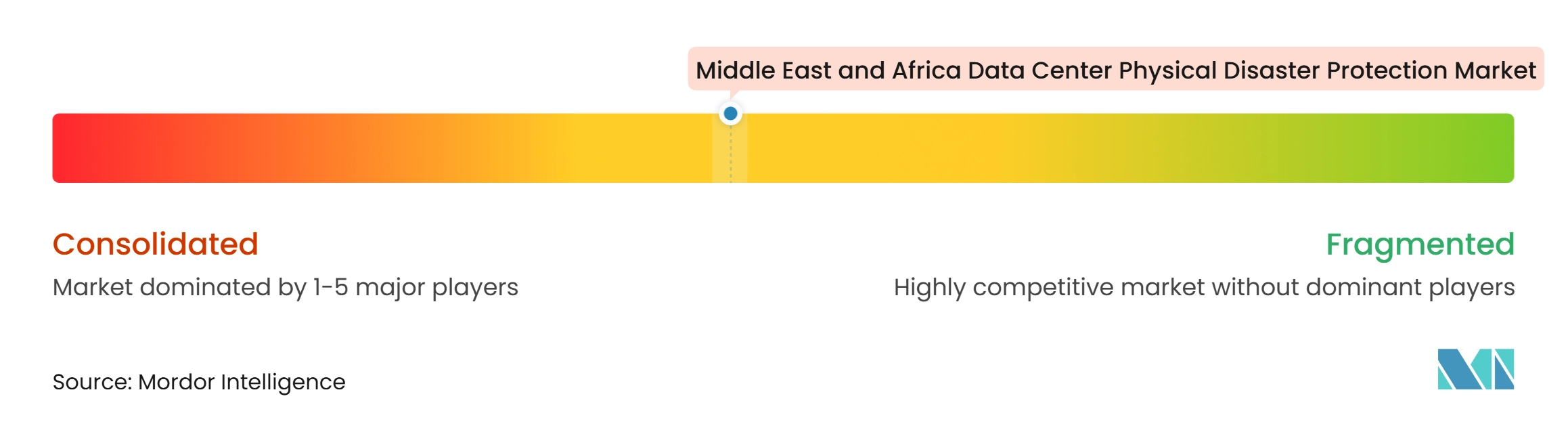
The Middle East and Africa data center physical disaster protection market is moderately concentrated at the design-specification stage. Installation and maintenance remain more fragmented because regional integrators serve local projects. Global fire-safety groups influence design specifications through integrated detection and suppression systems and digital service platforms. Major operators often select systems aligned with NFPA 2001, NFPA 750, FM Approvals Standard 5560, and UAE requirements. Honeywell offers cloud-connected life safety solutions for remote monitoring and predictive maintenance. Siemens has demonstrated digital twin tools for simulating fire spread in Saudi projects. These tools can reduce false alarms and strengthen operational decision-making. This is moving fire protection toward data-supported operations rather than isolated equipment purchases. Large suppliers benefit when they can provide a complete evidence trail for compliance reviews.
Johnson Controls presented fire detection and low-pressure water mist solutions for data centers at DCD Dubai 2025. The company positions water mist as a way to remove heat without flooding IT spaces or displacing oxygen. Its detection systems are designed to warn operators before a risk becomes critical. Marioff competes with its FM Approved HI-FOG water mist systems for data center applications. VID FIREKILL has an additional advantage: FM Approval under Standard 5560 for low-pressure water mist. These offerings support facilities where water use, equipment protection, and certification are important purchasing criteria. Regional manufacturers compete on price, local certification knowledge, and short supply routes. They are strong in detection hardware, sprinklers, extinguishers, and standard installation work. Their role is particularly important where local response and maintenance capacity affect selection.[3]
Competition is shifting toward lifecycle contracts that cover design, installation, testing, and maintenance. AI-ready data halls create opportunities to adapt clean-agent and water-mist systems to high airflow and thermal density. Unmanned edge sites are also opening demand for autonomous, self-actuating equipment. IoT sensors and machine-learning tools are being used to move systems from incident response toward predictive risk management. TIA-942, ISO 27001, and Uptime Institute requirements act as vendor qualification gates. Suppliers must provide evidence of integration and documentation for annual recertification cycles. This favors vendors with local service capacity and proven compliance processes.
Middle East and Africa Data Center Physical Disaster Protection Industry Leaders
-
Johnson Controls International plc
-
Honeywell International Inc.
-
Siemens AG
-
Fike Corporation
-
Minimax Viking GmbH
- *Disclaimer: Major Players sorted in no particular order
Middle East and Africa Data Center Physical Disaster Protection Market Companies Covered in this Report
- Johnson Controls International plc
- Honeywell International Inc.
- Siemens AG
- Fike Corporation
- Minimax Viking GmbH
- Robert Bosch GmbH
- Eaton Corporation plc
- WAGNER Group GmbH
- Hochiki Corporation
- Victaulic Company
- Marioff Corporation Oy
- Spectrum Safety Solutions
- Nohmi Bosai Ltd.
- Amerex Corporation
- Securiton AG
- Africa Data Centres Ltd.
- Teraco Data Environments (Pty) Ltd.
- Khazna Data Centers LLC
- Gulf Data Hub LLC
- Data Hub Integrated Solutions Moro L.L.C. (Moro Hub)
Recent Industry Developments in Middle East and Africa Data Center Physical Disaster Protection Market
- November 2026: Humain, backed by Saudi Arabia’s Public Investment Fund, advanced plans to raise an initial USD 2.5 billion from global and domestic investors to finance multi-phase data center development across the kingdom. The company proceeded with construction of more than 6 GW of computing capacity, placing sustained pressure on regional protection system supply chains.
- December 2025: General International Group received the Honeywell Resilience Award for its contribution to the Khazna Data Center project in the UAE. The award recognized resilient protection solutions for mission-critical infrastructure.
- November 2025: Teraco completed its CT2 data center expansion in Cape Town, South Africa, bringing the facility’s total critical IT load to 50 MW across 16 data halls. The expansion added to its portfolio of ISO 9001, ISO 27001, ISO 50001, ISO 14001, ISO 45001, PCI-DSS, and ISAE 3402-compliant facilities.
- November 2025: Teraco announced the start of its CT1 expansion in Rondebosch, Cape Town. The project adds 1,000 sq m of data halls and 2 MW of critical IT load to a 3 MW carrier-dense interconnection hub, with completion expected in early 2027.
Middle East and Africa Data Center Physical Disaster Protection Market Report Scope
The Middle East and Africa Data Center Physical Disaster Protection Market encompasses physical protection systems, technologies, equipment, and related services that protect data center facilities, critical IT infrastructure, power and cooling systems, and other mission-critical assets from physical disasters and environmental hazards across the region. These solutions are implemented across data center campuses, buildings, data halls, electrical and mechanical rooms, and critical equipment areas to reduce physical damage, avoid operational interruptions, ensure business continuity, and preserve the reliability and availability of data center infrastructure.
The Middle East and Africa Data Center Physical Disaster Protection Market Report is Segmented by Protection System Type (Fire Detection and Alarm Systems, Fire Suppression Systems, Smoke Detection and Control Systems, Flood Detection and Water Ingress Protection, Structural and Seismic Protection Systems, Storm and Wind Protection Systems, Physical Barriers and Compartmentalization, and Emergency Drainage and Water Removal Systems), Fire Protection Technology (Clean Agent Suppression, Inert Gas Suppression, Water-Based Suppression, Pre-Action Sprinkler Systems, Water Mist Systems, Aerosol Suppression, Aspirating Smoke Detection, and Conventional and Addressable Fire Detection), Disaster Type (Fire and Smoke, Flooding and Water Ingress, Earthquakes and Ground Movement, Hurricanes, Cyclones, and Severe Windstorms, Extreme Rainfall and Surface Water, Extreme Heat and Related Facility Hazards, and Rest of Physical and Environmental Hazards), Protection Layer (Site and Perimeter Protection, Building Envelope and Structural Protection, Data Hall and White Space Protection, Electrical and Mechanical Room Protection, Critical Equipment-Level Protection, and Integrated Facility-Wide Protection), Service Type (System Design and Engineering, Installation and Commissioning, Inspection and Testing, Maintenance and System Upgrades, and Compliance Assessment and Certification), Data Center Size (Small Data Centers, Medium Data Centers, Large Data Centers, and Hyperscale Data Centers), Data Center Type (Colocation Data Centers, Cloud Service Providers, Enterprise Data Centers, Edge Data Centers, Government and Military Data Centers, and Telecommunications Data Centers), and Geography (Saudi Arabia, United Arab Emirates, South Africa, and Rest of Middle East and Africa). The Market Forecasts are Provided in Terms of Value (USD).
Segmentation Overview
| Fire Detection and Alarm Systems |
| Fire Suppression Systems |
| Smoke Detection and Control Systems |
| Flood Detection and Water Ingress Protection |
| Structural and Seismic Protection Systems |
| Storm and Wind Protection Systems |
| Physical Barriers and Compartmentalization |
| Emergency Drainage and Water Removal Systems |
| Clean Agent Suppression |
| Inert Gas Suppression |
| Water-Based Suppression |
| Pre-Action Sprinkler Systems |
| Water Mist Systems |
| Aerosol Suppression |
| Aspirating Smoke Detection |
| Conventional and Addressable Fire Detection |
| Fire and Smoke |
| Flooding and Water Ingress |
| Earthquakes and Ground Movement |
| Hurricanes, Cyclones, and Severe Windstorms |
| Extreme Rainfall and Surface Water |
| Extreme Heat and Related Facility Hazards |
| Rest of Physical and Environmental Hazards |
| Site and Perimeter Protection |
| Building Envelope and Structural Protection |
| Data Hall and White Space Protection |
| Electrical and Mechanical Room Protection |
| Critical Equipment-Level Protection |
| Integrated Facility-Wide Protection |
| System Design and Engineering |
| Installation and Commissioning |
| Inspection and Testing |
| Maintenance and System Upgrades |
| Compliance Assessment and Certification |
| Small Data Centers |
| Medium Data Centers |
| Large Data Centers |
| Hyperscale Data Centers |
| Colocation Data Centers |
| Cloud Service Providers |
| Enterprise Data Centers |
| Edge Data Centers |
| Government and Military Data Centers |
| Telecommunications Data Centers |
| Saudi Arabia |
| United Arab Emirates |
| South Africa |
| Rest of the Middle East and Africa |
| By Protection System Type | Fire Detection and Alarm Systems |
| Fire Suppression Systems | |
| Smoke Detection and Control Systems | |
| Flood Detection and Water Ingress Protection | |
| Structural and Seismic Protection Systems | |
| Storm and Wind Protection Systems | |
| Physical Barriers and Compartmentalization | |
| Emergency Drainage and Water Removal Systems | |
| By Fire Protection Technology | Clean Agent Suppression |
| Inert Gas Suppression | |
| Water-Based Suppression | |
| Pre-Action Sprinkler Systems | |
| Water Mist Systems | |
| Aerosol Suppression | |
| Aspirating Smoke Detection | |
| Conventional and Addressable Fire Detection | |
| By Disaster Type | Fire and Smoke |
| Flooding and Water Ingress | |
| Earthquakes and Ground Movement | |
| Hurricanes, Cyclones, and Severe Windstorms | |
| Extreme Rainfall and Surface Water | |
| Extreme Heat and Related Facility Hazards | |
| Rest of Physical and Environmental Hazards | |
| By Protection Layer | Site and Perimeter Protection |
| Building Envelope and Structural Protection | |
| Data Hall and White Space Protection | |
| Electrical and Mechanical Room Protection | |
| Critical Equipment-Level Protection | |
| Integrated Facility-Wide Protection | |
| By Service Type | System Design and Engineering |
| Installation and Commissioning | |
| Inspection and Testing | |
| Maintenance and System Upgrades | |
| Compliance Assessment and Certification | |
| By Data Center Size | Small Data Centers |
| Medium Data Centers | |
| Large Data Centers | |
| Hyperscale Data Centers | |
| By Data Center Type | Colocation Data Centers |
| Cloud Service Providers | |
| Enterprise Data Centers | |
| Edge Data Centers | |
| Government and Military Data Centers | |
| Telecommunications Data Centers | |
| By Geography | Saudi Arabia |
| United Arab Emirates | |
| South Africa | |
| Rest of the Middle East and Africa |
Key Questions Answered in the Report
What is the Middle East and Africa data center physical disaster protection market size?
The market is projected to expand from USD 342.51 million in 2026 and USD 379.9 million in 2027 to USD 646.19 million by 2032, at a 10.92% CAGR.
What is driving demand for physical disaster protection systems in MEA data centers?
Hyperscale construction, sovereign AI programs, critical-infrastructure requirements, higher AI rack density, and flood exposure are supporting demand.
Which protection system type has the largest share in the region?
Fire suppression systems held 29.31% share in 2026 because fire protection is a core requirement for data halls and critical power areas.
Which disaster risk is expanding fastest in MEA data centers?
Flooding and water ingress are projected to expand at a 12.48% CAGR through 2032 as developers address drainage and extreme-rainfall risks.
Why are water mist systems gaining use in data centers?
Water mist systems are projected to expand at a 12.31% CAGR because they can control fires while using up to 90% less water than conventional sprinklers.
Which country leads physical disaster protection demand in the region?
Saudi Arabia held 34.58% share in 2026 and is projected to expand at an 11.69% CAGR through 2032, supported by large new data center capacity plans.