
Middle East 5G Infrastructure Market Size and Share
Market Overview
| Study Period | 2020 - 2031 |
|---|---|
| Forecast Data Period | 2026 - 2031 |
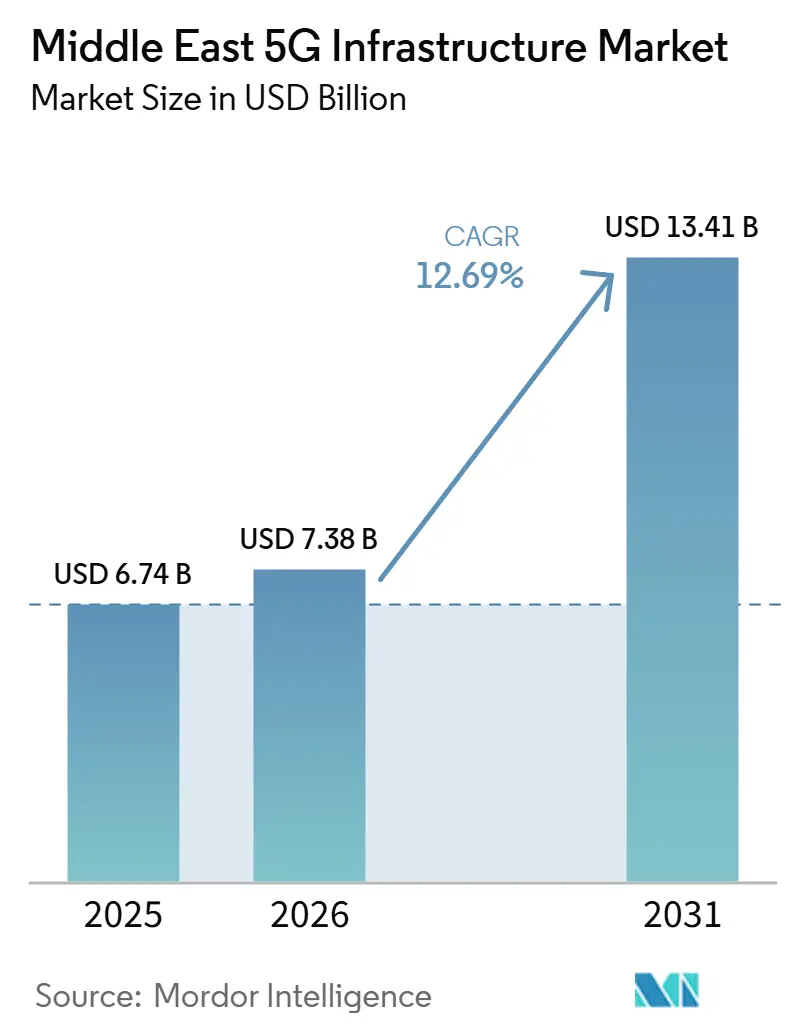
| Base Year Market Size (2025) | USD 6.74 Billion |
| Market Size (2026) | USD 7.38 Billion |
| Market Size (2031) | USD 13.41 Billion |
| Growth Rate (2026 - 2031) | 12.69 % |
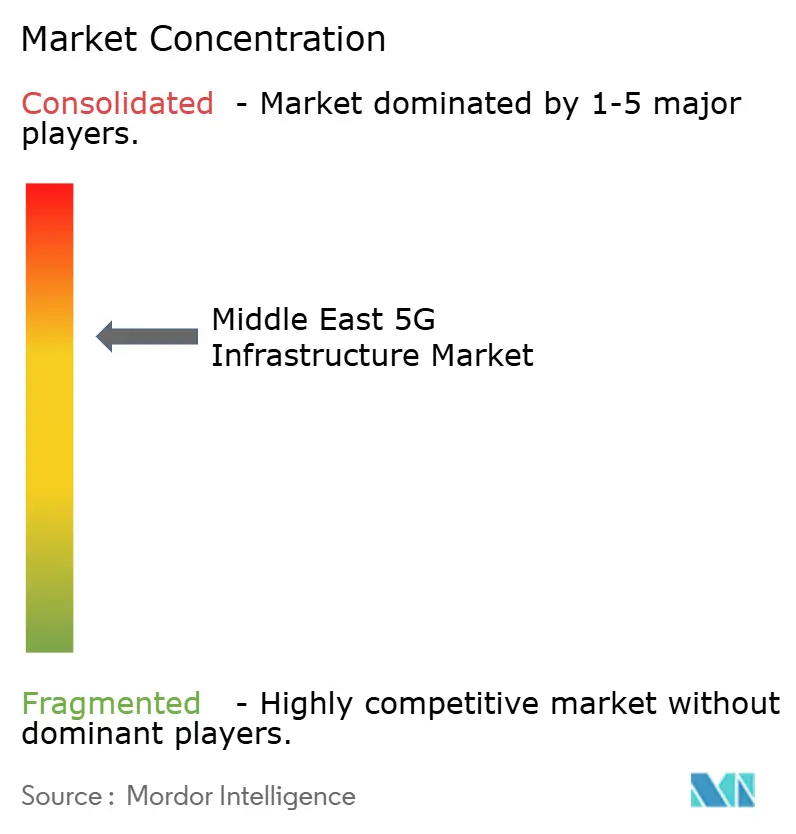
| Market Concentration | Medium |
Major Players *Disclaimer: Major Players sorted in no particular order Image © Mordor Intelligence. Reuse requires attribution under CC BY 4.0. | |
Middle East 5G Infrastructure Market Analysis by Mordor Intelligence
The Middle East 5G Infrastructure Market size is expected to increase from USD 6.74 billion in 2025 to USD 7.38 billion in 2026 and reach USD 13.41 billion by 2031, growing at a CAGR of 12.69% over 2026-2031. Government-backed digital programs, spectrum planning, and operator investment commitments are supporting the Middle East 5G infrastructure market. GCC 5G penetration reached 53% at the end of 2025, and 5G is expected to account for 88% of mobile connections, or 84 million subscriptions, by 2031. Mobile data use is raising the need for additional radio capacity and transport links. The Middle East 5G infrastructure market is also moving from early coverage deployment toward denser networks that can support enterprise services. Suppliers are responding with broader radio, core, transport, and cloud-native offerings, although integration costs and uncertainty around network slicing revenue remain material constraints.
Key Report Takeaways
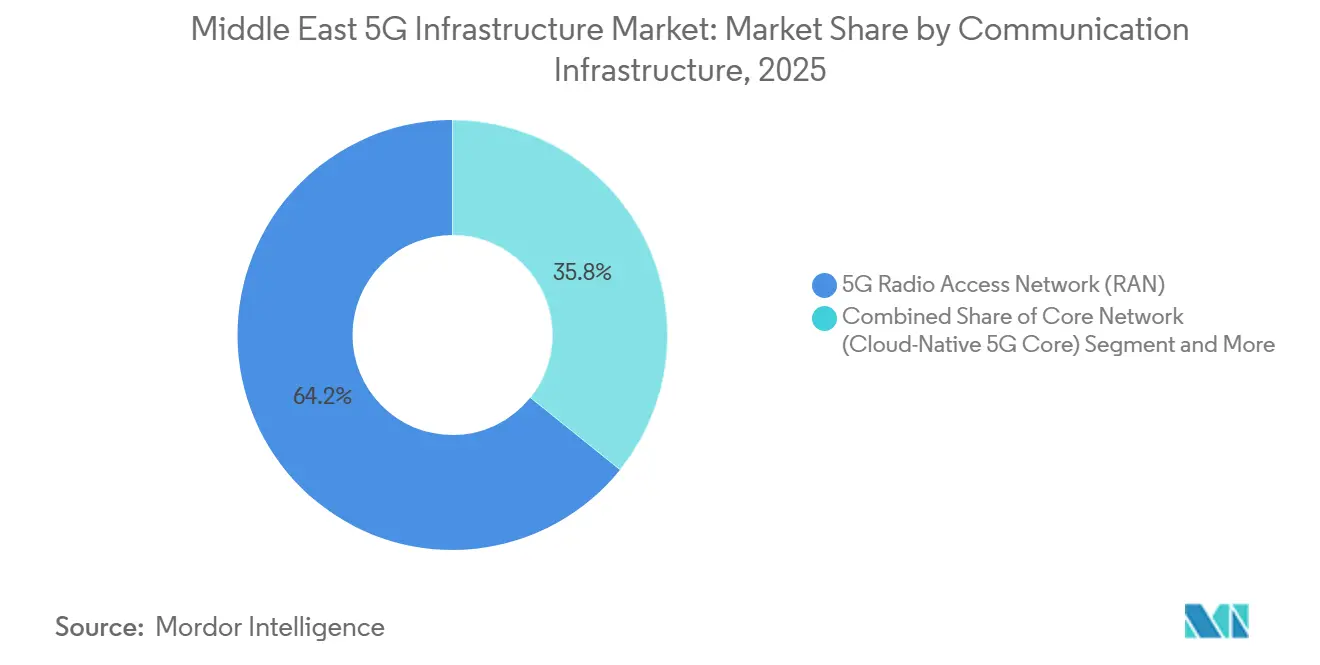
- By communication infrastructure, 5G radio access network (RAN) held 64.23% of revenue share in the Middle East 5G infrastructure market in 2025, while the core network (cloud-native 5G core) is projected to expand at a 15.21% CAGR through 2031.
- By spectrum band, mid-band (1-6 GHz) held 61.10% of revenue share in the Middle East 5G infrastructure market in 2025, while high-band/mmWave (above 24 GHz) is projected to expand at an 18.34% CAGR through 2031.
- By network architecture, non-standalone held 58.80% of revenue share in the Middle East 5G infrastructure market in 2025, while standalone is projected to expand at a 19.21% CAGR through 2031.
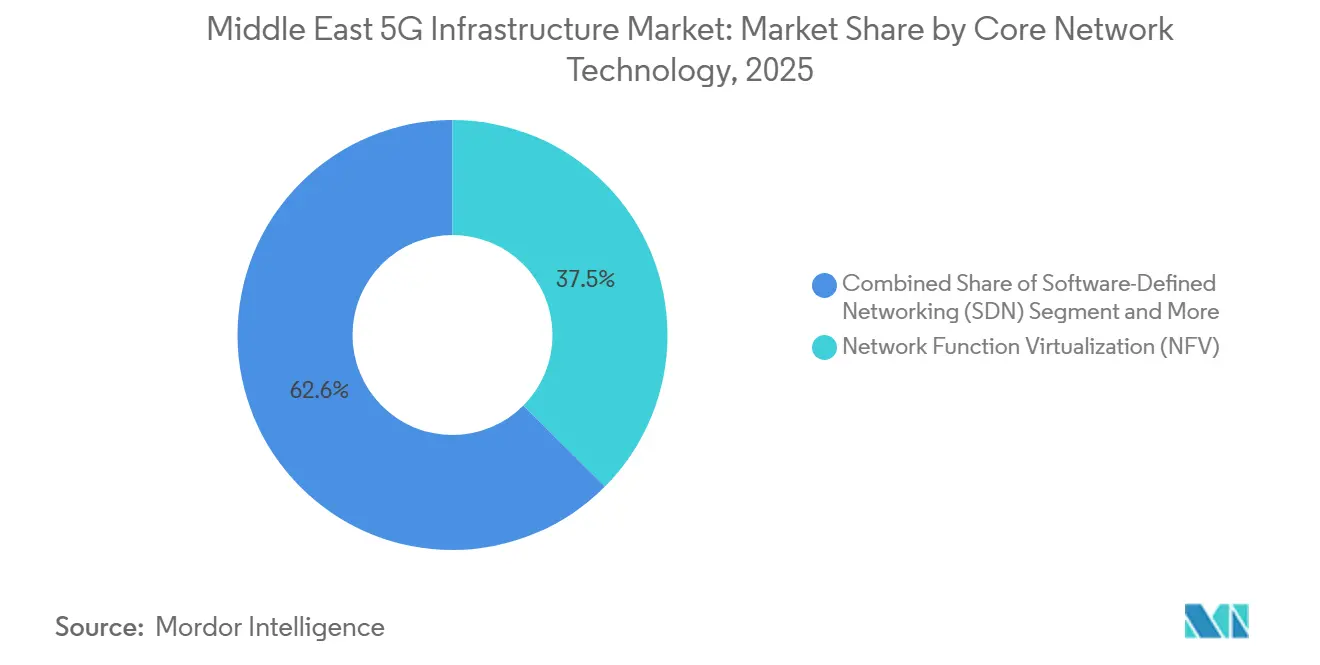
- By core network technology, network function virtualization held 37.45% of revenue share in the Middle East 5G infrastructure market in 2025, while network slicing is projected to expand at a 17.54% CAGR through 2031.
- By end-user vertical, consumer electronics held 46.40% of revenue share in the Middle East 5G infrastructure market in 2025, while smart cities and infrastructure are projected to expand at a 17.80% CAGR through 2031.
- By country, Saudi Arabia held 35.27% of revenue share in the Middle East 5G infrastructure market in 2025, while the United Arab Emirates is projected to expand at a 15.66% CAGR through 2031.
Note: Market size and forecast figures in this report are generated using Mordor Intelligence’s proprietary estimation framework, updated with the latest available data and insights as of January 2026.
Market Trends and Insights
Drivers Impact Analysis of Middle East 5G Infrastructure Market*
| Driver | (~) % Impact on CAGR Forecast | Geographic Relevance | Impact Timeline |
|---|---|---|---|
| Rising 5G Device and IoT Node Density | +3.2% | Global, concentrated in GCC core markets including Saudi Arabia, the UAE, Kuwait, and Qatar | Short term (≤ 2 years) |
| State-Led Spectrum Refarming and Auction Momentum | +2.5% | Saudi Arabia, including C-band and 600 MHz, and Turkey, including 700 MHz and 3.5 GHz, with spillover to the GCC | Short term (≤ 2 years) |
| Fixed Wireless Access Expansion in Underserved Sites | +2.0% | GCC rural corridors and secondary cities in Saudi Arabia, Oman, and Turkey | Medium term (2-4 years) |
| Carrier Migration Toward Cloud-Native Open RAN | +1.8% | The United Arab Emirates and Saudi Arabia, with spillover to Kuwait and Qatar | Medium term (2-4 years) |
| Private 5G Demand in Industrial Zones and Giga Projects | +1.2% | Saudi Arabia, including giga projects, NEOM, and KAFD, and United Arab Emirates industrial free zones | Medium term (2-4 years) |
| Network Monetization Pressure From 5G-Advanced Use Cases | +0.6% | The United Arab Emirates and Saudi Arabia, with spillover to Turkey and Qatar | Long term (≥ 4 years) |
| Source: Mordor Intelligence | |||
Rising 5G Device and IoT Node Density
The rising number of 5G devices and IoT nodes is increasing traffic on existing radio networks. This is pushing operators to add capacity rather than only expand geographic coverage. Global 5G subscriptions exceeded 3.1 billion in the first quarter of 2026, while the GCC has a high data-intensity consumer base.[1]Ericsson, “Ericsson Mobility Report June 2026,” Ericsson, ericsson.com Extended reality, vehicle telematics, and AI inference can place more demand on cell sites than standard mobile broadband use. Saudi Arabia’s digital economy strategy has also identified IoT as an important area for industrial and smart-city activity.[2]U.S. International Trade Administration, “Saudi Arabia - Digital Economy,” International Trade Administration, trade.gov In operational settings such as oil fields, ports, and logistics hubs, greater device density strengthens the case for private network slices that use shared macro RAN infrastructure. These sites often combine sensors, vehicles, cameras, and worker devices within the same operating area. Their connectivity requirements may differ from those of public mobile traffic, as they involve continuous monitoring and time-sensitive operational processes.
State-Led Spectrum Refarming and Auction Momentum
Spectrum refarming is easing a major constraint on 5G densification in the Middle East 5G infrastructure market. Saudi Arabia assigned spectrum in the 3.8-4.0 GHz range and was the first country in EMEA and ITU Region 1 to assign the 600 MHz band.[3]GSMA, “Saudi Arabia Leads the Way,” GSMA, gsma.com The combination gives operators low-band spectrum for coverage and sub-6 GHz spectrum for capacity. It also allows network plans to address indoor coverage and outdoor macro deployment simultaneously. Turkey’s spectrum release broadened the regional investment cycle by adding a large national network buildout. These actions improve the availability of spectrum needed for RAN and transport investment, although operator deployment schedules will still depend on commercial priorities. Spectrum availability gives operators more planning flexibility, but site access, equipment procurement, and customer demand still determine when capacity is installed. Regulatory momentum, therefore, supports deployment without removing every execution risk.
Fixed Wireless Access Expansion in Underserved Sites
Fixed wireless access is becoming more relevant where last-mile fiber installation is expensive or difficult to permit. Around 70% of fixed wireless access service providers offered 5G service in 2026. The GCC has favorable conditions for this model, as operators are expanding broadband coverage across secondary cities and less-dense corridors. Seasonal demand between Mecca and Medina also creates a distinct requirement for high-capacity connectivity at transport and hospitality sites. This can support targeted mid-band deployment even where permanent household density is lower. In these locations, operators can plan capacity around periods of concentrated use rather than relying only on standard residential demand forecasts. This makes fixed wireless access relevant to both permanent communities and temporary demand peaks across the region. The Middle East 5G infrastructure market can therefore use fixed wireless access as a complement to fiber rather than only as a temporary substitute for it.
Carrier Migration Toward Cloud-Native Open RAN
Carriers are moving gradually from closed network architectures toward cloud-native systems with more open interfaces. This shift changes the balance between hardware, software, and managed-service spending. Cloud-native RAN can allow operators to use more flexible software tools and to separate some network functions from dedicated equipment. The UAE and Saudi Arabia are leading this transition, while Kuwait and Qatar are potential follow-on markets. Migration can also bring cloud platforms and automation suppliers closer to the network procurement process. However, open interfaces do not remove the need for detailed integration testing, operational planning, and clear accountability between vendors. Operators need a clear approach to performance management, software updates, fault resolution, and security across components. Without this coordination, the flexibility of an open architecture can be offset by additional operational complexity.
Restraints Impact Analysis of Middle East 5G Infrastructure Market*
| Restraint | (~) % Impact on CAGR Forecast | Geographic Relevance | Impact Timeline |
|---|---|---|---|
| High Cost of Dense Radio and Fiber Backhaul Builds | -2.0% | Global, concentrated in urban cores of Riyadh, Dubai, and Istanbul | Medium term (2-4 years) |
| Vendor Sanctions and Procurement Fragmentation | -1.5% | Saudi Arabia and GCC markets with geopolitically sensitive procurement mandates | Medium term (2-4 years) |
| mmWave Skill Gaps and Field-Force Constraints | -0.9% | The United Arab Emirates and Saudi Arabia, with spillover to Turkey after launch | Short term (≤ 2 years) |
| Slow Payback on Enterprise Network-Slicing Monetization | -0.5% | GCC early adopters and the broader Middle East as enterprise uptake matures | Long term (≥ 4 years) |
| Source: Mordor Intelligence | |||
High Cost of Dense Radio and Fiber Backhaul Builds
Dense mid-band and mmWave networks require both radio equipment and fiber backhaul. These requirements raise the capital intensity of deployment in central business districts and other congested locations. Riyadh, Dubai, and Istanbul need many small cells and fiber connections, where access to civil works can be difficult. As a result, operators may focus spending on the busiest locations before extending dense networks to mid-tier commercial areas. Shared infrastructure can reduce costs when several operators use a common fiber-connected radio platform. The Middle East 5G infrastructure market may therefore see stronger interest in neutral-host models for indoor venues and high-demand urban locations. A shared approach can reduce duplicated site equipment and fiber work, especially where building access or civil permits are constrained. It can also help venue owners offer consistent coverage without requiring separate infrastructure from every operator.
Vendor Sanctions and Procurement Fragmentation
Vendor restrictions and differing procurement rules can make network sourcing more complex. Some GCC operators use multiple suppliers across network layers to preserve procurement flexibility. Turkey has also applied domestic equipment requirements to its 5G rollout, adding a local manufacturing consideration to network planning. Multi-vendor networks require more software interface testing, configuration work, and support processes. These additional requirements can raise operating costs and extend the time needed to award contracts. The effect is most pronounced when operators must balance network performance, supplier eligibility, and long-term maintenance obligations.
*Our forecasts treat driver/restraint impacts as directional, not additive. The impact forecasts reflect baseline growth, mix effects, and variable interactions.
Middle East 5G Infrastructure Market Segment Analysis
By Communication Infrastructure:
RAN Remains the Largest Spending Category While Cloud-Native Core Gains Momentum5G RAN accounted for 64.23% of the Middle East 5G infrastructure market share in 2025. This position reflected the continued cost of macro-cell deployment, Massive MIMO upgrades, and multi-band antenna installations. RAN remains central because operators need broader coverage and higher capacity across established urban networks. Transport and xHaul, including fronthaul, midhaul, and backhaul, formed a meaningful secondary component. These links are needed to connect small-cell clusters and micro-edge facilities with the wider network. The cloud-native 5G core is projected to record the highest growth in this category, at a 15.21% CAGR from 2026 to 2031. Its growth reflects the move from monolithic core systems toward containerized services. Such systems can support network slicing and lower-latency service management. The core also coordinates authentication, policy, and session control, so its modernization affects service delivery across the wider network. Operators must integrate this layer with existing systems while keeping consumer services available. This requirement explains why the migration is phased rather than immediate. Operators also need to train teams, update operating procedures, and coordinate vendors around the new model. The practical pace of adoption will reflect these organizational requirements and the availability of technology.
The communications infrastructure mix is changing as operators link radio upgrades more closely to core modernization. The Middle East 5G infrastructure market continues to require large RAN budgets because coverage and capacity projects remain unfinished. At the same time, cloud-native core platforms support services that cannot be fully delivered through a 4G-anchored network. A more software-led core can make network functions easier to update and automate. It can also shift part of the operator cost base from upfront equipment spending toward recurring software and managed services. Multi-access edge computing adds additional transport requirements, as edge sites require dedicated connectivity and computing hardware. Giga projects are likely to require these integrated radio, transport, core, and edge deployments. The result is a broader infrastructure package than a standard macro-cell upgrade alone would provide. Radio upgrades deliver visible coverage improvements, but their value depends on sufficient transport capacity and core processing at each site. Operators are therefore likely to coordinate investment decisions across several network domains. This approach can reduce bottlenecks as data demand and enterprise requirements increase.



By Spectrum Band:
Mid-Band Holds the Largest Position While mmWave Expands for Dense Use CasesMid-band spectrum, covering 1-6 GHz, held 61.10% of the Middle East 5G infrastructure market share in 2025. Its lead was supported by extensive C-band deployment among GCC operators. Mid-band provides a balance between coverage and capacity for large urban populations. Refarming of 2.6 GHz and 1800 MHz spectrum has also supported 5G deployment, where dedicated spectrum policies were less mature. The low-band spectrum below 1 GHz remains important for coverage in rural Saudi Arabia and in Oman's inland areas. Its relative role is declining as advanced antennas improve the reach and capacity of mid-band macro cells. Regulatory action to make spectrum available remains an important foundation for the Middle East 5G infrastructure market. Saudi Arabia’s spectrum assignments show how low-band and mid-band holdings can be used together.
High-band/mmWave is projected to grow at an 18.34% CAGR from 2026 to 2031. This segment is being supported by dense-venue connectivity, industrial links, and residential fixed wireless access. mmWave offers high throughput but requires careful site selection and a stronger field workforce. Its role is most compelling in locations where fiber is difficult to deploy, and high traffic is concentrated. The technology can support fixed wireless access for households and enterprise last-mile connections. It can also serve event venues, transport hubs, and smart-city corridors with concentrated data demand. The coexistence of low-, mid-, and high-band assets allows operators to match spectrum characteristics to specific coverage and capacity needs. This layered approach will be important as the region moves toward 5G-Advanced services. Low-band spectrum can extend services across wider areas, while mid-band supports mainstream urban traffic, and mmWave addresses localized peaks. The bands are not direct substitutes because their propagation and capacity characteristics differ. Effective planning requires operators to combine them according to local demand and site conditions. Geographic terrain, building density, available fiber, and the expected mix of consumer and enterprise traffic influence these decisions. Spectrum strategy is consequently a continuing operating issue rather than a one-time licensing event.
By Network Architecture:
NSA Maintains the Installed Base While SA Supports New Service ModelsNSA held 58.80% of the Middle East 5G infrastructure market share in 2025. The installed position reflected prior investment in 4G anchor networks and a cautious approach to changing live commercial cores. NSA has allowed operators to introduce 5G radio services without fully replacing their existing core architecture. It remains useful for broad mobile broadband coverage and near-term network expansion. However, it cannot provide all the functions required for dedicated network slicing and ultra-reliable low-latency communications. This limitation becomes more important as enterprise customers seek defined service levels. SA is projected to grow at a 19.21% CAGR from 2026 to 2031. This makes it the fastest-growing network architecture in the Middle East 5G infrastructure market.
SA migration is closely linked to the development of enterprise connectivity services. A standalone core enables more direct control of latency, traffic policy, and network resources. This matters for industrial automation, connected transport, healthcare applications, and critical IoT services. Operators that complete the transition earlier may be better placed to offer services requiring managed network slices. The move is still operationally demanding because it involves core changes, device support, and new service assurance processes. It also needs investment in automation and billing systems before the services can be sold at scale. NSA will remain relevant while operators manage these technical and commercial dependencies. The market will therefore experience a gradual overlap between NSA expansion and SA-led service development. Existing NSA assets can continue to serve large consumer populations while SA investment develops in areas with stronger enterprise demand. This sequencing can limit operational disruption and spread the cost of core modernization. It gives operators time to verify compatibility between radio systems, core functions, devices, and enterprise applications. The speed of migration will vary across markets according to existing network assets and commercial demand. It also allows operators to test new applications before committing to broad commercial deployment.
By Core Network Technology:
NFV Provides the Largest Base While Network Slicing Gains Commercial RelevanceNFV accounted for 37.45% of the Middle East 5G infrastructure market share in 2025. Operators adopted NFV as a practical software-disaggregation layer during the first phase of 5G core deployment. It enables selected network functions to run in virtualized environments rather than on dedicated hardware. SDN complements NFV by managing traffic paths and policies across the network. MEC extends computing resources closer to users and devices that need low latency. These technologies can work together at industrial sites and large development projects. NFV retained the largest share because many operators have already integrated it into their core modernization plans. The installed base also reflects the staged nature of migration from legacy virtual network functions to cloud-native functions.
Network slicing is projected to grow at a 17.54% CAGR from 2026 to 2031. It is becoming the key value layer for operators seeking to deliver differentiated services on a shared network. Slicing can support separate performance requirements for gaming, healthcare, industry, and public services. Commercial 5G SA slicing offers are increasing globally as service providers develop these packages. The commercial outcome depends on more than the radio and core network. Billing platforms, enterprise procurement arrangements, automation, and service management must work together. These requirements can lengthen the path from a technical trial to a scalable commercial offer. Network slicing will gain traction where operators can align this full operating model with clear customer demand. A technically capable network, by itself, does not create enterprise revenue. Customers also need understandable service packages, agreed performance terms, and reliable support processes. Operators that establish these conditions can use slicing to differentiate services beyond standard connectivity. They can also offer clearer performance commitments to customers who operate essential or time-sensitive applications. The opportunity is strongest when technical capability is matched with a defined commercial use case.
By End-User Vertical:
Consumer Electronics Holds the Largest Base While Smart Cities and Infrastructure Lead GrowthConsumer electronics accounted for 46.40% of the Middle East's 5G infrastructure market share in 2025. Smartphone-led broadband consumption remains the main revenue base for macro-RAN investment. Consumer demand continues to justify upgrades in capacity, coverage, and device support. Automotive and mobility, industrial manufacturing, healthcare and life sciences, energy and utilities, and public safety and defense are adding enterprise demand. These verticals require more specialized performance and security arrangements than consumer services. Their current contract volumes and revenue per user remain below the scale of consumer smartphone services. However, their requirements can create high-value use cases for standalone networks and edge computing. The Middle East 5G infrastructure market must support both the large consumer base and the more tailored needs of enterprise customers.
Smart cities and infrastructure are projected to expand at a 17.80% CAGR from 2026 to 2031. This growth is tied to development zones that need digital twins, connected mobility, and AI-enabled urban services. NEOM, Diriyah, Qiddiya, KAFD, and King Salman Park have been identified as areas where such connectivity needs are developing. These projects require persistent, low-latency data links between devices, facilities, and control systems. Energy, logistics, and industrial locations also need secure connections for monitoring and operational technology. Private 5G can help keep sensitive data within a defined site while supporting high-speed applications. Smart-city demand can therefore raise the value of dense coverage and transport networks. It also shifts attention from basic consumer capacity toward reliable connectivity for a broad set of physical assets. These projects require radio coverage, transport links, edge processing, and secure network management to work together. Their investment patterns may be less uniform than consumer coverage programs because each site has different operational requirements. This creates scope for tailored infrastructure designs across public and private locations. Consumer networks remain necessary within these areas, but they may be supplemented by dedicated capacity and more controlled data flows. The two demand streams can share selected infrastructure while serving different operational needs.
Geography Analysis
Saudi Arabia 5G Infrastructure Market
Saudi Arabia held 35.27% of the Middle East 5G infrastructure market share in 2025. The country’s leading position reflected its macro-cell investment, spectrum availability, and the scale of Vision 2030-related infrastructure programs. The Middle East 5G infrastructure market in Saudi Arabia is supported by demand from large cities, transport corridors, and planned development zones. The country has assigned 3.8-4.0 GHz spectrum and the 600 MHz band, providing a portfolio for both coverage and capacity. Deployment priorities are shifting from broad population coverage toward denser capacity in areas with high traffic. Smart-city projects and major visitor corridors create additional demand for resilient wireless networks. Shared-spectrum and neutral-host approaches can lower the cost of serving commercial venues and large developments. Tower and site-sharing arrangements can also improve the economics of densification where several operators serve the same area. This is particularly relevant for high-traffic venues, business districts, and development zones. Saudi Arabia, therefore, combines large-scale coverage needs with specialized demand for high-capacity networks. Its infrastructure investment is not limited to a single service type, as consumer, enterprise, visitor, and development-zone demand coexist. This diversity supports demand for radio, fiber, core, and shared-infrastructure solutions. Network planners must account for high demand concentrations in cities and visitor locations, as well as the connectivity requirements of new development areas. The need to combine these priorities supports a wide range of infrastructure projects over the forecast period.
United Arab Emirates 5G Infrastructure Market
The UAE is projected to grow at a 15.66% CAGR from 2026 to 2031. Its compact geography and two-operator structure support rapid testing of new network capabilities. The UAE has focused on technology differentiation across 5G-Advanced, private networks, cloud-native systems, and future spectrum options. This supports demand for modern radio equipment, core platforms, and transport capacity. Industrial parks, ports, healthcare facilities, and smart-city sites are relevant locations for private 5G development. The country can also use fixed wireless access and dense urban coverage to support household and business connectivity. Its role as an early adopter strengthens the regional case for commercial deployment of advanced 5G features. The UAE’s operating environment also allows suppliers and operators to assess new spectrum and network functions in a concentrated service area. Successful deployments can inform later investment decisions elsewhere in the region. The country remains important for pilots who may progress into broader commercial programs. Its operators can test the effect of new capabilities on consumer, enterprise, and public-sector use cases. This makes the UAE a significant reference market for suppliers seeking regional deployment opportunities. The country’s smaller geographical scale can make it easier to coordinate trials, commercial upgrades, and service launches across an operator's footprint. It can also provide operating experience that suppliers use when preparing proposals for other GCC markets.
Middle East 5G Infrastructure Market
Turkey launched commercial 5G in April 2026, following its October 2025 spectrum auction, which raised USD 3.53 billion. The country brings a large national subscriber base and a new RAN and transport investment cycle. Operators secured spectrum across the 700 MHz and 3.5 GHz bands, which support both coverage and capacity deployment. Turkey also applies a domestic equipment requirement, adding an industrial policy element to network procurement. Kuwait, Qatar, Oman, Bahrain, and Jordan represent a smaller share of the Middle East 5G infrastructure market but add to regional technology activity. These countries can contribute demand for cloud-native RAN, C-band services, and high-speed urban connectivity. Their infrastructure needs are diverse, ranging from dense Gulf cities to less populated inland and coastal areas. Turkey’s large national rollout introduces a different scale of demand compared to the smaller Gulf markets. Kuwait and Qatar can support advanced network features in compact urban locations, while Oman and Jordan require a different balance of reach and capacity. Together, these markets widen the range of deployment models served by regional vendors. Their varying regulatory approaches, terrain, subscriber bases, and commercial priorities prevent a single deployment formula from fitting the entire region. Suppliers must adapt their network plans to national spectrum conditions and operator investment plans. The mix of low-band, mid-band, and high-band spectrum differs by country, as do the timing and terms of available licenses. These differences affect the radio design, site density, and transport requirements for each national rollout.
Competitive Landscape
The Middle East 5G infrastructure market is moderately consolidated at the vendor level. Huawei, Ericsson, and Nokia have leading positions across RAN, core, and transport contracts in GCC countries and Turkey. Their scale gives them established product portfolios and experience with complex operator deployments. A wider group of suppliers competes in Open RAN, transport virtualization, optical xHaul, and cloud-native platforms. This group includes Mavenir, Rakuten Symphony, Cisco, Juniper Networks, and Ciena. Competition is increasing in software-led network functions, as operators seek greater flexibility. Vendor-diversification requirements and domestic content mandates also shape the supplier environment. Operators must weigh the benefits of established suppliers against the need to maintain optionality across network layers. This creates a procurement setting in which technical integration is as important as equipment performance. Operators must consider whether a new platform will work reliably with installed radio, core, and transport equipment. The cost of testing and maintaining these connections can materially affect the value of a proposed solution. It also gives specialist suppliers a route into projects where a full replacement of the incumbent vendor is not required. A supplier may provide a targeted radio, transport, or software component while the existing operator ecosystem remains in place. This lowers the barrier to entry for vendors with focused product portfolios. It also allows operators to introduce new capabilities without a full network replacement. This model is especially relevant when cloud-native, automation, or transport functions can be added around an established radio footprint.
Huawei has a strong installed presence in Saudi Arabia and the UAE, which can support its position in 5G-Advanced upgrades. Ericsson is pursuing longer-term operator relationships that cover radio, core, and cloud-native technology. Nokia is emphasizing neutral-host models and mmWave spectrum sharing for large venues and enterprise campuses. These approaches address different customer needs within the same Middle East 5G infrastructure market. Established suppliers must also manage the requirements of multi-vendor networks and open interfaces. This can create opportunities for vendors that specialize in interoperability, transport, and orchestration. It also means contract wins may be divided across multiple technology layers rather than awarded to a single supplier. Radio, core, transport, orchestration, and edge functions may be sourced separately when operators seek greater control over their technology choices. This can increase the importance of system integration capabilities. Vendors that can demonstrate compatibility with established networks may have an advantage in these projects. Their value proposition can include smoother migration, lower integration risk, and operational support across existing network assets. These factors may influence purchasing decisions as much as a new product's headline capability.
Opportunities remain in cloud-native core software and private 5G platforms for industrial users. Operators that have not moved from monolithic systems need support for core modernization and service automation. Smaller suppliers can use open-interface compliance to compete against full-stack vendors. Samsung Electronics is expanding its RAN position in Turkey and selected GCC markets, providing another option for operator procurement. Neutral-host architecture is becoming more relevant where several operators share indoor or dense-venue infrastructure. Intellectual property related to shared-spectrum management may become an important factor as these models mature. The competitive balance will depend on whether operators prefer integrated solutions or select specialized suppliers for individual network layers. Integrated offers can simplify accountability and deployment management for operators. Specialized solutions can offer greater flexibility when an operator has clear requirements for a specific network function. Both approaches will remain relevant as regional operators progress from broad coverage goals to more differentiated service models. The choice will reflect each operator’s installed base, internal technical resources, procurement rules, and intended customer segments. Competition is likely to remain active across the radio, core, transport, and software layers. Supplier selection will continue to be based on price, deployment experience, product compatibility, local requirements, and the ability to support a defined network roadmap. These factors create a more diverse competitive environment than a standard single-vendor equipment purchase.
Middle East 5G Infrastructure Industry Leaders
Huawei Technologies Co., Ltd.
Telefonaktiebolaget LM Ericsson
Nokia Corporation
ZTE Corporation
Samsung Electronics Co., Ltd.
- *Disclaimer: Major Players sorted in no particular order
Middle East 5G Infrastructure Market Companies Covered in this Report
- Huawei Technologies Co., Ltd.
- Telefonaktiebolaget LM Ericsson
- Nokia Corporation
- ZTE Corporation
- Samsung Electronics Co., Ltd.
- Cisco Systems, Inc.
- Broadcom Inc.
- Hewlett Packard Enterprise Company
- Mavenir Systems, Inc.
- NEC Corporation
- CommScope Holding Company, Inc.
- Juniper Networks, Inc.
- Ciena Corporation
- Oracle Corporation
- Airspan Networks Holdings Inc.
- Dell Technologies Inc.
- Radisys Corporation
- Rakuten Symphony, Inc.
- Ribbon Communications Inc.
- Fujitsu Limited

Recent Industry Developments in Middle East 5G Infrastructure Market
- December 2025: stc Group signed a five-year Master Frame Agreement with Ericsson to accelerate 5G expansion, including 5G Standalone, 5G Advanced, Massive MIMO, Ericsson Radio System products, cloud-native platforms, and advanced managed services across Saudi Arabia. The agreement builds on a long-standing partnership dating to Saudi Arabia’s first 5G deployment in 2019 and anchors the kingdom’s next infrastructure investment phase.
- May 2025: Rakuten Symphony and Zain Kuwait signed a Memorandum of Understanding to deploy Kuwait’s first cloud-native Open RAN, using Rakuten Symphony’s virtualized distributed unit and centralized unit software for 5G Standalone sites, marking the initial phase of a planned large-scale commercial Open RAN deployment across the Zain Group’s eight-country footprint.


Middle East 5G Infrastructure Market Report Scope
The Middle East 5G infrastructure market generates revenue from 5G equipment, software licenses and subscriptions, integration, deployment, modernization, managed services, maintenance, and support for mobile operators and enterprises in manufacturing, automotive, healthcare, energy, smart cities, public safety, and consumer applications.
The Middle East 5G infrastructure market report is segmented by communication infrastructure (5G radio access network (RAN), transport/xHaul (front-haul, mid-haul, back-haul), and core network (cloud-native 5G core)), spectrum band (low-band (less than 1 GHz), mid-band (1-6 GHz), and high-band / mmWave (above 24 GHz)), network architecture (non-standalone (NSA), and standalone (SA)), core network technology (software-defined networking (SDN), network function virtualization (NFV), multi-access edge computing (MEC), and network slicing), end-user vertical (consumer electronics, automotive and mobility, industrial manufacturing, healthcare and life sciences, energy and utilities, public safety and defense, smart cities and infrastructure, and other end-user verticals (retail, media, agriculture)), and country (Saudi Arabia, United Arab Emirates, Turkey, and Rest of the Middle East). The market forecasts are provided in terms of value (USD).
| 5G Radio Access Network (RAN) |
| Transport / xHaul (Front-, Mid-, Back-haul) |
| Core Network (Cloud-native 5GC) |
| Low-Band (less than 1 GHz) |
| Mid-Band (1-6 GHz) |
| High-Band / mmWave (above 24 GHz) |
| Non-Standalone (NSA) |
| Standalone (SA) |
| Software-Defined Networking (SDN) |
| Network Function Virtualization (NFV) |
| Multi-access Edge Computing (MEC) |
| Network Slicing |
| Consumer Electronics |
| Automotive and Mobility |
| Industrial Manufacturing |
| Healthcare and Life Sciences |
| Energy and Utilities |
| Public Safety and Defense |
| Smart Cities and Infrastructure |
| Other End-User Verticals (Retail, Media, Agriculture) |
| Saudi Arabia |
| United Arab Emirates |
| Turkey |
| Rest of the Middle East |
| By Communication Infrastructure | 5G Radio Access Network (RAN) |
| Transport / xHaul (Front-, Mid-, Back-haul) | |
| Core Network (Cloud-native 5GC) | |
| By Spectrum Band | Low-Band (less than 1 GHz) |
| Mid-Band (1-6 GHz) | |
| High-Band / mmWave (above 24 GHz) | |
| By Network Architecture | Non-Standalone (NSA) |
| Standalone (SA) | |
| By Core Network Technology | Software-Defined Networking (SDN) |
| Network Function Virtualization (NFV) | |
| Multi-access Edge Computing (MEC) | |
| Network Slicing | |
| By End-User Vertical | Consumer Electronics |
| Automotive and Mobility | |
| Industrial Manufacturing | |
| Healthcare and Life Sciences | |
| Energy and Utilities | |
| Public Safety and Defense | |
| Smart Cities and Infrastructure | |
| Other End-User Verticals (Retail, Media, Agriculture) | |
| By Country | Saudi Arabia |
| United Arab Emirates | |
| Turkey | |
| Rest of the Middle East |


Key Questions Answered in the Report
What is the Middle East 5G infrastructure market size?
The Middle East 5G infrastructure market was USD 6.74 billion in 2025 and is forecast to reach USD 13.41 billion by 2031, growing at a 12.69% CAGR during 2026-2031.
Which communication infrastructure segment leads regional spending?
5G RAN led with a 64.23% share in 2025, reflecting continued macro-cell deployment, Massive MIMO upgrades, and multi-band antenna investment.
Which spectrum band is growing fastest in the region?
High-band/mmWave is projected to grow at an 18.34% CAGR from 2026 to 2031, supported by dense venues, fixed wireless access, and industrial use cases.
Why are operators moving from NSA to SA networks?
SA supports network slicing, lower-latency services, and more controlled enterprise connectivity, while NSA depends on a 4G anchor network.
Which country leads 5G infrastructure demand in the Middle East?
Saudi Arabia led with a 35.27% share in 2025, supported by macro-cell deployment, spectrum availability, and large infrastructure programs.
What end-user area is projected to grow fastest?
Smart cities and infrastructure is projected to grow at a 17.80% CAGR through 2031, supported by connected urban services, industrial sites, and development zones.
Page last updated on:





