
Mexico Secure Logistics Market Size and Share
Market Overview
| Study Period | 2020 - 2031 |
|---|---|
| Forecast Data Period | 2026 - 2031 |
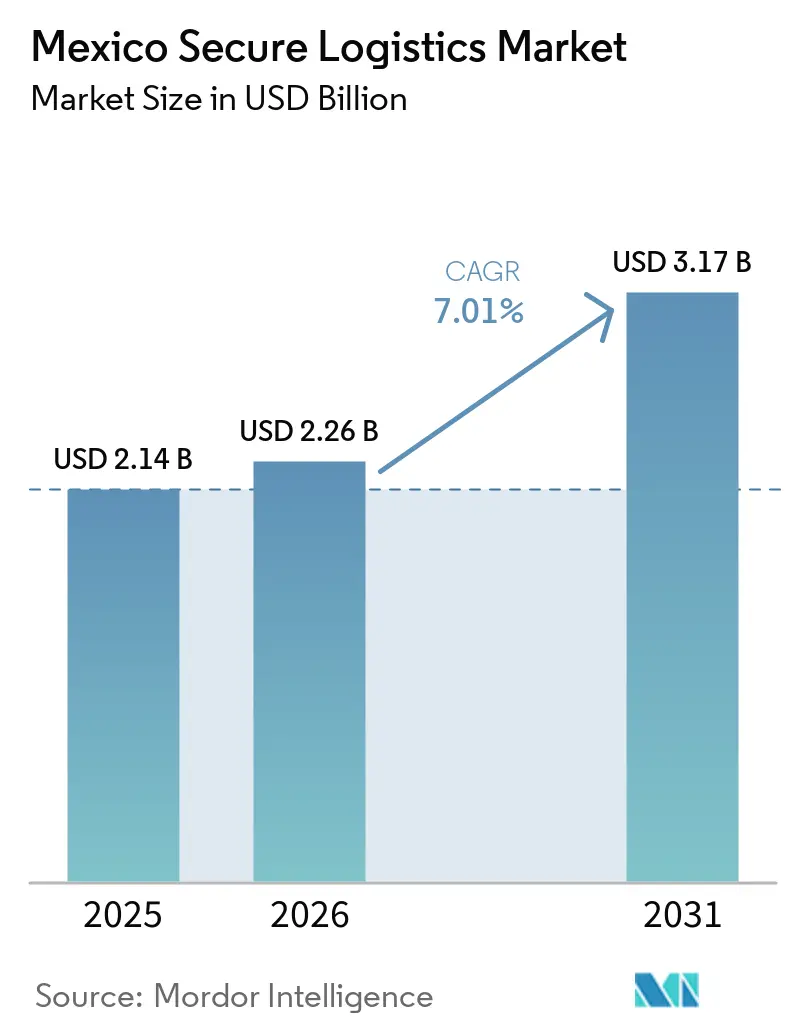
| Base Year Market Size (2025) | USD 2.14 Billion |
| Market Size (2026) | USD 2.26 Billion |
| Market Size (2031) | USD 3.17 Billion |
| Growth Rate (2026 - 2031) | 7.01 % |
| Market Concentration | Medium |
Major Players *Disclaimer: Major Players sorted in no particular order Image © Mordor Intelligence. Reuse requires attribution under CC BY 4.0. | |
Mexico Secure Logistics Market Analysis by Mordor Intelligence
The Mexico secure logistics market size was valued at USD 2.14 billion in 2025, and is estimated to grow from USD 2.26 billion in 2026 to reach USD 3.17 billion by 2031, at a CAGR of 7.01% during the forecast period (2026-2031).
The Mexico secure logistics market grew from the continued role of cash in retail and remittance collection, even as electronic payments gained traction. Cargo crime also kept security requirements high for cash, industrial goods, and high-value shipments. Cross-border manufacturing and trade expanded the service base beyond conventional cash transport. Providers increasingly combined armored movement with monitoring, reporting, insurance coordination, and custody controls. This combination created opportunities for operators that could cover urban corridors, industrial zones, and less-served regional routes.[1] “Ingresos y Egresos por Remesas, diciembre de 2025,” Banco de México, banxico.org.mx
Key Report Takeaways
- By service type, transportation held 64.50% of the Mexico secure logistics market share in 2025, while value-added services recorded the highest projected CAGR at 8.70% through 2031.
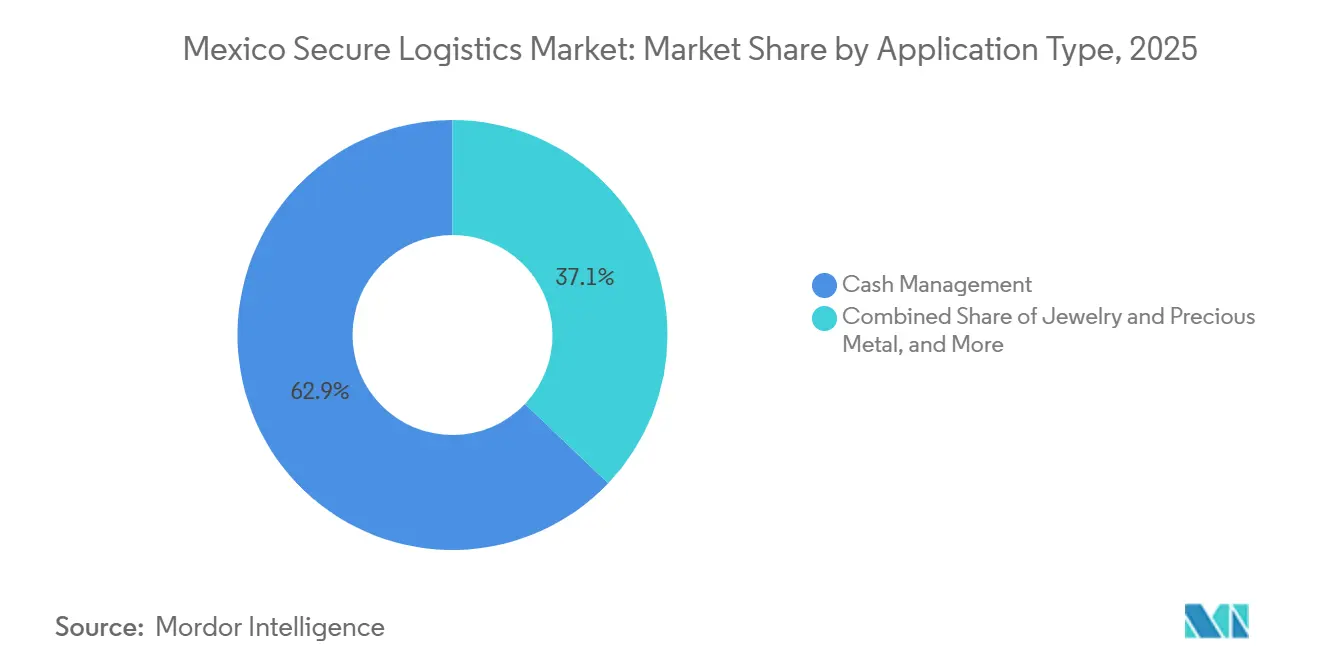
- By application, cash management held 62.85% of the Mexico secure logistics market size in 2025, while jewelry and precious metals recorded the highest projected CAGR at 9.10% through 2031.
- By type, mobile services held 57.90% of the Mexico secure logistics market share in 2025 and recorded the highest projected CAGR at 7.55% through 2031.
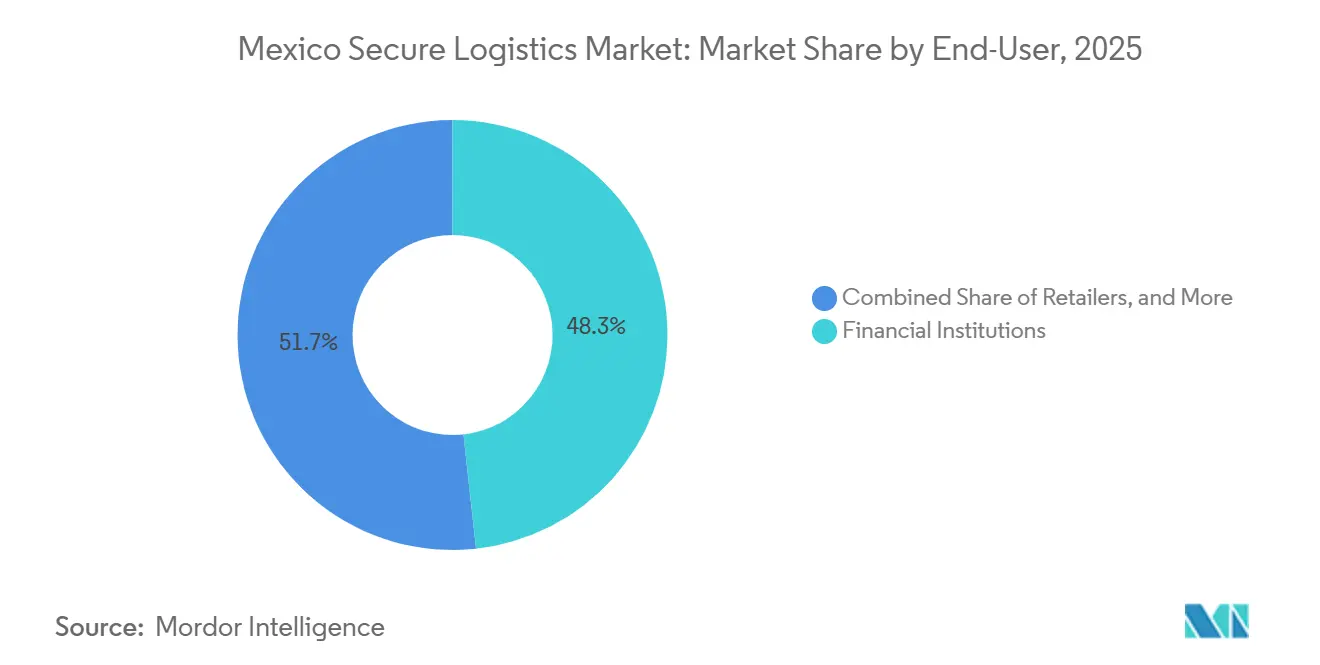
- By end user, financial institutions held 48.25% of the Mexico secure logistics market size in 2025, while retailers recorded the highest projected CAGR at 7.70% through 2031.
Note: Market size and forecast figures in this report are generated using Mordor Intelligence’s proprietary estimation framework, updated with the latest available data and insights as of January 2026.
Mexico Secure Logistics Market Trends and Insights
Drivers Impact Analysis*
| Driver | (~) % Impact on CAGR Forecast | Geographic Relevance | Impact Timeline |
|---|---|---|---|
| High incidence of cargo theft and violent robbery | +1.3% | Central Mexico, Bajío, and West | Short term (≤ 2 years) |
| Growth of e-commerce and high-volume parcel flows | +1.2% | National, with concentration in Mexico City, Monterrey, and Guadalajara | Short term (≤ 2 years) |
| Continued importance of physical cash | +1.1% | National, with higher relevance in rural and semi-urban areas | Medium term (2-4 years) |
| Expansion of cross-border trade and manufacturing | +1.1% | Northern border states and the Bajío industrial corridor | Medium term (2-4 years) |
| Security Logistics Technology Adoption | +0.9% | Major urban centers, with national expansion | Medium term (2-4 years) |
| Rising requirements for regulated, traceable custody | +0.7% | National | Long term (≥ 4 years) |
| Source: Mordor Intelligence | |||
High Incidence of Cargo Theft and Violent Robbery
Cargo theft remained a central demand factor for the Mexico secure logistics market during 2026. Mexico’s National Guard recorded 2,519 thefts through August 2026, compared with 6,263 thefts in all of 2025. The remaining incidents involved a high level of violence, with 76% involving physical violence in the second quarter. The Center and West regions accounted for 77% of reported incidents, including 18% in the State of Mexico, 17.9% in Puebla, and 10.8% in Guanajuato.[2]“Informe de Seguridad en Carreteras / Estadística de Robo al Autotransporte de Carga,” Gobierno de México, gob.mx/guardianacional CANACAR reported that 93% of thefts were concentrated in 10 states, and the State of Mexico and Puebla together accounted for 50%. These conditions favored providers with active intelligence, route controls, and coordination procedures over providers focused only on armored vehicle deployment.
Continued Importance of Physical Cash
Physical cash continued to support cash-management demand across the Mexico secure logistics market. Banco de Mexico reported that 49.6% of electronic remittances were collected in cash from total remittances of USD 61.8 billion received during 2025. This collection pattern required cash redistribution across receiving locations and local communities. New ATMs and correspondent banking arrangements also added distribution routes in municipalities with limited access to traditional banking. Card payments exceeded 10.6 billion transactions in the 12 months through June 2025, while the average real transaction value declined from MXN 903 in 2015 to MXN 580 (USD 50.93 to USD 32.26) in 2025. The evidence indicated that digital substitution focused on lower-value urban purchases, while branch deposits, ATM replenishment, and larger cash collections continued to require specialized handling.[3]“Balanza Comercial de Mercancías de México, diciembre de 2025,” INEGI, inegi.org.mx
Growth of E-Commerce and High-Volume Parcel Flows
E-commerce created a distinct operating need within the Mexico secure logistics market. Retail e-commerce reached MXN 941 billion (USD 52.34 billion) in 2025 and grew 19.2% during the year. High-value parcel flows involved electronics, jewelry, luxury goods, and other goods that required more controlled custody. Return shipments presented a separate exposure because reverse flows could fall outside the chain-of-custody procedures used for outbound deliveries. This gap increased the relevance of tracking, documented handoffs, and inventory controls for retailers. The Mexico secure logistics market, therefore, had room for services that connected parcel security with conventional cash and valuables protection.[4]“Estadística del Programa de la Industria Manufacturera, Maquiladora y de Servicios de Exportación 2025, Datos al mes de diciembre,” INEGI, inegi.org.mx
Expansion of Cross-Border Trade and Manufacturing
Cross-border trade and manufacturing widened the cargo base served by the Mexico secure logistics market. Mexico’s goods exports totaled USD 664.8 billion in 2025, of which manufacturing represented 91.6%. The IMMEX program had 6,512 active manufacturing programs in December 2025 and employed 3.15 million workers. Automotive, electronics, and pharmaceutical operations moved components that required documented custody on domestic and cross-border routes. Northern border states and the Bajio corridor held particular relevance because production, consolidation, and border crossings were concentrated there. The resulting demand favored providers able to apply security procedures across factory pickups, warehouse transfers, and international handoffs.
Restraints Impact Analysis*
| Restraint | (~) % Impact on CAGR Forecast | Geographic Relevance | Impact Timeline |
|---|---|---|---|
| High capital and operating costs | -0.8% | National | Medium term (2-4 years) |
| Stringent regulation and compliance burden | -0.6% | National | Medium term (2-4 years) |
| Long-term shift toward digital payments | -0.5% | Urban Mexico, including Mexico City, Monterrey, and Guadalajara | Long term (≥ 4 years) |
| Availability of skilled security personnel | -0.5% | National | Short term (≤ 2 years) |
| Source: Mordor Intelligence | |||
High Capital and Operating Costs
High entry and operating costs limited the number of providers able to scale in the Mexico secure logistics market. The regulated armored vehicle sector expanded 39% in 2025, which tightened available fleet capacity in the sector. Vehicle procurement, maintenance, communications equipment, insurance, and armed staffing required sustained capital commitments. Mexico’s labor reform took effect in May 2026, while payroll provisions are set to begin in January 2027. The reform increased compensation exposure for personnel-intensive security operations. A shortage of 150,000 certified logistics technicians annually, as reported, further increased competition for trained and vetted personnel.
Long-Term Shift Toward Digital Payments
Digital payments created a longer-term limitation for urban cash-in-transit activity in the Mexico secure logistics market. SPEI processed more than 7,300 million transfers during 2025, with a combined value close to MXN 600 trillion (USD 33.37 trillion). The same source projected that SPEI volumes would surpass card payment volumes by the end of 2026. Urban collection routes faced volume pressure first because digital payment acceptance was more developed in major cities. Rural routes faced a different challenge because lower collection frequency weakened route economics. Formal cash handlers still needed documented custody under Mexico’s anti-money-laundering framework, which preserved demand for licensed, compliant cash services.
*Our forecasts treat driver/restraint impacts as directional, not additive. The impact forecasts reflect baseline growth, mix effects, and variable interactions.
Segment Analysis
By Service Type: Transportation Led Revenue While Value-Added Services Grew Faster
Transportation held 64.50% of the Mexico secure logistics market share in 2025. Road-based armored movement remained the primary commercial activity because trucking carried a large share of freight across the country and through cross-border corridors. Air and sea transport served premium cargo and consolidated international shipments where speed or cargo value justified added controls. Rail maintained a smaller but relevant role for mining and industrial cargo on northern and western corridors. Transportation also covered the recurring movement of ATM cash, branch deposits, retail collections, and valuables. Its large installed fleet and operational reach kept it central to the Mexico secure logistics industry.
Value-added services recorded a 8.70% CAGR through 2031, making it the fastest-growing service type. Customers increasingly sought risk analysis, real-time monitoring, reporting, insurance coordination, and documented custody alongside physical movement. These services allowed operators to build a fuller record of each transfer and to respond to changing security conditions. Secure warehousing and vault services also gained relevance near manufacturing and distribution centers. Manufacturers using nearshoring-oriented supply chains needed monitored storage closer to production and distribution points. The Ley Federal de Seguridad Privada and CNBV requirements for providers serving financial institutions reinforced the advantage held by established operators with certified staff, compliant equipment, and operating scale.
By Application: Cash Management Held the Largest Position While Precious Metals Advanced
Cash management accounted for 62.85% of the Mexico secure logistics market size in 2025. ATM replenishment, branch deposit collection, vault redistribution, and cash processing supported this leading position. Financial institutions and retailers required frequent collections even as customers adopted more electronic payment methods. Remittance collection in cash further supported dispersed distribution requirements in local markets. Cash-management contracts also relied on verified personnel, secure vehicles, custody documentation, and reliable scheduling. These operating requirements made the segment a durable part of the Mexico secure logistics industry.
Jewelry and precious metals recorded a 9.10% CAGR through 2031. Mexico ranked sixth in global gold production, while the precious-metal jewelry import market reached USD 1.01 billion in 2025 and grew 11.23% in the trade analysis. The Camara de Joyeria de Jalisco estimated that in-transit theft or distribution-center discrepancies accounted for up to 7% of annual sector losses. This loss exposure raised the value of dedicated transport and verified delivery procedures. Manufacturing also represented a meaningful application through shipments of automotive, electronics, and pharmaceutical components. Diamonds and other goods, including pharmaceuticals, electronics, and luxury products, expanded with e-commerce, although their insurance and documentation standards were less formalized than those used for cash and precious metals.



By Type: Mobile Services Combined Scale With Faster Growth
Mobile services held 57.90% of the Mexico secure logistics market size in 2025 and recorded a 7.55% CAGR through 2031. This dual position reflected the need to move cash and valuables across Mexico’s road network instead of holding them at fixed sites for extended periods. Mobile operations required route planning, GPS monitoring, driver vetting, and coordination procedures. These requirements increased the value of dispatch systems and risk-management tools for larger providers. The 39% expansion of Mexico’s armored vehicle sector during 2025 also supported mobile-service capacity in the Mexico secure logistics market. Overhaul reported zero theft across more than 5,500 monitored pharmaceutical shipments in Mexico through its device-agnostic platform, which combined GPS, GPRS, and predictive analytics.
Static services included vault storage, on-site counting, and smart-safe deployments at retail locations. These activities produced recurring contract revenue and involved lower transport exposure than mobile services. Large retailers and financial institutions used static services to manage substantial daily cash volumes. Smart safes were increasingly relevant at pharmacies, convenience stores, and quick-service restaurants. Cash accumulated in those devices still required periodic armored collection, linking static locations to mobile networks. Integrated providers were better positioned to manage this connection than single-mode operators because they could combine equipment, pickup, custody, and reporting in one service arrangement.
By End User: Financial Institutions Anchored Demand While Retailers Grew Faster
Financial institutions held 48.25% of the Mexico secure logistics market share in 2025. Banks remained the largest buyers of armored cash transport, ATM managed services, smart-safe replenishment, and vault custody. The segment’s operating needs were shaped by ATM networks, branch servicing schedules, deposits, and regulatory requirements. Brinks reported that Latin America AMS and DRS organic revenue grew 15% in the first quarter of 2026. This result aligned with greater outsourcing of ATM management and smart-safe replenishment by banks. Financial Institutions therefore, retained an important role in sustaining recurring service contracts in the Mexico secure logistics market.
Retailers recorded the highest projected CAGR at 7.70% through 2031. E-commerce and physical retail expanded at the same time, creating security needs for cash, parcel flows, returns, and high-value inventories. Mexico had 77.2 million digital shoppers in 2025. Retail clients needed protection at stores, fulfillment locations, delivery nodes, and return points. Government demand remained supported by social-program cash distribution and payroll services in regions with limited banking coverage. Other end users, including pharmaceutical firms, mining companies, and jewelers, were individually smaller but collectively relevant because organized crime targeted high-value commodities.
Geography Analysis
Central Mexico represented the largest concentration of Mexico secure logistics market demand. The State of Mexico recorded 1,074 cargo theft investigations between January and May 2026, while Puebla recorded 486, according to CANACAR. Together, the 2 states accounted for 50% of national incidents in that source. National investigations declined 21% year over year, but the continuing violence in cargo incidents sustained demand for armored transport. State of Mexico, Mexico City, Puebla, and Tlaxcala combined population density, retail activity, banking infrastructure, and road freight. These features made Central Mexico a critical operating area for secure transport providers.
Northern Mexico recorded the fastest geographic growth in the Mexico secure logistics market. The region included Monterrey, Chihuahua, Tamaulipas, and Baja California, with strong links to manufacturing and United States trade routes. Mexico attracted USD 34.97 billion in foreign direct investment during the first half of 2026, including USD 13.48 billion in manufacturing, according to the Secretaria de Economia figures. The United States accounted for 48.2% of total inflows. Northern border states captured a substantial share because of their maquiladora infrastructure and location near United States markets. UPS announced a USD 50 million investment on May 29, 2026, for time-definite North American air-freight services to and from Mexico for automotive and industrial customers.
The Bajio corridor, covering Jalisco, Guanajuato, Queretaro, and Aguascalientes, was the second major growth node. Automotive, electronics, and pharmaceutical production underpinned demand for documented cargo custody in the area. Guanajuato accounted for 10.8% of national second-quarter 2026 cargo theft incidents. The security environment increased the requirement for protected transport between factories, warehouses, and distribution centers. Southeast Mexico was the smallest geography by revenue in the Mexico secure logistics market. Chiapas, Oaxaca, Yucatan, and Quintana Roo relied more heavily on regional coverage, including cash-management services and government-program distribution. Demand in these states provided a baseline of activity that was less dependent on broader economic cycles.
Competitive Landscape
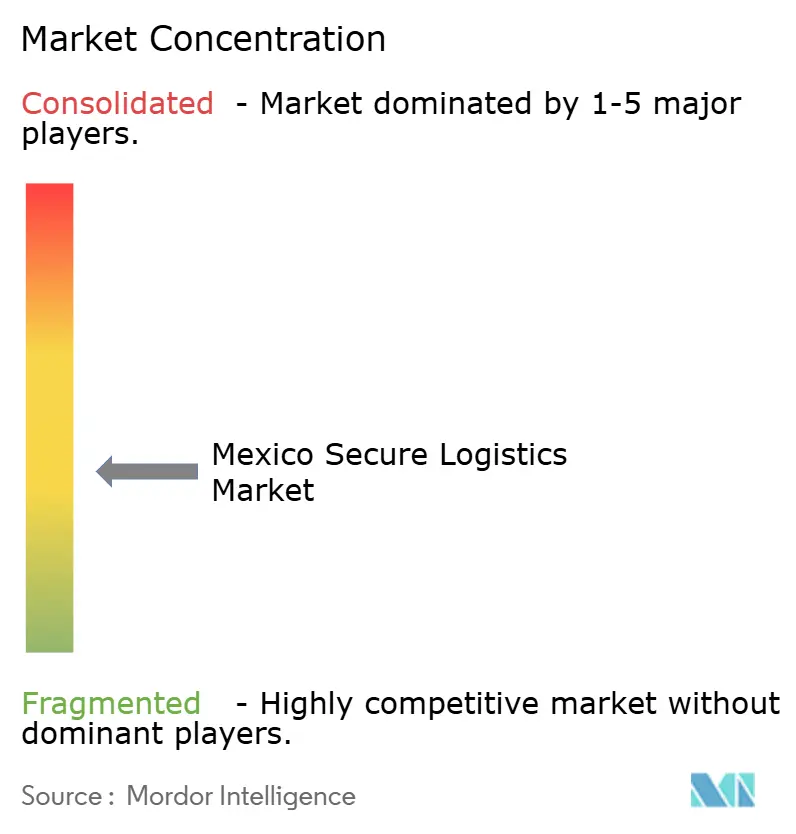
The Mexico secure logistics market remained moderately fragmented. The 5 largest companies generated less than 10% of the investigation and security services revenue in 2025. This low share indicated that national market power was dispersed, even though global specialists held strong positions in urban cash management. Capital, compliance, personnel vetting, and fleet investment still created meaningful barriers for new operators. Larger providers competed through network coverage, managed ATM services, risk tools, and reporting capability. Regional providers competed through local service coverage and lower operating costs in specific territories.
Brinks entered a definitive agreement on February 26, 2026, to acquire NCR Atleos, with a targeted USD 200 million in annual run-rate groups and a planned first-quarter 2027 close. The transaction expanded its ATM managed-services and digital-retail services platform in Latin America, including Mexico. Prosegur presented its 2026-2029 Strategic Plan in July 2026, with research, development, and business transformation among its priorities. Prosegur also received an S&P outlook revision from negative to stable in August 2026, with debt-to-EBITDA projected at 2.5x for 2026. These moves showed how major providers combined service expansion with financial and operating discipline.
DSV activated its integrated Mexico operations on February 1, 2026, after incorporating DB Schenker’s entity DSV. The combined operation included 1,000 employees, more than 40 operations centers, 1,700 trucks running daily, and over 800,000 annual shipments. This network strengthened logistics coverage in nearshoring corridors where security overlays were increasingly relevant. Overhaul competed in the intelligence layer by giving shippers real-time cargo visibility and predictive risk analytics. Smart-safe deployment outside major metropolitan areas, secure rail-linked interurban transport, and correspondent-banking support for newly banked municipalities remained areas with limited service coverage. These gaps gave regional and integrated providers opportunities to build coverage where large national networks remained less dense.
Mexico Secure Logistics Industry Leaders
Grupo Seguridad Integral (GSI)
The Brink’s Company
Prosegur S.A.
DHL Group
FedEx
- *Disclaimer: Major Players sorted in no particular order

Recent Industry Developments
- May 2026: UPS announced a USD 50 million investment to introduce time-definite North American Air Freight services to and from Mexico, offering 1-day, 2-day, and 3-day options, beginning in August 2026, for automotive and industrial manufacturers moving high-value, time-sensitive components across the border.
- February 2026: Brinks entered a definitive agreement to acquire NCR Atleos, an ATM operator with 600,000 ATMs globally, with USD 200 million in targeted annual run-rate cost groups and an anticipated first-quarter 2027 close.
- February 2026: DSV formally activated its integrated Mexico operations after incorporating DB Schenker’s entity and deploying 1,000 employees across more than 40 operations centers, with 1,700 trucks running daily and over 800,000 annual shipments.
- January 2026: Prosegur introduced an anti-drone protection system for critical infrastructure, industrial facilities, data centers, and transport nodes, with Mexico among the initial markets.


Mexico Secure Logistics Market Report Scope
| Transportation | Road |
| Rail | |
| Air | |
| Sea and Inland Waterways | |
| Warehousing and Storage (including Secure Storage and Vault Services) | |
| Value-added Services |
| Cash Management |
| Diamonds |
| Jewelry and Precious Metal |
| Manufacturing |
| Others |
| Static |
| Mobile |
| Financial Institutions |
| Retailers |
| Government |
| Others |
| By Service Type | Transportation | Road |
| Rail | ||
| Air | ||
| Sea and Inland Waterways | ||
| Warehousing and Storage (including Secure Storage and Vault Services) | ||
| Value-added Services | ||
| By Application | Cash Management | |
| Diamonds | ||
| Jewelry and Precious Metal | ||
| Manufacturing | ||
| Others | ||
| By Type | Static | |
| Mobile | ||
| By End User | Financial Institutions | |
| Retailers | ||
| Government | ||
| Others |


Key Questions Answered in the Report
What was the size of the Mexico secure logistics market in 2026?
The Mexico secure logistics market stood at USD 2.26 billion in 2026 and will reach USD 3.17 billion by 2031 at a CAGR of 7.01%. The forecast reflected demand for cash handling, protected cargo movement, and higher-value logistics services across retail, financial, and industrial activity.
What services generated the most revenue in Mexico secure logistics?
Transportation held 64.50% revenue share in 2025. Armored road movement supported ATM replenishment, deposit collection, retail pickups, and the controlled movement of industrial and high-value cargo across domestic and cross-border corridors.
Which application grew fastest through 2031?
Jewelry and precious metal recorded the highest projected CAGR at 9.10% through 2031. The segment benefited from theft exposure, jewelry imports, and the need for documented handoffs between production, storage, distribution centers, and retail locations.
Why did cash handling remain important in Mexico?
Cash collection remained relevant for remittances, ATM replenishment, branch services, retail collections, and communities with limited banking access. Cash use in these activities required secure collection, counting, custody, redistribution, reporting, and trained personnel.
Which customer group held the largest revenue share?
Financial institutions held 48.25% revenue share in 2025. Banks used armored transport, ATM managed services, smart-safe replenishment, vault custody, and scheduled servicing of branch and ATM networks with recurring cash-handling requirements.
How did secure logistics demand vary across Mexico?
Central Mexico held the largest concentration of demand because of cargo theft exposure, dense banking activity, and road freight. Northern Mexico grew fastest through manufacturing investment, maquiladora operations, and higher-value trade routes linked to the United States.
Page last updated on:





