
Market Overview
| Study Period | 2020 - 2031 |
|---|---|
| Forecast Data Period | 2026 - 2031 |
| Base Year Market Size (2025) | USD 1.31 Billion |
| Market Size (2026) | USD 1.36 Billion |
| Market Size (2031) | USD 1.67 Billion |
| Growth Rate (2026 - 2031) | 4.23 % |
| Market Concentration | Medium |
Major Players *Disclaimer: Major Players sorted in no particular order Image © Mordor Intelligence. Reuse requires attribution under CC BY 4.0. | |
Mexico Print Label Market Analysis by Mordor Intelligence
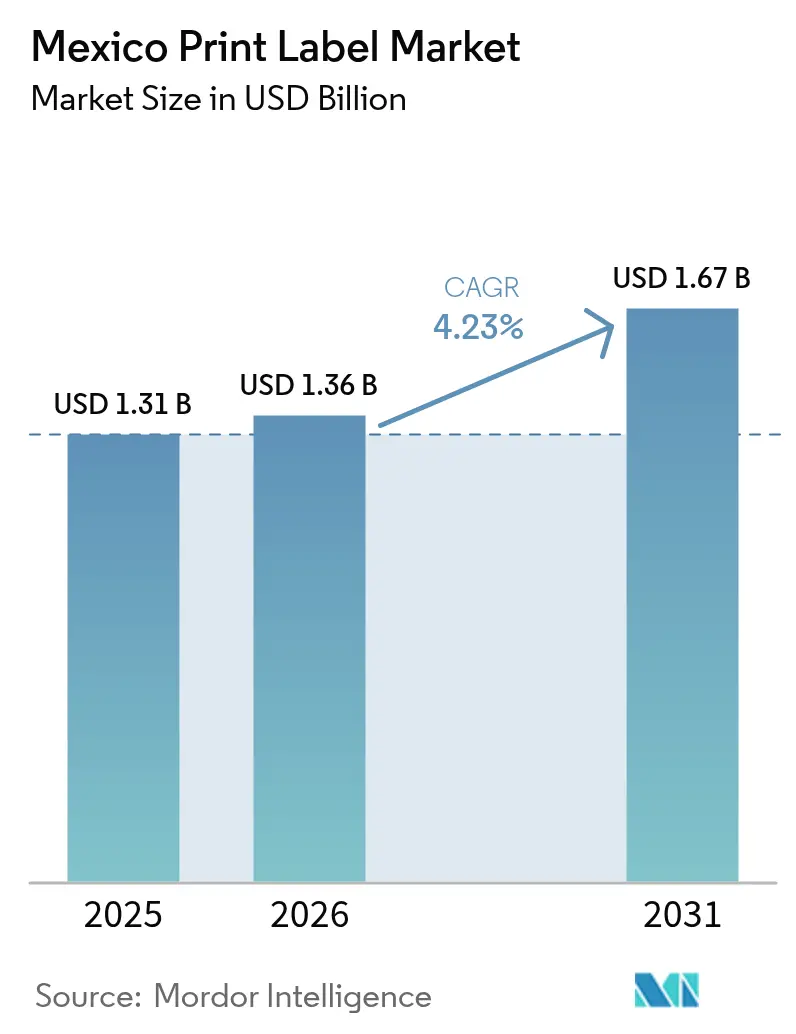
The Mexico print label market size is projected to expand from USD 1.31 billion in 2025 and USD 1.36 billion in 2026 to USD 1.67 billion by 2031, registering a CAGR of 4.23% between 2026 to 2031. Over the forecast horizon, brand owners that relocated production from Asia to Mexico after the United States-Mexico-Canada Agreement drove incremental label demand that outpaced historical averages. Converter order books lengthened because near-shore factories require replenishment in hours rather than in weeks, which shifted pricing power toward suppliers that operate plants inside major industrial corridors. Rising e-commerce parcel volumes, regulatory mandates for circular packaging, and serialized pharmaceutical track-and-trace labels further expand application breadth, encouraging capital spending on hybrid digital-flexo presses and liner-less converting lines. Competitive intensity remains moderate, yet recent mergers show that scale, software integration, and sustainable substrate portfolios now dictate margin resilience rather than low labor costs.
Key Report Takeaways
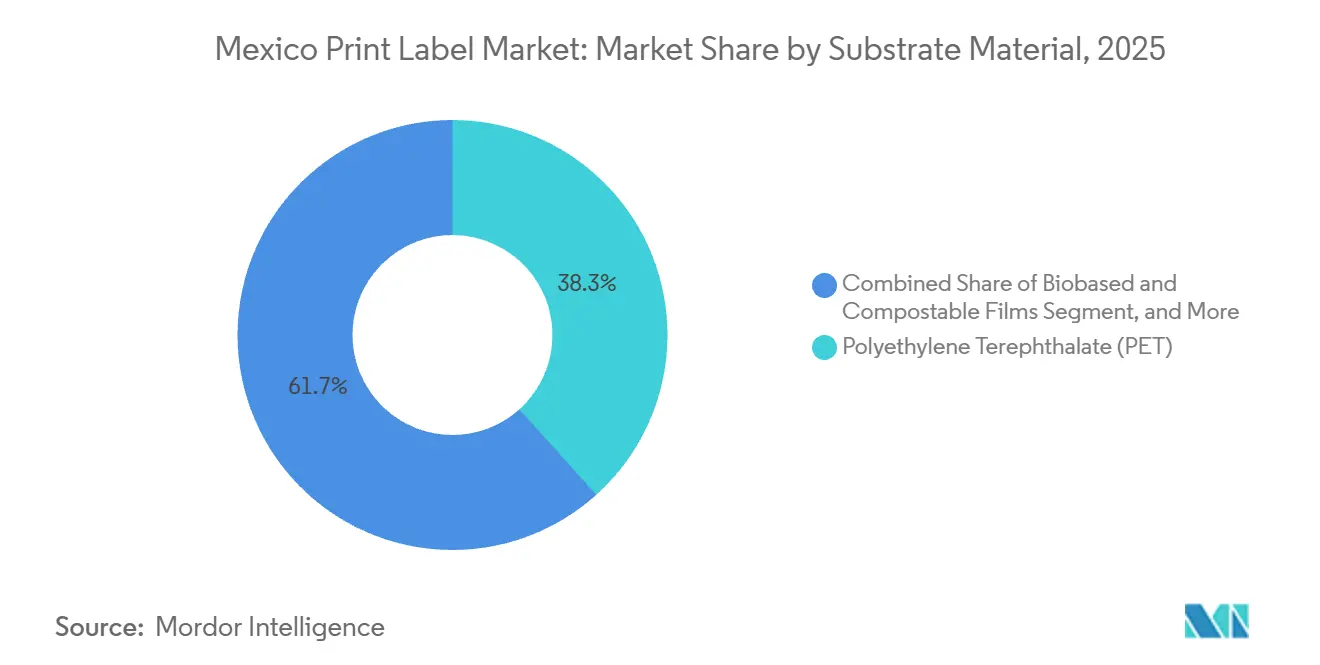
- By substrate material, polyethylene terephthalate captured 38.34% of the Mexico print label market share in 2025, while biobased and compostable films are projected to expand at a 5.68% CAGR through 2031.
- By print technology, flexography held 46.32% market share in 2025, whereas digital printing is forecast to grow at a 5.12% CAGR to 2031.
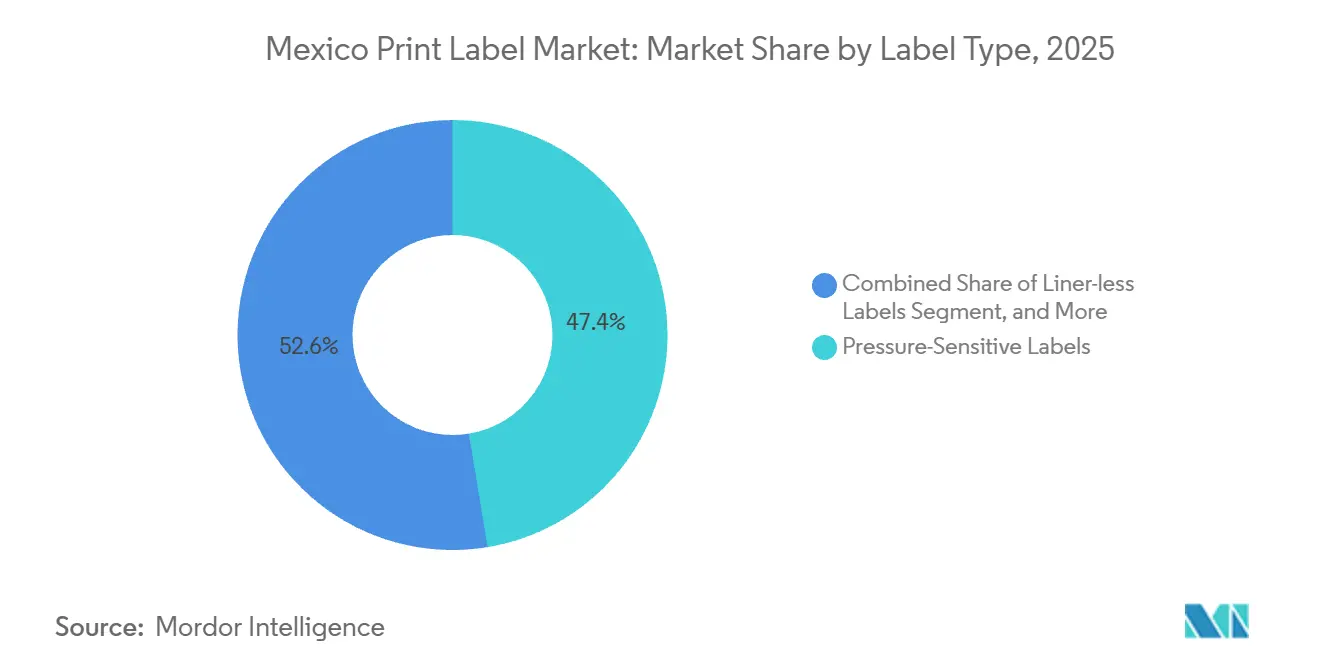
- By label type, pressure-sensitive formats accounted for 47.39% of the Mexico print label market size in 2025, and liner-less labels are expected to advance at a 5.76% CAGR during the outlook period.
- By end-user industry, food applications led with 28.64% share in 2025, while healthcare and pharmaceutical labels are poised to record the fastest 5.41% CAGR through 2031.
Note: Market size and forecast figures in this report are generated using Mordor Intelligence’s proprietary estimation framework, updated with the latest available data and insights as of 2026.
Mexico Print Label Market Trends and Insights
Drivers Impact Analysis*
| Driver | (~) % Impact on CAGR Forecast | Geographic Relevance | Impact Timeline |
|---|---|---|---|
| Reshoring-Driven Surge in Local Label Demand | +1.2% | National, concentrated in Nuevo León, Guanajuato, Querétaro, Jalisco industrial corridors | Short term (≤ 2 years) |
| Growth of E-Commerce and Logistics Automation | +0.9% | National, with early gains in Mexico City, Monterrey, Guadalajara metropolitan zones | Medium term (2-4 years) |
| Sustainability Mandates Boosting Liner-Less and Wash-Off Labels | +0.8% | National, compliance-driven in export-oriented facilities | Medium term (2-4 years) |
| Expansion of Mexican Craft Beverage Exports | +0.6% | Jalisco, Oaxaca, Guanajuato tequila and mezcal production zones; Baja California craft beer clusters | Long term (≥ 4 years) |
| Smart Labeling and Traceability Regulations | +0.5% | National, pharmaceutical and food sectors under COFEPRIS and Secretaría de Economía oversight | Medium term (2-4 years) |
| Corporate Near-Term CAPEX Incentives (Green Tax Credits) | +0.4% | National, immediate-deduction provisions favor Monterrey, Querétaro, Tijuana manufacturing hubs | Short term (≤ 2 years) |
| Source: Mordor Intelligence | |||
Reshoring-Driven Surge in Local Label Demand
Multinational manufacturers that transferred final assembly from Asia to Mexico now require label converters located inside the same industrial parks, because just-in-time systems tolerate only a few hours of lead time. Average labor costs of USD 3.50-5.00 per hour in Tijuana, Monterrey, and Hermosillo strengthen the business case for proximity, while tariff-free USMCA access eliminates customs delays.[1]Boston Consulting Group, “The New Economics of Global Manufacturing,” bcg.com Avery Dennison’s USD 100 million RFID plant in Querétaro demonstrates how embedded production, prototyping, and fulfillment converge inside one campus to deliver sub-24-hour replenishment.[2]Avery Dennison, “Avery Dennison Opens World’s Largest RFID Facility in Querétaro, Mexico,” Averydennison.com Brand owners now sign 18- to 24-month contracts instead of multi-year supply agreements, preserving flexibility when footprints shift. Converters that cannot guarantee overnight delivery lose bids even when they offer lower unit prices. As a result, the Mexico print label market rewards geographic density and agile scheduling rather than sheer output tonnage.
Growth of E-Commerce and Logistics Automation
Parcel hubs operated by Amazon and Mercado Libre in Mexico City, Monterrey, and Guadalajara deploy high-speed sortation lines that run at 200 units per minute, which pushes demand toward liner-less and pressure-sensitive labels engineered for automated application. South America’s logistics sector totaled USD 426.2 billion in 2024 and is expanding rapidly, with Mexico capturing an outsized share thanks to cross-border traffic into the United States. Liner-less rolls eliminate silicone-coated waste and lower material usage by 15-20%, giving fulfillment operators both cost and sustainability benefits. Technical specifications around die-cut tolerances and adhesives that perform across humidity swings raise entry barriers for small converters lacking R&D labs. Consequently, the Mexico print label market consolidates e-commerce volume into suppliers that bundle software, printers, and consumables in one contract.
Sustainability Mandates Boosting Liner-Less and Wash-Off Labels
The Circular Economy Law, which took effect in January 2026, obliges producers to register packaging materials, meet recycled-content thresholds, and demonstrate circular design, thereby forcing label redesign for recyclability. Liner-less formats remove non-recyclable release liners, while wash-off adhesives allow PET recyclers to recover clean flake. UPM Raflatac’s Carbon Action portfolio quantifies cradle-to-gate emissions, enabling brand owners to meet Scope 3 targets. Biofase scales 500 tons per month of avocado-seed resin that feeds compostable films, aligning with food-service labels disposed of with organic waste.[3]Biofase, “Sustainable Bioplastics from Avocado Seeds,” biofase.com.mx Converters that invest early capture premium pricing from global brands, whereas laggards risk exclusion from export supply chains once enforcement tightens.
Expansion of Mexican Craft Beverage Exports
Tequila, mezcal, and craft beer rely on labels as brand assets, demanding metallic foils, tactile varnishes, and security holograms that add 15-25% to unit cost. Grupo Flexográfico purchased a Nilpeter FA-17 press to supply 5,000-10,000-lot orders for premium tequila runs. Marbetes and precintos issued by the Consejo Regulador del Tequila embed serialized QR codes that deter counterfeits in export channels. Currency exposure emerges because distillers invoice in U.S. dollars but pay suppliers in pesos, squeezing converter margins when the peso strengthens. Companies that can hedge or invoice in dollars win cross-border contracts, splitting the Mexico print label market along financial-risk capabilities.
Restraints Impact Analysis*
| Restraint | (~) % Impact on CAGR Forecast | Geographic Relevance | Impact Timeline |
|---|---|---|---|
| Volatility in Petro-Based Film Prices | -0.6% | National, acute in import-dependent converters lacking hedging mechanisms | Short term (≤ 2 years) |
| Shortage of Skilled Flexo and Digital Press Operators | -0.4% | National, concentrated in Monterrey, Guadalajara, Querétaro industrial zones | Medium term (2-4 years) |
| High Upfront Cost of Hybrid Digital Presses | -0.3% | National, capital-access constraints in regional converters | Long term (≥ 4 years) |
| Fragmented Recycling Infrastructure | -0.2% | National, urban-rural disparity in collection and sortation capacity | Long term (≥ 4 years) |
| Source: Mordor Intelligence | |||
Volatility in Petro-Based Film Prices
Polypropylene and PET film costs track Brent crude with a 60-90-day lag, yet Mexican converters often sign fixed-price contracts that run 12-18 months. When Brent rose 22% in early 2025, film prices jumped 18%, but suppliers passed through only 40% of the spike, eroding gross margins. Limited access to futures markets leaves converters exposed, forcing cuts in R&D and maintenance that eventually impair quality. Multinationals with global purchasing desks hedge exposure, leaving local independents vulnerable and tilting the Mexico print label market toward players with treasury sophistication.
Shortage of Skilled Flexo and Digital Press Operators
The Flexographic Technical Association Mexico certifies fewer than 200 new operators each year, while the industry needs 500-700 to staff expansions.[4]Flexographic Technical Association Mexico, “Certification Programs,” flexography.org Poaching drives 20-30% wage escalation and disrupts smaller converters. Mark Andy partnered with Canvitech in March 2025 to broaden training access, yet coverage remains thin outside main corridors. Consequently, converters with in-house academies maintain uptime and color consistency, whereas under-resourced rivals suffer waste and missed SLAs, ultimately conceding share inside the Mexico print label market.
*Our forecasts treat driver/restraint impacts as directional, not additive. The impact forecasts reflect baseline growth, mix effects, and variable interactions.
Segment Analysis
By Substrate Material: PET Dominance Meets Biobased Disruption
Polyethylene terephthalate generated 38.34% of market 2025, affirming its clarity, barrier strength, and compatibility with high-speed applicators that underpin the Mexico print label market share leadership in beverages and personal care. Cost-per-square-meter and robust supply chains keep PET the baseline choice even as resin volatility rises. The Mexico print label market size derived from biobased and compostable films is projected to grow fastest at a 5.68% CAGR, because retailer scorecards and corporate net-zero pledges favor substrates that support circular claims. Biofase supplies 500 tons per month of avocado-seed resin for compostable films, and Innovia Films upgraded its Zacapú coating line to boost oxygen and moisture barriers, positioning biobased stocks for mainstream adoption.
The strategic dilemma centers on economics. Biobased webs command 30-50% premiums over petro-based equivalents, limiting uptake to premium SKUs or export packs facing strict environmental audits. Converters that scale early build process know-how and secure feedstock under long-term agreements, lowering future conversion costs. Should regulators impose minimum biocontent thresholds by 2028, installed capacity on compostable lines will convert into defensible advantage across the Mexico print label market.



By Print Technology: Hybrid Digital Systems Narrow Flexo’s Lead
Flexography accounted for 46.32% of market share in 2025, due to superior cost efficiency on runs exceeding 10,000 linear meters and steady gains in water-based ink performance. However, digital engines are forecast to advance at 5.12% per year as marketing teams demand late-stage artwork changes, serialized codes, and regional promotions. Labelexpo Mexico 2025 showcased HP Indigo, Durst, and Xeikon units capable of 80 m per minute, demonstrating that print quality gaps with offset have closed at typical viewing distances. The Mexico print label market, tied to digital output, is expanding as pharmaceutical and craft-beverage customers value versioning over unit cost.
Hybrid configurations that embed UV-inkjet heads into servo-driven flexo frames enable converters to toggle between digital and analog lanes in a single pass, capturing both scale and personalization margins. Although sticker prices range from USD 1.2-2.5 million, Plan Mexico depreciation incentives shorten paybacks and unlock financing. Converters lacking capital risk relegation to commodity SKUs, shrinking relevance inside the Mexico print label market.
By Label Type: Pressure-Sensitive Leadership Faces Liner-Less Challenge
Pressure-sensitive constructions accounted for 47.39% of the market share in 2025, spanning the food, logistics, and personal-care segments, as peel-and-stick convenience matches automated application speeds. Liner-less alternatives, supported by the Circular Economy Law, are projected to rise 5.76% annually, outpacing all other forms. E-commerce fulfillment lines value the 15-20% material reduction and 40% faster application that liner-less rolls enable. Shrink sleeves and in-mold labels retain strongholds where 360-degree graphics or high chemical resistance are vital.
Adoption hinges on adhesive chemistry. Liner-less stocks require formulas that remain tacky yet avoid ooze or blocking, constraining supply to a handful of multinational substrate makers. Early movers that master coating and slitting specifications secure multi-year contracts with parcel carriers and third-party logistics firms. The Mexico print label market, therefore, rewards converters that integrate applicator retrofits with consumables, transferring switching costs from the brand owner to the converter.
By End-User Industry: Healthcare Outpaces Food’s Volume Base
Food labels captured 28.64% of market share in 2025 because NOM-051 octagon warnings forced redesigns across snack, dairy, and beverage lines. Yet, healthcare and pharmaceutical demand is set to log a 5.41% CAGR from 2026-2031 as COFEPRIS serialization moves from pilot to full enforcement. The Mexico print label market size related to serialized vials, blister packs, and medical devices expands faster than grocery staples because regulation, rather than consumption, drives turnover.
Pharma lines require ISO 13485 clean-room environments, vision-system verification, and integration with enterprise resource planning for real-time data capture. Converters that invested in compliant clean rooms and validation protocols already quote 20-30% pricing premiums, shielding margins from resin volatility. Food converters with basic GMP credentials face steep CapEx to pivot, prompting joint-venture discussions with multinational label groups that seek rapid market entry.
Geography Analysis
Central and northern industrial corridors anchor activity inside the Mexico print label market, with Monterrey, Guadalajara, Querétaro, and Guanajuato accounting for the majority of installed converting horsepower. Monterrey hosts Avery Dennison’s RFID campus, Oben Group’s new BOPP line, and multiple medicine-pack contract manufacturers, generating steady demand that keeps machine utilization above 80%. Guadalajara leverages consumer-electronics clusters and proximity to tequila heartlands, drawing craft-beverage converters who value quick truck runs to bottling plants.
Querétaro and Guanajuato benefit from aerospace and automotive OEMs that mandate just-in-sequence label deliveries at hourly cadences, reinforcing the need for converters within 50 km of assembly sites. Mexico City and Estado de México add volume through consumer-goods factories and the nation’s largest e-commerce fulfillment centers, both of which intensify demand for pressure-sensitive and liner-less labels. Border cities such as Tijuana and Ciudad Juárez handle medical-device labeling destined for the U.S. market, leveraging FDA familiarization to command price premiums in the Mexico print label market.
Emerging secondary hubs include Puebla and San Luis Potosí, where new EV and aerospace investments call for specialty labeling in high-temperature and chemical-resistant formats. Infrastructure shortfalls in Oaxaca and Chiapas limit scalability despite buoyant mezcal growth, as substrate trucks face long transit times and intermittent power supply. Converters with binational footprints, notably AGH Labels and Valley, run plants on both sides of the frontier to synchronize cross-border replenishment, a capability increasingly requested by multinational brand owners.
Regulatory Landscape
Mexico print labels used on packaged goods are governed by Mexican Official Standards (NOMs) administered through the Secretaría de Economía (SE) standards system, with health-related label content and claims overseen by COFEPRIS and marketplace enforcement actions carried out by PROFECO. For mass-consumption categories, NOM-051-SCFI/SSA1-2010 remains the core reference for prepackaged food and non-alcoholic beverages, while NOM-050-SCFI-2004 serves as a general labeling fallback when no product-specific standard applies; these regimes reinforce Spanish-language requirements and prescribed commercial information, driving recurring label redesign and SKU changeovers for converters.
For imports, labeling and relabeling workflows are tied to customs readiness and verification, with pathways that allow labeling in Mexico when importers maintain arrangements with registered Verification Units (Unidad de Verificacion) ahead of clearance. Tools such as SNICE help map labeling obligations by tariff code, reducing compliance risk at the border. COFEPRIS also introduced new guidelines published in March 2025 requiring permits to advertise prepackaged food and non-alcoholic beverages carrying front-of-pack warning seals, extending compliance beyond physical labels into coordinated regulatory review of packaging-linked marketing materials.
Value Chain Analysis
The Mexico print label value chain begins with raw-material inputs (paper, PET, PP/BOPP, PVC, and emerging biobased/compostable films), pressure-sensitive adhesives and release liners, plus inks and coatings. These inputs move to label converters that handle prepress, printing (flexo, offset, screen, and digital), and finishing (die-cutting, slitting, inspection, and variable-data/RFID integration), before distribution to brand owners and co-packers across food and beverage, healthcare and pharmaceutical, cosmetics and personal care, industrial, and e-commerce logistics. As smart labeling (serialization and RFID) expands, software, vision inspection, and data management carry more weight in the converting step, which raises switching costs for end users that standardize on qualified suppliers.
Upstream supply is shaped by petro-based resin volatility and specialized materials availability (liner-less constructions and wash-off adhesives), while midstream constraints include skilled-operator availability and capital intensity for hybrid digital-flexo lines. Downstream, just-in-time replenishment and cross-border trade increase the importance of logistics performance, with ongoing congestion risks at crossings such as Nuevo Laredo and delays at ports such as Manzanillo and Lazaro Cardenas affecting both inbound substrates and outbound finished labels. Industry bodies and supplier ecosystems, including AMEE, ANIPAC, and ANFEC, are increasingly focused on capability-building around traceability, automation, and circular-economy readiness, supporting converters targeting multinational brand requirements across Mexico’s key industrial corridors.
Competitive Landscape
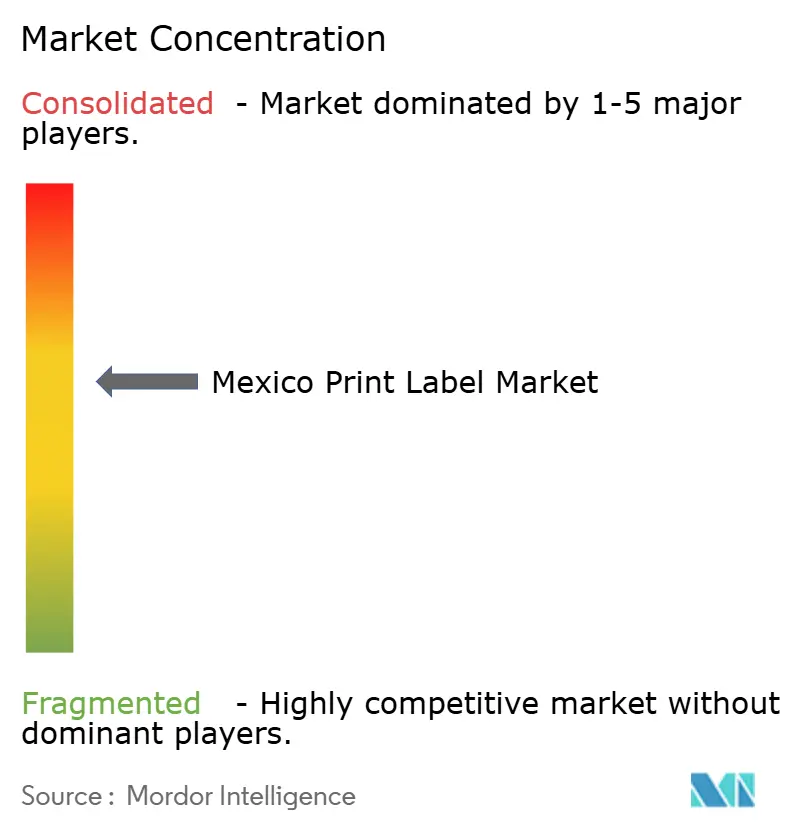
The Mexico print label market sits in a mid-concentration tier where the top five multinational converters, Avery Dennison, CCL Industries, UPM Raflatac, Multi-Color Corporation, and Amcor, dominate high-value niches such as RFID, security holograms, and pharmaceutical serialization. Regional family-owned firms, including Papeles y Conversiones de México, AGH Labels, Grupo Sigma Q, and Grupo Flexográfico, chase volume work by leveraging proximity, bilingual service, and quick changeovers. Recent M&A Multi-Color’s purchase of Eximpro and ProMach’s takeover of Etiflex signals that scale and proprietary software are now prerequisites for sustainable margins.
Technology investments create a widening gap. Avery Dennison’s USD 100 million RFID campus in Querétaro elevates label functionality from static identification to data infrastructure. Converters installing hybrid presses and LED-UV curing systems lock in craft-beverage and cosmetics business that values tactile and variable-data effects. Firms that rely solely on legacy flexo presses struggle to match color consistency at fast turnaround, pushing them toward commoditized food applications with thin spreads.
Financing capacity divides the field further. Plan Mexico tax incentives favor entities that can front large checks and document structured training, effectively handing a subsidy to well-capitalized multinationals. Local independents unable to access low-cost credit become acquisition targets or retreat to niche jobs. Over the outlook period, competitive dynamics in the Mexico print label market will depend less on labor cost and more on the ability to integrate software, smart substrates, and circular-economy compliance into a single value proposition.
Mexico Print Label Industry Leaders
Avery Dennison Corporation
CCL Industries Inc.
Amcor plc
UPM Raflatac Oy
Brady Corporation
- *Disclaimer: Major Players sorted in no particular order

Market Opportunities and Future Outlook
Circular-economy compliance is creating near-term whitespace in recyclable label constructions and waste-reducing formats, especially liner-less and wash-off adhesive solutions that support PET recovery while reducing liner disposal. With the Circular Economy Law taking effect in January 2026, producers have shifted toward documented packaging-material registries and circular design, increasing demand for converters that can qualify sustainable substrates, validate performance on automated applicators, and provide traceability documentation for export-oriented supply chains. Portfolios that quantify footprint and enable reporting, such as UPM Raflatac’s Carbon Action, fit into brand owner Scope 3 workflows and can support premium pricing in compliant label programs.
Automation and smart manufacturing investments across Mexican packaging operations also create room for converters to bundle labels with application, inspection, and data capabilities, particularly for high-throughput e-commerce and regulated healthcare lines. Equipment and modernization activity was visible in mid-2026 through major industry gatherings such as EXPO PACK Mexico (June 2026, 24,500 participants reported), while print and packaging suppliers pointed to investment demand for automation solutions at Expografica 2026 in Guadalajara, including new offset press purchases reported for Mexican printers. Nearshoring-driven procurement in hubs such as Monterrey, Guadalajara, and the Bajio corridor continues to favor plants located close to customer factories, where lead times and frequent artwork changes make hybrid workflows and variable-data readiness more valuable than commodity output.
Recent Industry Developments
- May 2026: CCL Industries highlighted momentum in RFID-related operations, pointing to its Checkpoint segment and a Mexico RFID inlay facility as a platform for North American leadership. The update signals continued capital and customer attention on RFID-enabled labels and inlays tied to traceability and inventory visibility programs across retail and logistics.
- November 2025: Amcor announced an expansion of North American printing, lamination, and converting capabilities for the protein market, with equipment installation continuing through the first half of 2026. Added converting and print capacity supports higher-throughput packaging programs that consume large volumes of printed labels and compatible materials across food supply chains serving the region, including Mexico-linked networks.
- October 2024: Avery Dennison inaugurated a 25,000-square-meter RFID and digital ID facility in the FINSA III industrial park in Queretaro, Mexico, representing about USD 181 million in investment. The site strengthens local supply of RFID-enabled label components and shortens replenishment cycles for brand owners and logistics operators that require rapid, serialized identification solutions.


Research Methodology Framework and Report Scope
Market Definition and Coverage
For this study, the Mexico print label market is defined as the value of printed labels supplied for product identification, branding, and compliance on packaged goods and industrial items, covering label converting output sold within Mexico.
Scope exclusions: It excludes printing of books, newspapers, brochures, and other commercial print products that are not labels.
Segmentation Overview
- By Substrate Material
- Paper and Paperboard
- Polyethylene Terephthalate (PET)
- Polypropylene (PP and BOPP)
- Polyvinyl Chloride (PVC)
- Biobased and Compostable Films
- Other Substrate Materials
- By Print Technology
- Offset
- Flexography
- Screen
- Digital Printing
- Other Print Technologies
- By Label Type
- Wet-glued Labels
- Pressure-Sensitive Labels
- Liner-less Labels
- In-mold Labels
- Shrink Sleeve Labels
- Other Label Types
- By End-user Industry
- Food
- Beverage
- Healthcare and Pharmaceutical
- Cosmetics and Personal Care
- Industrial
- Other End-user Industries
Data Sources, Market Sizing, and Validation
Desk Research
Desk work starts by mapping label demand to measurable packaging activity in Mexico, so the model is grounded in real consumption and production signals. The approach uses public sources such as INEGI industrial output series, Mexico customs and trade statistics for paper and plastic inputs, UN Comtrade for cross-checking trade flows, and FAO or similar food production datasets to track label-heavy end uses over time.
To keep assumptions grounded, we also review company annual reports and investor presentations, packaging and printing association publications, and credible business press for capacity additions and pricing changes. In a few cases, paid subscriptions are used only for elements like company financials and shipment-level import or export checks, plus patent databases to track material and ink related innovation. These sources are not exhaustive, and we also relied on other public references for data collection, validation, and clarification.
Primary Interviews and Surveys
Primary work was used to pressure-test desk assumptions around label mix, demand timing, and pricing, since labels vary by material and format. Interviews covered a mix of converters, material suppliers, printers, and large label buyers in end-use industries, and we also captured input from logistics and retail packaging teams where labeling specifications change frequently.
Feedback from these discussions helped close gaps around typical order sizes, import substitution trends, and how much price movement is passed through when paper films, inks, or adhesives shift. Those inputs then feed back into the final model.
Distribution of primary research fieldwork respondents
| Company type | Respondent position |
|---|---|
| Top tier: 39% | CXOs: 14% |
| Mid tier: 47% | Functional/Unit leaders: 31% |
| Smaller Players: 14% | Managers: 55% |
Market-Sizing & Forecasting
Sizing begins with a top-down build that reconstructs Mexico label demand using packaging output indicators and trade movement of key inputs. We then translate the demand into label value using typical label intensity and pricing by material and format. To keep the model operational, it uses variables such as packaged food and beverage production volumes, pharma and personal care manufacturing trends, labelstock and film availability, import and export shifts for packaging materials, and observed print and converting price changes.
After forming the total, we use selective bottom-up checks as a reality test, including sampled converter revenue ranges, channel discussions on average selling prices by label type, and volume-to-value conversions where reliable production proxies exist. If a segment is under-reported in public data, we apply proportional allocation based on primary feedback, and then stress-test the result against overall packaging spend patterns.
For forecasting, scenario analysis translates macro and industry drivers into demand. The scenarios are anchored by interview consensus on end-use growth, material substitution (paper versus films), and the pace of sustainability driven format changes. Assumptions are kept traceable so each step links back to a defined driver.
Data Validation & Update Cycle
Validation is done in layers so major errors are caught early. Outputs are checked against independent signals such as packaging market direction, manufacturing output patterns, and trade-based movement of label related inputs, and variances are investigated before sign-off.
When an unusual jump appears, the team re-checks currency timing, inflation effects, and potential one-time triggers like capacity expansions or policy changes. Key interviewees may also be re-contacted to confirm the interpretation. Reports are refreshed annually, with interim updates when material events occur, and a final pre-delivery pass is completed so clients receive the latest updated view.
Mordor Intelligence's Mexico Print Label Market Size Compared Against Other Published Estimates
Published market values for Mexico print labels can differ even when the topic sounds the same, since each publisher may define what counts as a label, pick a different base year, and treat pricing and inflation in its own way. Differences also show up when some estimates use packaging labels only, while others include broader label use cases tied to industrial products.
Key gap drivers in this market are usually the included label formats (for example, whether shrink sleeves and in-mold labels are counted), how much imported labelstock is assumed to be converted locally versus sold as finished labels, and whether forecast pricing follows a stable average or allows step changes when raw materials move. The spread in 2025 is also explained by whether value is built from packaging output and label intensity or taken from a narrower packaging-label revenue pool, which is the approach applied here by Mordor Intelligence.
Benchmark comparison
| Source | Market Size | Gaps in Research Methodology |
|---|---|---|
| Mordor Intelligence | USD 1.31 B (2025) | |
| Global Consultancy A | USD 1.30 B (2024) | Uses an earlier base year and a simplified CAGR application, and it is less clear on how label formats are treated when converting volume signals into USD value. |
| Industry Publisher B | USD 0.61 B (2025) | Appears to focus on a narrower packaging-label revenue pool, which can exclude label use cases outside packaged goods and undercount formats like sleeves or in-mold labels. |
The table shows that year choice and scope are the main reasons the estimates do not line up. By keeping the scope tied to printed label value supplied in Mexico, and then checking results against packaging activity and interview-based price logic, the final number stays traceable to inputs that can be reviewed and repeated.


Key Questions Answered in the Report
How large will the Mexico print label market be by 2031?
It is forecast to reach USD 1.67 billion by 2031, expanding at a 4.23% CAGR between 2026 and 2031.
Which substrate grows fastest inside Mexican label converting?
Biobased and compostable films are projected to post a 5.68% CAGR through 2031, outpacing petro-based options.
Why are liner-less labels gaining ground in Mexico?
Fulfillment centers favor their 15-20% material savings and 40% faster application speeds, while the Circular Economy Law penalizes waste-generating liners.
What makes healthcare labeling attractive for converters?
COFEPRIS serialization rules and near-shored pharmaceutical plants create steady demand for high-margin variable-data and RFID-enabled labels.
How do Plan Mexico tax incentives influence press investments?
Immediate depreciation plus a 25% training deduction shorten paybacks by roughly 15-20%, encouraging hybrid digital-flexo press adoption.
Which regions offer the strongest growth prospects for converters?
Industrial corridors in Monterrey, Guadalajara, Querétaro, and Guanajuato lead demand thanks to automotive, aerospace, and e-commerce expansions.
Page last updated on:


 Your data is secure and never sold or shared.


