
Mexico Pet Treats Market Size and Share
Market Overview
| Study Period | 2021 - 2031 |
|---|---|
| Forecast Data Period | 2026 - 2031 |
| Base Year Market Size (2025) | USD 652.17 Million |
| Market Size (2026) | USD 700.40 Million |
| Market Size (2031) | USD 990.09 Million |
| Growth Rate (2026 - 2031) | 7.17 % |
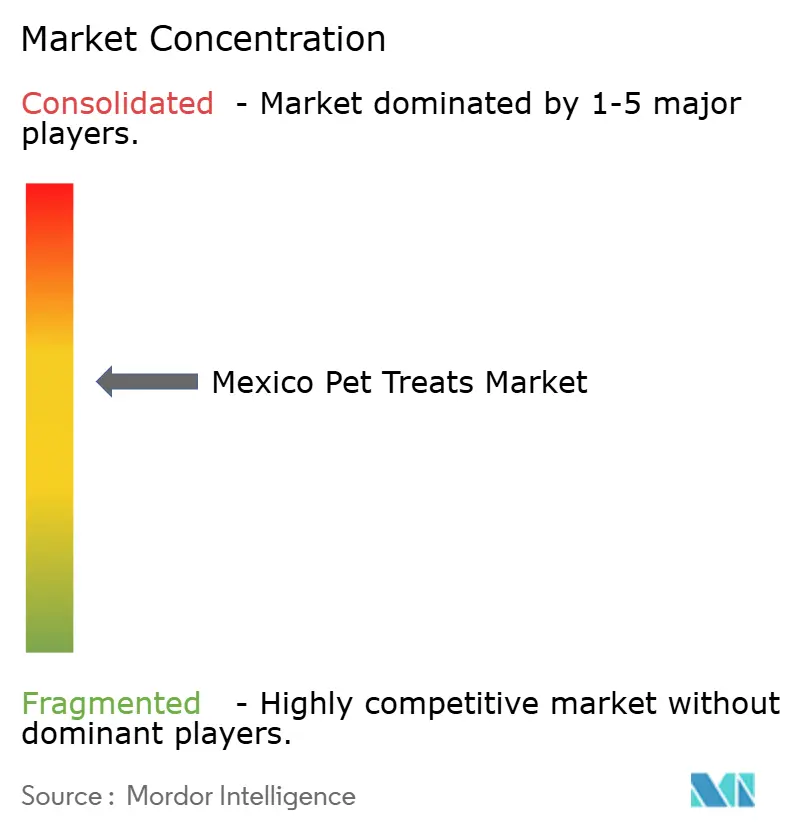
| Market Concentration | Medium |
Major Players
*Disclaimer: Major Players sorted in no particular order Image © Mordor Intelligence. Reuse requires attribution under CC BY 4.0. |
|
Mexico Pet Treats Market Analysis by Mordor Intelligence
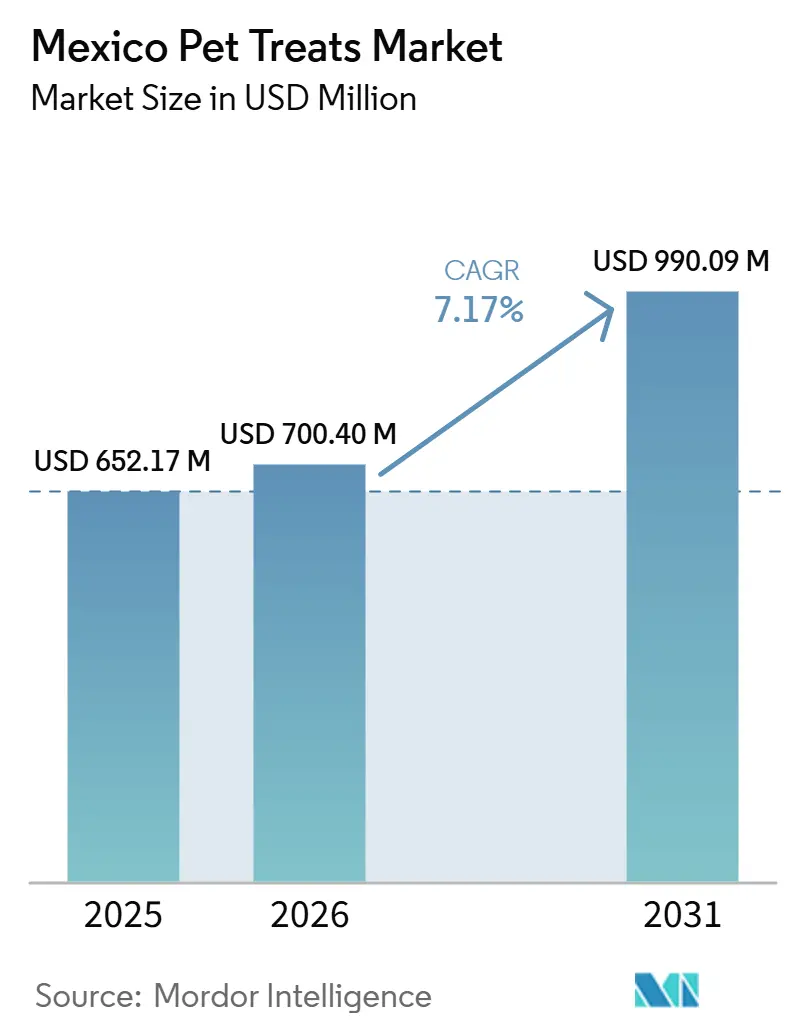
The Mexico pet treats market is projected to grow from USD 652.17 million in 2025 to USD 700.40 million in 2026, reaching USD 990.10 million by 2031, at a CAGR of 7.17% during the forecast period 2026 to 2031. The market benefits from a large and stable pet population, which supports steady repeat demand for reward, dental, and functional treat formats. Growth is further supported by rising urban pet ownership, increased use of treats in daily training routines, and broader consumer acceptance of preventive care products in mainstream retail. The market is also seeing a wider premium product mix as international brands introduce science-backed formulations and domestic players expand retail access through modern trade partnerships. Competitive conditions remain moderate, with global companies holding strong branded positions while local manufacturers retain a presence in value-focused and regional channels. Additional growth opportunities exist in online distribution, feline treat formats, and health-oriented products, where consumer familiarity and organized retail visibility are both improving.
Key Report Takeaways
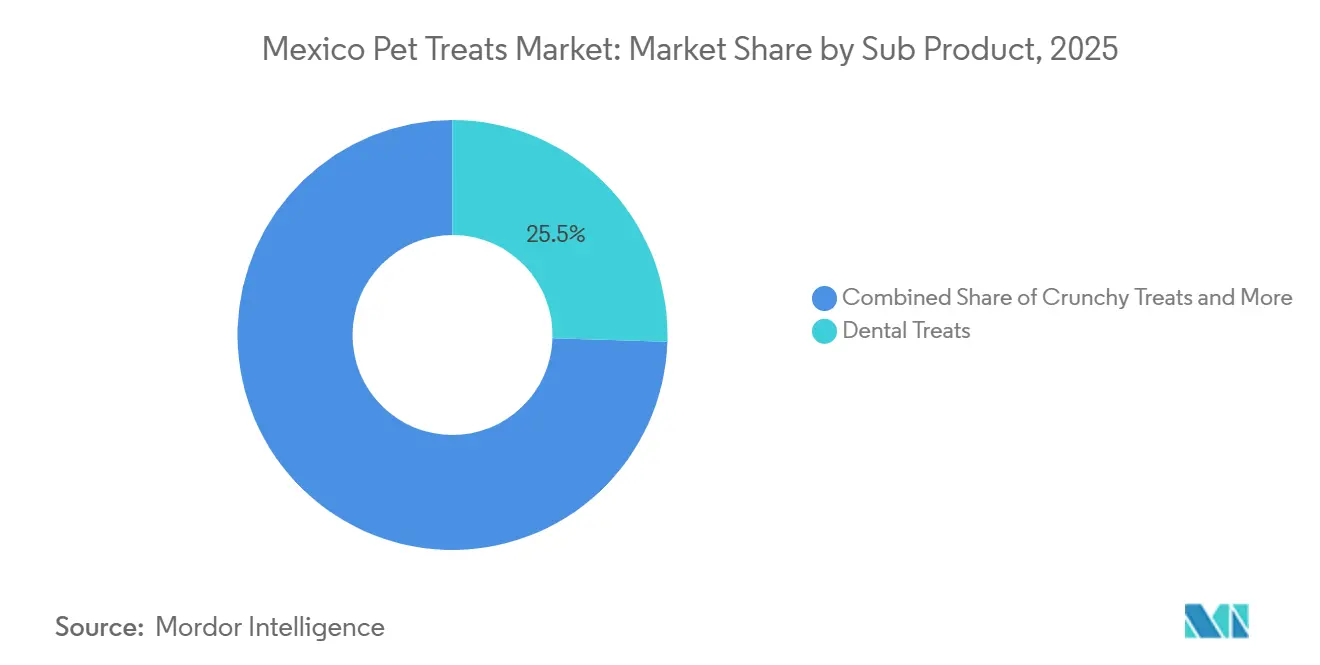
- By sub product, dental treats were the largest segment and held 25.5% of the Mexico pet treats market share in 2025, while dental treats are also the fastest growing segment and are anticipated to expand at a 7.5% CAGR between 2026 and 2031.
- By pets, dogs were the largest segment and held 87.6% of the Mexico pet treats market size in 2025, while cats are the fastest growing segment and are anticipated to expand at a 8.5% CAGR between 2026 and 2031.
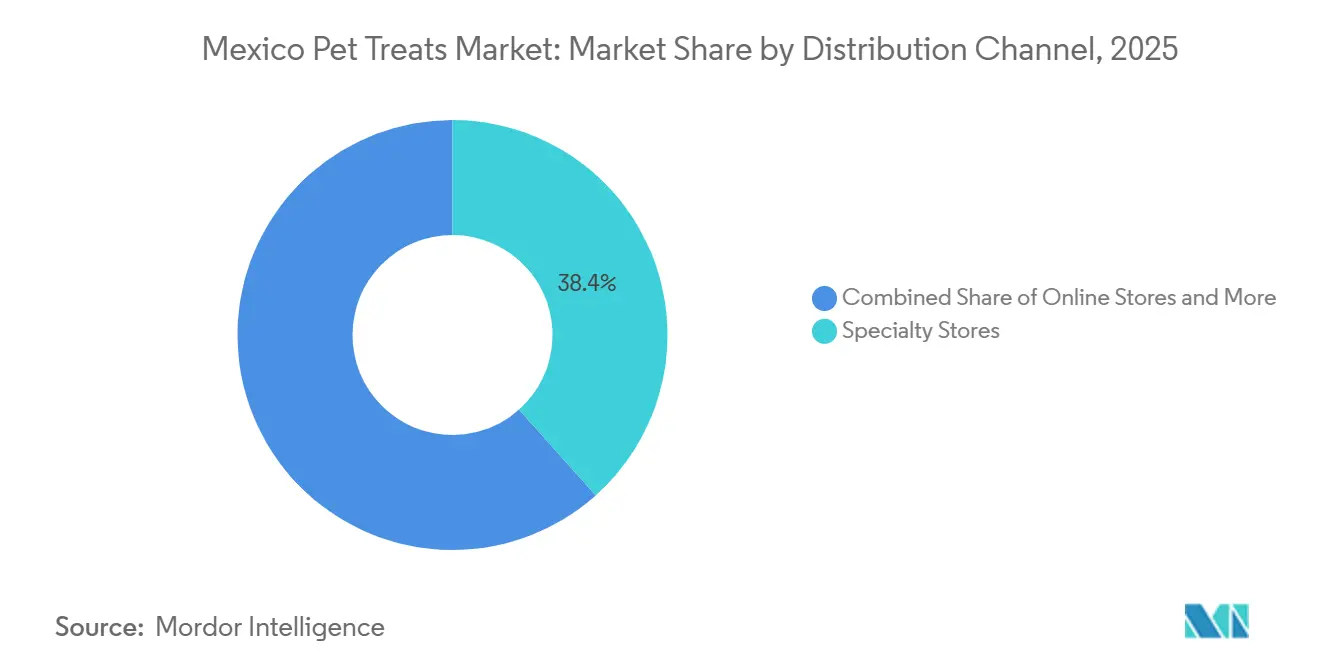
- By distribution channel, specialty stores were the largest segment and held 38.4% of the market share in 2025, while the online channel is the fastest growing segment and is anticipated to expand at an 8.0% CAGR between 2026 and 2031.
Note: Market size and forecast figures in this report are generated using Mordor Intelligence’s proprietary estimation framework, updated with the latest available data and insights as of January 2026.
Mexico Pet Treats Market Trends and Insights
Drivers Impact Analysis*
| Driver | (~) % Impact on CAGR Forecast | Geographic Relevance | Impact Timeline |
|---|---|---|---|
| Rising dog ownership in urban Mexico | +1.8% | National, with the strongest gains in Mexico City, Guadalajara, and Monterrey | Medium term (2-4 years) |
| Strong growth in dental treats | +1.5% | National, with deeper traction in premium urban retail clusters | Short term (≤ 2 years) |
| Expansion of modern retail and e-commerce | +1.2% | National, with e-commerce most visible in the Mexico City metropolitan region | Medium term (2-4 years) |
| Premiumization of pet care spending | +1.4% | National, with stronger premium demand in Nuevo León, Mexico City, and Jalisco | Long term (≥ 4 years) |
| Local manufacturing and regional supply scale | +0.8% | National, anchored by major facilities in Querétaro and Guanajuato | Medium term (2-4 years) |
| Treats used for training and bonding | +0.9% | National, with the highest adoption in urban centers | Short term (≤ 2 years) |
| Source: Mordor Intelligence | |||
Rising Dog Ownership in Urban Mexico
Urban demand remains a core growth driver for the Mexico pet treats market, as dog ownership is both large in scale and concentrated in dense cities where treat usage is more frequent. In major cities, treats are used more deliberately for training, enrichment, and behavior management, as smaller homes and apartment settings favor portion control and routine reinforcement. This pattern makes treat spending less occasional and more habitual, particularly in households that already purchase packaged pet food regularly. The market also benefits from rising urban employment and increasing household income in secondary cities, where pet care routines are becoming more structured even before specialty retail coverage fully expands. As a result, demand is widening beyond the largest metropolitan areas, creating a broader base for national distribution.
Strong Growth in Dental Treats
Dental treats occupy a distinct position in the Mexico pet treats market as preventive oral care becomes an increasingly routine part of pet ownership. This trend is supported by greater veterinary awareness, clearer product positioning, and the availability of clinically validated products carrying the Veterinary Oral Health Council (VOHC) seal in regulated retail channels. Mexico's regulatory framework, overseen by the Servicio Nacional de Sanidad, Inocuidad y Calidad Agroalimentaria (SENASICA), has contributed to more structured category development for animal-use products. Dental treats benefit from a clear value proposition, as pet owners associate regular chewing with improved oral hygiene and reduced need for more expensive clinical dental interventions[1]Source: Gobierno de Mexico, "Mexico is at the forefront in the regulation of feed for animal use or consumption," gob.mx. As a result, the category continues to expand across both mass-market and premium veterinary-backed products.
Expansion of Modern Retail and E-Commerce
Channel modernization is expanding access to the Mexico pet treats market by making branded products more available beyond specialty outlets. Large retail chains, online marketplaces, and omnichannel pet retailers are providing brands with faster national visibility, better replenishment rates, and more room for premium line extensions. The 2025 partnership between Kimberly-Clark Mexico and Grupo Nutec demonstrated how quickly a new pet nutrition platform could enter broad retail distribution, reaching more than 3,000 Walmart stores before expanding to Chedraui, H-E-B, Al Super, and Smart, as well as digital platforms like Amazon and wholesale channels in the same year[2]Source: News Article, "Kimberly-Clark, Nutec Launch New Pet Food Proposals,"mexicobusiness.news. This is relevant for treats because distribution depth often determines whether a product remains an impulse purchase or becomes part of a recurring basket. The online channel is particularly relevant in cities where consumers prioritize convenience and subscription-style replenishment, and also in secondary locations where physical specialty store coverage is limited. As a result, distribution is becoming a stronger growth driver in the Mexico pet treats market, rather than functioning solely as a route-to-market.
Premiumization of Pet Care Spending
The Mexico pet treats market is benefiting from a premium shift in household pet spending, where value growth is increasingly tied to health, ingredient quality, and specialist positioning. Mexico's broader pet food category has experienced stronger value growth than volume growth, indicating consumers are willing to pay more for differentiated products rather than simply purchasing larger quantities. This trend supports greater acceptance of natural, functional, and veterinary-recommended pet treats, particularly among urban households that increasingly view pets as family members. Premium momentum is further supported by brand investment, including General Mills' June 2025 launch of Love Made Fresh under Blue Buffalo, which signaled a broader push into fresh and functional pet nutrition formats. In parallel, international players continue to build science-led positioning and broaden channel access for higher-value lines, strengthening premium credibility in Mexico. Over time, this is anticipated to shift the product mix toward specialized treats targeting dental care, digestion, and overall wellness, rather than simple reward use alone.
Restraints Impact Analysis*
| Restraint | (~) % Impact on CAGR Forecast | Geographic Relevance | Impact Timeline |
|---|---|---|---|
| High price sensitivity | -0.8% | National, with the sharpest effect in rural and semi-urban markets | Short term (≤ 2 years) |
| Heavy dependence on imported inputs | -0.7% | National, with greater exposure among import-reliant manufacturers | Medium term (2-4 years) |
| Informal and fragmented retail channels | -0.6% | National, most visible in smaller cities and rural areas | Long term (≥ 4 years) |
| Regulatory and labeling compliance burden | -0.5% | National, with higher compliance pressure in import-heavy retail channels | Medium term (2-4 years) |
| Source: Mordor Intelligence | |||
High Price Sensitivity
Price sensitivity continues to limit the pace at which the Mexico pet treats market can move into premium tiers. A large share of demand still comes from households that require affordable formats, keeping value-tier crunchy and soft treats relevant even as premium products gain visibility. This creates a challenge for manufacturers, as premium formulations can increase unit value, but mainstream volume still depends on accessible pack sizes and price points. Private-label activity in grocery retail adds to this pressure, as budget-conscious shoppers can switch more easily in standard treat categories where product differences are less apparent. The Mexico pet treats market therefore requires format innovation, smaller entry packs, and clearer benefit communication to broaden adoption without exceeding household budgets. This constraint is most pronounced outside major urban centers, where treat use remains more discretionary and brand loyalty is less established.
Heavy Dependence on Imported Inputs
Dependence on imported proteins, additives, premixes, and specialty functional ingredients remains a structural constraint for the Mexico pet treats market, exposing margins to currency fluctuations and supply volatility. Treat categories are particularly affected because functional ingredients, specialty proteins, and higher-value inclusions are often sourced from outside Mexico and carry a dollar-linked cost base. Exchange rate movements can therefore narrow profitability even when unit sales remain stable, particularly for mid-tier players with limited purchasing power. Local sourcing programs can partially ease this pressure, but scaling them takes time, as suppliers must meet consistency, safety, and formulation standards. Until local supply networks develop further, dependence on imported inputs will continue to constrain margin flexibility.
*Our forecasts treat driver/restraint impacts as directional, not additive. The impact forecasts reflect baseline growth, mix effects, and variable interactions.
Segment Analysis
By Sub Product: Dental Treats Lead on Both Scale and Growth
Dental treats held a 25.5% share of the Mexico pet treats market in 2025 and is anticipated to expand at a 7.5% CAGR between 2026 and 2031. The segment leads in both current size and projected growth, which is notable for a category that has already reached mainstream shelf presence. The segment has moved beyond a narrow veterinary niche as consumers now recognize oral care as part of routine pet maintenance rather than a response to visible health issues alone. Market size for dental treats has been supported by repeat purchase behavior, stronger recommendation networks, and clearer product education in organized retail. Products with clinically aligned positioning benefit from consumer trust, particularly when brand messaging connects daily chewing habits to broader health outcomes. That trust makes dental treats easier to justify at a higher price point than basic reward formats. It also gives manufacturers reason to invest in premium packaging, benefit-led labeling, and channel partnerships that reinforce specialist positioning.
Crunchy treats are easy to distribute, familiar to shoppers, and well suited to regular grocery channels. Soft and chewy formats fit training routines more naturally as they are easy to portion, easy to carry, and widely used in reward-based behavior reinforcement. Freeze-dried and jerky products represent a smaller base but capture the premium movement toward simpler ingredient profiles and less processed positioning. Other treat formats, including supplement-style products for joint health, digestion, and skin support, are broadening the definition of what a treat can deliver in daily use. As these formats gain visibility, the product mix will continue shifting toward more specialized offerings. Dental treats are likely to remain at the center of growth because they combine a straightforward consumer message with strong repeat purchase potential, keeping them in a stronger position than categories that depend more heavily on novelty or one-time trial.



By Pets: Dog Treats Dominate, but Cats Gain Ground
Dogs accounted for 87.6% of the Mexico pet treats market in 2025, making them the clear volume base for almost every major treat format. Most new product development still begins with dog-focused stock keeping units, as this is where scale, shelf turnover, and established consumer behavior are strongest. This market share also means that innovation in dental, training, and high-protein formats tends to be validated in canine lines before extending to other segments. Large dog ownership across urban and semi-urban households creates consistent usage occasions, from behavior reinforcement to daily chewing routines. This gives manufacturers room to refresh pack sizes, textures, and health claims without building new consumer habits from scratch. It also explains why international brands continue to prioritize dog portfolios when entering or expanding in Mexico. The dog segment will remain the anchor for branded competition, channel investment, and premium assortment building over the forecast period.
Cats are the fastest growing pet segment in the Mexico pet treats market, with a forecast CAGR of 8.5% between 2026 and 2031. This growth is tied to urban living patterns, as cats are better suited to smaller homes and apartment settings common in dense cities. Feline owners are also becoming more receptive to specialized nutrition and functional care, creating a stronger base for dental and health-oriented treats than in the past. Growth in premium cat food usage supports this trend, indicating a broader willingness to spend on higher-value products within the feline basket. Cat-specific dental formats remain less developed than dog lines, leaving a clear opportunity for companies that can combine palatability with oral care messaging. The other pets category remains modest but adds variety to the broader category as ownership becomes more diverse in urban households. Over time, the Mexico pet treats market will likely see stronger demand for life-stage and species-specific products addressing younger pets, senior pets, and more tailored health needs. This shift will not displace dogs from their leading position, but it will make the category mix more balanced than it is today.
By Distribution Channel: Specialty Stores Lead, Online Accelerates
Specialty stores held 38.4% of the market in 2025, maintaining their position as the leading distribution channel in the Mexico pet treats market. Their advantage stems from curated product assortments, stronger merchandising for higher-value lines, and an environment where shoppers are more receptive to expert guidance. This is particularly relevant for dental and functional formats, where purchase decisions often depend on trust and explanation rather than price alone. Sales through specialty stores benefit from these consultative conditions, especially when brands need to justify premium positioning or introduce a new health-related use case. These stores also support brand credibility, as product discovery occurs alongside broader pet care shopping rather than in a purely promotional grocery aisle. As a result, specialty retail remains central to brand-building even as other channels expand. This role is especially important for global manufacturers seeking controlled product presentation and stronger consumer education at the point of sale, as well as for domestic premium players that require a strong environment for trial and repeat conversion.
The online channel is anticipated to expand at a CAGR of 8.0% between 2026 and 2031, making it the fastest-growing distribution route. Growth is driven by convenience, broader assortment access, and the ability to reach households beyond the footprint of large pet specialty chains. Supermarkets and hypermarkets remain important for scale, supporting frequent, low-involvement purchases in widely recognized formats. Convenience stores and other smaller outlets are relevant for impulse buying but are less suited to premium, education-heavy products. The 2025 partnership between Kimberly-Clark Mexico and Grupo Nutec demonstrated how quickly brands can expand across modern trade and online channels simultaneously when the retail network is already established. This model is significant because it shortens the path from launch to national visibility and reduces the time needed to build household familiarity. It also raises the competitive bar for smaller brands that rely on a slower, city-by-city rollout. Over the forecast period, channel strategy will be nearly as important as formulation, as access and replenishment will determine how quickly new treat consumption habits can scale.
Geography Analysis
Within Mexico, demand intensity remains uneven, as large urban centers concentrate household purchasing power, organized retail access, and greater acceptance of premium pet care. Mexico City, Guadalajara, Monterrey, Puebla, and the State of Mexico are the most important demand anchors, as their dense populations support faster new-product diffusion and stronger specialty retail economics. These locations also provide better conditions for launching benefit-led formats, since consumers in major cities are more likely to encounter veterinary guidance, premium merchandising, and digital pet commerce. The Mexico pet treats market therefore functions as a national category with distinct urban cores rather than a uniform countrywide demand pattern.
Central Mexico is significant as it anchors manufacturing and logistics capacity for the broader pet food system. In May 2024, Nestlé Purina PetCare announced an investment of CHF 200 million (USD 220 million) to expand its Silao plant in Mexico with additional wet and dry production lines and a larger distribution footprint and is being operational[3]Source: Press Release, "Nestlé Purina invests 220 million dollars for plant expansion in Guanajuato,"nestle.com.mx. This move reinforced Guanajuato's role as a strategic supply location for Mexico and neighboring export destinations. Large-scale production in the center of the country supports faster replenishment for organized retail and helps established brands manage service levels more efficiently across regions. It also reinforces the advantage of firms that have the capital base and regulatory discipline to scale nationally.
Secondary cities represent the next layer of opportunity, as pet care spending is spreading beyond the largest metropolitan areas. In many of these locations, e-commerce can partially close the gap before specialty retail density becomes comparable to that of top-tier cities. Rural and semi-urban areas remain more price-sensitive and rely more heavily on informal or less specialized trade channels, making economy packaging and familiar treat types more relevant than premium formats in those zones. Regulatory compliance applies across the country, and Mexico's labeling and registration requirements add cost and execution demands for suppliers seeking full retail participation. Overall, national opportunity remains strong, but the appropriate route depends on whether a company is serving premium urban consumers or value-conscious households outside the largest city clusters.
Competitive Landscape
The Mexico pet treats market is moderately concentrated, with the top five players collectively holding a major share in 2025. Mars Petcare, Nestlé Purina PetCare, and Hill's Pet Nutrition combine strong brand portfolios with established credibility in dental, wellness, and premium treat formats. General Mills, through Blue Buffalo, and The J.M. Smucker Company, through Milk-Bone, extend competition across natural, mainstream, and routine reward segments. This structure gives the market clear leaders while still leaving room for domestic manufacturers in value-focused products and selected channel niches. The market is therefore not fully consolidated, and competitive outcomes depend on how well companies align product benefits with channel strategy and price architecture.
Manufacturing investment remains one of the clearest strategic signals in the category. Nestlé Purina PetCare's May 2024 investment in Silao strengthens its ability to defend shelf space, support broader assortments, and respond more quickly to shifts in demand. It also raises the entry barrier for smaller players that lack the same capacity to supply national retail accounts consistently. In a category where repeat purchase matters, scale and supply reliability function as strategic assets.
Product and portfolio expansion remains another major competitive lever. General Mills' June 2025 launch of Love Made Fresh under Blue Buffalo signals its intent to extend further into premium and fresh pet nutrition, which could eventually influence treat positioning in Mexico. Hill's Pet Nutrition has continued to reinforce its science-based reputation through clinically oriented formulations, supporting its position at the health-driven end of the category. Domestic players such as Grupo Nutec are also relevant, as they can move quickly on retail partnerships and respond to local price conditions more flexibly than some multinational competitors. Private-label pressure in mainstream retail adds another layer of competition by affecting entry-level loyalty and value-tier margins. Overall, competition in the Mexico pet treats market is being shaped by scale, scientific positioning, and the ability to secure visibility in both specialty and mainstream retail channels.
Mexico Pet Treats Industry Leaders
-
Mars, Incorporated
-
The J.M. Smucker Company (Milk-Bone)
-
General Mills, Inc. (Blue Buffalo)
-
Hill's Pet Nutrition (Colgate-Palmolive Company)
-
Nestlé Purina PetCare (Nestlé S.A.)
- *Disclaimer: Major Players sorted in no particular order

Recent Industry Developments
- May 2026: Mexican brand B-pet (under Grupo B-fit) launched a premium "ready-to-eat" functional treats line for dogs in May 2026, developed with veterinary nutrition specialists. The five SKUs target specific health outcomes, Calm Pro (relaxation), Gastro Aid (digestion), Pelaje Plus (skin/coat), Arti Care (joints), and Inmuni Can (immune defense) and are sold via Amazon, Mercado Libre, and B-pet's own website.
- February 2026: Symrise Pet Food officially inaugurated its new production facility in Querétaro, Mexico. The facility strengthens local supply of palatability solutions and flavor ingredients for pet food and treats manufacturers and aligns with Symrise's reported sustained double-digit growth in its South America pet food business.
- May 2024: Nestlé Purina PetCare announced a CHF 200 million investment, stated as USD 220 million, to expand its Silao, Guanajuato facility with additional wet and dry production lines and a new distribution center. For the Mexico pet treats market, this strengthens local manufacturing depth, improves supply reliability, and supports faster rollout of premium and functional pet products across the country.


Mexico Pet Treats Market Report Scope
Pet treats are snack and reward products formulated for companion animals and are used for indulgence, training, oral care, and functional health support.
The Mexico Pet Treats Market is Segmented by Sub Product Type (Crunchy Treats, Dental Treats, Freeze-Dried and Jerky Treats, Soft and Chewy Treats, and Other Treats), by Pet Type (Dogs, Cats, and Other Pets), and by Distribution Channel (Convenience Stores, Online Channel, Specialty Stores, Supermarkets and Hypermarkets, and Other Channels). The Market Forecasts are Provided in Terms of Value (USD) and Volume (Metric Tons).
| Crunchy Treats |
| Dental Treats |
| Freeze-Dried and Jerky Treats |
| Soft and Chewy Treats |
| Other Treats |
| Cats |
| Dogs |
| Other Pets |
| Convenience Stores |
| Online Channel |
| Specialty Stores |
| Supermarkets and Hypermarkets |
| Other Channels |
| By Sub Product | Crunchy Treats |
| Dental Treats | |
| Freeze-Dried and Jerky Treats | |
| Soft and Chewy Treats | |
| Other Treats | |
| By Pets | Cats |
| Dogs | |
| Other Pets | |
| By Distribution Channel | Convenience Stores |
| Online Channel | |
| Specialty Stores | |
| Supermarkets and Hypermarkets | |
| Other Channels |


Key Questions Answered in the Report
What is the current size of the Mexico pet treats sector?
The Mexico pet treats market size stands at USD 700.40 million in 2026 and is forecasted to reach USD 990.10 million by 2031, at a 7.17% CAGR between 2026 and 2031.
Which sub product leads sales in Mexico pet treats?
Dental treats lead the category with a 25.5% share in 2025.
Which sales channel is growing fastest for pet treats in Mexico?
The online channel is the fastest-growing route, with a forecast CAGR of 8.0% between 2026 and 2031, as convenience and wider assortment access continue to improve.
What is holding back faster premium growth in Mexico pet treats?
Price sensitivity and imported input exposure remain the main constraints because they limit how quickly manufacturers can move consumers into higher-value formulations across all regions.
Page last updated on:





