Mexico Passenger Vehicles Lubricants Market Analysis by Mordor Intelligence
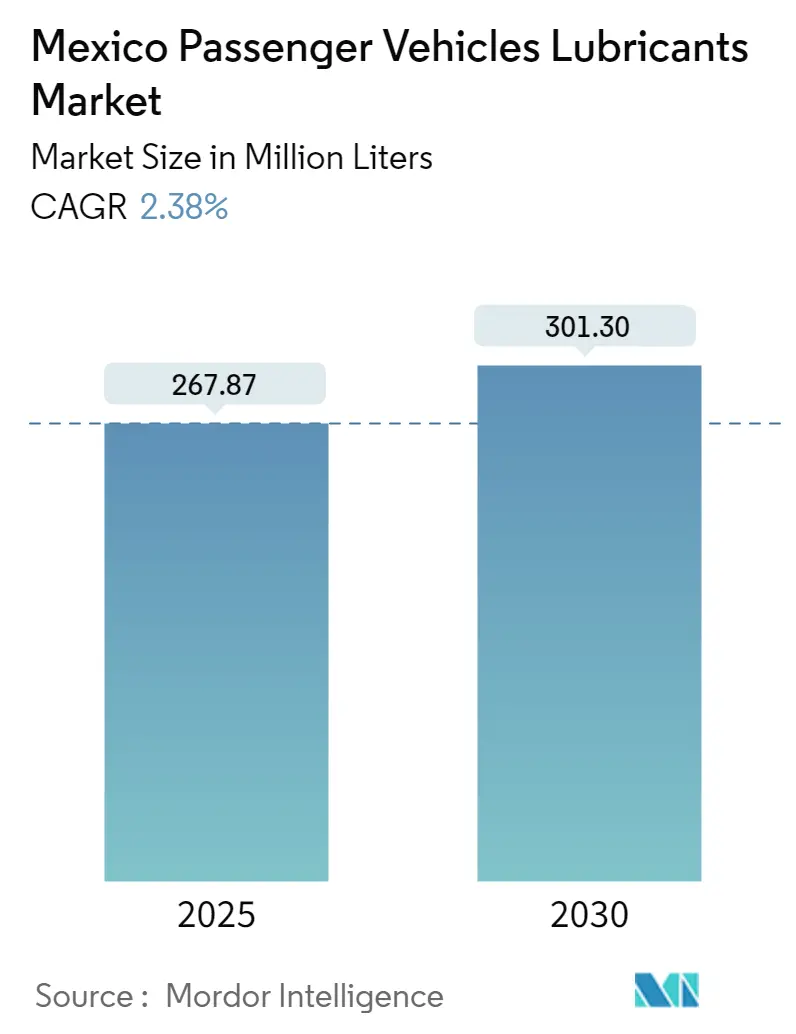
The Mexico Passenger Vehicles Lubricants Market size is estimated at 267.87 million liters in 2025, and is expected to reach 301.30 million liters by 2030, at a CAGR of 2.38% during the forecast period (2025-2030).
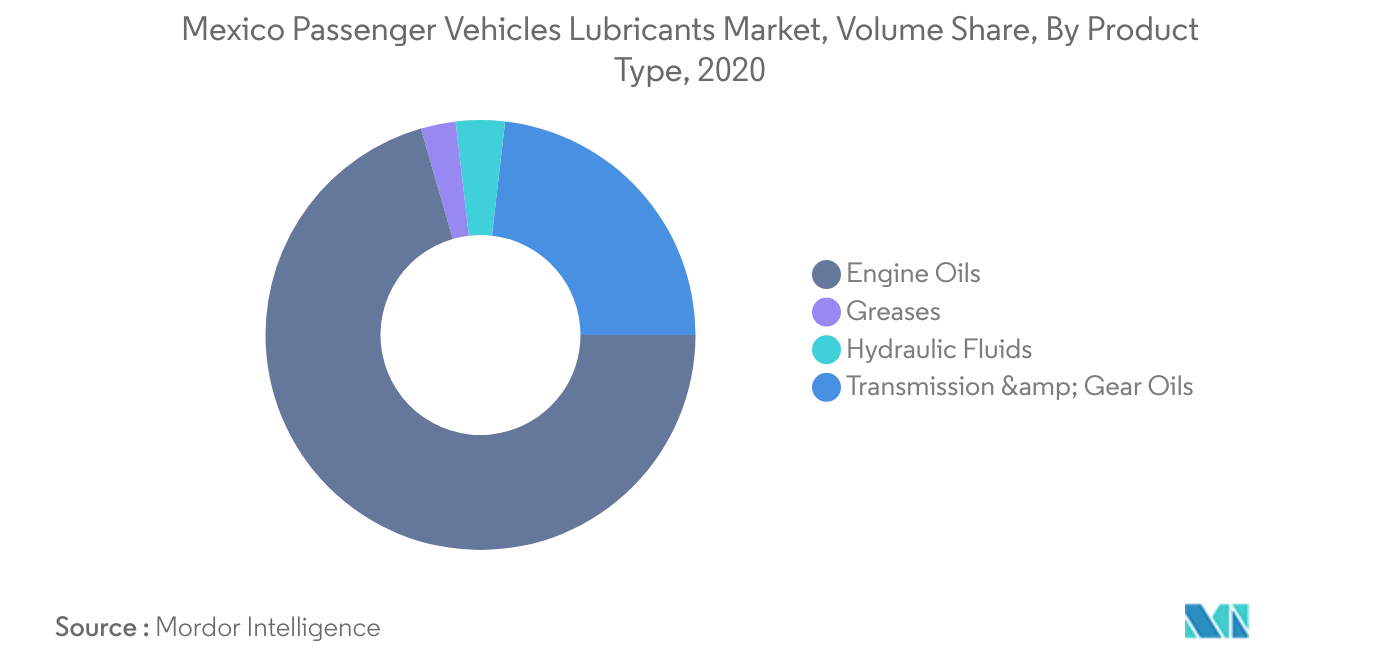
Largest Segment by Product Type - Engine Oils : Engine oils form the leading product type, owing to their high volume requirements and low drain interval. They are used for high-temperature and high-pressure applications.
Fastest Segment by Product Type - Transmission & Gear Oils : An increase in the usage, sales, and maintenance requirements of passenger vehicles in the country may drive the demand for transmission oils during the forecast period.
Mexico Passenger Vehicles Lubricants Market Trends and Insights
Largest Segment By Product Type : Engine Oils
During 2015-2019, the passenger vehicle lubricant consumption in Mexico witnessed a robust growth. The penetration of synthetic lubricants in Mexico during this period was very low in Mexico, unlike Canada and the United States. This factor, combined with the growing vehicle parc in the country, resulted in a consistent increase in lubricant consumption for this segment during this period.
However, during 2020, the consumption dropped significantly, owing to the COVID-19 pandemic, which has caused a considerable decline in the maintenance requirements of the existing passenger vehicle fleet of the country.
The passenger vehicle sales in Mexico are likely to recover at a much faster growth rate than in the United States and Canada. As a result, the passenger lubricant consumption is expected to witness a CAGR of 3.78% during the forecast period.
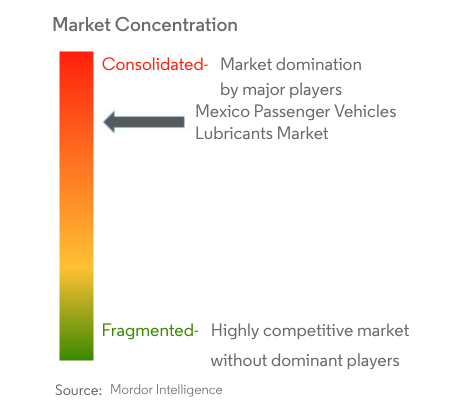
The Mexico Passenger Vehicles Lubricants Market is fairly consolidated, with the top five companies occupying 65.38%. The major players in this market are Bardahl, BP PLC (Castrol), ExxonMobil Corporation, Roshfrans and Royal Dutch Shell Plc (sorted alphabetically).
Mexico Passenger Vehicles Lubricants Industry Leaders
Bardahl
BP PLC (Castrol)
ExxonMobil Corporation
Roshfrans
Royal Dutch Shell Plc
*Disclaimer: Major Players sorted in no particular order
June 2021: TotalEnergies and Stellantis group renewed their partnership for cooperation across different segments. Along with the renewal of partnerships with Peugeot, Citroën, and DS Automobiles, the new collaboration extends to Opel, and Vauxhall as well. This partnership includes the development and innovation of lubricants, first-fill in Stellantis group vehicles, recommendation of Quartz lubricants, and shared usage of charging stations operated by TotalEnergies, among others.
June 2021: Castrol launched Castrol ON TM, a new line of e-fluids for electric vehicles. It includes e-greases, e-thermal fluids, and e-transmission fluids, all of which are employed in different electrical vehicle applications.
April 2021: Motul launched two engine oils, namely CLASSIC EIGHTIES 10W-40 and CLASSIC NINETIES 10W-30, for classic cars manufactured between the 1970s and 2000s.
Table of Contents for Mexico Passenger Vehicles Lubricants Industry Report
How big is the Mexico Passenger Vehicles Lubricants Market?
The Mexico Passenger Vehicles Lubricants Market size is expected to reach 267.87 million Liters in 2025 and grow at a CAGR of 2.38% to reach 301.30 million Liters by 2030.
What is the current Mexico Passenger Vehicles Lubricants Market size?
In 2025, the Mexico Passenger Vehicles Lubricants Market size is expected to reach 267.87 million Liters.
Who are the key players in Mexico Passenger Vehicles Lubricants Market?
Bardahl, BP PLC (Castrol), ExxonMobil Corporation, Roshfrans and Royal Dutch Shell Plc are the major companies operating in the Mexico Passenger Vehicles Lubricants Market.
What years does this Mexico Passenger Vehicles Lubricants Market cover, and what was the market size in 2024?
In 2024, the Mexico Passenger Vehicles Lubricants Market size was estimated at 261.49 million Liters. The report covers the Mexico Passenger Vehicles Lubricants Market historical market size for years: 2019, 2020, 2021, 2022, 2023 and 2024. The report also forecasts the Mexico Passenger Vehicles Lubricants Market size for years: 2025, 2026, 2027, 2028, 2029 and 2030.
Statistics for the 2025 Mexico Passenger Vehicles Lubricants market share, size and revenue growth rate, created by Mordor Intelligence™ Industry Reports. Mexico Passenger Vehicles Lubricants analysis includes a market forecast outlook for 2025 to 2030) and historical overview. Get a sample of this industry analysis as a free report PDF download.
Please copy & paste this embed code onto your site:
Images must be attributed to Mordor Intelligence. Learn more
About The Embed Code X
Mordor Intelligence's images may only be used with attribution back to Mordor Intelligence. Using the Mordor Intelligence's embed code renders the image with an attribution line that satisfies this requirement.
In addition, by using the embed code, you reduce the load on your web server, because the image will be hosted on the same worldwide content delivery network Mordor Intelligence uses instead of your web server.










 Your data is secure and never sold or shared.


