
Mexico Luxury Residential Real Estate Market Size and Share
Market Overview
| Study Period | 2021 - 2032 |
|---|---|
| Forecast Data Period | 2027 - 2032 |
| Base Year Market Size (2026) | USD 10.11 Billion |
| Market Size (2027) | USD 10.75 Billion |
| Market Size (2032) | USD 14.58 Billion |
| Growth Rate (2027 - 2032) | 6.28 % |
| Market Concentration | Medium |
Major Players *Disclaimer: Major Players sorted in no particular order Image © Mordor Intelligence. Reuse requires attribution under CC BY 4.0. | |
Mexico Luxury Residential Real Estate Market Analysis by Mordor Intelligence
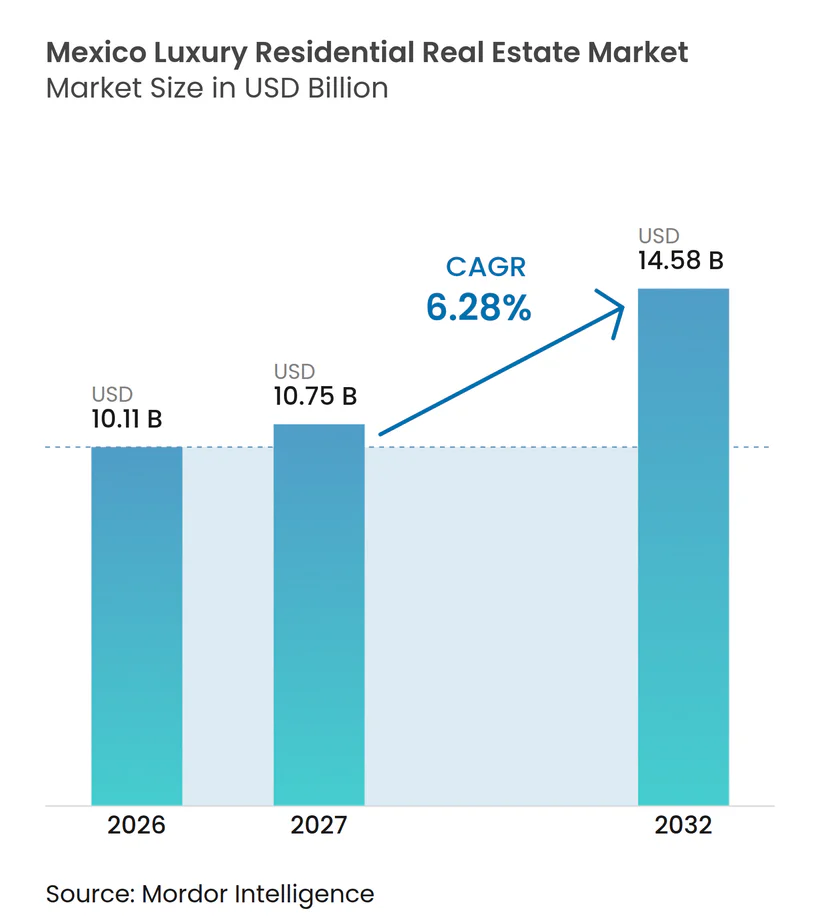
The Mexico Luxury Residential Real Estate Market size is projected to be USD 10.11 billion in 2026, USD 10.75 billion in 2027, and reach USD 14.58 billion by 2032, growing at a CAGR of 6.28% from 2027 to 2032.
Domestic wealth creation and international investment support demand for premium homes in large cities and coastal destinations, although the balance between these buyer groups differs significantly by location and property format. Buyers are placing more value on managed properties, private security, reliable building operations, and services associated with leading hospitality brands, especially when a residence is purchased from abroad or intended for periodic use. Nearshoring activity also brings executive tenants and buyers into industrial centers, broadening demand beyond traditional resort locations and linking residential demand to new corporate investment. Higher financing costs, water limits, and the legal steps required for foreign ownership in restricted zones could slow transactions in selected locations, particularly when buyers need a quick closing process or developers require new infrastructure. The Mexico luxury residential real estate market therefore favors developers that can combine strong locations, reliable delivery, credible property management, clear ownership processes, and product designs that meet both local and cross-border buyer expectations.
Key Report Takeaways
- By sales property type, apartments and condominiums held 69.8% of the Mexico luxury residential real estate market share in 2026, and apartments and condominiums are forecast to grow at a 6.81% CAGR through 2032.
- By mode of sale, secondary existing-home resale held 57.8% of the Mexico luxury residential real estate market share in 2026, while primary new-build properties are forecast to grow at a 6.75% CAGR through 2032.
- By rental property type, apartments and condominiums held 60.1% of the Mexico luxury residential real estate market share in 2026, while villas and landed houses are forecast to grow at a 6.92% CAGR through 2032.
- By geography, Mexico City, or CDMX, held 31.2% of the Mexico luxury residential real estate market share in 2026, while Querétaro is forecast to grow at a 7.20% CAGR through 2032.
Note: Market numbers in this report are based on Mordor Intelligence's proprietary estimation framework, which combines nine months of actuals with Q4 projections for base year 2026.
Market Trends and Insights
Drivers Impact Analysis of Mexico Luxury Residential Real Estate Market*
| Drivers | (~) % Impact on CAGR Forecast | Geographic Relevance | Impact Timeline |
|---|---|---|---|
| Domestic high-net-worth wealth expansion | +1.7% | National, with concentration in Mexico City, Monterrey, and Guadalajara | Long term (≥ 4 years) |
| International second-home investment | +1.4% | Los Cabos, Riviera Maya, Puerto Vallarta, and Riviera Nayarit | Medium term (2-4 years) |
| Branded residence development | +1.1% | Mexico City, Tulum, Los Cabos, Guadalajara, Mérida, and Querétaro | Medium term (2-4 years) |
| Nearshoring-led corporate expansion | +0.9% | Nuevo León, Jalisco, Querétaro, and Baja California | Short term (≤ 2 years) |
| Preference for privacy and security | +0.5% | National, with early gains in Los Cabos, Riviera Maya, and San Pedro Garza García | Medium term (2-4 years) |
| Redevelopment of prime urban districts | +0.4% | Mexico City, including Polanco, Reforma, Cuauhtémoc, Tabacalera, Escandón, and Roma | Long term (≥ 4 years) |
| Source: Mordor Intelligence | |||
Domestic High-Net-Worth Wealth Expansion Sustains Metropolitan Luxury Demand
Domestic high-net-worth wealth gives the Mexico luxury residential real estate market a stable local source of demand. This larger buyer base can support purchases in Mexico City, Monterrey, and Guadalajara, where corporate activity, family wealth, private education, and business ownership are concentrated. It also helps developers plan projects around local demand instead of relying entirely on international visitors or short-term investor interest. Younger wealthy buyers increasingly seek apartments with services and branded homes rather than large traditional estates. That preference supports projects with security, shared amenities, reliable maintenance, and professional management that fit a more mobile lifestyle. It may also support demand for homes close to cultural districts, private clubs, schools, and business areas. The result is a wider buyer pool for well-positioned urban luxury developments, especially where project design supports practical daily use rather than relying only on prestige or a recognizable address.
International Second-Home Investment Anchors Coastal Luxury Valuations
International second-home demand remains important to the Mexico luxury residential real estate market in coastal locations[1]. Resort buyers from North America, Europe, and Asia-Pacific support villas and condominiums in Los Cabos, Cancún, Riviera Maya, Puerto Vallarta, and Riviera Nayarit. These buyers often compare Mexico with other warm-weather destinations. They may place particular importance on service quality, airport access, property management, and the ease of using a home for family stays. Domestic investors represented 60% to 65% of buyers in Zapopan, which highlights the different buyer mix in urban locations. Resort markets have a larger international component and are more exposed to cross-border travel and investment conditions. This broader nationality base can reduce reliance on a single foreign buyer group and help support absorption when demand from one origin market softens. It also increases the value of clear ownership structures, property management, and trusted local development partners, because buyers who live abroad need greater certainty about how their residence will be maintained between visits.
Branded Residence Growth Creates a Premium Product Category
Branded residences are becoming a clear point of distinction in the Mexico luxury residential real estate market. Global hospitality partnerships give buyers a recognizable service model, which can improve confidence in a property that is bought from abroad or held as a second home. Projects linked to brands such as Armani, Ritz-Carlton, Thompson, Waldorf Astoria, and Montage show how developers are combining residences with hotel-style operations. Brand affiliation can be especially useful during an off-plan sale, because buyers have fewer completed features to evaluate and rely more heavily on the developer’s track record. These properties can also lift buyer interest in nearby projects when they establish a stronger standard for building services, design, and operations. Environmental certification is becoming a further point of comparison for buyers and investors with formal sustainability requirements. Developers that can meet these expectations may have stronger pricing power in dense urban corridors and resort destinations, since their product is better aligned with the service, security, and operating standards that buyers now expect.
Nearshoring-Led Corporate Expansion Adds Executive Housing Demand
Nearshoring is adding a new source of housing demand in Mexico’s industrial and business centers. Announced investment commitments across 39 public announcements supported the nearshoring pipeline in major Mexican cities[2]. The investment pipeline covers Monterrey, Querétaro, Guadalajara, Tijuana, and Saltillo. Industrial investment does not create housing demand immediately in every location. Still, it expands the number of senior employees, specialist contractors, and professional service workers who require secure and well-connected homes. Incoming management teams often need housing near workplaces, airports, international schools, and daily services. Some tenants may later become buyers when their assignments extend, and local business operations grow. This process links industrial investment to demand for premium rentals and new-build homes in cities beyond Mexico City, where the availability of suitable executive housing can influence how quickly new teams settle into a location.
Restraints Impact Analysis of Mexico Luxury Residential Real Estate Market*
| Restraints | (~) % Impact on CAGR Forecast | Geographic Relevance | Impact Timeline |
|---|---|---|---|
| Elevated property prices and financing costs | -0.5% | National, with greater pressure in Mexico City and Nuevo León | Short term (≤ 2 years) |
| Security concerns in selected regions | -0.4% | Selected municipalities in Jalisco, Michoacán, and Tamaulipas | Medium term (2-4 years) |
| Water scarcity and utility constraints | -0.3% | Los Cabos, Cancún, and Querétaro | Long term (≥ 4 years) |
| Foreign ownership requirements in restricted zones | -0.2% | Coastal and border restricted zones | Short term (≤ 2 years) |
| Source: Mordor Intelligence | |||
Elevated Property Prices and Financing Costs Narrow the Buyer Pool
Higher financing costs can limit activity in the Mexico luxury residential real estate market, even though many luxury transactions are cash-funded [3]. Borrowing costs increase the opportunity cost of holding property and affect buyers who use credit for part of a purchase, including buyers moving up from smaller premium homes. Higher prices in prime districts can also extend the sales period for the most expensive homes because the qualified buyer group is smaller. Buyers may take more time to compare locations, building services, ownership costs, and expected rental demand before committing to a purchase. Developers have responded by considering smaller projects and shorter delivery periods in selected locations. This approach can reduce carrying costs, limit unsold inventory, and match supply more closely with qualified demand. The effect is likely to be strongest in Mexico City and Monterrey, where premium prices are already high, and buyers have a wide range of competing completed and planned properties to assess.
Security Concerns in Selected Regions Complicate Buyer Decisions
Security concerns can affect buyer confidence in selected interior markets. Their effect is less severe in established premium districts and professionally managed gated communities, where buyers place a high value on controlled access, trained personnel, and reliable property management. This has directed some demand toward homes with visible security features and clearly communicated building protocols. It can also widen the price gap between secure communities and comparable unprotected properties, especially for foreign buyers who do not know local conditions well. Developers that include credible security systems can better address this concern and make a project easier for sales teams to explain. Building operations, lighting, controlled entry, and response procedures can matter as much as finishes in the buyer decision. The Mexico luxury residential real estate market may therefore continue to favor buildings and communities that make security part of their core offering, rather than treating it as an optional feature added after a project is designed.
*Our forecasts treat driver/restraint impacts as directional, not additive. The impact forecasts reflect baseline growth, mix effects, and variable interactions.
Mexico Luxury Residential Real Estate Market Segment Analysis
By Sales Property Type:
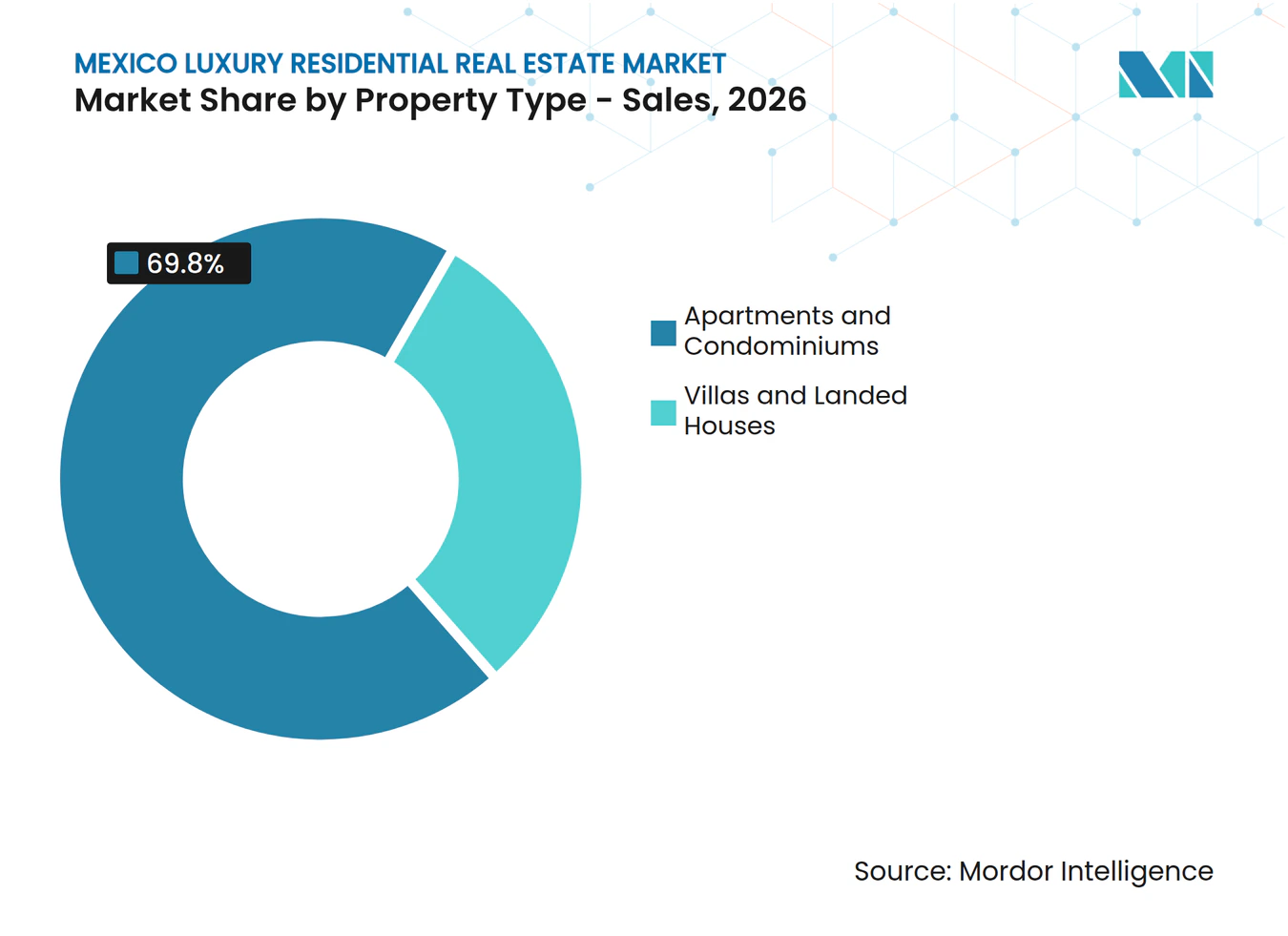
Condominiums Anchor Urban Premium DemandApartments and condominiums held 69.8% of the Mexico luxury residential real estate market share in the sales segment during 2026. Dense neighborhoods in Mexico City, Guadalajara, and Monterrey have limited prime land, which supports vertical development. Buyers also value the services, shared facilities, and easier maintenance that premium towers can provide. The Reforma corridor had 59 active luxury developments in 2026, with 228 unit sales per quarter and 8.9% annual price appreciation. Apartments and condominiums are also forecast to grow at a 6.81% CAGR from 2027 to 2032. Branded residences in Polanco and Reforma reinforce the role of condominiums in the Mexico luxury residential real estate market, because they pair an urban location with services that would be difficult to provide in a stand-alone home.
Villas and landed houses accounted for the remaining 30.2% of sales during 2026. They appeal to buyers who want privacy, outdoor space, and greater control over the property. Demand is concentrated in resort locations, including Los Cabos and Riviera Nayarit, and in low-density gated communities near Monterrey and Querétaro. Thor Urbana has developed or advanced premium hospitality-linked residential projects, including Ritz-Carlton Reserve Residences Siari in Riviera Nayarit. This format can attract buyers seeking both a private residence and access to managed resort services. The Mexico luxury residential real estate market supports both formats. Still, each serves a different buyer need, which means developers must match site selection and operating plans to the expected buyer profile.
The condominium format also gives developers a way to combine private living space with shared facilities. Concierge services, controlled entry, fitness areas, parking, and maintenance programs can be organized at the building level. This is useful in central neighborhoods where a stand-alone home may require more time and attention from the owner. The format can also support buyers who live in the home part time or use it as a city base. These practical benefits help explain why apartments and condominiums lead sales demand, particularly in central districts where buyers want a secure, low-maintenance home close to business and cultural activity.


By Mode of Sale:
New Construction Outpaces Resale in GrowthSecondary existing-home resale held 57.8% of the Mexico luxury residential real estate market share in 2026. Established neighborhoods such as Polanco, Lomas de Chapultepec, and San Pedro Garza García have limited supply, making resale transactions the main route into proven premium locations. Existing homes also allow buyers to assess the neighborhood, building operations, and available services before a purchase. This is particularly useful for buyers who want a completed residence rather than a property under construction. Resale inventory can therefore retain strong appeal despite a growing pipeline of new towers. The Mexico luxury residential real estate market continues to rely on this stock of established homes for liquidity, as completed properties give buyers an immediate option in neighborhoods where new construction is limited.
Primary new-build properties are projected to grow at a 6.75% CAGR from 2027 to 2032. Buyers are drawn to modern layouts, energy-efficient features, new amenities, and opportunities to select finishes before delivery. Off-plan sales can give buyers entry at an earlier stage while supporting developer funding for construction. Armani Residences Masaryk achieved 30% to 40% pre-sales before construction completion. The result shows that buyers will commit early when the location, brand, and developer are credible. New construction is likely to remain important for branded and service-focused projects, particularly when developers can show clear delivery plans and a well-defined approach to ongoing building operations.
The choice between resale and new construction depends on the buyer’s priorities. Resale can provide immediate occupancy and a clear view of the surrounding neighborhood. New projects can provide modern building systems, tailored finishes, and planned amenities. Developers need to explain these differences clearly because both routes can appeal to high-income buyers. The balance between them supports a wider range of purchase decisions in the Mexico luxury residential real estate market, giving buyers a meaningful choice between immediate occupancy, established neighborhoods, and the features of a newly delivered home.
By Rental Property Type:
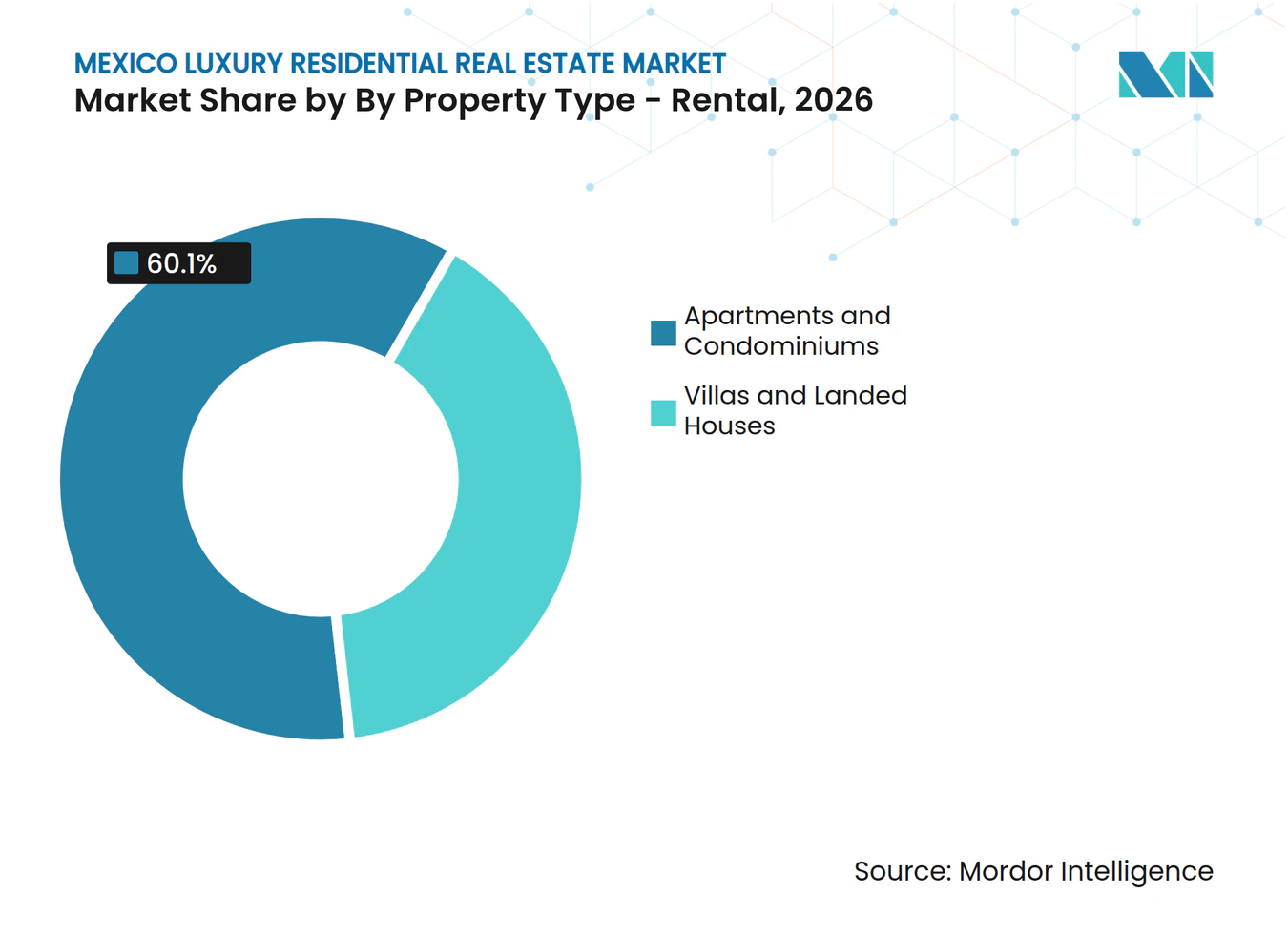
Lifestyle Migration Supports Villa GrowthApartments and condominiums held 60.1% of the Mexico luxury residential real estate market share in rentals during 2026. Corporate managers moving to Mexico for manufacturing, logistics, and technology assignments often prefer well-located apartments in established urban districts. These homes offer access to business centers, schools, and transport links. They also provide building services that simplify a short- or medium-term stay. This makes apartments the main rental format in Mexico City and other large employment centers. Strong urban rental demand gives owners a reason to hold premium apartments as income-producing assets, while also preserving the flexibility to use the residence for their own business or family needs.
Villas and landed houses are forecast to grow at a 6.92% CAGR from 2027 to 2032. Affluent remote workers, international retirees, and extended-stay visitors are attracted to private outdoor space and secure residential settings. Coastal destinations benefit from this demand because villas can combine lifestyle use with managed rental programs. The format also fits buyers who want a second home that can be rented when not occupied. Thor Urbana’s resort residential activity illustrates the connection between luxury hospitality and private residences. The Mexico luxury residential real estate industry is thus seeing stronger rental demand for lower-density homes in resort locations, where privacy and outdoor space can be as important to tenants as access to managed services.
Rental demand also depends on how long a tenant expects to stay in Mexico. Corporate tenants often value apartments close to work and daily services, while lifestyle tenants may prefer villas with more private space. Owners can use managed rental programs to make a second home available when it is not occupied. This gives a property both personal-use and income potential. Developers that recognize these different tenant needs can plan the right mix of location, services, and property type, rather than applying the same rental strategy across urban business districts and coastal lifestyle destinations.

Geography Analysis
Mexico City held 31.2% of the Mexico luxury residential real estate market share in 2026. The city combines corporate headquarters, international institutions, wealthy family networks, and limited prime land. These conditions support demand in Polanco, Reforma, Lomas de Chapultepec, and other established premium districts. The Reforma corridor had 59 active luxury developments and recorded 8.9% annual price appreciation in 2026. New branded projects in Escandón, Tabacalera, and Roma indicate that premium development is moving beyond the traditional Polanco-Reforma axis, allowing developers to seek locations with a different land-cost base while remaining close to central business and cultural areas.
Nuevo León and Jalisco are important centers for premium housing because they combine industrial activity, corporate wealth, and growing professional populations. Monterrey’s San Pedro Garza García area remains a major high-end location for buyers who want proximity to business activity and private services. Guadalajara has added branded residential supply, including Waldorf Astoria Residences Guadalajara, which GFA Grupo Inmobiliario developed in partnership with Waldorf Astoria. The opening reflects the growing role of hospitality partnerships in Jalisco’s premium property market. Coastal and lifestyle destinations such as Tulum, Los Cabos, Puerto Vallarta, Mérida, and San Miguel de Allende also attract international buyers. However, local infrastructure and ownership processes can shape the pace at which individual projects progress.
Querétaro is projected to record a 7.20% CAGR from 2027 to 2032, making it the fastest-growing geography in the Mexico luxury residential real estate market. Its position in the Bajío industrial corridor links it to nearshoring investment and executive housing needs. Housing demand in the Querétaro metropolitan area is supported by industrial expansion and incoming professional workers. Planned transport links to Mexico City could increase interest in accessible locations near future stations. Water availability and utility capacity may still limit project timing in high-growth areas. Developers that secure suitable sites and infrastructure are better placed to serve the expanding executive buyer base, particularly when a project can offer convenient access to employment clusters alongside the privacy and service levels expected in premium housing.
Competitive Landscape
Market Concentration
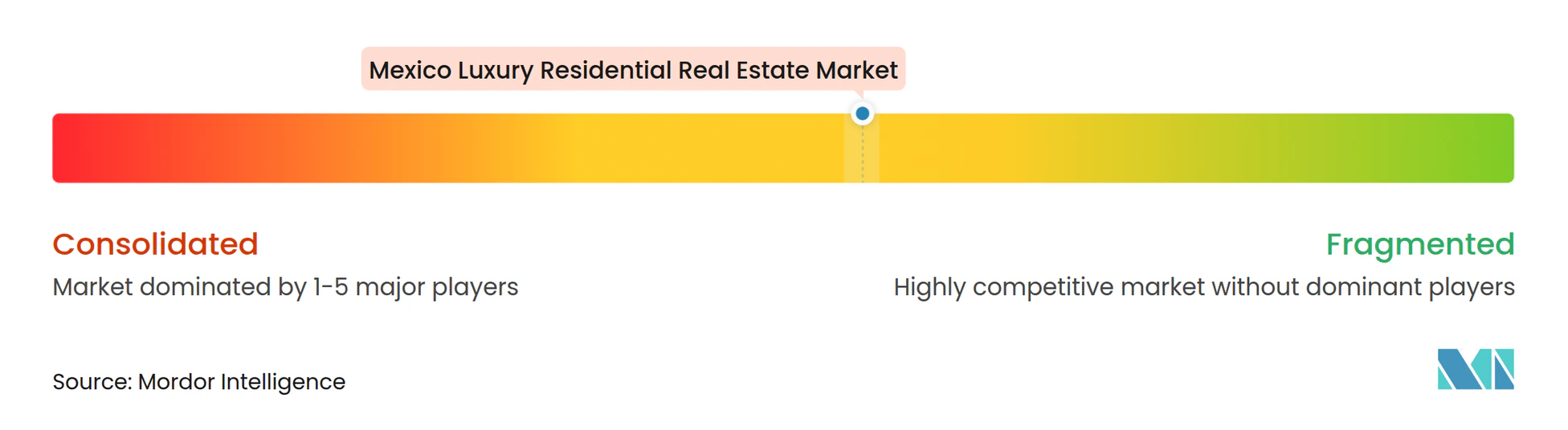
The Mexico luxury residential real estate market has a moderately concentrated premium tier. Large multi-city developers lead many of the most visible branded and large-scale projects, while regional specialists focus on selected city or coastal markets. Thor Urbana operates in more than 17 Mexican cities and reports USD 3.7 billion in assets under management. Its platform covers site acquisition, development, brand partnerships, and capital management. This scale can make it harder for smaller developers to compete for major sites and global hospitality relationships.
Hospitality partnerships are a key source of competition. Developers such as GFA Grupo Inmobiliario, Inmobilia Desarrollos, and MiRA Companies use global hotel brands to build buyer trust and differentiate projects. Montage International, Thor Urbana, and Life Properties International announced Montage Valle de Guadalupe, with an expected opening in 2028. MiRA Companies also advanced Armani Residences Masaryk in Polanco, a branded residential project designed for delivery in 2027. These moves show that recognized brands, delivery capability, and service standards are central to the competitive position of the Mexico luxury residential real estate market.
There is still room for developers in long-term luxury rentals and secondary lifestyle locations. Mérida, San Luis Potosí, and San Miguel de Allende can offer lower land costs than the leading metropolitan and resort markets. Developers must also respond to buyer expectations for energy performance, building technology, security, and reliable management. Sustainability certifications such as Leadership in Energy and Environmental Design and Excellence in Design for Greater Efficiencies can help meet formal investor and buyer requirements.
Mexico Luxury Residential Real Estate Industry Leaders
-
Grupo GFA
-
Be Grand
-
Grupo Carso
-
Sordo Madaleno
-
Thor Urbana
- *Disclaimer: Major Players sorted in no particular order
Mexico Luxury Residential Real Estate Market Companies Covered in this Report
- Grupo GFA
- Be Grand
- Grupo Carso
- Sordo Madaleno
- Thor Urbana
- Inmobilia Desarrollos
- Vinte Viviendas Integrales
- Grupo GP
- Grupo Frisa
- Abilia
- MIRA Companies
- Tierra y Armonía
- Grupo Vidanta
- Grupo Lomas
- Be Grand Country and Park Country
- Citelis
- Grupo Caabsa
- Cumbres Residencial
- Grupo SADASI
- Ruba Residencial
Recent Industry Developments in Mexico Luxury Residential Real Estate Market
- October 2026: KARL LAGERFELD and Grupo Bosque Real launched KARL LAGERFELD Residences Bosque Real in Huixquilucan, Mexico. The 38-floor tower is the brand’s first residential project in Latin America and includes 73 residences exceeding 475 square meters each. Jafif Arquitectos leads the architecture, while The One Atelier oversees interiors. Delivery is planned for early 2029.
- June 2026: Murano Global Investments PLC launched pre-sales for Mondrian Residences Cancun, Mondrian’s first branded residential project in Mexico. The project includes 328 fully fitted residences in Cancun’s Hotel Zone and is supported by the Accor One Living platform.
- March 2026: GFA Grupo Inmobiliario and Hilton Hotels and Resorts announced Waldorf Astoria Residences Guadalajara. The 30-floor, 128-meter tower in Zapopan, Jalisco, will provide 114 residences designed by Gensler. Delivery is planned for winter 2029.
Mexico Luxury Residential Real Estate Market Report Scope
Segmentation Overview
| Apartments and Condominiums |
| Villas and Landed Houses |
| By Property Type | Apartments and Condominiums |
| Villas and Landed Houses |
Key Questions Answered in the Report
What is the projected value of luxury residential real estate in Mexico by 2032?
The sector is projected to reach USD 14.58 billion by 2032, growing at a 6.28% CAGR from 2027 to 2032. Growth is supported by domestic wealth, international second-home demand, branded residences, and executive housing needs.
Which sales property type leads Mexico’s luxury home sector?
Apartments and condominiums lead the sales segment with a 69.8% share in 2026. They are well suited to dense premium areas where land is limited and buyers value building services, amenities, and easier maintenance.
What is driving demand for premium homes in Mexico?
Domestic high-net-worth wealth, international second-home buyers, branded residences, and nearshoring-related executive demand support growth. Local demand is especially important in Mexico City, Monterrey, and Guadalajara, while foreign demand remains important in resort markets.
Which Mexican location has the largest luxury residential sales share?
Mexico City leads with 31.2% of sales in 2026, supported by its business base, established premium districts, and limited prime land. Polanco and Reforma remain important locations for high-end apartments and branded residential projects.
Which location is growing fastest for premium residential development?
Querétaro is forecast to grow at a 7.20% CAGR through 2032, helped by nearshoring investment and executive housing demand. Its growth prospects depend on suitable development sites, transport links, and adequate water and utility infrastructure.
Why are branded residences important to premium housing buyers?
They combine private ownership with recognizable service standards, property management, and hospitality-linked amenities. This can be valuable for buyers who purchase before construction is complete, live abroad, or use a home as a second residence.