
Mexico Electric Two-Wheeler Market Size and Share
Market Overview
| Study Period | 2019 - 2031 |
|---|---|
| Forecast Data Period | 2026 - 2031 |
| Base Year Market Size (2025) | USD 179.40 Million |
| Market Size (2026) | USD 220.01 Million |
| Market Size (2031) | USD 470.01 Million |
| Growth Rate (2026 - 2031) | 16.39 % |
| Market Concentration | Low |
Major Players *Disclaimer: Major Players sorted in no particular order Image © Mordor Intelligence. Reuse requires attribution under CC BY 4.0. | |
Mexico Electric Two-Wheeler Market Analysis by Mordor Intelligence
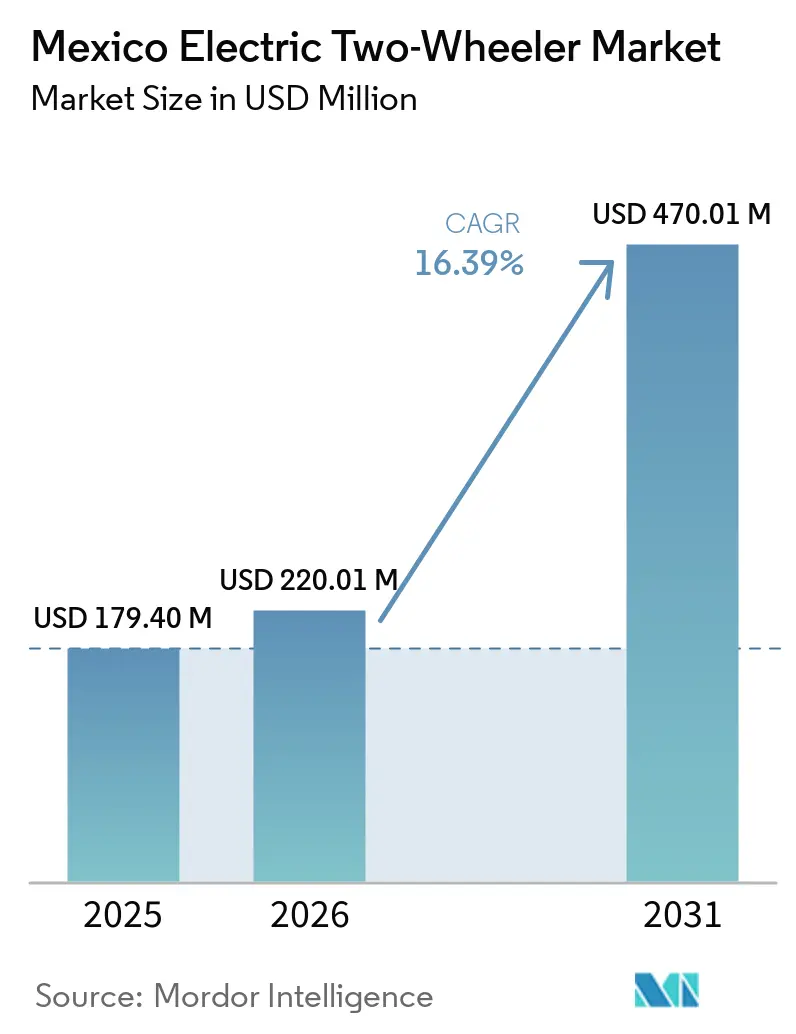
The Mexico electric two-wheeler market size was valued at USD 179.40 million in 2025 and is estimated to grow from USD 220.01 million in 2026 to reach USD 470.01 million by 2031, growing at a CAGR of 16.39% during the forecast period from 2026 to 2031. The Mexican electric two-wheeler market is benefiting from the rising use of motorcycles for daily travel and delivery work. Delivery platforms are driving demand for vehicles with greater range, payload capacity, and dependable service support, shifting attention toward designs that can complete repeated trips without disrupting riders' earnings or requiring long charging breaks. Local assembly, dealer growth, and battery-swapping services are making ownership more practical in major cities. Registration requirements in Mexico City favor brands that can provide invoices, service, and compliance support. Charging access remains uneven, so growth outside large urban areas will depend on practical charging and battery-swapping options, along with local repair capacity and financing arrangements that reduce risk for buyers beyond established metropolitan centers.
Key Report Takeaways
- By vehicle type, scooters held 69.14% of the Mexican electric two-wheeler market share in 2025, while motorcycles are forecast to grow at a 17.84% CAGR through 2031.
- By motor power, the 1.1 to 3.0 kW category held 41.22% of the Mexican electric two-wheeler market share in 2025, while the above 5.0 kW category is forecast to grow at an 18.22% CAGR through 2031.
- By voltage platform, 60 V held 43.55% of the Mexican electric two-wheeler market share in 2025, while 72 V is forecast to grow at an 18.71% CAGR through 2031.
- By battery configuration, fixed packs held 57.16% of the Mexican electric two-wheeler market share in 2025, while swappable dual batteries are forecast to grow at a 21.38% CAGR through 2031.
- By motor type, BLDC motors held 66.24% of the Mexican electric two-wheeler market share in 2025 and are forecast to grow at a 17.36% CAGR through 2031.
- By price band, the USD 1,001 to 1,500 price band held 38.04% of the Mexican electric two-wheeler market share in 2025, while the USD 3,001 to 5,000 price band is forecast to grow at a 20.57% CAGR through 2031.
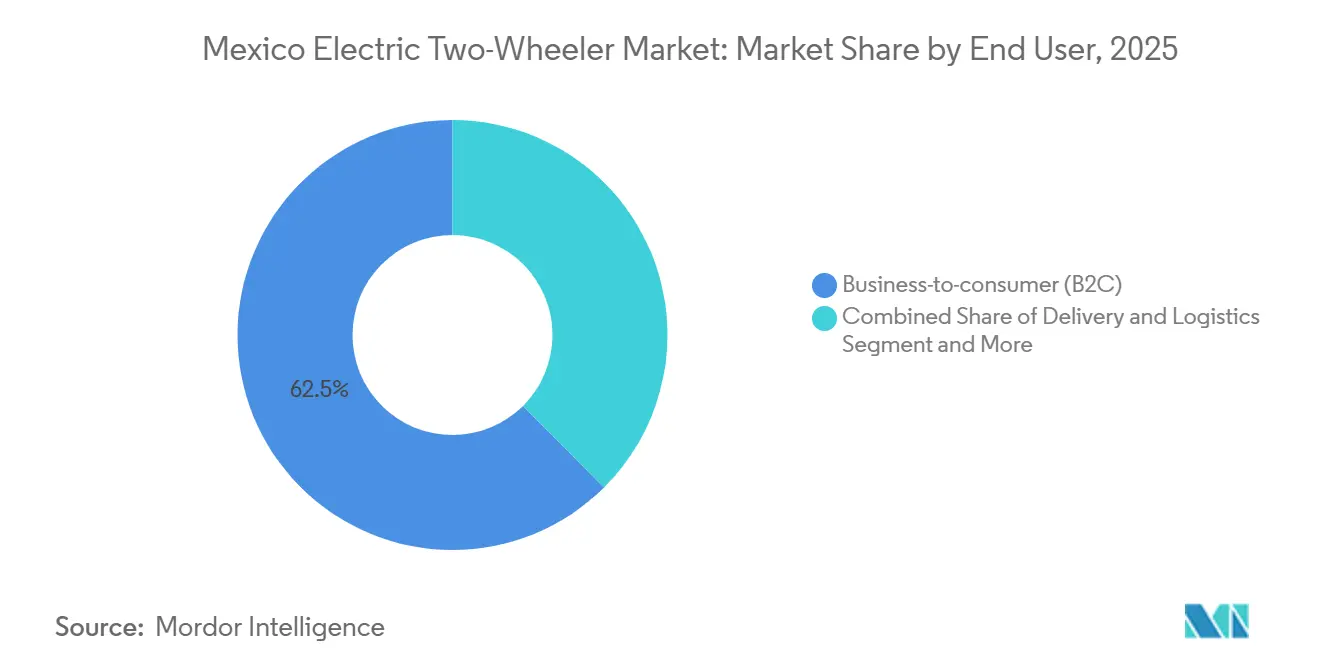
- By end user, B2C held 62.45% of the Mexican electric two-wheeler market share in 2025, while delivery and logistics are forecast to grow at a 19.33% CAGR through 2031.
- By sales channel, offline stores held 68.02% of the Mexican electric two-wheeler market share in 2025, while online channels are forecast to grow at a 20.12% CAGR through 2031.
- By geography, Central Mexico held 40.15% of the Mexican electric two-wheeler market share in 2025, while Northern Mexico is set to grow at 16.85% through 2031.
Note: Market size and forecast figures in this report are generated using Mordor Intelligence’s proprietary estimation framework, updated with the latest available data and insights as of January 2026.
Mexico Electric Two-Wheeler Market Trends and Insights
Drivers Impact Analysis*
| Driver | (~) % Impact on CAGR Forecast | Geographic Relevance | Impact Timeline |
|---|---|---|---|
| Delivery Fleet Electrification | +3.0% | National, with early gains in Mexico City, Guadalajara, and Monterrey | Short term (≤ 2 years) |
| Fuel and Operating Costs | +2.5% | National, with concentration in Mexico City and Northern Mexico | Short term (≤ 2 years) |
| Manufacturing and Dealer Expansion | +2.2% | Central Mexico, with an Estado de México hub and ripple effects in Northern Mexico | Medium term (2-4 years) |
| Congestion and Parking Scarcity | +2.0% | Central Mexico, including Mexico City and Guadalajara, with spillover to Monterrey | Medium term (2-4 years) |
| Battery Swapping for High-Utilization Fleet | +1.5% | Mexico City, Guadalajara, Tulum, and expanding to Nuevo León | Medium term (2-4 years) |
| Technician and After-Sales Ecosystem | +1.0% | Central Mexico, with early gains in Monterrey and Guadalajara | Long term (≥ 4 years) |
| Source: Mordor Intelligence | |||
Delivery Fleet Electrification
Delivery and logistics are forecast to grow significantly over the coming years, making it the fastest-growing end-user category. Fleet operators require reliable range, payload capacity, and quick maintenance support for repeated urban trips. Rappi partnered with ITALIKA and Citio to offer delivery riders discounts, battery swaps, and GPS integration. This model connects vehicle access with rider retention and operational availability. Demand from fleets also supports the above 5.0 kW motor category, which is forecast to grow through 2031. The segment is encouraging suppliers to prioritize models that can perform consistently throughout a full working day.
Rising Fuel and Operating Costs
Rising fuel and operating costs are strengthening the case for electric two-wheelers, especially for riders who travel frequently. Electric scooters and motorcycles can reduce energy costs compared with equivalent combustion models under routine urban use. For delivery workers with regular daily routes, lower running costs can shorten the time required to recover the higher initial purchase price. This makes the operating-cost advantage more meaningful for high-use riders than for occasional commuters. The effect supports demand for practical entry and mid-range models that balance upfront cost with dependable daily use.
Localized Manufacturing and Dealer Expansion
The Mexican electric two-wheeler market is gaining commercial demand from delivery and logistics operators. These users need a consistent range, carrying capacity, and quick access to repairs. Local production can shorten spare-parts lead times and support local technician training, helping dealers respond more consistently when a customer needs maintenance, a replacement component, or assistance with an unfamiliar electric powertrain. Yadea also plans to have more than 1,000 sales and service points nationwide by the end of 2026. TVS Motor introduced the iQube in Mexico in February 2026 through authorized dealers in Guadalajara, Mexico City, and Monterrey.
Urban Congestion and Parking Scarcity
Crowded urban traffic conditions and limited parking access support the Mexican electric two-wheeler market. Compact scooters can be stored more easily than cars in dense residential areas, a useful consideration for households with limited parking and for riders who need a vehicle that fits near their home or workplace. Higher fuel and operating costs also enhance the appeal of electric models for frequent riders, particularly when the vehicle is used for regular commutes or multiple delivery trips rather than only occasional personal travel. The USD 1,001-1,500 price band held the largest share in 2025, underscoring the importance of affordable vehicles for commuters and delivery workers. Delivery riders travel long daily distances, so energy savings and lower routine maintenance can influence vehicle selection. Formal registration in Mexico City may also create better fleet data for future mobility planning.
Restraints Impact Analysis*
| Restraint | (~) % Impact on CAGR Forecast | Geographic Relevance | Impact Timeline |
|---|---|---|---|
| High Upfront Purchase Cost | -1.9% | National, most acute outside Mexico City, Guadalajara, and Monterrey | Short term (≤ 2 years) |
| Limited Charging and Service | -1.5% | Secondary cities and nonmetropolitan areas nationwide | Medium term (2-4 years) |
| Battery Replacement and Residual-Value | -1.0% | National, especially nonmetro areas with limited service coverage | Long term (≥ 4 years) |
| Registration and Safety Requirements | -0.7% | Mexico City, with potential state-by-state replication | Medium term (2-4 years) |
| Source: Mordor Intelligence | |||
High Upfront Purchase Cost
The Mexican electric two-wheeler market faces an upfront affordability barrier in cities outside the largest ones. An entry-level scooter can represent several months of income for many nonmetropolitan buyers. Limited financing options make the purchase decision harder for price-sensitive households, especially when a buyer cannot spread the initial expense over time or rely on a delivery income stream to support a shorter repayment period. This condition creates demand at the lowest price levels and at higher commercial price points. The middle price bands face pressure because buyers may either seek the cheapest option or choose a vehicle that supports intensive delivery work. Domestic production could reduce costs over time, but a national subsidy program for electric two-wheelers was not identified in the supplied material.
Limited Charging and Service Coverage
The Mexican electric two-wheeler market is constrained by charging and service coverage beyond the main metropolitan areas. Public charging locations remain much fewer than private charging positions. This is difficult for riders who do not have private parking or access to home charging. Battery-swapping services help, but their coverage remains limited to selected urban and tourism locations, leaving many prospective users dependent on home charging, workplace access, or a public charging network that is not yet evenly distributed. Mexico City's registration and plating rules took effect on July 1, 2026, for electric two-wheelers exceeding 25 km/h. The requirement may raise compliance costs, although it can also favor formal brands with invoices and dealership support.
*Our forecasts treat driver/restraint impacts as directional, not additive. The impact forecasts reflect baseline growth, mix effects, and variable interactions.
Segment Analysis
By Vehicle Type: Scooters Lead Volume and Motorcycles Gain Fleet Demand
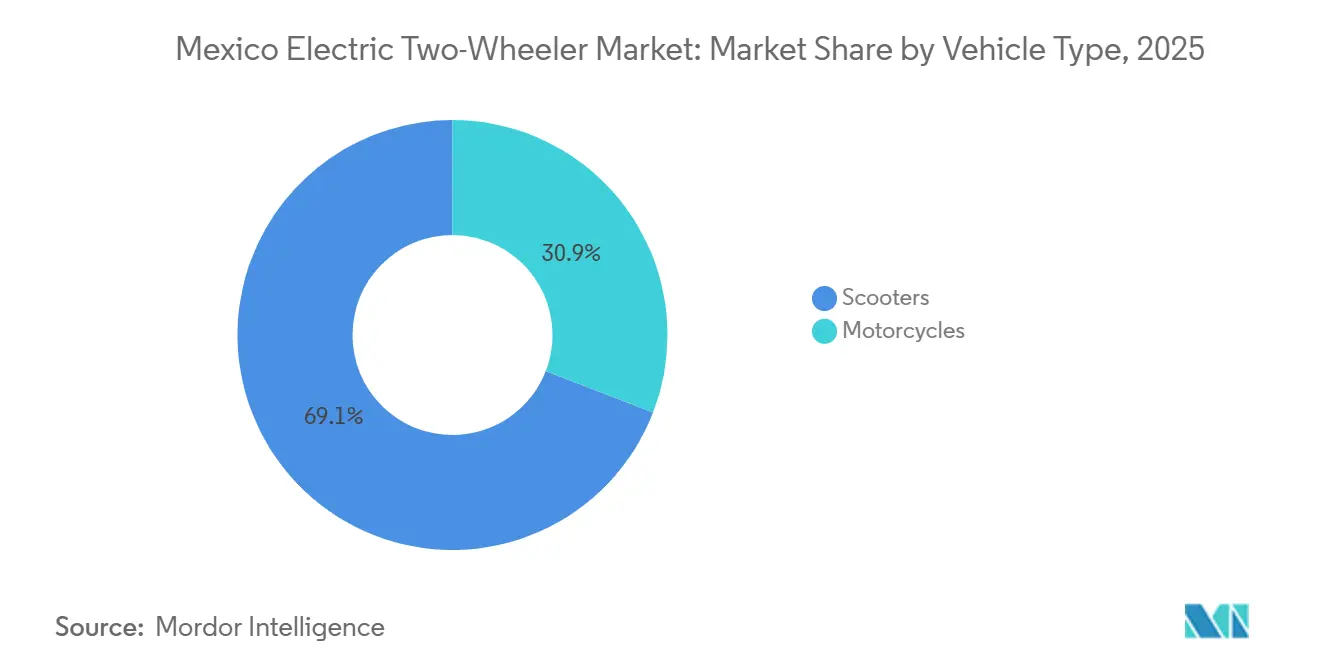
Scooters held 69.14% of the Mexican electric two-wheeler market share in 2025. Their compact size, automatic operation, and lower operating costs suit daily urban travel. They are particularly relevant for new riders and short-distance commuters. Scooters also fit the needs of entry-level delivery workers. Their lower purchase price supports broader adoption in the largest cities. The Mexican electric two-wheeler market continues to rely on scooters as its main volume category because their familiar form, accessible operating profile, and suitability for congested commuting make them an understandable first choice for a broad group of urban buyers.
Motorcycles are forecast to grow at a 17.84% CAGR through 2031: their stronger payload capacity and range suit intensive delivery work. Fleet buyers also value durability during repeated daily use. NIU's NQiX 150 offers an optional second battery and standard ABS braking [1]“NQiX 150 City Riding, Made Easy,” NIU Technologies, global.niu.com . These features address riders who combine commuting with delivery work. Motorcycle growth can contribute more revenue than scooter growth because motorcycles generally carry higher unit values, and fleet purchasers often assess vehicles against daily operating requirements rather than basing decisions solely on initial price.


By Motor Power: Mid-Power Models Hold the Largest Position
The 1.1-3.0 kW category accounted for 41.22% of the Mexican electric two-wheeler market in 2025. This range fits scooters used for routine city trips and moderate daily distances. It also aligns with the leading USD 1,001-1,500 price band. Lower-power models serve the most price-sensitive and micro-mobility users. The 3.1-5.0 kW range serves commuters who need stronger performance at higher loads. These power categories give manufacturers several routes to address urban rider needs, allowing product lines to serve light personal travel, routine commuting, and more demanding delivery work without treating all electric riders as a single customer group.
The above 5.0 kW category is forecast to grow at an 18.22% CAGR through 2031. Delivery fleets and premium urban riders are the main sources of demand. These buyers need higher sustained performance and greater range reliability. Zero Motorcycles updated 2026 S and DS models with 3.3 kW onboard chargers and a 15.6 kWh battery [2]“EICMA 2025 2026 Model Year Launch,” Zero Motorcycles, zeromotorcycles.com . TVS iQube offers 4.6 kW of peak power and falls within the mid-power range. The higher-power category reflects the importance of commercial applications in Mexico's electric two-wheeler industry, where repeated trips, heavier loads, and the need for predictable performance impose a different set of requirements on vehicle design and service support.
By Voltage Platform: 60 V Retains a Strong Base While 72V Expands
The 60 V platform held 43.55% of the Mexican electric two-wheeler market in 2025. It is widely used in mid-range scooters for everyday urban routes. The platform balances battery weight, vehicle cost, and practical operating range. It therefore remains well-suited to mainstream customers. The 48 V platform serves the entry-level category. Higher-voltage platforms remain more relevant to riders with greater range and performance needs. At the same time, mainstream buyers continue to weigh vehicle cost, battery weight, route length, and the availability of practical charging or swapping support.
The 72 V platform is forecast to grow at an 18.71% CAGR through 2031. It supports high-performance scooters and delivery motorcycles. NIU's FQiX 150 uses dual 72 V batteries to provide an extended combined range. Battery modularity can improve use in commercial fleets. Higher-voltage platforms may also support faster motor response. The smaller other-voltage category includes emerging designs for extended-range commercial use. However, these products remain less central to current demand because their cost and technical specification are better suited to specialized fleets and premium users.
By Battery Configuration: Fixed Packs Remain Common and Dual Swapping Grows Fastest
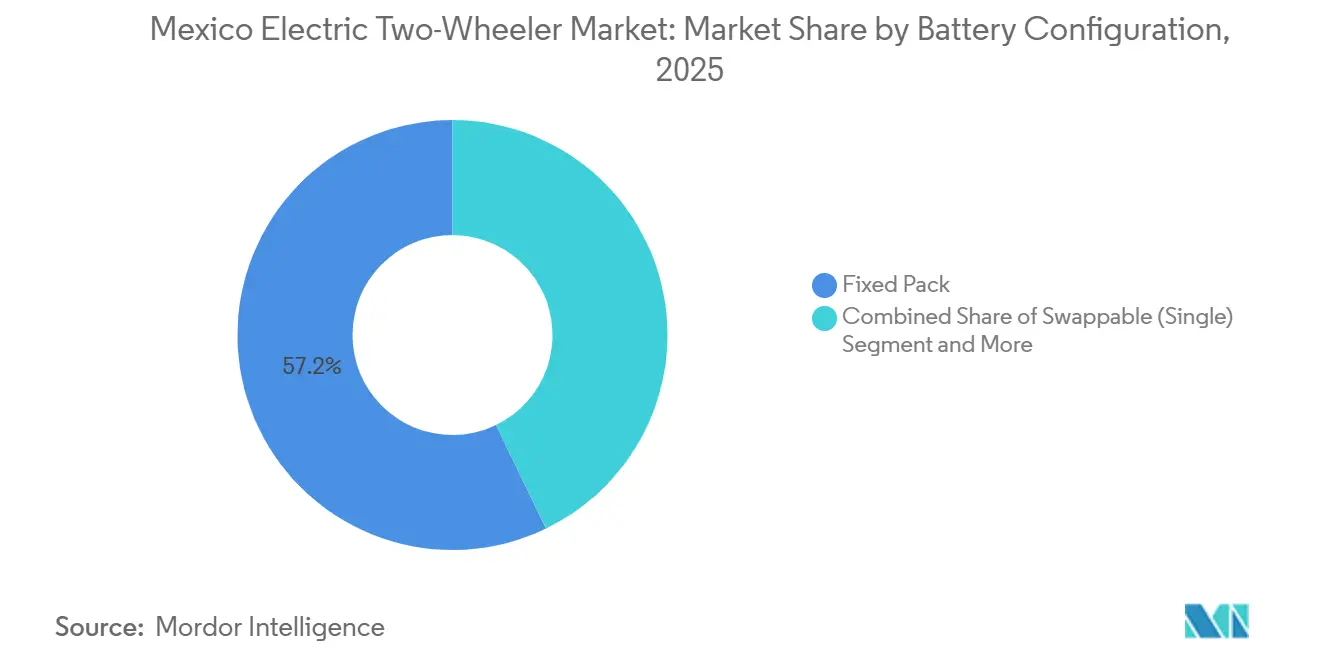
Fixed packs held 57.16% of the Mexican electric two-wheeler market in 2025. They offer a simpler vehicle design and lower initial cost. This configuration is widely used in mass-market scooters. It suits riders with predictable routes and access to charging. Fixed-pack vehicles remain important to consumer adoption. They continue to support the established volume base of the Mexican electric two-wheeler market, particularly for customers whose daily travel patterns are predictable and who can charge at home, at work, or near their regular destinations.
Swappable dual batteries are forecast to grow at a 21.38% CAGR through 2031. The configuration is especially suited to riders who cannot accept charging downtime. Citio has deployed battery-exchange stations in selected Mexican cities. UNEX EV and DiDi Mobility signed a 2025 letter of intent for battery-swapping vehicles on the Mexican platform. The configuration can separate the battery service from the vehicle purchase decision. This approach can also improve fleet uptime and reduce battery replacement concerns, since operators can treat energy access as a recurring service and maintain vehicle use even when a single battery requires inspection or charging.

By Motor Type: BLDC Motors Consolidate Their Position
BLDC motors held 66.24% of the Mexican electric two-wheeler market in 2025. They are also forecast to grow at a 17.36% CAGR through 2031. The combined leadership in share and growth indicates an increasing concentration of technology. BLDC systems offer energy efficiency and lower maintenance needs. Their compatibility with regenerative braking is another practical advantage. These characteristics support their continued use in mainstream electric two-wheelers, as manufacturers can apply the technology across several vehicle types. At the same time, riders benefit from an established design that supports frequent stops and starts in city traffic.
PMSM motors are used in higher-performance applications but have higher production costs. This limits their use in a price-sensitive environment. Other motor technologies remain small and are used in limited applications. Super Soco's TC Max uses a 3.9 kW mid-mounted motor and a 72 V lithium-ion battery. BLDC systems are also well-suited to riders who require consistent urban performance under frequent use, which helps explain their relevance to commuters and delivery riders who need dependable operation on repeated journeys throughout the working day.
By Price Band: Affordable Models Lead and Mid-Premium Vehicles Grow Fastest
The USD 1,001-1,500 band accounted for 38.04% of the Mexican electric two-wheeler market in 2025. This range serves urban commuters and entry-level delivery riders. Chinese and domestic brands are important suppliers in this category. Buyers focus on purchase affordability and daily operating costs. Formal registration rules may also favor sellers who provide complete purchase documentation. The leading price band remains central to volume growth in the Mexican electric two-wheeler market because it sits between basic, low-cost products and more capable premium models, thereby addressing a large group of practical urban users.
The USD 3,001-5,000 band is forecast to grow at a 20.57% CAGR through 2031. It serves delivery operators and commuters seeking extended range and connected features. This creates demand for commercial-grade durability. The above USD 5,000 category remains smaller but includes premium offerings. NIU disclosed a 2026 NQiX 1000 launch with three removable 72 V batteries. The USD 1,501 to 3,000 bands are expected to expand more slowly than the lower and higher ends of the pricing range, reflecting a purchasing environment in which affordability and commercial capability can be more decisive than mid-range positioning.
By End User: B2C Leads Current Demand and Delivery Drives Growth
B2C buyers held 62.45% of the Mexican electric two-wheeler market in 2025. Personal commuting created the early demand base for electric two-wheelers. Consumers value lower operating costs and practical urban mobility. This group includes riders replacing short car or motorcycle trips. It also includes first-time users of electric vehicle technology, who may place particular value on accessible dealer guidance, clear documentation, and a practical explanation of charging, battery care, and service arrangements before committing to a purchase. B2C demand, therefore, remains important to the size of the Mexican electric two-wheeler market, as personal users create a broad base for vehicle sales, even as commercial demand shapes product specifications, charging expectations, and the expansion of local service networks.
Delivery and logistics are forecast to grow at a 19.33% CAGR through 2031. This group includes delivery operators, ride-hailing users, rentals, tourism services, and corporate fleets. Battery swapping and rapid service access are especially valuable in this segment. Commercial users often need financing and fleet-management support. Their demand is helping manufacturers prioritize higher-power models. The segment's expansion links vehicle specifications more closely to intensive operational use, encouraging suppliers to focus on range, battery availability, repair turnaround times, payload capacity, and products that remain usable throughout a full delivery shift.
By Sales Channel: Offline Stores Remain Important as Online Research Grows
Offline stores held 68.02% of the Mexican electric two-wheeler market in 2025. Test rides, local trust, and access to service support influence purchase decisions. First-time buyers often want to inspect the vehicle before purchase. Dealers can also assist with registration and documentation. These factors make physical points of sale important. Offline coverage is therefore a competitive requirement in the Mexican electric two-wheeler market, especially when buyers need a test ride, formal purchase paperwork, registration assistance, and a clear local contact for maintenance after the sale.
Online channels are forecast to grow at a 20.12% CAGR through 2031. Buyers use digital channels to compare products and explore financing. Many still complete the purchase through a dealership. This creates a combined online-and-offline buying process. Yadea's expansion of sales and service points supports this approach. Digital registration tools may further increase buyer comfort with formal online processes. However, the dealer remains important for physical handover, test rides, documentation review, and the after-sales relationship that many first-time electric vehicle buyers expect.
Geography Analysis
Central Mexico held 40.15% of the Mexican electric two-wheeler market share in 2025. Mexico City combines high motorcycle activity, delivery demand, and the strongest concentration of electric vehicle infrastructure. The region also contains Yadea's Ocoyoacac manufacturing site. Citio's battery-swapping activity is centered in Mexico City and extends to Guadalajara and Tulum. This combination makes Central Mexico the main current demand center, where manufacturing, dense urban travel, fleet activity, sales outlets, and battery services can reinforce one another more readily than in regions with fewer electric mobility resources.
Northern Mexico is forecast to grow at a 16.85% CAGR through 2031. Manufacturing activity and border trade corridors support the adoption of commercial vehicles. Nuevo León provides a regional base for battery-swapping service. The region has logistics activity that can support electric motorcycles for local delivery routes, particularly where operators can combine vehicle deployment with dependable battery access, dealer servicing, and routes that generate repeat demand throughout the week. Infrastructure expansion could strengthen its position before 2031, because local logistics activity and proximity to manufacturing corridors may allow charging, service, and fleet deployment to develop together as commercial use increases.
Southern Mexico has the smallest regional share. Tourism corridors offer a distinct route for rental and fleet demand. Puebla and Quintana Roo were identified as secondary infrastructure targets. Regional development is likely to remain below that of Central and Northern Mexico through 2031, although tourism-related rental activity and targeted infrastructure deployment provide a route for more focused local adoption where fleets can meet demand.
Competitive Landscape
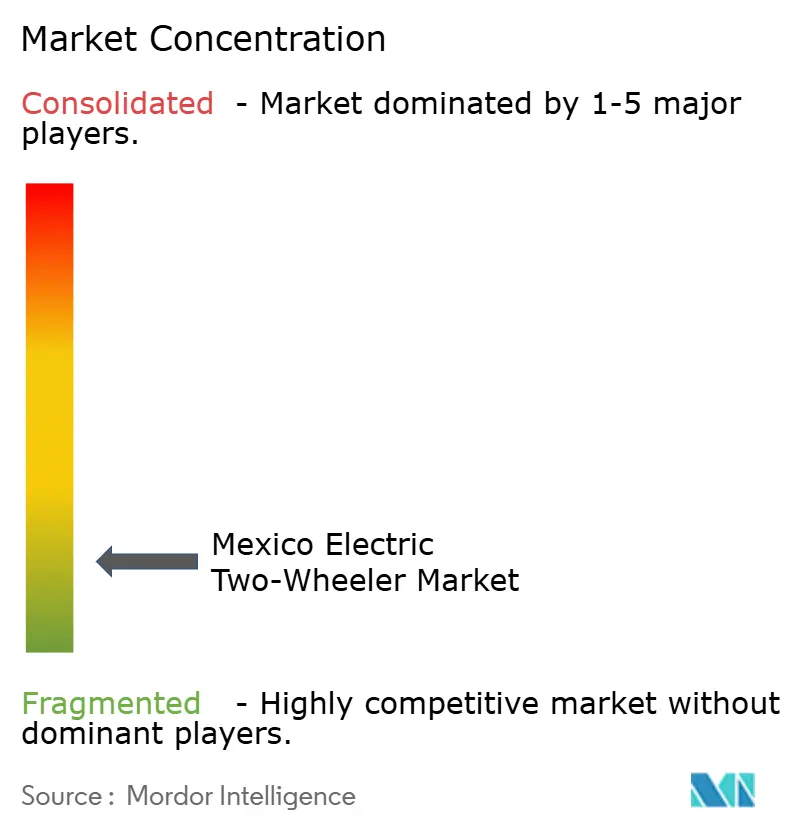
The Mexican electric two-wheeler market is fragmented, with numerous active brands. Yadea competes through local production, dealer coverage, and planned service expansion. Its Ocoyoacac facility provides a local operating base. The company plans more than 1,000 sales and service locations by the end of 2026. This model addresses spare-parts availability and buyer confidence. These two practical issues influence whether a prospective owner believes the vehicle can be serviced locally and retain acceptable value after the initial purchase.
ITALIKA has a different position through the Citio battery-swapping program. The service can create repeat revenue while reducing range concerns for delivery riders. NIU competes in the mid-tier and premium categories with range, safety, and connected features.
Opportunities remain in consumer financing, service coverage outside Central Mexico, and battery swapping in secondary cities. Goxxi uses a subscription model for battery exchanges in Nuevo León [3]“Battery Swap in 30 Seconds,” Goxxi, goxxi.mx . Mexico City registration rules can raise the entry threshold for informal sellers. Companies with documented sales, dealer networks, and service systems can therefore hold an advantage. The Mexican electric two-wheeler industry remains open to new entrants. Still, operating credibility is becoming more important as formal registration, local service expectations, and commercially demanding delivery use cases raise the standard for a sustainable market presence.
Mexico Electric Two-Wheeler Industry Leaders
Yadea Technology Group Co., Ltd.
ITALIKA Group
NIU Technologies
B-Electric
Voltec
- *Disclaimer: Major Players sorted in no particular order

Recent Industry Developments
- July 2026: Yadea announced plans to exceed 1,000 sales and service outlets across Mexico by the end of 2026. The plan included agreements with local educational institutions to train specialized electric vehicle technicians.
- July 2026: Mexico City's SEMOVI launched mandatory registration and plating for electric two-wheelers exceeding 25 km/h. The rules required proof of ownership, formal CFDI invoicing, and official identification from buyers.
- February 2026: TVS Motor Mexico launched the TVS iQube electric scooter through authorized dealerships in Guadalajara, Mexico City, and Monterrey. The model has 4.6 kW peak power, 100 km ECO-mode range, and SmartXonnect connectivity.


Mexico Electric Two-Wheeler Market Report Scope
The scope includes segmentation by vehicle type (scooters and motorcycles), motor power (less than or equal to 1.0 kW, 1.1–3.0 kW, 3.1–5.0 kW, and more than 5.0 kW), voltage platform (48 V, 60 V, 72 V, and others), battery configuration (fixed pack, swappable (single), and swappable (dual)), motor type (brushless direct current motor (BLDC), permanent magnet synchronous motor (PMSM), and others), price band (less than or equal to USD 1,000, USD 1,001-1,500, USD 1,501-2,000, USD 2,001-3,000, USD 3,001-5,000 and more than USD 5,000), end user (business-to-consumer (B2C), business-to-business (B2B), ride-hail/bike taxi/rental/tourism, delivery and logistics, corporate and SME fleets, and others (government, NGO, and institutional)), and sales channel (online and offline). The analysis also covers regional segmentation, including Northern, Central, and Southern Mexico. Market size and growth forecasts are presented by value in USD and volume in Units.
| Scooters |
| Motorcycles |
| Less than or Equal to 1.0 kW |
| 1.1-3.0 kW |
| 3.1-5.0 kW |
| More than 5.0 kW |
| 48 V |
| 60 V |
| 72 V |
| Others |
| Fixed Pack |
| Swappable (Single) |
| Swappable (Dual) |
| Brushless Direct-current Motor (BLDC) |
| Permanent Magnet Synchronous Motor (PMSM) |
| Others |
| Less than or Equal to USD 1,000 |
| USD 1,001-1,500 |
| USD 1,501-2,000 |
| USD 2,001-3,000 |
| USD 3,001-5,000 |
| More than USD 5,000 |
| Business-to-consumer (B2C) |
| Business-to-business (B2B) |
| Ride-hail / Bike-Taxi / Rental / Tourism |
| Delivery and Logistics |
| Corporate and SME Fleets |
| Others (Government, NGO, Institutional) |
| Online |
| Offline |
| Northern Mexico |
| Central Mexico |
| Southern Mexico |
| By Vehicle Type | Scooters |
| Motorcycles | |
| By Motor Power | Less than or Equal to 1.0 kW |
| 1.1-3.0 kW | |
| 3.1-5.0 kW | |
| More than 5.0 kW | |
| By Voltage Platform | 48 V |
| 60 V | |
| 72 V | |
| Others | |
| By Battery Configuration | Fixed Pack |
| Swappable (Single) | |
| Swappable (Dual) | |
| By Motor Type | Brushless Direct-current Motor (BLDC) |
| Permanent Magnet Synchronous Motor (PMSM) | |
| Others | |
| By Price Band | Less than or Equal to USD 1,000 |
| USD 1,001-1,500 | |
| USD 1,501-2,000 | |
| USD 2,001-3,000 | |
| USD 3,001-5,000 | |
| More than USD 5,000 | |
| By End User | Business-to-consumer (B2C) |
| Business-to-business (B2B) | |
| Ride-hail / Bike-Taxi / Rental / Tourism | |
| Delivery and Logistics | |
| Corporate and SME Fleets | |
| Others (Government, NGO, Institutional) | |
| By Sales Channel | Online |
| Offline | |
| By Geography | Northern Mexico |
| Central Mexico | |
| Southern Mexico |


Key Questions Answered in the Report
What is the projected value of Mexico electric two-wheelers by 2031?
The market is projected to reach USD 470.01 million by 2031, registering a CAGR of 16.39% during the forecast period (2026-2031). Increasing commuter demand and the expanding use of commercial delivery services are expected to support this growth.
Which vehicle category has the largest share in Mexico?
Scooters accounted for the largest share at 69.14% in 2025, driven by their suitability for urban commuting and entry-level delivery applications. Their compact design and manageable operating costs further supported adoption.
Which battery design is growing fastest in Mexico?
Swappable dual batteries are projected to grow at a CAGR of 21.38% through 2031, driven by fleet uptime requirements and the need to avoid extended charging interruptions during active workdays.
Why are delivery operators adopting electric two-wheelers?
Delivery operators need lower operating costs, reliable range, stronger payload capacity, and rapid battery service.
Page last updated on:


 Your data is secure and never sold or shared.


