
Mexico Beer Market Size and Share
Market Overview
| Study Period | 2022 - 2032 |
|---|---|
| Forecast Data Period | 2027 - 2032 |
| Base Year Market Size (2026) | USD 14.68 Billion |
| Market Size (2027) | USD 15.73 Billion |
| Market Size (2032) | USD 22.82 Billion |
| Growth Rate (2027 - 2032) | 7.72 % |
| Market Concentration | Medium |
Major Players *Disclaimer: Major Players sorted in no particular order Image © Mordor Intelligence. Reuse requires attribution under CC BY 4.0. | |
Mexico Beer Market Analysis by Mordor Intelligence
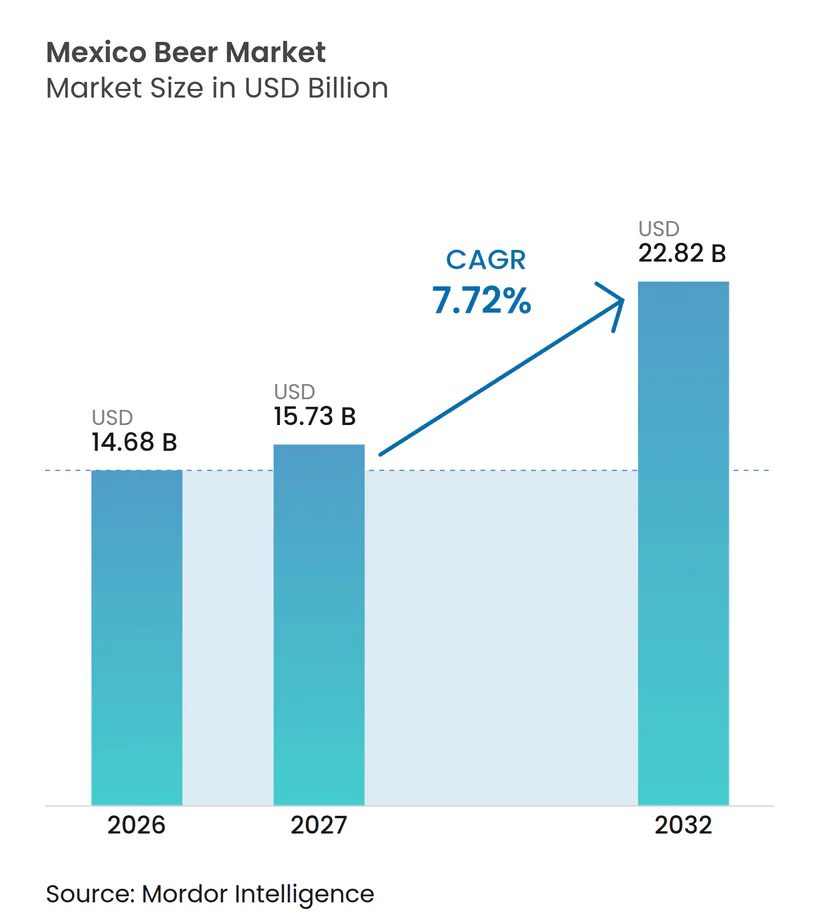
The Mexico beer market size grows from USD 14.68 billion in 2026 to USD 15.73 billion in 2027, and is forecast to reach USD 22.82 billion by 2032 at a 7.72% CAGR over 2027-2032. The Mexico beer market benefits from established drinking occasions, broad retail availability, and beer’s central role in domestic alcoholic beverage spending. Market value is expected to grow faster than production as consumers increasingly shift toward premium formats and non-alcoholic options. Tourism and foodservice activity are likely to support on-trade demand, particularly in resort destinations and urban hospitality venues. However, the market faces pressure from excise taxes, price sensitivity, water stress, and a distribution system that provides established brewers with a substantial advantage.
Key Report Takeaways
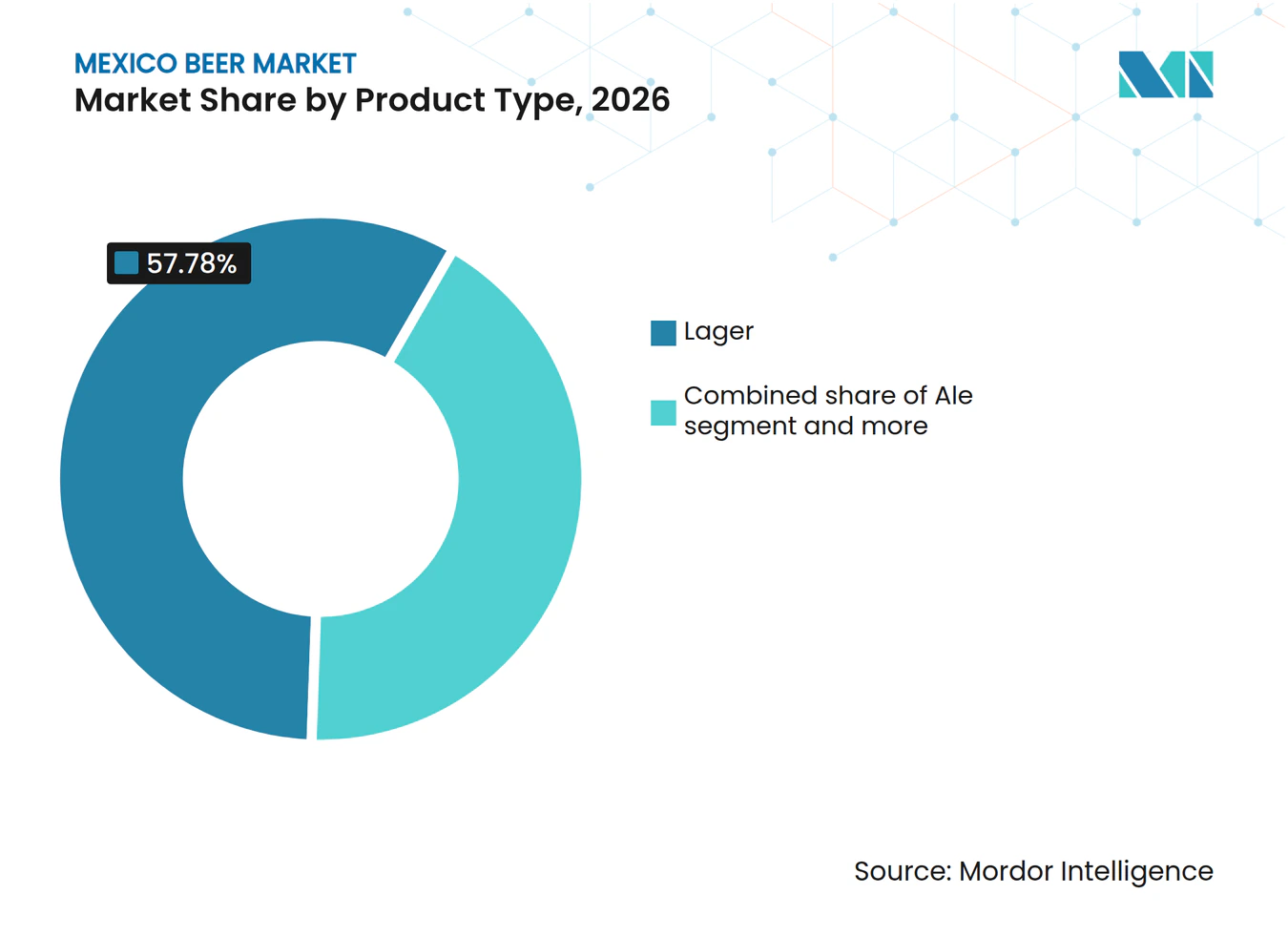
- By product type, lager led the Mexico beer market with a 57.78% share in 2026, while non-alcoholic beer is anticipated to register the fastest CAGR of 8.73% during 2027-2032.
- By category, standard retained a 66.95% share in 2026, while premium is anticipated to expand at an 8.45% CAGR through 2032.
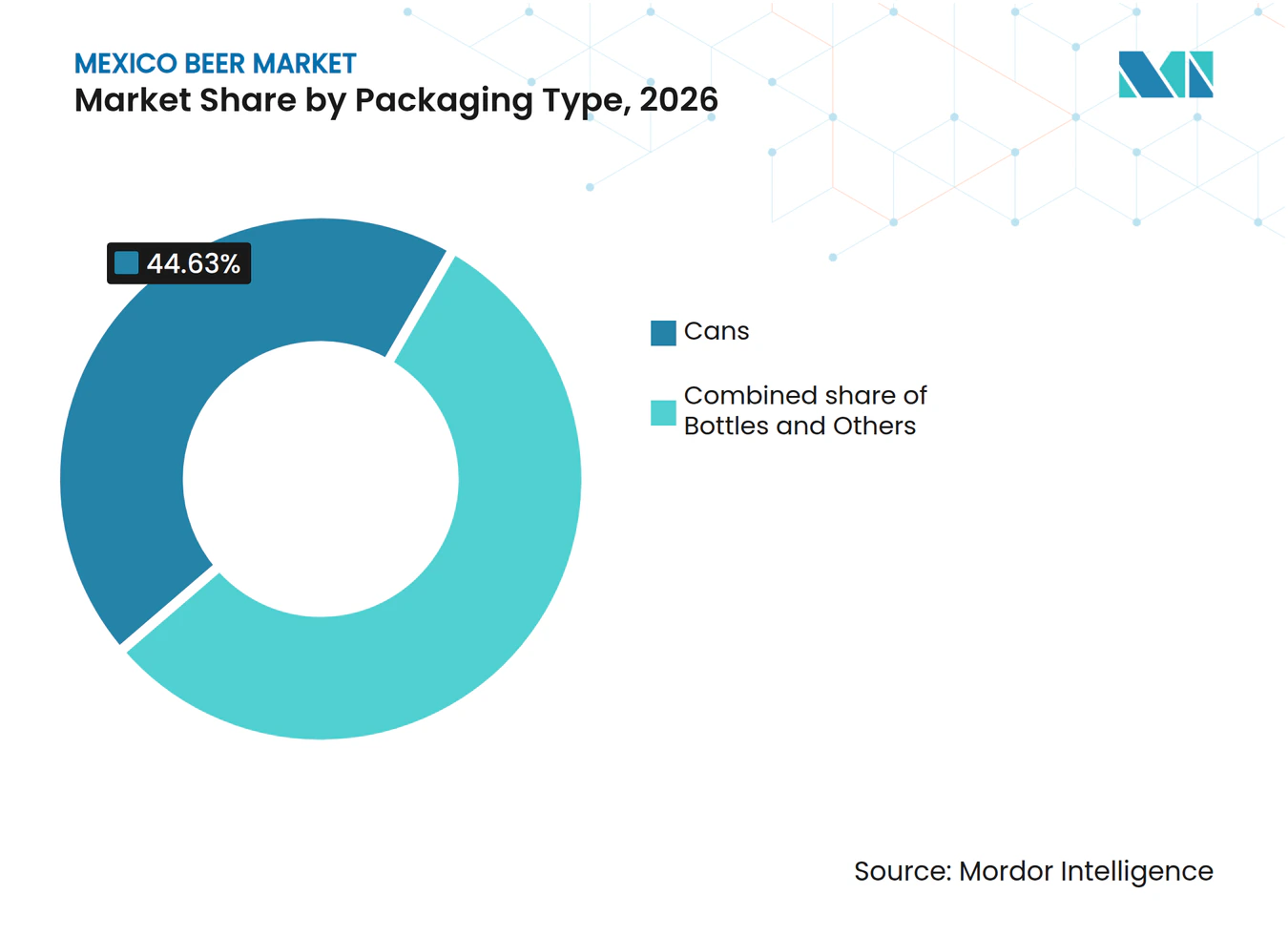
- By packaging type, cans led the market with a share of 44.63% in 2026, while bottles is anticipated to register the fastest CAGR of 8.64% during 2027-2032.
- By distribution channel, off-trade led the market with a share of 62.12% in 2026, while on-trade is anticipated to register the fastest CAGR of 8.32% during 2027-2032.
Note: Market numbers in this report are based on Mordor Intelligence's proprietary estimation framework, which combines nine months of actuals with Q4 projections for base year 2026.
Mexico Beer Market Trends and Insights
Drivers Impact Analysis*
| Driver | (~) % Impact on CAGR Forecast | Geographic Relevance | Impact Timeline |
|---|---|---|---|
| Strong domestic consumption and established drinking occasions | +2.0% | National, with intensity in Mexico City, Monterrey, and Guadalajara | Medium term (2-4 years) |
| Expansion of tourism and hospitality consumption | +1.2% | Coastal resort corridors, including Riviera Maya, Cancún, Los Cabos, and Riviera Nayarit | Medium term (2-4 years) |
| Demand for premium and differentiated beer brands | +1.5% | National, with early penetration among higher-income urban consumers | Long term (≥ 4 years) |
| Brewing infrastructure and domestic supply-chain capabilities | +1.0% | Northern and central states, including Zacatecas, Jalisco, and Sonora | Long term (≥ 4 years) |
| Expansion of craft breweries and specialty offerings | +0.8% | Mexico City, Baja California, Jalisco, Querétaro, and Guanajuato | Medium term (2-4 years) |
| Wider availability of non-alcoholic beer | +1.8% | National, with faster adoption in major urban and tourist locations | Short term (≤ 2 years) |
| Source: Mordor Intelligence | |||
Strong Domestic Consumption Anchored by Deepening Occasions
Beer is deeply embedded in Mexico’s social culture, with consumption closely associated with family gatherings, informal get-togethers, food occasions, and leisure activities. On August 1, 2025, Mexico’s Ministry of Agriculture described beer as part of the country’s cultural and culinary traditions, highlighting its role in family gatherings and its versatility in pairing with a wide range of Mexican dishes[1]. This cultural relevance supports beer consumption across both on-trade and off-trade occasions. The widespread availability of domestic brands through grocery stores, convenience stores, restaurants, and bars further enhances accessibility. Collectively, these factors reinforce beer’s position as a familiar and widely consumed beverage in Mexico.
Tourism Driving Premium On-Trade Demand
According to CBRE Mexico’s MarketView Hospitality and Tourism, Q4 2025, published in March 2026, Mexico welcomed 47.8 million international tourists in 2025, a 6.1% year-on-year increase[2]. Restaurants, bars, and nightclubs accounted for 15.3% of tourism GDP contribution, directly linking visitor spending to hospitality occasions. The World Travel and Tourism Council stated that travel and tourism accounted for 15.1% of Mexico’s GDP in 2025, valued at USD 281 billion. Visitors are more likely to purchase beer at hotels, restaurants, bars, and entertainment venues, where premium offerings and global beer styles have greater visibility. This trend supports higher average transaction values and exposes domestic consumers to products that may subsequently generate off-trade demand.
Rising Demand for Premium and Differentiated Beers
Mexico’s beer market is supported by consumer interest in distinctive flavor profiles, refined brewing styles, and products that provide a differentiated drinking experience. On August 5, 2025, HEINEKEN México marked the 120th anniversary of Bohemia, a brand recognized as a pioneer in Mexico’s premium beer segment, with its refined Pilsner style and European brewing heritage. Such developments demonstrate how brewers use premium positioning, differentiated ingredients, and specialized flavor profiles to appeal to consumers seeking alternatives to conventional beer offerings. This strategy also helps manufacturers strengthen brand differentiation and target consumers willing to pay a premium for distinctive beer experiences.
Non-Alcoholic Beer Expands Consumer Choice
Non-alcoholic beer recorded strong growth in the supplied material, expanding significantly faster than conventional beer. This indicates opportunities to create new consumption occasions among consumers seeking flavor and social participation without alcohol, rather than replacing all conventional beer occasions. Mexico’s regulatory treatment of beverages containing less than 2% alcohol by volume requires careful product labeling and transparent product claims. The Mexico beer market can benefit from clearer claims that improve consumer understanding of non-alcoholic options and strengthen trust in the category. Expanding availability across grocery, convenience, hospitality, and digital channels will be critical to converting consumer awareness into repeat purchases.
Restraints Impact Analysis*
| Restraint | (~) % Impact on CAGR Forecast | Geographic Relevance | Impact Timeline |
|---|---|---|---|
| High excise taxation and price sensitivity | -0.3% | National, with greater effect on lower-income and rural consumer groups | Medium term (2-4 years) |
| Restrictions on alcohol advertising and promotion | -0.2% | National, enforced by COFEPRIS and the Secretaría de Salud | Long term (≥ 4 years) |
| Local restrictions on alcohol sales and trading hours | -0.2% | State and municipal level, particularly in Mexico City and northern states | Short term (≤ 2 years) |
| Climate risks to barley supply and brewing operations | -0.3% | Northern Mexico, including Sonora, Chihuahua, Baja California, and Zacatecas | Long term (≥ 4 years) |
| Source: Mordor Intelligence | |||
High Excise Taxation and Price Sensitivity
Mexico’s beer market faces pricing pressure from the federal Special Tax on Production and Services (IEPS), which increases the cost of alcoholic beverages and may limit breweries’ pricing flexibility. Under Article 2 of Mexico’s IEPS Law, the tax rate applicable to beer with an alcohol content of up to 14° GL is 26.5% in 2025, while beverages with an alcohol content above 14° GL and up to 20° GL will be taxed at 30%[3]. This tax burden may raise final retail prices, making affordability a key consideration for price-sensitive consumers. Consequently, breweries may face challenges in passing higher tax and operating costs on to consumers without affecting demand, particularly in the economy and mainstream categories, where consumers are more likely to select lower-priced brands or promotional offerings.
Climate Risks to Barley Supply and Brewing Operations
Mexico’s beer market faces climate-related risks that can disrupt barley availability and water-intensive brewing operations. Prolonged droughts, irregular rainfall, and extreme temperatures can adversely affect barley cultivation, potentially reducing crop yields and causing fluctuations in raw material availability and procurement costs. Water scarcity also poses an operational challenge for breweries, as water is essential for brewing, cleaning, cooling, and other production processes. These conditions can raise sourcing and operating costs, complicate production planning, and pressure manufacturers’ profit margins. Consequently, climate variability remains a key restraint on supply chain reliability and cost stability in Mexico’s beer industry.
*Our forecasts treat driver/restraint impacts as directional, not additive. The impact forecasts reflect baseline growth, mix effects, and variable interactions.
Segment Analysis
By Product Type: Lager Retains Scale While Non-Alcoholic Beer Leads Growth
Lager hold 57.78% of the Mexico beer market share in 2026, supported by familiar taste profiles and established retail access. Economy pilsners, mainstream labels, and premium session lagers enable the category to serve multiple price points without requiring consumers to change their usual drinking habits. This breadth is important because household consumption, informal gatherings, convenience retail, and restaurant service each favor different pack sizes and price levels. The two largest brewers leverage extensive distribution networks, cold equipment, and long-standing retailer relationships to maintain lager availability across small stores, supermarkets, and hospitality venues.
Non-Alcoholic Beer is expected to record an 8.73% CAGR through 2032, the fastest growth rate among product types. Its 0.6% volume penetration provides the segment with a small base and significant room for broader adoption among consumers seeking an alternative for work, driving, sports, or social occasions. Volume is projected to reach 60 million liters in 2025, indicating that demand has expanded beyond a niche offering. Demand for participation in social occasions without alcohol supports the Mexico beer market size for Non-Alcoholic Beer. Under the applicable Mexican standard, products containing less than 2% alcohol by volume cannot be labeled “cerveza,” requiring clear consumer communication.



By Category: Standard Supports Broad Demand While Premium Raises Value
Standard beer accounted for a 66.95% share of the Mexico beer market in 2026, reflecting broad mass-market consumption and household price sensitivity. Standard brands cater to everyday occasions through informal retail outlets, convenience stores, supermarkets, and household purchases, where consistent availability strongly influences repeat purchases. This category includes economy domestic lagers and mid-tier mass-produced products that compete across multiple local price points. Competition centers on pricing, returnable bottles, retail availability, and local distribution density. While the category remains critical to overall volume, it faces greater exposure to taxes, inflation, and household budget pressures.
Premium beer is forecast to grow at a CAGR of 8.45% through 2032, faster than any other category segment. The supplied NielsenIQ-based material indicates that premium brands accounted for 29% of consumer goods expenditure growth, linking category value growth to consumers’ willingness to pay for differentiated products. The Mexico beer industry is responding by emphasizing experiences rather than product attributes alone. Event-based activities, food pairings, hospitality placements, distinctive packaging, and greater emphasis on craft provenance can support price realization. These strategies require investment and favor companies with strong financial resources, established brands, and extensive distribution networks.
By Packaging Type: Cans Lead Current Demand While Bottles Gain Value
Cans accounted for a 44.63% value share in 2026, driven by their portability, wide availability, and suitability for off-trade purchases. Their affordability and convenience support home consumption, informal gatherings, retail purchases, and occasions that require easy storage and transportation. Consumers also recognize that aluminum protects beer from ultraviolet light, reinforcing perceptions of product quality. This benefit is relevant across urban artisanal retail channels and mainstream sales. Other packaging formats include draught kegs and bulk containers used by restaurants, bars, and hospitality venues.
Bottles are projected to register an 8.64% CAGR through 2032, the fastest growth rate among packaging types. Premium single-serve glass formats and returnable glass systems support the Mexico beer market size for bottles. Grupo Modelo’s 2025-2027 program includes the modernization of returnable packaging infrastructure for more than 300,000 small-format retailers, creating a practical pathway for format expansion. Craft beers also typically command higher unit prices in bottled formats, supporting value growth. Environmental and circular economy requirements may further favor returnable systems and encourage retailers to maintain reverse-logistics capacity.

By Distribution Channel: Off-Trade Scale Supports Reach While On-Trade Builds Value
Off-trade is projected to account for 62.12% of revenue in 2026, highlighting the importance of at-home and informal social consumption. Convenience stores, supermarkets, and small neighborhood shops form the core of this channel, providing frequent local access across urban and informal retail areas. Incumbent brewers have invested in cold-chain equipment, cooler placements, retailer financing, and store modernization. These initiatives can improve product availability while making it more difficult for independent brands to secure comparable access.
On-trade is forecast to expand at a CAGR of 8.32% through 2032, supported by continued growth in the hospitality and food service industries. Hotel bars, premium restaurants, craft taprooms, and tourist venues expand faster than traditional cantinas. These establishments can support higher transaction values and offer consumers a broader product mix than neighborhood retail outlets. Growth will depend on visitor demand, local purchasing power, and operators' ability to manage input costs.
Geography Analysis
The Mexico beer market is assessed as a single national geography and is projected to grow at a CAGR of 7.72% from 2027 to 2032. However, regional dynamics remain important, as they influence consumption, investment, supply risk, and demand for premium products. Mexico City, the State of Mexico, Jalisco, and Nuevo León constitute the country’s core value area, combining higher disposable incomes with dense retail and hospitality activity. These locations also account for a significant share of the more than 2,500 craft breweries, along with supermarket, convenience, and on-trade channels that support premium and standard-plus offerings.
Coastal destinations, including Cancún, Riviera Maya, Los Cabos, and Riviera Nayarit, drive above-average on-trade and premium beer consumption. Higher accommodation spending creates opportunities for premium beer sales across resorts, restaurants, and other hospitality venues. Seasonal tourism peaks and a high concentration of international visitors further increase demand for imported, premium, and locally brewed beer varieties. In these tourism corridors, visitor spending and hospitality formats have a greater influence on the Mexico beer market size than the local population alone.
The Yucatán Peninsula is emerging as an additional growth area, driven by infrastructure investment, population movement, and new production capacity. HEINEKEN México announced a USD 2.75 billion investment program through 2028, which includes the construction of its eighth Mexican brewery in Kanasín, Yucatán. The facility will have an initial capacity of 4 million hectoliters, expandable to 8 million hectoliters. Northern locations remain strategically important because of their established production base, proximity to the U.S. border, and greater exposure to water constraints identified in the peer-reviewed geography study.
Competitive Landscape
Market Concentration
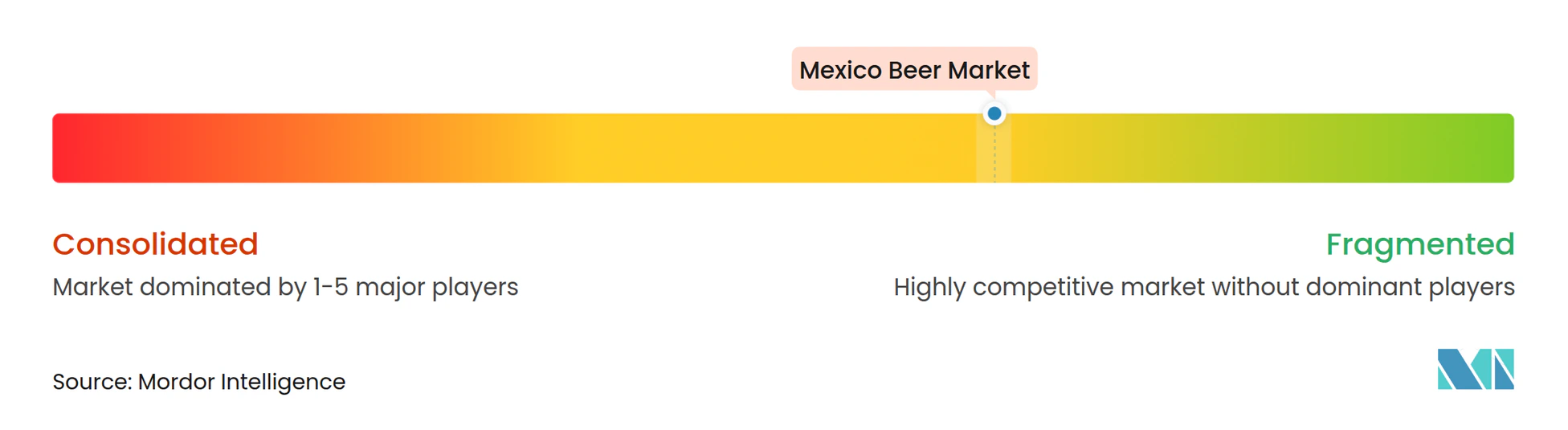
The Mexico beer market has a highly concentrated structure, with Grupo Modelo and HEINEKEN México collectively accounting for the majority of the market. The leading brewers benefit from extensive brand portfolios, large-scale production systems, established retail relationships, and broad national distribution networks. Their investments in coolers, modernization, retailer credit, and retail infrastructure further enhance their access to small-format stores.
Grupo Modelo announced USD 3.6 billion in domestic investments for 2025-2027, including plant modernization, digital and refrigeration upgrades for more than 300,000 small-format retailers, and glass recycling programs. HEINEKEN México announced its Kanasín brewery as part of a strategy that combines capacity expansion with a regional logistics location near road, rail, and port connections. These investments support capacity expansion, supply resilience, water management, packaging initiatives, and channel execution.
Smaller participants are targeting non-alcoholic beer, premium craft products, taprooms, online sales, and differentiated local offerings that do not rely solely on traditional supermarket access. Cervecería Punto Medio secured distribution through HEB in the Bajío region, reaching more than 120 points of sale with a monthly production capacity of 12,000 liters.
Mexico Beer Industry Leaders
-
Anheuser-Busch InBev SA/NV
-
HEINEKEN México, S. de R.L. de C.V.
-
Baja Brewing Company
-
Cervecería Minerva
-
Grupo Modelo, S.A. de C.V.
- *Disclaimer: Major Players sorted in no particular order
Recent Industry Developments
- August 2026: Grupo Modelo is constructing a new brewing and bottling complex in Apan, Hidalgo, with an investment of USD 760 million (MXN 14 billion). The facility has an initial production capacity of 12 million hectoliters per year. The project has created more than 4,500 construction jobs and generates over 600 direct operational positions. As one of the largest single-site brewing investments in the company’s global network, the facility forms part of Grupo Modelo’s USD 3.6 billion investment commitment in Mexico for 2025–2027.
- June 2025: HEINEKEN México announced a USD 2.75 billion investment program through 2028. The program includes the construction of its eighth brewery in Mexico, located in Kanasín, Yucatán. The facility will have an initial production capacity of 4 million hectoliters, with potential expansion to 8 million hectoliters, and will create more than 3,000 direct and indirect jobs.
- May 2025: Grupo Modelo expanded its Model0% non-alcoholic beer portfolio, identifying Mexico as a core pilot market in the supplied material. The company aimed for zero-alcohol and low-alcohol products to account for at least 20% of its global volume.
Mexico Beer Market Report Scope
Beer is an alcoholic beverage produced by fermenting malted grains—primarily barley—with water, hops, and yeast. It is available in several varieties, including lager, ale, stout, porter, and wheat beer.
The Mexico beer market is segmented by product type, category, packaging type, and distribution channel. By product type, the market is segmented into ale, lager, non-alcoholic beer, and others. By category, the market is segmented into standard and premium. By packaging type, the market is segmented into bottles, cans, and others. By distribution channel, the market is segmented into on-trade and off-trade (specialty liquor stores and other off-trade channels). The market forecasts are provided in terms of value (USD) and volume (liters).
| Ale |
| Lager |
| Non-Alcoholic Beer |
| Others |
| Standard |
| Premium |
| Bottles |
| Cans |
| Others |
| On-Trade | |
| Off-Trade | Specialty Liquor Stores |
| Other Off Trade Channels |
| By Product Type | Ale | |
| Lager | ||
| Non-Alcoholic Beer | ||
| Others | ||
| By Category | Standard | |
| Premium | ||
| By Packaging Type | Bottles | |
| Cans | ||
| Others | ||
| By Distribution Channel | On-Trade | |
| Off-Trade | Specialty Liquor Stores | |
| Other Off Trade Channels | ||
Key Questions Answered in the Report
What is the current and projected size of the Mexico beer market?
The Mexico beer market was valued at USD 14.68 billion in 2026 and is projected to grow from USD 15.73 billion in 2027 to USD 22.82 billion by 2032, registering a CAGR of 7.72% during 2027-2032.
Which product type held the largest share of the Mexico beer market in 2026?
Lager beer was the leading product type, accounting for 57.78% of the market in 2026.
Which category dominated the Mexico beer market in 2026?
The standard beer category dominated the market, holding a 66.95% share in 2026.
What was the most popular packaging type in the Mexico beer market in 2026?
Cans were the most widely used packaging format, capturing 44.63% of the market in 2026.
Which distribution channel accounted for the largest market share in 2026?
The off-trade channel led the market with a 62.12% share in 2026.